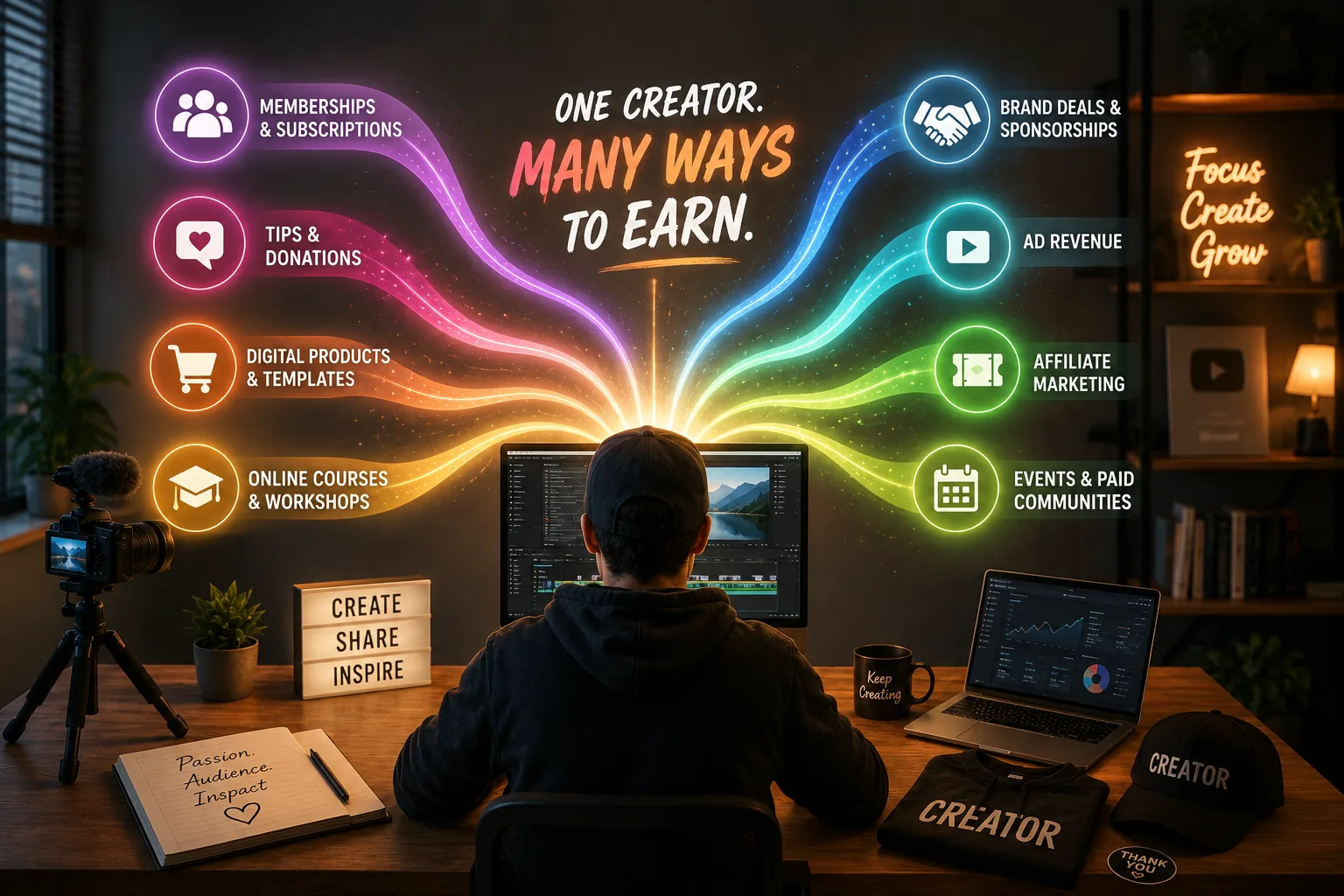

Digital platforms have let individual creators reach audiences and earn from advertising, sponsorships, subscriptions, products, and merchandise without traditional media gatekeepers. The creator economy changes both how creative work is distributed and how a media career can be built. It also shifts responsibility for production, audience relationships, and business operations onto the creator.
Goldman Sachs Research put the creator economy at roughly $250 billion in 2023 and projected it would approach $480 billion by 2027, with the 50 million people who call themselves creators growing at 10 to 20 percent a year. The same research found that about 4 percent of them clear $100,000 annually. Everyone else is somewhere below that line.
Those two numbers describe the thing accurately: a sector large enough that banks model it, in which almost nobody makes a living. The count of 50 million comes originally from a market map the venture firm SignalFire published in September 2020, which put around 2 million creators in full-time work and the remaining 46.7 million in part-time or amateur territory. That ratio has been quoted so often since that it is worth saying plainly how old it is.
What changed structurally is who stands between a creator and an audience. Nobody does. A cooking enthusiast can teach recipes on YouTube and earn from ad revenue, sponsorships, courses and merchandise without ever approaching a food magazine. A financial analyst can write investment breakdowns on Substack at $15 a month and build a business from a few thousand paying subscribers. Neither needed a commissioning editor to say yes first.
The trade is that everything the old gatekeepers did badly, and everything they did well, now lands on one person. Distribution, production, audience relations, invoicing, tax, and the decision about what to make next. Kevin Kelly's formulation is the optimistic version of the arithmetic.
"A thousand true fans is all you need. If you can earn $100 per year from each of a thousand true fans, you can make a living."
Kevin Kelly
A thousand people paying $100 a year is $100,000, which is the same threshold Goldman uses for a professional creator. The 4 percent figure is what happens when you check how many have actually got there.
The Historical Evolution: From Mass Media to Individual Creators
The old arrangement was not a conspiracy, it was a capital problem. Broadcasting television meant transmitters, studio space and a regulatory licence. Publishing a newspaper meant printing presses and a distribution network. Recording music meant studio time, a pressing plant and relationships with radio. Nobody could reach a national audience without someone else's money, so whoever held the money decided who got heard.
The arrangement bought real things. An editor read the work before anyone else saw it. Someone funded projects too expensive to self-finance. Distribution actually reached people. It also meant a commissioning editor in one city decided what a country watched, and nobody could back more than a sliver of the talent available. The sliver tended to resemble the people choosing it.
The erosion ran on specific dates rather than a vague trend. Blogs removed the editor. Cheap audio recording meant a podcast needed a microphone and a laptop, and nothing else. YouTube launched in 2005 and its Partner Program followed in 2007, which is the point at which posting video stopped being a hobby and started being a thing you could be paid for.
Michelle Phan began posting makeup tutorials that same year, and by 2015 the subscription company she co-founded, Ipsy, had raised $100 million at a valuation above $500 million.
Infrastructure caught up in the 2010s. Patreon launched in May 2013 so fans could fund creators monthly. Substack arrived in 2017 for paid newsletters. Gumroad and Teachable made selling a digital product routine, and Stripe removed the merchant-account problem that had made international payments a project in itself.
Instagram, launched in 2010, put a camera and an audience in the same device. TikTok went international in 2018 with editing tools built in and a recommendation system that could surface someone with no following at all.
By 2020 the thing had a name and a balance sheet. Venture firms were raising funds specifically for it. Business schools were teaching it. Traditional media was competing for attention it had previously allocated. What had not changed, and still has not, is that someone else still owns the distribution. The gatekeeper is now an algorithm rather than a commissioning editor, and it does not take meetings.
Defining the Modern Creator
The word covers people whose working lives have almost nothing in common. Mark Rober builds engineering spectacles with budgets and a crew. Someone else films commentary on a phone in a kitchen. Both are video creators, and the category tells you nothing useful about either.
Writers moved next, and Casey Newton is the clearest case because the numbers are public. He left The Verge in 2020 with about 24,000 subscribers and started Platformer. By January 2024 it had passed 170,000, and Nieman Lab's outside estimate put subscription revenue around $775,000 before Substack's 10 percent and Stripe's fees.
Then he left Substack too, over its handling of publications he judged to be explicitly pro-Nazi, and moved Platformer to Ghost. Revenue went up about 11 percent after the move, partly because he stopped paying the 10 percent. That sequence is the whole argument for owning your list: he changed platforms twice and took the business with him.
Podcasting runs on the same logic at a different scale. Joe Rogan's Spotify deal was reported at $200 million, which is the number everyone quotes, but the interesting tier is the one below: shows with audiences in the tens of thousands earning through sponsorship, premium feeds and listener support.
Beyond that it fragments further. Course creators sell structured teaching on Teachable or Maven. Community builders charge for access to a Discord or a cohort rather than for content at all. Visual artists sell prints, brushes and templates through Gumroad and Etsy, frequently to other creators. Musicians distribute through streaming and then make the actual money somewhere else, on Patreon or at shows or by selling sample packs.
What unites them is not the format. It is who holds the relationship. A journalist at the New York Times reaches the Times's readers and leaves them behind on the way out. A newsletter writer reaches their own, and Newton proved you can carry them across two platform changes without losing the business.
The Economic Scale and Structure
Two independent counts of the same population give you the shape of it. SignalFire's market map, published in September 2020, found about 2 million creators working full time against roughly 46.7 million part-time or amateur, out of some 50 million in total. Goldman Sachs Research, looking at the same 50 million three years later, found that around 4 percent earn more than $100,000 a year.
Different thresholds, same conclusion: professional creators are a rounding error inside the population that calls itself creators.
What sits above that line is genuinely large. Michelle Phan started posting makeup tutorials in 2007 and co-founded the subscription company Ipsy, which raised $100 million in 2015 at a valuation above $500 million. Joe Rogan's Spotify deal was reported at $200 million.
MrBeast runs a production operation with staff, warehouses and a food brand attached. These are businesses with payroll, not people filming in bedrooms, and the gap between them and the median creator is not a difference of degree.
What sits below the line is harder to see, because platforms rarely publish it and the people in it have no reason to advertise. Spotify gives the clearest picture anyone has released. Since April 2024 a track needs 1,000 streams in a year before it earns any recording royalty at all.
Tens of millions of tracks fall under that bar, averaging about three cents a month each, and together they accounted for roughly 0.5 percent of streams. Spotify redistributed the resulting pool, about $25 million, to tracks above the threshold. Only 37.5 million tracks in the service's history have ever crossed 1,000 streams.
Music is not the whole creator economy, but the distribution it exposes is the one the whole sector runs on. A small professional tier with real revenue, a long tail earning amounts too small to administer, and a policy decision at some point about whether the tail is worth paying at all.
Against that, the growth forecasts. Goldman put the total addressable market at roughly $250 billion in 2023 and projected it approaching $480 billion by 2027, with creator numbers growing 10 to 20 percent a year, driven mainly by influencer marketing spend and platform payouts on short-form video. The forecast is about the size of the pot. It says nothing about who gets paid out of it, which is the question most people reading about the creator economy are actually asking.
Creator Economy vs. Traditional Media: A Structural Comparison
One difference between these two arrangements generates most of the others, and it is not money, autonomy or working hours. It is who keeps the audience when the relationship ends.
A columnist at a major newspaper may be read by millions, and if they resign on Friday the readers stay with the paper. They were always the paper's readers. The writer brought the talent and the institution supplied the audience, which is precisely what the institution was being paid for.
Casey Newton's sequence is the control experiment: he left The Verge with 24,000 people who had chosen to follow him specifically, grew that to over 170,000, then moved the whole operation from Substack to Ghost and kept it, with revenue rising afterwards. Two platform changes, no audience lost.
That is not possible inside an institution, and it is the thing creators actually own.
Nearly everything else follows from it. Owning the audience means owning the business risk, since nobody pays you while you build it, and owning whatever it eventually becomes worth. Not owning the audience means a salary that arrives whether a particular piece succeeded or not, and a ceiling, since the upside of work that reaches an enormous audience accrues to the employer.
Specialisation is the part of the salary nobody itemises. A staff reporter reports, and somebody else edits, designs, clears the legal risk, distributes it and sells the advertising against it. Strip the institution away and those jobs still exist.
MrBeast's answer was to rebuild the whole apparatus privately, and the Beast Industries deck shows what that costs: a content operation turning over $246 million in 2024 and losing $80 million, paid for by selling chocolate. He did not escape the overheads of a media company, he bought them.
Geography did genuinely change, and this is the clearest gain. Traditional media concentrated into a few expensive cities and the requirement to move there quietly excluded anyone who could not afford it. Nuseir Yassin built Nas Daily while travelling. Ali Abdaal built his business in Cambridge. Equipment costs collapsed the same way.
But Duffy's fieldwork shows the wealth filter moved rather than lifted. What her participants needed was not the rent in Manhattan, it was somebody else covering their rent for the years before anyone paid them, and the ones who lasted were disproportionately those who arrived with money. Same selection, less visible mechanism.
Autonomy is similarly partial. There is no editor, which is the freedom people mean when they say it. There is a recommendation system deciding what gets seen, a 0.89 Gini on the outcomes, and no appeal. So the choice is not freedom against security. It is an editor you can argue with, against a ranking system that will not tell you anything. What makes anyone take the second deal is that the audience comes along.
The Platform Ecosystem Enabling Creators
No platform does everything, which is why a working creator ends up holding an assortment of them: somewhere to publish, somewhere to take money, somewhere to send email, somewhere to sell a thing. The split matters because each layer takes a cut, and the cuts compound.
Distribution is where the audience is. YouTube for long-form video, TikTok for short, Instagram for a mix of both, Spotify and Apple Podcasts for audio. These platforms pay out of advertising and keep a share for providing the audience. YouTube's split is the most transparent: creators in the Partner Program get 55 percent of ad revenue on standard videos and the platform keeps 45, though on Shorts the ratio inverts and the creator share drops to 45 percent.
The platform also claims its recommendation engine drives 70 percent of watch time, a figure it has repeated for years without releasing the data behind it, as Mozilla has pointed out more than once.
Monetization platforms do the opposite job, taking money from an audience the creator already has. Patreon runs memberships, Substack runs paid newsletters, Buy Me a Coffee and Ko-fi handle one-off tips. Both of the large ones now charge 10 percent.
Substack has held at that rate since it introduced paid subscriptions in 2017. Patreon arrived there more recently: creators who joined from August 2025 are on a single flat 10 percent plan, while earlier ones sit on legacy tiers of 5, 8 or 12 percent depending on what they signed up for.
The headline percentage is not what comes out the other end. Stripe takes roughly 2.9 percent plus 30 cents per transaction, there is a further 2.5 percent if the supporter pays in another currency, and the fixed 30 cents bites hardest on small monthly pledges. Across both platforms a creator keeps somewhere around 85 to 87 percent of a pledge rather than the advertised 90.
Run the arithmetic on a membership base and the appeal is obvious. A thousand supporters at $5 a month is $60,000 a year gross, and roughly $51,000 to $52,000 after fees. Reaching the same figure through advertising alone requires millions of views a month, sustained, with no month off.
Revenue Models and Monetization Mathematics
Every published guide to creator revenue contains a table of rates, and the tables are worth less than they look. Most are published by companies selling something to creators. Put two of them side by side and the recommended rate for the same sponsored video can differ tenfold, which tells you there is no market price to look up. The mechanisms underneath, though, are documented.
Spotify published the clearest one. Since April 2024, a track must reach 1,000 streams in the preceding twelve months before it earns anything from the royalty pool, and there is a minimum number of unique listeners too, which Spotify deliberately does not disclose so that nobody can game it by replaying their own song. Eligibility is recalculated monthly, so a track can qualify, stop qualifying and qualify again.
Spotify's defence of this is factually unanswerable: 99.5 percent of all streams on the service go to tracks that clear the threshold, and removing the rest from the pool does not shrink the pool, it redistributes it upward. Both halves of that are true. The disputed part is the scale of what got cut.
Press coverage using Spotify's own figures suggested roughly 60 percent of tracks on the service fall below the line; the United Musicians and Allied Workers union put it nearer 86 percent, and an analysis by the chief executive of Disc Makers estimated the rule moved about $47 million away from the artists below it, a figure Spotify contested after publication.
Whatever the correct number, the mechanism is the lesson. A per-stream rate implies that a thousand small successes pay the same as one large one. A threshold cancels that: below the line the rate is not low, it is zero, and the money that would have gone there is handed to everyone above. Concentration here is not emerging from what listeners do. It is written into the payout rule.
YouTube does a milder version with eligibility floors: a thousand subscribers and four thousand watch hours for the full programme, doubling to eight thousand hours in February 2027. Advertising rates then vary by what an advertiser will pay to reach a particular audience, which is why finance and software content earns multiples of what entertainment earns at identical viewership, and why a creator's subject matter constrains their income more than their competence does.
Subscriptions are the one model that does not work this way, because they count committed people instead of views. Casey Newton's 170,000 subscribers funded a newsroom. The same audience, valued as advertising inventory, would have funded one person badly. Hence the recurring oddity of a niche writer out-earning an entertainment channel ten times their size. They are not selling the same thing.
The Challenge of Sustainability and the Power Law Distribution
Mathias Bärtl went through ten years of YouTube data for a 2018 paper in Convergence and found that about 3 percent of channels were taking roughly 85 percent of the views. He also found the concentration had tightened over the decade: in 2006 that same top 3 percent accounted for 63 percent of viewing, and by 2016 it was around nine views in every ten. The platform did not become more equal as it grew. It became less so.
Attention is finite and increasingly fragmented, and creative industries have always concentrated around that scarcity. Book publishing, recorded music, acting and stand-up all pay a handful of people extremely well and most people badly or not at all.
What platforms add is a mechanism that accelerates it. Recommendation systems optimise for engagement, and the cheapest signal of likely engagement is engagement already observed, so a video on 100,000 views gets pushed ahead of one on 1,000. Early advantage compounds into permanent advantage through network effects, and Bärtl's own term for the pattern was the rich getting richer.
The practical consequence is that the middle is missing. Most industries have a working professional tier, people who are neither famous nor failing, and in creation that tier is unusually thin. Spotify makes the gap visible by accident. Since April 2024 a track earns nothing from its royalty pool until it passes a thousand streams in a year, and by the company's own account 99.5 percent of listening happens above that line. Almost every track ever uploaded sits below it.
None of this makes creation a bad bet, but it does make it a particular kind of bet. Someone deciding whether to go full time is not choosing between a modest career and a large one. They are choosing between a small chance at the professional tier and a large chance of earning something that does not cover rent, and the platform economics give them very little information about which way it will go until years have already been spent.
Skills Required for Creator Success
A staff journalist writes. Editors edit, designers design, a marketing department worries about whether anyone reads it, and a business side worries about whether it pays. Remove the institution and all of those jobs remain, but one person now holds them, which is the actual difficulty of the work and the part that sounds trivial until you try it.
The craft itself is the obvious requirement and the one people overestimate. Plenty of carefully made, genuinely good work has no audience whatsoever, and the reason is almost never quality. It is that nobody encountered it.
Which is why the discovery layer swallows so much of the job. In September 2024 an internal MrBeast onboarding document leaked, and what it reveals is an operation organised almost entirely around three numbers: click-through rate, average view duration and average view percentage. His illustration of the principle is blunt enough to be useful.
Nobody clicks "I Spent 50 Hours In My Front Yard," he writes, but you would click "I Spent 50 Hours In Ketchup." The content of those two videos could be identical. The difference is whether the packaging gives anyone a reason to begin.
That is not a cynical observation, or not only one. A feed is a place where unopened work does not exist, so the title and the image are not promotion bolted on afterwards, they are load-bearing parts of the thing itself. Plenty of creators find this distasteful. They are obliged to be good at it anyway.
The audience-building work sits next to that and behaves differently, because it compounds where individual pieces do not. Collaborations, turning up in the forums and group chats where the relevant people already are, appearing on somebody else's show: none of it shows a return on the day you do it, and the accumulation of it is most of where you end up in three years.
Then the half nobody opens a channel to do. Contracts, invoicing, pricing, filing. Pricing is the one that quietly costs the most, because there is no observable market rate to anchor against. Published influencer rate cards exist in abundance, they disagree with each other by an order of magnitude, and the few analyses of actual negotiated deals suggest the real distribution does not resemble the advertised one.
So the first sponsorship offer arrives with nothing to compare it to, and gets accepted as a valuation rather than treated as an opening position.
Community work has a hard threshold in it. At a few hundred followers you reply to everybody, and that contact is frequently the thing the early audience is actually there for. At fifty thousand it is arithmetically impossible. Whatever replaces it, moderators, a members' space, scheduled sessions, is a different product, and the part of the audience that noticed the change is not wrong.
Analytics underpin the rest, and the skill is mostly restraint. The dashboards report retention curves, traffic sources and click-through in great detail, most week-to-week movement in them is noise, and a creator who reacts to every fluctuation produces an incoherent body of work that does worse than one who ignores the numbers for a quarter.
Last, and least teachable: continuing when it is not working. Nobody sets a deadline. Nobody notices you stopped. The failures are public and quantified, and the recommendation system can erase a year of momentum without explaining itself. The people who leave are very rarely the ones who could not make anything good.
Platform Dynamics and Creator Dependency
What a platform supplies is genuinely enormous and usually understated by the people complaining about it. Global video delivery, an advertising marketplace with real demand in it, payment processing across dozens of currencies and tax regimes, fraud handling, and a recommendation system that can introduce an unknown person to a million strangers. No individual could build any one of those. The arrangement is not a scam, it is a trade, and the terms of the trade are the entire issue.
The terms are that the platform can change them. Not through bad faith particularly, just through ordinary commercial decision-making in which creators are an input rather than a counterparty.
Early 2017 showed how fast it can happen. A Wall Street Journal investigation found advertising running against extremist and hateful content on YouTube, major advertisers suspended spending, and YouTube tightened what counted as advertiser-friendly. Channels that had broken no rule as it existed the previous week were demonetised, and the event got a name, the Adpocalypse, because enough people lost enough income simultaneously that it needed one.
The videos had not changed. The advertisers' tolerance had, and the creators absorbed it.
TikTok's Creator Fund shows the same thing arriving on a slower fuse. The fund was a fixed pool of money, somewhere between one and two billion dollars depending on which figure you credit, divided among whoever qualified. That design has a mathematical consequence: the more creators join, the less each view is worth, and the per-view rate necessarily falls regardless of how good anyone's work is or how well the platform performs.
Creators watched it decline for years and read it as a betrayal, when it was arithmetic that had been built into the structure from the beginning. TikTok withdrew the fund in the US, UK, Germany and France on 16 December 2023 and moved people to a replacement paying substantially better rates, with eligibility conditions attached, including a minimum video length.
Opacity makes all of this harder to navigate than it needs to be. Nobody outside the company knows how the ranking works, so strategy is assembled from observation and folklore, and a change nobody announced can invalidate a year of accumulated technique overnight. The feedback signal is real but unattributable: you can see that something stopped working and never learn why.
The standard defence is diversification, and it works unevenly. Posting across several platforms genuinely hedges the risk, at the cost of multiplying the work, since content that performs on one rarely transfers to another unmodified. Multiple revenue streams help more, particularly any that leave the platform entirely.
The strongest protection remains an email list, because it is the only asset in the business that the creator actually owns and can carry elsewhere, which is exactly what Casey Newton did twice.
Franchising is the analogy people reach for and it flatters the arrangement. A franchisee signs a contract with terms, a defined territory and legal recourse. A creator has an account, terms of service revisable at will, and an appeals process staffed largely by automated systems. The relationship holds while the platform needs engaged creators, which it genuinely does. It stops holding the moment some other priority outranks that, and there is no mechanism by which anyone has to be told.
The Future Trajectory of the Creator Economy
Forecasting this industry has a poor record, so it is worth starting with a prediction that already failed. Around 2021 a set of well-funded companies set out to become the professional infrastructure the creator economy was missing. Jellysmack took creators' videos and redistributed them across platforms the creator did not actively run, splitting the proceeds.
Spotter paid cash upfront for the rights to back catalogues and collected the YouTube advertising revenue afterwards, and told TechCrunch it intended to spend $500 million doing it in 2022 alone. SoftBank valued Jellysmack at a billion dollars in 2021.
By October 2024 Jellysmack was restructuring, cutting 22 US roles with French positions expected to follow, and retreating from its Meta creator programme toward channels it owned outright. The reason it gave is the one that matters: Meta changed how it paid, and a business built on arbitraging another company's monetisation terms discovered it did not control the terms. The infrastructure layer turned out to be exposed to exactly the same platform risk as the creators it was meant to insulate.
That is the pattern to hold onto when reading the rest of the predictions, because most of them are extrapolations and this one was too.
Production tools are the safest of them. Machine learning now handles editing, thumbnails and optimisation suggestions that used to require either skill or money. The consequence is not that more people succeed. It is that technical competence stops distinguishing anyone, because everyone has it, and whatever is left over becomes the thing you compete on.
Niches keep narrowing for the same reason. Early YouTube had room for a channel about cooking. A new channel now generally needs a position specific enough that nobody established occupies it, which works until the niche is too small to support anyone.
Where the predictions get unreliable is on the missing middle. The standard hope is that better monetisation tools will let creators live off smaller, more committed audiences, and it is usually illustrated with arithmetic: so many fans times so much per month equals a good salary. That argument is Kevin Kelly's, from a 2008 essay, and his version was more modest than the ones that circulate now.
He proposed 1,000 true fans at $100 a year for $100,000, and defined a true fan as one who buys anything you produce. The restatements inflate both numbers, and they share his original omission, which is that he described the destination without describing how anyone reaches it. Assembling a thousand people who will buy anything is not a smaller version of assembling a large audience.
It is a different and harder problem.
Web3 was supposed to solve the ownership question and has not, for reasons that are about users rather than technology: audiences showed no appetite for the complexity, and a creator cannot adopt a payment system their audience refuses to use.
Generative AI poses a sharper question. It can already produce competent generic informational content, which is the category that fills most of the internet and the one furthest from any particular person. What it cannot easily counterfeit is a specific individual whose judgement an audience has decided to trust. Whether that remains true is genuinely unknown, and anyone claiming confidence about it is guessing.
The one structural fact that has not moved through any of this is the distribution. Attention concentrates, tooling improvements apply to everyone simultaneously and therefore change nobody's relative position, and the likely shape of the next decade is more people creating part-time for supplementary income rather than more people reaching the professional tier.
Real-World Creator Business Models in Practice
Most published breakdowns of creator businesses are guesses. Someone multiplies a view count by an assumed advertising rate, adds a figure for sponsorships, and presents the total as though it were disclosed. Almost none of it is. The cases below are limited to businesses where somebody outside the company has actually seen the numbers, which is a short list, and the short list tells a consistent story.
Start with the subscription newsletter, because it is the cleanest. Casey Newton left The Verge in 2020 with roughly 24,000 subscribers, launched Platformer, and by January 2024 had passed 170,000 across free and paid tiers. Nieman Lab estimated subscription revenue near $775,000 before Substack's cut and payment processing.
He then moved the publication to Ghost over Substack's handling of pro-Nazi publications, and revenue rose about 11 percent afterwards, partly from no longer paying a platform share. One person, one subject, an email list that survived two platform changes.
The entertainment end looks nothing like that, and the real figures are the opposite of what the category's reputation suggests. In March 2025 The Verge obtained Beast Industries' investor deck. MrBeast's channels generated $246 million during 2024 and lost $80 million.
Feastables, the chocolate brand, turned roughly $250 million in sales into about $20 million of profit, and the company had been loss-making for three years running. The most successful video operation in the world does not pay for itself. It sells confectionery.
Emma Chamberlain's business has the same shape at a tenth of the size. Forbes reported in April 2024 that Chamberlain Coffee had done around $20 million in revenue and reached 8,500 retail locations including Target and Walmart. The YouTube channel and the podcast are what make a bag of coffee recognisable on a supermarket shelf; the shelf is where the money is. The company has raised venture funding and would continue to exist, at least for a while, if she stopped posting.
Educational creators are the group whose numbers get quoted most often and verified least. Ali Abdaal is the usual example, and he has published more about his own finances than almost anyone at his scale, which is precisely how we know the circulating figures are wrong. The widely repeated breakdowns show steady growth.
His own December 2022 newsletter, titled around losing a million dollars, describes revenue flat against the previous year while costs rose by roughly that amount, with profit falling accordingly. The headline anyone would have written from the outside was growth. What he reported was a team that had outgrown its income.
Three patterns hold across all of them. Nobody successful at scale depends on advertising revenue alone. The ones making real margin are selling something that exists off-platform, physical goods for Chamberlain and Donaldson, a direct subscription for Newton. And every one of these is an outlier chosen because its figures became public, which means reasoning from them to a typical outcome is the same error as reasoning about restaurants from the ones with Michelin stars.
Geographic Variations and Global Creator Economy
The same video earns wildly different money depending on who happens to watch it, and the gap is large enough to change what people decide to make.
IsThisChannelMonetized went through analytics on videos uploaded during 2024 and published median advertising rates for fifty countries. American views paid $11.95 per thousand. British views paid $7.60 and German $6.43, which is roughly the pattern anyone would guess.
The bottom of the table is the part worth looking at. India came in under a dollar, at $0.96, and Pakistan at $0.42, meaning an American view was worth about twelve Indian ones and nearly thirty Pakistani ones. Identical work, identical effort, twelve to one.
Now put that in front of somebody deciding what to make. A Hindi channel for an Indian audience has to pull roughly twelve times the viewership of an American equivalent to bring in the same money. Switch to English, aim at Western viewers, and the gap closes immediately. That is the most effective single change available to them, and taking it means no longer making things for the people they live among. Nobody chose this. Advertising demand did.
Which is why the regions with the largest audiences do not run on advertising at all. Indian creators lean on brand partnerships, because a company wanting to reach forty million Hindi speakers will pay for that access regardless of what the programmatic advertising market thinks a view is worth. Latin America behaves similarly, with Brazilian and Mexican creators moving into live events, product lines and television crossover.
In each case the platform supplies the audience and something else supplies the income.
China skipped the model entirely. YouTube, Instagram and Facebook are blocked, and Douyin, Kuaishou, Bilibili and WeChat built their economics around live streaming, tipping and virtual gifts instead of pre-roll advertising. The incentives that produces are different in kind: advertising rewards content that accumulates views indefinitely, while tipping rewards being present and responsive right now, for a real-time audience.
The result is a creator economy with similar revenue and almost no structural resemblance to the Western one.
Africa has the audiences and not the advertisers. Qualifying for monetisation is attainable, and YouTube now opens its early tier at 500 subscribers with 3,000 watch hours or three million Shorts views, falling to the full programme at 1,000 subscribers and 4,000 hours. Qualifying is not the constraint.
Advertiser spending on African audiences is, which is why the median for South Africa sits at $1.69 and much of the continent does not appear in the table at all. Some creators target diaspora audiences in London or Atlanta, keeping the cultural material and acquiring Western advertising rates. Others skip advertising and build around events, merchandise or brand ambassadorships.
Underneath all of it is the plumbing, which is the barrier nobody plans for. Patreon, Stripe and PayPal operate unevenly outside their core markets, and a creator in a country where the payment processor does not fully function can have the audience, the monetisation approval and the brand interest and still be unable to get paid. Workarounds exist and all of them involve relying on a partner in a better-served country, which means paying someone for access to the banking system rather than for any contribution to the work.
The Business Operations: From Solo Creator to Media Company
Growth in this business means acquiring employees, and acquiring employees means the thing you built to escape a job becomes a job with payroll attached. The transition has a shape, and the far end of it is more interesting than anyone expects.
It starts with one person doing everything: filming, editing, thumbnails, comments, invoices, taxes. Time is the binding constraint and no amount of discipline removes it, because the administrative work is not optional and every hour of it is an hour not spent making anything. Batching helps. Scheduling tools help. Neither changes the arithmetic.
The first hire is almost always an editor, because editing is the largest block of skilled work that does not require being the person on camera. The decision is simpler than it is usually made to sound: an editor is worth hiring when the hours they return generate more than they cost. What goes wrong is not the arithmetic but the ordering, because people copy the org chart of creators they admire rather than hiring against whatever is actually blocking them, and end up paying a social media manager while still editing at two in the morning.
A larger operation specialises further, and at some point the founder stops producing and starts directing. This is where a substantial number of people discover they have accidentally become a manager. Giving feedback, running a team, resolving disputes between people who both want more of your attention: none of it resembles the work that built the audience, and nothing about being good at the one predicts being good at the other.
Some find they prefer it. Others spend years resenting an organisation they chose to build.
Then there is the top of the distribution, where the economics invert in a way almost nobody outside it realises. In March 2025 The Verge obtained Beast Industries' investor deck, and Bloomberg published slides from it. MrBeast's network of channels, the most successful content operation on the platform by a wide margin, brought in $246 million during 2024 and lost $80 million doing it.
Feastables, the chocolate brand, made roughly $250 million and returned about $20 million in profit. The company had posted losses for three consecutive years.
Read that again, because it reframes the whole category. The videos are not the business. The videos are a marketing expense for the business, operated at a deliberate loss on a scale no advertiser would fund directly, and the money is made selling physical confectionery in supermarkets. The single most-watched creator on earth could not make the content itself pay, and resolved it by becoming a consumer packaged goods company that happens to produce the best-performing videos on YouTube as a customer acquisition channel.
Whatever the ceiling of a pure content business is, that is where it sits.
The Psychology and Mental Health Challenge
The evidence here is thinner than the topic deserves. Most of what circulates comes from surveys run by companies selling services to creators, with self-selected samples in the hundreds. The largest attempt so far, published in November 2025 by Creators 4 Mental Health with Lupiani Insights & Strategies, covered 542 full and part-time creators in North America. Treat the numbers as a first sketch rather than a measurement, because nobody has published the recruitment method.
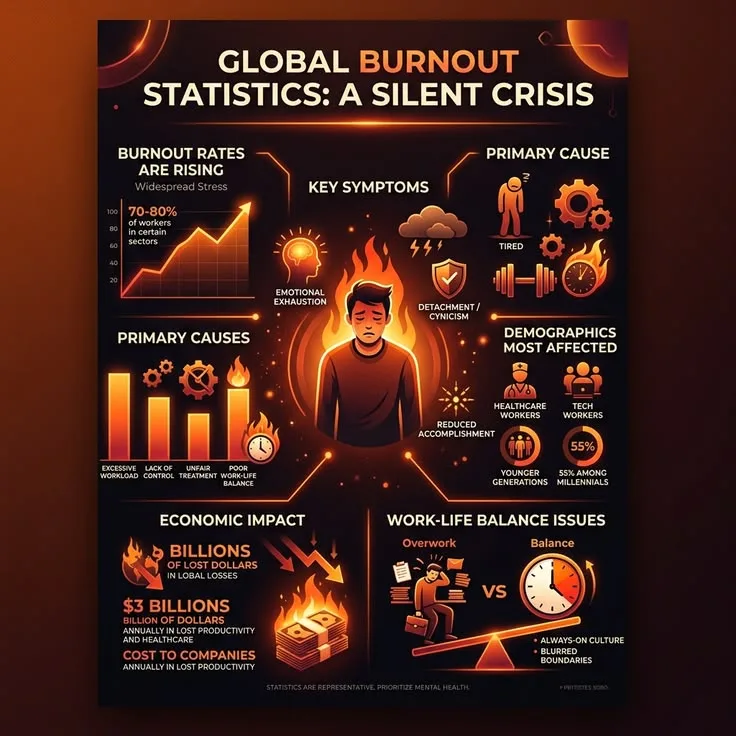
With that caveat, the sketch is grim. Sixty-two percent reported burnout. Sixty-nine percent said they obsess over how their content performs, and the same proportion reported financial insecurity. Fifty-eight percent said their sense of self-worth falls when a piece underperforms.
Ten percent reported suicidal thoughts connected to their work, against a past-year rate for US adults generally of roughly 4 to 5 percent in national household surveys. Burnout and performance obsession were both more common among people who had been at it five years or more, which is the opposite of what you would expect if the problem were inexperience.
That last finding is the one worth sitting with. Experience usually protects people. Here it appears to accumulate damage instead, and the structural reasons are not hard to identify.
Feedback arrives from strangers at volume. A software engineer whose work is criticised hears it from a handful of colleagues in private. A creator hears it from a comment section, and the arithmetic of a large audience means even an overwhelmingly positive reception delivers a substantial absolute number of people telling you that you are worthless.
The usual defences, turning off comments or hiring moderators, work by severing the audience contact that made the job appealing, and the public persona stays on display either way.
The performance figures compound it. Views, retention, subscriber change and revenue all report continuously, and they are the only legible measure of whether the work is any good. The 58 percent figure describes what happens when that measure is also your self-assessment. The difficulty is that the measure is substantially outside your control: the recommendation system decides how far something travels, and an identical piece of work can succeed or vanish depending on factors the creator cannot see, let alone influence.
Income moves the same way and for the same reasons. Advertising rates are seasonal, recommendation changes land without notice, and a single piece doing unusually well or badly moves a month's earnings substantially. Salaried workers plan against a known number. Creators plan against a distribution, which makes a mortgage application an awkward conversation.
Then there is the possibility of losing everything at once. Account terminations do get reversed, and YouTube's own appeals process reinstates a meaningful share of removed material, but the asymmetry is the point: the platform holds the business, the creator holds a login, and a mistaken enforcement action can remove a decade of work while the appeal is pending. Most creators never experience it. All of them know someone who has.
The 89 percent who said they lack access to specialised mental health support is the number that suggests what to do about any of this. Traditional industries built occupational health provision over decades, through employers, unions and professional bodies. Creation has none of those, and the people doing it are classified as self-employed in almost every jurisdiction, so the obligation falls on nobody.
Tax, Legal, and Financial Considerations
Nobody starts a channel because they wanted to run a small business, but the entrepreneurial reality arrives with the first payment, and the obligations attach whether or not anyone notices them. The rules below are American, because the platforms route most creators through them, and because they punish anyone who assumed tax was the employer's problem.
Start with the payroll taxes, where the arithmetic is genuinely unkind. An employee sees 6.2 percent for Social Security and 1.45 for Medicare come off their payslip, and never sees the matching half their employer pays. Work for yourself and you owe both halves.
That is 15.3 percent, charged on 92.35 percent of net earnings, with the Social Security part stopping at $184,500 in 2026 and the Medicare part never stopping. All of it sits on top of income tax. Budget for a 22 percent bracket and the real number lands nearer 37 before your state has taken anything.
The second surprise is the timing. There is no withholding, so the money sits in your account looking like yours until the IRS asks for it in four instalments, three during the year and one the following January. Paying the whole bill on time in April does not help: the penalty is for missing the instalments, and it accrues regardless.
The way out is a rule most creators never hear about. Pay what you owed last year, or 110 percent of it if you earned over $150,000, and the underpayment penalty cannot touch you however well this year goes. For a business whose income can triple or halve without warning, knowing last year's number is worth more than any deduction, because it converts an unknowable obligation into a fixed one.
Creators outside the US hit the same machinery from the other side, and here the stakes of an unfilled form are absurd. Google withholds American tax on whatever share of your earnings came from American viewers. Fine.
But if you have filed nothing, the default is not a penalty rate on the US share, it is up to 24 percent of your worldwide earnings, including every view from your own country. Submitting a W-8BEN moves you to your treaty rate, anywhere from nothing to 30 percent depending on where you live, and Google's documentation walks through India at 15 percent.
Ten minutes of form-filling against a quarter of everything, which is probably the best return on administrative effort available anywhere in this business.
Business structure is the question everyone asks first and it matters least. You are a sole proprietor already, by default, with your personal assets exposed to anything the business does. An LLC fixes that. The S-corporation election people get excited about works by splitting the money into a salary and a distribution, taxing only the salary for payroll, which genuinely saves thousands once there is enough income to split, and costs more than it saves below that point once you have paid for the payroll administration and the accountant who has to defend the salary figure as reasonable.
Copyright runs in both directions and creators usually prepare for only one. The obvious risk is using music, footage or fonts without a licence, which on YouTube means a copyright strike or demonetisation rather than a lawsuit. The less obvious one is enforcement: content gets reposted, scraped and occasionally used in advertising without permission, and the DMCA takedown process puts the burden of finding and reporting each instance on the person who made the work.
The gaps that matter most are the ones an employer normally fills. No group health plan, no disability cover, no pension contribution, no payroll department. Each has an individual-market equivalent, and each requires someone to notice it is missing and go and buy it, which is a different cognitive task from having it deducted automatically and never thinking about it again.
Infrastructure Companies and the Creator Support Ecosystem
An industry grew up around creators, and tracing where the money goes is more revealing than any list of what the tools do.
Start with the platform itself. On ordinary long-form YouTube videos the creator takes 55 percent of advertising revenue and YouTube keeps 45, which is the figure everyone knows. On Shorts that ratio inverts, and the mechanism is worth following because almost nobody who posts Shorts could describe it.
Advertising revenue from the Shorts feed goes into a monthly pool, country by country. Music licensing comes out of that pool before anyone's share is calculated, and YouTube's own documentation is specific about the cost: a Short using one track sends half the revenue it generated to music partners, and a Short using two sends two thirds. Whatever survives is allocated between creators by their share of engaged views.
The creator then receives 45 percent of their allocation, whether or not they used music at all.
Work that through. A creator posting Shorts with two licensed tracks is paid 45 percent of a third of what their views earned. Nothing about this is hidden, and it is also not something you would ever discover from the interface.
The same pattern, a cost that is documented and still invisible from inside the product, runs through the rest of it. Patreon and Substack each take a tenth of direct payments, Patreon having moved every page created after August 2025 onto that single rate. Underneath that sits card processing, a percentage plus a flat charge per transaction, and because the flat part ignores the size of the payment it dominates everything else on a pledge of a pound or two a month.
Annual billing gets pushed for exactly that reason. The pound-a-month pledge, the thing patronage was finally supposed to enable, is the payment the rails handle worst.
Spotter buys a channel's future advertising revenue for cash today. Karat issues credit cards underwritten on channel analytics instead of a credit file, which solves a genuine problem, because a self-employed person with no payslips and lumpy income is close to unbankable by ordinary criteria. Neither is cheap, and neither pretends to be.
A revenue advance is a loan whose cost is quoted as a share of future earnings instead of as an interest rate, and that difference in presentation is what makes it hard to compare against any other way of raising the same money. Agencies take their percentage of brand deals on the same principle, and earn it mainly when the creator has no deal history and so no idea what the work is worth.
Take any one of these charges and it is defensible. Stack them, platform share, processing margin, monetisation cut, agency percentage, software subscriptions, and the total arrives before tax does. Published figures for what a creator keeps are guesses, because the answer depends entirely on the mix.
What Academic Research Reveals About Creator Economy Structure and Labor Conditions
Researchers have been studying this for long enough now to have findings that embarrass both the promotional account of the creator economy and the dismissive one.
Brooke Erin Duffy at Cornell did the fieldwork that named the central problem. For (Not) Getting Paid to Do What You Love, published by Yale in 2017, she spent three years interviewing roughly fifty young women working in fashion, beauty and lifestyle, and attending the blogging boot camps, product launches and fashion-week events where that work gets done. Her term for what she found is aspirational labour: work performed unpaid, independently, in expectation of a payoff that for almost everyone never arrives.
The detail that makes it a structural finding rather than a sad one is who can afford to do it. Sustaining years of unpaid creative work requires someone else covering your rent, so the people who last long enough to be discovered are disproportionately those who arrived with money. Working-class participants exited earlier, not because they were less capable but because they could not fund the waiting.
And the platforms need that pool to exist: a large supply of people producing free content is what keeps the content flowing and holds down what the paid creators can demand.
What does get paid has now been counted. A study in European Societies went through a large sample of YouTube channels across Germany, Austria and Switzerland and put the Gini coefficient on creator earnings at 0.89, which on a scale where one means a single person takes everything is about as concentrated as a distribution gets. People reach for national inequality statistics at this point and they should not: those track household disposable income across an entire population, a different quantity measured a different way.
Read narrowly, within one occupation, it still says that nearly all of the money goes to nearly none of the workers.
Economics predicted this before YouTube existed. Sherwin Rosen's "The Economics of Superstars," published in the American Economic Review in December 1981, set out why certain markets concentrate rewards so extremely: where the best performer can serve every customer at no additional cost, demand does not spread itself across the quality range, it piles onto whoever is considered best. Someone picking an investing newsletter picks the one they think is best, because reading a worse one costs the same.
Rosen was writing about performers and recorded media. Digital distribution took every friction out of his model and the concentration followed.
One more finding belongs here because it is usually left out. Pew Research Center's analysis of federal employment data found newspaper newsroom jobs in the United States fell 57 percent between 2008 and 2020, from about 71,000 to roughly 31,000, with most of that loss landing before 2014. Over the same period digital-native newsrooms grew 144 percent, to around 18,000.
That is not a straight substitution, and the shortfall matters, because reported, verified, locally covered information is an input a great deal of independent commentary depends on without paying for.
Historical Precedents and Comparative Case Studies in Creator Economy Development
The creator economy is not the first industry where a new distribution technology removed the gatekeepers. Three earlier cases have run far enough to show how the story tends to end.
Recorded music is the most complete. US revenues peaked at $14.6 billion in 1999, the year Napster launched, and the collapse that followed is the standard illustration of disintermediation: labels lost control of distribution, and the narrative at the time was that artists would now reach listeners directly. What actually happened is that distribution reconsolidated around a small number of streaming services, which set their own per-stream rates.
The industry has recovered in nominal terms, but adjusted for inflation that 1999 peak was worth roughly $22.7 billion in today's money, and revenues remain well below it. Removing the gatekeeper did not return the money to the artists. It moved the gate.
Etsy compresses the same arc into one company. It launched in 2005 on an explicitly maker-first proposition: low fees, handmade only, seller advisory boards. Then it went public in 2015. Sellers describe what followed as a steady tilt toward volume: compulsory advertising that cost small shops more than it returned, search that started rewarding conversion over uniqueness, and a 2021 rule change permitting production partners, which on a handmade marketplace means somebody else can manufacture your handmade goods.
The complaint is not that Etsy lied. It is that the maker-first language outlasted the maker-first policy by about a decade.
Twitch supplies the clearest evidence that platform incentives drive creator behaviour directly rather than creatively. Ludwig Ahgren went live on 14 March 2021 and did not stop until 13 April, because every new subscription added time to a clock on screen. He ended with 282,191 subscribers, a Twitch record.
Within weeks other streamers were running subathons of their own. The interesting part is not that one person won. It is how fast a single public success rewrote what thousands of other people decided to make, which is what an incentive structure looks like when you can watch it operate in real time.
Sources & Further Reading
Mathias Bärtl, "YouTube channels, uploads and views: A statistical analysis of the past 10 years," Convergence, 2018, View source
Brooke Erin Duffy, (Not) Getting Paid to Do What You Love: Gender, Social Media, and Aspirational Work, Yale University Press, 2017, View source
"Working on an algorithm-controlled platform as a content creator: what explains unequal earnings on YouTube?" European Societies, View source
Sherwin Rosen, "The Economics of Superstars," American Economic Review 71(5), December 1981, pp. 845-858, View source
Pew Research Center, "U.S. newsroom employment has fallen 26% since 2008," July 2021, View source
Kevin Kelly, "1,000 True Fans," The Technium, 2008, View source
Li Jin, "The Creator Economy Needs a Middle Class," Harvard Business Review, 2020, View source
Goldman Sachs Research, "The Creator Economy Could Approach Half-a-Trillion Dollars by 2027", View source
Spotify for Artists, "Track monetization eligibility", View source
YouTube Help, "Shorts monetization policies and revenue sharing", View source
Sam Gutelle, "MrBeast's investor pitch deck shows why he's shifting his focus to Beast Industries," Tubefilter, March 2025, View source
"In sweeping study, 89% of creators claim to lack access to specialized mental health resources," Tubefilter, November 2025, View source
Taylor Lorenz, Extremely Online: The Untold Story of Fame, Influence, and Power on the Internet, Simon & Schuster, 2023