
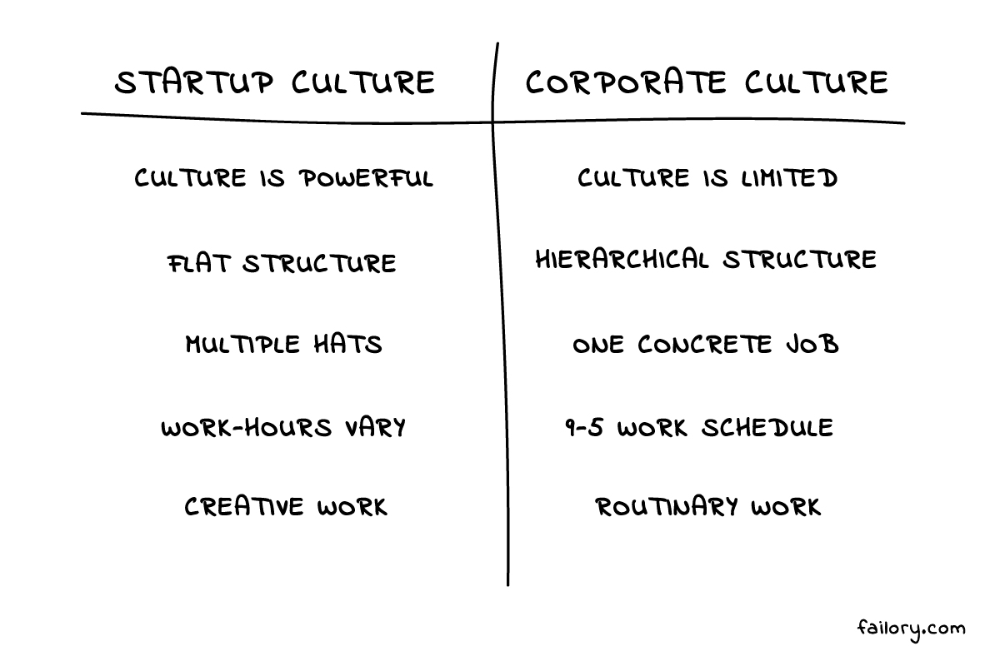
Startup: In 2004, Mark Zuckerberg hung a sign in Facebook's first office: "Move fast and break things." It became Silicon Valley's mantra-prioritize speed over perfection, iteration over planning, disruption over stability.
By 2014, after controversies involving user privacy and platform manipulation, Zuckerberg changed the motto to "Move fast with stable infrastructure." The evolution captured startup culture's central tension: innovation requires risk and speed, but unchecked, these values produce harm-to employees, users, and society.
Startup culture isn't just ping-pong tables and free snacks. It's a coherent set of values, practices, and assumptions shaping how people work, what they prioritize, and what tradeoffs they accept. Understanding this culture requires examining its origins, core elements, benefits, pathologies, and how it scales (or fails to).
Why does this matter? Startups directly employ millions globally and influence broader work culture disproportionately-remote work, equity compensation, flat hierarchies, and hustle mentality spread from startups into mainstream organizations.
Simultaneously, startup culture's problems-overwork, instability, exclusion, ethical shortcuts-reveal fundamental tensions in knowledge work.
This analysis dissects startup culture at structural level: what values define it, how they manifest in practices, what they enable and constrain, when they become toxic, and how they must evolve as organizations scale.
Defining Startup Culture: Core Values and Assumptions
| Cultural Value | What It Enables | Pathological Form | Who Bears the Cost |
|---|---|---|---|
| Bias toward action | Rapid learning, fast iteration | Shipping without safety review | Users who receive broken products |
| Risk tolerance | Bold bets, exponential ambition | Reckless neglect of employee welfare | Employees who forfeited salary for equity that vanished |
| Mission-driven work | Alignment, meaning, dedication | Exploitation justified by purpose | Workers asked to accept below-market compensation "for the mission" |
| Meritocracy | Reward on performance not politics | Inherited advantage called talent | Underrepresented founders excluded by network effects |
| Flatness | Speed, autonomy, lack of bureaucracy | Ambiguity, favoritism, no career path | Employees without sponsors in an opaque system |
| Move fast | First-mover advantages captured | Technical debt, ethical shortcuts | Users harmed by premature products |
What Is a Startup?
Paul Graham's definition: A startup is a company designed to grow fast.[1] Not just small or new-oriented toward rapid, scalable growth.
This growth imperative shapes everything else-culture, hiring, product decisions, fundraising. Unlike traditional businesses (restaurants, law firms) that grow linearly with effort, startups seek exponential growth-doubling revenue yearly, 10x user growth, winner-take-all markets.
Implication: Startup culture optimizes for speed, risk-taking, and adaptability because survival and success depend on outpacing competitors in winner-take-all races.
Core Cultural Values
1. Bias toward action
Principle: Do something imperfect now beats planning something perfect never. Execution over analysis. Iteration over specification.
Manifestation:
- Ship early, learn from users, fix in production.
- Minimum viable product (MVP)-launch with core features, not complete vision.[3]
- "Permissionless innovation"-don't ask, just build.
Tradeoff: Enables rapid learning but risks technical debt, user harm (releasing buggy/incomplete products), and ethical oversight.
2. Risk tolerance
Principle: Accept high probability of failure for potential exponential upside. Startups are expected to have ~10% success rate-most fail, few become unicorns.
Manifestation:
- Equity over salary-accepting lower pay for uncertain future compensation.
- Career risk-joining unproven company versus stable corporation.
- Bold bets-"moonshot" projects, unproven technologies, contrarian strategies.
Tradeoff: Attracts certain personalities (risk-tolerant, young, financially secure) while excluding others (risk-averse, caregivers, those needing stability). Creates selection bias in who participates.
3. Mission-driven work
Principle: We're changing the world, not just making money. Work has meaning and purpose beyond paycheck.
Manifestation:
- "Dent the universe" rhetoric (Steve Jobs).
- Identity fusion-company mission becomes personal identity.
- Moral justification for sacrifice-long hours acceptable because mission important.
"We're here to put a dent in the universe. Otherwise, why else even be here?" - Steve Jobs
Tradeoff: Inspires dedication and creates alignment, but also enables exploitation (expecting unpaid overtime because "we're changing the world"). Can become cult-like, suppressing dissent.
4. Meritocracy and impact
Principle: Ideas and results matter, not credentials or hierarchy. Anyone can have impact regardless of title or tenure.
Manifestation:
- Flat hierarchies-few management layers, minimal bureaucracy.
- Open communication-all-hands meetings, transparent metrics, direct access to leadership.
- Autonomy-individuals or small teams make decisions without approval chains.
Tradeoff: Empowers talented individuals but can disadvantage those needing structure, mentorship, or explicit process. "Meritocracy" often reproduces existing biases-benefits those with confidence to speak up, networks, and cultural fit.
5. Growth mindset
Principle: Abilities aren't fixed-people improve through effort, learning, and feedback. Failure is learning opportunity.
Manifestation:
- Hiring for potential over experience-"smart generalists" who can learn anything.
- Rapid skill development-expected to master new domains quickly.
- Experimentation-A/B tests, product experiments, trying unproven strategies.
Tradeoff: Creates learning culture but also constant pressure to grow, unrealistic expectations (learn machine learning in a week!), and burnout from perpetual inadequacy.
Practices and Rituals: How Culture Manifests
Equity Compensation: Aligning Incentives
Structure: Employees receive stock options or restricted stock units (RSUs) in addition to (often below-market) salary.
Logic: If company succeeds (IPO, acquisition), equity worth far more than salary differential. Creates alignment-everyone benefits from company success.
Reality:
- Most equity worthless: 90% of startups fail. Options expire worthless.
- Illiquidity: Can't sell equity until exit event (IPO, acquisition), which may never occur or take 10+ years.
- Information asymmetry: Employees often don't understand valuation, dilution, or likelihood of exit.
- Golden handcuffs: Unvested equity keeps people in toxic situations-leaving means forfeiting potential millions.
Who benefits: Early employees with significant equity stakes if company succeeds. Later employees with small grants get minimal upside. Founders and investors hold most equity.
Inequality: Equity-heavy compensation favors those who can afford low salaries (young, financially supported, no dependents). Excludes caregivers, immigrants needing visa sponsorship, people with debt.
"An entrepreneur is someone who will jump off a cliff and assemble an airplane on the way down." - Reid Hoffman[2]
Hustle Culture: Glorifying Overwork
"Rise and grind" mentality: Working nights, weekends, sacrificing health/relationships is badge of honor.
Manifestations:
- Early/late hours: Office culture from 8am-10pm. "Night owls" coding past midnight.
- Always available: Slack messages at all hours; expectation of immediate response.
- Vacation martyrdom: Bragging about not taking vacation, working through holidays.
- Health sacrifice: Ignoring sleep, exercise, mental health because "building something important."
Drivers:
- Existential urgency: Runway is finite (months of funding remaining). Failure means company death, not quarterly loss.
- Competition: Competitors working equally hard. Slowing down means losing.
- Status signaling: Overwork demonstrates commitment and "grit." Refusing signals lack of dedication.
Costs:
- Burnout: Unsustainable pace leads to exhaustion, health problems, mental health crises.
- Quality degradation: Sleep-deprived, burned-out people make worse decisions and ship buggier code.
- Attrition: People leave due to unsustainability, losing institutional knowledge.
- Exclusion: Only those without caregiving responsibilities or health constraints can participate.
- Toxic masculinity: Hustle culture often gendered-"work like a man," ignore weakness/vulnerability.
"Burnout is what happens when you try to avoid being human for too long." - Michael Gungor
Counterpoint: Some distinguish intensity (focused productivity bursts during critical periods) from chronic overwork (sustained unsustainable pace). Former can be valuable; latter is always destructive.
Move Fast: Speed as Strategic Advantage
Philosophy: Rapid iteration beats careful planning. Ship quickly, learn from real users, fix problems in production.
Practices:
- Weekly/daily deploys: Continuous deployment pipelines push code to production constantly.
- Fail fast: Quick experiments with clear success/failure criteria. Kill failing projects immediately.
- Bias toward reversibility: Make decisions that can be undone (feature flags, A/B tests), avoiding lengthy deliberation.
Benefits:
- Learning velocity: Real user feedback more valuable than internal debate.
- Competitive advantage: Outpace slower competitors who deliberate for months.
- Adaptability: Can pivot quickly when strategy changes.
Risks:
- Technical debt: Quick solutions become permanent infrastructure requiring expensive refactoring.
- User harm: Shipping broken/incomplete features damages trust and experience.
- Ethical shortcuts: Speed used to justify skipping privacy reviews, accessibility, security-"we'll fix it later" (often doesn't happen).
- "Things" that break are people: When moving fast breaks employee wellbeing, user trust, or ethical norms, cost exceeds benefit.
Flat Hierarchies: Access and Autonomy
Structure: Minimal management layers. Engineers, designers, PMs work directly with founders. Few titles.
Claimed benefits:
- Speed: No approval chains-decisions made quickly.
- Agency: Individuals empowered to act without bureaucratic gatekeeping.
- Communication: Direct access to leadership facilitates alignment and transparency.
- Meritocracy: Ideas judged on merit, not who proposes them.
Actual dynamics:
- Informal hierarchy: Official flatness masks real power structures-founders, early employees, well-networked individuals hold disproportionate influence.
- Ambiguity: Unclear decision rights create confusion and politics ("Who approves this?").
- Lack of mentorship: Flat structures don't provide career ladders, formal mentorship, or skill development.
- Overwhelmed leadership: Founders managing everyone directly doesn't scale beyond ~20 people. Creates bottleneck.
- Bias reproduction: "Meritocracy" in practice favors loud voices, confidence, pre-existing networks-often white men from elite backgrounds.
Reality: Flatness works at small scale (<30 people) but requires structure as organizations grow. Most successful startups gradually introduce management layers, processes, and hierarchy-culture must evolve.
Startup Culture's Benefits: Why People Choose It
1. Learning and Growth Velocity
Reality: Startups offer unparalleled learning opportunities.
Mechanisms:
- Generalist roles: Wearing multiple hats-engineers do product, designers code, PMs do customer support. Breadth of exposure.
- Compressed timeline: Experience equivalent to years at large company condensed into months-rapid iteration, high stakes, constant novelty.
- Ownership: Responsible for entire features or products, not narrow slices. End-to-end understanding.
- Feedback loops: See impact directly and immediately. Actions have visible consequences.
Especially valuable early career: Accelerates skill acquisition, reveals strengths/interests, builds confidence through agency.
2. Impact and Agency
Autonomy: Ability to make meaningful decisions affecting product and company.
Visibility: Contributions directly attributable. Not anonymous cog in bureaucracy.
Influence: Can shape product direction, culture, strategy through persuasion and execution.
Meaning: For those who believe in mission, work feels purposeful not transactional.
3. Potential for Life-Changing Upside
Equity lottery: Small probability of enormous wealth (IPO/acquisition windfall) motivates risk.
Examples: Early Facebook employees became millionaires. Stripe, Airbnb, Uber created significant wealth for early team members.
Reality check: Survivorship bias-we hear about successes, not the 90% who earned nothing. Expected value often lower than stable corporate salary.
Who benefits: Early employees (first 10-50) with significant equity grants. Later employees' small grants rarely life-changing.
4. Cultural Fit: Values Alignment
For certain personalities and life stages, startup culture attractive:
- Risk-tolerant: Thrive in uncertainty, enjoy variability.
- Achievement-oriented: Motivated by impact, growth, challenge.
- Mission-driven: Intrinsically motivated by specific problem or vision.
- Autonomy-seeking: Prefer independence over structure and stability.
Life stage: Often suits young, single, child-free individuals with time, energy, and financial flexibility. Less compatible with caregiving responsibilities or health constraints.
Startup Culture's Pathologies: When Values Become Toxic
1. Hustle Culture and Burnout
Problem: Glorifying overwork creates unsustainable expectations.
Manifestations:
- Peer pressure to work evenings/weekends-leaving at 6pm seen as "not committed."
- Health sacrifices normalized-sleep deprivation, poor nutrition, skipped exercise.
- Mental health stigma-admitting burnout or stress seen as weakness.
- Vacation guilt-taking earned time off perceived negatively.
Consequences:
- Individual: Burnout, anxiety, depression, health problems, relationship strain.
- Organizational: Attrition, poor decisions (exhausted people think poorly), quality degradation.
- Structural: Excludes people with caregiving responsibilities, chronic illness, or healthy boundaries.
Root cause: Confusing intensity with effectiveness. Mistaking hours worked for value created.
2. "Culture Fit" and Exclusion
Problem: Hiring for "culture fit" reproduces homogeneity.
Mechanism:
- Culture fit often means "people like us"-similar backgrounds, interests, communication styles.[4]
- Unconscious bias favors candidates resembling existing team (usually young white men from elite universities).
- "Beer test"-would we want to drink beer with this person?-selects for social similarity, not competence.
Consequences:
- Homogeneous teams: Lack cognitive diversity, blind spots, echo chambers.
- Exclusion: Women, people of color, older candidates, international candidates, introverts systematically filtered out.
- Illegal discrimination: Culture fit can mask biased hiring violating employment law.
Alternative: Culture add-hiring people who bring different perspectives, experiences, and strengths, expanding culture rather than replicating it.
3. Mission Justifies Means
Problem: "We're changing the world" used to justify ethical shortcuts and employee exploitation.
Manifestations:
- Overwork justified: Long hours acceptable because mission important.
- Low pay rationalized: Below-market salary justified by equity potential and mission.
- Ethics shortcuts: Privacy violations, regulatory workarounds, user manipulation justified as "move fast" or "greater good."
- Dissent suppressed: Questioning mission or practices labeled as "not a culture fit" or "lacking belief."
Examples:
- Uber: Aggressive tactics (Greyball circumventing regulators) justified as disrupting broken taxi industry.
- Theranos: Fraudulent blood testing justified by life-saving mission.
- Facebook: Privacy violations and manipulation experiments justified by connecting the world.
Reality: Mission doesn't exempt companies from ethics, labor law, or basic human decency. Ends don't justify means when means harm people.
4. Optimism Bias and Reality Distortion
Problem: Startups require irrational optimism (realistic founders don't attempt ventures with 10% success rate). But excessive optimism becomes denial.
Manifestations:
- Ignoring warning signs: Dismissing negative feedback, churn, market signals as "haters" or "not getting it."
- Overconfidence: Believing success inevitable despite evidence. "We're definitely going to succeed."
- Survivorship bias: Focusing on success stories, ignoring base rates of failure.
- Reality distortion field: Charismatic founders convincing team that impossible is achievable-sometimes inspires greatness, sometimes leads to collective delusion.
Consequences:
- Wasted effort pursuing doomed strategies.
- Employee disillusionment when promises don't materialize.
- Financial losses for investors and employees whose equity becomes worthless.
Balance needed: Enough optimism to persevere through setbacks, enough realism to pivot or shut down when evidence warrants.
5. Hero Culture and Single Points of Failure
Problem: Glorifying individual heroes ("10x engineers," "rockstars") creates fragility and toxicity.
Manifestations:
- Genius worship: Attributing success to individual brilliance, ignoring team contributions.
- Irreplaceable individuals: Single people holding critical knowledge or relationships. If they leave, projects fail.
- Tolerating toxicity: Brilliant jerks permitted to abuse others because "too valuable to lose."
- Ego and status games: Competition for recognition and "hero" status rather than collaboration.
Consequences:
- Fragility: Loss of key individuals cripples organization.
- Toxicity: Abusive behavior tolerated, driving away other talent.
- Burnout: Heroes overworked because "only they can do it."
- Knowledge silos: Critical information concentrated in individuals, not documented or shared.
Alternative: Team resilience-build systems, documentation, shared knowledge so no single person is irreplaceable. Celebrate collaboration over individual heroics.
Scaling Challenges: When Startup Culture Doesn't Scale
Critical Threshold: ~50-150 People
Dunbar's number: ~150 people humans can maintain stable social relationships with. Beyond this, informal coordination breaks down.
What breaks:
- Communication: Can't have all-hands discussions with 200 people. Information gets lost.
- Trust: Don't personally know everyone anymore. Need formal accountability mechanisms.
- Decision-making: Consensus doesn't work at scale. Need clear decision rights.
- Hiring: Can't interview every candidate personally. Need scalable processes.
Required Evolutions
1. Structure and hierarchy
Reality: Flatness becomes chaos beyond ~30 people. Need management layers, clear reporting, decision rights.
Resistance: Early employees resent bureaucracy. "We're losing startup culture."
Necessity: Without structure, duplicated work, conflicting priorities, communication breakdowns.
Challenge: Introduce structure while preserving autonomy and agency. Not replicating corporate bureaucracy but building minimal effective structure.
2. Process and systems
Early stage: Ad-hoc, improvised. Everyone knows everything.
Scale: Need formal processes for hiring, onboarding, performance reviews, product planning, incident response.
Resistance: Process seen as bureaucracy slowing speed.
Necessity: Without process, chaos-inconsistent quality, unfair decisions, repeated mistakes.
Balance: Lightweight processes serving teams rather than bureaucratic compliance.
3. Professionalization
Early stage: Generalists wearing multiple hats. Scrappy, informal.
Scale: Need specialists-HR, legal, finance, security, operations. Functional expertise matters.
Resistance: Specialists seen as corporate overhead.
Necessity: Legal compliance, financial controls, security, HR policies aren't optional at scale.
4. Culture documentation
Early stage: Culture implicit, absorbed through daily interaction.
Scale: New hires can't absorb culture through osmosis-too many people, remote workers, rapid hiring.
Necessity: Explicit values, documented practices, onboarding programs. Writing down "how we work."
Challenge: Documentation without killing spontaneity or becoming corporate PR.
What Should Evolve vs. Preserve
"What got you here won't get you there." - Marshall Goldsmith
Preserve:
- Bias toward action: Keep velocity, iteration, experimentation.
- Mission alignment: Maintain purpose and meaning.
- Impact orientation: Reward results over process compliance.
Evolve:
- Hustle culture: Sustainable intensity replaces chronic overwork.
- Informal meritocracy: Formal career development, feedback, promotion processes.
- Founder-centric: Distributed decision-making and leadership development.
- Culture fit: Diversity, inclusion, belonging replace homogeneity.
Add:
- Accountability: Clear expectations, performance management, consequences.
- Support: Management, mentorship, professional development.
- Sustainability: Work-life balance, mental health resources, reasonable pace.
Healthier Startup Culture: Alternatives and Improvements
1. Sustainable Intensity
Concept: Distinguish sprints (temporary high intensity for specific goals) from marathon (chronic overwork).
Practice:
- Project-based intensity: Work hard during launches, fundraising, crises-then rest.
- Recovery periods: Explicit downtime after intense periods.
- Boundaries: No expectation of evening/weekend work as default. Protect personal time.
2. Transparent Equity
Problem: Employees don't understand equity value or probability of payout.
Solution:
- Education: Teach options, strike price, dilution, exit scenarios, tax implications.
- Transparency: Share cap table, valuation, runway, exit likelihood.
- Fair allocation: Clear framework for equity grants tied to role and hire date, not negotiation savvy.
3. Inclusive Culture
Replace "culture fit" with "culture add": Seek cognitive diversity, different backgrounds, perspectives that expand team capabilities.
Practices:
- Structured interviews: Standardized questions reduce bias.
- Diverse hiring panels: Multiple perspectives prevent individual bias.
- Inclusive benefits: Parental leave, flexible hours, remote work, health insurance covering diverse needs.
4. Ethical Foundations
Mission doesn't justify means: Build ethics into culture from start.
Practices:
- Ethics reviews: Formal review of product decisions, experiments, data practices.
- Whistleblower protection: Safe channels for raising concerns without retaliation.
- Regulatory compliance: Legal and ethical guardrails, not obstacles to circumvent.
5. Knowledge Sharing and Resilience
Replace hero culture with team resilience:
Practices:
- Documentation: Write down processes, decisions, technical knowledge.
- Pair programming/shadowing: Distribute knowledge across people.
- Blameless postmortems: Learn from failures without scapegoating.
- Celebrate teams: Recognize collective achievements, not just individual heroes.
The Founding Team Effect: How Early Culture Gets Locked In
Why Founding-Era Decisions Become Permanent
Organizational culture research consistently finds that the values, behaviors, and practices established in a company's first two years are remarkably durable.
Edgar Schein, who spent four decades studying organizational culture at MIT Sloan School of Management, identified the mechanism: early employees are hired partly for cultural fit with the founders, and they in turn hire people who fit with them.[5]
The culture replicates itself through hiring before it is ever deliberately articulated or managed.
By the time a startup has 50 employees, the culture has a self-perpetuating structure that is extremely resistant to top-down change - even from the founders who created it.
This has concrete consequences for startup culture specifically. The practices adopted during the scrappy early phase - informal communication, founder decision-making on everything, equity-heavy compensation, blurred work-life boundaries - become normalized and then expected.
Employees hired at 20 people had those expectations. They resist changes at 200 people that would threaten the environment they were promised.
This is why cultural change at scaling startups is so difficult: it is not merely a matter of changing norms, but of managing the expectations of a founding cohort who chose the company precisely because of the culture they are now being asked to change.
Uber's trajectory between 2009 and 2017 illustrates this at scale. Travis Kalanick embedded a culture of aggressive growth, tolerance for rule-bending, and promotion of high performers regardless of behavior.[6]
When Susan Fowler published her account of sexual harassment and HR failures in 2017, the investigation led by former US Attorney General Eric Holder found not isolated misconduct but systematic cultural problems that had been embedded in Uber's operating norms from its early days.
The investigation identified cultural values - including "always be hustlin'" and "meritocracy and toe-stepping" - that had been on Uber's official list of values and that had enabled the documented abuses. Kalanick resigned shortly after.
The cost of not managing early cultural choices was ultimately a CEO's career and years of reputational damage to the company.
The Founder Personality Problem
Research by psychologists at Wharton School, published in the Administrative Science Quarterly, found that founder personality traits are the single strongest predictor of early organizational culture - stronger than industry, funding source, or team composition.
Founders who score high on conscientiousness tend to build process-oriented, systematic cultures. Founders who score high on openness to experience tend to build experimental, innovation-focused cultures. Founders who score high on extraversion tend to build visibility-focused, presentation-heavy cultures.
The complication is that the traits that make effective early-stage founders - high risk tolerance, intense mission focus, tendency toward overconfidence, willingness to move before full information is available - are systematically different from the traits that make effective later-stage leaders.
This creates the classic startup scaling problem: the founder who built the company to 100 people is often not the right person to take it to 1,000 people, not because they lack intelligence, but because the culture they built in their own image no longer serves the organization's needs.
Steve Jobs was removed from Apple in 1985 partly for this reason, though the specifics were complex. He was brought back in 1997 when Apple's crisis demanded the very founder-energy that had been seen as a liability.
The pattern repeats regularly: founders of successful companies are frequently replaced by professional CEOs at scale (Eric Schmidt replacing Page and Brin at Google is the canonical example), then sometimes recalled when the professional-CEO culture produces its own problems.
Conclusion: Culture as Competitive Advantage or Liability
Startup culture isn't monolithic. Values like speed, risk-tolerance, and mission-focus can enable innovation and impact-or produce exploitation, toxicity, and ethical violations. Implementation determines outcomes.
Core insight: Early-stage startup culture optimizes for survival and speed in high-uncertainty, resource-constrained conditions. These optimizations have costs-sustainability, inclusion, ethics, stability. As companies succeed and grow, culture must evolve to balance early advantages with scaling necessities.
"Culture eats strategy for breakfast." - a common business aphorism
Questions for founders and employees:
- Does our culture enable the work we need to do, or does it serve itself? Ping-pong tables aren't culture.
- Who thrives here, and who's excluded? If only young, single, wealthy, healthy people succeed, culture has inclusion problem.
- What are we sacrificing, and is it worth it? Clarity about tradeoffs enables informed choices.
- Can this be sustained for years? Sprints are valuable; marathons at sprint pace cause collapse.
- Are we building something valuable, or just performing startup theater? Genuine innovation versus cargo-cult mimicry of successful companies.
Future of startup culture: As tech industry matures, startup culture is evolving. Remote work, mental health awareness, diversity initiatives, ethical scrutiny-pushing beyond Silicon Valley's historical defaults. Next-generation startup culture may balance innovation with sustainability, speed with ethics, ambition with humanity.
The best startup cultures combine early-stage advantages (speed, impact, learning, autonomy) with scaling necessities (structure, support, inclusion, sustainability). This requires intentionality-culture doesn't maintain itself through beer kegs and inspirational posters.
It's designed, practiced, and evolved through deliberate choices about what to preserve, what to change, and what values actually guide decisions when tradeoffs become real.
The Empirical Evidence on Startup Culture's Productivity Claims
Much of startup culture's self-justification rests on productivity claims: that the intensity, speed, and cultural alignment of startup work produces genuinely better outcomes than conventional organizational models. The empirical evidence on this claim is more qualified than startup culture typically acknowledges.
Alex Soojung-Kim Pang at Stanford and later at the Oxford Internet Institute has spent a decade studying the relationship between working hours and productivity across knowledge work domains.
His 2016 book Rest: Why You Get More Done When You Work Less synthesizes research from industrial studies, cognitive psychology, and organizational behavior to document a consistent pattern: knowledge workers, including software engineers and product designers, typically produce their highest-quality output in four to five hours of concentrated work per day, with productivity declining sharply beyond that threshold.
Studies of elite performers in cognitively demanding domains - chess players, musicians, mathematicians - consistently show four hours as the approximate maximum for high-quality deliberate practice.
A startup culture that expects engineers to be productive for twelve hours daily is not getting three times the output of a culture expecting four-hour focus periods; it is likely getting a smaller total of genuinely productive work spread across more hours, with higher error rates in the additional hours and accumulated fatigue degrading subsequent days' output.
Startup compensation structures, specifically the combination of low salary and high equity, plausibly affect worker motivation and decision quality over time.
Equity-heavy compensation can create a cognitive distortion: workers heavily invested in a company's success through their own equity have an incentive to rationalize information that contradicts the company's strategic direction, because acknowledging failure would reduce the value of their compensation.
The startup culture that aligns employee interests with company success through equity thus also creates a systematic bias toward optimism about the company's prospects - precisely the optimism bias documented in the startup culture pathologies section above.
DeVoe and Pfeffer calculated that this effect was strongest for the employees with the largest equity stakes, meaning the most senior employees and founders were the most systematically biased toward overconfidence.
The diversity research is perhaps the most extensively documented empirical critique of startup culture's meritocracy claim.
Vivek Wadhwa at Carnegie Mellon University and colleagues conducted large-scale surveys of immigrant and minority founders published in 2009, finding that immigrant founders were responsible for 25% of US engineering and technology companies founded between 1995 and 2005, and 26% of US patent filings, despite comprising a much smaller share of the technology workforce.
The finding initially appeared to support the meritocracy narrative: diverse talent was succeeding in the startup ecosystem.
Subsequent research by Gompers and Kovvali at Harvard found, however, that immigrant founders who succeeded in the VC-funded startup ecosystem were disproportionately from elite universities and had reached the US through graduate education pathways that provided access to the network infrastructure (research labs, alumni networks, institutional credibility) that VC-funded entrepreneurship requires.
The ecosystem was not meritocratically open to diverse talent; it was selectively open to diverse talent that had acquired the specific credentials and network access that the ecosystem's gatekeepers rewarded.
The physical workspace dimension of startup culture has been studied extensively by Ethan Bernstein and Ben Waber at Harvard Business School and MIT's Human Dynamics Laboratory respectively.
Their 2019 Harvard Business Review article "The Truth About Open Offices" used sociometric badges - wearable sensors tracking face-to-face interaction patterns - to measure actual (not reported) collaboration in open office environments.
Their finding, based on data from two companies pre- and post-open-office renovation, was that open office designs reduced face-to-face interaction by approximately 70%, while increasing digital communication (email, messaging) to compensate.
The mechanism: people in open offices use headphones and other privacy signals to create personal boundaries that prevent the constant interruption that open offices would otherwise produce.
The startup culture assumption that open offices create collaboration is empirically backwards; open offices create the appearance of collaboration while reducing its frequency.
International Variants of Startup Culture: What Transfers and What Does Not
Startup culture originated in Silicon Valley and has spread globally, but research on international startup ecosystems documents substantial variation in which elements of the culture transfer effectively and which require modification or prove counterproductive in different contexts.
Yael Hochberg at Rice University and colleagues have built the most comprehensive database of global startup accelerators, with data on over 3,000 programs across 100 countries.
Their research, published in a series of papers from 2015 onward in the Journal of Finance and the Review of Financial Studies, found that accelerator effectiveness - measured by post-program funding, survival, and revenue - varied substantially by country.
In environments with strong investor networks, clear intellectual property protections, and deep talent pools (US, UK, Israel, Singapore), accelerators had significant positive effects on startup outcomes.
In environments with weaker investor networks, weaker IP protections, and shallower talent pools (most of Sub-Saharan Africa, Central and South America, and much of Southeast Asia), accelerator effects were much smaller or statistically indistinguishable from zero.
The finding suggests that startup culture's practices work in environments that provide the institutional infrastructure those practices assume but fail when transplanted to environments lacking that infrastructure.
Israel's technology ecosystem, often called "Silicon Wadi," has been studied as a distinct variant of startup culture with specific local characteristics that explain its success.
Dan Senor and Saul Singer documented in Start-up Nation (2009) that Israeli startup culture's specific characteristics - extreme informality, disregard for hierarchy, willingness to challenge authority including senior officers and investors - derived from the specific experience of elite military units including Unit 8200 (intelligence) and Sayeret Matkal (special operations), where the operational context required junior personnel to make consequential decisions without waiting for authorization.
This cultural background produced founders who were comfortable with the autonomy, urgency, and informality that startup culture requires.
IDF veteran status, particularly service in elite technical units, is widely cited as a positive predictor of startup founding in the Israeli ecosystem.
The implication: what looks like a cultural attitude toward risk and authority is actually traceable to a specific institutional formation experience.
Attempts to export Israeli startup culture without the underlying institutional formation that produces the relevant behaviors have had limited success.
Singapore's government-engineered startup culture provides the most extensively documented case of deliberate ecosystem construction.
The Singapore Economic Development Board has tracked the outcomes of its various startup support programs since the 1980s, with findings compiled by researchers at the Lee Kuan Yew School of Public Policy.
Their 2019 analysis found that government-funded startup programs in Singapore produced high rates of company formation but lower rates of high-growth exits than comparable private-market ecosystems.
The explanation: government funding selection criteria optimized for safety (avoiding embarrassing failures) rather than upside potential, selecting companies that were lower-risk but also lower-potential.
The Singaporean government's subsequent pivot toward allowing greater risk in its innovation programs - including accepting higher failure rates as part of supporting genuine innovation - was a deliberate institutional response to this evidence.
The case illustrates that startup culture's tolerance for failure is not merely an attitude but a structural requirement: ecosystems that penalize failure through funding selection produce systematically lower-quality innovation outcomes.
Sources & Further Reading
- Graham, P. (2012). Startup = Growth. Paul Graham Essays. Retrieved from View source
- Hoffman, R., & Casnocha, B. (2012). The Start-up of You: Adapt to the Future, Invest in Yourself, and Transform Your Career. Crown Business.
- Ries, E. (2011). The Lean Startup: How Today's Entrepreneurs Use Continuous Innovation to Create Radically Successful Businesses. Crown Business.
- Rivera, L. A. (2012). Hiring as cultural matching: The case of elite professional service firms. American Sociological Review, 77(6), 999-1022. DOI: 10.1177/0003122412463213
- Schein, E. H. (2010). Organizational Culture and Leadership (4th ed.). Jossey-Bass.
- Stone, B. (2017). The Upstarts: How Uber, Airbnb, and the Killer Companies of the New Silicon Valley Are Changing the World. Little, Brown and Company.
Further Reading
- Pang, A. S. (2016). Rest: Why You Get More Done When You Work Less. Basic Books.
- Wadhwa, V., Saxenian, A., Rissing, B., & Gereffi, G. (2007). America's New Immigrant Entrepreneurs. Duke University / UC Berkeley.
- Bernstein, E., & Waber, B. (2019). The Truth About Open Offices. Harvard Business Review, 97(6), 82-91.
- Senor, D., & Singer, S. (2009). Start-up Nation: The Story of Israel's Economic Miracle. Twelve.
- Drucker, P. F. (1954). The Practice of Management. Harper & Row.
- Horowitz, B. (2014). The Hard Thing About Hard Things: Building a Business When There Are No Easy Answers. Harper Business.
- Saxenian, A. (1996). Regional Advantage: Culture and Competition in Silicon Valley and Route 128. Harvard University Press.
- Thiel, P., & Masters, B. (2014). Zero to One: Notes on Startups, or How to Build the Future. Crown Business.