
In 2019, a YouTube creator named MatPat - known for running multiple popular theory channels with tens of millions of subscribers - posted a video about the psychological weight of the creator lifestyle.
He talked about the anxiety of algorithm fluctuations, the inability to take real time off, the way subscriber counts become a measure of self-worth.
He was one of the largest creators on the platform. And he was describing something the platform's metrics could never capture: the burnout lurking beneath the view counts.
He was not alone, and the problem has not improved. In early 2024, MatPat announced his retirement from YouTube at 37, citing the relentless demands of the career.
His departure prompted widespread reflection across creator communities: if someone with 50 million subscribers across multiple channels cannot sustain the work, what does that signal about the system producing the work?
Creator burnout has become one of the defining structural problems of the creator economy - a feature of the system, not a personal failing of individuals who happen to break down.
What Is Creator Burnout
Creator burnout is a state of chronic exhaustion, cynicism, and reduced efficacy that affects content creators - YouTubers, podcasters, social media personalities, Twitch streamers, newsletter writers, and others who build audiences and livelihoods through digital content production.
It shares features with occupational burnout as defined by Maslach and Leiter (1997) in The Truth About Burnout: emotional exhaustion, depersonalization (emotional distance from one's work and audience), and reduced personal accomplishment.
Maslach's burnout inventory, validated across thousands of occupational studies, identifies these three dimensions as the core of the burnout syndrome across all professions.
But creator burnout also has distinctive features that make it different from burnout in most traditional employment contexts - features rooted in the specific structure of creator work that no previous occupational category had to contend with simultaneously.
What Makes Creator Burnout Distinctive
Identity-work fusion: For most employees, work is something they do. For creators, content creation is typically fused with personal identity - their name is their brand, their personality is their product, their life is their content. Burnout from work becomes indistinguishable from burnout from self.
When a teacher burns out, they can leave work at school. When a creator burns out, there is no door to close between the workplace and the self.
Algorithmic accountability: Traditional workers are accountable to human managers.
Creators are also accountable to algorithms - systems that punish output gaps with reduced reach, that reward emotional and provocative content over nuanced content, and that can devastate a channel's trajectory through opaque policy changes the creator cannot control or predict.
An algorithm does not negotiate, does not give feedback, and does not care about the worker's capacity.
Parasocial relationship labor: Creators maintain parasocial relationships - audiences that feel genuine connection and intimacy while the creator knows millions of people they have never met.
Managing audience expectations, handling hostile comments, maintaining the performance of accessibility, and navigating fan boundary violations creates a specific form of emotional labor with no equivalent in most careers.
Income volatility: Creator income is often tied directly to platform performance metrics - views, subscribers, sponsorship rates. A bad month algorithmically is a bad month financially. This adds a financial anxiety dimension to the creative pressure that compounds the psychological burden.
Unlike most employed workers, there is no separation between "how well I performed creatively" and "whether I can pay rent."
Public visibility of failure: When a video underperforms, that underperformance is public and quantifiable. View counts, like/dislike ratios, and comment sections display the creator's relative failure - or success - in real time, to themselves and to their audience.
Research on performance monitoring consistently finds that high-visibility, quantified performance feedback with negative valence is a significant stressor (Spector, 2002).
The Platform Architecture of Pressure
Understanding creator burnout requires understanding how platform incentive structures create systematic pressure toward unsustainable output.
Recency and Consistency Rewards
YouTube, TikTok, Instagram, Twitch, and most major creator platforms use recommendation algorithms that heavily weight recency and upload consistency. A channel that uploads weekly grows its recommendations; one that takes a month off often returns to find its algorithmic reach significantly reduced.
This is not accidental. Platforms benefit from a steady supply of fresh content to engage users and serve ads. The algorithm design that serves platform interests directly conflicts with creator wellbeing.
The practical effect is that taking a break carries a genuine financial cost: reduced reach translates to reduced ad revenue, reduced sponsorship rates, and reduced subscriber growth - all of which are tied directly to income for creators operating at scale.
Research by Bishop (2018) at the University of Leeds, examining YouTube's recommendation architecture, found that the platform's "upload velocity" weighting in its recommendation algorithm was a core mechanism driving creator burnout, and that this structural feature had been retained across multiple algorithm updates because it served the platform's interest in content volume regardless of its effects on creators.
The Engagement Optimization Trap
Platform algorithms generally optimize for engagement - time on platform, comments, shares, emotional reactions. Content that produces strong emotional responses (outrage, fear, excitement, controversy) tends to outperform content that is nuanced, careful, or simply thoughtful.
This creates persistent pressure on creators to produce more emotionally activated content than they might naturally want to create. Over time, this misalignment between what creators want to make and what the algorithm rewards is a significant source of creative exhaustion and cynicism.
The streamer Pokimane, one of the largest female creators on Twitch with over 9 million followers, articulated this dynamic in a 2023 interview with The New York Times: she described the pressure to be "on" - emotionally available, high-energy, reactive - during 8-hour streams as a performance demand that could not be sustained indefinitely without cost to mental health.
Monetization Thresholds and Precarity
Many platforms use monetization thresholds that require sustained performance: YouTube Partner Program requires 1,000 subscribers and 4,000 watch hours in the past year, and demonetization of individual videos occurs through systems that creators experience as opaque and unpredictable.
Sponsorship income depends on audience engagement rates that can fluctuate for reasons outside the creator's control.
This creates a precarity that is structurally distinct from traditional employment. A traditional employee who is ill for a month typically keeps their job. A creator who is ill for a month may lose a significant portion of their income-generating reach with no guarantee of recovery.
The comparison to traditional employment is stark. Sick leave, mental health days, and extended medical leave are legally protected rights in most developed economies for employees. For creators, any absence from content production is an unprotected financial risk.
The system has no mechanism for the inevitable human reality of illness, grief, or the simple need for recovery.
The Research on Creator Wellbeing
Systematic academic research on creator wellbeing is relatively recent, but several important findings have emerged.
Prevalence of Burnout Symptoms
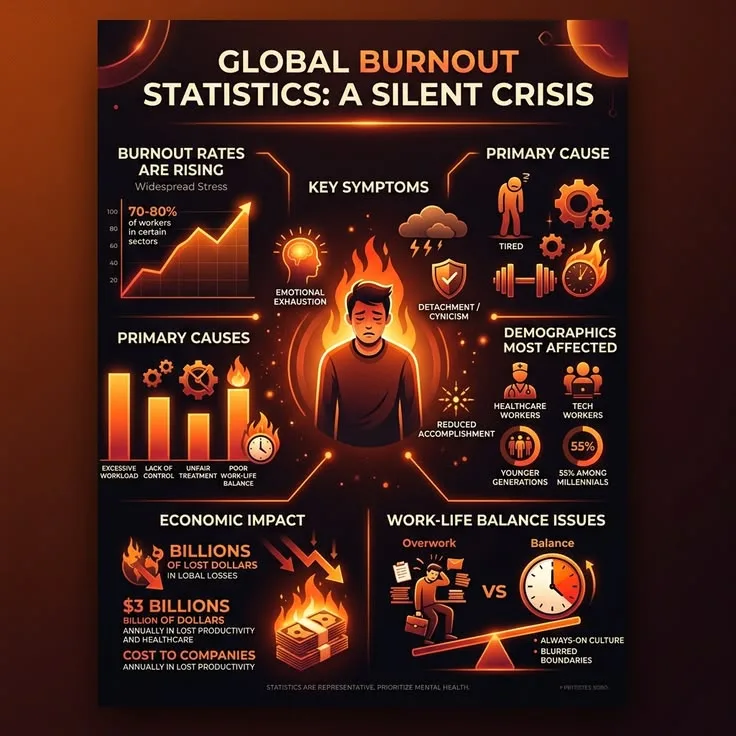
Survey research on YouTubers and other creators consistently finds high rates of burnout symptoms. A 2022 survey by the creator platform Patreon found that 90% of full-time creators had experienced significant burnout at some point in their career.
A separate survey by the influencer management platform Hashtag Pay Me found that 71% of creators reported burnout as a primary concern about their career.
Studies by researchers including Ferris Jabr and independent surveys of creator communities suggest that 70-90% of full-time creators report experiencing significant burnout symptoms at some point in their career.
These figures should be interpreted cautiously given the self-report and sample bias issues involved, but the directional finding is consistent across multiple independent data sources.
A 2023 study by researchers at King's College London (Woodcock and Johnson) specifically examining video game streamers found that the intersection of performance pressure, social isolation, and income volatility produced burnout rates substantially higher than those documented in conventional high-stress occupations such as nursing or teaching.
The Parasocial Labor Literature
Research on emotional labor - performing feelings as part of work - by Hochschild (1983) in The Managed Heart provides theoretical grounding for creator burnout.
Hochschild documented how flight attendants and other service workers were required to manage their emotional expressions as a core job competency, and how this "emotional labor" produced distinctive psychological costs distinct from the physical and cognitive demands of work.
Creators perform intimacy, authenticity, and availability as part of their professional identity. The performance of authentic connection, maintained across videos, streams, and social posts, is emotionally demanding in ways that are rarely acknowledged in conversations about the glamour of the creator lifestyle.
Researchers Brock and Johnson (2018) have written specifically about the emotional labor of content creation as a form of care work that is invisibilized by its digital medium and informal employment status.
They note that creator work requires constant emotional performance directed at an imagined audience - a more demanding form of emotional labor than Hochschild's model of face-to-face interaction, because it must be performed into a camera with no real-time feedback about whether the emotional performance is being received and reciprocated.
Income Volatility and Mental Health
Research on gig economy workers broadly - to which creator work is closely related - documents elevated rates of anxiety and depression associated with income volatility and lack of employment protections.
Katz and Krueger (2019) found that independent contractors and gig workers reported 23% higher rates of anxiety symptoms than comparable W-2 employees, controlling for income level.
The financial precarity of creator work, combined with the social pressure of public performance, creates a mental health burden that standard employment mental health research underestimates for this population.
A 2021 study by Hesmondhalgh and Baker in Creative Labour: Media Work in Three Cultural Industries specifically examined creative sector workers and found that the "passion" framing of creative work - the belief that doing work you love should feel inherently rewarding rather than laborious - made creative workers slower to recognize burnout symptoms and more likely to attribute burnout to personal inadequacy rather than structural causes.
"The creator economy presents itself as liberation from traditional employment - no bosses, no offices, creative freedom. What it often delivers instead is a more total form of work, one where the product is yourself and the factory never closes." - Commentary from creative labor researchers, Hesmondhalgh and Baker, 2021
| Creator Stressor | Category | Comparative Risk Level |
|---|---|---|
| Algorithm-driven income volatility | Financial | Very High - no floor, no benefits |
| Upload consistency pressure | Output demands | Very High - financial penalty for gaps |
| Parasocial relationship maintenance | Emotional labor | High - no clear boundary possible |
| Identity-work fusion | Psychological | High - self is literally the brand |
| Hostile audience interactions | Social stress | Moderate-High at scale |
| Creative constraint from optimization pressure | Autonomy | Moderate-High |
| Isolation of solo creation | Social support | Moderate |
| Public metric visibility of failure | Psychological | Moderate-High |
| Absence of employment protections | Structural | Very High |
Parasocial Relationships and Boundary Erosion
The parasocial dimension of creator work deserves particular attention because it is the least visible stressor from the outside.
Parasocial relationships - one-sided relationships where one party knows the other intimately while being unknown to them - were first described by Horton and Wohl (1956) in their landmark study of television audiences.
They noted that viewers developed genuine feelings of familiarity and connection with television personalities, responding to them as if they were personal acquaintances despite having never met them.
The creator economy has intensified parasocial dynamics dramatically beyond what Horton and Wohl observed. Television audiences were passive consumers. Creator audiences interact - commenting on videos, joining Discord servers, participating in livestream chats, subscribing to patron tiers that promise personal access.
The bidirectionality of digital platforms creates the conditions for parasocial relationships that feel far more mutual than anything broadcast media produced.
At small scale, this is manageable. At the scale of hundreds of thousands or millions of subscribers, the demands become impossible to meet: there are too many comments to respond to, too many personal messages to acknowledge, too many audience members who feel entitled to the creator's attention and time based on their felt but unreciprocated relationship.
Boundary erosion occurs when audiences' parasocial expectations conflict with creators' human limitations. Creators who take mental health breaks receive messages accusing them of abandoning their community. Creators who address personal struggles are flooded with amateur advice and intrusive questions.
Creators who change their content style face organized audience criticism. The parasocial relationship that built the audience can become the psychological cage that traps the creator.
This dynamic was visible in 2021 when Twitch streamer Disguised Toast returned from a three-month hiatus and expressed shock at the negative community response - audience members who felt genuinely abandoned by his absence, despite the fact that the absence was due to undisclosed mental health challenges.
The expectation of creator availability had become so normalized that a creator's decision to take a mental health break was experienced by portions of the audience as a betrayal of commitment.
Creator Burnout and Platform Power
An underappreciated dimension of creator burnout is the power asymmetry between creators and platforms.
Creators build their businesses on platform infrastructure they do not own. The algorithm that determines their reach is controlled by the platform. The monetization policies that govern their income are set and changed by the platform. The community guidelines that affect their content are enforced by the platform.
This power asymmetry creates a specific form of anxiety: creators are vulnerable to platform decisions they cannot predict, influence, or appeal. Algorithm changes can halve a channel's growth overnight. Policy changes can demonetize an entire content category.
Platform shutdowns (Vine being the canonical example) can eliminate a creator's entire business.
When Vine was shut down by Twitter in January 2017, it eliminated the primary platform for thousands of creators - many of whom had not diversified onto other platforms and found themselves starting over from zero. The platform had 200 million users at peak; the creators who built those audiences had no ownership over any of it.
The YouTube AdPocalypse of 2017 - in which major advertisers pulled spending after their ads appeared alongside extremist content - resulted in mass demonetization of creator channels across the platform, many of which had no connection to the problematic content.
Creators whose income depended on ad revenue lost 50-90% of their earnings in a matter of days, with no warning and no recourse. The experience was described by many affected creators as a defining moment of recognition that their businesses were fundamentally insecure regardless of their individual quality or audience size.
Building a sustainable creator business theoretically requires diversifying away from platform dependency - email lists, direct subscriber relationships through Patreon or Substack, owned websites, physical products.
But building these alternative revenue streams requires additional work and creative output, compounding the burnout pressure.
Sustainable Creation: What the Evidence Supports
Research on sustainable creative work, burnout recovery, and occupational health suggests several practices with meaningful evidence behind them.
Content Batching
Producing content in batches - recording multiple pieces in a session and scheduling their release - reduces the psychological pressure of continuous production and allows for genuine gaps in creative work without gaps in publication. Batching separates the creative act from the publication schedule.
This is one of the few platform-compatible strategies that directly addresses burnout without requiring creators to sacrifice reach. A creator who films eight videos in one week and schedules them to release over eight weeks maintains algorithmic consistency without the daily production grind.
Research on cognitive depletion by Baumeister et al. (2007) supports the efficacy of batching: creative and decision-making quality deteriorates with continuous deployment of cognitive resources, and recovery periods restore rather than waste productive capacity.
Separation of Identity from Metrics
Therapists and coaches working with creators consistently identify identity-metrics fusion as a primary burnout driver. Therapeutic work on this dimension involves separating self-worth from subscriber counts, view numbers, and engagement rates - treating these as business metrics rather than judgments on personhood.
This is cognitively difficult given the personal nature of creator content but is consistently identified as necessary for long-term sustainability.
The sports psychology literature offers a useful parallel. Research by Harter (1978) and Deci and Ryan (1980) found that athletes whose self-esteem was contingent on performance outcomes showed dramatically faster burnout rates than athletes who maintained stable self-worth regardless of performance.
The creator who treats 100,000 views as evidence of personal worth will experience 20,000 views as personal failure; the creator who treats views as business data will experience 20,000 views as information to inform strategy.
Financial Reserves and Income Diversification
Creators who have financial reserves - several months of living expenses set aside - report significantly lower anxiety about taking breaks, saying no to brand deals, and experimenting with content formats that may underperform.
Income diversification (multiple platforms, direct support mechanisms, merchandise, licensing) reduces the power of any single platform's algorithm over a creator's financial survival.
A common benchmark cited by financial advisors who work with creators is six months of operating expenses in liquid reserves.
This is higher than the three-month emergency fund commonly recommended for traditionally employed workers, reflecting the higher income volatility and the greater financial risk of extended output gaps in creator work.
Community-Based Support
Research on creative worker wellbeing finds that peer communities - groups of creators who share their experiences, challenges, and strategies - have significant protective effects against burnout.
A 2022 study by the Reuters Institute for the Study of Journalism found that independent journalists (a population with structural similarities to creators) reported significantly lower burnout rates when embedded in professional communities compared to those working in complete isolation, even when controlling for income and workload.
Creator communities normalize the structural difficulties of the work, provide accountability and support, and reduce the isolation of solo creation. Creator house collectives, genre-specific Discord servers, and formal mastermind groups all serve this function.
The key mechanism appears to be normalization of difficulty - the relief of discovering that the struggles one assumed were personal failures are in fact universal features of the work.
Setting Off-Platform Hours
The blurred boundary between content and life in creator work makes explicit time boundaries important. Creators who set specific times during which they do not read comments, do not monitor analytics, and do not generate content ideas report lower rates of burnout and higher creative satisfaction.
Research on "always-on" work culture in conventional employment finds that the expectation of constant availability - answering emails at midnight, checking Slack during vacations - is associated with substantially worse burnout outcomes regardless of total work hours (Dettmers, 2017).
Creator work has this dynamic built into its architecture: platforms are accessible 24 hours a day, audience interactions occur continuously, and analytics dashboards deliver real-time feedback at any hour.
Creators who set structured boundaries around this constant availability have built those boundaries against significant resistance from both platform design and audience expectation.
The Psychological Dimensions of Creator Work
Academic psychology offers several frameworks that illuminate why creator work is especially taxing in ways that are invisible from the outside.
Self-Determination Theory and Motivation Erosion
Self-determination theory, developed by Deci and Ryan (1985), identifies three core psychological needs that support sustainable motivation: autonomy (choosing your own direction), competence (feeling capable and effective), and relatedness (feeling connected to others).
Creator work appears to offer all three, which is part of its appeal.
The problem is that sustained platform pressures systematically undermine all three. Autonomy is eroded when algorithm demands dictate content format, length, cadence, and subject matter.
Competence is undermined when creators who feel their best work is their most thoughtful or experimental work find that it consistently underperforms their more formulaic content.
Relatedness becomes distorted when genuine connection with an audience of individual people is replaced by performance for an undifferentiated mass and management of parasocial demands at scale.
When the conditions that make work intrinsically motivating are systematically undermined, the work that originally felt like freedom comes to feel like obligation. This is the motivational core of creator burnout.
Deci and Ryan's research found that external rewards - money, metrics, subscriber counts - actively undermine intrinsic motivation when they become the primary reason for an activity.
A creator who began making videos for the love of the subject matter and now makes videos primarily to hit monetization thresholds has undergone an overjustification effect: the external reward has displaced the internal drive that originally made the work sustainable.
The Role of Social Comparison
Social media platforms create unusually dense comparison environments. Creators can see, with precise metrics, exactly how their content performs relative to peers and competitors.
Research on social comparison theory consistently finds that upward comparison - comparing yourself to those doing better - is associated with lower wellbeing, while the creator environment provides constant, real-time upward comparison data.
A creator whose video received 50,000 views can immediately observe that a similar video from another creator received 5,000,000 views. This comparison is not just demoralizing - it creates anxiety about what they are doing wrong, pressure to change their approach, and a distorted sense of what "normal" performance looks like.
Research by Vogel et al. (2014) at the University of Toledo found that passive social media consumption - scrolling feeds, viewing others' content performance - was associated with significantly lower self-evaluation and higher depressive symptoms compared to active engagement.
For creators who must consume competitor content to stay current in their niche, this passive consumption dynamic is built into their professional responsibilities.
The Authenticity Trap
Creator content that performs best is frequently described as "authentic" - personal, candid, emotionally honest. Platforms and audiences reward vulnerability, behind the-scenes access, and the appearance of unfiltered self-expression.
This creates a specific pressure: creators are incentivized to perform authenticity, which is different from being authentic, and which eventually produces what researchers call the authenticity paradox.
The paradox operates as follows: genuine authenticity is uncontrolled and cannot be optimized. But creators who have watched their analytics know which types of authentic moments perform best - tears in a certain type of confessional video, joy in a certain type of achievement celebration, frustration in a certain type of commentary.
This knowledge inevitably influences how creators engage with their own emotional experiences, selecting and amplifying those that have historically performed well.
The result is a sophisticated simulation of authenticity that the creator themselves may struggle to distinguish from the real thing.
Creators who share their struggles for engagement are performing difficulty, not simply experiencing it. Over time, the gap between the performed self and the private self widens, and managing that gap becomes its own psychological burden.
The creator who built their channel on being "real" with their audience may find that performing realness has crowded out the actual experience of their own life.
This dynamic was articulated with unusual clarity by YouTuber Casey Neistat, who in a 2019 interview described the experience of watching his own life become content: events he experienced were simultaneously experienced as potential videos, transforming his relationship to his own life from lived experience to raw material for production.
What Platforms Could Do
The structural nature of creator burnout means that individual coping strategies can only go so far. The architecture of platform incentive systems produces the burnout, and changing that architecture is the only systemic solution.
Several researchers and advocates have proposed platform-level interventions:
Algorithm changes that reduce recency penalties: Reducing the reach penalty for output gaps would reduce the pressure on creators to produce continuously regardless of their capacity.
YouTube experimented with longer content shelf-life weighting in 2022, which may have modestly reduced upload-velocity pressure, though the full effects on creator behavior are not yet documented.
Mental health resources: Some platforms have launched nominal mental health resources for creators; the evidence on their effectiveness is limited, and critics argue they are primarily public relations rather than substantive support.
YouTube launched a "Creator Well-being" initiative in 2020, which provides links to mental health resources but does not address the structural algorithm pressures that produce burnout.
Monetization stability: Policies that create more stable monetization baselines - less dependent on per-view algorithmic performance and more on subscriber base - would reduce income volatility.
Some creators have advocated for floor-price revenue guarantees for channels above certain size thresholds, similar to how streaming residuals work for traditional actors.
Transparency in policy enforcement: Clearer, more predictable, and more appealable content policy enforcement would reduce the anxiety of arbitrary demonetization that contributes to creator psychological distress.
The current appeals process for YouTube demonetization, which can take weeks and often results in unexplained reversals, is a documented source of creator anxiety.
The economic incentive structure of platforms, however, creates limited motivation for most of these changes. Platforms benefit from high-volume, consistent creator output; changes that enable creators to produce less but more sustainably would reduce the total content supply that drives platform advertising revenue.
This is the fundamental tension: creator wellbeing and platform revenue are, under the current architecture, in direct structural conflict.
"The platforms have created a system where creators are simultaneously the product, the production workers, and the quality control staff, bearing all the risks of an independent contractor while operating under conditions that would constitute employment law violations if applied to traditional workers.
The health outcomes are exactly what labor economics would predict." - Dr. Mark Graham, Oxford Internet Institute, 2023
What Creators Themselves Say
The most credible testimonies about creator burnout come from the creators themselves, who have increasingly spoken publicly about the psychological toll of their work. Several high-profile examples are worth examining not as celebrity gossip but as data points about structural conditions.
When Jacksepticeye (Sean McLoughlin), one of YouTube's most subscribed creators with over 30 million subscribers, took a hiatus in 2019 for mental health reasons, he posted a video that was watched 12 million times.
The audience response - largely supportive - and the scale of engagement with a video literally about mental health burnout suggests both that the experience resonates broadly and that audience communities, at their best, can respond with compassion rather than entitlement.
Pokimane's 2023 semi-retirement from daily streaming, Ethan Klein's 2022 discussion of therapy and burnout on H3H3's podcast, and the general trend of large creators moving to reduced upload schedules all reflect the same structural dynamic: the pace that built the audience cannot be maintained indefinitely, and the creators who survive long enough to recognize this adapt before the adaptation is forced by breakdown.
Summary
Creator burnout is a systemic problem produced by the structural features of creator work: algorithm pressure that punishes output gaps, parasocial relationship demands that blur work and life, identity-work fusion that makes creative struggles existential, income volatility that adds financial anxiety to creative pressure, and a power asymmetry with platforms that creates vulnerability to decisions outside creator control.
The prevalence of burnout symptoms among full-time creators is high by all available measures - ranging from 70% to 90% in survey research across multiple platforms and methodologies. The causes are structural, not individual.
Sustainable creation requires practices that separate identity from metrics, create genuine financial stability, set clear work-life boundaries, and diversify away from single-platform dependency.
But the most significant changes needed are at the platform level, where the incentive structures that create burnout in the first place are set and could, in principle, be changed.
The research converges on a conclusion that challenges the dominant cultural narrative of the creator economy: the psychological and financial risks of creator work are not exceptional edge cases but predictable outcomes of a system designed to extract maximum content volume from a large pool of aspirational workers, most of whom will not achieve the outcomes that made the work seem worth attempting.
For anyone considering the creator economy as a career, the glamour of the view count obscures a labor environment with exceptionally high emotional demands, precarious income, and professional structures designed primarily to benefit platforms rather than the people creating the content on which those platforms depend.
This is not a reason to avoid the work - but it is a reason to enter it with clear eyes about what the structural pressures are, rather than believing that the burnout visible in so many prominent creators is a problem that will somehow not apply to you.
Health note: This article is general educational information about how a topic works, not medical, psychological, or mental-health advice, diagnosis, or treatment. Everyone's situation is different, and research findings describe groups, not individuals.
If you are struggling or have concerns about your health, please talk to a qualified professional such as a doctor or licensed therapist.
If you are in crisis or thinking about harming yourself, contact your local emergency services or a crisis line right away, in the US you can call or text 988 (Suicide & Crisis Lifeline); elsewhere, find local lines at findahelpline.com.