
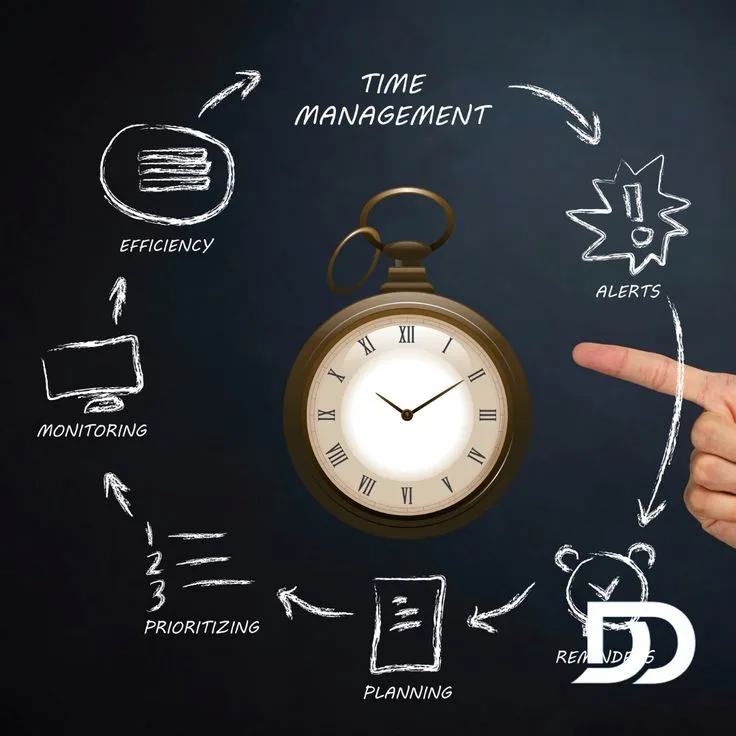
Effective time management techniques combine goal-setting, priorities, scheduling systems, and attention management, but their most important benefit may be a felt sense of control over time. Research links that sense of agency more strongly to wellbeing than to performance alone. Planning also needs protection against optimistic estimates, distraction, and work expanding to fill available time, problems that effort or a new app cannot solve by themselves.
Time management is the process of planning, organizing, and consciously controlling how you allocate time across activities to increase effectiveness, reduce stress, and achieve meaningful goals. It encompasses prioritization, scheduling, attention management, and the behavioral systems that govern when and how you work.
Far from being a simple matter of willpower or the right app, time management is a cognitive skill shaped by well-documented psychological biases - and the research on what actually works often contradicts popular advice.
In the early 1990s, Denver International Airport's automated baggage system had been running nearly three years over schedule. The original plan called for six months of development. Project managers were confident in their timeline.
The airport ultimately opened 16 months late, at a cost of $569 million in overruns, largely because of the baggage system's delays. The engineers had been working extremely hard. The problem was not effort. It was planning.
The project had fallen victim to one of the most reliably documented phenomena in human psychology: the planning fallacy. People are systematically overoptimistic about how long tasks will take, how many obstacles will arise, and how much they will accomplish in a given period.
This is not a character flaw. It is a property of the cognitive systems we use to think about future tasks.
Time management is often discussed as though the problem is insufficient willpower, poor tools, or lack of discipline. The research suggests otherwise. Most time management failures trace back to systematic cognitive errors that no calendar app can fix - combined with environments that actively work against human attention and planning.
"The bad news is time flies. The good news is you're the pilot." - Michael Altshuler
This article examines what time management research actually shows about what works, what does not, and why - drawing on meta-analyses, cognitive psychology, and the accumulated evidence of decades of productivity science.
What Does the Research Actually Say About Time Management?
A landmark 2021 meta-analysis published in PLOS ONE by Brad Aeon, Aïda Faber, and Alexandra Panaccio reviewed 158 studies encompassing over 53,000 participants to produce the most comprehensive picture to date of time management's effects.
This was not a self-help book or a productivity guru's opinion - it was a rigorous quantitative synthesis of the scientific literature.
Key findings from the meta-analysis:
- Time management is positively associated with job performance (r = 0.22)
- Time management is positively associated with life satisfaction and wellbeing (r = 0.29)
- The wellbeing association was stronger than the performance association - time management may matter more for how you feel than for how much you produce
- The associations are stronger for complex, autonomous knowledge work than for routine tasks with external pacing
- The strongest predictor within time management behavior is not any specific tool but rather perceived control over one's time - the metacognitive feeling that you are steering your schedule rather than being driven by it
Three components of time management behavior consistently emerge from factor analyses across studies:
- Setting goals and priorities - knowing what matters most
- Using tools and systems to schedule and plan
- Perceiving control over time - the psychological sense of agency
All three are associated with positive outcomes, but perceived control is the strongest predictor of wellbeing benefits. This suggests that the psychological dimension of time management - feeling that you are choosing how to spend your time - matters independently of the specific techniques used.
A sophisticated system that leaves you feeling controlled by your calendar may be worse than a simple system that leaves you feeling in charge.
| Finding | Effect Size | Practical Meaning |
|---|---|---|
| Time management and job performance | r = 0.22 | Real but modest; one input among many |
| Time management and wellbeing | r = 0.29 | Stronger than performance link; feeling in control matters |
| Time management and stress reduction | r = -0.21 | Time management reduces perceived stress |
| Time management training effectiveness | Positive but fades | Works initially; needs structural support to persist |
| Strongest single predictor | Perceived control | How you feel about your time matters most |
The implication: time management is valuable, but not primarily as a productivity trick. Its deepest benefit may be psychological - the sense of agency that comes from deliberately choosing how to spend your hours. This aligns with what decision-making research tells us about the relationship between choice, control, and wellbeing.
Parkinson's Law: Why Work Always Fills the Time
In 1955, British naval historian and organizational theorist C. Northcote Parkinson opened an essay in The Economist with a sardonic observation that would become one of the most quoted principles in management: "Work expands so as to fill the time available for its completion." This is now known as Parkinson's Law.
The observation grew from Parkinson's study of the British Civil Service, where he noticed that bureaucratic staffing and workloads were essentially unrelated to actual work output. Between 1914 and 1928, the number of Admiralty officials increased by 78 percent while the number of ships in the Royal Navy declined by 67 percent.
An organization with less to do was employing more people to do it. A simple task that could be done in an hour would occupy a full day if that was the time allocated to it.
The mechanism is psychological and behavioral:
- Tentative approach: With ample time, we approach tasks more cautiously, revise more, second-guess more, and add complexity that would not arise under constraint
- Present bias: An hour of leisure today is more attractive than an hour of task completion for a distant deadline, so we start later when the deadline is far away
- Interruption tolerance: We allow distractions to consume time we assume we have in reserve
- Scope creep: Without time pressure, tasks expand in ambition and complexity beyond what is necessary
The Evidence on Deadlines and Performance
Research on deadlines and creative performance shows that moderate time pressure improves focus and output quality, while excessive pressure (impossibly tight deadlines) degrades performance.
Teresa Amabile and colleagues at Harvard Business School studied this extensively in their 2002 paper "Creativity Under the Gun," analyzing over 9,000 diary entries from 177 employees across seven companies.
They found that moderate time pressure with a sense of meaningful mission produced the best creative work, while extreme time pressure with fragmented attention produced the worst.
The practical application is counterintuitive: shorter deadlines, if realistic, often produce better work in less time. The optimal deadline is tighter than you would naturally set, but not so tight as to produce panic.
Time-boxing - deliberately constraining how long you will spend on a task - is the behavioral intervention that operationalizes this insight. Rather than working on a report until it is done, you allocate 90 minutes and work until the timer ends.
This forces decisions about scope and completeness that open-ended time frames perpetually defer. It is Parkinson's Law, turned from an observation about dysfunction into a tool for productivity.
The Planning Fallacy: Why Your Estimates Are Almost Always Wrong
Daniel Kahneman and Amos Tversky coined the term planning fallacy in 1979 to describe the systematic tendency to underestimate how long tasks will take and to be overoptimistic about the likelihood of completing them on schedule.
The phenomenon is remarkably robust:
- In a 1994 study by Buehler, Griffin, and Ross, psychology students estimated they would complete their honors theses in an average of 34 days. The actual average was 55 days - 56 percent longer than predicted. Even when asked to give a "worst-case scenario" estimate, students still underestimated.
- The Standish Group's CHAOS Report (2015) found that only 29 percent of IT projects were delivered on time and on budget. Cost overruns exceeding 50 percent were common across industries.
- The Sydney Opera House, originally estimated at $7 million and four years, cost $102 million and took 16 years to complete.
- The Boston Big Dig highway project was budgeted at $2.8 billion in 1985 and ultimately cost $14.6 billion.
Renovating a home, launching a product, writing a book, implementing a software system - nearly every estimate-intensive task in human experience tends to run over. The planning fallacy is not limited to optimistic amateurs; it affects experienced professionals, project managers, and entire organizations.
Why the Planning Fallacy Occurs
Inside vs. outside view. When estimating, people naturally focus on their specific situation - what they plan to do, how they will do it, what resources they have. This inside view ignores the base rate of similar tasks: how long projects like this actually take, in reality, for people with similar plans and similar resources.
The outside view asks: "Forget this specific case. How long do projects like this typically take?" The outside view is almost always more accurate, but it feels wrong because it ignores the details that make your situation feel unique.
Optimism bias. People systematically underweight obstacles, interruptions, learning curves, dependencies on others, scope creep, and unforeseen complications. These are the invisible items not captured in any plan, yet they are the primary reason projects run over.
Tali Sharot's research at University College London (2011) demonstrated that optimism bias is neurologically hardwired - brain regions associated with positive expectation are more active than those processing negative information about future events.
Motivational factors. We want tasks to be quick and want our estimates to be right. Pessimistic estimates feel defeatist. Committing to a plan feels like commitment to success. This motivated reasoning corrupts the accuracy of estimates even when people have knowledge of past overruns.
The Fix: Reference Class Forecasting
Kahneman's recommended solution is reference class forecasting, developed and refined by Bent Flyvbjerg, now at the IT University of Copenhagen (formerly Oxford). Instead of estimating from the inside view, you:
- Identify the reference class - what category of project is this? (IT implementations, creative projects, renovations, research papers)
- Research the base rate - how long do projects in this reference class actually take? What is the distribution of outcomes?
- Apply the base rate as your starting point, not your inside-view estimate
- Adjust for specific features of your project that make it genuinely different from the average - but adjust conservatively, because most people overestimate how unique their situation is
Flyvbjerg's research, published across multiple papers and summarized in his 2021 article in the Harvard Business Review, shows that reference class forecasts are substantially more accurate than inside-view estimates, particularly for long, complex projects.
The method has been adopted by the UK government for major infrastructure planning and by several national transportation authorities.
The method is uncomfortable because it often requires accepting that your project will take twice as long as you feel it should. But that discomfort is itself evidence of the cognitive biases that make the planning fallacy so persistent.
Timeboxing vs. Time Blocking: Understanding the Difference
Two scheduling techniques dominate evidence-based productivity advice, and they are often conflated despite being distinct.
Time blocking allocates specific blocks of time in your calendar for specific categories of work or specific tasks: Monday 9-11am is for deep work on Project X; Tuesday 2-4pm is for email and administrative tasks; Wednesday mornings are for meetings.
The goal is to defend against the tendency for urgent-but-not-important interruptions to fill all available time, and to ensure that high-priority work has scheduled space.
Research supports time blocking. Putting specific intentions in a calendar - as opposed to a to-do list - increases follow-through by creating implementation intentions: plans that specify not just what you intend to do but when, where, and how.
Peter Gollwitzer's research, published in American Psychologist (1999) and replicated across more than 200 subsequent studies, shows that implementation intentions approximately double the rate of goal achievement compared to goal intentions alone.
The mechanism is powerful: specifying when and where activates automatic behavioral triggers that bypass the need for conscious motivation at the moment of action.
Timeboxing constrains the duration of a task. You allocate a fixed amount of time - "I will work on this for 90 minutes" - and stop when the time is up, regardless of whether you feel finished. Timeboxing applies Parkinson's Law deliberately: by constraining the time, you force completeness decisions within the constraint.
The two techniques complement each other: time blocking reserves space for important work, and timeboxing governs how that space is used.
| Technique | What It Does | Best For | Key Research |
|---|---|---|---|
| Time blocking | Reserves calendar slots for categories of work | Defending important work from interruption | Gollwitzer (1999), implementation intentions |
| Timeboxing | Constrains duration of specific tasks | Combating perfectionism and open-ended effort | Parkinson's Law; Amabile (2002) on time pressure |
| Pomodoro Technique | 25-minute focused sessions with short breaks | Maintaining focus; countering procrastination | Cirillo (2006); based on attention research |
| Eat the Frog | Do hardest task first each day | Reducing decision fatigue and avoidance | Baumeister & Tierney (2011) on willpower |
| Time audit | Track actual time use for 1-2 weeks | Diagnosing where time actually goes | Aeon, Faber, & Panaccio (2021) meta-analysis |
Why To-Do Lists Fail (and What Works Better)
The to-do list is the most ubiquitous time management tool. It is also, research suggests, deeply flawed as typically practiced. Understanding why reveals a great deal about the psychology of planning and execution.
Why To-Do Lists Underperform
They do not specify when. A task on a list exists in temporal limbo - it can be done now or later or never. Lists without time assignments devolve into wish lists.
Gollwitzer's research on implementation intentions shows that specifying when and where dramatically increases completion rates; a list without time coordinates provides no such specification.
They mix trivial and important indiscriminately. "Reply to Sarah's email" and "Complete strategic planning document" coexist on the same list, given apparent equal status.
This creates false equivalence and the satisfying illusion of productivity through completion of trivial items while large important tasks are perpetually deferred.
The Eisenhower Matrix - distinguishing urgent from important - was designed to address this problem, but a flat to-do list undermines it.
They grow faster than they are completed. Most people's to-do lists are in a state of permanent growth. Research on the Zeigarnik effect (Bluma Zeigarnik, 1927) shows that uncompleted tasks occupy working memory even when you are not actively thinking about them, creating persistent cognitive load and anxiety.
A study by Masicampo and Baumeister (2011) in the Journal of Personality and Social Psychology found that merely making a specific plan for when to complete an unfinished task eliminated the Zeigarnik effect - the intrusive thoughts stopped, even though the task was not yet done.
This suggests that the cognitive burden comes from the lack of a plan, not from the incompleteness itself.
They do not account for time. Listing ten tasks for a day without asking whether they fit in a day - given realistic estimates of how long each takes - creates an inherently unrealistic workday, guaranteeing either incomplete lists or unsustainable hours.
Better Alternatives
Research on planning effectiveness points toward systems that combine task capture with temporal scheduling: writing tasks into specific calendar slots at the time of capture, limiting daily task lists to what actually fits in the available hours (given realistic time estimates), and distinguishing between a capture system (for everything you might want to do) and a commitment system (for what you are actually committing to today).
David Allen's Getting Things Done (GTD) methodology, published in 2001 and updated in 2015, addresses several of these problems by insisting on immediate processing of captured items into actionable next steps with specific contexts.
While the full GTD system is more complex than most people sustain, its core insight is sound: the purpose of a task management system is not to remember everything but to decide about everything - to convert open loops into specific commitments or explicit decisions not to act.
The Attention Management Frame
Cal Newport, in Deep Work (2016) and subsequent writing including A World Without Email (2021), argues that attention management is a more useful frame than time management for knowledge workers. The most valuable knowledge work requires extended periods of focused, uninterrupted cognitive effort.
The enemy is not poor scheduling but the fragmented attention economy in which most people operate.
Research powerfully supports this framing. Gloria Mark at UC Irvine found in a series of studies (2004, 2008, 2015) that office workers switch tasks every 3 minutes and 5 seconds on average, and that it takes approximately 23 minutes and 15 seconds to return to a task at full depth of focus after an interruption.
In an environment of constant notifications, meetings, email, Slack messages, and ambient noise, this means most knowledge workers spend their working hours never reaching the cognitive depth where their most valuable work can be done.
Mark's 2023 book Attention Span synthesizes two decades of research and reports that the average attention span on a single screen decreased from 2.5 minutes in 2004 to 47 seconds by 2020. The trend is accelerating, driven by the design of digital tools that prioritize engagement over sustained focus.
From this perspective, the most important time management decision is not how to schedule tasks but what context to create for different kinds of work:
- Protect long uninterrupted blocks (minimum 90 minutes) for complex work
- Batch shallow work into designated periods rather than allowing it to fragment deep work
- Design the physical and digital environment to support rather than undermine focused attention - close email, silence notifications, use website blockers during deep work blocks
- Accept that not all hours are equal - an hour of deep, focused work produces more than three hours of fragmented, interrupted effort
The research is consistent: time management tools cannot compensate for structural attention fragmentation. Scheduling focused blocks only helps if those blocks are genuinely protected from interruption.
Technology that tracks tasks but also delivers constant notifications may actively counteract the time management benefits it promises. This connects to broader questions about how complex systems create unintended consequences.
The Eisenhower Matrix: Urgent vs. Important
President Dwight D. Eisenhower reportedly said: "What is important is seldom urgent and what is urgent is seldom important." Stephen Covey popularized this insight as a 2x2 matrix in The 7 Habits of Highly Effective People (1989), and it remains one of the most useful frameworks for prioritization.
The matrix sorts tasks into four quadrants:
| Urgent | Not Urgent | |
|---|---|---|
| Important | Do immediately (crises, deadlines) | Schedule proactively (strategy, relationships, health) |
| Not Important | Delegate or minimize (most email, many meetings) | Eliminate (busywork, time-wasters) |
The key insight: most people spend the majority of their time in the urgent quadrants (both important and not important) and too little time in the important but not urgent quadrant - the quadrant that contains the work that builds long-term success: strategic planning, relationship building, skill development, health, and prevention.
The reason is neurological. Urgency triggers the brain's threat-detection systems, creating a sense of activation and importance that is disproportionate to the task's actual value. Responding to an urgent email feels productive.
Working on a strategic document that is due in three weeks does not generate the same neurological urgency, even though it is far more valuable.
Effective time management requires consciously overriding this bias by scheduling important-but-not-urgent work and protecting that schedule from urgent-but-not-important interruptions.
A Practical Evidence-Based Framework
Synthesizing the research, a time management approach grounded in evidence would include:
Weekly planning. Identify the 1-3 most important outcomes for the week - the things that, if accomplished, would make the week a success regardless of what else happens. Block time for these first. This is the Eisenhower Matrix in practice: important-not-urgent work gets scheduled before urgent-not-important work can fill the space.
Realistic daily planning. Estimate time for tasks honestly (using reference class thinking - how long did similar tasks actually take last time?), total the estimates, and compare to available hours. Start with what fits; defer what does not.
Most people can accomplish 4-6 hours of focused work in an 8-hour day once meetings, transitions, and administrative tasks are accounted for.
Time audit. Spend one or two weeks tracking actual time use in 30-minute increments before redesigning your schedule. Most people are surprised where their time actually goes.
A 2018 study by the Bureau of Labor Statistics found that American workers spent an average of only 2 hours and 53 minutes on productive work in an 8-hour day. Knowing your actual pattern is prerequisite to improving it.
Scheduled deep work. Block time for cognitively demanding work at the time of day when your cognitive performance peaks (for most people, late morning), and protect those blocks from meetings and interruptions. Treat these blocks as non-negotiable appointments.
Implementation intentions for important tasks. Do not just list important work - schedule it with full specificity. "I will work on the strategic document from 9:00 to 10:30am Tuesday in my office with my phone on do not disturb" is dramatically more likely to happen than "work on strategic document."
Regular system review. A system you do not review decays. A weekly review of the prior week's actuals against intentions, and a planning session for the next week, keeps the system calibrated to reality rather than aspiration.
Allen's GTD weekly review and Covey's "Sharpen the Saw" habit both emphasize this maintenance function.
None of these are sophisticated. The obstacle is not technique - it is the persistent gap between knowing what works and actually doing it, which is perhaps the deepest and most enduring problem in the science of human behavior.
Sources & Further Reading
- Aeon, B., & Aguinis, H. (2017). It's About Time: New Perspectives and Insights on Time Management. Academy of Management Perspectives, 31(4), 309-330.
- Aeon, B., Faber, A., & Panaccio, A. (2021). Does Time Management Work? A Meta-Analysis. PLOS ONE, 16(1). DOI: 10.1371/journal.pone.0245066
- Kahneman, D., & Tversky, A. (1979). Intuitive Prediction: Biases and Corrective Procedures. TIMS Studies in Management Science, 12, 313-327.
- Flyvbjerg, B. (2021). Top Ten Behavioral Biases in Project Management. Project Management Journal, 52(6), 531-546.
- Gollwitzer, P. M. (1999). Implementation Intentions: Strong Effects of Simple Plans. American Psychologist, 54(7), 493-503.
- Mark, G. (2023). Attention Span: A Groundbreaking Way to Restore Balance, Happiness and Productivity. Hanover Square Press.
- Newport, C. (2016). Deep Work: Rules for Focused Success in a Distracted World. Grand Central Publishing.
- Allen, D. (2015). Getting Things Done: The Art of Stress-Free Productivity (revised ed.). Penguin Books.
- Amabile, T. M., Hadley, C. N., & Kramer, S. J. (2002). Creativity Under the Gun. Harvard Business Review, 80(8), 52-61.
- Masicampo, E. J., & Baumeister, R. F. (2011). Consider It Done! Plan Making Can Eliminate the Cognitive Effects of Unfulfilled Goals. Journal of Personality and Social Psychology, 101(4), 667-683.
- Covey, S. R. (1989). The 7 Habits of Highly Effective People. Free Press.
- Parkinson, C. N. (1955). Parkinson's Law. The Economist, November 19, 1955.