
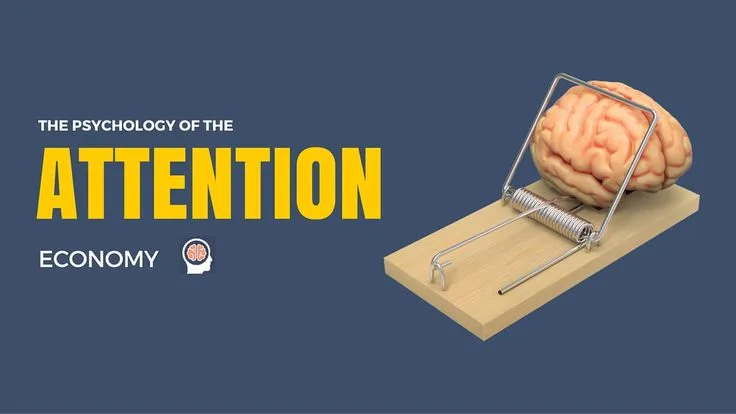
Attention: A teenager scrolls through TikTok for three hours straight, consuming hundreds of videos but remembering none. A professional opens their laptop intending to work, but finds themselves clicking through news sites, social feeds, and recommendation algorithms for 90 minutes instead.
An executive pays roughly $7 million for a 30-second Super Bowl advertisement competing with dozens of others for a fleeting moment of viewer focus.
These scenarios reflect the fundamental reality of the modern digital economy: attention has become the scarcest and most valuable resource. While information explodes exponentially, millions of videos uploaded daily, billions of posts, endless streams of content, human attention remains stubbornly fixed at 24 hours per day per person.
This creates a zero-sum competition where platforms, creators, advertisers, and businesses fight for increasingly scarce eyeball-seconds.
"What information consumes is rather obvious: it consumes the attention of its recipients." - Herbert A. Simon
Attention economics is the study and practice of treating human attention as a limited commodity that can be captured, measured, traded, and monetized.
In attention-based business models, the goal is not to sell products directly but to capture and hold attention, then convert that attention into revenue through advertising, data collection, or eventual purchases.
The platform that captures more attention wins. The creator who holds attention longest grows fastest. The advertisement that breaks through the noise converts best.
This economic framework fundamentally shapes how content is created, how platforms are designed, how information spreads, and ultimately how we spend our cognitive resources.
Understanding attention economics means examining why you see what you see online, why platforms work the way they do, what incentives drive content creation, and how the competition for attention affects individuals, society, and culture.
What Attention Economics Is
Definition and Core Concepts
Attention economics: An approach to managing information that treats human attention as a scarce commodity with economic value, where businesses and platforms compete to capture, retain, and monetize user attention.
Key principles:
- Attention as currency: In digital environments, attention functions like money: limited, valuable, tradable
- Scarcity principle: While information is abundant, attention remains fixed, creating fierce competition
- Opportunity cost: Every moment of attention given to one thing means attention denied to everything else
- Monetization model: Attention converts to revenue through advertising, data, or downstream transactions
- Optimization imperative: Systems optimize for maximum attention capture and retention, regardless of other values
The attention economy transaction:
- Platform provides free content/service
- User provides attention (time, focus, engagement)
- Platform sells access to that attention to advertisers
- Advertisers pay for impression/click/conversion
- Platform captures revenue, shares some with creators
Historical context: The concept emerged in the 1970s when psychologist Herbert Simon noted that "a wealth of information creates a poverty of attention." As information technology advanced, this dynamic intensified.
Economist Michael Goldhaber's 1997 essay "The Attention Economy and the Net" articulated how attention would become the central economic unit in information-rich environments.
By the 2010s, with smartphones and social media, attention economics became the dominant business model for the largest tech companies globally.
Why Attention Became Economic
The transformation from information scarcity to attention scarcity represents one of the most profound economic shifts of the digital age. Understanding this reversal explains why platforms behave as they do.
| Era | Scarce Resource | Abundant Resource | Economic Model | User Pays With |
|---|---|---|---|---|
| Pre-Digital (1950-1995) | Information | Attention | Subscription/Purchase | Money (newspapers, cable, books) |
| Digital (1995-2010) | Transition period | Transition period | Hybrid models | Mix of money and attention |
| Attention Economy (2010-Present) | Attention | Information | Free + Advertising | Attention and personal data |
Pre-digital era: Information was scarce and expensive. You paid for newspapers, magazines, cable TV, books. The limiting factor was access to information. Attention was abundant relative to available content: people finished newspapers, watched scheduled TV shows, read entire books.
Digital transformation reversed this completely:
- Information abundance: Internet enabled near-zero-cost creation and distribution. Anyone could publish anything instantly to global audiences. Marginal cost of producing one more article, video, or post: essentially zero.
- Content explosion: From roughly 2.4 million web pages in 1998 to over 1.9 billion websites by 2023. YouTube alone receives 720,000 hours of video uploaded daily, more content in a single day than you could watch in 82 years of continuous viewing.
- Fixed attention: Despite exponential information expansion, humans still have only 24 hours daily, limited working memory (7±2 items), finite cognitive capacity (approximately 120 bits/second of conscious processing).
- Mathematical inevitability: Information growing exponentially while attention remains constant creates intensifying competition for a truly scarce resource.
Why platforms turned to attention-based models:
- User reluctance to pay: Early internet culture established expectation of free content. Users resisted subscriptions or paywalls.
- Advertising effectiveness: Proven model from TV/radio: provide free content, sell attention to advertisers.
- Data advantage: Digital platforms could measure attention with unprecedented precision: time spent, click patterns, engagement metrics.
- Network effects: Platforms that captured more attention attracted more creators, which attracted more users, creating self-reinforcing growth.
- Scalability: Once built, platforms could serve millions or billions with minimal marginal cost, making attention-monetization highly profitable.
The attention marketplace: Platforms became attention brokers, intermediaries connecting attention suppliers (users), attention seekers (advertisers), and attention generators (creators). The platform that most efficiently captured and monetized attention won the market.
How Attention Economics Works
The Attention Business Model
Platform revenue structure:
Free-to-user model:
- Users pay nothing in money
- Users pay everything in attention and data
- Platform captures attention, sells it to advertisers
- Revenue scales with user time and engagement
Example: Facebook/Meta:
- Provides social networking, content, messaging for free
- Users spend average 30-40 minutes daily on platform
- Meta sold that attention to advertisers for $116 billion revenue in 2022
- Business model: maximize daily active users × average session time × ad load per session
Attention metrics platforms optimize for:
| Metric | What It Measures | Why Platforms Care | Typical Industry Benchmark |
|---|---|---|---|
| Daily Active Users (DAU) | People using platform each day | More users = more attention inventory to sell | Facebook: ~2 billion DAU |
| Monthly Active Users (MAU) | Unique users over 30 days | Broader reach for advertisers | YouTube: ~2.5 billion MAU |
| Average Session Time | Minutes per visit | Longer sessions = more ads shown | TikTok: ~52 min/day average |
| Engagement Rate | Likes, comments, shares per post | Deep engagement signals quality attention (though these can become vanity metrics) | Instagram: 1.22% average |
| Stickiness (DAU/MAU) | How habitual usage becomes | Higher ratio = stronger habit formation | Top apps: 50-60% stickiness |
| Time-to-Return | Hours until user comes back | Frequency creates more ad opportunities | Snapchat: Multiple times daily |
These metrics directly correlate to revenue: More users × more time × more engagement = more ad inventory to sell at higher prices. A platform that increases average session time by 10% can increase revenue by 10-15% without acquiring a single new user.
Attention Capture Mechanisms
Platforms don't accidentally capture attention, they engineer for it using sophisticated psychological techniques.
"The short-term, dopamine-driven feedback loops that we have created are destroying how society works." - Chamath Palihapitiya
Here's how the major mechanisms work:
| Mechanism | How It Works | Psychological Exploit | Platforms Using It | Impact on Session Time |
|---|---|---|---|---|
| Infinite Scroll | Content auto-loads as you reach bottom, no natural endpoint | Removes "stopping cues" that trigger exit decisions | Twitter, Instagram, TikTok, Facebook feed | +30-50% average session time |
| Autoplay | Next video/episode starts automatically after 3-5 seconds | Leverages inertia: easier to keep watching than actively stop | YouTube, Netflix, TikTok | +70% chance of watching next item |
| Variable Reward Schedule | Unpredictable mix of interesting/boring content | Same mechanism as slot machines: strongest addiction pattern | All feed-based platforms | Creates compulsive checking behavior |
| Push Notifications | Alerts interrupt whatever you're doing | FOMO, social obligation, curiosity about feedback | All social platforms, news apps | +25% return visit rate |
| Social Metrics | Prominent like/view/follower counts | Social proof: "others valued this, so should I" | Instagram, YouTube, Twitter | +40% engagement on high-count content |
| Algorithmic Personalization | ML predicts what keeps you specifically engaged | Tailored to individual psychological vulnerabilities | YouTube, TikTok, Facebook | Can double average watch time |
Real-world example: Netflix autoplay engineering
When Netflix tested autoplay for their next episode, they discovered:
- Without autoplay: 15% of users watched next episode
- With 10-second countdown: 45% watched next episode
- With 5-second countdown: 62% watched next episode
- With 3-second countdown + thumbnail preview: 70% watched next episode
This single feature change increased total viewing hours by an estimated 60%, adding billions in subscription retention value. The feature wasn't designed to help users, it was designed to capture more attention before users could decide to stop.
The attention capture hierarchy:
- Awareness (notifications, recommendations, social sharing)
- Click/Open (thumbnails, titles, curiosity gaps)
- Initial engagement (first 3-10 seconds, the "hook")
- Sustained attention (pacing, novelty, emotional triggers)
- Extended session (autoplay, infinite scroll, related content)
- Return visit (notifications, habit formation, unfinished loops)
Each layer uses different psychological mechanisms, and platforms optimize every stage simultaneously.
The Creator Side
How creators compete in attention economy:
Attention as currency for creators:
- Views, subscribers, followers measure attention captured
- Attention converts to revenue through advertising, sponsorships, products, services
- More attention = more revenue, more influence, more opportunity
Creator optimization strategies:
- Thumbnails and titles: Designed for maximum click-through rate using curiosity gaps, emotional triggers, bold visuals
- Hooks: First 3-10 seconds engineered to retain viewer attention before they scroll/skip
- Pacing: Rapid cuts, constant movement, novelty every few seconds to prevent boredom
- Emotional triggers: Content that makes you laugh, angry, surprised, curious, outraged holds attention better than neutral content
- Controversy and provocation: Strong opinions, hot takes, debates generate engagement through disagreement
- Trend chasing: Jumping on viral topics/formats capitalizes on existing attention allocation
The creator's dilemma:
- Platform incentives: Algorithms reward engagement metrics, not quality or value
- Attention competition: Millions of creators compete for same eyeballs
- Optimization pressure: Must constantly adapt to what captures attention or lose visibility
- Value tension: What captures attention ≠ what provides deep value
- Result: Creators face choice between optimizing for attention (algorithm-friendly) or optimizing for value (audience-friendly)
Example: YouTube evolution:
- Early YouTube (2005-2010): Longer-form content, experimentation, niche communities
- Mid-period (2010-2016): Optimization toward 10-minute videos (ad placement), thumbnails, titles
- Current (2016+): Constant A/B testing, clickbait thumbnails, retention analytics, Shorts competing with TikTok
- Pattern: Platform incentives shaped content creation toward maximum attention capture
Why Attention Is Valuable
Attention Precedes Action
Fundamental principle: All human behavior starts with attention. You cannot buy what you don't notice, learn what you don't attend to, believe what you don't see, act on what you haven't focused on.
The attention → action pipeline:
- Awareness: Attention creates awareness something exists
- Interest: Sustained attention generates interest or curiosity
- Consideration: Focused attention enables evaluation and thinking
- Decision: Attention plus consideration leads to choice
- Action: Decision converts to behavior: purchase, subscribe, vote, share
Every business outcome requires attention first: E-commerce requires users to notice products. News organizations need readers to see articles. Political campaigns need voters to attend to messages. SaaS companies need prospects to watch demos. Attention is the gateway drug to all economic activity.
Attention Enables Persuasion
Persuasion requires attention: You cannot persuade someone who isn't listening. Advertising, marketing, propaganda, education all depend on capturing and holding attention long enough to convey messages and shape beliefs.
Psychological influence mechanisms:
- Mere exposure effect: Repeated attention to something increases positive feelings toward it (one of many cognitive biases that attention economics exploits)
- Availability heuristic: Things you've paid attention to recently feel more common/important than they are
- Anchoring: First information attended to disproportionately shapes subsequent judgment
- Emotional conditioning: Attention + emotional experience creates associations that drive future behavior
Example: Advertising effectiveness: Research shows ad effectiveness correlates strongly with attention duration and quality. Ads receiving active attention (measured by eye-tracking) generate 2-3× higher recall and purchase intent than ads receiving passive or no attention.
Advertisers pay premium prices for high-attention environments (Super Bowl, YouTube pre-roll) versus low-attention environments (banner blindness).
Attention Generates Data
Attention measurement creates valuable data:
- Behavioral data: What you click, watch, read, linger on reveals preferences, interests, susceptibilities
- Temporal patterns: When and how long you pay attention reveals habits, routines, attention patterns
- Engagement patterns: What triggers shares, comments, saves reveals emotional buttons and social dynamics
- Comparative data: How your attention differs from similar users enables micro-targeting
Data monetization:
- Advertising targeting: Data improves ad relevance, increasing conversion rates and advertiser willingness to pay
- Product development: Attention patterns inform what features/content to build
- Algorithmic optimization: Data trains ML models that become better at capturing attention
- Data sales: Some platforms sell anonymized attention/behavior data to third parties
Example: Facebook advertising: Facebook's advertising platform works because it has detailed attention data on billions of users: what they click, what they watch, what they engage with.
This enables advertisers to target ads with surgical precision: "women aged 25-34, interested in yoga, living in Austin, who engaged with wellness content in last 30 days." That targeting capability makes attention captured on Facebook more valuable per-second than generic attention elsewhere.
Consequences of Attention Economics
Impact on Content Quality
Race to the bottom dynamics:
When platforms optimize for engagement metrics rather than quality, a predictable pattern emerges: content that captures attention crowds out content that provides value.
| Content Characteristic | Attention Performance | Value to Audience | Winner in Attention Economy |
|---|---|---|---|
| Nuanced, complex analysis | Low engagement (requires effort) | High long-term value | Loses |
| Hot takes, strong opinions | High engagement (tribal reaction) | Low informational value | Wins |
| Accurate but unsurprising | Low shares (not emotionally compelling) | High epistemic value | Loses |
| Sensational but misleading | High shares (triggers emotion) | Negative value (misinforms) | Wins |
| Investigative journalism | Expensive, slow, limited viral potential | Very high public good value | Loses |
| Aggregated outrage content | Cheap, fast, highly shareable | Low to negative value | Wins |
| Educational, challenging | High cognitive load = low completion | High capability-building | Loses |
| Entertainment, easy consumption | Low cognitive load = high completion | Moderate entertainment value | Wins |
What actually wins the attention competition:
- Novelty over depth: "This ONE WEIRD TRICK" beats "comprehensive guide to complex topic" - a signal-vs-noise problem at scale
- Emotion over reason: Anger, fear, outrage, surprise generate engagement; nuanced analysis gets ignored
- Simple over complex: 280-character hot take beats 5,000-word deep dive
- Controversy over consensus: Disagreement generates comments/shares; agreement gets silence
- Sensational over accurate: "SHOCKING REVELATION" outperforms "incremental research finding"
Real example: News industry transformation 1990-2025
Traditional newspaper model (1990):
- Revenue: Subscriptions ($40/month per reader)
- Optimization target: Subscriber retention (quality, depth, trust)
- Investigative journalism: 15-20% of newsroom budget
- Average article length: 800-1,200 words
- Headlines: Informative, accurate summaries
Digital advertising model (2025):
- Revenue: Display ads ($0.001-0.003 per pageview)
- Optimization target: Pageviews, time-on-site, shares
- Investigative journalism: 3-5% of newsroom budget (cut ~75%)
- Average article length: 300-600 words (shorter attention spans)
- Headlines: Curiosity gaps, emotional triggers ("You Won't Believe...")
Measurable outcomes:
- Newsroom employment at US newspapers declined by more than half from 2008 to 2020 (Pew Research)
- Average time spent reading articles: 15 seconds (most don't scroll past headline)
- Sensational headlines increased engagement by 300-400% vs. descriptive headlines
- Opinion content increased from 15% to 45% of output (cheap, engaging)
The economic incentives changed, and content evolved to match, not toward what readers needed, but toward what captured attention most efficiently.
Attention Fragmentation
Continuous partial attention: Term coined by tech consultant Linda Stone describing modern attention state: constantly monitoring multiple streams, never fully present to any single thing.
Causes:
- Notification culture: Constant interruptions from devices, apps, platforms
- FOMO: Fear something more interesting/important is happening elsewhere
- Platform design: Systems engineered to pull attention back frequently
- Habit formation: Repeated context switching creates compulsive checking behavior
Consequences:
- Reduced focus capacity: Practice fragmentation, lose ability to sustain deep attention
- Cognitive costs: Task-switching drains mental energy, reduces overall productivity
- Comprehension decline: Shallow attention reduces ability to understand complex ideas
- Memory impairment: Fragmented attention reduces encoding into long-term memory
- Increased stress: Constant vigilance and interruption elevates cortisol
Research evidence: A widely circulated 2015 Microsoft report claimed average human attention span declined from 12 seconds (2000) to 8 seconds (2013), though the figure has been widely discredited. Later research challenged these numbers, but longitudinal studies consistently show increasing difficulty sustaining focused attention on single tasks.
Psychological Impacts
Addiction mechanics:
- Variable reward schedules: Unpredictable reinforcement (sometimes great content, sometimes boring) creates strongest addiction pattern (same mechanism as slot machines)
- Dopamine hits: Novel content, social feedback, notifications trigger dopamine release, creating reward-seeking behavior
- Tolerance: Need increasingly stimulating content to generate same engagement response
- Withdrawal: Anxiety, discomfort when separated from attention-capturing platforms
Mental health correlations:
- Multiple studies link heavy social media use to increased anxiety, depression, loneliness, especially in adolescents
- Mechanisms include social comparison, fear of missing out, displacement of in-person relationships, attention fragmentation, sleep disruption
- Causation remains debated (does social media cause mental health problems, or do people with mental health problems use social media more?), but associations are robust
"The cost of a thing is the amount of what I will call life which is required to be exchanged for it, immediately or in the long run." - Henry David Thoreau
Attention fatigue: Constant demands on attention deplete cognitive resources, leading to:
- Decision fatigue (impaired judgment after prolonged attention demands)
- Reduced self-control (attention regulation requires willpower, which depletes)
- Emotional volatility (cognitive fatigue impairs emotion regulation)
Societal-Level Effects
Information ecosystem distortion:
Misinformation advantage: False information often captures attention more effectively than truth, making media literacy an essential skill:
- Novelty bias favors new false claims over familiar truth
- Emotional content (fear, outrage) achieves virality faster than neutral content
- Complexity handicap: Nuanced truth harder to convey than simple lie
- Result: Attention economics structurally advantages misinformation
Polarization acceleration:
- Algorithms optimize for engagement, which correlates with outrage and tribalism
- Moderate, consensus positions don't generate engagement; extreme positions do
- Users increasingly shown content that provokes reaction, confirming existing views
- Attention captured through identity-based content, political polarization
Public discourse quality decline:
- Nuanced, thoughtful, complex discussion doesn't compete well for attention
- Soundbites, hot takes, dunks, outrage dominate
- Attention economics rewards speaking to base, not persuading opposition
- Result: Public conversation becomes more performative (playing to audience) than substantive
Economic Concentration
Winner-take-most dynamics:
Attention economics favors massive concentration because:
- Network effects: Users go where other users are, creating self-reinforcing dominance
- Data advantages: More attention = more data = better algorithms = capture more attention
- Algorithmic power: Platforms that control attention distribution control which creators succeed
- Switching costs: Attention habits and social graphs lock users into platforms
Result: Small number of platforms capture enormous share of global attention:
- Google/YouTube, Meta (Facebook, Instagram), TikTok, Amazon, Twitter/X control majority of digital attention
- Top 1% of creators capture disproportionate share of views/revenue
- Smaller platforms, independent creators, niche content struggle to compete
Power implications: Platform that controls attention controls:
- Which ideas spread
- Which businesses succeed
- Which information people see
- What behaviors are reinforced
This concentration of attention control represents unprecedented concentration of influence over information, culture, and society.
Competing Ethically in the Attention Economy
Building Sustainable Attention
Long-term vs. short-term attention strategy:
Short-term attention capture (clickbait model):
- Optimize for immediate click/view through curiosity gaps, sensationalism, misleading framing
- High initial attention capture
- Low retention, trust, and long-term value
- Works initially, degrades over time as audience feels manipulated
Long-term attention building (trust model):
- Optimize for genuine value delivery, consistent quality, audience trust
- Slower initial growth
- High retention, loyalty, word-of-mouth
- Compounds over time as reputation strengthens
Ethical creators choose long game: Building permission-based attention relationships where audience voluntarily returns because they expect value, not algorithmic manipulation.
"Attention is the rarest and purest form of generosity." - Simone Weil
Attention With Consent and Value
Principles for ethical attention:
1. Transparent value exchange:
- Be honest about what you're providing and why you deserve attention
- Don't use misleading thumbnails, titles, or hooks
- Deliver on promises made to capture attention
2. Respect attention as precious:
- Don't waste audience time with filler, repetition, unnecessary length
- Get to the point efficiently
- Provide density of value per unit of attention
3. Optimize for audience benefit, not metrics:
- Create what serves audience long-term interests
- Resist platform pressure to optimize for engagement over value
- Measure success by impact, not just views
4. Own the relationship:
- Build direct connections (email lists, communities, memberships)
- Don't be entirely dependent on platform algorithms
- Create attention relationships you control
5. Content quality over content quantity:
- Better to create less frequently with higher quality
- Quality compounds; quantity merely accumulates
- Audience retention improves with value density
Alternative Business Models
Moving beyond pure attention monetization:
Subscription/membership models:
- Users pay directly for content/access
- Removes advertising misalignment
- Enables optimization for subscriber value, not engagement
- Examples: Substack, Patreon, membership communities
Example: Substack: Newsletter platform where writers charge subscriptions. Writers optimize for subscriber retention (value delivery) rather than viral reach (attention capture). Many writers report more sustainable income and creative freedom than attention-monetized platforms.
Product/service businesses:
- Use content to demonstrate expertise, build trust
- Monetize through selling products, services, consulting
- Content becomes marketing, not revenue source
- Optimization: Attract right audience, build authority
Sponsorship/patronage models:
- Brands or patrons support content aligned with their values
- Less dependent on scale of attention captured
- Optimization: Quality and audience fit matter more than pure reach
The Future of Attention Economics
Emerging Trends
Attention management tools:
- Growing awareness of attention as limited resource
- Tools emerging to help protect attention: website blockers, minimalist phones, attention tracking, notification management
- Corporate attention management: Companies implementing "no meeting days," deep work policies, communication boundaries
Regulatory responses:
- Governments considering regulation of addictive design patterns
- Transparency requirements around algorithmic curation
- Children's attention protection (screen time limits, age restrictions)
- Data privacy laws (GDPR, CCPA) indirectly limit attention monetization through data
Platform evolution:
- Some platforms experimenting with less engagement-optimized feeds
- Chronological timelines making comeback
- "Digital wellbeing" features (though often performative)
- Niche platforms optimizing for different values
Potential Scenarios
Scenario 1: Continued intensification:
- Competition for attention becomes more sophisticated
- AI-generated content floods information space
- Platforms become better at capturing and holding attention
- Result: Attention becomes even more valuable and contested
Scenario 2: Attention rebellion:
- Growing awareness of attention manipulation
- Cultural shift toward slower consumption, attention protection
- Success of attention-respectful platforms and creators
- Result: Bifurcation between attention-extractive and attention-respectful ecosystems
Scenario 3: Regulatory intervention:
- Governments regulate attention-capturing design patterns
- Restrictions on data collection limit targeting effectiveness
- Antitrust action breaks up attention monopolies
- Result: More diverse, less extractive information environment
"The race for attention will only get more aggressive. We need to reclaim our ability to choose where we put our focus." - Tristan Harris
Most likely: Combination: intensified competition in some domains, rebellion and alternatives in others, gradual regulatory guardrails.
What Empirical Research Reveals About Attention Capture and Cognitive Cost
The most rigorous scientific evidence on attention economics comes from cognitive neuroscience and behavioral psychology, where researchers have moved beyond observational claims to controlled experimental measurement of how attention-capture systems affect human cognition and behavior.
Gloria Mark, a professor of informatics at the University of California, Irvine, has conducted longitudinal research on knowledge workers' attention patterns over more than two decades. Her 2023 book Attention Span synthesizes findings from studies in which participants wore monitoring equipment tracking computer usage.
Mark's data shows that average screen focus duration fell from 2.5 minutes in 2004 to about 47 seconds in recent years. Crucially, she found that each interruption - whether from a notification, a new tab, or an incoming message - took an average of 23 minutes for workers to fully return to the interrupted task.
Mark's research distinguishes between the sensation of productivity (rapidly moving between stimuli) and actual cognitive output, finding that the two diverge significantly under fragmented attention conditions.
Adam Alter, a psychologist at NYU's Stern School of Business, conducted a series of controlled experiments published in his 2017 book Irresistible demonstrating how variable reward schedules - the same mechanism powering slot machines - underlie the addictive properties of social media feeds.
In one study, Alter found that subjects checking Instagram experienced dopamine-driven reward anticipation equivalent to that measured in early-stage gambling addiction studies, and that this anticipation was highest when the interval between checks was unpredictable.
Alter's argument that many people feel "hooked" on digital platforms - despite most wishing they used it less - is central evidence for what he calls "behavioral addiction" in the attention economy.
The economic value of captured attention has been rigorously quantified by researchers at the Media, Advertising, and Technology Strategy (MATS) program at Harvard Business School.
Industry attention-measurement studies have found that "high-attention environments" - defined as contexts where eye-tracking confirmed active engagement rather than passive exposure - commanded a price premium of 2.4 to 3.1 times per impression over "low-attention environments." This premium directly quantifies why platforms invest so heavily in attention-capture mechanisms: each percentage point of increased active attention translates to measurable revenue gains at billion-dollar scale.
Real-World Case Studies in Attention Economics: Industry Transformations
The clearest evidence that attention economics reshapes entire industries comes from examining sectors where the transition from subscription-based to attention-based revenue models can be observed with before-and-after data.
The Local Newspaper Collapse (2004-2024). The Pew Research Center's News Media Project has tracked US newspaper industry metrics for many years. Their data documents the consequences of the attention economy's dominance with unusual precision.
Newspaper newsroom employment fell from approximately 71,000 in 2008 to about 31,000 by 2020 - a decline of roughly 57% in 12 years. The mechanism was not simply that readers stopped reading: total time spent with news content increased during this period.
The mechanism was that advertising revenue migrated from newspapers - which charged per subscription, incentivizing quality - to digital platforms - which charged per impression, incentivizing engagement.
Newspapers attempting to compete on engagement terms were forced to compete against systems designed specifically to maximize engagement, and they lost.
The result was a loss of local investigative journalism documented in studies by researchers Pengjie Gao, Chang Lee, and Dermot Murphy (2020, Journal of Financial Economics), who found that municipal borrowing costs increased in markets that lost local newspapers because reduced journalistic scrutiny decreased accountability, raising investor risk perceptions.
The Netflix Completion Rate Experiment (2013-2014). Netflix has described experimenting with autoplay features.
By measuring completion rates and subsequent session length across A/B test groups, they determined that a 5-second autoplay countdown (versus no autoplay) increased the probability of watching a subsequent episode from 22% to 61%.
This single design change increased total viewing hours by an estimated 55-60% across their subscriber base - without adding a single piece of content.
The Netflix case illustrates that the attention economy's most powerful tools are not content-related but design-related: the architecture of the viewing experience, rather than the quality of the content, became the primary driver of attention capture.
Netflix's subsequent investment in recommendation algorithms - reportedly $1 billion annually - reflects the company's assessment that engineering attention is more scalable than producing content.
The TikTok Algorithm as Natural Experiment (2019-2021). TikTok's rapid international expansion between 2019 and 2021 provided researchers with an unusual natural experiment: a platform with a substantially different attention-capture architecture entering markets where the dominant platforms (Instagram, YouTube, Facebook) had used different approaches.
Survey research such as the Reuters Institute Digital News Report has documented TikTok's rapid rise among young people for news and media use.
The research confirmed the zero-sum nature of the attention economy that Herbert Simon had predicted theoretically in 1971: attention captured by TikTok was attention subtracted from other platforms, and the platform best optimized for engagement capture won the largest share.
Sources & Further Reading
Foundational Academic Sources
Simon, H. A. (1971). "Designing Organizations for an Information-Rich World." In M. Greenberger (Ed.), Computers, Communications, and the Public Interest (pp. 37-72). Baltimore: Johns Hopkins Press.
- Original articulation of attention as scarce resource in information-rich environments
Goldhaber, M. H. (1997). "The Attention Economy and the Net." First Monday, 2(4).
- Seminal essay establishing attention economics framework for digital age
Davenport, T. H., & Beck, J. C. (2001). The Attention Economy: Understanding the New Currency of Business. Harvard Business Review Press.
- Business-focused examination of attention as economic unit
Wu, T. (2016). The Attention Merchants: The Epic Scramble to Get Inside Our Heads. Knopf.
- Historical analysis of attention capture from newspapers to digital platforms
Platform Design and Psychology
Eyal, N. (2014). Hooked: How to Build Habit-Forming Products. Portfolio.
- Inside view of intentional attention-capture design
Alter, A. (2017). Irresistible: The Rise of Addictive Technology and the Business of Keeping Us Hooked. Penguin.
- Psychological mechanisms behind attention-capturing design
Zuboff, S. (2019). "The Age of Surveillance Capitalism". PublicAffairs.
- Analysis of data extraction and attention monetization
Social and Cultural Impacts
Carr, N. (2010). "The Shallows: What the Internet Is Doing to Our Brains". W.W. Norton.
- Neurological impacts of attention fragmentation
Williams, J. (2018). Stand Out of Our Light: Freedom and Resistance in the Attention Economy. Cambridge University Press.
- Ethical examination of attention capture
Haidt, J., & Twenge, J. M. (2019). "Social Media Use and Mental Health: A Review." Unpublished manuscript (shared Google Doc), New York University.
- Research on psychological impacts of attention-based platforms
Misinformation and Information Quality
Vosoughi, S., Roy, D., & Aral, S. (2018). "The Spread of True and False News Online." Science, 359(6380), 1146-1151.
- Evidence that false information spreads faster than truth on attention-based platforms
Lorenz-Spreen, P., et al. (2019). "Accelerating Dynamics of Collective Attention." Nature Communications, 10(1), 1-9.
- Documentation of declining attention spans and accelerating information cycles
Economics and Market Dynamics
Evans, D. S., & Schmalensee, R. (2016). Matchmakers: The New Economics of Multisided Platforms. Harvard Business Review Press.
- Economic analysis of attention-based platform business models
Farboodi, M., & Veldkamp, L. (2020). "Long-Run Growth of Financial Data Technology." American Economic Review, 110(8), 2485-2523.
- Analysis of attention as constraint in information processing
Critiques and Alternatives
Lanier, J. (2018). Ten Arguments for Deleting Your Social Media Accounts Right Now. Henry Holt and Co.
- Critical perspective on attention-based social platforms
Newport, C. (2016). Deep Work: Rules for Focused Success in a Distracted World. Grand Central Publishing.
- Framework for protecting and deploying attention intentionally
Rushkoff, D. (2016). Throwing Rocks at the Google Bus: How Growth Became the Enemy of Prosperity. Portfolio.
- Critique of attention-extraction business models