
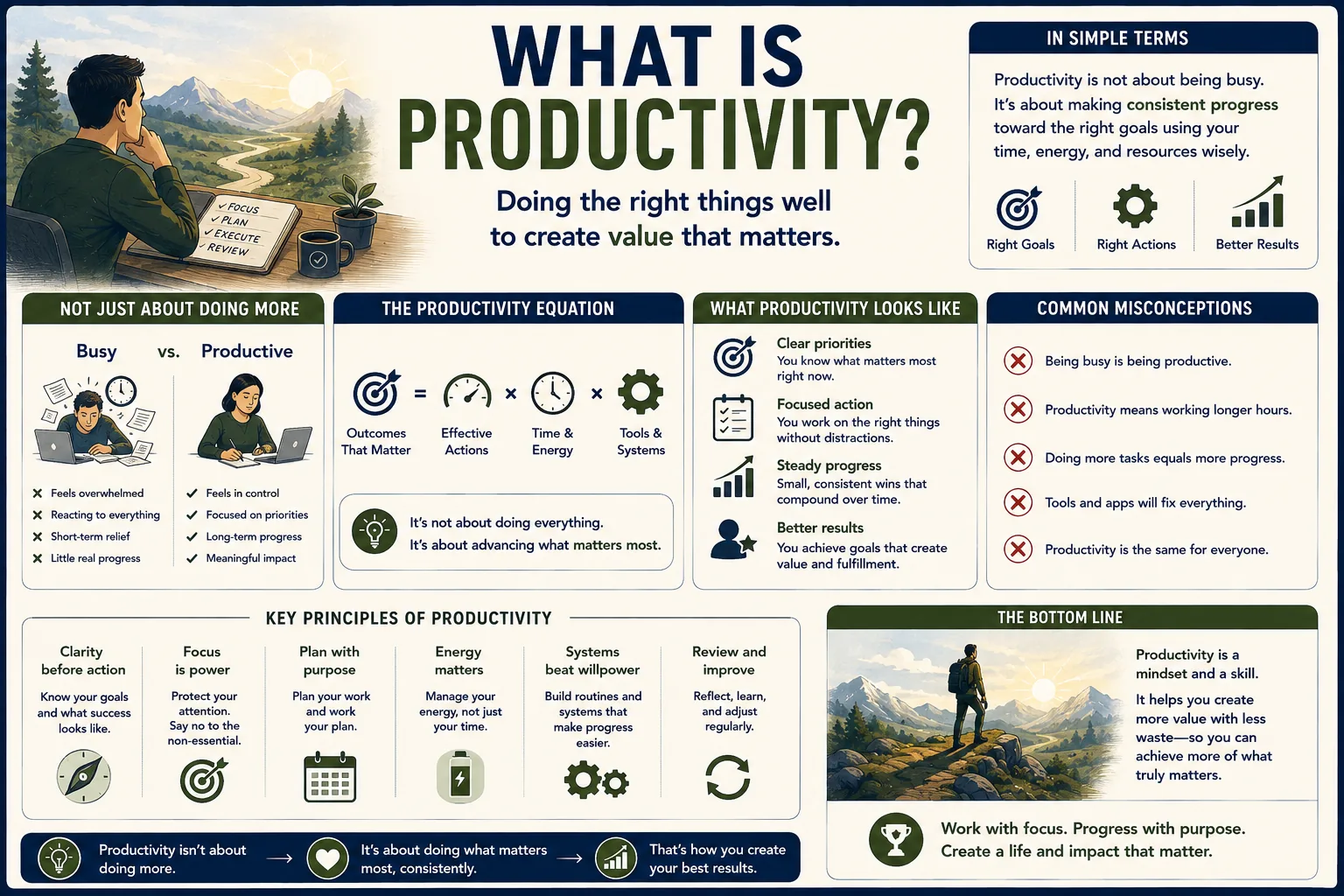
Productivity is one of the most talked about topics in professional life and one of the least clearly defined. It is routinely conflated with busyness, efficiency, and output volume - concepts that describe activity without addressing whether the activity is valuable.
For knowledge workers in particular, the conventional vocabulary of productivity largely does not apply.
This article examines what productivity actually means, why the knowledge work context requires a fundamentally different framework, and what research genuinely supports as effective.
Defining Productivity
The economic definition of productivity is precise: output divided by input. A factory that produces 1,000 units per hour with 10 workers has a labor productivity of 100 units per worker-hour. This definition is measurable, comparable, and improvable through process engineering.
The challenge is that this definition works cleanly only when output can be counted in comparable units. Knowledge work - work that involves applying information, judgment, and expertise to create value - produces outputs that are qualitatively different from each other and whose value is often not apparent at the time of production.
A software engineer who writes 500 lines of code in a day is not necessarily more productive than one who writes 100 lines. A consultant who produces three reports is not necessarily more productive than one who produces one, if the single report is transformative and the three are mediocre.
An executive who attends eight meetings is not more productive than one who attends three, if the three generate better decisions.
"The most important question to ask on the job is not 'How am I doing?' but rather 'What needs to be done?'" - Peter Drucker, The Effective Executive (1966)
Peter Drucker, who coined the term "knowledge worker" in his 1959 work Landmarks of Tomorrow, argued that the central challenge of knowledge worker productivity was defining the right task - not executing tasks efficiently.
In his framework, effectiveness (doing the right things) precedes efficiency (doing things right), because efficient execution of the wrong work is a sophisticated form of waste.
Drucker observed in The Effective Executive that the knowledge worker's most important tool is not a production method but a decision about contribution: "What am I here to contribute?
What results can I, and should I, achieve to make a real difference?" This question is structurally different from the question industrial management asks ("How can this task be done more efficiently?"), and the answers require different forms of management and self-management.
The Scale of the Productivity Challenge
Before examining what drives knowledge worker productivity, it is worth understanding the scale of the problem - and how large the gap is between current and potential performance.
A 2022 McKinsey Global Institute report on the future of work found that knowledge workers spend only 39% of their time on work they were specifically hired to do. The rest is consumed by email, meetings, searching for information, and coordination overhead.
A companion study on "superstar firms" found that the most productive knowledge workers are roughly eight times more productive than average workers in their categories - a productivity distribution that has no equivalent in industrial work.
Research by Bassi and McMurrer (2007) on human capital investment found that improvements in knowledge worker productivity are systematically underprioritized compared to physical capital investments, even though knowledge worker output represents the largest and fastest-growing share of developed-economy GDP.
The failure to invest in knowledge worker productivity is, in aggregate, one of the largest sources of economic waste in modern economies.
The Factory Model's Failure in Knowledge Work
The dominant productivity frameworks in use today were developed for industrial-era work. Frederick Winslow Taylor's scientific management (developed circa 1900) optimized physical labor through time-and-motion studies, breaking work into standardized components and measuring each.
This approach generated enormous productivity gains in manufacturing.
When applied to knowledge work, Taylorist productivity thinking produces:
- Time tracking that measures presence rather than output
- Meeting schedules that prioritize visibility over thinking time
- Performance metrics that count outputs (emails sent, reports filed, calls made) rather than value created
- Work environments optimized for communication rather than concentration
The result is what Cal Newport has called the "busyness trap" - workers who are continuously active, continuously connected, and genuinely busy, but producing far less value than their hours and effort would suggest possible.
A 2020 study by Microsoft analyzing workplace behavior data found that remote work during the pandemic increased the volume of communications (more meetings, more messages) while reducing focused work time - the inverse of what most workers needed to perform well.
Workers sending and receiving more messages reported lower self-assessed productivity, not higher - a direct contradiction of the industrial intuition that more activity equals more output.
The British economist Charles Goodhart articulated what became known as Goodhart's Law: "When a measure becomes a target, it ceases to be a good measure." In productivity contexts, this means that organizations which measure and reward visible activity (meetings attended, emails answered, hours at desk) reliably produce workers who optimize for those measures - often at the direct expense of the deeper work that creates actual value.
Deep Work vs. Shallow Work
In his 2016 book Deep Work: Rules for Focused Success in a Distracted World, computer science professor Cal Newport introduced a distinction that has become central to knowledge worker productivity discussions.
Deep work is professional activity performed in a state of distraction-free concentration that pushes cognitive capacity to its limit. It creates new value, improves skills, and produces outputs that are difficult to replicate.
Examples: writing original analysis, solving a complex engineering problem, developing a new strategy, composing music.
Shallow work is non-cognitively demanding, logistical, or communicative work that can be performed while distracted and whose outputs are relatively low-value and easily replaceable. Examples: responding to routine emails, attending update meetings, filling out administrative forms, scheduling.
The problem Newport identifies is not that shallow work is unnecessary - it is often genuinely necessary - but that it has colonized most people's working days, leaving little or no time for deep work. And yet deep work is where most genuine value is created.
Newport argues that the ability to perform deep work is becoming simultaneously more valuable (as cognitive complexity of work increases) and rarer (as digital distraction increases). This convergence makes it, in his terms, "the superpower of the 21st century economy."
The Cost of Interruptions
The cost of fragmented attention is quantified by research. Gloria Mark and colleagues at UC Irvine found that after an interruption, it takes an average of 23 minutes to fully return to a complex task.
Given that most knowledge workers are interrupted every three to five minutes in typical office environments, full cognitive recovery may essentially never occur during a normal workday.
A study by Microsoft Research found that workers who were frequently interrupted showed elevated cortisol levels - a marker of stress - and produced lower-quality work on cognitively demanding tasks compared to uninterrupted periods.
The same study found that workers in open-plan offices - widely adopted in the 2000s and 2010s on the logic of facilitating collaboration - showed significantly higher rates of interruption and significantly lower rates of sustained focus than workers with private offices (Kim and de Dear, 2013).
The implication for productivity is significant: the quality of your attention during working hours matters more than the quantity of hours. A worker with four hours of genuine, uninterrupted deep work produces more than one with eight hours of continuously fragmented attention.
| Work Type | Cognitive Demand | Value Created | Replaceability | Interruptibility |
|---|---|---|---|---|
| Deep work | High | High | Low | Very low |
| Focused project work | Medium-High | Medium-High | Medium | Low |
| Collaborative problem-solving | Medium | Variable | Medium | Medium |
| Meetings and coordination | Low-Medium | Low-Medium | High | High |
| Administrative / communication | Low | Low-Medium | High | Very high |
Flow State: The Optimal Experience of Productivity
The deepest version of focused, high-quality work is what Hungarian-American psychologist Mihaly Csikszentmihalyi described as flow - a mental state of complete absorption in a challenging activity.
In his 1990 book Flow: The Psychology of Optimal Experience, Csikszentmihalyi described flow as emerging when:
- The activity has clear goals
- Immediate feedback allows continuous adjustment
- The challenge level is matched to skill level - neither too easy (boredom) nor too hard (anxiety)
- Attention is fully absorbed - self-consciousness disappears
Csikszentmihalyi's research spanned decades and cultures, using the experience sampling method (ESM) to capture real-time reports from thousands of participants.
His data showed that flow occurred most frequently not during leisure but during skilled work that was appropriately challenging - a finding that challenged the assumption that happiness lies in relaxation.
In flow, people report:
- Intrinsic motivation without effort
- Loss of awareness of time
- High performance without feeling like high effort
- Satisfaction that is intrinsic, not dependent on external reward
Research by McKinsey Global Institute found that senior executives reported being five times more productive during flow states than during normal working states.
Steven Kotler and colleagues at the Flow Research Collective have extended this research, finding consistent performance improvements across creative, analytical, and physical domains during flow.
Kotler (2014) estimated, based on flow research data, that a 20% increase in time spent in flow would represent a doubling of productivity for most knowledge workers.
The Conditions for Flow
Flow cannot be commanded. But its conditions can be cultivated:
- Eliminate interruptions during periods designated for deep work
- Match task difficulty to current skill level - tasks that are slightly above current ability (what Csikszentmihalyi called the "challenge-skill balance") are more likely to trigger flow than tasks that are trivially easy or impossibly hard
- Set clear, specific goals for a work session - open-ended goals fragment attention because the brain cannot organize effort without a target
- Use ritual to signal transition into deep work - consistent pre-work rituals (specific music, location, preparation steps) appear to help prime the neurological state. Newport calls these "depth rituals."
- Allow adequate warm-up time - flow typically takes 15 to 20 minutes to enter and is easily disrupted in its early stages
Nakamura and Csikszentmihalyi (2002) documented that the subjective value of flow experiences motivates workers to seek out and create the conditions for its recurrence - making flow self-reinforcing over time. Workers who experience flow regularly become better at creating its conditions.
Energy Management vs. Time Management
The dominant metaphor in productivity advice is time. We "manage" time, "protect" it, "waste" it, "invest" it. But time, as researchers Jim Loehr and Tony Schwartz pointed out in The Power of Full Engagement (2003), is a fixed resource - you cannot create more of it.
Energy, however, is renewable and expandable.
Loehr and Schwartz, working initially with professional athletes before extending their research to executives and knowledge workers, identified four dimensions of energy that affect cognitive performance:
| Energy Dimension | Basis | What Depletes It | What Renews It |
|---|---|---|---|
| Physical | Nutrition, sleep, exercise, recovery | Sleep deprivation, sedentary behavior, poor nutrition | Sleep, exercise, movement, healthy diet |
| Emotional | Self-regulation, social connection | Conflict, negative rumination, isolation | Positive relationships, gratitude, autonomy |
| Mental | Focus, attention, cognitive capacity | Multitasking, decision fatigue, chronic distraction | Focused work, mental challenges, rest |
| Purpose | Meaning, values alignment | Disengagement, values conflict, lack of contribution | Meaningful work, clarity of purpose |
The argument is not that time management is irrelevant - it is that managing a calendar full of well-scheduled tasks still produces poor results if the person doing the work is exhausted, emotionally depleted, or operating in a state of chronic distraction.
This framework aligns with research by Kimberly Elsbach and Andrew Hargadon (2006) on the value of "mindless work" - routine, low-demand tasks - as a cognitive recovery mechanism.
Their research found that brief periods of mindless work embedded in knowledge worker schedules provided genuine recovery that improved subsequent performance on demanding tasks. This challenges pure "maximize deep work" prescriptions and suggests a more nuanced view of workday rhythm.
The Sleep Variable
Of all the factors that affect knowledge worker productivity, sleep is the most strongly evidenced and most routinely underestimated.
Research by Matthew Walker (Why We Sleep, 2017) synthesizing decades of neuroscience research establishes that:
- Sleeping less than 7 hours per night produces cognitive performance deficits equivalent to multiple days of total sleep deprivation
- Decision-making quality, emotional regulation, memory consolidation, and creative problem-solving all degrade significantly under sleep restriction
- People with chronic sleep deprivation consistently underestimate their own impairment - they believe they are performing normally when they are not (Van Dongen et al., 2003)
A 2016 study by RAND Europe found that sleep deprivation costs the US economy approximately $411 billion per year (about 2.28% of GDP) in lost productivity.
The calculation is based on the frequency of short sleepers in the US workforce (currently about 35%), the documented performance degradation associated with insufficient sleep, and the economic value of that degraded output.
The productivity implication: protecting sleep is a performance decision, not a lifestyle preference. Leaders who model sleep deprivation as a badge of dedication are, by the research, modeling cognitive impairment.
Time of Day and Cognitive Performance
Research by chronobiologist Till Roenneberg, psychologist Marily Oppezzo, and others shows that cognitive performance is not uniform across the day. Most people follow a predictable arc:
- Morning (peak): Analytical reasoning, focused concentration, decision-making. The prefrontal cortex is most active after waking from adequate sleep, cortisol is naturally elevated as part of the healthy morning response, and working memory capacity is at its daily high.
- Mid-afternoon (trough): Lowest alertness and cognitive performance - the period most suited to routine, non-demanding tasks. Research by Saper et al. (2005) identifies this as part of the natural circadian sleep-wake cycle, not simply post-lunch sleepiness.
- Late afternoon/early evening (recovery): Rebounds for creative, associative thinking. Inhibitory control slightly relaxes, and research by Harrison and Horne (1999) found this period favorable for insight problems.
This has practical implications for scheduling. Demanding analytical work (complex writing, strategic planning, data analysis, critical code reviews) belongs in peak energy periods. Administrative and shallow work belongs in the trough. Creative brainstorming and generative thinking may benefit from recovery periods.
Night owls (chronotypes with later natural sleep-wake cycles) show the same pattern shifted several hours later. Research by Roenneberg et al. (2007) found that chronotype is normally distributed in the population, with a substantial share having a chronotype later than the conventional 9-to-5 workday assumes.
Forcing chronotype-incompatible schedules reduces performance by an estimated 15-20% in late chronotypes working early shifts (Facer-Childs and Brandstaetter, 2015) - a substantial and avoidable cost.
"Timing is not just a quirk of performance - it is a biological imperative. We are not built to be equally capable at all hours, and pretending otherwise is not dedication; it is biology-denial." - Daniel H. Pink, When: The Scientific Secrets of Perfect Timing (2018)
The Multitasking Myth
One of the most consistently replicated findings in attention research is that multitasking does not work - at least not for complex cognitive tasks.
Research by Rubinstein, Meyer, and Evans (2001) established that what people experience as multitasking is in fact rapid task-switching, and that each switch incurs a cognitive "switch cost" - a period of reduced performance during which the brain reorients to the new task.
For complex tasks, these costs are significant: their studies found performance degradation of 20-40% on complex cognitive tasks when multitasking versus focused single-tasking.
Watson and Strayer (2010) conducted a study on what they called "supertaskers" - people who can genuinely perform multiple demanding tasks simultaneously. They found that approximately 2.5% of the population shows negligible multitasking costs on their specific test battery.
The other 97.5% - including many people who describe themselves as good multitaskers - show substantial degradation. Self-reported multitasking ability correlates negatively with actual multitasking performance: people who think they are best at it are often the worst.
The implication for workplace design is significant. Open offices that expose workers to constant auditory and visual interruption, and meeting-heavy cultures that continuously fragment attention, are not neutral environments for knowledge work - they are actively hostile to the kind of focused thinking that generates the most value.
Measuring Knowledge Worker Productivity
One of the fundamental challenges of knowledge work is that output is hard to measure. This creates two failure modes:
Measurement of the wrong thing: Counting emails answered, meetings attended, lines of code written, or hours logged measures activity rather than value. Organizations that measure these proxies incentivize exactly the behaviors that reduce genuine productivity. This is Goodhart's Law in operation.
No measurement at all: Organizations that abandon metrics entirely lose the ability to identify underperformance, recognize high performance, or improve systematically. The result is that pay and advancement become disconnected from contribution, which has well-documented negative effects on motivation.
The most defensible approach combines:
- Outcome measures: Did the project ship? Did the client outcome improve? Did the analysis change the decision?
- Quality assessments: Was the work accurate? Was it useful? Did it generate value?
- Lag indicators: Revenue, customer satisfaction, and other downstream outcomes that reflect the accumulated quality of knowledge work over time
Individual knowledge workers can apply the same logic. Rather than tracking tasks completed, tracking outcomes produced - decisions made better, products shipped, problems solved, skills developed - provides a more honest accounting of actual productivity.
Newport (2016) proposes a useful individual metric: the number of hours per week spent in deep, uninterrupted work. For most knowledge workers, this number is surprisingly low - often under 4 hours per week. Tracking it makes visible the gap between time at work and time producing high-quality output.
Habits, Systems, and the Productivity Infrastructure
Individual productivity techniques are most effective when embedded in systems - habitual workflows and environmental arrangements that reduce the decision cost of every productive action.
Research on habit formation by Wendy Wood (2019) in Good Habits, Bad Habits established that approximately 43% of daily behavior is habitual - performed in the same context, triggered by consistent cues, without deliberate decision-making.
Productivity habits that become automatic (closing email before deep work, weekly review on Friday afternoon, morning planning before checking messages) conserve decision-making capacity for higher-value choices.
James Clear's Atomic Habits (2018), drawing on this and related research, argues that small habit changes compounded over time produce disproportionate results - a claim consistent with behavioral science research on the compounding effects of small behavioral differences over extended periods.
The key mechanism is what Clear calls "identity-based habits": habits that are tied to a self-concept ("I am someone who protects my deep work time") are more stable than those tied to outcomes ("I want to be more productive").
David Allen's Getting Things Done (GTD) system, developed in Getting Things Done (2001), takes a different approach - not habit formation but systematic "mind like water": a state where all commitments are captured externally (not held in working memory), contexts are organized, and nothing falls through cracks.
Allen's key insight is that the cognitive burden of remembering what needs to be done competes with the cognitive resources needed to do what needs to be done. An external system that reliably holds commitments frees attention for execution.
Both approaches - habit-based systems and capture-based systems - have empirical support and a large body of practitioner evidence. They are complementary: habits reduce friction for routine decisions; capture systems reduce cognitive load from open commitments.
Technology's Role: Tool or Trap?
The relationship between digital technology and knowledge worker productivity is complex and often counterintuitive.
Research by Pew Research (2014) found that 46% of employed internet users said the internet, email and cell phones had made them more productive.
The same workers, when analyzed behaviorally, showed significant time spent on communication overhead, interruption recovery, and low-value administrative tasks that the same tools had created. The subjective and objective pictures diverged substantially.
The specific technology most implicated in productivity loss is email. A McKinsey (2012) analysis found that the average knowledge worker spends 28% of their working week reading and answering email - a figure that has likely increased since that study.
Research by Kostadin Kushlev found that workers who processed email continuously reported higher stress and lower task performance than those who batched email three times daily - with no measurable reduction in email effectiveness.
This does not mean technology reduces productivity overall. Research by Brynjolfsson and McAfee (2014) in The Second Machine Age documented the enormous productivity gains enabled by information technology across the economy. The issue is that communication technologies produce friction when overused as attention-capture devices.
The productive use of email is as a communication tool checked and processed at defined intervals; the unproductive use is as a real-time notification system that fragments attention throughout the day.
What Actually Works: Evidence Summary
The strongest evidence for improving knowledge worker productivity converges on a short list:
Protect focused time. Schedule uninterrupted blocks of at least 90 minutes for cognitively demanding work. Remove notifications and interruptions during these blocks. Research on "ultradian rhythms" by Peretz Lavie (1982) suggests that 90-minute focus blocks align with natural cognitive cycles.
Align task types with energy levels. Do the hardest cognitive work during peak energy periods; batch administrative work into low-energy periods.
Prioritize sleep. Seven to nine hours is not a luxury for exceptional performers - it is a physical requirement for cognitive function.
Single-task on complex work. Research on multitasking consistently shows performance degradation of 20 to 40 percent on complex tasks compared to focused single-tasking.
Build in recovery. Short breaks (10 to 15 minutes) between intensive work periods improve sustained output. The Pomodoro technique (25-minute work blocks with 5-minute breaks) reflects this principle, though the optimal ratio varies by individual and task type.
Ericsson, Krampe, and Tesch-Romer's (1993) research on deliberate practice in expertise development found that four hours of genuinely focused, deliberate practice per day was near the maximum sustainable level for most expert performers.
Clarify objectives before working. The single most common productivity failure in knowledge work is beginning a task without a clear output goal. Thirty seconds of clarification ("What specifically will I produce in this session?") prevents hours of unfocused effort.
Reduce decision overhead. Standardize routines for recurring decisions (when to check email, how to start a workday, how to plan a week) to conserve decision capacity for higher-value choices.
The Deeper Principle
The most fundamental insight from research on knowledge worker productivity is that the quality of attention determines the quality of output - not the quantity of hours, not the number of tools used, not the sophistication of the organizational system.
In a world that is systematically optimized to fragment attention (social media, notifications, open offices, meeting culture), the ability to direct sustained focused attention toward demanding work is increasingly rare - and therefore increasingly valuable.
Productivity, at its core, is not about doing more. It is about producing more of what matters, from the available resources of time, energy, and attention that you have. The implication is as simple as it is difficult: defend your attention with the same seriousness that you defend your time.