
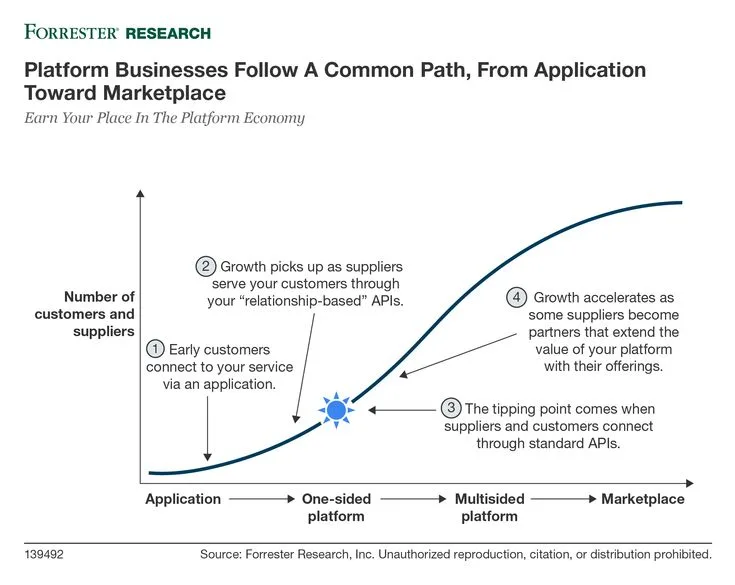
What is platform economics? It studies markets where an intermediary connects distinct groups whose participation creates value for one another. Pricing is often asymmetric because a platform may subsidize the side that generates more cross-side value or is more price-sensitive. Network effects, rules, trust mechanisms, and control of terms distinguish these markets from ordinary linear retail businesses.
Platform economics is the study of markets where an intermediary creates value by connecting two or more distinct groups who need each other, and where the pricing structure on each side is deliberately designed to maximize overall system participation.
When you use a credit card, you are participating in one of the oldest and most instructive examples: the card network connects you to millions of merchants and connects those merchants to you. The network charges merchants a fee for every transaction.
It pays you cash back - essentially a negative price - for using the card. Two groups, two completely different price structures, one platform.
This asymmetric pricing - charging one side to subsidize the other - would be irrational in a traditional one-sided market. In a platform market, it is the optimal strategy, and understanding why is the key to understanding businesses from Uber to the App Store, from Airbnb to Google Search.
Platform businesses now account for seven of the ten most valuable companies in the world by market capitalization (as of early 2025), and their economic logic differs fundamentally from the businesses that MBA programs traditionally teach.
"In a two-sided market, a platform's competitive weapon is not the level of price charged but rather the structure of prices - which side to charge more and which to subsidize."
- Jean Tirole, Nobel Lecture, 2014
The Theoretical Foundations: Rochet and Tirole
The formal economic analysis of two-sided markets was developed by Jean Tirole and Jean-Charles Rochet in a series of papers beginning in 2000, with the foundational paper "Platform Competition in Two-Sided Markets" published in the Journal of the European Economic Association in 2003.
Tirole later won the Nobel Memorial Prize in Economic Sciences in 2014, with two-sided market theory among his cited contributions.
Rochet and Tirole's key insight was that the pricing structure - not just the total price level - matters in two-sided markets.
In a traditional one-sided market, if you need to raise revenue by $1, it does not fundamentally matter whether you raise it from buyers or sellers (in a competitive market, the tax incidence shifts regardless).
In a two-sided market, it matters enormously. Charging one side more subsidizes the other, changes participation levels on both sides, and alters the cross-side value the platform generates.
Their analysis showed that the optimal pricing structure depends on four factors:
- The price sensitivity of each side: The more price-sensitive side should pay less.
- How much value each side's participation creates for the other side: The side whose participation generates more cross-side value should be subsidized.
- The intensity of competition on each side separately: If one side has many alternatives, pricing must be more competitive on that side.
- The costs of providing the platform to each side: Sometimes one side is genuinely more expensive to serve.
This framework explains pricing decisions that seem irrational from a conventional business perspective - like giving away software to consumers while charging developers, subsidizing rider acquisition at a loss for years, or charging merchants fees that appear above competitive market rates.
These are not market failures or predatory practices; they are rational responses to the economics of two-sided markets.
Before Rochet and Tirole, Geoffrey Parker and Marshall Van Alstyne (2000, 2005) independently developed models of information goods platforms, showing how platforms that manage two-sided network externalities can generate value impossible in traditional linear businesses.
Their later book, Platform Revolution (Parker, Van Alstyne, and Choudary, 2016), became the standard business reference on platform strategy.
What Makes a Market Two-Sided
A market qualifies as two-sided when four conditions hold simultaneously:
Two distinct user groups. The platform serves populations with meaningfully different needs, roles, or identities. Riders and drivers. Buyers and sellers. Advertisers and readers. Users and developers.
The groups must be genuinely distinct - if the same people play both roles interchangeably (as on some social networks), the two-sided dynamics are weaker.
Cross-side network effects. The value to users on one side depends on how many users are on the other side. More drivers means shorter rider wait times. More buyers on eBay means sellers can find a market for almost anything. More users of Windows means developers have a larger market for software built on Windows.
A platform intermediary. Some entity organizes and facilitates interactions between the two sides. The platform may set rules, manage payments, establish trust mechanisms, curate quality, and create the infrastructure for exchange.
Ability to set prices on both sides. The platform has sufficient market position to set the prices or terms for both user groups rather than simply passing through competitive pricing.
Not all markets that connect two groups are two-sided in the technical sense. A simple retailer buys from suppliers and sells to customers, but the cross-side network effects are absent or weak - a customer does not directly benefit from the retailer having more suppliers in a way that changes their willingness to pay.
A true two-sided market requires that participation by each group directly enhances the value proposition for the other.
Network Effects: The Engine of Platform Value
Network effects are the general phenomenon whereby a product or service becomes more valuable as more people use it. They are central to platform economics and come in two distinct types with different strategic implications.
Same-Side Network Effects
Same-side network effects occur within one user group. Telephone networks exhibit the classic example: every additional subscriber makes the network more valuable to all other subscribers because there are more people to call.
Metcalfe's Law - the idea that a network's value grows roughly proportional to the square of its users - describes this phenomenon, though empirical research by Andrew Odlyzko and Benjamin Tilly (2005) suggests the actual growth rate is somewhat slower than n-squared for most networks.
Social media platforms exhibit strong same-side effects on their core user side: Facebook is valuable because your friends are there, and each additional friend who joins makes it more valuable to you. Messaging apps like WhatsApp exhibit almost pure same-side effects.
Cross-Side Network Effects
Cross-side network effects occur between user groups. More Airbnb hosts means more accommodation options for guests; more guests means more revenue opportunity for hosts. These cross-side effects are the defining feature of two-sided markets and the primary source of competitive moat for platform businesses.
| Platform | Side 1 | Side 2 | Cross-Side Effect | Key Asymmetry |
|---|---|---|---|---|
| Uber/Lyft | Riders | Drivers | More drivers = shorter waits; more riders = higher utilization | Riders more price-sensitive |
| Apple App Store | Users | Developers | More users = larger dev market; more apps = more useful device | Developers pay (30% commission) |
| Visa/Mastercard | Cardholders | Merchants | More cardholders = higher acceptance; more merchants = more utility | Merchants pay interchange fees |
| Google Search | Users | Advertisers | More users = more valuable ads; ad revenue funds better search | Users pay nothing; advertisers pay per click |
| Airbnb | Guests | Hosts | More hosts = more options; more guests = more host revenue | Guests pay service fees; hosts pay lower fees |
| Amazon Marketplace | Buyers | Third-party sellers | More buyers = larger seller audience; more sellers = more selection | Sellers pay commission (8-15%) |
The strength and asymmetry of cross-side effects shape the platform's optimal strategy.
If having more riders creates much more value for drivers than having more drivers creates for riders, the platform should invest disproportionately in rider acquisition - even at a loss - because rider growth is the bottleneck for total system value.
Negative Network Effects
Not all network effects are positive. Negative same-side effects occur when additional users on one side reduce the value for existing users on the same side. More sellers on Amazon Marketplace increases competition and drives down margins for existing sellers.
More drivers on Uber during off-peak hours means each driver gets fewer rides. Platforms must manage these negative effects to prevent one side from becoming oversaturated and defecting.
The Chicken-and-Egg Problem
Every two-sided platform faces the same founding challenge: why would users on either side join a platform that does not yet have users on the other side?
Riders will not use a rideshare app with no drivers. Drivers will not sign up to a platform with no riders. Merchants will not accept a credit card no one carries. Cardholders will not get a card no merchant accepts.
This is the chicken-and-egg problem, and how platforms solve it largely determines whether they survive their launch phase. Research by David Evans (2003) found that this problem is the single most common cause of platform startup failure.
Common Solutions
Subsidizing one side first. Most platforms subsidize the supply side at launch - the side that can provide value to early adopters even without scale. OpenTable, the restaurant reservation platform, built a comprehensive CRM and management system for restaurants before building consumer demand.
Restaurants adopted it for the operational tool before the consumer network existed - solving the chicken-and-egg problem by making one side's product valuable independently of the other.
Targeting a single vertical or geography first. Rather than launching nationally, platforms with strong local network effects (rideshare, food delivery, neighborhood social networks) saturate a small geography to build local density before expanding.
Uber launched in San Francisco with black car service. Facebook launched at Harvard, then expanded university by university. Craigslist started in San Francisco. This strategy works because network effects are often local - a driver surplus in Austin does not help a rider in Boston.
Creating standalone value for one side. Some platforms create a tool or service with standalone utility for one side, eliminating the need for the other side to exist first. Adobe made PDF readers free, creating a reader installed base before there were significant publisher economic incentives.
Amazon Web Services started as internal infrastructure, then was opened to outside developers - the massive compute infrastructure had standalone value before the external developer ecosystem existed.
Marquee strategy. Platforms can attract a small number of high-profile participants on one side whose presence alone attracts the other side. Video game consoles use this extensively: securing exclusive launch titles from major game studios (the marquee) attracts consumers, which then attracts other developers.
Sony's exclusive deal with Square for Final Fantasy VII on the original PlayStation was one of the most consequential marquee moves in platform history.
Seeding supply artificially. In some cases, a platform can bootstrap by creating its own initial supply. Reddit's founders famously created fake user accounts and submitted content themselves for months until organic participation reached a self-sustaining threshold.
DoorDash initially placed restaurant menus on its platform without formal partnerships, using a phone-ordering workaround to fulfill early orders.
Winner-Take-Most Dynamics
Platform markets tend toward concentration because network effects compound advantages at scale. A platform with twice as many drivers as its competitor does not merely offer twice the service - it may offer four times the utility if coverage density and wait times improve exponentially with driver density.
This positive feedback loop creates winner-take-most dynamics: the leading platform captures a disproportionate share of value, sometimes approaching monopoly.
Operating systems (Windows held over 90% desktop share for two decades), social networks (Facebook in most geographies), professional networking (LinkedIn), search engines (Google holds approximately 90% of global search, per StatCounter 2024), and app stores (iOS and Android together hold approximately 99%) are all examples of markets where one or two players dominate.
However, winner-take-all outcomes are not inevitable. Several factors limit platform dominance:
Multi-homing. If users can participate in multiple competing platforms simultaneously at low cost, no single platform captures all the value. Most Uber drivers also drive for Lyft. Many merchants accept both Visa and Mastercard. Consumers install both DoorDash and Uber Eats.
Research by Thomas Eisenmann, Geoffrey Parker, and Marshall Van Alstyne (2006) showed that multi-homing is the most important structural factor preventing platform monopoly. When multi-homing costs are near zero, winner-take-all dynamics are significantly weakened.
Niche differentiation. Specialized platforms can carve defensible positions by serving specific user groups better than the dominant platform. Etsy competes with Amazon Marketplace by serving artisan sellers and buyers who value handmade goods.
VRBO competes with Airbnb by focusing on whole-home rentals for families. Stack Overflow serves a developer Q&A niche that no general-purpose platform has replicated effectively.
Regulatory intervention. Platform dominance increasingly invites antitrust scrutiny.
The EU's Digital Markets Act (2022), the UK's Digital Markets, Competition and Consumers Act (2024), and US antitrust investigations of Apple, Google, Amazon, and Meta all represent attempts to limit the rent extraction phase of platform lifecycles and ensure competition remains possible.
Platform envelopment. Large incumbent platforms are vulnerable to being enveloped by platforms that combine their functionality with adjacent services. WeChat in China enveloped messaging, payments, mini-programs, and social media into a single super-app that displaced multiple standalone platforms.
TikTok's algorithmic discovery feed disrupted platforms organized around social graphs by making content quality, not social connections, the primary distribution mechanism.
Pricing Strategy in Two-Sided Markets
The pricing logic of two-sided markets often looks strange or anti-competitive from a conventional perspective, but follows clear economic logic grounded in Rochet and Tirole's framework.
The Money Side and the Subsidy Side
Most platforms have a money side (the side that pays) and a subsidy side (the side that is subsidized or receives service for free or below cost). This asymmetry is rational when:
- One side is much more price-sensitive than the other
- One side's participation creates substantially more value for the other side
- One side is harder to attract and retain
Newspapers charge advertisers and sell to readers at below-cost prices (or give content away free online). Dating apps often charge men and subsidize women. Consoles like PlayStation price hardware below manufacturing cost and charge game developers licensing fees (the "razor and blades" model applied to platforms).
Credit card networks charge merchants 2-3% interchange fees and reward cardholders with cash back. In each case, the subsidized side is the one whose participation creates the most value for the other side or is harder to attract.
Platform Rent Extraction and the Lifecycle Problem
As platforms gain market power, they face the temptation to increase prices on both sides - extracting more value from the participants they have already attracted.
This is the rent extraction problem, and it typically follows a predictable lifecycle that the technology journalist Cory Doctorow (2023) has termed "enshittification":
- Platform subsidizes participation on both sides to build scale and reach critical mass.
- Network effects create lock-in - switching costs rise as the platform becomes indispensable. Users have invested in profiles, reviews, connections, and content that do not transfer.
- Platform gradually increases prices or reduces service quality, capturing more of the value generated by the network.
- Participants stay because the network is more valuable than alternatives, even at higher prices - up to a point.
- Eventually, extraction reaches a tipping point where users begin to defect, creating an opening for competitors.
Apple's App Store commission structure (30% of revenue for most transactions, reduced to 15% for small developers after regulatory pressure) is the most visible contemporary example. Developers argue the fee is extractive; Apple argues it reflects the value of access to the iOS user base.
Epic Games' lawsuit against Apple (2021) brought this tension into public view, with the court ruling that Apple's practices were not monopolistic under current antitrust law but ordering Apple to allow alternative payment links - a partial victory that illustrates how rent extraction is increasingly subject to legal challenge.
Amazon's treatment of Marketplace sellers illustrates a different dimension. Research by the Institute for Local Self-Reliance (2023) estimated that Amazon collects an average of 50% of third-party seller revenue through fees for referrals, fulfillment, advertising, and other services - up from approximately 27% in 2014.
Sellers remain because Amazon controls access to over 300 million active customer accounts. This is rent extraction enabled by platform dependency, and it is the mechanism that makes platform economics politically consequential.
The Uber-Lyft Case Study: Platform Theory Meets Reality
The US rideshare market is a natural experiment in platform competition that illustrates - and complicates - several theoretical predictions.
Subsidy competition. Both companies subsidized riders and drivers heavily from 2014 to 2019, spending billions in venture capital to acquire users. Uber's S-1 filing before its 2019 IPO disclosed cumulative losses exceeding $8 billion.
The implicit bet was that whoever achieved sufficient scale first would generate the dominant position needed to subsequently raise prices and become profitable.
Multi-homing limits moat. Drivers routinely run both apps simultaneously, picking rides from whichever platform offers better economics at any moment. Riders install both apps and compare prices.
This multi-homing has prevented either platform from achieving the dominant position that, in a single-homing world, strong cross-side network effects would have produced.
Uber holds approximately 68% of US rideshare market share (Second Measure, 2024), a strong position but far from the 90%+ dominance that theory would predict in a market without multi-homing.
Geographic fragmentation. Rideshare network effects are local - a driver surplus in one city does not help a rider in another. This geographic fragmentation allowed Lyft to maintain meaningful market share even as Uber grew, because scale in one city does not transfer.
Profitability and the long road to margins. Having not achieved the dominant winner-take-all positions their early investors hoped for, both companies raised prices on riders and reduced incentive payments to drivers, pursuing profitability.
Uber reported its first full-year operating profit in 2023, nearly fifteen years after founding. Lyft followed in 2024. The multi-homing capability of drivers and riders limits how far prices can rise before users defect or reduce usage - a structural constraint that theory predicted but investors initially underweighted.
When Platforms Fail
Platforms fail in distinctive ways that differ from traditional business failures:
Failure to solve the chicken-and-egg problem. The graveyard of failed marketplace startups - Homejoy, Washio, and countless others - is littered with platforms that could attract one side adequately but never achieved the critical mass on the other side needed for self-sustaining growth.
Governance failures. Platforms depend on trust from both sides. When platforms are perceived to systematically favor one side, or when they fail to enforce their own rules, trust collapses rapidly.
Facebook's handling of user data (the Cambridge Analytica scandal, 2018), Amazon's competition with its own Marketplace sellers (documented by the Wall Street Journal, 2020), and Airbnb's struggles with property damage and neighbor disputes have all been governance crises that threatened platform viability.
Technological disruption. Incumbent platforms can be disrupted when a new platform with fundamentally different technology changes the value proposition. Instagram disrupted Flickr not by being a better photo-sharing platform but by being a mobile-first platform when Flickr was desktop-first.
TikTok disrupted platforms organized around social graphs by making algorithmic content discovery - not who you follow - the primary distribution mechanism. The disrupting platform does not need to be better at the same game; it needs to change which game matters.
Regulatory dismantling. The EU's Digital Markets Act designates platforms with over 45 million monthly active users and EUR 7.5 billion in market capitalization as "gatekeepers" subject to obligations including data portability, interoperability requirements, and prohibitions on self-preferencing.
This represents the most comprehensive attempt to regulate platform economics legislatively, and its enforcement (beginning in 2024) may fundamentally alter the dynamics of platform power in Europe.
Platform Economics Beyond Technology
While tech platforms dominate current discussion, the economic principles apply to any market structure with the four defining characteristics. Shopping malls are platforms connecting retailers and shoppers. Newspapers are platforms connecting readers and advertisers.
Academic journals are platforms connecting researchers (as authors) and researchers (as readers). Job fairs are platforms connecting employers and candidates.
Understanding platform economics is increasingly important for anyone analyzing technology businesses, developing competitive strategy, thinking about the governance of digital markets, or evaluating the power dynamics of markets they participate in daily.
The pricing structures that seem arbitrary or exploitative often follow clear economic logic - and recognizing that logic is the first step to navigating it effectively, whether as a user, a participant, a regulator, or a builder.
Sources & Further Reading
- Rochet, J.C. & Tirole, J. "Platform Competition in Two-Sided Markets." Journal of the European Economic Association, 1(4), 990-1029, 2003.
- Tirole, J. "Market Power and Regulation." Nobel Prize Lecture, 2014. nobelprize.org
- Parker, G.G., Van Alstyne, M.W., & Choudary, S.P. Platform Revolution: How Networked Markets Are Transforming the Economy. W.W. Norton, 2016.
- Evans, D.S. "Some Empirical Aspects of Multi-Sided Platform Industries." Review of Network Economics, 2(3), 191-209, 2003.
- Eisenmann, T., Parker, G., & Van Alstyne, M. "Strategies for Two-Sided Markets." Harvard Business Review, 84(10), 92-101, 2006.
- Parker, G. & Van Alstyne, M. "Two-Sided Network Effects: A Theory of Information Product Design." Management Science, 51(10), 1494-1504, 2005.
- Odlyzko, A. & Tilly, B. "A Refutation of Metcalfe's Law." University of Minnesota Digital Technology Center, 2005.
- Doctorow, C. "The 'Enshittification' of TikTok." Pluralistic, 2023. pluralistic.net
- Institute for Local Self-Reliance. "Amazon's Toll Road." ILSR Report, 2023. ilsr.org
- European Commission. Digital Markets Act: Regulation (EU) 2022/1925. Official Journal of the European Union, 2022.
- Epic Games, Inc. v. Apple Inc. Case No. 4:20-cv-05640 (N.D. Cal. 2021).
- Hagiu, A. & Wright, J. "Multi-Sided Platforms." International Journal of Industrial Organization, 43, 162-174, 2015.
- Cusumano, M.A., Gawer, A., & Yoffie, D.B. The Business of Platforms: Strategy in the Age of Digital Competition, Innovation, and Power. Harper Business, 2019.
- Zhu, F. & Iansiti, M. "Why Some Platforms Thrive and Others Don't." Harvard Business Review, 97(1), 118-125, 2019.
- StatCounter. Global Search Engine Market Share. statcounter.com, 2024.
- Second Measure. US Rideshare Market Share. secondmeasure.com, 2024.