
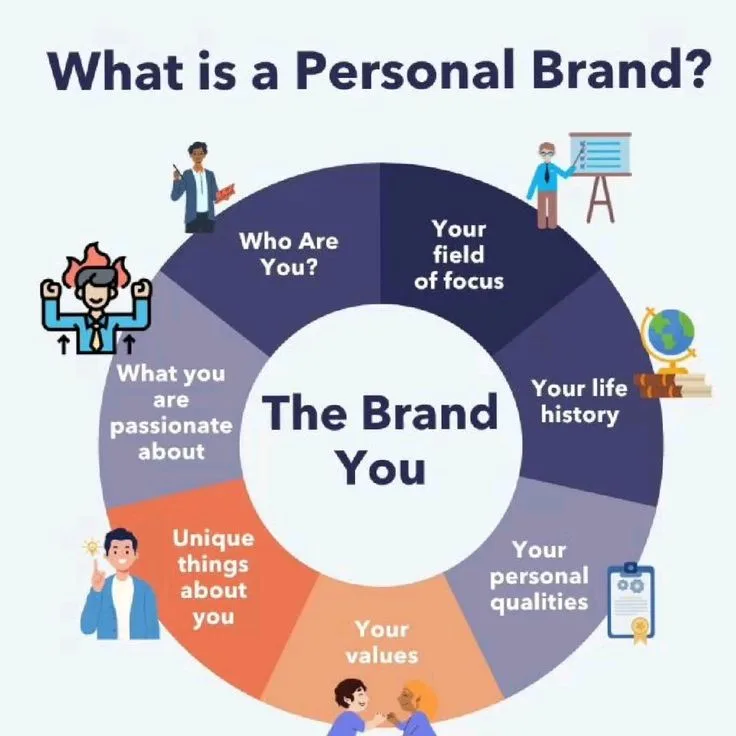
In August 1997, a consultant, author, and former McKinsey consultant named Tom Peters wrote an article for Fast Company with a deliberately provocative premise.[1] "Regardless of age, regardless of position, regardless of the business we happen to be in," Peters wrote, "all of us need to understand the importance of branding.
We are CEOs of our own companies: Me Inc. To be in business today, our most important job is to be head marketer for the brand called You."
The article was called "The Brand Called You." It ran in a business magazine, but it arrived at the cultural moment of the early internet and landed like a manifesto.
The idea seemed both obvious and radical simultaneously: that the same principles marketing professionals used to build product brands - consistency, differentiation, a clear value proposition, deliberate management of perception - could and should be applied to individual professional careers.
Nearly three decades later, the concept Peters introduced has become mainstream to the point of cliche. Personal branding now has its own industry of coaches, consultants, and online courses.[2] LinkedIn has made it a visible, measurable, and in many ways unavoidable aspect of professional life.[4]
And the underlying dynamics Peters identified - that professional reputation is an asset that can be managed deliberately - have only grown more consequential as the labor market has changed around them.
"We are CEOs of our own companies: Me Inc. To be in business today, our most important job is to be head marketer for the brand called You." - Tom Peters
What Personal Branding Actually Means
Strip away the marketing vocabulary and personal branding is about reputation: specifically, the deliberate management of the professional reputation you want to have.
Reputation has always existed. What changed is that reputations are now observable, searchable, and persistent in ways they were not before the internet.
A generation ago, your professional reputation existed primarily in the minds of people who had direct experience of your work - your colleagues, your managers, people in your immediate professional network.
It was real but local. It did not follow you across contexts, it did not accumulate in a public archive, and it was not visible to strangers before they met you.
Now your professional reputation extends as far as your digital footprint. A hiring manager at a company you have never worked for can know what you think about a topic before speaking to you, because you wrote about it on LinkedIn.
A potential client can evaluate your credibility before meeting you, because your case studies and testimonials exist online. A recruiter can see your career trajectory in detail, because your resume is effectively public.
This is the core structural shift. Whether you actively manage your personal brand or not, you have one. The only question is whether it reflects something you chose or something that happened by default.
"Your brand is what people say about you when you're not in the room." - Jeff Bezos
Personal branding, done well, is not performance or self-promotion in any crass sense. It is the deliberate communication of the genuine most valuable aspects of what you know, how you think, and what you stand for professionally.
Like an editor who makes a good piece of writing clearer and more compelling, a well-managed personal brand makes what is already true about you more visible and accessible to the right people.
Why It Matters More Now
Several forces have converged to make personal branding more consequential than at any previous point.
Career trajectories have become less linear and more portfolio-based. In 1980, it was common for professionals to spend most or all of a career with one employer. By 2024, the median job tenure in the United States was 3.9 years according to Bureau of Labor Statistics data (January 2024).[3]
Workers navigate multiple employers, multiple roles, and sometimes multiple industries across a career. In this environment, the portable credential is not your current job title - it is your reputation.
What do people say about you when you are not in the room? What is your area of recognized expertise? What does your name reliably signal to people in your field who have not personally worked with you?
Remote work and distributed hiring have expanded both the opportunity and the necessity of building visibility beyond your immediate local network. When companies hire globally, they cannot rely on informal reputation networks that work over lunch and in conference hallways.
Your visible professional presence - your writing, your speaking, your documented work - does the credentialing work that proximity used to do.
The gig economy and freelance work have made personal brand a direct commercial asset. A freelance designer, consultant, or writer whose personal brand is strong attracts clients who find them; one without a personal brand must continuously prospect for work.
The strong brand converts visibility into inbound opportunity, which is structurally different from and more valuable than outbound hustle.
AI is beginning to change hiring in ways that further amplify personal branding's importance.
As AI tools screen resumes and initial applications, the people who get through to human consideration increasingly do so because a human already knows who they are - through content they have created, talks they have given, or introductions through mutual contacts.
The personal brand shortcircuits algorithmic filtering.
The Authenticity Tension
The most common objection to personal branding is also the most legitimate one: it feels false. The concern is that managing your professional presentation means manufacturing a persona that does not reflect who you really are, and that this is both ethically uncomfortable and practically unsustainable.
This objection is well-founded as a critique of bad personal branding. A personal brand built on performed expertise you do not have will eventually collapse when the gap between the presentation and the reality becomes visible.
A persona that requires you to be someone you are not is exhausting to maintain and tends to fragment when you are tired or under pressure or simply being yourself in an unguarded moment.
But the objection mistakes the nature of good personal branding. The goal is not to construct a false identity. It is to strategically communicate the genuine most valuable aspects of what you already are.
Every person has more depth than any public presentation can capture. You have expertise, experience, opinions, and a track record that most of the people who could benefit from knowing you have never heard about.
The question personal branding asks is: which dimensions of your genuine self should be made visible, to whom, and in what form?
"Create the highest, grandest vision possible for your life, because you become what you believe." - Oprah Winfrey
This is the work of curation, not fabrication. A good personal brand is specific and honest: it reflects a real point of view, real experience, and real values that you can demonstrate consistently under any circumstances.
The test of authenticity is not whether every aspect of your personality is publicly visible - no one can or should communicate everything about themselves professionally - but whether what is visible is genuinely representative of who you are.
The most durable personal brands belong to people whose public persona matches their private one closely enough that nothing surprising or contradictory emerges under scrutiny. They do not have to manage inconsistency between who they present as and who they are, because the gap is small.
Building Your Brand Online: Where to Start
LinkedIn is the most important platform for most professionals, and for most people it is the right place to begin.
The starting point is a profile that does more than list your job history. A strong LinkedIn profile answers several questions a stranger would ask: What do you do? Who do you serve? What problems do you solve? What is your particular approach or perspective?
What makes you distinctive from others with similar titles or experience? The default LinkedIn profile answers only the first question, and the answer it gives is a job title - the least distinctive possible answer, since thousands of other people have the same one.
The headline field, which defaults to your current job title, should instead communicate value and specificity. "Marketing Director at Acme Corp" tells a stranger nothing actionable.
"Helping B2B software companies build content programs that drive qualified pipeline" tells a stranger what you do, who it is for, and what the outcome is - in one sentence.
Content creation is the lever that extends visibility beyond people who already know you. Publishing on LinkedIn - articles, commentary on industry topics, documentation of interesting work - builds an audience of people who share interests but have not met you personally.
The compounding effect of content is significant: a post you wrote eighteen months ago may still be surfacing in searches and recommendations today, building awareness without ongoing effort.
The goal is not volume. It is specificity and consistency. A person who writes about one topic with a clear point of view, published regularly over months and years, builds stronger association between their name and that topic than someone who posts prolifically about everything.
The economist Tyler Cowen has written daily on his blog Marginal Revolution since 2003. The journalist and author Cal Newport built an audience for deliberate practice and deep work over more than a decade of consistent writing. The specificity is the point: their names reliably signal a particular set of ideas.
Speaking at industry conferences and events extends visibility into communities you cannot reach through writing alone. A talk at a niche industry conference of 400 people is frequently more valuable for brand-building than a post that gets 4,000 views, because the engagement is deeper and the audience is more targeted.
Podcast appearances work similarly - a thoughtful guest slot on a podcast listened to by your target professional audience can produce more inbound opportunity than months of content creation.
Personal Brand Platform Comparison
| Platform | Effort Level | Audience Type | Best For | Content Type |
|---|---|---|---|---|
| Medium | Professional, hiring, B2B | Career growth, B2B leads, thought leadership | Articles, short posts, case studies, commentary | |
| Twitter / X | Low-Medium | Tech, media, startup ecosystems | Real-time conversation, building in public, network access | Short takes, threads, opinions, links |
| Newsletter | High | Opted-in, highly engaged subscribers | Deep expertise, direct monetization, long-term trust-building | Long-form essays, curated insights, analysis |
| Podcast | High | Commuters, audio learners, niche professionals | Relationship-building through extended conversation, warm authority | Interviews, solo expertise, case studies |
| Speaking | Medium (per event) | Targeted niche audiences, in-person networks | Credibility signaling, deep-impression brand moments | Keynotes, panels, workshops, fireside chats |
Personal Branding for Introverts
The word "branding" carries extroverted associations - self-promotion, constant visibility, social performance - that make many introverts immediately hostile to the concept.
This resistance is partly justified as a critique of the loudest personal branding advice, and partly a misunderstanding of what effective personal branding actually requires.
Effective personal branding does not require constant visibility. It requires strategic visibility: being visible in the right places, to the right people, on the topics that matter, at whatever frequency is sustainable.
A person who publishes two genuinely substantive articles per month reaches more of the right people, more durably, than a person who posts daily with thin content.
Introverts frequently excel at written communication - the reflective, careful, structured form of expression that tends to produce the most durable and widely shared professional content.
A long-form article that demonstrates genuine depth of expertise works better for personal branding than a high-energy video that demonstrates personality.
Many of the most respected personal brands in professional contexts belong to introverts whose writing is their primary medium.
"Document, don't create. Share what you're learning as you learn it. That's your brand." - Gary Vaynerchuk
Depth of engagement tends to work better for introverts than breadth. Having a handful of substantive, genuine conversations at a conference produces more lasting professional relationships than circulating through the room collecting business cards.
A thoughtful, detailed comment on someone's article builds more connection than liking it. Introverts' natural inclination toward depth is a brand asset, not a liability.
The reframe that most helps introverts is this: personal branding is not self-promotion. It is making your expertise findable by people who would genuinely benefit from it. If you know things that would help other people in your field, making those things visible is a service, not a vanity project.
Positioning: What You Want to Be Known For, and to Whom
Positioning is the strategic core of personal branding, and most people skip it.[5] They begin creating content or updating profiles without first answering the foundational questions: What do I want to be known for? To whom? Why?
The answers to these questions define everything downstream. The person who wants to be known as the leading expert on enterprise software procurement among finance executives at mid-sized companies will produce very different content, speak at very different events, and engage with a very different community than the person who wants to be known as a creative director in the fashion industry.
Positioning that is too broad produces a brand that registers with no one. "Passionate about leadership, strategy, and innovation" is not a position. It is noise. The strongest positions are specific enough to be meaningful, which also means they are not for everyone.
Acceptance of that is necessary: a brand that appeals to everyone appealed to no one.
A useful positioning exercise: write down what you want to be the first name someone thinks of when they have a specific problem in your domain. Not the tenth name, and not the name for a general category - the first name for a specific problem.
"When a Series B startup founder needs help thinking through their go-to-market strategy for enterprise sales, I want them to think of me." That level of specificity reveals both the audience (Series B founders) and the problem (go-to-market for enterprise sales), which then drives every content and networking decision.
Common Mistakes
Trying to appeal to everyone is the most common and most damaging mistake. A positioning broad enough to be inoffensive to any audience communicates nothing to any audience. The clarity that makes a brand strong requires accepting that it is not for everyone.
Inconsistency across channels and over time is the second most common mistake. If your LinkedIn profile, your website bio, your conference speaker bio, and the way you introduce yourself in meetings all describe you differently, people cannot form a stable mental model of who you are or what you stand for.
Consistency does not mean identical content everywhere - different platforms have different conventions and your tone should adapt - but the core positioning, the domain, and the key message should be coherent everywhere.
Confusing credentials with differentiation is a third common mistake. Listing credentials, certifications, and prestigious employers is table stakes - it establishes that you are qualified. It does not differentiate you, because many people have similar credentials.
What differentiates you is a distinctive point of view, a specific methodology, a track record on a specific type of problem, or a perspective that comes from your particular combination of experiences. Credentials open the door; the perspective is what people remember.
Starting to build a personal brand before building the underlying expertise is the fourth mistake. A brand built on thin substance - confident positioning without real depth to back it up - is fragile and tends to collapse under scrutiny as the platform grows and the audience includes people who can evaluate the claims being made.
The sequence matters: develop real expertise and results first, then make them visible. The brand should represent something real.
When Personal Branding Goes Wrong
The history of personal branding includes cautionary examples alongside success stories.
The personal brand that outpaces the substance behind it is the most common failure mode.
Professionals who build large audiences through confident positioning before they have genuine depth tend to encounter reputational damage when their limitations become visible - and as the platform grows, it grows precisely by attracting people who can evaluate those claims.
Gary Vaynerchuk, who built one of the largest personal brands in entrepreneurship media, has been publicly criticized for the gap between his confident predictions and his actual investment track record. The audience a provocative personal brand attracts is often the audience most likely to scrutinize it harshly.
Branding based primarily on controversy attracts attention quickly but requires constant escalation and creates fragility. The audience that followed you for provocation will move on when the provocation normalizes or when someone more provocative comes along.
A brand built on genuine expertise and a distinctive perspective is slower to build and far more durable.
Personal brand conflicts with employer brand most acutely when an employee's visible content takes positions that conflict with the organization's official ones, or when an employee's public persona creates confusion about whether they represent the organization.
Most employers welcome visible, credible employees who enhance the organization's reputation by association. The tension arises when the distinction between personal opinion and organizational position is unclear.
Managing this requires understanding your employer's communication guidelines and being explicit when speaking in a personal capacity.
The employee who builds a personal brand tied primarily to their current employer creates a different kind of fragility: the brand becomes dependent on the affiliation, and when the employment relationship ends - as it eventually will - the brand has to be rebuilt from scratch.
The most resilient personal brands are built on genuine expertise and perspective that would exist regardless of which organization you are currently working for.
Measuring Whether Your Brand Is Working
Personal brand strength shows up in practical, observable indicators rather than in abstract metrics.
Inbound opportunity is the clearest signal: speaking invitations, job inquiries, partnership requests, consulting approaches, and media inquiries that come to you rather than requiring you to seek them out. The volume of inbound opportunity is one measure; the specificity is equally important.
If the inbound opportunities align precisely with the area you want to be known for, your positioning is working. If they reflect a different area than you are targeting - or a previous version of your career - the positioning needs adjustment.
Recognition before meeting is a strong brand signal. When you are introduced to someone at an event and they say "I know your work on X" before you have said a word about yourself, your brand has reach beyond your immediate circle.
This happens when your content, your talks, or your writing has made an impression on people who have not personally interacted with you.
Quality of engagement on content indicates depth of resonance: substantive written responses and genuine conversations are more meaningful brand signals than passive like counts.
An article that generates 15 thoughtful comments from senior people in your field is doing more brand work than an article that gets 1,500 likes from a broad, undifferentiated audience.
Practical Takeaways
Clarify your positioning before creating anything. Write down, in one or two specific sentences, what you want to be known for and by whom. Everything you do publicly should be consistent with that positioning.
Start with LinkedIn if you are not already there with a complete, strong profile. The headline, summary, and featured content are the highest-leverage elements. Update them to communicate value and specificity, not just job title.
Choose a consistent medium and commit to it for at least a year. Content compounding requires time; six months of sporadic activity produces almost nothing. Twelve to eighteen months of consistent, specific content in one medium produces meaningful brand presence.
Introverts: written content is your medium. You do not need to perform. You need to think clearly and write honestly about what you know and believe. That is enough.
Do not start brand-building before building the substance the brand should represent. Expertise first, visibility second. The sequence matters.
Measure by inbound opportunity and recognition, not by follower counts or like rates. The metrics that matter are the ones that translate into professional value.
Treat your brand as a long-term asset. The professionals with the strongest personal brands have typically been building them, sometimes without thinking of it that way, for ten to fifteen years. There are no shortcuts, but there is compounding.
What Research Shows About Personal Branding
Academic research on professional reputation and personal brand effects has moved beyond theory into measurable outcomes, providing clearer evidence for what works and what does not.
Herminia Ibarra at London Business School has conducted the most rigorous longitudinal research on professional identity and career transitions.
Her 2003 book Working Identity and subsequent Harvard Business Review research found that professionals who made successful career transitions typically built their new professional identities in public - through small steps, new projects, and new associations - rather than resolving their identity crisis through internal reflection before acting.
The personal brand, in Ibarra's framework, is not something you discover about yourself and then broadcast; it is something you construct through action and refine based on feedback. This challenges the common advice to "find your authentic brand first."
Cal Newport has argued - controversially - that the emphasis on personal branding is often backwards in career development.
In So Good They Can't Ignore You (2012) and his subsequent writing, Newport's research found that most professionals who advise others to build personal brands before building deep expertise produce fragile, hollow brands.
His contrasting research finding: the strongest personal brands he studied were built by people who spent years developing genuine expertise and then, somewhat belatedly, made that expertise visible.
The sequence - substance first, then visibility - produced brands with unusual durability because the expertise could absorb scrutiny.
Adam Grant's research on giving behavior and professional reputation in Give and Take (2013) found that professionals who built reputations for generosity - helping colleagues, sharing knowledge freely, making introductions - built stronger professional brands than those who pursued visibility through self-promotion.
Grant's longitudinal research found that the reputation-building effects of generosity were more durable and more portable across organizations than reputation built through self-promotion.
The practical implication: "teaching your expertise publicly" is a more effective brand-building strategy than "promoting your expertise publicly."
Researchers at Edelman have published annual Trust Barometer studies since 2000 that track how professional trust is formed and sustained. A consistent finding: thought leadership content that acknowledges uncertainty and complexity is trusted more than content that projects confident certainty.
Professionals who build personal brands through nuanced, intellectually honest content - acknowledging what they do not know and where evidence is mixed - build more loyal, high-trust audiences than those who project omniscient confidence. This directly contradicts much popular personal branding advice.
Brian Uzzi at Northwestern's Kellogg School of Management studied LinkedIn data to examine how personal brand signals translate into career outcomes.
His research found that the strength of one's professional network was more predictive of job quality than either the quality of one's LinkedIn content or the number of connections.
Content-based visibility matters primarily when it reaches people in strong-tie networks - people who already trust you enough to act on what they learn about you. Broadcasting to weak-tie networks produces awareness but rarely produces action.
Real-World Case Studies in Personal Brand Building
Rand Fishkin built one of the most credible personal brands in digital marketing through a decade of radical transparency about Moz, the SEO software company he founded. Fishkin published detailed blog posts about Moz's revenue, his mistakes, his struggles with fundraising, and eventually his departure from the company he founded.
The transparency - which violated most personal branding advice to project strength and success - built an unusually loyal audience because readers could see that Fishkin's advice came from real experience, including real failure.
His 2018 memoir Lost and Founder was published to a pre-existing audience that already trusted him because of the transparency.
Michael Hyatt, former CEO of Thomas Nelson Publishers, is a case study in intentional personal brand construction after 50. Hyatt began blogging in 2004 in his 40s and built an audience through consistent, specific content about leadership and productivity.
He documented his personal brand strategy - choosing a specific niche (leadership for executives), choosing a primary medium (blogging then podcasting), publishing consistently for years before the brand generated significant financial return.
His company, Full Focus, generates over $20 million in annual revenue. The lesson from Hyatt's case: personal brand as a business asset compounds slowly and then dramatically.
Anne-Marie Imafidon, founder of Stemettes, built a personal brand around increasing diversity in STEM careers through programs, public speaking, and media appearances.
Her case illustrates the organizational brand versus personal brand relationship: her personal brand was built through organizational work (Stemettes), and the organizational work built credibility that the personal brand then leveraged.
When she was named an MBE and subsequently appeared in lists of influential women in tech, the visibility amplified work she had already built rather than preceding it.
The Gary Vaynerchuk high-visibility cautionary case illustrates what happens when the personal brand machine outpaces substance. Vaynerchuk built one of the largest personal brands in entrepreneurship media through prolific content creation and confident predictions about social media trends.
His advice on specific platforms - heavily promoting platforms that subsequently declined - has been widely documented as inconsistent with outcomes. The large platform attracted scrutiny it could not withstand on specifics.
His case is not that personal branding failed but that brand volume without sustained substance accuracy creates fragility as the platform scales.
Evidence-Based Approaches to Personal Brand Development
Research and case evidence converge on specific practices for building personal brands that are both visible and durable.
The expertise-first sequencing, supported by Newport's research and numerous case studies, argues for a specific developmental order: (1) build genuine expertise through deliberate practice, (2) document that expertise through writing or projects, (3) share the documentation in public, and (4) build on the feedback to deepen expertise further.
This is a virtuous cycle rather than a linear sequence, but the entry point matters: starting from step three without steps one and two produces fragile visibility.
Niche specificity before platform breadth, supported by Brian Uzzi's network research and the case study literature, suggests that personal brands that try to reach everyone reach no one meaningfully.
The optimal strategy is to establish authority in a specific, defined niche - specific enough that you can become one of the recognized voices in that niche - before expanding to adjacent areas.
Specific niches compound trust faster than broad ones because the audience is self-selected for engagement with exactly the content you produce.
Consistency metrics over engagement metrics as the primary measurement framework.
Research on content performance by the Content Marketing Institute and similar organizations consistently finds that the brands with the strongest business outcomes measure content effectiveness by audience retention and direct response (inquiries, sales, referrals) rather than by engagement metrics (likes, shares, views).
Building a personal brand strategy around engagement metrics optimizes for the wrong thing; building it around audience retention and relationship depth produces the outcomes that matter.
The trust cadence, derived from research on relationship formation in professional contexts, suggests that personal brand trust accumulates through consistent contact over time at a specific frequency, more than through volume or novelty.
Research on communication frequency and trust formation found that regular, predictable contact at a sustainable pace builds stronger trust than burst communication followed by silence.
For personal brand building, this translates to choosing a publication frequency you can sustain indefinitely rather than a frequency that maximizes early output.
Sources & Further Reading
- Peters, T. (1997). "The brand called you." Fast Company, Issue 10, August/September.
- Schawbel, D. (2009). Me 2.0: Build a Powerful Brand to Achieve Career Success. Kaplan Publishing.
- Bureau of Labor Statistics, U.S. Department of Labor (2024). Employee Tenure Summary. U.S. Department of Labor.
- LinkedIn (2023). Global Talent Trends 2023: The New World of Work. LinkedIn Corporation.
- Arruda, W. & Dixson, K. (2007). Career Distinction: Stand Out by Building Your Brand. John Wiley & Sons.