
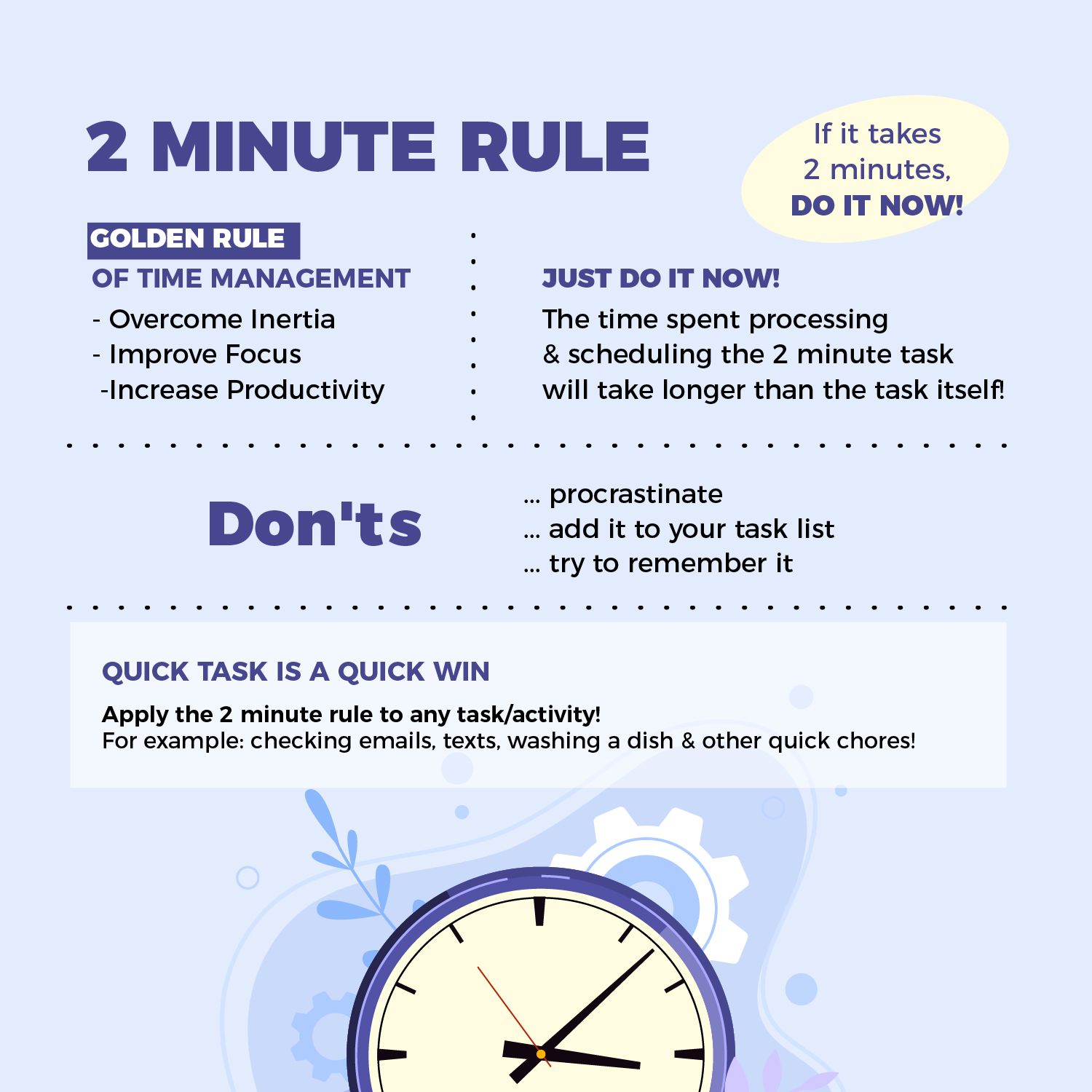
The two-minute rule is a productivity principle from David Allen's Getting Things Done (GTD) system: if a task will take less than two minutes to complete, do it immediately rather than adding it to a list.
The rule works because the cognitive cost of tracking, deferring, and returning to small tasks almost always exceeds the cost of simply completing them on the spot.
First published in 2001, this deceptively simple idea has become one of the most widely adopted techniques in modern productivity practice - and one of the most frequently misapplied.
Somewhere in your inbox right now, there are probably several emails you have read and not replied to. The replies would take less than two minutes. You know what they need to say.
But you did not write them, because you were "in the middle of something" or "going to get back to them later." And so they sit, waiting, nagging at you in quiet moments, consuming attentional bandwidth you cannot see but can definitely feel.
This is the problem the two-minute rule was designed to solve. But understanding why it works - and more importantly, when it does not - requires a deeper look at the psychology of open tasks, the economics of attention, and the structural conditions of modern knowledge work.
The GTD System: Where the Rule Lives
The two-minute rule comes from Getting Things Done: The Art of Stress-Free Productivity, the productivity system developed by management consultant David Allen and published by Penguin in 2001. The book has sold over two million copies worldwide and has been translated into more than 30 languages.
It remains, alongside Stephen Covey's The 7 Habits of Highly Effective People (1989) and Cal Newport's Deep Work (2016), one of the most influential productivity books of the past four decades.
GTD is, at its core, a system for managing cognitive overhead - the invisible mental cost of having many open commitments simultaneously. Allen's central insight was that most productivity problems are not problems of time. They are problems of attention management.
The enemy is not a full calendar but a cluttered mind: the background hum of undone tasks, unresolved questions, and open loops that prevent full engagement with whatever you are doing right now.
The system organizes around five stages: capture everything out of your head into a trusted external system, clarify what each item means and what action it requires, organize items into appropriate categories, reflect on the system regularly, and engage with the right tasks at the right time.
The two-minute rule operates during the clarify stage - when you are reviewing your inbox and deciding what to do with each item.
"If the next action can be done in two minutes or less, do it when you first pick it up. Even if it is not a high-priority item, doing it immediately takes less time than filing it away, putting it on a list, and tracking it as something to do." - David Allen, Getting Things Done
The logic is economic, not motivational. Allen is not arguing that small tasks are important.
He is arguing that the transaction cost of managing them - writing them down, categorizing them, scheduling them, remembering them, finding them again, re-reading them for context, and finally doing them - is greater than the cost of simply doing them now.
Two minutes of action versus five or ten minutes of task management overhead. The math favors immediate action.
The Psychology of Open Loops
Why does leaving a two-minute task undone cost more than it seems? The answer involves cognitive phenomena that were identified decades before Allen formalized his system, but which his framework elegantly addresses.
The Zeigarnik Effect
In the 1920s, Russian psychologist Bluma Zeigarnik, working in the laboratory of Kurt Lewin at the University of Berlin, noticed something peculiar about restaurant waiters. They had excellent memories for orders they had not yet delivered but forgot them quickly once the order was complete.
She designed a series of experiments to test this observation, published in 1927, finding consistently that people remembered uncompleted tasks better than completed ones - sometimes by a factor of two (Zeigarnik, 1927).
The Zeigarnik effect describes what David Allen calls "open loops": uncompleted tasks occupy working memory and generate intrusive thoughts until they are resolved. Your brain treats an incomplete task as a priority until it has been closed - not because the task is important, but because the loop is open.
The cognitive system does not distinguish between "reply to a routine email" and "finish the quarterly strategy document." Both create open loops. Both consume attentional resources.
For small, quickly completable tasks, this means that deferral creates a continuous background cost. The un-replied email is still present in your cognitive system. It surfaces in quiet moments, contributes to a diffuse sense of being behind, and consumes attentional resources that might otherwise be available for focused, creative work.
Research by Masicampo and Baumeister (2011) at Florida State University confirmed this mechanism, finding that unfulfilled goals cause intrusive thoughts that interfere with subsequent tasks - but that simply making a specific plan for when and how to complete the goal eliminated the intrusive thoughts, even before the goal was accomplished.
This finding is directly relevant to GTD: Allen's system works not only because you complete tasks, but because you capture them into a trusted system. The brain relaxes its vigilance over an open loop once it trusts that the loop will be handled.
The two-minute rule takes this one step further - it closes the loop entirely, eliminating both the task and the cognitive overhead of tracking it.
Attention Residue
Computer scientist Cal Newport, drawing on research by Sophie Leroy at the University of Washington, describes a related phenomenon called attention residue. When you switch tasks - even briefly - part of your attention remains with the previous task, reducing your cognitive capacity for the new one.
Leroy's 2009 study, published in Organizational Behavior and Human Decision Processes, found that people who were interrupted mid-task and moved to a new task performed measurably worse on the new task than people who completed the first task before switching.
The mechanism is straightforward: your brain cannot fully disengage from an incomplete task. Residual thoughts about the unfinished work persist, occupying a portion of your working memory and degrading performance on whatever you do next.
Leroy found that the effect was strongest when the interrupted task had no clear stopping point - exactly the condition created by small, deferred tasks that sit in your inbox or on your mental to-do list without resolution.
The implication for small undone tasks: each one represents a potential interruption that your brain is perpetually preparing for. Close the loop, and the attention residue dissolves. Leave it open, and it accumulates - not as a single dramatic distraction, but as a gradual degradation of your ability to think clearly about anything else.
Decision Fatigue and the Cost of Reprocessing
There is a third psychological cost to deferring small tasks that is less commonly discussed: decision fatigue.
Research by Roy Baumeister and colleagues, published extensively through the 2000s and 2010s, suggests that making decisions depletes a limited cognitive resource, leading to progressively worse decisions over the course of a day (Baumeister et al., 2008).
Every time you encounter a small task and decide to defer it, you are making a decision. Every time you return to your task list and encounter that deferred task again, you must re-read it, re-evaluate it, and decide again what to do with it.
A task that takes two minutes to complete but is deferred three times has consumed three decision cycles plus whatever cognitive overhead each cycle generated - in addition to the eventual two minutes of execution. The two-minute rule eliminates this reprocessing entirely: one encounter, one decision, one action, done.
This connects to broader research on decision fatigue and why simplifying routine decisions can preserve cognitive resources for the work that genuinely requires deep thought.
The Mechanics: How the Two-Minute Rule Works in Practice
In GTD, the two-minute rule applies during the processing or clarifying stage - when you are reviewing your inbox (email, physical, or otherwise) and deciding what to do with each item.
The decision tree looks like this:
- What is this? - Identify what the item is
- Is it actionable? - If not, trash it, file it as reference, or defer it for later consideration
- If actionable: What is the next action? - Identify the specific physical or digital action required
- How long will that action take? - If less than two minutes, do it now; if more, either delegate it or add it to your action list
The rule is deliberately simple. It does not require estimation, prioritization, or sophisticated judgment. The decision is binary: under two minutes, do it now. Over two minutes, process it into the appropriate category.
What Counts as a Two-Minute Task
The distinction between genuine two-minute tasks and tasks that merely appear quick is critical to using the rule effectively.
Genuine two-minute tasks:
- Replying to a short email with a clear answer
- Filing a document in its correct folder
- Making a brief phone call or leaving a voicemail
- Approving or declining a meeting invitation
- Forwarding a message to the right person
- Entering a contact into your address book
- Scheduling a follow-up on your calendar
- Sending a quick acknowledgment or status update
- Signing a document that has already been reviewed
- Adding an item to a shared list or project board
Tasks that look like two minutes but are not:
- Emails that require diplomatic or carefully worded responses
- Tasks that require research before you can respond
- Items that depend on other tasks completing first
- Tasks that will trigger a cascade of further work or conversation
- Requests where you need to check with someone else before committing
- Any task where you open it and hesitate - hesitation is the signal
A practical test: if you have opened the task and are now pausing to think about how to respond, it is probably not a two-minute task. The two-minute rule applies to items where the next action is genuinely clear, bounded, and executable without further deliberation.
The Two-Minute Threshold: Science or Heuristic?
Allen chose two minutes as an illustrative boundary, not a scientifically derived threshold. The underlying principle is about the break-even point where the overhead of managing a task exceeds the cost of doing it. This break-even point varies by context:
| Factor | Effect on Threshold |
|---|---|
| Volume of incoming tasks per day | Higher volume favors a shorter threshold (one minute) to prevent small tasks from consuming all processing time |
| Complexity of your task management system | More complex systems increase management overhead, favoring a longer threshold |
| Nature of your work | Creative/deep work benefits from a shorter threshold during processing windows; administrative work can tolerate a longer one |
| Time available for processing | Limited processing windows favor a shorter threshold |
| Personal tendency toward productive procrastination | If you tend to use small tasks to avoid deep work, a shorter threshold is safer |
Some practitioners extend the threshold to five minutes, arguing that the transaction cost of deferring and tracking is higher for longer tasks than Allen's model implies. Others use a context-specific threshold: one-reply for emails, one-call for phone tasks.
The specific number is less important than the underlying discipline: recognize the category of small, immediately completable tasks and handle them during designated processing time.
When the Two-Minute Rule Breaks Down
The two-minute rule is a powerful heuristic with specific failure modes. Understanding them is the difference between using the rule productively and letting it undermine the work that actually matters.
The Productive Procrastination Trap
The most insidious failure mode is using the two-minute rule to avoid deep work. Knowledge work creates value primarily through sustained, focused, cognitively demanding effort: writing, analysis, design, coding, complex problem-solving.
This work is often difficult to start and psychologically uncomfortable - what psychologist Mihaly Csikszentmihalyi described as the "activation energy" required to enter a flow state.
Small, two-minute tasks are the opposite: easy to start, immediately completable, and satisfying in a way that closely resembles real productivity. An inbox processed to zero, a string of notifications cleared, a set of small requests handled - these feel productive. But if they consumed the morning, the day's real work has not begun.
Cal Newport observes in Deep Work (2016) that many knowledge workers "fill their time with busyness rather than depth, and their busyness is organized around completing a high volume of small tasks rather than producing the hard-to-replicate outcomes that create value." A 2019 study by Mark, Gonzalez, and Harris at UC Irvine found that knowledge workers spend an average of only 12.5 minutes on a task before switching - and that the fragmentation was largely self-initiated, not imposed by external interruptions.
The two-minute rule, applied indiscriminately, can accelerate this pattern. It should be applied to genuinely miscellaneous items during processing time - not used as a systematic approach to how you prioritize your day.
The Interruption Cost Problem
In an environment with constant incoming messages, the two-minute rule applied to every notification would result in perpetual context-switching. Studies on interruption at work consistently find that the cost of interruptions is not the time spent on the interrupting task - it is the recovery time.
Gloria Mark's research at UC Irvine, published across multiple studies from 2005 to 2023, found that it takes an average of 23 minutes and 15 seconds to return to full focus after an interruption (Mark, Gudith, and Klocke, 2008).
Her more recent work, summarized in her 2023 book Attention Span, found that the average time workers spend on a single screen before switching dropped from 2.5 minutes in 2004 to 47 seconds in 2020 - a dramatic acceleration of fragmentation.
A text message that genuinely takes two minutes to reply to might cost 25 minutes of diminished focus if it interrupts deep work. A Slack notification that takes 30 seconds to process might cost 15 minutes of recovery. In this context, the two-minute rule should emphatically not apply. The rule is for processing time, not for all time.
When Two Minutes Is Not Really Two Minutes
Tasks are easy to underestimate. An email that looks like a two-minute reply can expand into a research task, a difficult interpersonal navigation, or a rabbit hole of related correspondence.
The planning fallacy - the well-documented tendency to underestimate how long tasks will take, first described by Kahneman and Tversky in 1979 - applies even to very small tasks.
Research by Buehler, Griffin, and Ross (1994) found that people's time estimates for future tasks are consistently optimistic, even when they have direct experience with how long similar tasks took in the past.
For two-minute tasks, the practical consequence is that a queue of ten "two-minute" items might actually consume 30 to 45 minutes once you account for context-switching, unexpected complexity, and the tasks that turn out to require more thought than expected.
Adapting the Rule for Deep Work
For knowledge workers whose value comes primarily from depth work, the most productive adaptation of the two-minute rule involves batching and time-boxing processing time.
The Processing Window Model
Rather than applying the two-minute rule continuously throughout the day, designate specific windows for processing:
- Morning processing (20-30 minutes): Handle overnight messages and clear the inbox before deep work begins
- Midday processing (10-15 minutes): A brief pass during a natural transition time, such as before or after lunch
- End-of-day processing (20 minutes): Clear the day's accumulation before leaving
During these windows, the two-minute rule applies aggressively - handle anything completable in two minutes immediately. Outside these windows, new items are captured for the next processing window, even if they are quick. This requires discipline, particularly around notifications.
Many practitioners disable email and messaging notifications entirely during deep work blocks, checking them only during designated processing windows.
This model combines the cognitive benefits of the two-minute rule (closed loops, cleared attention) with the structural protection of deep work blocks (extended focus, no interruption).
| Time | Activity | Two-Minute Rule Status |
|---|---|---|
| 8:00-8:30 AM | Morning processing: email, messages, admin | ON - handle anything under two minutes now |
| 8:30-10:30 AM | Deep work: writing, analysis, complex tasks | OFF - everything captured for later |
| 10:30-10:45 AM | Mid-morning processing | ON |
| 10:45 AM-12:30 PM | Second deep work session | OFF |
| 12:30-12:45 PM | Midday triage | ON |
| 1:00-3:00 PM | Meetings, collaboration, shallow work | Situational |
| 3:00-3:15 PM | Afternoon processing | ON |
| 3:15-5:00 PM | Third deep work session or project work | OFF |
| 5:00-5:20 PM | End-of-day processing and planning | ON |
This structure is consistent with research on ultradian rhythms - the roughly 90-minute cycles of focused attention that neuroscientist Nathaniel Kleitman first documented in sleep research and that subsequent researchers have found also govern waking concentration.
Working in 90-minute focused blocks with processing breaks between them aligns both productivity technique and biological reality.
Integration with Other Systems
The two-minute rule does not exist in isolation. It works best as one component of a broader attention management system. Practitioners frequently combine it with:
- Time blocking (Cal Newport): scheduling specific blocks for specific types of work, with processing windows built in
- The Pomodoro Technique (Francesco Cirillo): 25-minute focused work intervals separated by short breaks, with processing happening during breaks
- Eisenhower Matrix: using urgency/importance classification to decide which tasks deserve processing time at all
- Weekly reviews (GTD): a regular session to review all open loops, projects, and commitments - the two-minute rule for processing, combined with strategic thinking about what actually matters
The key insight across all these approaches is that the two-minute rule is a tactical tool, not a strategy. It tells you what to do with small tasks when you encounter them. It does not tell you what to work on, what matters, or how to allocate your most valuable cognitive resources.
Those are strategic questions that require different mental models.
The Behavioral Science Behind the Rule
The two-minute rule works partly because it lowers the activation energy for action. Activation energy, a concept borrowed from chemistry and applied to behavior by BJ Fogg in his research on motivation and ability at Stanford University, is the psychological effort required to begin a task.
When a task is small, the barrier to starting is low - and since starting is the hardest part of many tasks, low activation energy means higher completion rates.
Fogg's Tiny Habits framework (2019) builds on a similar insight: the most reliable way to establish a new behavior is to make it so small that it requires almost no motivation to start. The two-minute rule, in this framing, is not just a processing heuristic - it is a behavioral design principle that removes friction from action.
The rule also leverages implementation intentions - specific "if-then" plans that convert vague intentions into automatic behavioral responses.
Research by Peter Gollwitzer (1999) at New York University has repeatedly found that implementation intentions increase follow-through rates by 20 to 30 percentage points compared to simple goal intentions.
The two-minute rule is itself an implementation intention: "If I encounter a task that will take less than two minutes during processing time, then I will do it now." The specificity of the trigger condition ("less than two minutes, during processing") converts a judgment call into an automatic response.
Additionally, completing small tasks generates small dopamine rewards - the neurochemical associated with goal completion and satisfaction.
While individual two-minute completions are minor, a processing session that closes ten or fifteen open loops produces a cumulative sense of progress and control that has measurable effects on mood and subsequent motivation.
This is related to what Teresa Amabile and Steven Kramer describe in The Progress Principle (2011): the single most powerful motivator in daily work life is making progress on meaningful work, and even small wins contribute to this sense of forward movement.
Common Misunderstandings
Misunderstanding 1: It is only about email. The two-minute rule applies to any task in any domain - physical tasks, administrative tasks, communication tasks, and brief decisions. Filing a receipt, watering a plant, putting away a tool, responding to a text message - the medium does not matter. The time estimate does.
Misunderstanding 2: The threshold should be precise. Two minutes is a convenient approximation. What matters is the principle: tasks that are quick to complete are often more expensive to defer than to do.
Whether your personal threshold is 90 seconds or five minutes depends on your context and your tendency toward productive procrastination.
Misunderstanding 3: It replaces prioritization. The two-minute rule is not a prioritization system. A two-minute task is not necessarily more important than a longer one - it is simply handled differently. High-value deep work is always more important than two-minute items, regardless of duration.
The rule exists to prevent small items from clogging the system, not to elevate them above strategic work.
Misunderstanding 4: You should always apply it. The right time to apply the rule is during designated processing time, not during deep work, not during meetings, and not every time your phone buzzes. Context matters enormously, and misapplying the rule is worse than not using it at all.
Misunderstanding 5: It means you should never batch small tasks. Some small tasks are better batched even if each takes under two minutes.
If you have fifteen expense receipts to file and each takes one minute, filing them all in sequence during a single processing window is more efficient than filing each one the moment it enters your inbox throughout the day.
The rule applies to individual items encountered during processing, not to categories of work that benefit from batching.
The Two-Minute Rule and Task Accumulation
One of the least-discussed benefits of the two-minute rule is what it does to task list hygiene over time.
A task list that grows faster than it shrinks is demoralizing. If every new item is captured for future processing, and many items are genuinely small, the list becomes a source of anxiety rather than a tool for clarity.
Research on goal overload by Dalton and Spiller (2012) found that people with more active goals report lower wellbeing and complete fewer goals overall - the list itself becomes an impediment.
The two-minute rule prevents small items from colonizing the list. They are handled immediately and never appear there at all. This keeps the task list reserved for items that genuinely require planning, prioritization, and deliberate scheduling: the meaningful work that deserves its own cognitive investment.
In organizations, this effect compounds. Teams that adopt the two-minute rule for internal communication - responding promptly to quick requests, closing small loops immediately - report less friction in collaboration and fewer "where is the status on X?" follow-up messages.
The small completions prevent the accumulation of coordination overhead that slows larger projects.
James Clear's Two-Minute Rule: A Different Application
It is worth noting that James Clear, author of Atomic Habits (2018), popularized a different "two-minute rule" focused on habit formation.
Clear's version states: "When you start a new habit, it should take less than two minutes to do." The idea is that any habit can be scaled down to a two-minute version - "read before bed each night" becomes "read one page before bed each night" - and that starting with the tiny version builds the consistency needed for the habit to take root.
| Two-Minute Rule Version | Creator | Purpose | Application |
|---|---|---|---|
| GTD Two-Minute Rule | David Allen (2001) | Eliminate cognitive overhead of small tasks | During inbox/task processing: if it takes <2 min, do it now |
| Habits Two-Minute Rule | James Clear (2018) | Lower the activation energy for new habits | When building habits: start with a version that takes <2 min |
Both rules leverage the same psychological principle - reducing the barrier to action - but apply it in fundamentally different contexts. Allen's rule is about processing existing commitments efficiently. Clear's rule is about building new behaviors sustainably.
Conflating them leads to confusion; understanding the distinction makes both more useful.
Conclusion
The two-minute rule is one of the simplest and most durable ideas in productivity literature because it addresses a real and universal cost: the cognitive overhead of small undone things. Open loops accumulate. Attention residue builds.
A mind cluttered with tiny incompletions is less available for the deep, focused work that creates genuine value.
The rule's genius is its simplicity. The decision is binary and requires almost no deliberation: under two minutes, do it now. There is no system to maintain, no prioritization matrix to consult, no project management tool to update. It is a single behavioral rule that, applied in the right context, produces disproportionate benefits.
But its usefulness depends on applying it in the right context - during processing time, for genuinely small tasks, in ways that protect rather than interrupt depth work. Used well, it is a minor tool with outsized benefit.
Used indiscriminately, it becomes an elegant way to spend a day feeling productive while avoiding the hard work that actually matters.
The deeper lesson of the two-minute rule is not really about small tasks at all. It is about understanding the hidden costs of cognitive clutter and designing your work systems to minimize them. Close the loops that need closing. Protect the time for the work that cannot be rushed.
And recognize that the small things you leave undone are never quite as small as they seem.
Sources & Further Reading
- Allen, David. Getting Things Done: The Art of Stress-Free Productivity. Penguin, 2001 (revised 2015).
- Clear, James. Atomic Habits: An Easy & Proven Way to Build Good Habits & Break Bad Ones. Avery, 2018.
- Newport, Cal. Deep Work: Rules for Focused Success in a Distracted World. Grand Central Publishing, 2016.
- Mark, Gloria. Attention Span: A Groundbreaking Way to Restore Balance, Happiness and Productivity. Hanover Square Press, 2023.
- Leroy, Sophie. "Why Is It So Hard to Do My Work? The Challenge of Attention Residue When Switching Between Work Tasks." Organizational Behavior and Human Decision Processes 109, no. 2 (2009): 168-181.
- Zeigarnik, Bluma. "On Finished and Unfinished Tasks." Psychologische Forschung 9 (1927): 1-85.
- Masicampo, E.J. and Roy F. Baumeister. "Consider It Done! Plan Making Can Eliminate the Cognitive Effects of Unfulfilled Goals." Journal of Personality and Social Psychology 101, no. 4 (2011): 667-683.
- Gollwitzer, Peter M. "Implementation Intentions: Strong Effects of Simple Plans." American Psychologist 54, no. 7 (1999): 493-503.
- Fogg, BJ. Tiny Habits: The Small Changes That Change Everything. Houghton Mifflin Harcourt, 2019.
- Amabile, Teresa and Steven Kramer. The Progress Principle: Using Small Wins to Ignite Joy, Engagement, and Creativity at Work. Harvard Business Review Press, 2011.
- Mark, Gloria, Daniela Gudith, and Ulrich Klocke. "The Cost of Interrupted Work: More Speed and Stress." Proceedings of the SIGCHI Conference on Human Factors in Computing Systems (2008): 107-110.