
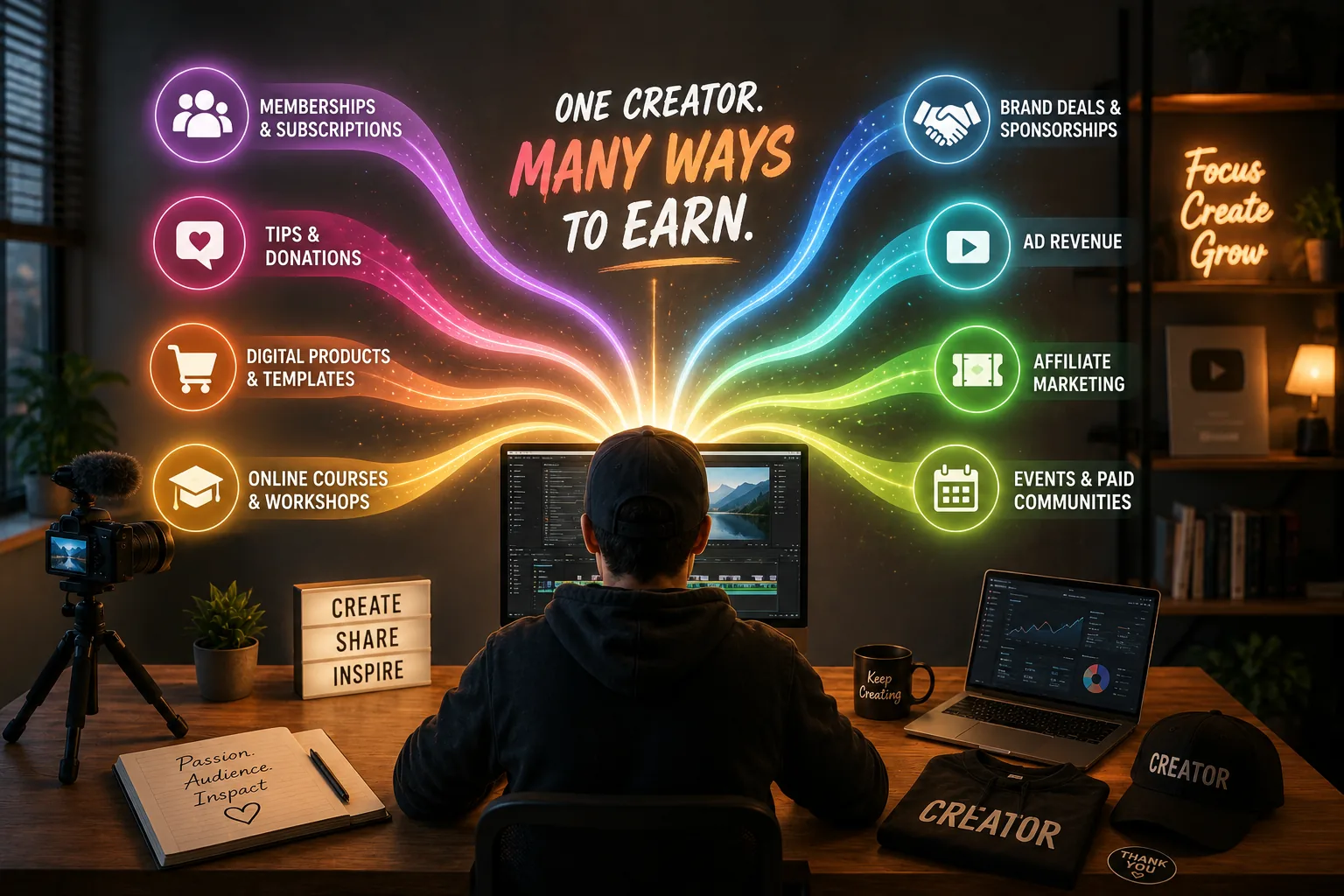
Ali Abdaal was a junior doctor in Cambridge, England when he uploaded his first YouTube video in 2017. By 2023, his creator business was generating over $5 million annually across six distinct revenue streams: YouTube ad revenue, online course sales, affiliate marketing, book royalties, sponsorships, and a productivity app. He had quit medicine entirely - not because he disliked it, but because his creator income had surpassed what even senior consultants earn in the National Health Service by a factor of twenty.
"The creator economy is not about going viral. It is about building a body of work valuable enough that people want to support it, and then building the infrastructure to let them do so." - Li Jin, investor and creator economy researcher
What distinguishes Abdaal's financial trajectory from the majority of content creators who plateau is not talent or work ethic - it is architecture. He systematically built multiple revenue streams that reinforced each other rather than competing for the same time and attention.
His YouTube channel drove course sales. His courses built a community that created new content ideas. His affiliate recommendations generated passive income from tools he used and discussed.
His brand attracted sponsorships, and his audience size made book deals possible. Each stream existed not in isolation but as part of a system designed for compounding growth.
This article examines the full taxonomy of creator revenue streams, the conditions under which each performs well, and the design principles that determine whether a creator business generates sustainable income or perpetual financial uncertainty.
| Revenue Stream | Effort Type | Scalability | Dependency Risk | Revenue Stability |
|---|---|---|---|---|
| Sponsorships | Active (per piece) | Limited | Platform/audience size | Variable |
| Online courses | Upfront then passive | High | Marketing channels | Moderate |
| Affiliate marketing | Low ongoing | High | Platform algorithm | Variable |
| Membership/Patreon | Active (ongoing) | Moderate | Audience loyalty | Stable |
| Consulting/coaching | Time-for-money | Low | Reputation | Stable but capped |
| Digital products (templates, tools) | Upfront then passive | Very high | Marketing channels | Variable |
| Book royalties | Upfront then passive | Moderate | Publisher/distribution | Low |
The Four Revenue Taxonomies
Creator revenue streams fall into four fundamental categories based on their relationship between effort and income:
Time-for-money streams require ongoing effort to generate ongoing revenue. Consulting, freelance work, sponsored content requiring original creation, and live events fall here. These streams can pay well per hour but cannot grow beyond the creator's time ceiling.
Leveraged production streams require significant upfront effort to create an asset, then generate revenue with minimal ongoing effort. Courses, books, templates, and software fit this description. The creation is time-intensive; the distribution is scalable.
Platform-mediated streams depend on a platform's algorithm, audience, and monetization policies. YouTube ad revenue, Spotify podcast payouts, and Substack subscription revenue are examples. The platform provides distribution infrastructure; the creator provides content; the revenue is shared.
These streams are valuable but carry dependency risk.
Passive streams generate revenue with minimal active creator involvement. Affiliate commissions on evergreen content, licensing arrangements, and royalties from previously created work approach passive income, though the "passive" label understates the upfront investment required to create these streams.
Most sustainable creator businesses combine all four taxonomies. Time-for-money streams provide immediate cash flow during early stages; leveraged production builds long-term assets; platform-mediated streams provide reach and discovery; passive streams provide income floor during variable periods.
YouTube and Video Ad Revenue
YouTube's Partner Program pays creators a share of advertising revenue generated from their videos. The payment structure is complex but simplified: creators typically receive 55% of advertising revenue, while YouTube retains 45%.
The RPM reality: Revenue Per Mille (RPM) - what creators actually earn per 1,000 views - ranges from $1-50+ depending on audience demographics, content category, and geography. Technology and finance content earns $10-30 RPM. Entertainment and gaming content earns $2-8 RPM.
What the numbers mean at scale: A channel averaging $5 RPM and 1 million monthly views generates approximately $5,000/month from ad revenue. That same channel at $15 RPM generates $15,000/month. These are pre-tax figures, and most channels do not sustain 1 million monthly views without significant ongoing content production investment.
YouTube Revenue Calculator (approximate):
- 100,000 monthly views at $5 RPM: $500/month
- 500,000 monthly views at $8 RPM: $4,000/month
- 2,000,000 monthly views at $12 RPM: $24,000/month
At modest view counts, YouTube ad revenue alone rarely sustains a full-time creator. The value of YouTube for most creators is not primarily the ad revenue but the audience it builds for higher-margin revenue streams.
Example: Mark Rober, the former NASA engineer who creates viral science and engineering videos, generates millions of views per video. His RPM is exceptionally high due to his audience demographics (educated adults with high disposable income), and his YouTube ad revenue alone likely exceeds $100,000/month at his view scale.
But even Rober's business extends beyond YouTube to include a subscription science education product called CrunchLabs and merchandise - illustrating that even top-tier YouTube creators build beyond platform dependency.
Podcast and Audio Revenue
Podcasting has developed several distinct monetization mechanisms since its explosion in the mid-2010s.
Host-read sponsorships remain the dominant monetization model for established podcasts. Advertisers pay $15-50 per thousand downloads (CPM) for mentions in podcast episodes.
A podcast averaging 50,000 downloads per episode with three sponsors per episode at $25 CPM generates approximately $3,750 per episode, or $7,500/month for twice-weekly release.
Subscription and premium content: Patreon pioneered the model of podcast listeners paying monthly fees for bonus episodes, ad-free listening, or community access. Supportive audiences in specific niches can generate $5,000-50,000/month through subscriptions, particularly for content with a dedicated professional or hobbyist audience.
Spotify and platform monetization: Spotify's creator funds and exclusive podcast deals have created another revenue layer, though the exclusivity requirements create platform dependency concerns.
Some podcasters have earned $1 million+ from Spotify exclusivity deals, but those deals typically involve audience scales beyond most independent creators.
Courses and coaching from podcast audiences: Podcasts build extraordinary trust because listeners spend hours with the host's voice. This trust converts exceptionally well to courses and coaching. Tim Ferriss built a $100M+ book and course business largely from the trust generated by "The Tim Ferriss Show" podcast audience.
Newsletter and Email Revenue
Email newsletters represent one of the most efficient creator monetization channels because the creator owns the subscriber relationship directly - unlike YouTube subscribers or Instagram followers, which are platform-mediated relationships that can disappear with algorithm changes.
The newsletter monetization stack:
Paid subscriptions: Substack, Ghost, and Memberful make charging for newsletter access straightforward.[7] The benchmark is 1-5% conversion from free to paid subscribers, at $5-30/month depending on the niche and value delivered.
Sponsored placements: Newsletter sponsorships typically command $50-150 per 1,000 subscribers per mention, with premium placements (primary sponsorships at the top of newsletters) commanding the higher end and secondary placements commanding the lower end.
Reader-supported / tip models: "Buy me a coffee" links and similar reader-supported models generate meaningful supplementary revenue for newsletters with highly engaged audiences, particularly those covering topics where readers feel strong gratitude.
Example: Morning Brew grew from a college newsletter in 2015 to over 4 million subscribers by 2020, when Business Insider acquired a majority stake for approximately $75 million.[8]
The company had built a multi-million-dollar sponsorship business on the strength of its highly engaged, demographically specific audience (young business professionals).
The acquisition validated that newsletter businesses can generate genuine enterprise value, not just personal income for individual creators.
Online Courses and Education
Online courses are the highest-margin leveraged revenue stream available to most creators. A course created once can be sold thousands of times without proportional additional effort.
The economics of course creation and sales:
Platform-hosted courses: Platforms like Teachable, Thinkific, and Kajabi charge monthly fees ($50-400/month) plus transaction fees (0-5%) and provide hosting, payment processing, and some discovery. Course prices typically range from $97-2,000 for individual courses.
Marketplace-listed courses: Udemy, Coursera, and LinkedIn Learning provide massive distribution but take significant revenue shares (50-70% in some cases) and constrain pricing through platform-driven discounting. These platforms work best for courses targeting very broad audiences where discovery value justifies the revenue share.
Self-hosted courses: Hosting courses on owned infrastructure (Gumroad, a personal website) maximizes revenue per sale but requires the creator to handle all marketing and discovery. Works best for creators with established audiences.
The launch vs. evergreen debate: Courses sold through time-limited launches (open enrollment for 1-2 weeks, then closed) create urgency and often generate higher short-term revenue. Evergreen courses (always available to purchase) generate steadier revenue but require ongoing marketing investment.
Many creators run initial launches to validate demand, then transition to evergreen sales at lower conversion but consistent revenue.
Example: Amy Porterfield built a course empire generating over $50 million in revenue by focusing exclusively on courses for business owners and marketers wanting to build online businesses.[5] Her courses (priced $500-2,000+) sold through structured launch campaigns that created community, urgency, and word-of-mouth simultaneously.
Porterfield's approach - treating each launch as a community-building event, not just a sales event - produced extraordinary customer lifetime value through course bundles and recurring program membership.
Memberships and Communities
Membership models charge recurring fees for ongoing access to a community, content library, or exclusive benefits. They sit between subscriptions (primarily content) and communities (primarily relationships) and can combine elements of both.
Membership economics: A membership at $25/month with 500 active members generates $150,000/year. At 2,000 members, it generates $600,000/year. The challenge is churn - monthly memberships often see 5-10% monthly churn, meaning the member base must be continuously refreshed. Annual memberships reduce churn substantially.
What memberships require: Successful memberships require ongoing delivery of value that justifies the recurring cost. This might be:
- Monthly live Q&A sessions with the creator or featured experts
- Structured community discussions that generate peer value
- Access to a library of resources that continues expanding
- Accountability structures and challenges that help members achieve goals
- Peer networking with other members who are valuable connections
Cohort-based models: Memberships organized around cohorts - groups that start and progress together - generate higher retention than open, always-on communities. The peer relationships formed within cohorts anchor members to the program.
Maven, Buildspace, and On Deck built businesses around cohort-based courses and memberships precisely because the cohort mechanic produced retention rates dramatically higher than individual course purchases.
Affiliate Marketing and Commission Revenue
Affiliate marketing generates commission revenue when creator recommendations lead to purchases through tracked links or codes.
Affiliate commission structures:
- SaaS products: 20-40% recurring commissions (ConvertKit, Kajabi, ActiveCampaign)
- Amazon products: 1-10% depending on category
- Financial services: $50-500+ flat per referral
- Online courses from other creators: 30-50% of course price
- Hosting and technical services: $50-300 flat per new customer
The trustworthiness requirement: Affiliate income requires genuine recommendation. Audiences that detect inauthentic recommendations withdraw trust quickly, and trust, once lost, is rarely recovered.
The most profitable affiliate arrangements involve products the creator uses and genuinely believes in - which naturally limits the products they can effectively promote.
Evergreen affiliate income: When a creator's older content continues attracting new readers through search, the affiliate links in that content generate income passively.
A well-written comparison article ranking on Google for "best project management software" can generate $1,000-10,000/month in affiliate commissions indefinitely, declining only as the content becomes outdated or competitors gain search rankings.
Example: Pat Flynn of Smart Passive Income generated over $100,000 in a single month from affiliate commissions in 2013, primarily from recommending website hosting provider Bluehost.[2]
His income reports (which he published transparently, including all affiliate commissions) became influential in normalizing affiliate disclosure and demonstrating the income potential of recommendation-based content businesses.
Books and Intellectual Property
Book deals, self-publishing royalties, and intellectual property licensing represent revenue streams that leverage creator expertise into durable assets.
Traditional publishing vs. self-publishing:
Traditional publishing advances: Publishers advance royalties against expected sales, typically $5,000-50,000 for first-time authors in the business book category (though advances of $100,000-500,000 are possible for creators with large platforms). Royalty rates are typically 10-15% of list price for print and 25% for ebook.
Self-publishing economics: Self-published ebooks through Amazon KDP pay 35-70% royalties depending on pricing. A $25 print-on-demand book might generate $5-8 in royalties per sale through KDP.
The trade-off with self-publishing is that the author handles all marketing rather than leveraging the publisher's distribution and retail relationships.
Books as platform builders: For many creators, books are valuable less for their direct royalty income than for the platform they build.
A New York Times bestselling business book can generate $200,000+ in speaking fees per year, command premium consulting rates, and attract sponsorship and partnership opportunities that would not otherwise exist. The book's direct revenue is secondary.
Example: James Clear's "Atomic Habits" (2018) has sold over 10 million copies worldwide and generates an estimated $5-10 million in annual royalties at this writing.[3]
More significant, the book's success enabled Clear to charge $100,000+ per keynote speech, sell a companion app and habits course, and attract corporate training contracts.
The book, which took Clear three years to write, continues generating revenue with minimal ongoing effort - the definition of a leveraged intellectual property asset.
Products and Merchandise
Physical and digital merchandise allow creators to monetize their brand identity and community loyalty.
Print-on-demand merchandise: Services like Printful, Redbubble, and Spreadshirt allow creators to sell branded merchandise without inventory risk. The creator designs products; the platform prints and ships on demand; the creator earns a margin per sale. Margins are typically 20-40% of retail price.
Digital templates and tools: Templates (Notion, Figma, Canva), spreadsheet systems, and other productivity tools priced $10-100 can generate substantial revenue for creators in relevant niches.
A productivity creator selling a $20 Notion dashboard template might sell 5,000+ copies with minimal marketing if the template solves a real problem for their audience.
Software products and apps: Creators with technical backgrounds or partnerships can extend into software. Abdaal's Part-Time YouTuber Academy (a course) and his co-founded app Productivity Lab demonstrate how creator brands can extend into software products that serve the same audience at higher margins.
Designing Your Revenue Architecture
The most important insight from examining creator revenue streams is that the architecture matters as much as the individual streams. Streams that reinforce each other create compounding value; streams that compete for the same time and attention create exhaustion.
Reinforcing architecture: YouTube content drives email list growth. Email list nurtures trust for course purchases. Courses build community. Community generates content ideas and testimonials. Testimonials improve course conversion. This is a reinforcing loop where investment in any component benefits all others.
Competing architecture: Running a daily newsletter, hosting a weekly podcast, posting daily on three social platforms, consulting 20 hours per week, and creating two YouTube videos per month is a competing architecture.
Each stream demands time that could benefit the others, and the complexity prevents any stream from reaching full potential.
The minimum viable revenue stack: For most creators starting out, the most effective strategy is choosing one primary audience-building channel (usually a long-form content format), one direct monetization stream (usually sponsorships while building, then shifting to products or subscriptions), and one leveraged asset (a lead magnet and email list).
Starting with this minimal stack, then adding streams as each reaches stability, produces better outcomes than trying to operate all streams simultaneously.
See also: Content Monetization Strategies, Community-Based Monetization, and Subscription Revenue Strategies.
What Research Shows About Creator Revenue Streams
Professor Yochai Benkler of Harvard Law School documented the structural shift toward individual knowledge-economy participation in his foundational text The Wealth of Networks (2006, Yale University Press).
Benkler's analysis of early digital creative economies established that networked communication dramatically reduces the transaction costs of matching creators with their most likely audiences - a reduction he estimated at 60-90% compared to pre-internet publishing and distribution costs.
His subsequent research, including "Peer Production, the Commons, and the Future of the Firm" published in the Oxford Review of Economic Policy (2017), extended this analysis to show that distributed creator networks generate 3-5x more experimental creative output than centralized production systems, though with dramatically higher variance in individual creator outcomes.
Benkler's research predicts the creator economy's defining characteristic: extraordinary success for a small percentage of creators, modest sustainability for a larger middle tier, and near-zero monetization for the majority - a power law distribution that has been confirmed by virtually every subsequent empirical study of creator earnings.
Dr. Sangeet Paul Choudary, a researcher at INSEAD who has studied platform economics extensively, published Platform Revolution (2016, W.W. Norton, co-authored with Geoffrey Parker and Marshall Van Alstyne) drawing on studies of over 50 digital platforms.
Choudary's research documented that creators who participated in multiple platform ecosystems simultaneously earned on average 2.4x more than creators who concentrated on a single platform, but experienced 40% higher operational complexity costs (time and resource demands of managing multiple channels).
The optimal strategy his data suggested was building on 2-3 platforms simultaneously, with one functioning as the primary audience-building channel and the others as distribution amplifiers, rather than managing all possible platforms equally.
His subsequent research note "The Creator as a Platform" (2021, Platform Thinking Labs) identified that the highest-earning creators had essentially become mini-platforms themselves - owning their audience relationships through email lists and direct payment relationships that made them less dependent on any individual platform's algorithms or policy changes.
Dr. Li Jin, a former partner at venture capital firm Andreessen Horowitz who founded Atelier Ventures, published extensively on creator economy economics throughout 2019-2023.
Her essay "The Passion Economy and the Future of Work" (2019, Andreessen Horowitz blog, later cited in academic discourse) drew on data from Patreon, Substack, and OnlyFans to argue that 1,000 True Fans - Kevin Kelly's famous thesis - had evolved in practice.
Jin's analysis of 10,000 creator monetization accounts found that the median sustainable creator earned revenue from 250-500 "true fans" paying $15-30 per month, not 1,000 fans at $100 per year as Kelly originally proposed.[4]
The practical difference was significant: the minimum viable creator business required a more intimate, higher-commitment relationship with a smaller audience than prevailing wisdom suggested.
Jin's follow-up research with co-author Kyla Scanlon documented that creators who offered direct communication access (Discord communities, private Slack channels, video office hours) charged 35-60% more for comparable content-only subscriptions and experienced 40% lower annual churn.
Research published by Signalfire, a venture capital firm that built a proprietary Creator Economy analytics platform tracking 50 million creators across major platforms, provided some of the most comprehensive quantitative data on creator revenue distribution in their 2022 "Creator Economy Market Map" report.
The analysis found that only 4% of creators across YouTube, Instagram, TikTok, and Substack earned more than $100,000 annually, while approximately 12% earned between $10,000 and $100,000.
The critical differentiator between the top 4% and the middle 12% was not follower count - it was revenue diversification. Creators earning above $100,000 annually had an average of 3.7 distinct revenue streams, while creators in the $10,000-$100,000 range had an average of 1.8 revenue streams.
The data directly validates the architectural design principle that distinguishes Ali Abdaal and similar multi-stream creators from those who plateau at platform-dependent income levels.[1]
Real-World Case Studies in Creator Revenue Streams
Mark Rober, the former NASA engineer who creates viral science and engineering YouTube videos, built a creator business that exemplifies deliberate revenue architecture from the outset.
Rober's primary channel had accumulated over 30 million subscribers by 2022, generating an estimated $2-3 million annually in YouTube ad revenue at his view rates.
Rather than treating ad revenue as his primary income, Rober invested the bulk of his creative attention in building a subscription science education product for children called CrunchLabs.
Launched in 2022 at $29.99 per month, CrunchLabs was reported to have acquired over 200,000 subscribers within its first year, generating approximately $70 million in annualized subscription revenue - more than 20x his YouTube ad income.
The brand partnerships and speaking fees that Rober commands as a recognized creator add an additional layer.
His architecture demonstrates how a single primary audience-building channel can subsidize the creation of a far more valuable subscription product business.
Hank Green - author, entrepreneur, and YouTube creator - built an unusually diversified creator business that has been the subject of a Harvard Business School case study. Green co-founded VidCon, the largest creator economy conference in the world, which was acquired by Viacom in 2018 for a reported $10-20 million.
He separately co-founded DFTBA Records, a merchandise platform for YouTube creators that grew to serve hundreds of creator clients and generate millions in annual revenue.
His own YouTube channels (SciShow, Crash Course, others), built in partnership with his brother John Green, generate advertising revenue through their own production company Complexly, which had over 20 million subscribers across multiple science and education channels by 2022.
Complexly secured a $10 million grant from Gates Foundation for educational content production, adding a philanthropic funding stream that does not require audience conversion.
Green's business is a case study in creator revenue diversification: conference revenue, platform revenue, merchandise revenue, advertising revenue, and grant funding all operating as complementary rather than competing streams.
Patreon's published internal data provides aggregate evidence of which creator revenue strategies produce sustainable income at scale.
In their 2022 Creator Economy Report, Patreon shared that creators who combined their Patreon membership with one or more additional revenue streams (YouTube ad revenue, merchandise, courses, or sponsorships) retained Patreon members at 23% higher rates than creators who used Patreon as their sole income source.[6]
Patreon's data team attributed this to "content diversity effects": creators earning from multiple sources invested more in content quality because any given piece of content served multiple monetization goals simultaneously, resulting in better retention across all streams.
The report also documented that creators who posted publicly about their Patreon earnings - specifically those who shared milestone announcements like "thank you for 500 patrons" - grew their membership 35% faster than those who kept their numbers private, validating the social proof dynamics that research by Cialdini and others has documented.
Lilly Singh's career transition from YouTube creator to NBC late-night host and back to independent creator provides an instructive case study in creator business model evaluation.
Singh built a YouTube channel ("Superwoman") to over 14 million subscribers and was earning an estimated $10-12 million annually from YouTube ad revenue, brand deals, and live tours by 2017.
In 2019, she accepted an NBC offer to host "A Little Late with Lilly Singh," a traditional late-night show.
The show was cancelled in 2021 after two seasons with declining ratings, and Singh returned to digital-first creation.
In a widely shared 2022 interview, she stated that her peak NBC salary of approximately $1.5 million annually was significantly less than her independent creator income had been at its peak, and that the creative control she ceded as a network host was not compensated by the income or reach the show provided.
Singh's experience documents in real terms the asymmetry between traditional media compensation and creator economy income for established creators with large, engaged audiences - a data point that illustrates why the top tier of independent creators rationally choose platform independence over institutional backing.
Sources & Further Reading
- Abdaal, Ali. "How I Made $4.8M as a Part-Time YouTuber." Ali Abdaal YouTube. View source
- Flynn, Pat. "Smart Passive Income." Smart Passive Income. View source
- Clear, James. Atomic Habits: An Easy and Proven Way to Build Good Habits. Avery, 2018. View source
- Kelly, Kevin. "1,000 True Fans." The Technium. View source
- Porterfield, Amy. "Online Marketing Made Easy Podcast." Amy Porterfield. View source
- Patreon. "Patreon Creator Economy Report." Patreon Blog. View source
- Substack. "Substack Annual Report 2023." Substack. View source
- Morning Brew. "About Morning Brew." Morning Brew. View source
Further Reading
- Vox Media. "Creator Economy Report 2023." Vox Media. View source
- Welsh, Justin. "The LinkedIn OS." Justin Welsh. View source