Understanding: In 2016, DeepMind's AlphaGo defeated Lee Sedol, one of the world's strongest Go players, in a five-game match.[9] Go, an ancient Chinese board game, was thought to be far beyond AI's reach-too complex for brute-force computation, requiring intuition and creativity that seemed uniquely human.
In the second game, AlphaGo made move 37-a placement so unusual that professional commentators thought it was a mistake. Lee Sedol left the room, stunned. The move looked wrong. But as the game progressed, its brilliance became clear.
It was a creative, strategic move that no human player would likely have considered. AlphaGo won that game and the match.
How did a machine develop intuition for a game requiring creativity and strategic thinking? It wasn't programmed with Go strategy-it learned by playing millions of games against itself, discovering patterns and strategies humans had never found in thousands of years of play.
This is machine learning: systems that improve through experience rather than explicit programming.[2] Not science fiction or magic-mathematical patterns extracted from data.
But the implications are profound: machines can now learn skills previously thought to require human intelligence, not by mimicking human thinking, but by finding patterns in massive amounts of data.
Understanding how machine learning works-its capabilities, limitations, and fundamental mechanisms-is increasingly essential. Not to become a data scientist, but to use these tools effectively, evaluate their outputs critically, and understand their impact on work, society, and decision-making.
This article explains AI and machine learning fundamentals comprehensively: key concepts without overwhelming math, how models actually learn, what neural networks are, different types of learning, why AI sometimes fails, what training data means, practical limitations, and conceptual frameworks for thinking about machine intelligence.
Defining the Terms: AI, ML, and Deep Learning
| Term | Definition | Relationship | Example |
|---|---|---|---|
| Artificial Intelligence (AI) | Any computer system that performs tasks typically requiring human intelligence | Broadest category; encompasses all approaches | A chess engine, a recommendation system, a language model |
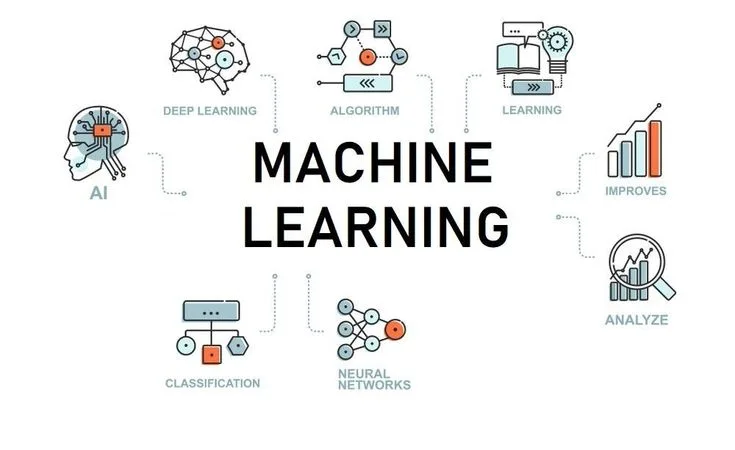
| Machine Learning (ML) | AI systems that improve through exposure to data rather than explicit programming | Subset of AI; the dominant approach in modern AI | A spam filter trained on labeled emails |
| Deep Learning | ML using neural networks with many layers that learn hierarchical representations | Subset of ML; responsible for most recent AI advances | GPT language models, image recognition systems |
| Supervised Learning | ML where models train on labeled input-output pairs | Subset of ML | Image classifier trained on photos labeled with categories |
| Unsupervised Learning | ML where models find structure in unlabeled data | Subset of ML | Clustering customer behavior patterns without predefined groups |
| Reinforcement Learning | ML where agents learn by receiving rewards for actions | Subset of ML | AlphaGo learning Go strategy through millions of self-play games |
The terminology is often confused. Clarifying relationships helps.
Artificial Intelligence (AI)
Broadest term: Making machines perform tasks that typically require human intelligence.
Scope includes:
- Reasoning and problem-solving
- Understanding language
- Recognizing patterns
- Planning and decision-making
- Learning from experience
Historical note: Term coined in 1956. Early AI used explicit rules and logic (expert systems). Modern AI relies primarily on machine learning-statistical pattern recognition from data.
Machine Learning (ML)
Subset of AI: Systems that improve automatically through experience without being explicitly programmed for every scenario.[5]
Key characteristic: Learning from data rather than following hand-coded rules.
Example distinction:
- Not ML: Chess program with hand-coded rules for every situation
- ML: Chess program that learns strategy by playing millions of games[8]
Deep Learning (DL)
Subset of ML: Using neural networks with multiple layers ("deep" networks) to learn hierarchical representations.[1]
Breakthrough: Around 2012, deep learning dramatically improved performance on image recognition, speech recognition, and language tasks where traditional ML struggled.
The Hierarchy
AI (Artificial Intelligence)
 Machine Learning
     Deep Learning
All deep learning is machine learning. All machine learning is AI. But not all AI uses machine learning, and not all machine learning uses deep learning.
How Machine Learning Actually Works: The Core Mechanism
Stripped to essentials, machine learning is optimization through trial and error at massive scale.
"Machine learning is essentially a glorified curve fitting. The magic is in the scale and the architecture, not in anything resembling thought."
Yann LeCun
The Learning Process
Step 1: Start with random guesses
Model begins with random parameters (weights). Its initial predictions are essentially random-terrible performance.
Step 2: Make predictions
Feed training examples through model. For each input, model produces prediction.
Step 3: Measure error
Compare predictions to correct answers (labels). Calculate loss-a number representing how wrong the model is.
Example:
- Model predicts house price: $250,000
- Actual price: $300,000
- Error: $50,000 (or some mathematical function of this difference)
Step 4: Adjust parameters to reduce error
Using gradient descent (calculus-based optimization), adjust model parameters slightly in direction that reduces error.
Step 5: Repeat millions of times
Process repeated across thousands or millions of examples, many times over (epochs). Gradually, parameters converge toward values that minimize prediction error.
The Key Insight
Models don't "understand" in human sense-they find statistical patterns that predict outputs from inputs.
When image recognition model identifies a cat, it's not understanding "catness"-it's detecting statistical patterns in pixels (edges, textures, shapes) that correlate with training images labeled "cat."
This works remarkably well for pattern recognition but has fundamental limitations (discussed later).
Supervised Learning: Learning from Examples
Most common ML approach: Learn from labeled examples (input-output pairs).[6]
Training data structure:
- Inputs: Features describing examples (pixel values, text, measurements)
- Outputs: Labels or values to predict (category, number, recommendation)
Process: Model learns function mapping inputs to outputs by minimizing prediction error on training examples.
Examples:
- Email spam detection: Input=email text, Output=spam or not spam
- House price prediction: Input=square footage/location/bedrooms, Output=price
- Image recognition: Input=pixel arrays, Output=object category
- Language translation: Input=sentence in English, Output=sentence in French
Generalization: Goal isn't memorizing training examples-it's learning patterns that generalize to new, unseen examples.
Challenge: Overfitting-model memorizes training data specifics rather than learning general patterns. Performs well on training data but poorly on new data.
Neural Networks: The Architecture
Neural networks are the dominant architecture for modern machine learning, especially deep learning.
Conceptual Model
Inspiration: Loosely inspired by biological neurons-connected processing units that activate based on inputs.
Reality: Mathematical simplification. Real brains vastly more complex. But the metaphor is useful.
Structure
1. Neurons (nodes)
Individual computational units. Each neuron:
- Receives multiple inputs
- Weights each input (some inputs more important)
- Sums weighted inputs
- Applies activation function (determines if neuron "fires")
- Outputs result
2. Layers
Neurons organized in layers:
- Input layer: Receives raw data
- Hidden layers: Intermediate processing (extract features)
- Output layer: Produces final prediction
3. Connections
Neurons in one layer connect to neurons in next layer. Each connection has weight-learned parameter indicating importance.
Deep Networks
"Deep" means many hidden layers (sometimes hundreds).
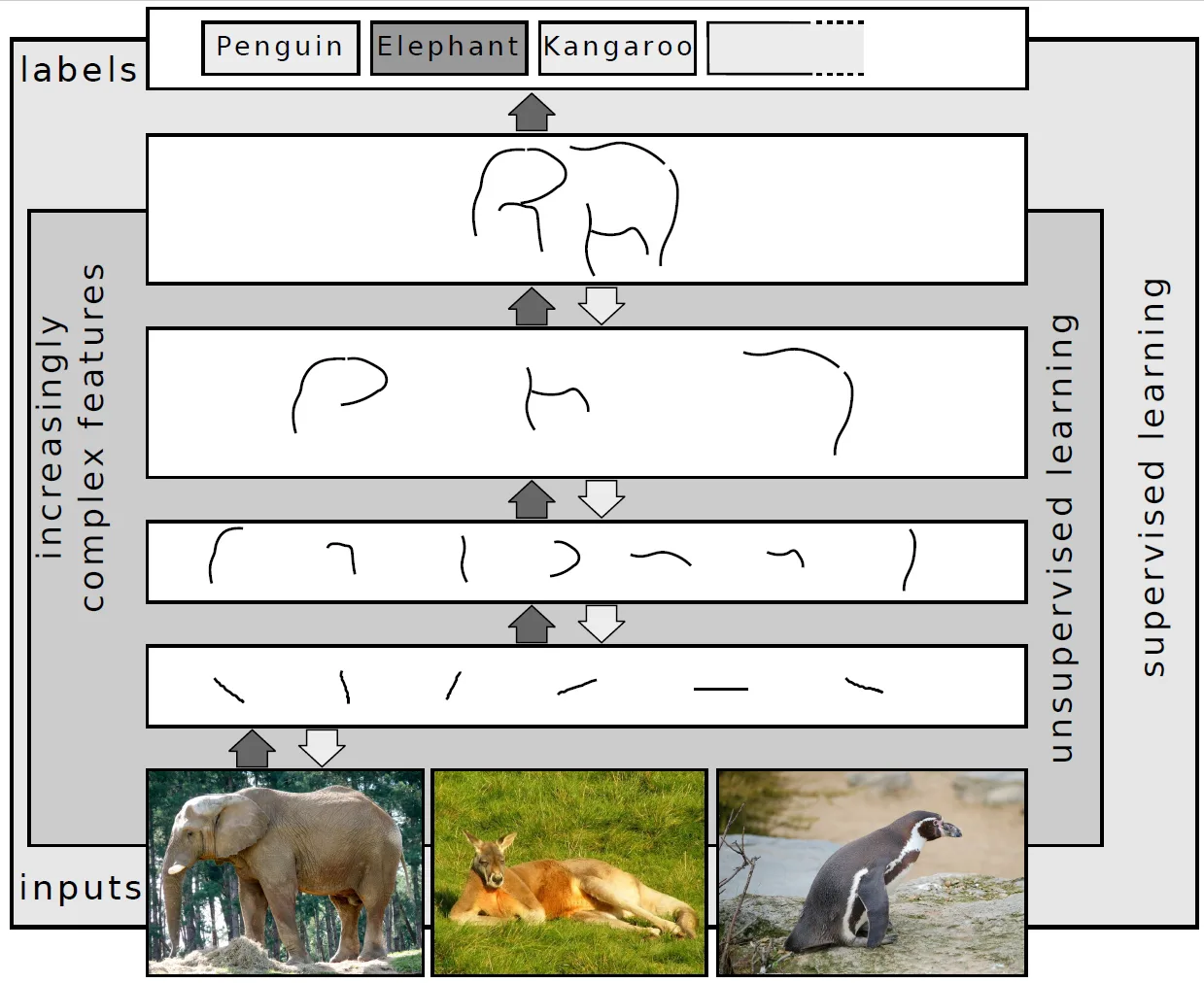
Hierarchical feature learning: Early layers learn simple patterns, later layers combine into complex concepts.
Image recognition example:
- Layer 1: Detects edges and basic shapes
- Layer 2: Combines edges into corners, curves
- Layer 3: Combines into object parts (eyes, wheels, windows)
- Layer 4: Recognizes whole objects (faces, cars, buildings)
Each layer builds on previous, learning increasingly abstract representations.
Why Deep Networks Work
Representation learning: Networks automatically learn useful features from raw data, rather than requiring human experts to design features manually.
Historical breakthrough: Before deep learning, humans had to engineer features (e.g., "design edge detectors for images"). Deep learning discovers features automatically through training.
"The hierarchy of learned representations is the key idea. At each layer, the network learns a more abstract, more compressed version of reality."
Geoffrey Hinton
Types of Machine Learning
Beyond supervised learning, other paradigms suit different problems.
Unsupervised Learning
Learning from unlabeled data-finding structure without explicit labels.
Common tasks:
1. Clustering: Grouping similar examples
Example: Customer segmentation. Input=customer behavior data. Output=customer groups with similar patterns (without pre-defined labels).
2. Dimensionality reduction: Compressing high-dimensional data while preserving structure
Example: Visualizing thousands of product features in 2D space.
3. Anomaly detection: Identifying unusual patterns
Example: Fraud detection-finding transactions that don't fit normal patterns.
Use case: Exploring data structure, preprocessing for supervised learning, discovering hidden patterns.
Reinforcement Learning
Learning through interaction-agent takes actions in environment, receives rewards or penalties, learns policy maximizing cumulative reward.[10]
Components:
- Agent: Learner/decision-maker
- Environment: What agent interacts with
- Actions: Choices agent can make
- Rewards: Feedback (positive or negative)
- Policy: Strategy mapping situations to actions
Key difference from supervised: No labeled correct answers-agent must discover good strategies through trial and error.
Examples:
- AlphaGo: Learned Go by playing against itself, receiving reward for winning
- Robotics: Robot learns to walk by trying movements and being rewarded for forward progress
- Game AI: Learns to play video games by trying actions and receiving game scores as reward
Challenge: Exploration vs. exploitation trade-off. Should agent try new actions (explore) or use known good actions (exploit)?
Semi-Supervised and Self-Supervised Learning
Semi-supervised: Small amount of labeled data, large amount of unlabeled data. Learn from both.
Self-supervised: Create pseudo-labels from data itself.
Example: Language models (like GPT) learn by predicting next word in text-labels come from text itself (next word is "answer"). No human labeling needed.
Advantage: Leverage vast amounts of unlabeled data (much cheaper than human labeling).
Training Data: The Foundation
Data quality determines model quality-no amount of algorithmic sophistication compensates for bad data.
What Makes Good Training Data
1. Representative: Covers the distribution of real-world cases model will encounter
Poor: Training self-driving car only on sunny California roads, then deploying in snowy Michigan.
2. Sufficient quantity: Enough examples to learn patterns without memorizing specifics
Rule of thumb: More complex models (more parameters) need more data. Deep learning often requires thousands to millions of examples.
3. Accurate labels: In supervised learning, labels must be correct
Example: Image dataset with mislabeled images teaches model wrong patterns.
4. Balanced: In classification, sufficient examples of each class
Problem: If 99% of training data is class A, 1% class B, model might learn to always predict A (99% "accuracy" but useless for detecting B).
5. Diverse: Captures variation in real world
Example: Face recognition trained only on certain demographics performs poorly on others.
Common Data Problems
Bias: Training data reflects existing societal biases or is systematically unrepresentative.
Example: Hiring model trained on historical hiring data learns historical biases (e.g., gender bias in tech hiring).
Noise: Errors, outliers, inconsistencies in data.
Drift: Data distribution changes over time but model trained on old distribution.
Example: E-commerce recommendation model trained pre-pandemic performs poorly during pandemic (shopping patterns changed).
Label ambiguity: Different annotators might label same example differently, introducing inconsistency.
The "Garbage In, Garbage Out" Principle
Models learn patterns in training data-good or bad.
If training data contains biased patterns, model learns bias. If data is unrepresentative, model doesn't generalize. If labels are wrong, model learns wrong answers.
No algorithm is smart enough to overcome fundamentally flawed data.
Why AI Makes Mistakes: Fundamental Limitations
Understanding failure modes is as important as understanding capabilities.
Limitation 1: Models Don't "Understand" Meaning
Models learn statistical correlations, not causal relationships or semantic understanding.
Example: Language model can generate grammatical text without understanding meaning. It predicts likely next words based on patterns, not comprehension.
Consequence: Models can be confidently wrong when asked questions outside training distribution. They don't know what they don't know.
Limitation 2: Poor Generalization Outside Training Distribution
Models interpolate well within training data distribution but extrapolate poorly outside it.
Example: Model trained on images of cats on couches might fail to recognize cat on tree-if training data lacked that context.
Adversarial examples: Slightly modified inputs (imperceptible to humans) that fool models.
Example: Adding specific noise to image causes model to confidently misclassify panda as gibbon.
Limitation 3: Brittleness and Lack of Common Sense
Models lack human common sense and reasoning.
Example: Image captioning model captions "person surfing" when shown person ironing clothes-posture is similar to surfing stance, and model lacks understanding that you don't surf indoors with an iron.
Limitation 4: Spurious Correlations
Models learn correlations that happen to exist in training data but aren't causal or meaningful.
Famous example: Tank detector trained on photos of tanks in forest. Actually learned to detect overcast skies (tank photos happened to be taken on cloudy days). Failed when tested on tanks under clear skies.
Limitation 5: Hallucinations in Generative Models
Language models generate plausible-sounding text that may be factually incorrect.
Why: Model predicts likely completions based on patterns, not truth. If training data contained misinformation or model extrapolates beyond knowledge, it generates confident falsehoods.
Consequence: Output sounds authoritative regardless of accuracy. Users must verify claims.
Limitation 6: Context and Nuance
Models struggle with context-dependent meaning, sarcasm, implication, and cultural nuance.
Example: Sentiment analysis model might classify "Yeah, right!" as positive (contains "yeah") when it's sarcastic and negative.
Evaluating Machine Learning Models
How do you know if model is good? Metrics and methods matter.
Training vs. Validation vs. Test Data
Training data: Used to train model (adjust parameters).
Validation data: Used during training to tune hyperparameters and prevent overfitting. Model doesn't directly learn from this.
Test data: Held out completely. Used only once at end to evaluate final model performance. Simulates real-world use.
Why separate: If you evaluate on training data, you measure memorization, not generalization. Test data provides unbiased estimate of real-world performance.
Common Metrics
Classification (predicting categories):
Accuracy: % of correct predictions. Simple but can be misleading with imbalanced classes.
Precision: Of predicted positives, what % are actually positive? (Minimize false positives)
Recall: Of actual positives, what % did model catch? (Minimize false negatives)
F1 Score: Harmonic mean of precision and recall. Balances both.
Example: Spam detection.
- High precision: Few good emails marked spam (low false positives)
- High recall: Catches most spam (low false negatives)
- Trade-off: Increasing one often decreases other
Regression (predicting numbers):
Mean Absolute Error (MAE): Average absolute difference between predictions and actual values.
Root Mean Squared Error (RMSE): Square root of average squared errors (penalizes large errors more).
R-squared: % of variance explained by model.
The Generalization Gap
Goal: Small gap between training performance and test performance.
Large gap indicates overfitting-model memorized training data specifics rather than learning general patterns.
Techniques to reduce overfitting:
- More training data
- Simpler model (fewer parameters)
- Regularization (penalty for complexity)
- Early stopping (stop training before memorization occurs)
- Data augmentation (create variations of training examples)
Practical Considerations for Using AI
You don't need to build models to use AI effectively. But conceptual understanding prevents misuse.
When Machine Learning is Appropriate
Good fit:
- Pattern recognition tasks with large datasets
- Problems where defining explicit rules is difficult
- Repeated decisions at scale
- Optimizing measurable outcomes
- Tasks where human performance exists but is expensive or slow
Poor fit:
- Small datasets (statistical learning needs data)
- Needing explainability for every decision (deep learning is black box)
- One-off unique decisions
- Situations where errors are unacceptable (safety-critical without fallbacks)
- Tasks requiring true reasoning or common sense
Understanding Model Confidence
High confidence does not equal correctness. Models output confidence scores, but these are calibration estimates, not certainty.
Example: Model predicts "cat" with 99% confidence. This means: "Based on training data, inputs like this were cats 99% of the time." Doesn't mean this specific prediction is definitely correct.
Overconfidence problem: Models can be very confident about wrong predictions, especially for inputs unlike training data.
The Human-in-the-Loop Principle
For high-stakes decisions, use AI as decision support, not decision replacement.
Framework:
- AI provides predictions/recommendations
- Humans review and make final decisions
- Humans can override AI when context warrants
- Track cases where humans override to improve model
Example: Medical diagnosis. AI suggests possible conditions based on symptoms and scans. Doctor reviews, applies clinical judgment, orders confirmatory tests, makes final diagnosis.
Continuous Monitoring and Updating
Models degrade over time as real-world distributions shift.
Solution: Monitor performance on new data. Retrain periodically with recent data. Update when performance degrades.
Example: Fraud detection model. Fraudsters adapt to detection, creating new attack patterns. Model must be retrained regularly on new fraud examples.
The Path Forward: Developing AI Literacy
You don't need PhD in machine learning to work effectively with AI. But conceptual understanding matters.
Essential Mental Models
1. Pattern matching, not reasoning: Models find statistical patterns, they don't reason about causation or meaning.
2. Garbage in, garbage out: Data quality determines model quality. No algorithm overcomes bad data.
3. Interpolation, not extrapolation: Models work well within training distribution, poorly outside it.
4. Confidence does not equal correctness: Models can be confidently wrong.
5. Brittleness: Small input changes can cause large output changes. Lack human robustness.
6. Tool, not magic: ML is sophisticated pattern matching, not general intelligence.
Questions to Ask About AI Systems
About training data:
- What data was model trained on?
- Is training data representative of use case?
- What biases might exist in data?
- How was data labeled? By whom?
About performance:
- How is model evaluated? What metrics?
- What's performance on test data (not just training)?
- What failure modes exist? When does model perform poorly?
- How well-calibrated are confidence scores?
About deployment:
- How is model monitored in production?
- What's the human oversight process?
- How are errors detected and corrected?
- How often is model retrained?
Building Intuition
Experiment with AI tools: Use ChatGPT, image generators, etc. Observe where they succeed and fail. Develop intuition for capabilities and limitations.
Read case studies: Learn from others' successes and failures implementing ML.
Focus on problem definition: Often the hardest part isn't ML technique but clearly defining problem, identifying right data, and designing appropriate evaluation.
Conclusion: Intelligence Through Data, Not Magic
Machine learning represents a genuine breakthrough-systems that learn from experience rather than explicit programming, achieving super-human performance on many pattern recognition tasks. But it's not artificial general intelligence or consciousness. It's sophisticated statistical pattern matching.
The key insights:
1. Machine learning is optimization at scale-models start random, make predictions, measure errors, adjust parameters to minimize error, repeated millions of times until converging on good parameter values.
2. Neural networks learn hierarchical representations-layers extract increasingly abstract features from raw data, automatically discovering useful patterns without human feature engineering.
3. Training data is the foundation-model quality is bounded by data quality. Representative, sufficient, accurate, balanced data is essential. Biased or unrepresentative data produces biased or poorly generalizing models.
4. Models don't understand meaning-they learn statistical correlations, not causal relationships or semantic understanding. This works remarkably well for pattern recognition but has fundamental limitations.
5. Failures are systematic and predictable-models struggle with distribution shifts, adversarial inputs, spurious correlations, lack of common sense, and confident hallucinations. Understanding these limitations is as important as understanding capabilities.
6. Different learning paradigms suit different problems-supervised learning for labeled data, unsupervised for finding structure, reinforcement for sequential decision-making, self-supervised for leveraging unlabeled data.
7. Evaluation and monitoring matter-separate train/validation/test data, use appropriate metrics, monitor production performance, retrain as distributions drift. Models degrade without maintenance.
AlphaGo's move 37 wasn't creativity in human sense-it was a pattern learned from self-play training that humans hadn't discovered in millennia. But the result was functionally equivalent to creative insight: finding a superior strategy through learning rather than being programmed.
That's both the promise and limitation of machine learning: superhuman pattern recognition without human understanding. As Rodney Brooks (robotics pioneer) observes: "AI is not magic. It is just statistics." But statistics at unprecedented scale, with unprecedented results.
The question isn't whether to use machine learning-it's already embedded in tools you use daily. The question is whether you understand it well enough to use it effectively, evaluate its outputs critically, and recognize its appropriate domain of application.
That understanding doesn't require mastering the mathematics. It requires grasping the core concepts: learning from data, pattern recognition, limitations, evaluation, and the fundamental distinction between statistical correlation and true comprehension.
"The goal is to develop machines that can learn, not just execute. The distinction is crucial."
Andrew Ng
What Research Shows About Machine Learning Capabilities and Limits
The academic literature on machine learning has grown dramatically since the 2012 ImageNet breakthrough, when AlexNet - a deep convolutional neural network built by Alex Krizhevsky and Ilya Sutskever under the supervision of Geoffrey Hinton - reduced the image classification error rate from roughly 26 percent to 15 percent in a single year, exceeding the previous state of the art by a margin that shocked the research community.
Hinton, who received the 2018 Turing Award jointly with Yann LeCun and Yoshua Bengio for their foundational contributions to deep learning, has described the 2012 moment as the point at which the field pivoted from incremental improvement to rapid transformation.
The landmark 2015 paper by Yann LeCun, Yoshua Bengio, and Geoffrey Hinton in Nature, titled "Deep Learning," synthesized the theoretical foundations and empirical results that had transformed computer vision, speech recognition, and natural language processing.[3]
The paper established that hierarchical representation learning - the ability of deep networks to build complex feature representations from simpler ones across multiple layers - was the mechanism responsible for deep learning's performance advantage over prior approaches.
LeCun's earlier work on convolutional neural networks, developed in the late 1980s and applied to postal check reading at AT&T Bell Labs in the 1990s, provided the architectural foundation that ImageNet research validated at scale.
Stuart Russell's research program on AI alignment, articulated in his 2019 book Human Compatible and in technical papers published with colleagues at UC Berkeley's Center for Human-Compatible AI (CHAI), has produced a formal analysis of why standard reinforcement learning approaches to AI development face fundamental alignment challenges.[7]
Russell's key finding: systems trained to maximize a fixed reward function will, if sufficiently capable, optimize that function in ways that conflict with human values that the reward function imperfectly captures.
He calls this the "King Midas problem" - the mythological king received exactly what he wished for (that everything he touched turned to gold) with catastrophic results because his wish was an imperfect specification of what he actually wanted.
Russell's central proposed corrective is what he calls "assistance games" (also known as cooperative inverse reinforcement learning): systems designed to remain explicitly uncertain about human preferences and to treat learning what humans actually want as an ongoing part of the task, rather than optimizing a fixed, pre-specified objective. This general research direction - building in uncertainty about the objective rather than assuming it is correctly specified - has influenced AI safety programs at DeepMind, OpenAI, and Anthropic.
Andrew Ng, formerly head of Google Brain and Baidu AI, and founder of DeepLearning.AI, has contributed empirical research on the practical limitations of machine learning in enterprise deployment.
His concept of "AI transformation" - the process by which established companies build and deploy ML capabilities - is grounded in case studies showing that data quality and problem formulation are the primary determinants of AI project success, accounting for more variance in outcomes than model architecture choices.
Ng has repeatedly estimated that around 80 percent of the practical work in a typical ML project is spent on data preparation, feature engineering, and problem framing rather than model development itself, an observation that has influenced how AI investment is allocated at organizations that have adopted his "data-centric AI" framework.
Research on AI benchmark performance and its relationship to real-world capability has produced increasingly important findings as benchmark scores have grown dramatically.
A 2022 paper by Aarohi Srivastava and 444 co-authors, "Beyond the Imitation Game Benchmark" (BIG-Bench), evaluated 200+ language model tasks and found a consistent pattern: models that appeared to achieve human-level performance on aggregate benchmarks showed large within-benchmark variance, with some subtasks showing near-perfect performance and others near-random performance.
The pattern suggested that benchmark scores measured performance on the kinds of tasks that appear in benchmarks rather than general capability.
Ernest Davis at NYU and Gary Marcus have documented specific cases where large language models achieve superhuman performance on some tasks while failing on trivial variants of the same tasks - a pattern inconsistent with the general reasoning ability that benchmark performance might suggest.
Real-World Case Studies in Machine Learning Applications
DeepMind's AlphaFold: ML Solving a 50-Year Scientific Problem. DeepMind's AlphaFold2 system, described in a 2021 Nature paper by John Jumper and colleagues, achieved breakthrough performance on the protein structure prediction problem - predicting the three-dimensional shape of a protein from its amino acid sequence.
The problem had defeated the scientific community for 50 years. AlphaFold2 achieved accuracy that matched experimental methods (X-ray crystallography, cryo-electron microscopy) on the Critical Assessment of Protein Structure Prediction (CASP) benchmark, with median backbone accuracy of approximately 0.96 angstroms - effectively solving CASP.
By 2022, DeepMind had published predicted structures for over 200 million proteins in a freely accessible database, covering essentially every known protein.
The scientific impact has been described by Nobel laureate Venki Ramakrishnan as "a stunning advance" that will accelerate drug discovery and basic biology research for decades.
AlphaFold represents ML at its strongest: a well-defined optimization problem with clear evaluation criteria, a massive high-quality training dataset (the Protein Data Bank), and a domain where human expert performance had a measurable ceiling.
Google's RankBrain: ML for Query Understanding at Scale. Google's RankBrain, introduced in 2015 and confirmed publicly by Google's Gary Illyes, represented the first large-scale deployment of neural network-based query understanding in search ranking.
RankBrain addressed a specific problem: approximately 15 percent of Google's daily search queries were queries the system had never seen before - novel combinations of words for which no historical data existed to guide ranking.
RankBrain used word vector representations (derived from techniques similar to Word2Vec, developed by Google researcher Tomas Mikolov) to map novel queries to related queries for which ranking signal existed. The system enabled more accurate interpretation of ambiguous, long-tail, and never-before-seen queries.
Google's Danny Sullivan and John Mueller have noted in various public communications that RankBrain became the third most important ranking factor (behind links and content) within a year of deployment - a rapid adoption rate enabled by clear performance measurement on held-out query sets.
Netflix Recommendation System: Collaborative Filtering at Scale. Netflix's recommendation system, which the company credits with driving approximately 80 percent of viewing hours, represents one of the most influential commercial ML deployments in the entertainment industry.
The system's architecture, described in technical papers by Xavier Amatriain and Justin Basilico and in the Netflix Tech Blog, combines collaborative filtering (identifying users with similar taste profiles and recommending items that similar users enjoyed) with content-based features (genre, director, actors, visual style) and temporal dynamics (recent viewing history weighted more heavily than older history).
The Netflix Prize competition (2006-2009), which offered $1 million for a 10 percent improvement in recommendation accuracy, was instrumental in advancing collaborative filtering research - the winning entry combined dozens of algorithms, contributing methods that Netflix subsequently incorporated into its production system.
The competition also illustrated an important ML research principle: combining multiple diverse models (an ensemble) consistently outperforms any single model, a finding that has generalized to many production ML applications.
IBM Watson at MD Anderson: An Expensive Cautionary Tale. IBM's Watson supercomputer, which famously defeated human champions on Jeopardy! in 2011, was subsequently positioned as a medical AI system capable of assisting oncologists with treatment decisions.
IBM entered a partnership with MD Anderson Cancer Center in 2013 to develop a "Cognitive Computing" system for leukemia treatment recommendations. The project was terminated in 2017 after spending approximately $62 million, according to an audit by the University of Texas System.
The audit found that the system was "not ready for human use" - it had been trained primarily on hypothetical patient cases rather than real patient records, and its recommendations conflicted with those of MD Anderson physicians in ways the clinical team could not explain or validate.
The failure was attributed to multiple factors: overpromising by IBM's marketing relative to actual system capabilities, a mismatch between the training data (hypothetical cases) and the deployment population (real patients with complex comorbidities), and inadequate validation methodology.
The Watson for Oncology case is now a standard reference for the gap between AI demonstration performance and deployment-ready clinical AI.
Tesla Autopilot: The Distribution Shift Problem in Safety-Critical Deployment. Tesla's Autopilot driver assistance system has been involved in multiple documented accidents where the system failed to detect obstacles that human drivers would have recognized: a white truck trailer against a bright sky (2016), a concrete highway barrier (2018), stationary vehicles in the road (multiple incidents).
NHTSA investigations of these incidents have identified a consistent pattern: the system's performance degraded in conditions that differed from those well-represented in its training data.
Yann LeCun has cited the autonomous vehicle challenge as a primary example of why systems trained purely on passive data collection cannot achieve the robustness required for safety-critical applications - a car that has been driven billions of miles will still have seen relatively few instances of the exact edge cases that cause accidents, precisely because those cases are rare.
Tesla's "fleet learning" approach, in which all vehicles contribute data to system improvement, addresses this through data volume but not through the fundamental limitation that rare events remain rare regardless of fleet size.
Common Mistakes in Understanding Machine Learning
Mistake 1: Assuming Accuracy Metrics Transfer Across Populations. A well-documented failure in applied ML is deploying systems based on accuracy benchmarks measured on populations that differ from the deployment population.
Medical AI research has been particularly susceptible: a 2019 review in The Lancet Digital Health by Eric Topol and colleagues examined 82 published deep learning studies in medicine and found that only a small minority had been validated with external, independently collected data rather than held-out data from the same source distribution. A separate 2019 study by Kim and colleagues, reviewing 516 published deep learning diagnostic studies, found that only about 6 percent used genuine external validation.
Both studies point to the same underlying problem: accuracy figures reported on held-out data from the same source distribution - accuracy that frequently does not replicate on patients from different hospitals, demographic backgrounds, or geographic locations.
Timnit Gebru's work on model documentation (specifically her "Model Cards" framework, published with Margaret Mitchell and colleagues at Google) proposed systematic reporting of performance across subpopulations as a standard practice for responsible ML deployment - addressing the population mismatch problem through transparency about where systems have and have not been validated.
Mistake 2: Treating High Benchmark Scores as Evidence of General Intelligence. The field's increasing ability to achieve human-level or superhuman performance on specific benchmarks has generated a tendency to interpret benchmark results as evidence of general reasoning capability.
Gary Marcus and Ernest Davis have published extensively on why this interpretation is not supported by the evidence.[4]
Their analysis of large language model failures on logical reasoning, physical commonsense, and mathematical tasks demonstrates that high performance on tasks similar to the training distribution coexists with systematic failure on superficially similar tasks that require genuine reasoning rather than pattern matching.
Yann LeCun has argued that current systems are "impostors" - they produce outputs that look like reasoning without the underlying causal and world-model structures that reasoning requires.
The practical implication for organizations deploying ML systems: benchmark comparisons are useful for relative evaluation but do not predict performance on tasks outside the benchmark's scope.
Mistake 3: Underestimating the Data Labeling Bottleneck. The popular narrative about machine learning emphasizes algorithmic breakthroughs while underemphasizing the labeling work that produces training data.
Andrew Ng's research on data-centric AI, published in papers and articulated through his DeepLearning.AI educational programs, argues that the most impactful interventions for improving deployed ML systems are typically improvements to training data quality and labeling consistency rather than architectural changes.
His case studies show that systematically improving label quality - ensuring that ambiguous examples are labeled consistently according to clear guidelines - frequently produces larger performance improvements than switching between model architectures.
This finding challenges the "bigger model" narrative dominant in AI research journalism and points to human labeling work as an underappreciated determinant of system quality.
Sources & Further Reading
- Goodfellow, I., Bengio, Y., & Courville, A. (2016). Deep learning. MIT Press. View source
- Jordan, M. I., & Mitchell, T. M. (2015). Machine learning: Trends, perspectives, and prospects. Science, 349(6245), 255-260. DOI: 10.1126/science.aaa8415
- LeCun, Y., Bengio, Y., & Hinton, G. (2015). Deep learning. Nature, 521(7553), 436-444. DOI: 10.1038/nature14539
- Marcus, G., & Davis, E. (2019). Rebooting AI: Building artificial intelligence we can trust. Pantheon Books.
- Mitchell, T. M. (1997). Machine learning. McGraw-Hill.
- Murphy, K. P. (2012). Machine learning: A probabilistic perspective. MIT Press.
- Russell, S., & Norvig, P. (2021). Artificial intelligence: A modern approach (4th ed.). Pearson.
- Samuel, A. L. (1959). Some studies in machine learning using the game of checkers. IBM Journal of Research and Development, 3(3), 210-229. DOI: 10.1147/rd.33.0210
- Silver, D., Huang, A., Maddison, C. J., Guez, A., Sifre, L., van den Driessche, G., ... & Hassabis, D. (2016). Mastering the game of Go with deep neural networks and tree search. Nature, 529(7587), 484-489. DOI: 10.1038/nature16961
- Sutton, R. S., & Barto, A. G. (2018). Reinforcement learning: An introduction (2nd ed.). MIT Press.