
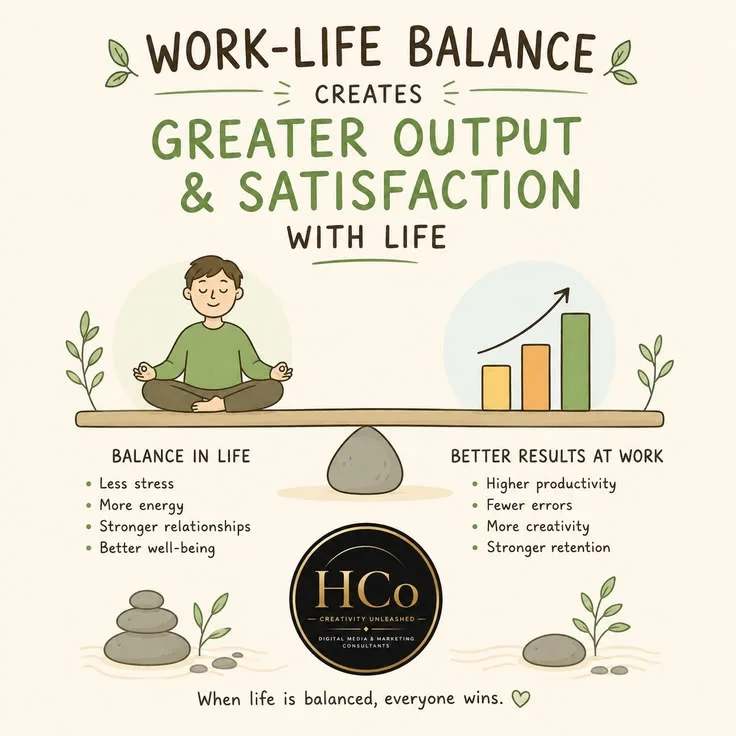
Balance between work and personal roles is a subjective fit defined by engagement, satisfaction, boundaries, and autonomy rather than equal hours. The answer to what is work-life balance distinguishes it from integration, harmony, and enrichment, and research finds that protected time off can outperform supposedly flexible but always-on expectations. Wellbeing improves when a preferred degree of separation matches the conditions a person can actually choose.
"Work-life balance" is one of those phrases that appears in almost every job listing, HR communication, and career advice column - and is almost never defined clearly. The term carries strong intuitive meaning but turns out to be surprisingly contested once you look at the research.
Does it mean equal hours? Equal attention? Equal satisfaction? And does achieving it even require working fewer hours?
This article cuts through the ambiguity to explain what work-life balance actually means, what the research says about overwork and its costs, why some models of balance work better than others, and what individuals can do with this knowledge.
Defining Work-Life Balance (and Its Alternatives)
Work-life balance in the academic literature is defined most precisely by Greenhaus, Collins, and Shaw (2003) as "the extent to which an individual is equally engaged in - and equally satisfied with - his or her work role and family role." This definition has two components: time invested and psychological satisfaction with that investment.
That definition has been challenged and refined considerably since. The key insight is that balance is not simply about equal hours. Someone who works 60 hours a week but feels energized and fulfilled may experience better balance than someone working 40 hours while feeling constantly resentful about those 40 hours.
The research literature has expanded significantly since Greenhaus et al.'s foundational definition. Clark (2000) proposed the work-family border theory, arguing that individuals are "border-crossers" who negotiate the boundaries between two distinct domains, each with its own culture and norms.
Grzywacz and Carlson (2007) argued for a behavioral approach, defining work-family balance as "the accomplishment of role-related expectations that are negotiated and shared between an individual and his or her role-related partners in the work and family domains." The common thread across these competing definitions is that balance is relational and subjective - not a fixed state defined by external standards.
Three Competing Models
| Concept | Core Idea | Key Assumption | Common Criticism |
|---|---|---|---|
| Work-life balance | Equal engagement and satisfaction in work and personal domains | The two domains can be kept appropriately separate | Assumes domains are comparable in demands and value |
| Work-life integration | Blending work and personal activities fluidly | Boundaries are permeable and that is acceptable | Can easily become "always on" for less powerful workers |
| Work-life harmony | Finding complementary rhythms between work and life | Conflict is not inevitable if timing and fit are right | Difficult to operationalize; may understate real conflicts |
| Work-life enrichment | Each domain enhances the other through resources and skills | Participation in one domain improves the other | Requires high-quality experiences in both domains |
Work-life integration became popular in the 2010s, particularly in Silicon Valley. The argument was that rigid separation was an outdated industrial-age concept. Knowledge workers could answer email on vacation if that meant they could also take a long lunch without guilt.
Critics pointed out that integration often looks like "always on" in practice, particularly for employees with less power to define their own schedules.
Perlow and Porter (2009), studying a Boston Consulting Group consulting team, found that "predictable time off" - structured, genuinely protected off-time - produced higher satisfaction and better work quality than flexibility that was nominally offered but culturally penalized when used.
Work-life harmony is more recent and popular in East Asian management contexts, drawing on ideas of natural rhythm rather than the adversarial framing implied by "balance." The Japanese concept of ikigai (reason for being), which integrates purpose across life domains, reflects a similar philosophy.
However, critics note that harmony frameworks can obscure structural inequalities - particularly around gender - that are more visible in explicit conflict models.
Work-life enrichment, formalized by Greenhaus and Powell (2006), offers perhaps the most optimistic view: participation in work can enrich family life and vice versa, through the transfer of skills, energy, mood, and identity across domains.
A lawyer who develops patience through family negotiation, or a parent whose creativity at work carries into weekend projects, exemplifies enrichment. This model shifts the question from "how do I protect one domain from the other?" to "how do I make each domain better?"
Boundary Theory: The Psychology of Separating Work and Life
One of the most useful frameworks for understanding work-life balance comes from boundary theory, developed by Blake Ashforth, Glen Kreiner, and Mel Fugate. The central idea: people manage multiple life domains by erecting psychological, temporal, and physical borders between them.
These borders vary along two dimensions:
- Flexibility: how permeable the border is - can work thoughts intrude on family time, or vice versa?
- Permeability: how much you physically cross between domains (working from home, for instance, increases permeability)
Segmenters and Integrators
On one end of the spectrum are segmenters - people who prefer strict separation. When they are at work, they think about work. When they leave, they do not check email. On the other end are integrators, who are comfortable blending domains constantly.
Research suggests neither style is inherently superior. What matters is:
- Person-environment fit: does your preferred style match your actual work conditions?
- Autonomy: are you choosing to integrate, or is integration being imposed on you?
A study by Kossek et al. (2012) found that when people's preferred boundary style matched their ability to enact it, they reported significantly higher wellbeing and lower conflict - regardless of whether they preferred integration or segmentation. The mismatch, not the style itself, is what causes distress.
This finding has important implications for hybrid and remote work policy. Mandating either integration (work from home, be flexible about hours) or segmentation (mandatory office days, no remote options) ignores the distributional reality that workers vary in their needs.
Organizations that offer genuine choice produce better outcomes than those that impose one model uniformly.
"The most harmful arrangement is not high-boundary or low-boundary work - it is a workplace that claims to support one style while delivering the other." - adapted from Kossek, Noe, and DeMarr, boundary theory research
Transitions and Boundary Rituals
One underappreciated element of boundary theory is the importance of transitions - the rituals and routines that help people psychologically cross from one domain to another.
Research by Ashforth, Kreiner, and Fugate (2000) found that sharper domain boundaries (segmenter style) require more elaborate transition rituals, while integrators need fewer because their boundaries are more fluid.
The practical import: the commute, for all its costs, functions as a transition ritual for many workers. Research by Hartig et al.
(1996) and subsequent studies found that commuters who used their journey for decompression - listening to audio, reading, or simply allowing the mind to wander - arrived home more psychologically available than those who continued working (by phone) during the same period.
Remote workers who lack a physical commute need to construct equivalent transitions deliberately.
A 15-minute walk, a consistent closing routine, or a physical change of environment serves the same psychological function.
What Overwork Actually Costs: The Research
The case against chronic overwork is one of the better-established findings in occupational health research. The evidence comes from multiple methodologies and countries.
Productivity Diminishes Sharply Past 50 Hours
Economist John Pencavel's 2015 study of World War I munitions workers - one of the most-cited studies on working hours - found that output is proportional to hours only up to about 49 hours per week. Beyond that threshold, productivity per hour drops sharply.
His analysis found that a worker at 70 hours per week produces almost no additional output compared to one working 55 hours. The extra 15 hours are largely lost to fatigue, errors, and cognitive depletion.
More recent studies in knowledge work reach similar conclusions. A Harvard Business Review analysis by Erin Reid found that managers could not reliably distinguish between employees who actually worked 80 hours per week and those who only pretended to.
Output measures showed no significant difference - a finding that cuts at the heart of the "face time" culture in many professional services firms.
Schor (1991), in The Overworked American, documented the long-term historical trend toward longer working hours in the US - a trend that contradicts the economic prediction that rising productivity would translate into increased leisure.
Instead, productivity gains have largely been captured as additional output rather than reduced working time.
This structural tendency means that the societal forces pushing toward overwork are strong and require deliberate individual and policy countermeasures.
Health Consequences Are Severe
A landmark 2021 study by the World Health Organization and International Labour Organization - the largest of its kind - analyzed data from 194 countries and found:
- Working 55 or more hours per week was associated with a 35% higher risk of stroke and a 17% higher risk of ischemic heart disease compared to working 35-40 hours
- An estimated 745,000 deaths in 2016 were attributable to overwork-related stroke and heart disease
- The burden fell disproportionately on men (72% of deaths) and workers in South-East Asia and the Western Pacific
The mechanism is primarily chronic stress activating the hypothalamic-pituitary-adrenal axis, elevating cortisol, and creating sustained cardiovascular strain.
Cortisol elevation from chronic work stress also impairs immune function (Segerstrom and Miller, 2004), reduces hippocampal volume (Lupien et al., 1998), and disrupts metabolic regulation - a constellation of effects that extend well beyond cardiovascular disease.
The Japanese have a specific word - karoshi - for death from overwork. The phenomenon was formally recognized as a compensable occupational cause of death in Japan in 1987.
Annual karoshi statistics in Japan consistently identify several hundred to over a thousand deaths per year from this cause, though researchers believe underreporting is substantial.
Sleep Deprivation Compounds Everything
Long work hours almost universally compress sleep. Research by Matthew Walker (University of California, Berkeley) and others documents that sleeping fewer than 7 hours per night for multiple consecutive nights:
- Reduces cognitive performance to a degree equivalent to legal intoxication
- Impairs prefrontal cortex function (planning, decision-making, impulse control)
- Creates deficits that accumulate - weekend sleep does not fully compensate for weekday losses
Critically, sleep-deprived individuals are poor judges of their own impairment. People who are significantly cognitively impaired by sleep deprivation consistently rate their own performance as adequate (Van Dongen et al., 2003).
This creates a dangerous self-reinforcing cycle: workers who chronically undersleep believe they are performing adequately and therefore see no reason to change their behavior.
The RAND Corporation (2016) estimated that sleep deprivation costs the US economy approximately $411 billion per year in lost productivity - more than the losses attributable to any other single health behavior. Japan loses $138 billion annually, Germany $60 billion.
These figures make sleep investment an economic issue, not merely a personal health choice.
The Relationship Between Hours and Happiness
Beyond health and productivity, long working hours have documented effects on subjective wellbeing. Research by Kahneman et al.
(2004), using the Day Reconstruction Method to capture how people actually feel during different daily activities, found that time spent at work is consistently rated among the least enjoyable portions of the day. This finding was robust across income levels, occupations, and genders.
Notably, this does not mean work itself is inherently unpleasant - research on engaged workers shows high work satisfaction. The hedonic penalty attaches specifically to involuntary overwork - the hours worked beyond personal preference, under conditions of insufficient control.
The distinction between chosen long hours and imposed long hours matters substantially for wellbeing outcomes.
Who Has Work-Life Balance (and Who Does Not)
Work-life balance is not distributed equally. Several structural factors predict who is more likely to achieve it.
Occupational Autonomy
Research consistently finds that schedule control is one of the strongest predictors of work-life satisfaction - stronger than total hours worked in some studies. Workers who control when and where they work can align their schedules with personal needs, regardless of how many hours they put in.
Professionals with high autonomy (doctors, lawyers in private practice, senior executives, freelancers) often work very long hours but report reasonable balance.
Workers in rigid shift structures - retail, hospitality, healthcare support - have low hours but poor balance when their schedules are unpredictable and noncontiguous with family needs.
Clarkberg and Moen (2001) analyzed longitudinal data from the Cornell Couples and Careers Study and found that schedule flexibility predicted work-family conflict more strongly than hours worked.
A worker with 45 hours but flexible scheduling reported less conflict than a worker with 35 hours but mandatory fixed shifts that clashed with school pickups.
Gender and Caregiving
Research from the Bureau of Labor Statistics American Time Use Survey consistently finds that women perform significantly more unpaid domestic and caregiving labor than men, regardless of employment status.
Working mothers face a "second shift" - a term introduced by sociologist Arlie Hochschild in her 1989 book of the same name - that their male counterparts largely do not.
This structural reality means that the same paid working hours represent different total demands on time and energy depending on caregiving responsibilities.
A 2019 McKinsey/LeanIn.org Women in the Workplace study found that women in corporate settings were significantly more likely to report that work-life balance was difficult to achieve, even controlling for job level and hours.
The study documented the "broken rung" phenomenon: women are less likely to be promoted into first-level management roles, which means they have less schedule control precisely at the life stage (early 30s) when caregiving demands are typically highest.
Internationally, the picture varies significantly by country. The OECD Better Life Index documents wide variation in work-life balance across member countries. The Netherlands, Denmark, and France consistently rank highest; the US, Mexico, and South Korea consistently rank lowest.
The differences track national policies on parental leave, childcare subsidies, and maximum working hours - suggesting that national policy shapes what individual balance is achievable, independent of individual choices.
| Country | Average Annual Hours Worked | Work-Life Balance Index Rank (OECD) |
|---|---|---|
| Netherlands | 1,427 | 1st |
| Denmark | 1,470 | 3rd |
| France | 1,490 | 5th |
| UK | 1,538 | 18th |
| US | 1,791 | 30th |
| Mexico | 2,128 | 38th |
Source: OECD Better Life Index and OECD Average Annual Hours Actually Worked, 2022 data
Remote and Hybrid Work
The COVID-19 pandemic produced a natural experiment in mass remote work. The results were mixed. Multiple studies found that remote work reduced commuting time (average 27 minutes each way in the US, per Census data) and increased schedule flexibility.
However, many remote workers reported longer working hours and greater difficulty psychologically detaching from work when home and office occupied the same space.
A study by Barrero, Bloom, and Davis (2021) analyzing time-use data from over 30,000 Americans found that workers saved on average 72 minutes per day by not commuting, but only 40% of that time was allocated to increased work - the rest went to personal activities.
This pattern suggests that remote work can genuinely benefit work-life balance, but only when workers actively claim the time savings rather than allowing them to be recaptured by work.
The boundary theory prediction - that permeability without intentional compensation measures erodes recovery - appears to have been confirmed.
Studies of "work-from-home" fatigue during 2020-2021 found a distinctive pattern: initial productivity and satisfaction gains that eroded over six to twelve months as the boundaries between work and home life collapsed.
Practical Approaches That Research Supports
Define Your Non-Negotiables
Researchers studying sustainable high performance - including those studying elite athletes - find that deliberate recovery periods are essential. The analogy with training is apt: athletes do not train at maximum intensity every day. They alternate intense effort with structured recovery.
Periodization theory in sports science (Matveyev, 1981) holds that performance improvements come from the recovery phase, not the training phase alone. The same principle applies to cognitive performance.
The practical implication: identifying specific recovery commitments (an evening routine, a non-work morning activity, a weekend without laptop) and treating them as non-negotiable rather than "earned" after sufficient productivity.
Research by Sonnentag and Bayer (2005) found that workers who designated specific non-work periods as "sacrosanct" showed better recovery and lower next-day fatigue than those who took unstructured recovery time.
The structure itself - the commitment - appears to reduce the cognitive cost of the decision about when to stop working.
Psychological Detachment
Sabine Sonnentag's research identifies psychological detachment - mentally disengaging from work during off-hours - as one of the most important recovery mechanisms. It predicts next-day energy, creativity, and emotional availability. Strategies that support detachment include:
- A consistent "shutdown ritual" (reviewing tomorrow's plan, closing applications, writing a brief handover note to yourself)
- Leaving work-related items at or near the workspace
- Engaging in activities that require enough attention to crowd out work thoughts
Passive activities like watching television provide low detachment for many people. Physical activity, social interaction, and engaging hobbies tend to produce higher detachment. Sonnentag et al.
(2008) found that mastery experiences outside work - activities that provide competence and challenge outside the occupational domain - were particularly restorative for workers showing high work engagement, suggesting that the skill-building aspect of hobbies has psychological value beyond simple relaxation.
Negotiating Boundary Conditions
Individuals can actively negotiate boundary conditions with employers and clients. This is not primarily about hours - it is about responsiveness expectations. A clear agreement that non-urgent communications will not receive responses outside working hours is more effective than vague attempts to "not check email on weekends."
Research on "always-on" cultures by Erin Reid and Lakshmi Ramarajan (2016) found that when leaders modeled boundary-setting behavior, employees felt significantly more empowered to do the same. The signal sent by a senior leader who does not respond to messages at 10pm is more powerful than any formal policy.
Conversely, leaders who respond to messages at midnight - even with no explicit expectation that others will do the same - implicitly signal that those hours are "available" for work.
Perlow (2012) documented how a deliberate, team-level agreement about off-time at a consulting firm - her "Predictable Time Off" experiment - improved both job performance and job satisfaction simultaneously.
The key mechanism was collective commitment: individual boundary-setting is difficult when organizational norms have not shifted, but collective norm change is achievable through deliberate coordination.
The Role of Organizations
Individual strategies have limits. Evidence increasingly points to organizational-level interventions as more effective than advice to individuals:
- A Microsoft Japan experiment with a four-day week (2019) found productivity increased 40%
- Iceland's 2015-2019 trial of reduced hours (35-36 hours/week for public sector workers) found equivalent or improved productivity with substantially better worker wellbeing
- Companies implementing mandatory time-off policies (not just offering them) see higher utilization and better retention. A US Travel Association study found that workers with mandated minimum leave requirements used more leave than those with unlimited policies - a counterintuitive finding explained by the decision-fatigue and social-signaling costs of unlimited leave.
- A 2022 Autonomy UK report on 61 companies completing a six-month four-day work week trial found that 92% of companies planned to continue the policy, with revenue increasing 1.4% on average and sick days falling 65%.
The challenge is that these interventions require leadership commitment and cultural change, not just policy updates. Organizations that announce flexible policies without changing the informal norms that penalize their use produce negligible change in actual behavior.
The gap between stated policy and lived culture is where most work-life balance programs fail.
Work-Life Balance Across Career Stages
Work-life balance needs and realities change significantly across a career.
Early career (20s-early 30s): Typically fewer caregiving obligations but often longer working hours as people establish themselves. Research suggests this is when long-term patterns are set. Those who establish norms of overwork early find them harder to break later.
Bidwell, Won, Barbulescu, and Mollick (2015) found that early-career norms of overwork become embedded in professional identity in ways that persist even when external demands reduce.
The person who worked 80-hour weeks at 25 often continues working long hours at 40 not because the job requires it, but because it has become how they understand what it means to be a dedicated professional.
Mid-career (mid-30s-late 40s): Often the most demanding phase - peak caregiving obligations (children, sometimes aging parents) coinciding with peak career demands. This is when balance breakdowns are most common and most costly.
Research by Barnett and Hyde (2001) found that multiple roles - parent, partner, worker - can be depleting or enriching depending on the quality of each role experience and the resources available. The mid-career squeeze is a real structural problem, not a personal failure of planning.
Late career (50s+): Caregiving obligations often decrease; accumulated skills and reputation may confer more autonomy. However, health consequences of prior overwork may become apparent, and many people report this is when they recalibrate priorities.
Research by Carstensen (2006) on socioemotional selectivity theory found that people become more present-oriented and relationally focused as they perceive life's horizon, leading to natural prioritization shifts that resemble what younger workers struggle to implement deliberately.
What the Research Does Not Show
It is worth being precise about limits:
- Research does not show that working fewer hours always produces more output. The relationship is nonlinear, not inverse. 40 hours typically produces more than 20; 70 often produces less than 50.
- Research does not show that work-life integration is always harmful. For people with genuine schedule autonomy who choose integration, it can work well.
- Research does not show that all jobs can achieve balance. Some roles - emergency medicine, early-stage startup founding, certain caregiving professions - involve genuine demands that resist easy balancing. In these cases, the question is whether the trade-off is worthwhile and whether it is sustainable over the required duration.
- Research does not show that everyone's optimal balance is the same. Individual differences in values, personality, and life circumstances produce different authentic balance points. A person who finds deep meaning in work and whose family structure supports intensive professional engagement may genuinely thrive with what others would experience as imbalance.
The Hidden Costs of "Balance Guilt"
One underexplored dimension of work-life balance research is the psychological cost of the ideal itself.
Research by Kelliher, Richardson, and Boiarintseva (2019) found that flexible working policies, while generally beneficial, can paradoxically increase the sense of obligation among workers who use them - leading to longer hours and reduced boundary maintenance as workers feel they must "earn" the flexibility they have been granted.
This suggests that framing balance as an individual achievement - something to be managed and optimized - can itself become a source of stress and self-criticism that undermines the wellbeing it is meant to support.
Balance understood as a personal discipline project, in which any deviation represents personal failure, may be more exhausting than the imbalance it replaces.
The more sustainable framing, supported by the research, is that balance is a negotiated relationship with structural conditions - something influenced by personal choices but also by employer policy, economic circumstances, caregiving responsibilities, and social norms.
This framing reduces individual blame and points toward collective and structural solutions alongside personal strategies.
Conclusion: Balance as a System Problem
The most important insight from the research is that work-life balance is fundamentally a systems problem, not a personal discipline problem.
Individual choices matter - boundary-setting, recovery habits, negotiating expectations - but they operate within structural constraints set by employers, industries, economic systems, and caregiving arrangements.
The consistent finding that autonomy and predictability matter more than total hours challenges the conventional advice to "work smarter, not longer." The more actionable version of that advice is: invest in the conditions that give you control over your time, even if that means slower advancement in roles that do not offer those conditions.
Balance, ultimately, is not a state you achieve and then maintain. It is an ongoing negotiation between competing demands - one made easier by clear values, structural conditions that support recovery, and the willingness to protect what matters.