
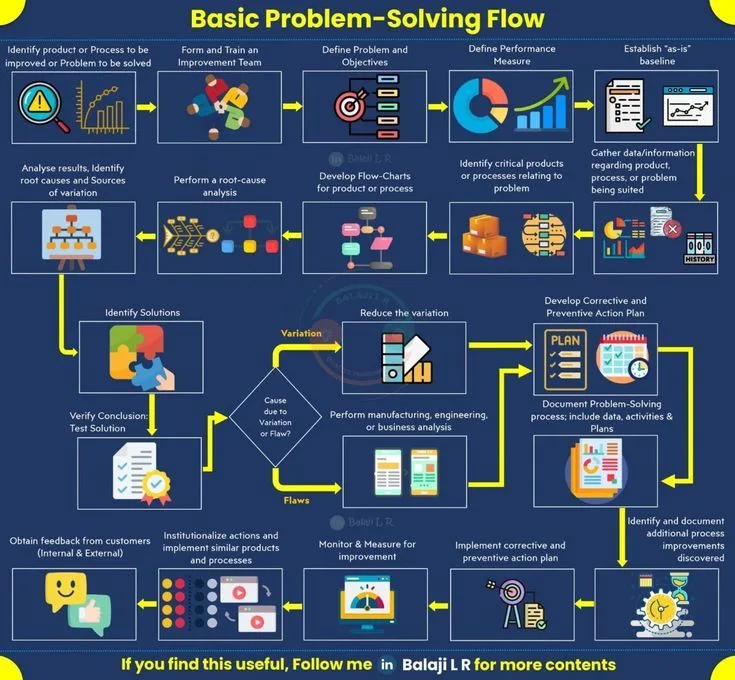
What Is a Problem-Solving Framework?
A problem-solving framework is a structured, step-by-step process for moving from a poorly understood problem to a well-defined solution - ensuring that problems are accurately diagnosed before solutions are generated, that root causes are addressed rather than symptoms treated, and that multiple options are evaluated rather than the first idea implemented.
Research consistently shows that most failed problem-solving efforts result not from weak solutions but from poor problem definition: when the problem is framed incorrectly, even technically correct solutions address the wrong issue. A framework imposes discipline on this process by making each phase explicit and sequential.
In 2010, the Deepwater Horizon oil rig exploded in the Gulf of Mexico, killing 11 workers and triggering the largest marine oil spill in history. Over 87 days, approximately 4.9 million barrels of oil poured into the Gulf before the well was sealed. The environmental, economic, and human costs were staggering.
The official investigation by the National Commission on the BP Deepwater Horizon Oil Spill and Offshore Drilling identified the root cause not as a single technical failure but as a cascade of decisions that systematically prioritized speed and cost reduction over safety.
Cement testing was skipped. Warning signs from pressure tests were misinterpreted or ignored. Safety-critical equipment had known deficiencies that were not addressed.
At each decision point, the problem was framed narrowly ("How do we save time on this cement test?") rather than broadly ("Is this well safe to proceed with?").
The Deepwater Horizon disaster illustrates a fundamental truth about problem-solving: how you define the problem determines what solutions you consider, and a poorly defined problem produces solutions that may be technically correct but strategically wrong. The cement workers who decided to skip a test solved the problem they were given (reduce delay) while creating the problem nobody had articulated (catastrophic well failure).
Structured problem-solving frameworks exist to prevent this pattern-to ensure that problems are defined clearly before solutions are generated, that root causes are identified rather than symptoms treated, that multiple solutions are considered rather than the first idea implemented, and that outcomes are evaluated and lessons learned.
This template provides a comprehensive, step-by-step framework for systematic problem-solving across any domain.
Phase 1: Problem Definition
Why Problem Definition Is the Most Critical Phase
Research on problem-solving in organizations consistently identifies poor problem definition as the most common cause of failed problem-solving efforts.
A study by Spradlin found that 85 percent of the time, companies that correctly diagnose a problem also successfully solve it, but companies that jump to solutions before understanding the problem succeed less than 25 percent of the time.
"If I had an hour to solve a problem, I'd spend 55 minutes thinking about the problem and five minutes thinking about solutions." - Albert Einstein
Albert Einstein reportedly said this, and whether he actually did is debatable, but the principle is sound: the quality of the solution depends primarily on the quality of the problem definition.
Step 1: Describe the Observable Gap
What are key steps in problem solving? The first step is describing the problem as an observable gap between the current state and the desired state, using concrete, specific language that avoids embedded assumptions about causes or solutions.
How to define problems clearly:
Describe the current state factually. What is actually happening? What are you observing? What data supports the observation? Avoid interpretations, explanations, or judgments-just describe what you see.
- Good: "Customer complaints about order delivery increased from 50 per month to 200 per month over the last quarter."
- Poor: "Our delivery system is broken." (This is a cause hypothesis, not a problem description.)
- Poor: "We need to hire more delivery drivers." (This is a solution, not a problem description.)
Describe the desired state specifically. What should be happening instead? What would success look like? What standard, target, or expectation is not being met?
- Good: "Customer complaints about delivery should be below 75 per month, consistent with our historical baseline and customer satisfaction targets."
- Poor: "We need better delivery." (Too vague to guide problem-solving.)
Articulate the gap. The problem is the gap between the current state and the desired state: "Customer delivery complaints are at 200 per month, 125 above our target of 75 per month."
Step 2: Quantify the Problem's Impact
A problem without quantified impact is hard to prioritize. Understanding the impact helps determine how much effort and resource the problem justifies and provides a baseline against which solution effectiveness can be measured.
Dimensions of impact:
- Financial: What is the cost of this problem? (Lost revenue, additional expenses, penalties, opportunity cost)
- Operational: How does this problem affect operations? (Delays, rework, capacity reduction, quality degradation)
- Customer: How does this problem affect customers? (Satisfaction reduction, churn increase, reputation damage)
- Employee: How does this problem affect employees? (Workload increase, morale decrease, turnover risk)
- Strategic: How does this problem affect strategic objectives? (Goal delay, competitive disadvantage, market position)
Step 3: Identify What You Know and Don't Know
What's the difference between problem space and solution space? The problem space is everything related to understanding the problem: what is happening, why it is happening, who is affected, and what the constraints are.
The solution space is everything related to fixing the problem: what interventions are possible, what resources are required, and what trade-offs are involved.
Effective problem-solving requires spending sufficient time in the problem space before entering the solution space. Premature entry into the solution space-jumping to "how do we fix this?" before fully understanding "what exactly is happening and why?"-is the most common problem-solving error.
This distinction is central to first principles thinking, which demands stripping a situation down to its fundamental truths before reasoning upward toward solutions.
"We cannot solve our problems with the same thinking we used when we created them." - Albert Einstein
Phase 2: Root Cause Analysis
Why Do Problem-Solving Efforts Fail?
Solving the wrong problem is the most common failure. Treating symptoms rather than causes is the second most common. A headache caused by dehydration is not solved by painkillers; the painkillers treat the symptom while the cause persists.
Similarly, a customer complaint surge caused by a systemic packaging error is not solved by adding customer service agents; the agents treat the complaints while the packaging error continues generating them.
"For every complex problem there is an answer that is clear, simple, and wrong." - H.L. Mencken
Step 4: What's Root Cause Analysis?
Root cause analysis is the process of tracing a problem backward from its observable symptoms to its fundamental underlying cause-the cause that, if eliminated, would prevent the problem from recurring.
The Five Whys technique. Developed by Sakichi Toyoda and used extensively in Toyota's production system, the Five Whys technique involves asking "why?" repeatedly until the fundamental cause is reached:
- Why are customers complaining about delivery? Because orders are arriving late.
- Why are orders arriving late? Because the warehouse is taking longer to process orders.
- Why is the warehouse taking longer? Because the picking system is frequently down.
- Why is the picking system frequently down? Because the software was updated last month and the update introduced bugs.
- Why did the software update introduce bugs? Because the update was not tested in the warehouse environment before deployment.
The root cause is not "orders arriving late" (symptom) or "warehouse taking longer" (intermediate cause) but "software updates not tested in the production environment before deployment" (root cause).
The solution that addresses the root cause (implement pre-deployment testing in the warehouse environment) prevents the problem from recurring. A solution that addresses the symptom (hire more delivery drivers) does not.
Fishbone diagrams (Ishikawa diagrams). For complex problems with multiple potential causes, fishbone diagrams organize potential causes into categories:
- People: Skill gaps, staffing levels, motivation, communication
- Process: Procedures, workflows, handoffs, approval chains
- Technology: Equipment, software, tools, infrastructure
- Materials: Inputs, supplies, data quality, information availability
- Environment: Physical conditions, market conditions, regulatory requirements
- Measurement: Metrics, data collection, monitoring, feedback mechanisms
By systematically exploring each category, fishbone diagrams reduce the risk of fixating on a single cause hypothesis and overlooking the actual root cause.
Step 5: Distinguish Causes from Contributing Factors
Not every factor that influences a problem is a root cause. Contributing factors increase the probability or severity of a problem but do not, by themselves, cause it. Root causes are the factors that, if eliminated, would prevent the problem from occurring.
Example: A project deadline was missed. Contributing factors include: one team member was sick for two days, a meeting ran long, and a stakeholder was slow to approve a design. The root cause might be: the project timeline had zero buffer for any delay, making it fragile to any disruption.
Addressing the contributing factors (preventing illness, shortening meetings, expediting approvals) would reduce the probability of future deadline misses.
Addressing the root cause (building realistic buffers into project timelines) would prevent the fundamental fragility that makes deadline misses inevitable. Understanding which factors are truly load-bearing is a core skill in analytical thinking.
Phase 3: Solution Generation
Step 6: Generate Multiple Solutions Before Evaluating Any
How do you generate better solutions? The most common solution-generation error is evaluating solutions as they are generated, which produces a premature convergence on the first acceptable idea.
The first idea is rarely the best idea; it is simply the most available idea, influenced by recency bias, familiarity, and the cognitive ease of incremental thinking.
Separate generation from evaluation. Establish a distinct generation phase during which ideas are produced without judgment, criticism, or feasibility evaluation. The goal during generation is quantity and diversity; the goal during evaluation (the next step) is quality and feasibility.
Techniques for generating diverse solutions:
Brainstorming with constraints removed. Ask: "If we had unlimited budget, unlimited time, and no organizational constraints, how would we solve this?" This question removes the self-censoring that practical constraints produce, allowing creative solutions to surface that can then be adapted to realistic constraints.
Analogical thinking. Ask: "How have similar problems been solved in other domains?" A hospital that wants to reduce patient handoff errors might study how air traffic control manages handoffs between controllers, or how nuclear power plants manage shift changes.
Inversion. Ask: "What would make this problem worse?" Then invert each answer to generate a potential solution. If "making the problem worse" includes "reducing communication between teams," then "improving communication between teams" is a potential solution direction.
Challenge assumptions. List the assumptions embedded in the current approach and challenge each one. "We assume that deliveries must be made by company-owned trucks" might be challenged, leading to solutions involving third-party logistics, customer pickup, or drone delivery.
This is the essence of first principles thinking-refusing to inherit the constraints of the status quo.
"The significant problems we face cannot be solved at the same level of thinking we were at when we created them." - Albert Einstein
Step 7: Evaluate Solutions Against Defined Criteria
Once multiple solutions have been generated, evaluate them against explicit criteria. Without explicit criteria, solutions are evaluated based on gut feeling, status quo bias, and the preferences of the most powerful person in the room. Structured decision frameworks exist precisely to override these biases.
Common evaluation criteria:
| Criterion | Question to Ask |
|---|---|
| Effectiveness | How well does this solution address the root cause? |
| Feasibility | Can we actually implement this with available resources? |
| Cost | What is the total cost of implementation (money, time, effort)? |
| Speed | How quickly can this solution be implemented? |
| Risk | What could go wrong with this solution? How reversible is it? |
| Side effects | What unintended consequences might this solution produce? |
| Sustainability | Will this solution continue to work over time, or is it temporary? |
| Scalability | Will this solution work as the organization grows? |
How to apply it: Create a simple evaluation matrix that rates each solution against each criterion on a consistent scale (1-5, low/medium/high, or similar). This structure forces systematic comparison and makes the trade-offs between solutions explicit rather than implicit.
Phase 4: Implementation
Step 8: Plan the Implementation
A good solution poorly implemented is indistinguishable from a bad solution. Implementation planning addresses the practical details that determine whether a solution actually works in practice:
What specific actions are required? Break the solution into concrete, actionable steps with clear ownership and deadlines.
What resources are needed? Identify the people, budget, tools, and organizational support required for implementation.
What are the dependencies? Identify actions that must be completed before other actions can begin.
What are the risks? Apply the same risk-thinking from Phase 2 to the implementation plan: what could go wrong during implementation, and how will you respond?
What is the rollout strategy? For solutions that affect multiple people or systems, should implementation be phased (gradual rollout), piloted (tested in a limited context before full deployment), or big-bang (everything at once)?
Step 9: Define Success Metrics Before Implementation
How will you know if the solution worked? Define success metrics that are tied to the original problem definition before implementing the solution. This prevents the common failure of declaring success based on activity (we implemented the solution) rather than outcomes (the problem was actually resolved).
Good success metrics:
- Are specific and measurable
- Are tied to the original problem description (closing the gap between current and desired state)
- Include a time horizon (when will you measure?)
- Include a threshold (what level of improvement constitutes success?)
Example: "Within 90 days of implementation, customer delivery complaints will decrease from 200 per month to 75 or fewer per month, as measured by the customer service complaint tracking system."
Phase 5: Evaluation and Learning
Step 10: Evaluate Outcomes Honestly
After implementation, measure actual outcomes against the success metrics defined in Step 9. This evaluation must be honest-resistant to confirmation bias (interpreting ambiguous data as confirming the solution's success) and sunk cost fallacy (continuing with a failed solution because of the resources already invested).
Questions for honest evaluation:
- Did the problem actually improve, as measured by the success metrics?
- Did the improvement reach the threshold defined as success?
- Did the solution produce any unintended side effects?
- Is the improvement sustainable, or did it fade after the initial implementation?
- Would the improvement have occurred without the solution (could external factors explain the change)?
"In theory, theory and practice are the same thing. In practice, they are not." - Yogi Berra
Step 11: Capture and Share Lessons Learned
What makes problem-solving templates effective? Templates are effective when they capture not just the process but the lessons generated by the process.
Every problem-solving effort produces learning: about the problem, about the organization, about the effectiveness of different solution approaches, and about the problem-solving process itself.
Lessons should be captured while the experience is fresh, documented in an accessible format, and shared with others who may face similar problems. Organizations that systematically capture and share problem-solving lessons build institutional knowledge that improves future problem-solving effectiveness.
Questions for lessons learned:
- What did we learn about the problem that we did not know before?
- What worked well in our problem-solving process?
- What would we do differently if we faced a similar problem?
- What assumptions did we make that proved correct or incorrect?
- What surprised us during the process?
The Complete Problem-Solving Framework Template
Phase 1: Problem Definition
- Problem described as observable gap (current state vs. desired state)
- Solution language avoided in problem description
- Impact quantified (financial, operational, customer, employee, strategic)
- Stakeholders and constraints identified
- Known and unknown information documented
Phase 2: Root Cause Analysis
- Five Whys or Fishbone diagram completed
- Root cause distinguished from symptoms and contributing factors
- Root cause validated with evidence (not just hypothesis)
- Multiple potential causes considered (not just first hypothesis)
Phase 3: Solution Generation
- Multiple solutions generated before any evaluation
- Solutions evaluated against explicit criteria
- Trade-offs between solutions made explicit
- Selected solution addresses root cause, not just symptoms
Phase 4: Implementation
- Implementation plan with specific actions, owners, and deadlines
- Resources and dependencies identified
- Risks and contingencies addressed
- Success metrics defined before implementation begins
Phase 5: Evaluation and Learning
- Outcomes measured against pre-defined success metrics
- Honest assessment of whether the problem was actually solved
- Unintended consequences identified and addressed
- Lessons learned captured and shared
Should You Always Use Frameworks?
Not every problem requires a formal framework. Simple problems with obvious causes and clear solutions can be solved through direct action without structured analysis. The framework is most valuable for:
- Complex problems with multiple potential causes and interconnected factors
- Important problems where the cost of a wrong solution is high
- Recurring problems that have resisted previous solution attempts
- Team problems where multiple people need to align on problem definition and solution selection
- Novel problems where the problem-solver lacks relevant experience
For simple, routine problems, the framework's overhead exceeds its value. For complex, important, or novel problems, the framework's structure prevents the cognitive shortcuts, premature convergence, and symptom-level thinking that produce ineffective solutions.
The value of a problem-solving framework is not in the framework itself but in the discipline of thinking it enforces: the discipline to understand the problem before generating solutions, to identify root causes before treating symptoms, to generate multiple options before committing to one, and to evaluate outcomes honestly rather than declaring victory based on activity.
These disciplines do not come naturally-human cognitive tendencies favor fast, intuitive problem-solving over slow, systematic analysis, a tension explored in depth in the comparison of analytical models versus intuition. The framework is a tool for overriding those tendencies when the stakes are high enough to justify the effort.
Choosing the right approach also requires knowing which mental model fits the situation. A framework designed for linear technical problems can actively mislead when applied to a complex adaptive system with feedback loops and emergent behavior.
Understanding the leverage points in systems-the places where a small change produces a large effect-requires a fundamentally different mode of analysis than tracing a simple cause-and-effect chain.
What Research Shows About Problem-Solving Frameworks
Dwayne Spradlin, in "Are You Solving the Right Problem?" (Harvard Business Review, September 2012), argued that most failed problem-solving efforts trace back to a poorly defined problem rather than a poor solution, and proposed a structured process for testing whether a problem has actually been correctly framed before committing resources to solving it.
Thomas Wedell-Wedellsborg made a related case in "Are You Solving the Right Problems?" (Harvard Business Review, January-February 2017). In a survey of executives, 85 percent said their organizations were not good at diagnosing problems correctly, and 87 percent said this had a significant business cost.
Wedell-Wedellsborg introduced "problem framing" as a distinct skill from problem-solving itself, and argued that reframing a problem before generating solutions is one of the highest-leverage steps a team can take.
Dietrich Dorner, in "The Logic of Failure" (Metropolitan Books, 1996), ran computerized simulations placing participants in charge of complex systems (a simulated town's economy, a simulated African region's development) and tracked their decisions over simulated years.
His central finding was that people who failed catastrophically were not less intelligent or less well-intentioned than those who succeeded - they failed because they generated solutions too quickly and then sought out only the information that confirmed their chosen solution, a pattern Dorner called a failure of situation analysis rather than a failure of intelligence.
Real-World Case Studies in Problem-Solving Frameworks
Toyota's A3 problem-solving report, named for the A3 paper size the complete analysis must fit on, is one of the most studied examples of a structured problem-solving format built into daily operations.
John Shook, who worked at Toyota and later documented the practice in "Toyota's Secret: The A3 Report" (MIT Sloan Management Review, Summer 2009), described how the format requires teams to document the current situation, root cause analysis, proposed countermeasures, and expected results on a single page - a constraint that forces conciseness and makes it harder to skip straight from symptom to proposed fix without an explicit root-cause step in between.
IDEO, the design and innovation firm co-founded by David Kelley, formalized the Design Thinking framework (Empathize, Define, Ideate, Prototype, Test) and has applied it across a large number of client projects spanning product design, services, and organizational change.
IDEO CEO Tim Brown documented the firm's approach and philosophy in "Change by Design" (HarperBusiness, 2009), arguing that skipping or rushing the empathize-and-define phases in favor of jumping straight to prototyping is one of the most common ways design projects go wrong.
The framework was adopted by Stanford's Hasso Plattner Institute of Design (the "d.school"), founded in 2005, which has since taught design thinking to a large number of students across many countries.
Sources & Further Reading
Spradlin, D. (2012). "Are You Solving the Right Problem?" Harvard Business Review. View source
Dorner, D. (1996). The Logic of Failure: Recognizing and Avoiding Error in Complex Situations. Metropolitan Books.
Ohno, T. (1988). Toyota Production System: Beyond Large-Scale Production. Productivity Press. View source
Wedell-Wedellsborg, T. (2017). "Are You Solving the Right Problems?" Harvard Business Review. View source
Meadows, D.H. (2008). Thinking in Systems: A Primer. Chelsea Green Publishing. View source
Ishikawa, K. (1985). What Is Total Quality Control? The Japanese Way. Prentice Hall. View source
De Bono, E. (1985). Six Thinking Hats. Little, Brown and Company. View source
Polya, G. (1945). How to Solve It. Princeton University Press. View source
National Commission on the BP Deepwater Horizon Oil Spill. (2011). Deep Water: The Gulf Oil Disaster and the Future of Offshore Drilling. View source
Sterman, J.D. (2000). Business Dynamics: Systems Thinking and Modeling for a Complex World. McGraw-Hill. View source
Kepner, C.H. & Tregoe, B.B. (1965). The Rational Manager. McGraw-Hill.
Klein, G. (1998). Sources of Power: How People Make Decisions. MIT Press. View source