
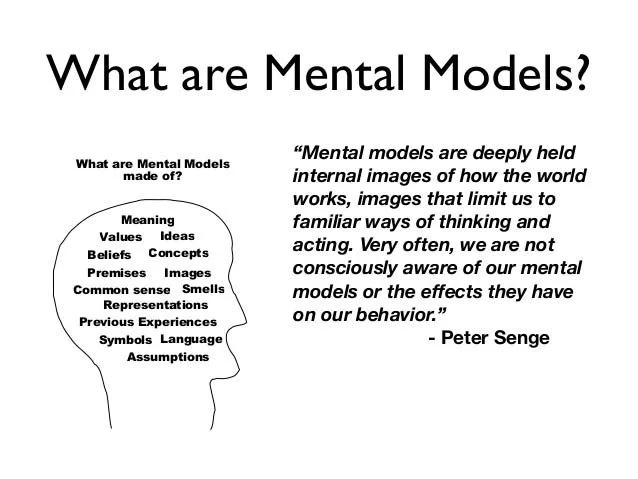
Your brain doesn't perceive reality directly. It perceives through models-simplified representations of how things work.[11] These models determine what you notice, how you interpret it, and what actions seem possible.[3]
Most mental models are invisible. You're not aware you're using them. They're just "how things are." This invisibility creates a problem: if your models are flawed, your thinking is flawed-and you won't notice.
Understanding mental models-what they are, how they work, why they matter-is foundational to thinking clearly.
This article covers the cognitive-science foundation: what a mental model fundamentally is, how it works in the mind, the different types, and how models fail, illustrated with real system-failure case studies. For a practical toolkit of specific named models to learn and how to build your own latticework of them, see What Is a Mental Model and How to Build a Better Toolkit.
What a Mental Model Actually Is
Definition
A mental model is a representation in your mind of how something works.[1]
| Component | Description |
|---|---|
| Simplified | Ignores details; captures essential structure |
| Functional | Lets you predict, explain, or manipulate |
| Often unconscious | Operates automatically; you don't think "I'm using a model" |
| Domain-specific | Models for physics, people, organizations, etc. |
Examples:
Physics: "Objects fall when dropped" (gravity model)
Social: "People reciprocate kindness" (reciprocity model)
Business: "Lower price → more customers" (demand curve model)
Cognitive: "Practice improves skill" (learning model)
Not Metaphors
Mental models → metaphors, though people often conflate them.
| Mental Model | Metaphor |
|---|---|
| Functional representation of mechanism | Comparison highlighting similarity |
| Lets you predict outcomes | Creates vivid imagery |
| "Supply and demand determine price" | "The market is a battlefield" |
| Can be tested | Evocative but not testable |
Example: Thinking of brain as computer
- As metaphor: Helps communicate ("brain processes information like CPU")
- As model: Misleading (brains don't work like CPUs; different architecture, mechanisms, limitations)
Good mental models describe actual mechanisms. Metaphors can mislead if taken literally.
How Models Shape Perception
Models are not neutral. They determine what you see.
"Mental models are the images, assumptions, and stories which we carry in our minds of ourselves, other people, institutions, and every aspect of the world. Like a pane of glass framing and subtly distorting our vision, mental models determine what we see." - Peter Senge, The Fifth Discipline[8]
Example 1: Seeing students
If your model is: "Students are empty vessels to be filled with knowledge"
- You see: Passive recipients
- You design: Lectures, transmission of facts
- You miss: Students' existing knowledge, active construction of understanding
If your model is: "Students are active sense-makers constructing knowledge"
- You see: Engaged learners with prior beliefs
- You design: Discussion, problem-solving, building on existing knowledge
- You notice: Misconceptions, questions, connections
Same students. Different model → different perception → different action.
Example 2: Seeing organizations
If your model is: "Organizations are machines"
- You see: Parts (departments), inputs/outputs, efficiency
- You optimize: Standardization, specialization, control
- You miss: Culture, politics, human motivation
If your model is: "Organizations are organisms"
- You see: Adaptation, health, environment, growth
- You optimize: Resilience, learning, evolution
- You miss: Mechanistic levers (process optimization)
Neither model is "true." Each highlights different aspects.
Why Mental Models Matter
Reason 1: They Determine What You Notice
Attention is selective. Models guide where attention goes.
Example: Walking through a forest
| Your Background | Model Active | What You Notice |
|---|---|---|
| Botanist | Plant taxonomy | Species, families, ecological relationships |
| Logger | Economic value | Timber quality, board feet, marketable trees |
| Hiker | Navigation + safety | Trail markers, terrain difficulty, weather |
| Poet | Aesthetic + symbolic | Light through leaves, mood, metaphorical resonance |
Same forest. Different models → different experience.
Implication: If your model is wrong or limited, you systematically miss critical information.
Reason 2: They Generate Predictions
Models let you predict what will happen.
Example: Predicting employee behavior
Model 1: "People are rational economic actors"
- Prediction: Higher pay → better performance
- Misses: Intrinsic motivation, social factors, diminishing returns of extrinsic rewards
Model 2: "People seek autonomy, mastery, purpose" (Pink's motivation model)
- Prediction: More autonomy → higher engagement
- Captures: Why pay increases often don't improve creativity or satisfaction
Your predictions are only as good as your models.
Bad model → systematically wrong predictions → repeated failures.
Reason 3: They Constrain Your Solution Space
Models determine what solutions seem possible.
Example: Low employee morale
| Model | Implied Solutions |
|---|---|
| "Morale is about pay" | Raise salaries, bonuses |
| "Morale is about workload" | Hire more staff, reduce hours |
| "Morale is about meaning" | Connect work to purpose, increase autonomy |
| "Morale is about relationships" | Improve management, team cohesion |
If you only have one model, you only see one class of solutions.
As Charlie Munger explained, "You must have multiple models because if you just have one or two that you're using, the nature of human psychology is such that you'll torture reality so that it fits your model."
More models → more solution options → better chance of finding what actually works.
Reason 4: They're Often Wrong-and You Don't Know It
Problem: Models are invisible. They feel like reality.
You don't think:
- "My model predicts X"
- You think: "X is true"
This creates overconfidence.
Example: Medical diagnosis
- Doctor has intuitive model: "These symptoms = this disease"
- Treats based on that model
- If model is wrong (misdiagnosis), treatment fails
- Without questioning model, doctor may blame patient, not model
The better you understand your own models, the more you can test them, update them, and avoid systematically wrong thinking.
Reason 5: Experts Have Better Models
What distinguishes experts from novices?
Not: More information (novices often have plenty of information)
Yes: Better mental models.
| Novice Model | Expert Model |
|---|---|
| Surface features | Deep structure |
| Linear causality | Feedback loops, emergence |
| Static snapshots | Dynamic processes |
| Isolated facts | Integrated frameworks |
Example: Physics problems
- Novice: Sees problem about "springs" or "inclined planes" (surface features)
- Expert: Sees problem about "conservation of energy" or "Newton's second law" (deep principles)[6]
As Richard Feynman put it, "I learned very early the difference between knowing the name of something and knowing something." Experts don't just know more names-they understand mechanisms.
Experts chunk information using better models → faster, more accurate reasoning.
How Mental Models Work
Compression
Models compress complex reality into manageable representations.
Example: Supply and demand
- Reality: Billions of transactions, diverse preferences, information asymmetries, strategic behavior, regulation, psychology
- Model: Two curves (supply, demand), intersection = equilibrium price
Compression is essential: You can't hold all details in mind.[7]
Trade-off: Compression loses information. The question is whether what's lost matters.
Prediction by Simulation
Once you have a model, you can "run" it mentally to predict outcomes.[2]
Example: "What happens if I raise prices?"
Mental simulation using supply-demand model:
- Higher price → movement along demand curve
- Quantity demanded decreases
- Revenue might increase or decrease (depends on elasticity)
You didn't need to run a real experiment. Model let you simulate.
Quality of prediction depends on:
- Model accuracy (does it capture real mechanism?)
- Model applicability (does it fit this context?)
- Your ability to run the simulation correctly
Causal Reasoning
Models provide causal explanations: X causes Y because of mechanism Z.
Example: Why does exercise improve mood?
Model 1 (neurochemical): Exercise → endorphin release → improved mood
Model 2 (psychological): Exercise → sense of agency, accomplishment → improved mood
Model 3 (social): Exercise → social interaction (gym, running group) → improved mood
Each model suggests different causal pathways. Understanding mechanism helps you:
- Predict when effect will occur
- Design better interventions
- Troubleshoot when effect doesn't occur
Transfer
Good models apply across contexts.
Example: Feedback loops
- Understand feedback loops in thermostats (temperature regulation)
- Recognize same structure in systems like ecosystems (predator-prey cycles)
- Apply to business (market share dynamics)
- Use in psychology (habit formation)
One model → many applications.
This is why learning foundational models is high-leverage: they transfer widely.
Types of Mental Models
1. Causal Models
Describe cause-and-effect relationships.
Examples:
- "Reward behavior → behavior increases" (operant conditioning)
- "Interest rates up → borrowing down → investment down → economic activity down"
- "Sleep deprivation → impaired judgment"
Use: Predicting outcomes of actions, diagnosing problems by tracing effects back to causes.
2. Process Models
Describe how systems operate over time.
Examples:
- Product development lifecycle (ideation → design → build → test → launch)
- Scientific method (hypothesis → experiment → analysis → conclusion)
- Grief stages (denial → anger → bargaining → depression → acceptance)
Use: Understanding sequences, managing workflows, knowing where you are in a process.
3. Structural Models
Describe relationships and organization.
Examples:
- Organizational hierarchy (who reports to whom)
- Biological taxonomy (kingdom, phylum, class, order...)
- Market structure (monopoly, oligopoly, perfect competition)
Use: Understanding how parts relate, navigating complex systems.
4. Quantitative Models
Describe relationships using numbers and equations.
Examples:
- Compound interest: A = P(1 + r)^t
- Expected value: EV = (probability × outcome)
- Revenue = Price × Quantity
Use: Precise predictions, optimization, trade-off analysis.
5. Analogical Models
Understand new domain by analogy to familiar domain.
Examples:
- "Atom is like solar system" (nucleus = sun, electrons = planets)
- "Memory is like filing cabinet" (retrieval = finding file)
- "DNA is like blueprint" (encodes instructions for building organism)
Use: Quick initial understanding; beware where analogy breaks down.
Where Mental Models Come From
1. Direct Experience
Most models learned implicitly through repeated exposure.
Example: Social norms
- Not taught explicitly
- Learned by observing what happens (reward, punishment, approval, disapproval)
- Become intuitive ("that's just how it's done")
Strength: Grounded in actual reality you inhabit
Weakness: Limited to your experience; may not generalize
2. Explicit Teaching
Some models taught formally.
Examples:
- Newton's laws (physics class)
- Supply and demand (economics class)
- Germ theory (biology class)
Strength: Access to knowledge beyond personal experience
Weakness: Often remains abstract without application practice
3. Cultural Transmission
Models embedded in language, stories, proverbs.
Examples:
- "The early bird catches the worm" (action timing matters)
- "Don't put all eggs in one basket" (diversification reduces risk)
- "A stitch in time saves nine" (early intervention prevents escalation)
Strength: Collective wisdom distilled
Weakness: Context-dependent; may not apply universally
4. Analogical Transfer
Apply model from one domain to another.
Example:
- Understand feedback loops in engineering
- Recognize same pattern in ecology
- Apply to organizational dynamics
Strength: Accelerates learning in new domains
Weakness: Analogy may mislead if domains differ in critical ways
Common Flaws in Mental Models
Flaw 1: Oversimplification
All models simplify. The question is whether simplification removes essential complexity.
Example: "Calories in, calories out" model of weight
- True at thermodynamic level
- Misses: Hormonal regulation, gut microbiome, metabolic adaptation, food quality, psychology of eating
- Predicts: Eat less + move more = weight loss
- Reality: Often fails because model ignores critical mechanisms
When simplification becomes flaw: When ignored factors dominate outcomes.
Flaw 2: Static Models for Dynamic Systems
Using snapshot thinking in evolving systems.
Example: "Market share is competitive advantage"
- Static view: High market share = winning
- Dynamic reality: High market share can breed complacency, invite disruption, trigger antitrust
- Blockbuster had dominant market share until it didn't
Better model: Competitive advantage is dynamic; requires continuous adaptation.
Flaw 3: Linear Models for Nonlinear Reality
Assuming proportional relationships where they don't exist.
Example: "Double effort → double results"
- Sometimes true (manufacturing widgets)
- Often false (creative work, learning, network effects)
Reality:
- Diminishing returns (effort 1-10: big gains; effort 90-100: marginal gains)
- Increasing returns (network effects: first users add little value; millionth user makes network far more valuable)
- Thresholds (no effect until critical point, then sudden change)
Flaw 4: Ignoring Feedback
Treating outcomes as independent when they feed back into system.
Example: "Punishment reduces bad behavior"
- Simple model: Punishment → behavior decreases
- Feedback ignored: Punishment → resentment → defiance → more bad behavior
- Result: Model predicts improvement; reality shows escalation
"Every system is perfectly designed to get the results it gets." - W. Edwards Deming
Most real systems have feedback. Models without feedback often fail.
Flaw 5: Domain Misapplication
Applying model outside its valid domain.
Example: "Survival of the fittest"
- Valid in: Biological evolution (reproductive success over generations)
- Misapplied to: Business ("weak companies should die"), society ("social Darwinism")
- Problem: Mechanism is different (cultural evolution → genetic evolution); moral implications unjustified
Every model has boundaries. Applying outside boundaries produces garbage.
Improving Your Mental Models
Strategy 1: Make Models Explicit
Most models operate unconsciously. Making them explicit lets you examine them.
Practice:
- When you make a prediction, ask: "What model am I using?"
- Write it out: "I believe X causes Y because..."
- Check: Does evidence support this? When has it failed?
Example:
- Prediction: "If I work longer hours, I'll be more productive"
- Model: "Productivity = hours worked"
- Test: Track actual output vs. hours
- Often find: Productivity drops after certain point (fatigue, diminishing returns)
- Update model: "Productivity = f(hours, focus, rest); nonlinear relationship"
Strategy 2: Seek Disconfirming Evidence
Models persist because we notice confirming evidence, ignore disconfirming.[4]
Deliberate practice:
- Ask: "What would prove this model wrong?"
- Look for those cases
- If you find them, update model
Example: "Customers choose us because of low prices"
- Disconfirming check: Do any customers choose us despite higher prices?
- If yes: Model incomplete; price isn't only factor
- Investigate: What else matters? (Service, quality, trust, convenience)
Strategy 3: Learn Models from Multiple Disciplines
Different fields develop different models for overlapping phenomena.
Example: Understanding human behavior
| Discipline | Core Models |
|---|---|
| Economics | Rational choice, incentives, opportunity cost |
| Psychology | Cognitive biases, heuristics, motivated reasoning |
| Sociology | Social norms, institutions, group dynamics |
| Evolutionary biology | Adaptation, signaling, kin selection |
Each discipline sees different aspects. Learning multiple models gives richer, more accurate understanding.
Strategy 4: Test Models with Predictions
Good models make accurate predictions. Test yours.
Process:
- Use model to predict outcome
- Record prediction before outcome occurs
- Observe actual outcome
- Compare prediction to reality
- If wrong, diagnose why (bad model? Misapplied? Missing factors?)[12]
Example: Hiring
- Model: "Candidates from top schools perform better"
- Prediction: Track performance of hires from top vs. non-top schools
- Result: No significant difference
- Update: School prestige is weak predictor; interview performance, work samples, references matter more
Strategy 5: Study Expert Models
Experts have better models. Learn what they see that you don't.
Approach:
- Find expert in domain you care about
- Ask: "How do you think about X?"
- Probe: "What do you pay attention to? What do you ignore? Why?"
- Compare to your model: Where do they differ?
Example: Expert investors
- Novice model: "Pick stocks that will go up"
- Expert model: "Find businesses with durable competitive advantages trading below intrinsic value; hold for years; think in probabilities not certainties"
The gap between models is the gap between novice and expert performance.
The Latticework Idea
Charlie Munger's concept: Build a "latticework of mental models."[5]
What this means:
| Element | Description |
|---|---|
| Multiple models | Not just one way of seeing |
| From multiple disciplines | Economics, psychology, physics, biology, history |
| Interconnected | Models support, constrain, and enrich each other |
| Fluent | Can apply them quickly and appropriately |
Goal: When you encounter a problem, multiple models activate, each highlighting different aspects. Synthesis of models produces insight no single model provides.
Example: Evaluating a business decision-making situation
Models that might apply:
- Incentives: How will this affect behavior?
- Opportunity cost: What am I giving up?
- Compound effects: How does this play out over time?
- Second-order thinking: What happens next?
- Margin of safety: What if I'm wrong?
- Feedback loops: Will this reinforce or self-correct?
Using one model: Limited view
Using all six: Much richer analysis
Mental Models vs. Reality
Critical distinction: The map is not the territory.
Models are tools, not truth.
| Models | Reality |
|---|---|
| Simplified | Infinitely complex |
| Static (or slow to update) | Constantly changing |
| Generalizations | Full of exceptions |
| Conscious constructions | Exists independently |
"All models are wrong, but some are useful." - George Box, statistician[10]
The question is never: Is this model true?
The question is: Is this model useful for this purpose in this context?
Example: Newtonian physics
- "Wrong" (superseded by relativity, quantum mechanics)
- Still useful for everyday scales (building bridges, launching satellites)
- Not useful at extreme scales (black holes, subatomic particles)
Model's value depends on:
- Accuracy within domain of application
- Simplicity (easier models preferred if accuracy sufficient)
- Actionability (does it guide decisions?)
When Models Conflict
You'll often face situations where different models suggest different actions.
Example: Should you specialize or generalize in your career?
Model 1: "Specialization creates expertise"
- Suggests: Go deep in one area
- Evidence: Experts are specialists; depth matters for mastery
Model 2: "Range creates adaptability"
- Suggests: Develop broad skills
- Evidence: Generalists adapt better to change; cross-pollination drives innovation[13]
Both models have evidence. They conflict.
How to resolve:
Option 1: Context Determines Which Model Applies
Ask: What are the environmental conditions?
| Condition | Model to Favor |
|---|---|
| Stable, predictable field | Specialization (depth pays off) |
| Rapidly changing field | Range (adaptability matters more) |
| Early career | Range (explore before committing) |
| Later career | Specialization (compound expertise) |
Option 2: Synthesize Models
Find higher-level model that integrates both.
Example: "T-shaped skills"
- Deep expertise in one area (vertical bar)
- Broad competence across multiple areas (horizontal bar)
- Integrates specialization + range
Option 3: Recognize Trade-offs
Some conflicts are real trade-offs, not resolvable.
Example: Exploitation vs. exploration
- Exploitation: Use what you know works (optimize current path)
- Exploration: Try new things (discover better paths)
- Can't maximize both simultaneously
- Must balance
Best practice: Be explicit about trade-off; make conscious choice rather than defaulting unconsciously.
Building Model Fluency
Knowing about models → using them effectively.
Fluency requires practice:
| Stage | Characteristic |
|---|---|
| Novice | Must consciously recall model; application is slow |
| Competent | Recognizes when model applies; can use it deliberately |
| Proficient | Models come to mind automatically in relevant contexts |
| Expert | Sees through multiple models simultaneously; intuitive synthesis |
How to build fluency:
- Learn model explicitly (read, study)
- Apply to examples (3-5 practice cases)
- Use in real decisions (when stakes are real, learning sticks)
- Reflect on results (did model help? What did you learn?)
- Repeat (fluency comes from repetition with variation)
Why This Matters for Everyday Thinking
Mental models aren't academic abstractions. They affect daily life.
Example: Parenting
Model: "Children are blank slates; all behavior is learned"
- Implication: Any outcome is achievable with right inputs
- Potential problem: Ignores temperament, biology, individual differences
- Risk: Blaming parents (or self) for things outside control
Model: "Children have innate temperaments; parenting shapes expression"
- Implication: Work with child's nature, not against it
- More realistic: Accounts for individual differences
- Better outcomes: Less frustration, more adaptive strategies
Better model → better decisions → better outcomes.
Example: Career decisions
Model: "Find your passion, do what you love"
- Sounds appealing
- Problem: Assumes passion pre-exists, waiting to be discovered
- Reality: Passion often follows mastery (you love what you're good at)
Model: "Build valuable skills, passion follows"
- Focus on skill development first
- Passion emerges as competence grows
- More actionable, less prone to endless searching
Example: Productivity
Model: "Productivity = hours worked"
- Implication: Work longer to achieve more
- Fails to account for: Fatigue, focus limits, diminishing returns
Model: "Productivity = focused hours → energy → skill"
- Implication: Optimize focus, energy management, skill development
- More accurate → better strategies (deep work blocks, rest, deliberate practice)
The Meta-Model
There's a model underlying this entire article:
"How you think depends on the models you use. Better models → better thinking."
This itself is a model. Is it accurate?
Evidence for:
- Experts outperform novices primarily through better models
- Teaching new models (statistical thinking, systems thinking) improves judgment
- Historical scientific progress comes from better models (heliocentrism, germ theory, evolution)[9]
Evidence against / limitations:
- Models can over-simplify, creating false confidence
- Collection of models → good judgment (see framework overload)
- Execution matters as much as understanding
Best interpretation: Models are necessary but not sufficient for good thinking. You also need judgment about when and how to apply them.
Research on Expert Mental Models: What Science Shows
The claim that experts have better mental models - not merely more information - has been investigated rigorously across multiple domains, producing consistent evidence that model quality, not information quantity, is the primary driver of expert advantage.
Michelene Chi, Paul Feltovich, and Robert Glaser at the University of Pittsburgh conducted the foundational study in 1981, comparing how physics experts and novices categorized problems.
Novices grouped problems by surface features (problems with inclined planes, problems with springs) while experts grouped by deep structural features (problems involving conservation of energy, problems requiring Newton's second law).
The categorization difference was not about knowledge volume - both groups had access to the same textbook content.
It was about the mental model structure. Experts' models organized information around causal mechanisms; novices' models organized information around surface appearance.
The practical consequence: experts recognized which solution approach to apply immediately, while novices had to search through strategies, often applying the wrong one and failing.
This study was replicated across medicine, chess, computer programming, and architecture, consistently finding the same structural difference.
William Chase and Herbert Simon's chess research at Carnegie Mellon (1973) quantified the chunking advantage precisely. When chess positions were shown for 5 seconds, masters reproduced an average of about 16 pieces correctly while novices reproduced about 4.
But when pieces were placed randomly (not from real games), masters reproduced only about 3-4 - about the same as novices. The difference was not visual memory but meaningful chunking: grandmasters had mental models of meaningful chess configurations, which allowed rapid encoding of real positions.
Random arrangements had no meaningful structure for their models to capture. Simon estimated that masters had stored roughly 50,000 meaningful chess configurations (chunks) over years of practice. What appeared as superior perception was superior model application.
In medical diagnosis, research by Arthur Elstein, Lee Shulman, and Sarah Sprafka published in Medical Problem Solving (1978) followed physicians through real clinical cases, thinking aloud.
A key finding: expert physicians generated their primary diagnostic hypotheses very early in the encounter, often within seconds, from just a handful of initial cues.
The remainder of the consultation tested and refined this hypothesis. Novices, lacking developed diagnostic models, gathered extensive information before forming any hypothesis.
The experts' early hypothesis generation was not guessing - it was model-based pattern recognition that constrained the hypothesis space appropriately given early findings.
The causal models that experts had developed from training and clinical experience allowed them to generate plausible hypotheses rapidly and to design targeted information gathering to differentiate among them.
Mental Model Failures in High-Stakes Systems: Case Studies
Understanding where mental model failures cause catastrophic outcomes provides the clearest evidence of models' practical importance - and the highest-stakes context for the prescriptions in this article.
The Columbia Space Shuttle accident (2003) investigated by the Columbia Accident Investigation Board revealed a mental model failure at institutional scale.
NASA engineers and managers had developed a mental model of foam shedding from the external tank as an "accepted risk" - a cosmetic problem that had occurred on many previous flights without catastrophic consequence.
This model was embedded in NASA's decision processes, risk classification systems, and reporting structures.
When foam struck Columbia's wing during launch, the existing mental model caused engineers to categorize the event as within the known-acceptable envelope rather than as a novel threat requiring urgent investigation.
The CAIB report documented that requests for on-orbit imaging to assess wing damage were denied in part because the mental model did not classify the situation as an imaging-warranting emergency.
A different mental model - one that encoded "foam strikes are potentially catastrophic because damage threshold is not well-characterized" - would have triggered different decisions. The accident killed seven astronauts.
The 2008 financial crisis produced extensive post-mortem analysis of the mental models that enabled it.
The Financial Crisis Inquiry Commission (2011) identified a common mental model failure across major financial institutions: risk models that encoded historical correlations of asset class returns treated those correlations as stable features of reality rather than contingent features of a particular market environment.
When correlation structures changed (as mortgage-backed securities from different geographic markets began failing simultaneously rather than independently), the mental models predicted manageable losses and actual losses were catastrophic.
Michael Lewis's The Big Short (2010) documented the contrasting mental models of the small number of investors who correctly predicted the crisis: they had models that encoded the possibility of simultaneous failure across previously uncorrelated assets, models that the dominant risk management community had not developed.
The mental model difference translated directly into financial outcomes - the investors who had built the correct model made billions while the institutions with the standard model lost hundreds of billions.
The Toyota unintended acceleration crisis (2009-2010) illustrates how organizational mental models constrain what information is even recognized as relevant.
Toyota's engineering culture had developed a mental model in which software defects were classified as quality problems requiring systematic process improvement, while safety defects were classified differently and escalated immediately.
When NHTSA began receiving complaints about unintended acceleration, the initial classification of the reports as "driver error" or "floor mat interference" reflected a mental model that categorized these events as outside the safety-critical domain.
A 2011 NASA technical assessment commissioned by NHTSA did not find an electronic cause of the high-speed unintended acceleration events, and found no evidence that software could produce the large throttle openings reported - conditions that Toyota's mental model had not included as a significant possibility.
The 89 deaths alleged by NHTSA-reported complaints in connection with unintended acceleration came from a period when the organizational mental model was actively filtering out evidence that contradicted it.
Sources & Further Reading
Johnson-Laird, P. N. (1983). Mental Models: Towards a Cognitive Science of Language, Inference, and Consciousness. Harvard University Press.
Craik, K. J. W. (1943). The Nature of Explanation. Cambridge University Press.
Gentner, D., & Stevens, A. L. (Eds.). (1983). Mental Models. Lawrence Erlbaum Associates.
Kahneman, D. (2011). "Thinking, Fast and Slow." Farrar, Straus and Giroux.
Munger, C. (1994). "A Lesson on Elementary, Worldly Wisdom as It Relates to Investment Management & Business." USC Business School.
Chi, M. T. H., Feltovich, P. J., & Glaser, R. (1981). "Categorization and Representation of Physics Problems by Experts and Novices." Cognitive Science, 5(2), 121-152.
Norman, D. A. (1983). "Some Observations on Mental Models." In D. Gentner & A. L. Stevens (Eds.), Mental Models. Lawrence Erlbaum Associates.
Senge, P. M. (1990). "The Fifth Discipline: The Art and Practice of the Learning Organization." Doubleday.
Nersessian, N. J. (1992). "How Do Scientists Think? Capturing the Dynamics of Conceptual Change in Science." In R. N. Giere (Ed.), Cognitive Models of Science. University of Minnesota Press.
Box, G. E. P. (1979). "Robustness in the Strategy of Scientific Model Building." In R. L. Launer & G. N. Wilkinson (Eds.), Robustness in Statistics. Academic Press.
Korzybski, A. (1933). "Science and Sanity: An Introduction to Non-Aristotelian Systems and General Semantics." Institute of General Semantics.
Tetlock, P. E., & Gardner, D. (2015). "Superforecasting: The Art and Science of Prediction." Crown.
Epstein, D. (2019). "Range: Why Generalists Triumph in a Specialized World." Riverhead Books.
Further Reading
Carey, S. (1985). Conceptual Change in Childhood. MIT Press.
Vosniadou, S. (1994). "Capturing and Modeling the Process of Conceptual Change." Learning and Instruction, 4(1), 45-69.