
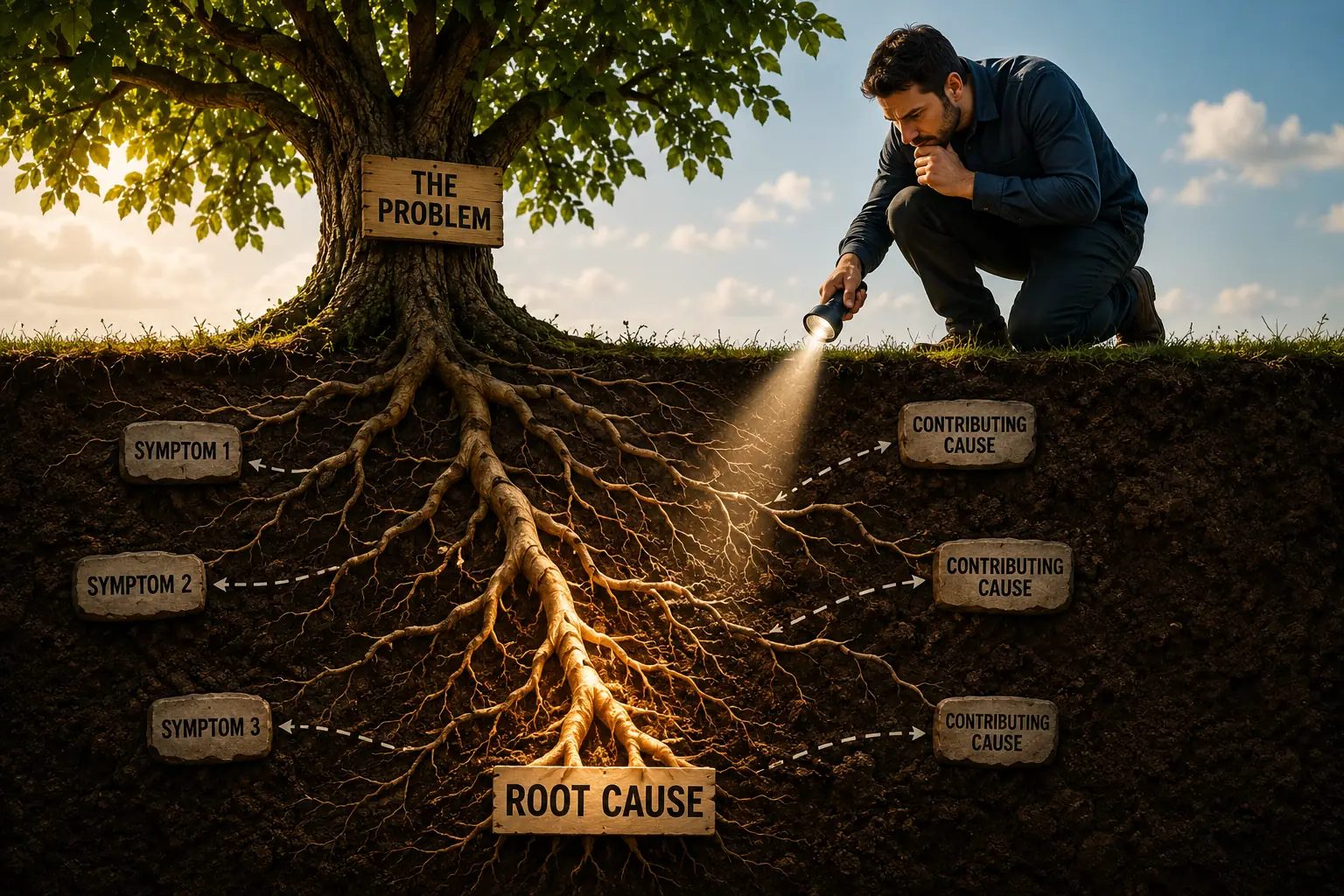
Root cause analysis investigates the systemic conditions that produce recurring problems rather than stopping at visible symptoms. Techniques such as the Five Whys, fishbone diagrams, and causal analysis help trace defects, outages, turnover, or complaints back to processes, incentives, culture, design, and communication. It is harder than a quick fix because root causes can be invisible, politically uncomfortable, and slow to address, but it enables prevention.
In 2003, Columbia Space Shuttle disintegrated during re-entry, killing all seven crew members. The immediate cause was clear: foam insulation struck the wing during launch, damaging heat-resistant tiles. But the investigation didn't stop there.
NASA's Columbia Accident Investigation Board asked why did the foam strike happen? Why wasn't it caught? Why wasn't it treated as critical?
The root causes went far deeper than foam:
- Organizational culture that normalized deviations from specification
- Budget pressure that deprioritized maintenance and safety
- Communication failures where engineers' concerns didn't reach decision-makers
- Confirmation bias where managers dismissed warnings that contradicted their belief the shuttle was safe
Fixing the foam problem alone-the visible symptom-would have left the systemic causes intact, making future catastrophic failures inevitable. True problem-solving required addressing root causes in organizational culture, communication, and decision-making.
This distinction between symptoms and root causes is fundamental to effective problem-solving across all domains. Most people, most of the time, solve symptoms: the visible, painful manifestations of problems. This provides temporary relief but guarantees the problem will recur, often worse than before.
Root cause analysis-the systematic investigation of underlying, fundamental causes-is how you solve problems permanently.
This article explains root cause analysis comprehensively: what distinguishes symptoms from root causes, why most people default to symptom-solving, established techniques for systematic investigation (Five Whys, fishbone diagrams, causal analysis), how to validate you've found true root causes, common mistakes in team settings, and how to implement solutions that prevent recurrence.
Symptoms vs. Root Causes: The Fundamental Distinction
Understanding the difference between symptoms and root causes is essential for effective problem-solving.
Defining the Terms
Symptom: The visible, experienced manifestation of a problem-what you notice or what causes immediate pain.
Root cause: The underlying, systemic condition that, if fixed, prevents the problem from recurring.
| Aspect | Symptom | Root Cause |
|---|---|---|
| Visibility | Obvious, immediately apparent | Often hidden, requires investigation |
| Level | Surface effect | Deep, systemic condition |
| Solution | Temporary relief | Permanent prevention |
| Recurrence | Problem returns if only symptom addressed | Problem eliminated if root cause fixed |
| Effort | Quick fix | Requires systemic change |
Examples Across Domains
Manufacturing defects:
- Symptom: Widget coming off assembly line has defect
- Root cause: Machine calibration drift due to maintenance schedule inadequacy
Fixing the defective widget (symptom) helps one customer. Fixing the maintenance schedule (root cause) prevents thousands of future defects.
Software outages:
- Symptom: Server crashed at 3 AM
- Root cause: Memory leak in specific code path, insufficient monitoring, no automated recovery
Manually restarting the server (symptom) gets systems back up. Fixing the memory leak, adding monitoring, and automating recovery (root causes) prevents future 3 AM pages.
Employee turnover:
- Symptom: Three high performers quit
- Root cause: Compensation below market, manager micromanages, no career growth path
Hiring replacements (symptom) fills seats temporarily. Addressing compensation, management practices, and career development (root causes) improves retention.
Customer complaints:
- Symptom: Customer angry about delayed delivery
- Root cause: Inventory forecasting algorithm doesn't account for seasonal demand patterns
Offering discount to angry customer (symptom) saves that relationship. Fixing forecasting algorithm (root cause) prevents hundreds of future delays.
Why People Default to Symptom-Solving
Despite the obvious superiority of root cause solutions, most problem-solving efforts focus on symptoms. Understanding why reveals how to overcome this tendency.
Reason 1: Symptoms Are Visible and Painful
Symptoms demand immediate attention. They're the fire alarm, the angry customer, the crashed server. This visibility and urgency create psychological pressure to act now.
Root causes are often invisible until investigated. They lurk beneath the surface-poor processes, inadequate training, misaligned incentives, architectural flaws. They don't scream for attention.
Cognitive bias: Humans respond to immediate, vivid threats (availability bias) and discount abstract, distant problems (temporal discounting). Symptoms are immediate; root causes feel remote.
Reason 2: Quick Fixes Feel Productive
Symptom-solving provides immediate relief and tangible accomplishment. You fixed something. Problem gone. Dopamine hit.
Root cause analysis requires investigation time where nothing seems fixed. To observers (and sometimes yourself), it looks like inaction, delay, or overthinking.
Organizational pressure: In fast-paced environments, "bias toward action" cultural values favor quick fixes over careful analysis. "Stop analyzing, start doing!" becomes a mantra that prevents root cause work.
Reason 3: Root Causes Often Reveal Uncomfortable Truths
Root cause analysis frequently points to systemic issues requiring significant changes:
- Leadership decisions that were wrong
- Long-standing processes that don't work
- Cultural problems (blame culture, poor communication)
- Strategic directions that need reversal
- Resource allocation that needs correction
It's psychologically and politically easier to blame a failing component or individual mistake than to acknowledge systemic dysfunction.
Defensive reasoning (as identified by organizational learning scholar Chris Argyris) makes people protect themselves and their organizations from threat or embarrassment.[1] Root cause analysis often threatens status quo.
Reason 4: Root Cause Skills Are Underdeveloped
Most people aren't trained in systematic root cause analysis. They've learned:
- Trial and error: Try solutions until something works
- Best practice adoption: Copy what others do
- Expert consultation: Ask someone experienced
These approaches work for many problems but fail when dealing with novel, complex, or systemic issues requiring causal investigation.
Without deliberate training, people default to intuitive problem-solving-which gravitates toward visible symptoms.
"If I had an hour to solve a problem I'd spend 55 minutes thinking about the problem and 5 minutes thinking about solutions." - Albert Einstein
The Five Whys: Drilling Down to Root Causes
The Five Whys technique, credited to Sakichi Toyoda and popularized by Taiichi Ohno at Toyota, is the simplest and most widely-used root cause analysis method.
How It Works
Start with a problem statement. Ask "Why did this happen?" Take the answer and ask "Why?" again. Repeat approximately five times until you reach a root cause.
Example:
Problem: Website was down for 2 hours, affecting 5,000 users.
Why was the website down? Database server became unresponsive.
Why did the database server become unresponsive? Too many simultaneous connections exhausted connection pool.
Why were there too many connections? API was retrying failed requests without exponential backoff, creating a retry storm.
Why was the API retrying without backoff? Developer implemented simple retry logic; no backoff pattern in our codebase to reference.
Why wasn't there a backoff pattern available? No engineering standards or reusable libraries for common patterns; each developer implements own version.
Root cause: Lack of engineering standards and shared libraries for common patterns like retries leads developers to implement ad-hoc solutions that fail under stress.
Solution: Create engineering standards, build shared library with retry/backoff patterns, conduct architecture review for critical code paths.
Why "Five"?
Five is approximate-not a rule. The goal is reaching a systemic, actionable root cause, which might take three whys or seven. Stop when:
- Further "why" leads to abstract, non-actionable causes ("humans make mistakes")
- You've identified a systemic condition that, if fixed, prevents recurrence
- Going deeper doesn't yield new insights
Common Pitfalls and How to Avoid Them
Pitfall 1: Stopping too early at proximate causes
Example: "Why did the project fail?" "Developer underestimated complexity."
This stops at individual error, missing systemic causes (Why did underestimation happen? Why wasn't it caught in review? Why was there insufficient buffer for uncertainty?).
Fix: Ask "Would fixing this alone prevent recurrence?" If no, continue investigating.
Pitfall 2: Following a single causal chain
Most problems have multiple contributing causes, not a single linear chain. Five Whys can oversimplify by forcing one path.
Fix: Branch your investigation. Ask "What else contributed?" Explore multiple causal paths simultaneously.
Pitfall 3: Blaming individuals rather than systems
Example: "Why did bug reach production?" "QA engineer missed it."
Individual blame stops investigation. The systemic question is: "What system allowed this to slip through?"
Fix: Pivot from "who" to "what system conditions enabled this?"
Pitfall 4: Accepting vague answers
Example: "Why did API fail?" "It wasn't working."
Vague answers prevent reaching true causes.
Fix: Demand specificity. "It wasn't working" "API response time exceeded 5-second timeout."
Pitfall 5: Going too far into philosophy
Example: Drilling past actionable causes into abstract truths like "humans are imperfect" or "resources are finite."
Fix: Stop at the deepest systemic cause you can actually fix.
Fishbone Diagrams: Mapping Multiple Causes
Also called Ishikawa diagrams or cause-and-effect diagrams, fishbone diagrams visualize multiple contributing causes.
Structure
A horizontal line (the "spine") points to the problem. Diagonal "bones" branch off, each representing a category of causes. Sub-causes branch from each bone.
Standard categories (can be customized):
- People: Human actions, skills, knowledge
- Process: Procedures, workflows, methods
- Equipment/Technology: Tools, systems, infrastructure
- Materials/Inputs: Data, resources, materials
- Environment: Context, conditions, culture
- Management: Decisions, policies, priorities
When to Use Fishbone
Better than Five Whys when:
- Problem has multiple complex causes
- Need comprehensive view, not just one causal chain
- Working with groups (visual diagram facilitates discussion)
- Exploring new or poorly understood problems
Example: Customer churn increase
People bone:
- Support staff inadequately trained on new features
- Sales overpromising capabilities
- Customer success team overwhelmed (too many accounts per person)
Process bone:
- Onboarding doesn't set clear expectations
- No proactive outreach to at-risk customers
- Renewal conversations happen too late
Product bone:
- New feature released with bugs
- Performance degradation with scale
- UI changes confusing existing users
Pricing bone:
- Competitors lowered prices
- Annual contracts too inflexible
Each bone can be explored with Five Whys to drill deeper.
Other Root Cause Analysis Techniques
Fault Tree Analysis (FTA)
Top-down, deductive approach: Start with failure and map all possible causal paths using logic gates (AND/OR).[9]
When to use: High-stakes systems (aviation, healthcare, nuclear) where exhaustive causal mapping is needed; engineering failures with multiple potential failure modes.
Example: Analyzing how aircraft could crash-mapping all combinations of equipment failures, human errors, environmental factors.
Failure Mode and Effects Analysis (FMEA)
Bottom-up, proactive approach: Identify all possible ways components could fail, assess likelihood and impact, prioritize mitigation.
When to use: Product design, process design-preventing problems before they occur rather than diagnosing after.[7]
Example: New medical device-systematically considering every component and how its failure could harm patients.
The "Six Serving Men" (5W1H)
Asking: Who, What, When, Where, Why, and How to gather comprehensive information before drilling into causes.
When to use: Early investigation phase to ensure you understand the problem fully before jumping to causes.
Example: Investigating production incident by documenting who was involved, what happened, when (timeline), where (system components), why (initial hypotheses), how (sequence of events).
Pareto Analysis
80/20 principle: Identify the vital few causes responsible for most effects. Prioritize addressing these high-impact causes.
When to use: When facing many potential causes and need to prioritize limited resources; combining quantitative data with root cause analysis.
Example: Customer support tickets-80% come from 20% of issues. Focus root cause analysis on that 20%.
Validating Root Causes: How Do You Know You're Right?
Proposed root causes must be validated-not just plausible stories. Use multiple tests:
Test 1: The Recurrence Prevention Test
Ask: "If we fix this and change nothing else, will the problem recur?"
- If yes or maybe: You haven't reached the true root cause. Keep investigating.
- If definitely no: You've likely found a root cause.
Example: "Developer made coding mistake" fails this test. Fixing the specific bug doesn't prevent future mistakes. "No code review process" passes-implementing code review prevents broad classes of bugs.
Test 2: The Systemic vs. Individual Test
True root causes are almost always systemic conditions, not individual actions.
Individual: "John clicked a phishing link"Systemic: "No multi-factor authentication, inadequate security training, email filtering missed phishing indicators"
Individual actions are symptoms or contributing factors. Systems that allow or enable problematic individual actions are root causes.
Test 3: The Counterfactual Test
Ask: "If this hadn't existed, would the problem definitely not occur?"
Strong counterfactuals indicate true root causes. Weak counterfactuals suggest contributing factors.
Example: "Employee clicked phishing link" is weak-attacker could target others. "Lack of MFA" is strong-MFA would block compromise even if link clicked.
Test 4: Multiple Instances Test
Root causes should explain multiple similar problems, not just one occurrence.
Example: "Unrealistic estimation" as root cause should explain multiple missed deadlines across projects. If only applies to one project ("designer got sick"), it's specific, not root.
Test 5: The Implementation Test
Root causes should lead to actionable, systemic solutions.
If proposed root cause leads to vague exhortations ("be more careful," "communicate better"), it's probably not the true root.
Actionable root cause examples:
- Implement code review requirement before merge
- Create estimation training and calibration process
- Build automated monitoring for system health
- Redesign onboarding flow with user testing
Test 6: Stakeholder Recognition
People close to the problem should recognize the root cause from their experience.
If you propose a root cause and everyone familiar with the system says "That doesn't match my experience," reconsider. True root causes usually have confirmation from multiple observers.
Common Mistakes in Team Root Cause Analysis
Group root cause analysis introduces social and organizational dynamics.
Mistake 1: Jumping to Consensus Prematurely
Social pressure makes teams converge on first plausible explanation without rigorous testing.
Fix:
- Require multiple competing hypotheses before investigating
- Assign devil's advocate role to challenge consensus
- Use silent brainstorming before discussion to prevent groupthink
Mistake 2: Blame Culture Blocking Honest Investigation
If people fear consequences, they hide information essential for finding root causes.
Fix:
- Adopt blameless postmortems (pioneered by John Allspaw at Etsy)
- Focus on "What system conditions allowed this?" not "Who did this?"
- Treat incidents as learning opportunities, not disciplinary triggers
- Leadership must model this-how they respond sets culture
"Every system is perfectly designed to get the results it gets." - W. Edwards Deming
Mistake 3: HiPPO Effect (Highest-Paid Person's Opinion)
Senior person's theory dominates regardless of evidence.
Fix:
- Present data first, interpretations second
- Explicitly invite dissent: "What evidence contradicts this?"
- Use neutral facilitator, not the most senior person
- Anonymous contribution methods (written input before verbal discussion)
Mistake 4: Conflicting Agendas
Different departments protect themselves, pushing narratives that deflect blame.
Fix:
- Align on shared goal: preventing recurrence for everyone's benefit
- Use cross-functional facilitator not from involved departments
- Focus on systemic factors that affect everyone
Mistake 5: Analysis Paralysis
Investigation never concludes; team endlessly debates causes.
Fix:
- Time-box investigation (e.g., 90-minute session)
- Define "good enough" criteria: high-confidence root causes with actionable solutions
- Distinguish high-confidence roots from contributing factors-act on former, note latter
- Accept uncertainty: Better to implement 80% confident solution than to endlessly debate
Implementing Root Cause Solutions: From Analysis to Action
Identifying root causes is pointless without implementation. Many root cause analyses produce reports that gather dust.
Why Implementations Fail
Reason 1: Vague recommendations
"Improve communication" isn't actionable. What specifically should change?
Reason 2: No ownership
"Someone should fix this" means no one does.
Reason 3: Competing priorities
Root cause fixes compete with feature development, customer requests, and other work-often losing.
Reason 4: Solutions address symptoms despite analysis
Team identifies root cause but implements solution for symptom because it's easier.
Designing Effective Preventive Solutions
Root cause solutions should prevent recurrence. Consider multiple prevention levels:
Level 1: Eliminate root cause entirely
Best when possible-remove the condition that causes problems.
Examples:
- Automate manual error-prone process
- Architectural changes that remove failure mode
- Remove unnecessary complexity
Level 2: Make errors impossible (forcing functions)
Can't eliminate root? Design so errors can't happen.
Examples:
- System won't allow skipping required steps
- Automated checks block problematic actions
- Type systems prevent certain bugs at compile time
Level 3: Detect problems early
Can't prevent? Detect quickly before escalation.
Examples:
- Monitoring and alerting
- Automated testing catching issues before production
- Canary deployments limiting blast radius
Level 4: Build recovery mechanisms
Can't prevent or detect early? Minimize impact.
Examples:
- Automated rollbacks
- Redundancy and failover
- Graceful degradation
Creating Actionable Implementation Plans
Effective plans specify:
1. What exactly will change
Not: "Improve code quality" But: "Implement mandatory code review: two approvals required before merge, automated checks for test coverage >80%, review checklist for common issues"
2. Who owns implementation
Single Directly Responsible Individual (DRI) per action. Groups don't have accountability; individuals do.
3. When it will be complete
Realistic timelines with milestones. "Soon" isn't a timeline.
4. How success will be measured
Specific metrics showing problem eliminated or dramatically reduced.
Example: "Production incidents caused by missing environment variables reduced from 5/month to 0/month"
5. How effectiveness will be verified
Follow-up reviews at 30, 60, 90 days:
- Has the problem recurred?
- Did the solution have unintended consequences?
- Do we need further adjustments?
Overcoming Implementation Barriers
Barrier 1: Leadership doesn't prioritize prevention
Solution: Connect root causes to business impact and ROI. Show cost of recurring problems vs. one-time fix cost.
Barrier 2: Team has no time for "extra" work
Solution: Allocate dedicated time. "Do it when you have time" means never. Some orgs use 20% time or dedicated sprints for improvements.
Barrier 3: Resistance to change
Solution: Involve affected people in solution design. People support what they help create. Imposed changes face resistance.
Barrier 4: Too many root causes identified
Solution: Prioritize using impact and effort matrix. Start with high-impact, low-effort quick wins to build momentum.
Barrier 5: Solutions are too ambitious
Solution: Break into phases. Implement minimum effective solution first, iterate to comprehensive solution.
Root Cause Analysis in Practice: Domain Examples
Software Engineering
Common symptoms: Bugs, outages, slow performance, technical debt
Common root causes:
- Inadequate testing practices
- Insufficient code review
- Architectural technical debt
- Poor operational monitoring
- Time pressure leading to shortcuts
- Knowledge silos (only one person understands system)
Techniques: Five Whys for incidents, blameless postmortems, fault tree analysis for critical paths
Manufacturing and Operations
Common symptoms: Defects, downtime, safety incidents, bottlenecks
Common root causes:
- Machine maintenance inadequacy
- Process design flaws
- Training gaps
- Material quality issues
- Environmental factors
Techniques: Fishbone diagrams, FMEA, statistical process control, Pareto analysis
Healthcare
Common symptoms: Medical errors, patient safety incidents, inefficiencies
Common root causes:
- Communication breakdowns
- Process design allowing errors
- Inadequate staffing or training
- System interoperability issues
- Alarm fatigue masking critical alerts
Techniques: Root cause analysis protocols (required for serious events), FMEA for process design, Swiss cheese model for understanding how defenses fail
Business and Strategy
Common symptoms: Revenue decline, customer churn, market share loss, low employee engagement
Common root causes:
- Product-market fit erosion
- Misaligned incentives
- Organizational structure creating silos
- Cultural problems
- Strategic direction misalignment with market reality
Techniques: Five Whys, stakeholder interviews, data analysis, competitor analysis
Conclusion: From Firefighting to Fire Prevention
The distinction between solving symptoms and addressing root causes is the difference between chronic firefighting and lasting problem prevention. Symptom-solving creates a treadmill-problems recur endlessly, consuming resources, frustrating teams, and preventing progress.
Root cause analysis breaks the cycle, solving problems permanently.
The key insights:
1. Most problem-solving efforts address symptoms, not root causes-not because people are incapable, but because symptoms are visible and urgent while root causes are hidden and require investigation.
2. Root cause analysis is a skill, not instinct-it requires systematic techniques (Five Whys, fishbone diagrams, validation tests) applied deliberately, not just intuitive problem-solving.
3. True root causes are systemic, not individual-they're process failures, design flaws, cultural issues, resource constraints, or incentive misalignments, not primarily individual errors.
4. Validation is essential-proposed root causes must pass tests: Would fixing this prevent recurrence? Is it systemic? Does it explain multiple instances? Is the solution actionable?
5. Implementation separates analysis from impact-root cause identification without concrete, owned, measured implementation is wasted effort. The goal isn't insight but prevention.
6. Organizations must create conditions for root cause analysis-blameless culture, allocated time for investigation, leadership support for systemic fixes, measurement of prevention not just quick fixes.
The Columbia Space Shuttle disaster's root causes were organizational and cultural-but similar dynamics exist in every domain.
Are you solving symptoms (restarting crashed servers, apologizing to angry customers, replacing departed employees) or addressing root causes (fixing memory leaks, redesigning customer experiences, building career paths)?
The choice determines whether you're endlessly fighting fires or systematically eliminating their sources. As quality management pioneer W. Edwards Deming observed: "A bad system will beat a good person every time." Root cause analysis identifies and fixes the bad systems, enabling good people to succeed.
Root Cause Analysis in Healthcare: Where the Evidence Is Strongest
Healthcare has produced the most rigorous research on root cause analysis because the consequences of symptom-treatment versus root-cause-treatment are most clearly measurable in mortality and morbidity outcomes.
Peter Pronovost at Johns Hopkins School of Medicine conducted what became one of the most cited patient safety studies in history, published in the New England Journal of Medicine in 2006.
Pronovost studied central line-associated bloodstream infections (CLABSIs) in Michigan intensive care units - infections that were killing an estimated 28,000 patients per year in U.S. ICUs and costing an estimated $2.3 billion annually. Previous approaches had treated CLABSIs as an inevitable complication of ICU care, essentially accepting the symptom and managing its consequences.
Pronovost's root cause analysis identified five evidence-based practices whose consistent application would prevent the majority of infections: washing hands before insertion, cleaning the patient's skin with chlorhexidine, using full-barrier precautions, avoiding femoral insertion sites when possible, and removing unnecessary catheters promptly.
The root cause - not infection itself, but inconsistent adherence to preventive practices - was addressable through a checklist enforcing systematic compliance.
Implementation across 103 Michigan ICUs reduced CLABSI rates by 66% within 18 months, with an estimated 1,500+ lives saved over the first 18 months.
The case became foundational evidence that root cause analysis followed by systematic countermeasure implementation can achieve dramatic results even in environments where a problem has been accepted as inevitable.
James Reason's Swiss Cheese Model in Aviation Safety: James Reason, Professor Emeritus at the University of Manchester, developed his Swiss Cheese Model in Human Error (1990), drawing on analyses of major accidents across industries.
His analysis revealed that no single major aviation accident had a single root cause - every accident investigated required the simultaneous failure of multiple independent defensive layers.
Reason's "Swiss Cheese Model" formalized this finding: each defensive layer in a system (engineering, procedures, training, regulatory oversight) has holes, and accidents occur when those holes align.
The practical implication for root cause analysis was profound: investigators who stopped at the first causal factor they identified were systematically missing the contributing factors in the other defensive layers, producing corrective actions that addressed one hole while leaving others open.
Reason's model transformed aviation accident investigation methodology. Post-accident investigations now systematically examine each defensive layer for contributing failures, producing multi-factor root cause analyses that generate multiple coordinated corrective actions.
Between 1975 and 2020, the U.S. commercial aviation fatality rate per flight fell dramatically, a decline attributed by aviation safety researchers largely to the systematic application of multi-factor root cause analysis.
The Virginia Mason Medical Center's Toyota Production System Adoption (2001-2010): Virginia Mason Medical Center in Seattle, led by CEO Gary Kaplan, undertook one of the most documented applications of Toyota-style root cause analysis methodology to healthcare delivery.
Kaplan and his team traveled to Japan to study the Toyota Production System directly and then systematically adapted its root cause analysis practices - particularly the Five Whys and value stream mapping - to hospital operations.
The results, documented by Charles Kenney in Transforming Health Care (2011), were remarkable across multiple domains. Capital investment needs fell by an estimated $11 million as root cause analysis revealed that space and equipment were being allocated to work-arounds rather than the actual bottlenecks, and inventory costs fell separately as poor demand forecasting and ordering system design were addressed.
Nurses' average daily walking distance fell dramatically as root cause analysis of care process inefficiency revealed that constant walking for supplies was the symptom and poor physical layout of care stations was the root cause.
Virginia Mason has earned an A safety grade from the Leapfrog Group in every rating period since 2012 and has been named a Top Hospital every year since 2006, one of the most sustained safety track records in U.S. healthcare.
The Bristol Royal Infirmary Inquiry (2001): The UK's Bristol Royal Infirmary inquiry, which investigated high death rates in pediatric cardiac surgery from the late 1980s to 1995, produced one of the most comprehensive publicly available root cause analyses of an organizational failure in healthcare.
The inquiry, led by Professor Ian Kennedy, found that the mortality rate for children undergoing open-heart surgery at Bristol was approximately twice the national average over a 10-year period.
Root cause analysis revealed that the direct causes (surgical technique concerns) were symptoms of deeper systemic causes: a hospital culture where concerns about performance could not be raised safely, an absence of outcome measurement systems that would have made the performance gap visible, a consultant culture that prioritized individual autonomy over peer accountability, and a regulatory environment that had no mechanism for identifying statistical outliers in surgical outcomes.
The Bristol inquiry's root cause findings directly shaped the UK's NHS patient safety framework, establishing mandatory outcome reporting, independent mortality review, and psychological safety requirements for clinical staff - systemic corrective actions targeting the actual root causes rather than the individual surgical performance that was the most visible symptom.
What Research Shows About Root Cause Analysis
The science underpinning root cause analysis draws from multiple disciplines, and the findings are more nuanced than most practitioners realize.
Sakichi Toyoda invented the Five Whys methodology in the 1930s as part of the Toyota Production System, and his son Kiichiro Toyoda institutionalized it across Toyota's manufacturing operations.
The technique's power lies in a counterintuitive principle that industrial engineering researcher Taiichi Ohno documented in Toyota Production System (1988): the answer to the first "Why?" is almost never the root cause.[5]
Ohno's observation - that organizations systematically stop too early because the first answer is plausible - has been validated repeatedly in subsequent research.
James Reason, Professor Emeritus at the University of Manchester, transformed root cause analysis with his Swiss Cheese Model, published in Human Error (1990) and refined in a landmark BMJ paper in 2000.[6]
Reason demonstrated that major failures in complex systems (aviation, healthcare, nuclear power) virtually never result from a single cause.
Instead, failures occur when multiple independent defensive layers each have "holes" that happen to align simultaneously.
Reason's research, conducted across aviation incidents analyzed by the UK's Air Accident Investigation Branch, showed that the typical major aviation accident had an average of 7-8 contributing causal factors, none of which alone would have caused the accident.
This finding fundamentally challenged the idea that root cause analysis should seek a root cause; the more accurate framing is identifying the system of causes.
Kaoru Ishikawa, Director of Quality Control at the Union of Japanese Scientists and Engineers in the 1960s, developed the fishbone diagram as a tool for making multi-cause analysis tractable in group settings.[4]
His research at Kawasaki shipyards demonstrated that visual cause mapping enabled frontline workers to identify root causes that engineers with more technical training had missed - because workers had direct observation of the process that engineers lacked.
Ishikawa's finding that root cause analysis is most effective when it incorporates diverse perspectives from people closest to the work remains one of the most practically important insights in the field.
A 2008 study by Percarpio, Watts, and Weeks in the Joint Commission Journal on Quality and Patient Safety examined the effectiveness of root cause analysis action plans in healthcare and found that stronger, system-level actions were less commonly implemented than weaker ones such as process design, staffing levels, or equipment design.
The analyses that reached systemic causes were significantly more likely to implement effective corrective actions and significantly less likely to see the problem recur within 24 months.
The research confirmed that the depth of analysis - not just its completion - determines whether it produces lasting improvement.
Real-World Case Studies in Root Cause Analysis
Toyota and the Andon Cord: One of the most powerful demonstrations of institutionalized root cause analysis is Toyota's Andon system, in which any worker on the production line can pull a cord to stop the entire assembly line when they observe a defect.
The rationale is directly rooted in root cause analysis principles: when a defect is found, the line stops immediately so that the cause can be investigated while the evidence is fresh and in context.
In a traditional system, defects are caught at the end of the line (or by customers), by which time the causal conditions are gone and root cause analysis depends on reconstructed memory.
Toyota's Georgetown plant, which produces the Camry and ES350, reported that Andon cord pulls averaged over 1,000 per shift in the early 2000s - each one triggering a brief root cause investigation.
This practice of performing thousands of small root cause analyses continuously produces dramatically lower defect rates than periodic large investigations.
NASA's Columbia Investigation (2003): The Columbia Accident Investigation Board's 2003 report remains the most thorough publicly documented root cause analysis of a catastrophic organizational failure.
CAIB chairman Admiral Harold Gehman Jr. and board members including physicist Sally Ride conducted a 7-month investigation that went far beyond the foam strike.
Their finding that NASA had a "broken safety culture" where dissenting technical opinions were structurally marginalized led to requirements for independent safety oversight, mandatory communication protocols for engineering concerns, and organizational restructuring - changes that directly addressed systemic root causes.[8]
The contrast with the Challenger investigation (1986), which produced primarily technical recommendations without addressing organizational culture, illustrates how root cause analysis depth determines whether changes prevent future failures.
Boeing 737 MAX (2018-2019): The two Boeing 737 MAX crashes (Lion Air Flight 610 and Ethiopian Airlines Flight 302, killing 346 people) generated multiple parallel root cause investigations by the FAA, the Joint Authorities Technical Review, and the House Transportation Committee.
The investigations converged on root causes that went far beyond the MCAS software system that directly caused the crashes.
The House report (2020) identified Boeing's commercial pressures overriding engineering concerns, certification processes that relied on Boeing's self-reporting, and organizational changes that had separated safety functions from production decisions.
Each of these systemic causes required different corrective actions than the software fix alone - demonstrating Reason's Swiss Cheese Model in practice: multiple defensive layers had failed simultaneously.
Etsy's Blameless Postmortems: When John Allspaw became CTO of Etsy in 2009, he implemented a blameless postmortem process that became a model for the software industry. The core principle - that human error is a symptom, not a cause - produces dramatically different root causes than blame-oriented investigations.
Etsy's engineering team documented that blameless postmortems revealed systemic causes (inadequate monitoring, ambiguous deployment procedures, insufficient testing coverage) that blame-oriented investigations consistently missed because individuals in blame cultures withhold information that might implicate them.
Companies including Google, Netflix, and Spotify subsequently adopted variants of Allspaw's blameless approach.
Google's DevOps Research and Assessment (DORA) program has found in its annual State of DevOps reports that organizational psychological safety and blameless review practices correlate with meaningfully better software delivery performance, including higher deployment frequency and lower change failure rates.
Evidence-Based Approaches: What Works and What Fails
The research literature on root cause analysis effectiveness points to several counterintuitive findings that should inform how organizations conduct these investigations.
What works: Time-boxed investigations with clear stopping criteria. Research by Doggett (2005, Quality Management Journal) on 120 manufacturing root cause analyses found that investigations conducted within structured time limits (typically 4-8 hours for a single-incident RCA) produced more actionable findings than open-ended investigations that continued until participants reached consensus.[3]
Longer investigations were associated with analysis paralysis and increasingly abstract causes that could not be acted upon.
Effective stopping criteria: "We have identified a cause that is systemic, actionable, and whose elimination would prevent recurrence."
What works: Testing proposed root causes before accepting them. The counterfactual test - "If this condition had not existed, would the problem definitely not have occurred?" - dramatically improves root cause identification accuracy.
As Sidney Dekker (2014) has argued, root causes accepted without counterfactual testing are especially vulnerable to hindsight bias: investigators mistake a plausible-sounding story for a verified cause, and the underlying problem often recurs despite the supposed fix.[2]
What fails: Single-cause thinking. Reason's research, validated by Percarpio et al.'s healthcare studies, consistently shows that single-cause conclusions lead to single-point corrections that fail to prevent recurrence.
The most effective RCA processes explicitly require identifying multiple contributing causes and multiple prevention levels (eliminate, make impossible, detect early, contain damage), not a single root cause with a single fix.
What fails: RCA without implementation tracking. Research on the Veterans Affairs' root cause analysis program, led by patient-safety researcher James Bagian, found that while nearly all RCAs produced a corrective action plan, only a minority of those plans were later assessed as genuinely effective.
The research suggests that root cause analysis processes need explicit implementation accountability mechanisms, named owners, deadlines, and follow-up reviews, built into the process itself, not added as optional afterthoughts.
Sources & Further Reading
- Argyris, C. (1991). Teaching smart people how to learn. Harvard Business Review, 69(3), 99-109.
- Dekker, S. (2014). The field guide to understanding 'human error' (3rd ed.). CRC Press. DOI: 10.1201/9781315233918
- Doggett, A. M. (2005). Root cause analysis: A framework for tool selection. Quality Management Journal, 12(4), 34-45. DOI: 10.1080/10686967.2005.11919269
- Ishikawa, K. (1990). Introduction to quality control. 3A Corporation.
- Ohno, T. (1988). Toyota production system: Beyond large-scale production. Productivity Press.
- Reason, J. (2000). Human error: Models and management. BMJ, 320(7237), 768-770. DOI: 10.1136/bmj.320.7237.768
- Stamatis, D. H. (2003). Failure mode and effect analysis: FMEA from theory to execution (2nd ed.). ASQ Quality Press.
- U.S. National Aeronautics and Space Administration (NASA). (2003). Columbia accident investigation board report (Vol. 1). NASA.
- Vesely, W. E., Goldberg, F. F., Roberts, N. H., & Haasl, D. F. (1981). Fault tree handbook. U.S. Nuclear Regulatory Commission. DOI: 10.2172/5365740
- Rooney, J. J., & Vanden Heuvel, L. N. (2004). Root cause analysis for beginners. Quality Progress, 37(7), 45-53.
- Sutton, R. I., & Rao, H. (2014). Scaling up excellence: Getting to more without settling for less. Crown Business.
- Weick, K. E., & Sutcliffe, K. M. (2007). Managing the unexpected: Resilient performance in an age of uncertainty (2nd ed.). Jossey-Bass.