
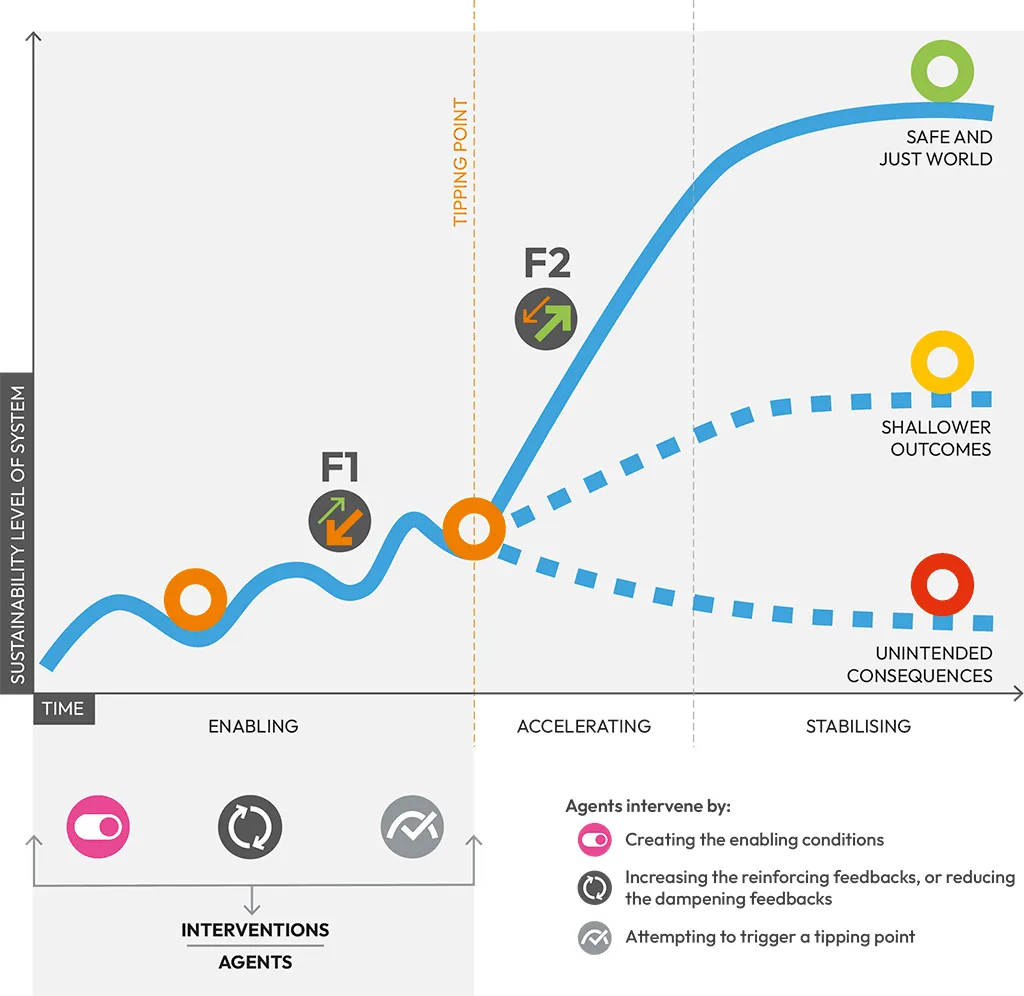
Changing a system's numbers is usually easier than changing its structure, goals, or underlying assumptions, but it often has less lasting effect. Leverage points in systems form a hierarchy from parameters and buffers through feedback and information flows to rules, goals, paradigms, and the ability to transcend paradigms. The most powerful interventions are typically harder to identify, negotiate, and alter.
In the early 1990s, Donella Meadows was involved in the international negotiations over the North American Free Trade Agreement (NAFTA). She and her colleagues had spent years building system dynamics models of global trade, environmental impact, and economic development.
They understood the feedback structures, the delay times, the stock-and-flow relationships that would determine NAFTA's actual consequences.
What she found at the negotiations was dispiriting. The parties were negotiating hard - sometimes brilliantly - over parameters. Tariff rates, import quotas, specific exceptions for specific industries, the timing of phase-ins. Each of these was a number in the system: a parameter.
And as her modeling work had shown repeatedly, parameters are among the weakest places to intervene in a system. You can move a parameter substantially and often produce modest, easily reversible changes.
Meanwhile, the structure of information flows, the goals of the agreement, and the underlying economic paradigm that assumed export-led growth as the model of development - these were largely unexamined.
Meadows wrote the observations that eventually became her 1999 paper "Leverage Points: Places to Intervene in a System," one of the most cited pieces in environmental and systems science.[1] Her thesis: all system interventions are not equal.
There is a hierarchy of places where interventions can change system behavior, ranging from parameters (least powerful) to paradigms (most powerful). Most change efforts focus on the low end of the hierarchy.
The highest leverage points - the ones that can produce fundamental, lasting change - are typically neither identified nor seriously pursued.
"People who are poor at systems thinking don't see leverage points at all. People who get good at systems thinking start to look for leverage. But at first they tend to find leverage points in places that are technically easy to intervene, not places that are actually powerful." - Donella Meadows, Thinking in Systems (2008)
| Leverage Point | Level | Example | Relative Power |
|---|---|---|---|
| 12. Numbers and parameters | Lowest | Tax rates, speed limits | Low |
| 11. Size of buffers | Low-low | Reservoir capacity, inventory | Low |
| 10. Physical flow structure | Low-medium | Highway networks, power grids | Low-medium |
| 9. Length of delays | Medium | Regulatory processing time | Medium |
| 8. Negative feedback strength | Medium | Market price mechanisms | Medium |
| 7. Positive feedback gain | Medium-high | Network effects, Amazon flywheel | Medium-high |
| 6. Information flows | High | Time-of-use electricity pricing | High |
| 5. Rules of the system | High | Patent law, property rights | High |
| 4. Power to change structure | High | Constitutional design | High |
| 3. Goals of the system | Very high | GDP vs. wellbeing as target | Very high |
| 2. Paradigm underlying system | Highest | Germ theory, market capitalism | Highest |
| 1. Ability to transcend paradigms | Ultimate | Scientific objectivity, Zen | Ultimate |
The Hierarchy: Twelve Places to Intervene
Meadows identified twelve leverage points, ordered from least to most powerful.[2] The ordering reflects not the ease of intervention - high-leverage points are often the hardest to change - but the magnitude and durability of change produced.
12. Numbers and Parameters
Constants, rates, and numerical values in the system equations. Tax rates, speed limits, pollution emission standards, interest rates, minimum wages.
Parameters matter - changing them changes system behavior - but they are the weakest leverage points because they do not alter the underlying system structure. Raising the carbon tax is a parameter change; it may shift behavior at the margin but leaves the energy system's feedback structure intact. The same system, slightly adjusted.
Parameters receive enormous policy attention precisely because they are specific, measurable, and politically negotiable. The debate about exactly how high to set a minimum wage, a tax rate, or an emissions limit is tractable in a way that deeper structural questions are not. But the tractability is at the price of leverage.
11. The Size of Buffers
Stocks that the system can draw on when flows are disrupted: reservoir capacity, warehouse inventory, financial reserves, strategic stockpiles.
Large buffers provide resilience - they allow the system to absorb shocks without dramatic behavioral changes. Small buffers amplify disturbances - any disruption in flows produces rapid, visible stock changes that trigger strong responses.
Buffer sizes are somewhat more powerful than parameters because they affect the system's inherent stability. But they are often hard to change: adding buffer capacity requires investment, space, or resources that have competing uses.
The oil industry's "just-in-time" supply model created profit-efficient inventory buffers that proved dangerously small during the 2021 supply chain disruptions.
10. The Structure of Material Flows
Physical stocks and flows: the infrastructure that determines how resources, goods, and people move through the system.
Highway networks, power grid topology, water distribution systems, manufacturing plant layouts. Structural changes to physical flows can produce large and lasting behavioral changes because the physical structure constrains what the system can do regardless of other interventions.
Physical infrastructure changes are high impact but extremely slow and costly. You cannot easily reroute a power grid or redesign a city's road network. This makes physical flow structure changes high-leverage when they happen but difficult to use as deliberate policy tools.
9. The Length of Delays
Time lags between cause and effect: how long information takes to reach decision-makers, how long actions take to produce results, how long it takes for stock levels to respond to flow changes.
Delays are critical because they cause oscillation and overshoot. A system where feedback is slow relative to decision cycles will overshoot its goal, then overcorrect, then overshoot in the other direction, producing characteristic oscillation that can be eliminated by reducing the delay.
The commodity price cycles described in systems thinking models - boom and bust driven by production lag - are delay-caused dynamics.[4]
*Example*: The United States Superfund hazardous waste remediation program, established in 1980, faced structural delays between identifying contaminated sites, completing environmental assessments, negotiating responsible party liability, designing remediation plans, and implementing them.
These delays stretched site remediation to decades, leaving communities exposed throughout. The leverage point was not increasing funding (a parameter) but reducing the delay through streamlined assessment and liability processes.
8. The Strength of Negative Feedback Loops
Balancing feedback loops that push the system toward a goal or equilibrium. Thermostats, market price mechanisms, immune responses, predator-prey population dynamics.
Negative feedback is what provides self-correction. A weak negative feedback loop allows the system to deviate substantially from its goal before correction occurs; a strong one maintains the system near its goal despite disturbances.
*Example*: Financial market regulation is a negative feedback mechanism on asset prices: regulations prevent prices from deviating too far from fundamental values by imposing costs on destabilizing behavior.
When financial regulation was weakened in the 1990s and 2000s, the negative feedback on mortgage lending and structured finance products became insufficient to prevent the price deviations that produced the 2008 crisis.
The leverage point was not any specific regulatory parameter but the strength of the balancing feedback loop.
7. The Gain Around Positive Feedback Loops
Reinforcing feedback loops that amplify change: the loops that drive growth, collapse, and winner-take-all dynamics.
Positive feedback gains are powerful leverage because small changes in gain produce large changes in system behavior over time. Modest changes in a network effect's strength can mean the difference between a market with multiple competing platforms and a monopoly.
Modest changes in an epidemic's transmission rate (R0) can mean the difference between an epidemic that burns out and one that becomes endemic.
*Example*: Amazon's flywheel is a reinforcing loop: more customers attract more sellers, who offer more selection and lower prices, which attracts more customers. Jeff Bezos originally drew this loop on a napkin in 2001.
Understanding the gain of this loop - and investing in every element that could increase it (Prime membership, fulfillment network, AWS, advertising) - was the strategic insight that made Amazon dominant.
The leverage was in understanding and investing in the reinforcing loop structure, not in any specific operational parameter.
6. The Structure of Information Flows
Who has access to what information and when, and what information triggers what responses.
Information structure is a powerful leverage point because information gaps and delays are often the primary cause of poor system behavior.
The system is behaving rationally given the information available to its actors; changing what information is available changes behavior without requiring anyone to change their goals or decision rules.
*Example*: California's residential electricity pricing historically charged flat rates that did not vary with time of day, hiding from consumers the dramatic variation in electricity generation cost.
When California began implementing time-of-use pricing - higher prices during peak demand, lower during off-peak - residential consumers reduced peak demand significantly without coercion or appeals to conservation.
They simply responded rationally to information that had previously been hidden from them. The information structure change produced the behavior change.
5. The Rules of the System
Incentives, constraints, and mechanisms that govern what actors within the system are allowed and motivated to do.
Rules are more powerful than parameters because they shape the behavior of all system actors simultaneously. Changing a parameter affects the magnitude of an existing behavior; changing a rule affects the direction and type of behavior.
*Example*: The structure of patent law governs pharmaceutical innovation. Under current rules, companies can patent drug molecules, creating temporary monopoly pricing that funds research but restricts access.
An alternative rule structure - prizes for drug development (pay once for the discovery, then generics compete) - would produce the same research incentive at dramatically lower downstream drug prices. The debate between these systems is a debate about rules, not parameters.
4. The Power to Change the System's Structure
Who can add, modify, or remove the rules, feedback loops, and structural elements of the system.
The ability to change structure is more powerful than any specific structure, because it determines how the system evolves over time. Constitutional design, regulatory design, organizational governance - these are choices about who can change what.
Self-modifying capacity is particularly powerful: systems that can redesign their own structures in response to feedback learn and adapt in ways that fixed-structure systems cannot.
3. The Goals of the System
What the system is designed to optimize - what objective function drives feedback structures and rule-following.
This is a much higher leverage point than it appears. GDP as the measure of national success produces systems optimized for GDP growth rather than wellbeing. Shareholder return as the measure of corporate success produces systems optimized for shareholder return rather than customer value or employee flourishing.
The metric that defines success shapes every feedback loop in the system, because feedback loops are always defined relative to the system's goal.
*Example*: Robert McNamara's use of body counts as the primary metric for progress in the Vietnam War is a classic example of goal specification producing perverse system behavior.
When body counts become the measure, field commanders are incentivized to maximize body counts - which produces behavior optimized for that metric (inflated counts, dangerous offensive operations) rather than for the actual goal (winning the political conflict).
The goal metric was a higher leverage point than any operational decision.
2. The Paradigm Out of Which the System Arises
The shared assumptions, beliefs, and worldviews from which system goals, rules, and structures emerge.
Paradigms are the deepest source of system structure. The paradigm that economic growth is the primary measure of social progress produces GDP-centered policy systems. The paradigm that nature is a resource for human use produces extractive environmental governance.
The paradigm that markets allocate efficiently produces minimal-intervention regulatory philosophy.
Paradigm changes are the most powerful leverage because they simultaneously shift goals, rewrite rules, and restructure information flows across entire systems.
The scientific revolution was a paradigm change; the transition from feudalism to market capitalism was a paradigm change; the recognition that ecosystems have intrinsic value as well as instrumental value is an ongoing paradigm change with profound implications for environmental policy.
Paradigm changes are also the most difficult to engineer deliberately. They typically require long cultural preparation, accumulated evidence against the existing paradigm, and catalyzing events that create openings for new frameworks. But when they occur, they transform entire systems rapidly.
1. The Ability to Transcend Paradigms
The meta-capacity to question any paradigm, to recognize that all paradigms are simplifications of reality with limited validity, and to operate from no fixed paradigm when understanding requires it.
This is the ultimate leverage point: not replacing one paradigm with another, but developing the capacity to see from multiple paradigms, to recognize the limitations of each, and to avoid being imprisoned in any single worldview.
Meadows noted that this capacity is described in various traditions - scientific objectivity, Zen's beginner's mind, the ancient Greek philosophical tradition of questioning all assumptions - but is rare and difficult to develop.[8]
It enables the kind of genuine systemic insight that can anticipate change rather than merely respond to it.
Why People Intervene at the Wrong Levels
The hierarchy predicts a paradox that empirical observation confirms: most change efforts focus on the weakest leverage points. Organizations facing strategic threats negotiate about operational parameters. Policy-makers confronting systemic problems debate the specific levels of taxes, regulations, and subsidies.
The high-leverage leverage points - information structures, rules, goals, paradigms - are either too abstract to be included in negotiations or too politically threatening to be addressed directly.
The reasons are structural:
Visibility: Low-leverage points are concrete and visible. A tax rate is a number you can fight over specifically. The paradigm underlying the tax system is a diffuse set of cultural assumptions that cannot be easily located, measured, or negotiated.
Safety: Challenging paradigms threatens the identities and institutional interests of the actors who built systems around them. Parameter changes are politically low-risk; they adjust an existing system without challenging it. Paradigm changes are existentially threatening to incumbent structures.
Time horizon: Low-leverage interventions produce visible, attributable change on political and organizational time horizons. High-leverage interventions (restructuring information flows, changing rules, shifting paradigms) produce effects on decades-long time horizons that extend beyond any individual actor's interest.
Understanding this hierarchy does not make high-leverage interventions easy. But it clarifies where the leverage actually is - and why the most sophisticated, well-resourced, well-intentioned change efforts often produce surprisingly little system change despite enormous effort.[9] They are working at the wrong level.
What Systems Researchers Found About Intervention Leverage
Donella Meadows developed the leverage points framework from her work in global systems modeling.
In the early 1970s, Meadows and her colleagues at MIT produced The Limits to Growth (1972), a systems dynamics simulation of global resource consumption that projected multiple scenarios of civilizational collapse if exponential growth continued.
The model was controversial, but the underlying analytical insight - that the world's trajectory was determined by its feedback structures, not its current conditions - was both methodologically significant and widely influential.
Jay Forrester, Meadows's mentor at MIT, had arrived at similar conclusions through industrial simulations in the 1950s and 1960s.[7]
His Industrial Dynamics (1961) demonstrated that the most common management interventions - adjusting production rates, changing inventory targets, hiring more salespeople - were low-leverage because they addressed parameters within existing feedback structures.
The high-leverage interventions were structural: changing the information available to decision-makers, altering the feedback loops themselves, changing the goals the system was organized to pursue.
Peter Senge's The Fifth Discipline (1990) popularized these insights for business audiences.[3] Senge's five disciplines - systems thinking, personal mastery, mental models, shared vision, and team learning - map closely onto Meadows's leverage hierarchy.
Systems thinking (understanding feedback structures) addresses leverage points 9 through 7. Shared vision (aligning on goals) addresses leverage point 3. Challenging mental models addresses leverage points 2 and 1. Senge's framework is, in effect, a management application of Meadows's leverage hierarchy.
Thomas Kuhn's The Structure of Scientific Revolutions (1962) provides the intellectual background for Meadows's highest leverage points.[5]
Kuhn showed that science does not progress through accumulation of evidence within a stable paradigm but through periodic paradigm shifts - revolutionary reconceptions of what the relevant questions are, what counts as evidence, and what theoretical framework organizes the field.
Kuhn's paradigm shifts are precisely what Meadows means by leverage point 2: the shared assumptions from which system goals, rules, and structures emerge. Changing those assumptions changes everything else.
Historical Case Studies in Leverage
Time-of-Use Electricity Pricing (Information Structure, Leverage Point 6): For most of the twentieth century, residential electricity customers paid flat rates that hid the dramatic variation in electricity's actual cost at different times of day.
Peak demand hours (late afternoon in summer) require expensive "peaker plants" that sit idle most of the time; off-peak hours have abundant cheap power. By hiding this variation, flat pricing gave consumers no information to act on, and they could not modify behavior rationally.
When California utilities began rolling out time-of-use pricing - higher rates during peak hours, lower during off-peak - residential peak demand fell measurably, though studies of time-of-use pricing typically find single-digit to low-double-digit percentage reductions in peak use rather than very large ones. The information structure change produced the behavior change.
This is leverage point 6 in pure form: the system behavior changed because what information triggered what responses changed, not because any constraint or goal changed.
The Soviet Planned Economy (Goals, Leverage Point 3): The Soviet Union's command economy is often used as a case study in how misspecified targets distort behavior. Misspecified goals were one important factor among many (including the absence of price signals, weak incentives, and political constraints) in its economic problems. Soviet planners set production targets (tonnage of steel, numbers of manufactured goods, meters of fabric) as the operational goals for factories.
Factory managers optimized for the stated targets, which was rational given the incentive structure. Factories producing nails optimized for tons of nails - producing a few very large nails to hit the tonnage target.
Fabric factories produced specified meters of cloth - making it very narrow or very thin to hit the meterage target while minimizing cost. The metrics defined the goal, and the goal drove behavior throughout the system.
The root cause of Soviet economic dysfunction was not technological, managerial, or resource-based - it was a leverage point 3 error: the system goal (plan fulfillment metrics) diverged from the actual goal (useful production) and the entire system optimized for the stated metric.
Elinor Ostrom and Commons Governance (Rules, Leverage Point 5): Elinor Ostrom's Nobel Prize-winning research on common pool resources (fisheries, forests, irrigation systems) found that communities successfully managing shared resources without collapse had typically developed rule structures with specific properties: boundaries that defined who could use the resource, rules that matched local conditions, collective choice arrangements that allowed rule modification, monitoring by accountable parties, graduated sanctions for rule violations, and conflict resolution mechanisms.
These rule structures were more powerful than any specific conservation measure (a parameter) because they governed all behavior within the system.
Ostrom's finding - that neither privatization nor government control was necessary to prevent tragedy of the commons - was a leverage point 5 insight: the right rules, developed and maintained by the resource users themselves, could govern the system effectively.[6]
The Green Revolution (Physical Flow Structure, Leverage Point 10): The Green Revolution of the 1960s and 1970s developed high-yield varieties of wheat and rice that dramatically increased food production in developing countries.
This was a physical flow structure change: the agricultural system's material flows (crop yields, nutrient cycling, water use) were restructured by the introduction of new crop varieties, irrigation infrastructure, and agricultural inputs.
The leverage was enormous - famines predicted by population growth models were largely averted. But the physical structure changes also produced second-order effects that Meadows's framework predicts: high-yield varieties required higher inputs (fertilizer, pesticide, water), creating dependencies that reduced resilience.
When input costs rose or water became scarce, the new agricultural system was more fragile than the traditional varieties it replaced. High-leverage interventions produce large effects in both intended and unintended directions.
Research Applications: Leverage in Practice
Amazon's Flywheel (Reinforcing Loop, Leverage Point 7): Jeff Bezos sketched the Amazon flywheel in 2001: lower prices attract more customers, which attracts more third-party sellers, which expands selection, which attracts more customers, which generates more volume, which enables lower prices.
Understanding this reinforcing loop structure - and investing in every element that increased its gain (Prime, AWS, fulfillment network, advertising) - was the strategic insight that made Amazon dominant.
Bezos was operating at leverage point 7: the gain around a positive feedback loop. Every operational decision (warehouse locations, shipping speed targets, pricing algorithms) was evaluated against whether it increased the flywheel's gain.
This is what strategic second-order thinking looks like: not optimizing individual parameters but investing in the feedback structures that produce compounding advantage.
The Montreal Protocol (Paradigm Shift, Leverage Point 2): The 1987 Montreal Protocol, which phased out ozone-depleting chlorofluorocarbons, is among the most successful environmental agreements in history.
The protocol succeeded through a combination of binding rules (a firm, adjustable phase-out schedule for ozone-depleting chemicals) and the availability of substitutes, supported by a shift in how the chemical industry and governments understood the ozone problem. It is better read as rules and technology working together with a changed mindset than as a paradigm shift alone.
Before the protocol, the assumption was that industrial chemicals, once released into the atmosphere, were inert - the atmosphere was effectively infinite.
The discovery of the ozone hole and the subsequent scientific consensus that CFCs were depleting stratospheric ozone was a paradigm change: the atmosphere is a finite system, and industrial emissions have consequences within it. Once the paradigm shifted, the regulatory and industrial response followed.
The protocol achieved greater compliance than most environmental agreements because it changed the underlying worldview, not just the rules operating within the old worldview.
Empirical Studies on Leverage Point Effectiveness
The leverage points framework makes a testable prediction: high-leverage interventions (information structure, rules, goals, paradigms) should produce larger, more durable system changes than low-leverage interventions (parameters, buffers). Several natural experiments allow this prediction to be examined.
Researchers studying climate policy effectiveness have found evidence consistent with the leverage hierarchy.
Research on climate policy, including work by Michael Grubb and colleagues, has examined how different instruments perform. A recurring theme is that carbon pricing alone has often delivered smaller emissions reductions than expected, while standards, mandates, and support for clean technology have in some cases driven larger and more durable changes. The comparison is debated and depends on how policies are measured.
In several analyses, countries emphasizing standards and deployment support saw greater reductions in carbon intensity than those relying primarily on carbon pricing, even controlling for the economic cost of each intervention.
The finding is consistent with Meadows's hierarchy: rules that restructure what actors are required to do produce larger system changes than prices that adjust incentives at the margin within an unchanged system structure.
Education research provides another test. Eric Hanushek at Stanford's Hoover Institution has spent decades studying the determinants of educational outcomes, synthesizing results from studies covering over 50 countries.
His analysis, summarized in Education and Economic Growth (2010) co-authored with Ludger Woessmann, consistently finds that per-pupil spending (a parameter) has weak and inconsistent effects on student achievement, while measures of teacher quality and student cognitive skills are more strongly related to outcomes. Whether formal accountability structures (rules, leverage point 5) have large, consistent effects.
Increasing funding for schools with weak accountability structures and poor feedback on teacher performance produces minimal outcome improvement. The same funds, redirected through accountability structures that change the feedback teachers receive about their effectiveness, produce measurable gains.
The hierarchy prediction holds: changing parameters within existing structures is lower leverage than changing the feedback structure.
Paradigm Shifts as Highest-Leverage Interventions: Documented Cases
Meadows's identification of paradigm change as the second-highest leverage point receives support from historical studies of rapid, widespread system change.
Thomas Kuhn's framework in The Structure of Scientific Revolutions (1962) predicted that paradigm shifts would be followed by rapid resolution of puzzles that had resisted solution for decades within the previous paradigm. The history of medicine offers multiple documented cases.
The germ theory of disease, established by Robert Koch and Louis Pasteur through the 1870s-1890s, was a paradigm shift from the miasma theory (disease caused by bad air and environmental corruption) to the microbial theory (disease caused by specific microorganisms).
Within the miasma paradigm, interventions were targeted at environmental conditions: draining swamps, improving ventilation, cleaning streets. Within the germ theory paradigm, interventions targeted specific causative organisms: antiseptic surgery, vaccination, antibiotic development.
The paradigm shift did not just add new interventions; it reorganized the entire system of medical practice, research priorities, hospital design, and public health infrastructure.
Thomas McKeown estimated in The Modern Rise of Population (1976) that the reduction of mortality from infectious disease in the 19th and 20th centuries was primarily driven by improved nutrition and sanitation - but the paradigm shift to germ theory enabled the targeted interventions (vaccination, antibiotics) that accelerated mortality reduction in the 20th century by several decades compared to what would have been achievable through nutritional and sanitary improvements alone.
The tobacco-disease paradigm shift provides a more precisely documented case with clear before-and-after data.
Before Richard Doll and Austin Bradford Hill's 1950 case-control study linking smoking to lung cancer, the tobacco industry's paradigm - that smoking was a personal choice without systematic health consequences - dominated regulatory thinking.
The paradigm operated through information structure (suppressing research), rules (no advertising restrictions), and goals (revenue maximization without health accounting).
Doll and Hill's research, and the subsequent Smoking and Health report by the U.S. Surgeon General in 1964, began a paradigm shift. U.S. smoking prevalence was approximately 42% of adults in 1964; by 2020 it had declined to 12.5%, even as roughly 480,000 deaths per year are still attributed to smoking-related illness.
The leverage was not any specific policy (advertising bans, taxes, warning labels) but the paradigm change that made those policies politically possible and socially legitimate.
Sources & Further Reading
- Meadows, D. "Leverage Points: Places to Intervene in a System." Sustainability Institute, 1999. View source
- Meadows, D. Thinking in Systems: A Primer. Chelsea Green Publishing, 2008. View source
- Senge, P. The Fifth Discipline: The Art and Practice of the Learning Organization. Doubleday, 1990. View source
- Sterman, J. Business Dynamics: Systems Thinking and Modeling for a Complex World. McGraw-Hill, 2000. View source
- Kuhn, T. The Structure of Scientific Revolutions. University of Chicago Press, 1962. View source
- Ostrom, E. Governing the Commons: The Evolution of Institutions for Collective Action. Cambridge University Press, 1990.
- Forrester, J. Industrial Dynamics. MIT Press, 1961. View source
- Korzybski, A. Science and Sanity: An Introduction to Non-Aristotelian Systems. International Non-Aristotelian Library, 1933.
- Stroh, D. Systems Thinking for Social Change. Chelsea Green, 2015. View source
Further Reading
- Gladwell, M. The Tipping Point: How Little Things Can Make a Big Difference. Little, Brown, 2000. View source