
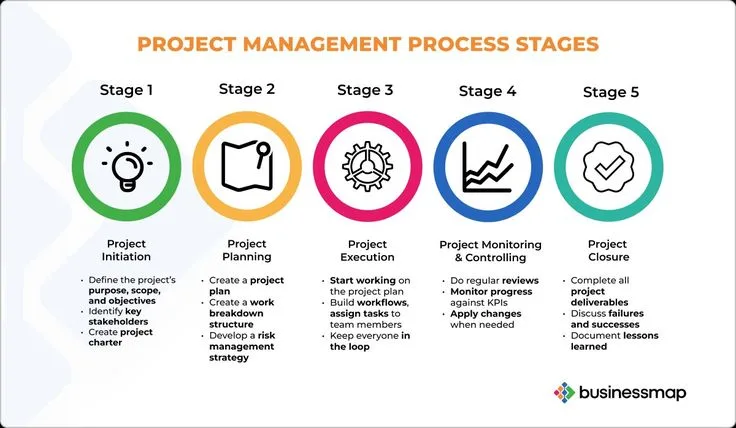
A project planning checklist addresses the recurring failures in goals, success criteria, scope, stakeholders, resources, timelines, risks, and communication. Clear goals define a desired change, while measurable success criteria prevent teams from confusing completed activities with meaningful outcomes. Explicit scope boundaries, realistic estimates, accountability, early integration, and risk planning cannot remove uncertainty but make preventable failures less likely.
In 2013, the United States government launched HealthCare.gov, the online marketplace for the Affordable Care Act's health insurance exchanges. The launch was a spectacular failure. The website crashed almost immediately under user load, with error rates exceeding 75 percent.
Users who managed to access the site encountered broken forms, lost data, and multi-hour delays. It took approximately two months of emergency fixes, involving a team of the nation's best engineers working around the clock, to bring the system to minimally functional status.
The technical problems were severe, but the root cause was not technical. It was a project planning failure of extraordinary proportions.
The Government Accountability Office's subsequent investigation identified multiple planning failures: unclear governance and accountability (no single person was responsible for the project's success), insufficient risk identification (load testing was inadequate and began too late),
poor stakeholder management (dozens of government agencies and contractors with conflicting priorities and no coordinating authority), unrealistic timelines (political deadlines overrode technical readiness assessments), and inadequate integration planning (components built by different contractors were not tested together until weeks before launch).
HealthCare.gov is an extreme example, but the planning failures it illustrates are ordinary. Research by the Project Management Institute consistently finds that approximately 70 percent of projects fail to meet their original goals, timeline, or budget.
The Standish Group's CHAOS Reports have documented for decades that only about one-third of software projects are considered successful by their own stakeholders. McKinsey research found that large IT projects run 45 percent over budget and 7 percent over time while delivering 56 percent less value than predicted.
These failure rates are not the result of incompetent project managers. They are the result of systematic planning failures: predictable, recurring errors in how projects are defined, scoped, estimated, staffed, and monitored.
A comprehensive project planning checklist cannot guarantee success-projects operate in uncertain environments where unexpected problems are inevitable-but it can systematically address the most common sources of failure before they become crises.
"Plans are worthless, but planning is everything." - Dwight D. Eisenhower
Phase 1: Defining the Project
What Should Project Planning Checklists Cover?
A comprehensive project planning checklist should address every dimension that research and experience have identified as common failure points. The framework below covers eight critical areas: goals, success criteria, scope, stakeholders, resources, timeline, risks, and communication.
Check 1: Is the Goal Clear and Specific?
The most common cause of project failure is an unclear or ambiguous goal. When the goal is vague ("improve our customer experience," "modernize our systems," "increase efficiency"), everyone involved can have a different understanding of what success looks like, leading to conflicting priorities, scope disagreements, and a project that satisfies no one because it was trying to satisfy everyone's different interpretation.
How to apply it: State the goal in a single sentence that is specific enough to be unambiguous. The sentence should describe the change in the world that the project will produce, not the activities the project will perform.
- Vague: "Improve our customer onboarding process" (improve how? for whom? by how much?)
- Specific: "Reduce the time from customer sign-up to first successful product use from an average of 14 days to 3 days"
The specific goal tells everyone exactly what success means, provides a clear measurement criterion, and eliminates the ambiguity that allows scope creep and conflicting interpretations.
Check 2: Are Success Criteria Defined?
Goals describe what you want to achieve. Success criteria describe how you will know you have achieved it. They are the specific, measurable KPIs that distinguish success from failure.
Why this distinction matters: A project can complete all its planned activities and still fail to achieve its goal. A software migration project can successfully migrate all data, deploy all systems, and train all users-and still fail if the migrated system is slower, less reliable, or less usable than the one it replaced.
Without success criteria that are tied to the goal (not just to activity completion), projects declare victory based on deliverables produced rather than outcomes achieved.
"What gets measured gets managed." - Peter Drucker
How to apply it: For each goal, define two to five success criteria that are:
- Specific: Clearly defined with no ambiguity
- Measurable: Quantifiable, with a defined method of measurement
- Achievable: Realistic given the project's resources and constraints
- Relevant: Directly connected to the goal
- Time-bound: Associated with a specific measurement date or period
Example:
- Goal: Reduce customer onboarding time
- Success criteria: (1) Average time from sign-up to first product use is 3 days or less, measured for the first 1,000 users after launch; (2) Customer satisfaction with onboarding process is 4.0 or higher on 5-point scale; (3) Support ticket volume related to onboarding decreases by 50 percent
Check 3: Are Scope Boundaries Set?
Scope defines what the project includes and, equally important, what it does not include. Without explicit scope boundaries, projects expand through scope creep-the gradual accumulation of additional requirements, features, and objectives that were not part of the original plan.
Scope creep is one of the most pervasive project management challenges. It occurs because stakeholders discover new requirements during the project, because the original scope was not defined precisely enough to exclude additions, because team members add features they think are valuable without formal approval, and because saying "yes" to scope additions is socially easier than saying "no."
How to apply it: Create a scope statement that explicitly defines:
- In scope: What the project will do, deliver, and achieve
- Out of scope: What the project will NOT do, even if it is related to the goal (this is often more important than the in-scope statement)
- Scope change process: How requests for scope changes will be evaluated, approved, and incorporated (or rejected)
Example:
- In scope: New customer onboarding flow for web application, including account creation, product tour, and first-use guidance
- Out of scope: Mobile app onboarding (separate project), existing customer re-onboarding, changes to the product itself
- Scope change process: All scope change requests must be submitted in writing, evaluated for impact on timeline and budget, and approved by the project sponsor
Phase 2: Stakeholder and Resource Planning
Check 4: Are Stakeholders Identified and Managed?
Stakeholders are everyone who is affected by, has influence over, or has interest in the project. Failing to identify and manage stakeholders is a common source of project failure because unidentified stakeholders can block progress, impose unexpected requirements, or withdraw support at critical moments.
How to apply it: Create a stakeholder map that identifies:
- Decision-makers: Who can approve or reject the project's direction?
- Influencers: Who can affect the project without having formal authority?
- Users/beneficiaries: Who will use the project's outputs?
- Impacted parties: Who will be affected by the project even if they are not users?
- Resource providers: Who controls the budget, people, or tools the project needs?
For each stakeholder, understand: What do they care about? What do they need from this project? What could cause them to oppose or withdraw support? How will they be kept informed and engaged?
"The single biggest problem in communication is the illusion that it has taken place." - George Bernard Shaw
Example from HealthCare.gov: The project had dozens of stakeholders across government agencies, each with different technical requirements, regulatory obligations, and political interests.
The failure to establish a single coordinating authority with decision-making power across stakeholder groups was identified as a primary cause of the project's failure.
Check 5: Are Resources and Constraints Understood?
Every project operates within constraints: budget, time, people, technology, organizational capacity, regulatory requirements, and dependencies on other projects or external factors.
Successful planning requires an honest assessment of these constraints and a realistic plan that operates within them. Effective delegation of responsibilities is essential for ensuring each constraint has an accountable owner.
Common resource planning mistakes:
Assuming ideal conditions. Plans that assume every team member will be 100 percent available, that no unexpected problems will arise, and that all dependencies will be met on time are plans that will fail on contact with reality.
Realistic resource planning accounts for meetings, context-switching, unexpected work, vacations, illness, and the normal friction of organizational life.
Underestimating complexity. The planning fallacy, documented by Daniel Kahneman and Amos Tversky, describes the systematic tendency to underestimate the time, cost, and effort required to complete tasks.
The planning fallacy is one of the most robust findings in behavioral psychology, affecting individuals, teams, and organizations across every domain.
Ignoring dependencies. Projects rarely exist in isolation. They depend on other projects, on external vendors, on organizational decisions, on market conditions, and on technological infrastructure. Dependencies that are not identified and managed become surprises that disrupt timelines and budgets.
How to apply it: List all resources required (people, budget, tools, access, data) and all constraints (timeline, budget limits, regulatory requirements, dependencies). For each resource, assess availability realistically. For each constraint, determine how it limits the project's options and plan accordingly.
Phase 3: Timeline and Estimation
How Do You Estimate Project Timelines?
Timeline estimation is one of the most difficult aspects of project planning, and one where human judgment is most consistently biased toward optimism.
Check 6: Is the Timeline Broken into Estimable Units?
Large tasks are impossible to estimate accurately because they contain too many unknowns. The solution is to decompose the project into smaller tasks that are individually estimable.
How to apply it: Break the project into tasks that are:
- Small enough to estimate with reasonable confidence (ideally completable in one to five days)
- Concrete enough to have clear completion criteria
- Independent enough to be assigned and tracked individually
Then estimate each task individually and aggregate. The aggregated estimate will be more accurate than a top-down estimate of the whole project because decomposition forces you to think through the actual work rather than making a holistic guess.
Check 7: Do Estimates Include Buffer for Unknowns?
Every project encounters unknowns that were not anticipated during planning. Technology that does not work as expected, requirements that change, team members who leave, dependencies that are delayed, and problems that are more complex than they appeared are all normal occurrences in projects of any significant complexity.
Estimates that do not include buffer for unknowns are plans for a world that does not exist-a world where everything goes according to plan.
In the real world, effective planning includes explicit buffer (typically 20-50 percent of the base estimate for tasks with significant uncertainty) to absorb the inevitable surprises. Understanding feedback loops in your project can help you anticipate where delays compound.
How to apply it: Add buffer at the project level, not at the individual task level. If you add buffer to each task, team members may use the buffer unproductively (Parkinson's Law: work expands to fill the time available).
If you add buffer at the project level, it is available for genuine surprises without incentivizing individual task padding.
Check 8: Have Estimates Been Validated Against Past Experience?
The best predictor of future project performance is past project performance. If similar projects in your organization have consistently taken 50 percent longer than their initial estimates, your current estimate is probably 50 percent too low.
"The first 90 percent of the code accounts for the first 90 percent of the development time. The remaining 10 percent of the code accounts for the other 90 percent of the development time." - Tom Cargill
How to apply it: Compare your estimate against:
- Previous similar projects in your organization
- Industry benchmarks for comparable work
- Independent estimates from people not involved in the current project (outside perspective reduces optimism bias)
If your estimate is significantly lower than historical precedent, you should either justify the difference (specific factors that make this project faster) or adjust the estimate to align with historical data.
| Estimation Technique | How It Works | Best For |
|---|---|---|
| Bottom-up | Decompose into tasks, estimate each, aggregate | Detailed projects with well-understood work |
| Analogous | Compare to similar past projects | Projects similar to previous ones |
| Three-point | Estimate optimistic, most likely, pessimistic; average | Tasks with significant uncertainty |
| Expert judgment | Ask experienced practitioners | Novel projects without historical data |
| Reference class forecasting | Use statistical data from similar projects | Strategic planning, large projects |
Phase 4: Risk Management
Check 9: Have Risks Been Identified Systematically?
Risk is the possibility that something will go wrong. Every project carries risks, and the projects that handle risk best are those that identify risks proactively rather than reacting to them as they materialize.
How to apply it: Conduct a structured risk identification exercise:
- Brainstorm potential risks across categories: technical risks (technology does not work), resource risks (key person leaves), schedule risks (dependency is delayed), scope risks (requirements change), external risks (market shifts, regulatory changes)
- Learn from history by reviewing post-mortems and lessons learned from similar past projects
- Seek diverse perspectives by involving team members from different functions, levels, and backgrounds who may see risks that others miss
- Consider second-order effects - not just "what could go wrong" but "if this goes wrong, what else would be affected?" Good decision frameworks help structure this thinking.
Check 10: Have Risks Been Assessed and Prioritized?
Not all risks are equally important. Risk assessment involves evaluating each identified risk on two dimensions: likelihood (how probable is it?) and impact (how severe would the consequences be?).
How to apply it: Create a risk matrix that plots each risk on likelihood (low/medium/high) and impact (low/medium/high):
| Low Impact | Medium Impact | High Impact | |
|---|---|---|---|
| High Likelihood | Monitor | Mitigate actively | Top priority - plan specific response |
| Medium Likelihood | Accept | Monitor and prepare | Mitigate actively |
| Low Likelihood | Accept | Accept | Monitor and prepare contingency |
Focus mitigation effort on risks in the upper-right quadrant (high likelihood, high impact). Accept risks in the lower-left quadrant (low likelihood, low impact). For risks in between, make proportional investments in monitoring and preparation.
Check 11: Do Risks Have Mitigation Plans and Contingencies?
Identifying and assessing risks is valuable only if it leads to action. Each significant risk should have:
- Mitigation strategy: Actions taken now to reduce the likelihood or impact of the risk
- Contingency plan: Actions to be taken if the risk materializes despite mitigation
- Trigger: The signal or condition that indicates the risk is materializing and the contingency should be activated
- Owner: The specific person responsible for monitoring the risk and executing the response
Phase 5: Communication Planning
Check 12: Is There a Communication Plan?
Projects fail when stakeholders do not have the information they need, when teams do not know what other teams are doing, when leaders are surprised by problems that could have been reported earlier, and when decisions are made without adequate input from affected parties.
Teams that invest in async communication practices reduce this risk by creating written records that keep distributed contributors aligned.
How to apply it: Define:
- Who needs to know what (different stakeholders need different information at different levels of detail)
- How often updates will be provided (daily standups, weekly status reports, monthly steering committee meetings)
- Through what channels (email, meetings, dashboards, documents)
- What escalation process exists for problems that cannot be resolved at the working level
For remote collaboration, written status updates and shared dashboards are especially important because informal hallway communication does not exist to fill the gaps.
Why Do Projects Fail Despite Planning?
Even well-planned projects fail, and understanding why is essential for making planning more effective:
Unclear goals. This is the number one cause of project failure across studies and industries. When the goal is ambiguous, every subsequent planning step is compromised because there is no clear target to plan toward.
Poor risk identification. Projects that do not identify risks proactively are surprised by problems that could have been anticipated and mitigated. The failure is not that problems occurred-problems always occur-but that the project was unprepared for predictable problems.
Optimistic estimates. The planning fallacy affects virtually every project. Estimates that are based on best-case scenarios rather than realistic assessment of past performance consistently understate the time and cost required.
Scope creep. Without explicit scope boundaries and a change management process, projects gradually expand beyond their original definition, consuming resources and extending timelines while delivering diminished focus.
Resource constraints. Projects that plan for resources they do not actually have-assuming full-time availability of people who have other responsibilities, assuming budget that has not been approved, assuming technology that has not been acquired-encounter resource shortfalls that delay progress and require painful scope or timeline adjustments.
Inadequate stakeholder management. Projects that do not identify and manage stakeholders encounter resistance, conflicting requirements, and loss of support from parties whose needs were not considered.
Should You Plan Everything Upfront?
No. The appropriate level of upfront planning depends on the project's characteristics:
More upfront planning for:
- Projects with high consequences of failure (safety-critical, regulatory, public-facing)
- Projects with many dependencies and stakeholders
- Projects in domains with well-understood requirements
- Projects where rework is expensive
Less upfront planning (more iterative) for:
- Projects with high uncertainty about requirements
- Projects in rapidly changing environments
- Projects where early feedback can inform later work
- Projects where the cost of iteration is low
The agile movement's emphasis on iterative planning reflects a genuine insight: in environments with high uncertainty, detailed upfront planning produces plans that become obsolete before they are completed.
In these environments, planning should establish clear goals and success criteria, identify major risks and constraints, and create a framework for iterative learning-but should leave the details of execution to be determined through short cycles of plan-do-learn-adjust.
The key insight is that planning and execution are not sequential phases; they are concurrent activities. The best project plans are not documents that are written once and followed rigidly. They are living frameworks that establish direction, create accountability, and adapt to new information as the project unfolds.
"No battle plan survives contact with the enemy." - Helmuth von Moltke the Elder
How Do Checklists Improve Project Success?
Atul Gawande's research on surgical checklists, documented in The Checklist Manifesto, demonstrated that simple checklists reduced surgical complications by 36 percent and deaths by 47 percent-not by introducing new knowledge or techniques but by ensuring that existing knowledge was consistently applied.
The same principle applies to project planning.
Project planning checklists improve success by:
Ensuring nothing critical is overlooked. In the complexity of project initiation, it is easy to forget a stakeholder, skip a risk assessment, or leave a dependency unidentified. Checklists systematically prompt consideration of each critical element.
Creating consistency. When every project goes through the same planning checklist, the organization develops a consistent standard of planning quality. This consistency makes it easier to identify projects that are under-planned and to compare planning quality across projects.
Capturing lessons learned. When a project fails and the post-mortem identifies a planning gap, that gap can be added to the checklist for future projects. Over time, the checklist becomes a repository of organizational learning about what goes wrong and how to prevent it.
Improving estimates over time. When projects consistently track actual performance against planned performance, the data enables progressively more accurate estimation. The checklist provides the framework for this tracking by ensuring that estimates are documented and reviewable.
The value of a planning checklist is not in the document itself but in the thinking it forces. Each item on the checklist represents a question that, if left unasked, could contribute to project failure.
The checklist does not guarantee success-no planning tool can guarantee success in an uncertain world-but it systematically reduces the probability of the most common and most preventable forms of failure.
What Research Shows About Project Planning
Bent Flyvbjerg, a professor of major program management at Oxford's Said Business School and now at the Copenhagen Business School, has assembled the world's largest database of infrastructure and IT project performance data, encompassing more than 16,000 projects worth a combined $5 trillion across 136 countries.
His research, published in Project Management Journal, Harvard Business Review, and his 2023 book How Big Things Get Done (co-authored with Dan Gardner), found that 91.5 percent of major projects exceeded their initial budget or schedule estimates, with an average cost overrun of 62 percent.
Flyvbjerg identified the root cause as "optimism bias and strategic misrepresentation"-planners consistently present best-case scenarios rather than reference-class estimates because doing so wins project approval.
His most significant practical finding was that projects using "reference class forecasting"-anchoring initial estimates to the statistical distribution of actual outcomes from similar past projects-reduced cost overruns by approximately 25 percent and schedule overruns by 30 percent.
The UK Treasury adopted Flyvbjerg's methodology for all major public infrastructure investments in 2004.
Roger Buehler, a psychologist at Wilfrid Laurier University, along with Dale Griffin at the University of British Columbia and Michael Ross at the University of Waterloo, published a foundational study of the planning fallacy in Journal of Personality and Social Psychology in 1994.
Their research demonstrated that people consistently underestimate project completion times by ignoring distributional information (how long similar tasks have taken others) in favor of singular information (how the current task feels from the inside).
In their experiments, even when participants were explicitly reminded that their past predictions had been systematically too optimistic, they continued to make optimistic predictions for new tasks.
Buehler and colleagues found that the most effective correction required explicitly prompting participants to recall specific instances of past task completion times before making new estimates-a principle directly embodied in the "lessons learned" component of project planning checklists.
Their research established that planning fallacy is not a fixable character flaw but a stable cognitive bias requiring structural corrections.
Mark Zuckerberg's description of Facebook's "move fast and break things" philosophy, and Facebook's subsequent abandonment of that motto in 2014 in favor of "move fast with stable infra," provides a high-profile illustration of research by Mik Kersten, who holds a PhD in computer science from the University of British Columbia and founded the enterprise software company Tasktop.
Kersten's 2018 book Project to Product (IT Revolution Press) introduced the Flow Framework, which measures the ratio of features, defects, risk, and debt work moving through a software delivery pipeline.
Kersten's actual argument runs somewhat differently than a simple case for more phase gates: he is critical of traditional, project-based planning structures and argues that continuous, flow-based delivery organized around value streams - not more checkpoints - is what allows organizations to see and correct planning problems in real time.
The relevant planning lesson is less about adding formal gates and more about building visibility into where work is actually flowing versus getting stuck, so that planning assumptions can be corrected quickly rather than discovered only at a scheduled checkpoint.
Real-World Case Studies in Project Planning
The Sydney Opera House project, completed in 1973 after 14 years of construction, has become the canonical case study of planning failure in architectural history. Architect Jorn Utzon's original estimate was $7 million Australian with a completion date of 1963.
The actual cost was $102 million and the building opened ten years late.
The Australian government's subsequent investigation, documented by Bent Flyvbjerg in multiple publications including Megaprojects and Risk (Cambridge University Press, 2003), found that the project began construction before the engineering was complete, that cost estimates were based on incomplete design specifications, and that political pressure to announce an opening date overrode technical readiness assessments.
Paradoxically, the Sydney Opera House also illustrates what good planning can achieve despite initial failures: the project delivered a building that has gone on to generate substantial ongoing tourism and cultural value for Australia, with a 50th-anniversary economic analysis estimating billions of dollars in cumulative value - a return that, while impossible to state as a single precise multiple, is understood to vastly exceed the original construction cost in the decades since completion.
The Denver International Airport (DIA) baggage system project, initiated in 1989 and intended to be completed for the airport's original 1993 opening, experienced one of the most widely studied technology project failures in US history.
The automated baggage system, contracted to BAE Automated Systems, ran 16 months late and cost far more than its original estimate. The city of Denver paid approximately $1.1 million per day to maintain the unopened airport during the delay.
Widely cited case analyses of the project, including academic studies of the failure, identified the primary planning failures as scope definition errors (the system's requirements expanded substantially after contract award),
stakeholder coordination failures (the many airlines and terminal operators involved had different integration requirements that were never fully mapped before design began), and inadequate risk identification (the complexity of the mechanical system was assessed by analogy to simpler conveyor systems rather than by analysis of the new system's specific failure modes).
DIA eventually opened in February 1995, and the automated system was shut down completely in 2005 after years of malfunction, with a manual system replacing it at lower cost.
The Denver airport's failure contrasted sharply with the planning approach used by Heathrow Airport's Terminal 5 project, completed in 2008 at a cost of roughly £4.3 billion (approximately $8.6 billion).
Notably, Terminal 5 was delivered on budget and on schedule - a rare outcome for a major infrastructure project of its complexity, and a direct contrast with both Denver and the Sydney Opera House.
BAA, the airport operator, used an "integrated project insurance" model that required dozens of contractors to work collaboratively under a single insurance policy, eliminating incentives for individual contractors to conceal problems that might expose them to liability.
Independent research on the Terminal 5 project, including analysis published in Construction Management and Economics, has credited this integrated planning and risk-sharing approach as a key factor in the project's unusually successful delivery, in contrast to the more adversarial, siloed contracting structures common on comparable megaprojects.
The project's risk-sharing structure and collaborative planning process became a model for subsequent UK government construction projects.
Sources & Further Reading
Gawande, A. (2009). The Checklist Manifesto: How to Get Things Right. Metropolitan Books. View source
Kahneman, D. & Tversky, A. (1979). "Intuitive Prediction: Biases and Corrective Procedures." TIMS Studies in Management Science, 12, 313-327. View source
Flyvbjerg, B. (2006). "From Nobel Prize to Project Management: Getting Risks Right." Project Management Journal, 37(3), 5-15. DOI: 10.1177/875697280603700302
Project Management Institute. (2021). A Guide to the Project Management Body of Knowledge (PMBOK Guide). 7th ed. PMI. View source
The Standish Group. (2020). CHAOS Report. View source
Brooks, F.P. (1975). The Mythical Man-Month: Essays on Software Engineering. Addison-Wesley. View source
McConnell, S. (2006). Software Estimation: Demystifying the Black Art. Microsoft Press. View source
Leffingwell, D. (2007). Scaling Software Agility. Addison-Wesley. View source
DeMarco, T. & Lister, T. (2013). Waltzing with Bears: Managing Risk on Software Projects. Dorset House. View source
Government Accountability Office. (2013). "Healthcare.gov: CMS Management of the Federal Marketplace." GAO-14-694. View source
Kerzner, H. (2017). Project Management: A Systems Approach to Planning, Scheduling, and Controlling. 12th ed. Wiley.
Cohn, M. (2005). Agile Estimating and Planning. Prentice Hall. View source
Buehler, R., Griffin, D. & Ross, M. (1994). "Exploring the 'Planning Fallacy.'" Journal of Personality and Social Psychology, 67(3), 366-381. DOI: 10.1037/0022-3514.67.3.366