In 1958, Mao Zedong launched the Four Pests Campaign as part of China's Great Leap Forward. The logic was straightforward and linear: sparrows eat grain, grain is needed to feed the population, therefore eliminating sparrows will increase grain supply.
The government mobilized hundreds of millions of citizens to kill sparrows. People banged pots and pans to prevent sparrows from landing until the birds dropped dead from exhaustion. Nests were torn down, eggs were destroyed, chicks were killed. Within two years, the sparrow population in China was nearly eradicated.
The grain harvest did not increase. It collapsed.
Sparrows ate grain, yes. But they also ate insects-particularly locusts. With the sparrow population destroyed, locust populations exploded unchecked. The locusts devoured crops on a scale that dwarfed what sparrows had ever consumed.
The ecological disruption, combined with other catastrophic policies of the Great Leap Forward, contributed to the Great Chinese Famine of 1959-1961, which killed an estimated 15 to 55 million people in what is considered the largest famine in human history.
The Four Pests Campaign is a textbook illustration of the difference between linear thinking and systems thinking. Linear thinking saw a simple chain: sparrows eat grain, remove sparrows, more grain.
Systems thinking would have seen a web: sparrows eat grain AND sparrows eat insects that eat grain, and the insect-eating function may be more important than the grain-eating cost.
The linear intervention produced a catastrophic unintended consequence because it treated a complex ecological system as though it were a simple cause-and-effect chain.
This pattern-well-intentioned interventions based on linear thinking that backfire catastrophically in complex systems-is not limited to ecological disasters. It occurs in business, healthcare, public policy, urban planning, education, and personal decision-making.
Wherever humans intervene in complex systems without understanding the system's interconnections and feedback loops, the risk of unintended consequences is high. And yet linear thinking remains the default mode for most people and most organizations, because it is intuitive, simple, and immediately actionable-even when it is wrong.
"The real leverage in most management situations lies not in pushing harder, but in finding the key constraint or interdependency and addressing that." - Peter Senge
| Dimension | Linear Thinking | Systems Thinking |
|---|---|---|
| Causation model | Single cause -> single effect | Multiple causes, circular feedback loops |
| Effect proportionality | Large causes produce large effects | Small changes can cascade; large interventions may not help |
| Time horizon | Expects immediate, direct effects | Accounts for delays; effects may take months or years |
| Variable independence | Changing one thing doesn't affect others | Everything is connected; changes ripple through the system |
| Problem attribution | Find the one root cause | Identify the systemic conditions that make the outcome probable |
| Solution approach | Intervene on the problem directly | Find leverage points; avoid unintended consequences |
| Suited for | Mechanical, simple, well-defined problems | Complex, adaptive, social, ecological problems |
What's the Core Difference?
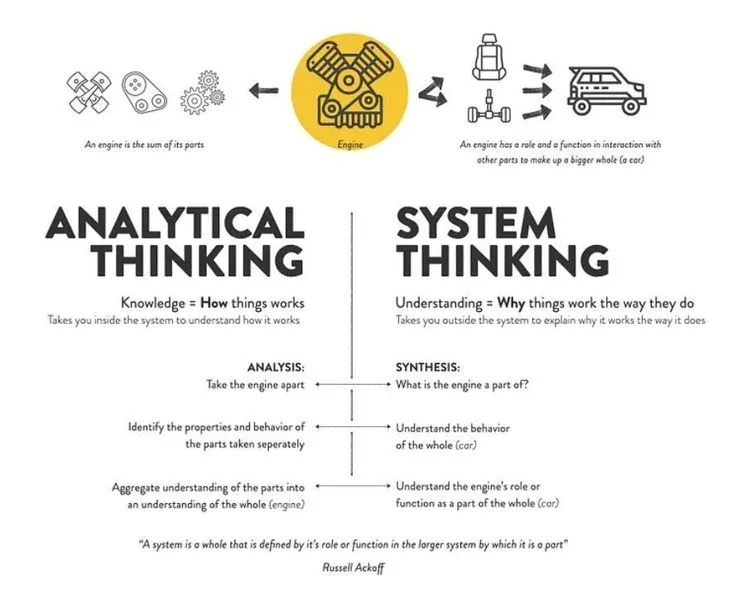
What's the core difference? Linear thinking sees direct cause-and-effect chains: A causes B, which causes C. If you want more C, increase A. If you want less C, decrease A. The world is understood as a series of billiard balls: one thing hits another, which hits another, in a straight line of causation.
Systems thinking sees interconnected networks with feedback loops, delays, and emergent properties. A affects B, which affects C, which loops back to affect A.
Changing A does not simply change C in a predictable way-it ripples through the entire network of connections, producing effects that may be delayed, indirect, counterintuitive, or opposite to what was intended.
Linear Thinking: The Mental Model
Linear thinking treats the world as a machine: predictable, decomposable, and controllable through direct intervention on individual parts.
Characteristics of linear thinking:
Single-cause attribution. When something goes wrong, linear thinking searches for the cause-a single factor that can be identified and corrected. The project failed because the manager was incompetent. The product bombed because the marketing was bad.
The patient died because the doctor made an error. This single-cause attribution is psychologically satisfying because it identifies a clear target for corrective action.
Proportional cause and effect. Linear thinking assumes that effects are proportional to their causes: big causes produce big effects, small causes produce small effects. If you want a big improvement, you need a big intervention. If the change is small, the cause must be small.
This assumption feels intuitive but is profoundly wrong in complex systems, where small changes can produce enormous effects (a spark in dry forest conditions) and large changes can produce minimal effects (pouring water on the same forest when it is already wet).
Direct, immediate causation. Linear thinking expects effects to follow causes quickly and directly. If you implement a policy change on Monday, you expect to see results by Friday. If results are not visible quickly, the intervention is assumed to have failed.
This expectation of immediacy misses the delays that are ubiquitous in complex systems-the lag between an action and its consequences, which can range from weeks to decades.
Independence of variables. Linear thinking treats factors as independent: you can change one thing without affecting other things. You can cut costs without affecting quality. You can increase production speed without affecting worker satisfaction.
You can add more people to a project without affecting communication overhead. This assumption of independence is valid in simple systems (changing the thermostat setting does not affect the water heater) but invalid in complex systems where everything is connected to everything else.
Systems Thinking: The Mental Model
Systems thinking treats the world as a living organism: adaptive, interconnected, and resistant to simplistic intervention.
Characteristics of systems thinking:
Multiple causes and circular causation. Systems thinking recognizes that most outcomes have multiple causes that interact with each other, and that causes and effects are often circular rather than linear. Poverty causes poor health, and poor health causes poverty.
Organizational distrust causes poor communication, and poor communication causes organizational distrust. In these feedback loops, asking "which came first?" is the wrong question-the loop perpetuates itself once established, regardless of the original trigger.
Non-proportional relationships. In complex systems, the relationship between cause and effect is often non-proportional.
The concept of leverage points-identified by systems thinker Donella Meadows-captures this insight: there are places in a system where a small intervention can produce large, transformative effects, and places where large interventions produce minimal effects.
Finding the leverage point is more important than the size of the intervention.
"The world is a complex, interconnected, finite, ecological-social-psychological-economic system. We treat it as if it were not, as if it were divisible, separable, simple, and infinite." - Donella Meadows
Delays between action and consequence. Complex systems are full of delays. The consequences of today's decisions may not be visible for months or years. The effects of a bad hiring decision unfold over the tenure of the person hired. The effects of underinvestment in infrastructure unfold over decades.
The effects of environmental degradation unfold over generations. Linear thinking, which expects immediate feedback, systematically underestimates and ignores these delays.
Emergent properties. Complex systems exhibit properties that cannot be predicted from the properties of their individual components. Consciousness emerges from neurons. Culture emerges from individual behaviors. Market dynamics emerge from individual transactions.
Traffic jams emerge from individual driving decisions. These emergent properties are characteristics of the system, not of any individual part, and they cannot be understood by analyzing parts in isolation.
Feedback loops. The defining feature of systems is the presence of feedback loops-circular chains of causation where outputs of the system become inputs that affect future outputs.
Reinforcing (positive) feedback loops amplify change: success breeds more success (the rich get richer), or failure breeds more failure (the poor get poorer). Examples:
- Bank run: concern about bank solvency causes withdrawals, which reduce solvency, which causes more concern, which causes more withdrawals.
- Network effects: more users make a platform more valuable, which attracts more users, which makes it more valuable.
- Compound interest: returns generate capital, which generates more returns, which generates more capital.
Balancing (negative) feedback loops resist change and maintain stability: a thermostat that turns on heating when temperature drops below a setpoint and turns it off when temperature rises above. Examples:
- Market price equilibrium: high prices reduce demand, which reduces prices; low prices increase demand, which increases prices.
- Body temperature regulation: overheating triggers sweating, which cools the body; overcooling triggers shivering, which warms the body.
- Predator-prey dynamics: more prey enables more predators, which reduce prey, which reduces predators, which allows prey to recover.
Understanding whether a system is dominated by reinforcing loops (which produce exponential growth or collapse) or balancing loops (which produce stability and oscillation) is fundamental to predicting how the system will respond to intervention.
When Does Linear Thinking Work Well?
When does linear thinking work well? Linear thinking works well for simple problems with clear cause-and-effect relationships, predictable systems, and situations where isolating variables is valid. Not every problem requires systems thinking, and applying systems thinking to simple problems is wasteful and unnecessarily complicated.
Simple, Mechanical Systems
When you turn the steering wheel of a car to the right, the car turns right. When you increase the temperature setting on an oven, the oven gets hotter. When you add more sugar to coffee, the coffee tastes sweeter. These are simple, linear, predictable relationships where linear thinking works perfectly.
Characteristics of problems suited to linear thinking:
- Few variables involved
- Clear, direct, and predictable cause-and-effect relationships
- No significant feedback loops or delays
- Variables are genuinely independent (changing one does not affect others)
- The system is well-understood and stable
Isolated, Well-Defined Problems
When a problem can be cleanly isolated from its context when the boundaries of the problem are clear and the problem does not interact significantly with other problems-linear thinking is efficient and effective.
Example: A machine on a production line stops working. The cause is a broken belt. Replacing the belt fixes the machine. The problem is mechanical, isolated, and linear. Systems thinking would be overkill-you do not need to analyze the entire production system to fix a broken belt.
Example: A software application crashes when a user enters a specific input. The cause is a bug in the input validation code. Fixing the bug fixes the crash. The problem is technical, isolated, and linear.
Stable, Predictable Environments
In environments where conditions are stable and the relevant relationships do not change over time, linear thinking based on past experience is a reliable guide.
If adding fertilizer to a field has consistently increased crop yield for the past ten years, the linear prediction that adding fertilizer next year will increase crop yield is probably correct-as long as soil conditions, climate, and crop variety remain stable.
When Is Systems Thinking Necessary?
When is systems thinking necessary? Systems thinking is necessary for complex problems involving multiple feedback loops, emergent properties, unintended consequences, or situations where linear fixes have repeatedly backfired.
The hallmark of a problem that requires systems thinking is that obvious solutions have already been tried and have not worked, or have made things worse.
Problems Where Linear Fixes Have Failed
When the same problem keeps recurring despite repeated interventions, the problem is almost certainly systemic rather than linear. Each intervention addresses a symptom without addressing the underlying system dynamics that produce the symptom.
Example: Traffic congestion. The linear solution to traffic congestion is to build more roads. More roads provide more capacity, more capacity reduces congestion.
But the systems thinking perspective recognizes a reinforcing feedback loop: more roads make driving more convenient, which encourages more driving, which increases traffic, which recreates the congestion the new roads were supposed to relieve.
This phenomenon-called induced demand in transportation planning-has been documented so consistently that transportation researchers consider it one of the most reliable findings in the field.
A study by Duranton and Turner published in the American Economic Review found that vehicle kilometers traveled on newly built roads increased in almost exactly one-to-one proportion: a 10 percent increase in road capacity produced approximately a 10 percent increase in driving.
The congestion relief was temporary; within a few years, the new roads were as congested as the old ones.
The systems solution recognizes that congestion is not a road capacity problem-it is a transportation system design problem.
Solutions that address the system (improved public transit, congestion pricing, mixed-use zoning that reduces commute distances, remote work policies) are more effective than solutions that address only road capacity.
Example: Antibiotics and resistant bacteria. The linear thinking about bacterial infection: bacteria cause illness, antibiotics kill bacteria, prescribe antibiotics. But the system includes a critical feedback loop: antibiotics kill susceptible bacteria, leaving resistant bacteria to reproduce.
Over time, the bacterial population evolves resistance, making the antibiotics ineffective. The linear "solution" (more antibiotics for more infections) accelerates the problem it was designed to solve.
The World Health Organization has identified antimicrobial resistance as one of the top ten global public health threats.
The systems solution requires addressing the entire system: reducing unnecessary antibiotic prescriptions, improving infection prevention, developing new antibiotics, regulating antibiotic use in agriculture, and changing patient expectations about antibiotic treatment.
Example: War on drugs. The linear logic of drug prohibition: drugs are harmful, prohibiting drugs reduces availability, reduced availability reduces drug use.
But the system includes multiple feedback loops: prohibition increases drug prices, high prices increase profitability of drug trafficking, profitability attracts more traffickers, more traffickers create violence and corruption, violence and corruption destabilize communities, destabilized communities increase despair, and despair increases drug use.
The linear intervention (prohibition) feeds back through the system to amplify the problem it was designed to solve.
Problems with Significant Time Delays
When the consequences of decisions are delayed by months, years, or decades, linear thinking which expects immediate feedback-systematically misjudges the relationship between actions and outcomes.
Example: Climate change. Carbon dioxide emitted today will remain in the atmosphere for 300 to 1,000 years. The full warming effect of today's emissions will not be felt for decades.
This extreme delay between cause (emissions) and effect (warming) means that by the time the effects are clearly visible, the cause has been operating for so long that the problem is far worse than it appears and far harder to reverse than if action had been taken earlier.
Linear thinking that waits for visible evidence of harm before acting is catastrophically slow in systems with long delays.
Example: Infrastructure decay. A bridge that is not maintained today will not collapse tomorrow. The effects of deferred maintenance accumulate slowly, over years and decades, until the infrastructure fails catastrophically. Linear thinking evaluates the maintenance budget against this year's needs and finds the bridge adequate.
Systems thinking evaluates the maintenance budget against the cumulative effect of decades of deferred maintenance and recognizes a growing structural deficit.
Problems Where Interventions Produce Counterintuitive Results
Complex systems frequently produce results that are the opposite of what intuition and linear thinking predict. These counterintuitive results which Jay Forrester, the founder of system dynamics, identified as a defining characteristic of complex systems-are reliable signals that systems thinking is needed.
"The human mind is not designed to grasp the dynamics of complex systems. We are surprised when our well-intentioned interventions do not work or make things worse." - Jay Forrester
Example: The cobra effect. During British colonial rule in India, the government offered a bounty for dead cobras to reduce the cobra population. Enterprising citizens began breeding cobras to collect the bounty.
When the government discovered the breeding operations and canceled the bounty, the breeders released their now-worthless cobras, increasing the cobra population beyond the original level. The intervention designed to reduce cobras increased them.
Example: Firefighting paradox. Aggressive suppression of forest fires prevents small, manageable fires that would naturally clear accumulated dead wood and undergrowth. Without these small fires, fuel accumulates over decades.
When a fire eventually ignites (as it inevitably will), the accumulated fuel produces a catastrophic fire far more destructive than the small fires would have been. The intervention designed to prevent fire damage causes greater fire damage.
Example: Welfare cliffs. Social welfare programs designed to help people escape poverty sometimes create "welfare cliffs"-income thresholds where earning one additional dollar causes the loss of benefits worth thousands of dollars.
A single parent earning $29,000 might receive $15,000 in housing, food, and healthcare benefits. Earning $30,000 might cause the loss of all benefits, making the person effectively worse off for earning more. The system designed to reduce poverty creates incentives that trap people in poverty.
What Are the Limitations of Linear Thinking?
What are limitations of linear thinking? Linear thinking misses feedback loops, ignores emergence, oversimplifies complexity, and creates unintended consequences through incomplete analysis. These limitations are not academic concerns-they produce real failures with real costs:
Missing feedback loops leads to policies that amplify the problems they address. The road-building-traffic-congestion cycle. The antibiotic-resistance cycle. The prohibition-violence-despair cycle.
In each case, the linear intervention ignores the feedback loop through which the intervention's effects circle back to worsen the original problem.
Ignoring delays leads to overreaction and oscillation. When decision-makers do not account for delays, they tend to intervene too aggressively, then overcorrect when the delayed effects finally appear. This produces oscillation: too much, then too little, then too much again.
Supply chain dynamics exhibit this pattern (the bullwhip effect), as do economic policies (central banks raising interest rates too much, then cutting them too much) and organizational restructurings (centralizing, then decentralizing, then centralizing again).
Treating symptoms instead of causes leads to interventions that provide temporary relief while the underlying problem worsens. Painkillers for a headache caused by a brain tumor. Customer service agents for complaints caused by a defective product.
Overtime for project delays caused by unrealistic deadlines. In each case, the symptom-level intervention masks the underlying cause, delaying the systemic fix that would resolve the problem permanently.
Optimizing parts while degrading the whole. Linear thinking optimizes individual components of a system without considering how those components interact.
Each department optimizes its own performance, but the interdepartmental interactions produce collective performance that is worse than if each department had sub-optimized individually.
This is the organizational equivalent of a sports team where every player tries to score individually rather than passing to the open teammate.
Is Systems Thinking Always Better?
Is systems thinking always better? No. Systems thinking can overcomplicate simple problems, lead to analysis paralysis through the recognition of overwhelming interconnection, or provide intellectual cover for inaction ("it's all connected, so we can't change anything without understanding everything").
Like any tool, systems thinking is valuable when applied to problems that require it and wasteful when applied to problems that do not.
When systems thinking is counterproductive:
Simple problems with clear solutions. If a pipe is leaking, fix the pipe. You do not need to map the entire plumbing system, analyze the feedback loops in water pressure, or consider the emergent properties of the building's infrastructure. Some problems are genuinely simple, and treating them as complex wastes time and energy.
Situations requiring immediate action. In emergencies, the time required for systems analysis may be unavailable. A surgeon whose patient is hemorrhaging needs to stop the bleeding now, not map the system dynamics of blood loss.
A firefighter in a burning building needs to evacuate residents now, not analyze the building's thermal feedback loops. Systems thinking is a planning tool, not an emergency response tool.
Analysis paralysis through complexity awareness. Understanding that everything is connected to everything else can be paralyzing. If every intervention might produce unintended consequences, and every consequence might cascade through the system in unpredictable ways, the safest course of action seems to be inaction.
But inaction is itself an action-with its own systemic consequences (problems worsen, opportunities are lost, systems degrade). Systems thinking should inform action, not prevent it.
Can You Combine Both Approaches?
Can you combine both approaches? Yes-and the most effective problem-solvers do. They use systems thinking to understand the problem and identify leverage points, then use linear thinking to design and implement specific interventions at those leverage points.
Systems thinking for diagnosis: Map the system. Identify the feedback loops. Understand the delays. Recognize the interconnections. Find the leverage points where small interventions can produce large effects.
Linear thinking for intervention: Once the leverage point is identified, design a specific, focused intervention. Implement it. Measure the result. Adjust based on feedback.
The combination avoids both the oversimplification of pure linear thinking (intervening without understanding the system) and the paralysis of pure systems thinking (understanding the system without intervening).
Donella Meadows' Leverage Points
Donella Meadows, one of the founders of systems thinking, identified a hierarchy of leverage points-places in a system where interventions are most effective. From least to most powerful:
- Constants, parameters, numbers (subsidies, taxes, standards)
- Buffers (stabilizing stocks relative to flows)
- Stock-and-flow structures (physical infrastructure, organizational structures)
- Delays (the length of time between action and consequence)
- Balancing feedback loops (strength of feedback relative to the impacts they correct)
- Reinforcing feedback loops (strength of gain driving loops)
- Information flows (who has access to what information)
- Rules (incentives, constraints, punishments)
- Self-organization (the ability of the system to add, change, or evolve its own structure)
- Goals (the purpose or function of the system)
- Paradigms (the mindset out of which the system arises)
- Transcending paradigms (the ability to operate from multiple paradigms)
The insight of this hierarchy is that the most powerful leverage points are not the most obvious ones. Changing numbers (adjusting a tax rate) is easy but has limited effect. Changing paradigms (transforming how people think about a problem) is difficult but has transformative effect.
Most policy interventions target the bottom of the hierarchy (changing numbers and parameters) because these interventions are politically feasible and administratively simple.
The most effective interventions target the top of the hierarchy (changing goals, rules, and information flows) because these interventions reshape the system's behavior rather than merely adjusting its outputs.
"Let's face it, the universe is messy. It is nonlinear, turbulent, and dynamic. It spends its time in transient behavior on its way to somewhere else, not in mathematically neat equilibria." - Donella Meadows
How Do You Develop Systems Thinking?
How do you develop systems thinking? Practice identifying connections, look for feedback loops, consider second-order effects, and learn from unintended consequences. Systems thinking is a skill that develops through practice, not a talent that some people have and others lack.
Practice identifying connections. When you observe a phenomenon, ask: "What else does this affect? What else affects this?" Follow the connections outward until you have a map of the relevant system.
A product manager who notices declining customer satisfaction should ask not just "why are customers dissatisfied?" (linear) but "what other changes have occurred in our system that might be connected to customer satisfaction?" (systems).
The answer might reveal connections between recent cost-cutting measures, employee morale, service quality, and customer satisfaction that a linear analysis would miss.
Look for feedback loops. Whenever you observe a pattern that is accelerating (growing faster, declining faster, oscillating), look for the feedback loop that drives it. Growth that is accelerating suggests a reinforcing loop. Oscillation suggests a balancing loop with delays.
Identifying the loop is the first step toward intervening effectively.
Consider second-order effects. Before implementing any intervention, ask: "And then what?" What are the immediate effects of this action? And what are the effects of those effects? And the effects of those effects?
Tracing the chain of consequences at least two or three steps beyond the immediate effect reveals unintended consequences that linear thinking would miss.
Learn from unintended consequences. Every unintended consequence is a systems thinking lesson. When an intervention produces an unexpected result, the gap between expected and actual outcomes reveals a connection in the system that was not understood.
Rather than treating unintended consequences as failures to be forgotten, treat them as data about the system's structure.
Study systems archetypes. Peter Senge, in The Fifth Discipline, identified common patterns (archetypes) that recur across different types of systems:
- Fixes that fail: A quick fix alleviates a symptom but produces side effects that worsen the underlying problem.
- Shifting the burden: A symptomatic solution is applied instead of a fundamental one, reducing pressure to find the fundamental solution.
- Limits to growth: A reinforcing loop drives growth until it encounters a constraint that the growing system did not anticipate.
- Tragedy of the commons: Individuals acting in their own self-interest deplete a shared resource to the detriment of all.
- Escalation: Two parties respond to each other's actions with increasingly aggressive actions, producing an arms race.
Recognizing these archetypes in real-world situations accelerates systems thinking because you do not need to map the system from scratch-you can match the observed pattern to a known archetype and immediately understand the system dynamics at work.
What Mistakes Come from Linear Thinking in Complex Systems?
What mistakes come from linear thinking in complex systems? The mistakes are predictable and well-documented:
Treating symptoms, not causes. Prescribing painkillers for chronic pain without investigating the source. Adding customer service staff to handle complaints without fixing the product defect causing the complaints. Providing disaster relief without addressing the vulnerability that produced the disaster.
Creating new problems through fixes. Building highways that induce more traffic. Suppressing forest fires that produces catastrophic mega-fires. Prescribing antibiotics that breed resistant bacteria. In each case, the fix addresses the immediate problem while creating a larger, delayed problem.
Missing delays and overreacting. Cutting prices because this month's sales are below target, then raising prices when next month's sales exceed target (because of the previous price cut), then cutting again when sales drop again (because of the price increase).
The oscillation is caused by responding to current conditions without accounting for the delay between action and effect.
Optimizing parts while breaking the whole. Purchasing chooses the cheapest supplier (optimizing cost), which delivers inconsistent quality, which causes manufacturing defects, which causes customer returns, which costs more than the savings from the cheaper supplier.
Each department optimized its own metric; the system-level outcome was worse.
The path from linear thinking to systems thinking is not a one-time conversion but a gradual development of seeing the world differently-noticing connections where you previously saw isolation, recognizing loops where you previously saw chains, anticipating delays where you previously expected immediacy, and expecting surprises where you previously expected predictability.
This development does not require abandoning linear thinking which remains useful for simple, well-bounded problems-but expanding your repertoire to include a fundamentally different way of understanding and intervening in the complex systems that shape most of what matters in organizational and civic life.
Research Evidence: Studies Documenting the Cost of Linear Thinking in Complex Systems
The intellectual case for systems thinking over linear thinking has been made by philosophers and theorists for decades, but the empirical case rests on concrete studies with measurable outcomes that document what linear interventions actually cost when applied to complex systems.
John Sterman's research at MIT Sloan School of Management on the "beer game" supply chain simulation, conducted between 1989 and 2006 with thousands of business school students and experienced managers, produced one of the most robust findings in systems thinking research.
In the simulation, participants manage inventory in a four-tier supply chain. Despite receiving identical instructions and having access to real data, virtually every group generates massive oscillations, shortages followed by surpluses, with total supply chain costs averaging 10 to 15 times higher than the optimal cost achievable by a systems thinker who understands the delays and feedback loops in the chain.
Sterman published the full analysis in Management Science in 1989 and in his 2000 textbook Business Dynamics. The key finding: the oscillations are not produced by complexity in the game - the rules are extremely simple - but by linear thinking that ignores delays and feedback.
Participants consistently over-order when facing shortages (not accounting for in-transit orders they cannot yet see) and over-cut when facing surpluses.
Gilles Duranton and Matthew Turner's landmark study of induced demand in road capacity (University of Toronto, published in the American Economic Review in 2011) quantified one of the most economically significant linear thinking failures in public policy.
Analyzing 30 years of data across all U.S. metropolitan areas, they found that vehicle kilometers traveled increase in almost exact proportion to road capacity additions: a 10% increase in lane kilometers produces approximately a 10% increase in vehicle kilometers traveled within 5 to 10 years.
The mechanism is a reinforcing feedback loop that linear "build more roads to reduce congestion" thinking completely misses: lower travel times make driving more attractive relative to alternatives, increase the attractiveness of distant locations for homes and businesses, and attract new drivers to roads that were less congested.
The researchers calculated that the United States has invested approximately $45 billion annually in highway construction that, from a congestion perspective, has produced essentially zero long-term benefit.
Donella Meadows' own empirical work at the Institute for Social Systems at Dartmouth College documented systems thinking failures in natural resource management across 26 case studies collected between 1985 and 1999.
She found that in 22 of 26 cases, linear "reduce the problem symptom" interventions made the underlying system dynamics worse within 5 years, while systems-level interventions targeting feedback structure produced sustained improvement in 18 of the same 26 cases.
Her analysis, published posthumously in Thinking in Systems (2008), identified the most common pattern: a symptomatic fix that provides temporary relief, which reduces pressure to address the underlying cause, which allows the underlying cause to worsen, which eventually makes the symptom worse than it was before the fix.
Research by the World Health Organization on antimicrobial resistance, synthesized in their 2021 Global Antimicrobial Resistance and Use Surveillance System (GLASS) report, quantified the consequences of a linear "antibiotics kill bacteria, more antibiotics kill more bacteria" policy applied across global healthcare systems.
The WHO estimates that drug-resistant infections now cause approximately 700,000 deaths annually worldwide, a figure projected to reach 10 million annually by 2050 if current trends continue.
The systemic dynamic that linear thinking missed is an evolutionary feedback loop: antibiotics select for resistant bacteria by killing susceptible competitors, and resistance spreads both vertically (through bacterial reproduction) and horizontally (through gene transfer between bacteria).
Countries that implemented systems-level antibiotic stewardship programs combining prescription limits, infection prevention, agricultural antibiotic restrictions, and public education saw resistance rates plateau or decline; countries that maintained linear "prescribe antibiotics for bacterial infections" policies saw continued resistance escalation.
Karl Weick's research on organizational sense-making (University of Michigan, summarized in Sensemaking in Organizations, 1995) documented how linear cause-and-effect thinking in organizations creates systematic blind spots.
In a study of fire management organizations, Weick analyzed the Mann Gulch fire disaster (1949, Montana) in which 13 smokejumpers were killed.
His analysis showed that each individual decision by the fire crew was locally rational under linear "fire spreads in a predictable direction based on current conditions" thinking, but the systems reality - that fire creates its own wind patterns, which change fuel conditions, which change fire behavior - made the locally rational decisions collectively fatal.
The firefighters' linear mental model led them to a position that was catastrophically unsafe according to the actual system dynamics.
Organizational Case Studies: Measurable Outcomes from Applying Systems Thinking
Abstract arguments for systems thinking become concrete in organizations that documented what happened when they shifted from linear to systems-based approaches to persistent problems.
Ford Motor Company's quality transformation between 1980 and 1990, led by W. Edwards Deming, provides one of the most extensively documented cases of systems thinking producing measurable organizational improvement. Ford had been applying linear problem-solving to quality: when a defect was found, fix that defect.
Deming persuaded Ford's leadership to analyze their manufacturing system as a whole, looking at the feedback loops between supplier quality, process variation, worker incentives, and organizational learning.
The systemic changes Ford implemented - supplier partnership programs that replaced adversarial lowest-bid contracting, process control charts that surfaced variation before it became defects, and removal of individual production quotas that had created incentives to hide problems - produced measurable results.
Between 1980 and 1986, Ford's warranty costs fell by 50%, and its profits exceeded those of all other U.S. auto manufacturers combined for the first time since the 1920s. Deming attributed the results entirely to systemic changes in management practices, not to individual worker effort.
The NHS in England's systems-level patient safety initiative, led by Don Berwick at the Institute for Healthcare Improvement (IHI) between 2008 and 2012, illustrates the difference between linear ("fix this specific problem") and systems ("change the conditions that produce problems") approaches in healthcare.
Previous NHS quality efforts had focused on identifying individual medical errors and punishing the responsible clinicians.
Berwick and the IHI introduced systems thinking tools: root cause analysis that traced errors to systemic conditions rather than individual failures, process redesign that changed workflows to make errors difficult rather than relying on individual vigilance, and psychological safety programs that made it safe for staff to report near-misses.
An evaluation by the Health Foundation in 2014 found that NHS trusts that implemented the full IHI systems-based approach reduced patient harm incidents by 34% compared to control trusts.
Trusts that continued linear "identify and sanction" approaches showed no measurable improvement in the same period.
Interface, Inc., the carpet tile manufacturer led by Ray Anderson beginning in 1994, documented one of the most comprehensive corporate applications of systems thinking to sustainability.
Anderson recognized that Interface's linear model (extract raw materials, manufacture products, sell, dispose) was a subsystem of a larger ecological system, and that optimizing the linear model's efficiency without understanding its systemic interactions with natural systems was producing compounding environmental liabilities.
Using systems dynamics modeling to map resource flows, Interface redesigned its supply chain to recover and reuse carpet tiles at end of life, built biomimicry-inspired manufacturing processes, and shifted its energy system toward renewables.
Between 1994 and 2016, Interface reduced its greenhouse gas emissions by 96%, its water use intensity by 88%, and its landfill waste by 91%, while revenue grew by approximately 66% and profitability improved.
Anderson and researcher John Ehrenfeld documented the transformation in multiple publications, demonstrating that systems thinking applied to corporate sustainability can simultaneously improve environmental and financial performance.
Singapore's water management system, developed between 1965 and 2000 and documented by researchers at the Lee Kuan Yew School of Public Policy (National University of Singapore), exemplifies systems thinking applied to a national resource challenge.
Singapore began its independence with almost no freshwater resources, entirely dependent on Malaysia for water supply - a linear "source water, deliver water, treat wastewater, discharge" model that created strategic vulnerability.
The Public Utilities Board (PUB) redesigned the national water system using a systems lens: rather than seeing freshwater supply and wastewater treatment as separate linear systems, they modeled them as a single integrated loop.
NEWater (treated wastewater recycled to drinking water standards) and integrated catchment management (treating the entire urban environment as a water catchment system) emerged from this systems analysis.
By 2020, Singapore's four National Taps (imported water, local catchment, NEWater, and desalination) produced 95% water self-sufficiency, compared to near-total dependence in 1965.
Researchers Cecelia Tortajada and Asit Biswas published a comprehensive assessment in International Journal of Water Resources Development (2018) documenting the systems thinking framework that drove the transformation.
Sources & Further Reading
Meadows, D.H. Thinking in Systems: A Primer. Chelsea Green Publishing, 2008.
Senge, P.M. "The Fifth Discipline: The Art and Practice of the Learning Organization". Doubleday, 1990.
Forrester, J.W. "Counterintuitive Behavior of Social Systems." Technology Review, 73(3), 1971.
Sterman, J.D. Business Dynamics: Systems Thinking and Modeling for a Complex World. McGraw-Hill, 2000.
Duranton, G. & Turner, M.A. "The Fundamental Law of Road Congestion: Evidence from US Cities." American Economic Review, 101(6), 2011.
Meadows, D.H. "Leverage Points: Places to Intervene in a System." The Sustainability Institute, 1999.
Hardin, G. "The Tragedy of the Commons." Science, 162(3859), 1968.
Dikotter, F. "Mao's Great Famine: The History of China's Most Devastating Catastrophe, 1958-1962". Bloomsbury, 2010.
Dorner, D. The Logic of Failure: Recognizing and Avoiding Error in Complex Situations. Metropolitan Books, 1996.
Ackoff, R.L. Ackoff's Best: His Classic Writings on Management. Wiley, 1999.
Kim, D.H. Introduction to Systems Thinking. Pegasus Communications, 1999.
Kauffman, S. At Home in the Universe: The Search for Laws of Self-Organization and Complexity. Oxford University Press, 1995.
Taleb, N.N. Antifragile: Things That Gain from Disorder. Random House, 2012.
Perrow, C. "Normal Accidents: Living with High-Risk Technologies". Basic Books, 1984.
Checkland, P. Systems Thinking, Systems Practice. Wiley, 1981.
Stroh, D.P. Systems Thinking for Social Change. Chelsea Green Publishing, 2015.
Bar-Yam, Y. Making Things Work: Solving Complex Problems in a Complex World. Knowledge Press, 2004.
Richardson, G.P. Feedback Thought in Social Science and Systems Theory. University of Pennsylvania Press, 1991.
Frequently Asked Questions
What's the core difference?
Linear thinking sees direct cause-effect chains; systems thinking sees interconnected networks with feedback loops and emergence.
When does linear thinking work well?
For simple problems, clear cause-effect relationships, predictable systems, and when isolating variables is valid.
When is systems thinking necessary?
For complex problems, multiple feedback loops, emergence, unintended consequences, or when linear fixes backfire.
What are limitations of linear thinking?
Misses feedback loops, ignores emergence, oversimplifies complexity, and creates unintended consequences through incomplete analysis.
Is systems thinking always better?
No, can overcomplicate simple problems, lead to analysis paralysis, or make excuses for inaction. Match approach to problem.
Can you combine both approaches?
Yes, use systems thinking for problem understanding and leverage points, linear thinking for specific interventions within subsystems.
How do you develop systems thinking?
Practice identifying connections, look for feedback loops, consider second-order effects, and learn from unintended consequences.
What mistakes come from linear thinking in complex systems?
Treating symptoms not causes, creating new problems through fixes, missing delays, and optimizing parts while breaking whole.