
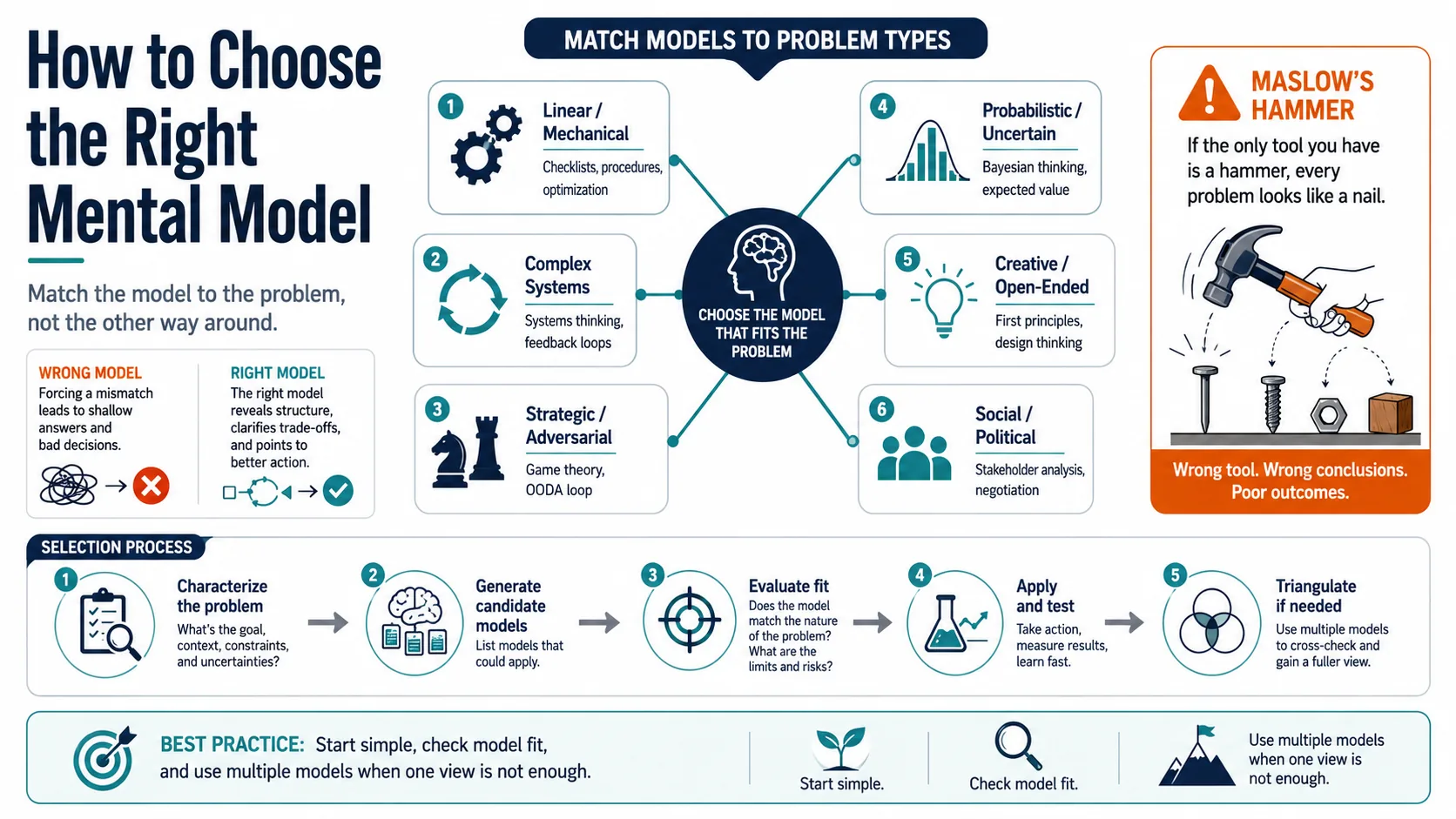
Mental models are powerful tools for understanding complexity. But having a toolbox full of models means nothing if you don't know which one to use. The wrong model leads you astray-forcing problems into inappropriate frameworks, missing critical dynamics, and producing flawed conclusions.
Model selection is a meta-skill: knowing which thinking tool fits which problem. This article explains how to choose mental models strategically, avoid common traps, and develop judgment about when different frameworks apply.
Table of Contents
- The Model Selection Problem
- The Law of the Instrument
- Matching Models to Problem Types
- Model Fit Criteria
- Starting Simple vs. Starting Complex
- Using Multiple Models (Triangulation)
- Context and Constraints
- Common Mismatches and Failures
- Decision Framework for Model Selection
- Building Model Selection Skill
- Practical Examples
- References
The Model Selection Problem
Why Selection Matters
All mental models are simplifications. They focus attention on certain variables while ignoring others. A model that reveals important dynamics in one situation may obscure them in another.
| Using the Right Model | Using the Wrong Model |
|---|---|
| Highlights essential features | Focuses on irrelevant details |
| Generates accurate predictions | Produces misleading forecasts |
| Suggests productive actions | Points to ineffective interventions |
| Reveals underlying structure | Obscures actual dynamics |
| Builds understanding | Creates false confidence |
Example: Traffic congestion
Wrong model: "More lanes = less congestion" (simple capacity model)
- Result: Build more lanes, congestion stays same or worsens (induced demand)
Right model: "Traffic follows supply-and-demand with feedback loops"
- Insight: More lanes increase supply, which induces more demand, creating equilibrium at a higher volume
- Better interventions: Congestion pricing, public transit, remote work policies
The right model reveals why the obvious solution fails.
The Challenge of Abundance
Modern problem: You know too many models, not too few.
| Era | Challenge |
|---|---|
| Pre-20th century | Limited models; needed to develop new ones |
| Mid-20th century | Growing model library; integration challenge |
| 21st century | Model overload; selection and application challenge |
With hundreds of mental models available-from systems thinking to game theory to cognitive biases to statistical reasoning-the bottleneck isn't knowing models. It's knowing which one to use when.
"You've got to have models in your head. And you've got to array your experience-both vicarious and direct-on this latticework of models." - Charlie Munger, USC Business School, 1994[12]
The Law of the Instrument
Maslow's Hammer
"If the only tool you have is a hammer, everything looks like a nail."
The pattern:
- You master a particular model or framework
- It works brilliantly in its domain
- You apply it to everything
- It fails in domains where its assumptions don't hold
- You force-fit reality to the model rather than adjusting the model
Real-World Examples
| Expert | Favorite Tool | Overextension |
|---|---|---|
| Economists | Supply-and-demand, incentives, optimization | Apply market logic to love, family, culture-misses non-economic values |
| Engineers | Optimization, efficiency, systems design | Treat organizations like machines-ignores human complexity |
| Psychologists | Cognitive biases, behavioral patterns | Attribute all problems to individual psychology-ignores structural causes |
| Data scientists | Correlation, prediction models | Conflate correlation with causation-misidentify interventions |
| Military strategists | Adversarial game theory, zero-sum thinking | See all conflicts as battles-miss cooperative solutions |
Why Experts Fall Into This Trap
| Reason | Mechanism |
|---|---|
| Expertise bias | Deep knowledge in one domain creates overconfidence about applicability |
| Availability heuristic | Familiar models come to mind first; unfamiliar ones don't surface |
| Success reinforcement | Model worked before; assume it will work again |
| Identity | "I'm an economist" "I think like an economist about everything" |
| Cognitive ease | Applying a familiar model is easier than learning a new one |
The solution: Deliberate humility and model diversity.
"The first principle is that you must not fool yourself-and you are the easiest person to fool." - Richard Feynman, Caltech commencement address, 1974
Matching Models to Problem Types
Different problem structures require different frameworks.
Problem Type Taxonomy
| Problem Type | Characteristics | Models That Fit |
|---|---|---|
| Linear/Mechanical | Predictable, proportional, stable | Checklists, step-by-step procedures, optimization |
| Complex Systems | Feedback loops, emergence, nonlinearity | Systems thinking, stock-flow models, agent-based models |
| Strategic/Adversarial | Intelligent opponents, moves and countermoves | Game theory, strategic thinking, OODA loop |
| Probabilistic/Uncertain | Randomness, incomplete information | Bayesian reasoning, expected value, scenario planning |
| Creative/Open-Ended | Multiple valid solutions, exploration | First principles, lateral thinking, design thinking |
| Social/Political | Multiple stakeholders, power dynamics, values | Stakeholder analysis, ethical frameworks, negotiation models |
Matching Process
Ask:
- What type of system is this? (Simple, complicated, complex, chaotic)[5]
- What am I trying to understand? (Structure, dynamics, outcomes, decisions)
- What variables matter most? (Quantitative, qualitative, relational)[11]
- How predictable is it? (Deterministic, probabilistic, unknowable)
- Who are the agents? (Rational actors, adaptive learners, diverse stakeholders)
Example: Choosing Models for a Business Problem
Problem: Declining sales
| Model | What It Reveals | When It Fits |
|---|---|---|
| Supply-demand | Price sensitivity, market equilibrium | If market is competitive, rational |
| Customer journey | Where customers drop off | If problem is in conversion funnel |
| Jobs-to-be-done | What need isn't being met | If value proposition is weak |
| Competitive analysis | What rivals are doing better | If market is zero-sum |
| Systems thinking | Feedback loops (e.g., quality cuts reputation damage fewer customers) | If interconnected causes |
| Statistical analysis | Correlation of sales with other factors | If you have data and patterns |
Best approach: Start with multiple models to triangulate.
"All models are wrong, but some are useful." - George Box, statistician, Journal of the American Statistical Association, 1976[1]
Model Fit Criteria
How do you know if a model fits?
The Good Fit Checklist
| Criterion | Good Fit | Poor Fit |
|---|---|---|
| Assumptions match reality | Model's foundational assumptions hold in this context | Model assumes things that aren't true here |
| Captures essential dynamics | Key causal relationships are represented | Misses important variables or interactions |
| Appropriate abstraction level | Right balance of detail and simplicity | Too abstract (loses meaning) or too detailed (overwhelms) |
| Generates useful predictions | Forecasts are accurate enough to guide action | Predictions are consistently wrong |
| Suggests actionable insights | Points to interventions you can actually do | Recommends things outside your control |
| Explains past patterns | Accounts for historical data | Can't explain what already happened |
| Fails gracefully | Clear when model breaks; knowable limits | Fails silently; unclear when to stop trusting it |
Testing Fit
Methods:
- Retrodiction: Can the model explain past outcomes?
- Prediction: Does it forecast future events accurately?
- Counterfactual testing: If X had been different, would the model predict different Y?[8]
- Boundary testing: Push the model to extremes-does it produce absurd results?
- Cross-context validation: Does it work in analogous situations?
Example: Testing "Supply-Demand" for Labor Market
| Test | Result | Interpretation |
|---|---|---|
| Retrodiction | Explains wage changes in competitive sectors | Fits there |
| Prediction | Doesn't predict wages in monopolistic employers | Breaks down |
| Counterfactual | If minimum wage rises, predicts unemployment (mixed evidence) | Partial fit |
| Boundary | Predicts $1M wage instant supply of brain surgeons (absurd) | Ignores training time, barriers |
| Cross-context | Doesn't fit volunteer labor, family work, caring professions | Limited domain |
Conclusion: Supply-demand model fits some labor markets, not all. Use cautiously and supplement with other models.
Starting Simple vs. Starting Complex
The Principle of Parsimony
"Start with the simplest model that could plausibly explain the phenomenon."
| Approach | Pros | Cons |
|---|---|---|
| Start simple | Easy to understand, fast, reveals whether complexity is needed | May miss essential features |
| Start complex | Captures nuance from the start | Harder to interpret, may overfit, computationally expensive |
Best practice: Occam's Razor in model selection-prefer simpler models unless complexity demonstrably improves accuracy.[3]
The Escalation Ladder
Model selection as progressive refinement:
| Stage | Model Type | Example |
|---|---|---|
| 1. Heuristic | Rule of thumb | "Sales usually dip in Q3" |
| 2. Simple linear | Proportional relationships | "Sales = 0.8 Marketing Spend" |
| 3. Multivariate | Multiple factors | "Sales = f(marketing, price, seasonality)" |
| 4. Nonlinear | Thresholds, saturation | "Diminishing returns on ad spend" |
| 5. Dynamic | Feedback loops, time delays | "Reputation affects sales, sales fund marketing" |
| 6. Agent-based | Heterogeneous actors, interactions | "Customer networks, word-of-mouth dynamics" |
Move up the ladder only when:
- Simple model fails predictive tests
- You have data to support complexity
- Added complexity produces actionable insights
Using Multiple Models (Triangulation)
Single models have blind spots. Multiple models provide robustness. This problem-solving approach-using several lenses at once-is the core of triangulation.
Why Triangulation Works
| Benefit | Explanation |
|---|---|
| Reveals blind spots | One model's weakness is another's strength |
| Cross-validates insights | If multiple models agree, confidence increases |
| Surfaces tensions | When models disagree, you've found important complexity |
| Generates hypotheses | Different perspectives suggest different tests |
| Reduces overconfidence | Reminds you that all models are partial |
Triangulation Strategy
Apply 2-4 models from different traditions:
| Model Type | What It Highlights |
|---|---|
| Economic | Incentives, tradeoffs, efficiency |
| Systems | Feedback loops, delays, emergence |
| Psychological | Biases, heuristics, emotions |
| Strategic | Competition, moves, positioning |
| Statistical | Patterns, correlations, distributions |
| Ethical | Values, fairness, rights |
Example: Understanding poverty
| Model | Insight |
|---|---|
| Economic | Poverty as lack of income/assets; interventions = cash transfers, jobs |
| Systems | Poverty traps-lack of capital low returns continued poverty; need leverage points |
| Psychological | Scarcity mindset impairs decision-making; cognitive load matters |
| Social | Networks determine opportunities; social capital is key |
| Political | Power structures perpetuate inequality; need institutional change |
| Ethical | Poverty violates human dignity; frames it as injustice, not just economic problem |
Convergence: All models agree that interventions must be multifaceted.
Divergence: Debate over whether to focus on individual capability vs. structural change.
Result: Richer understanding than any single model provides.
As Shane Parrish writes, "The quality of our thinking is proportional to the models in our head and their usefulness in the situation at hand." (Farnam Street, The Great Mental Models, 2019)
Context and Constraints
Model selection isn't just about the problem-it's about your context.[13]
Contextual Factors
| Factor | How It Affects Selection |
|---|---|
| Time available | Complex models take longer to apply |
| Data available | Quantitative models need data; qualitative models work with stories |
| Expertise | Some models require specialized knowledge |
| Stakeholder expectations | Audiences may prefer certain types of reasoning |
| Risk tolerance | High-stakes decisions need robust, validated models |
| Decision reversibility | Irreversible choices need more rigorous models |
| Resource constraints | Complex models may require tools, software, teams |
Practical Constraints
Example: Startup deciding on pricing
| Model | Ideal Use | Practical Constraint |
|---|---|---|
| Conjoint analysis | Precisely measure willingness-to-pay | Requires hundreds of survey responses; startup has no users yet |
| Competitor benchmarking | See what market will bear | Only 2 competitors; both are different business models |
| Cost-plus pricing | Ensure profitability | Don't know costs yet (pre-launch) |
| Value-based pricing | Charge based on value delivered | Hard to quantify value before customers use it |
| Experimentation (A/B testing) | Learn from real behavior | Need traffic to test; chicken-and-egg problem |
Practical choice: Start with simple heuristic ("Price similar to closest competitor adjusted for our differentiation"), then refine with experimentation once you have users.
Lesson: Perfect model selection is often infeasible. Use the best model you can apply given constraints.
"It is not enough to do your best; you must know what to do, and then do your best." - W. Edwards Deming, management theorist
Common Mismatches and Failures
Predictable ways model selection goes wrong. Understanding these failure modes is essential for decision-making under uncertainty.
Mismatch 1: Linear Model for Nonlinear System
Mistake: Assume proportional relationships in systems with thresholds, saturation, or feedback.
Example: "Work twice as hard twice the output"
- Reality: Diminishing returns, fatigue, burnout
- Better model: Inverted-U (Yerkes-Dodson law)-performance peaks at moderate effort, declines with overwork
Mismatch 2: Static Model for Dynamic System
Mistake: Ignore time, feedback loops, and adaptation.
Example: "Cut costs improve profitability"
- Reality: Cost cuts quality decline customer attrition revenue loss worse profitability
- Better model: Systems thinking with reinforcing/balancing loops[4]
Mismatch 3: Rational Actor Model for Bounded Rationality
Mistake: Assume perfect information, consistent preferences, optimal decisions.
Example: "Patients will choose the best health plan"
- Reality: Plans are complex, patients are overwhelmed, defaults matter more than optimization
- Better model: Behavioral economics-heuristics, biases, choice architecture
Mismatch 4: Aggregate Model for Heterogeneous Agents
Mistake: Treat all actors as identical when diversity matters.
Example: "Average customer wants X"
- Reality: Customers segment into groups with very different needs
- Better model: Market segmentation, personas, or agent-based models
Mismatch 5: Deterministic Model for Probabilistic System
Mistake: Predict exact outcomes in inherently uncertain systems.[9]
Example: "This marketing campaign will generate exactly 500 leads"
- Reality: Outcomes have distributions; variance is large
- Better model: Probabilistic forecasting-confidence intervals, expected value, scenarios[6]
Mismatch 6: Domain-Specific Model Applied Out of Domain
Mistake: Use a model beyond its valid scope.
Example: "Apply military strategy to family conflicts"
- Reality: Families aren't battlefields; adversarial framing is destructive
- Better model: Collaborative problem-solving, communication frameworks
Decision Framework for Model Selection
A structured process for choosing models.
Step 1: Characterize the Problem
| Question | Purpose |
|---|---|
| What type of system is this? | Determines model category (mechanical, complex, strategic, etc.) |
| What do I need to understand? | Structure, behavior, outcomes, decisions, tradeoffs? |
| What's the time horizon? | Short-term vs. long-term dynamics |
| How much uncertainty? | Deterministic, probabilistic, deep uncertainty |
| Who are the key actors? | Individuals, organizations, systems |
Step 2: Generate Candidate Models
Sources:
- Domain knowledge: What models do experts in this field use?
- Analogies: What similar problems have been solved? What models worked?
- Model libraries: Mental models, frameworks, theories from your knowledge base
- First principles: Can you reason from fundamentals?
Aim for 3-5 candidate models from diverse traditions.
Step 3: Evaluate Fit
For each candidate model, assess:
| Criterion | Rating (1-5) |
|---|---|
| Assumptions match reality | |
| Captures essential dynamics | |
| Appropriate complexity | |
| Data/info available to apply it | |
| Actionable insights likely | |
| You have expertise to use it | |
| Stakeholders will accept it |
Choose model(s) with highest total score.
Step 4: Apply and Test
- Apply the model to the problem
- Generate predictions or insights
- Test against reality (retrodiction, prediction, counterfactuals)
- Iterate: If model fails, revisit Step 2
Step 5: Triangulate (If Possible)
If stakes are high or problem is complex:
- Apply 2-3 different models
- Compare insights
- Look for convergence (robust conclusions) and divergence (areas of uncertainty)
Building Model Selection Skill
Model selection is a skill you develop over time. The same heuristics that help you recognize a good model also reveal when a model is failing.
Practice Strategies
| Strategy | How It Helps |
|---|---|
| Study diverse models | Expands your toolkit; prevents hammer problem |
| Analyze case studies | Learn which models worked (or failed) in real situations |
| Deliberate practice | Apply models to problems, get feedback, refine |
| Post-mortems | After decisions, assess whether model was appropriate |
| Learn from multiple fields | Cross-pollination reveals when models transfer |
| Maintain model journal | Document when/why you chose each model; build pattern library |
| Seek expert feedback | Experts can identify misapplications you missed |
Heuristics for Model Selection
| Heuristic | When to Use |
|---|---|
| "Has this been solved before?" | Look for established models in that domain |
| "What would an expert in [field] think?" | Borrow from relevant disciplines |
| "What's the simplest story?" | Start with the most parsimonious explanation |
| "What am I missing?" | Forces consideration of blind spots |
| "If I'm wrong, how will I know?" | Ensures model is testable |
| "What would disconfirm this model?" | Popperian falsification mindset |
Red Flags (Signs of Poor Selection)
| Warning Sign | What It Means |
|---|---|
| Model feels forced | Problem doesn't naturally fit the framework |
| Require heroic assumptions | Must assume away too much reality |
| Predictions are consistently wrong | Model doesn't capture actual dynamics |
| Insights aren't actionable | Model is descriptive but not useful |
| You're contorting language | Forcing terminology from one domain onto another |
| Experts in domain reject it | They know something you don't |
| You're ignoring inconvenient facts | Motivated reasoning; model confirms what you want to believe |
Practical Examples
Example 1: Declining Employee Morale
Problem: Employee engagement scores dropping.
Candidate models:
| Model | Insight | Intervention |
|---|---|---|
| Incentive misalignment | Employees aren't rewarded for what you want | Adjust compensation, recognition |
| Maslow's hierarchy | Basic needs (pay, security) not met | Address foundational issues first |
| Two-factor theory (Herzberg) | Hygiene factors (pay, conditions) prevent dissatisfaction; motivators (growth, recognition) create satisfaction | Fix hygiene factors; add meaningful work |
| Systems thinking | Management practices morale productivity management stress worse practices (vicious cycle) | Break the loop; invest despite short-term cost |
| Cultural misfit | Employees' values don't match organization's | Hire for fit or change culture |
Triangulation: All models point to lack of meaningful work and misaligned incentives. Systems thinking reveals why quick fixes fail (reinforcing loop).[10]
Action: Address both hygiene and motivators; redesign roles for autonomy and impact.
Example 2: Personal Productivity Plateau
Problem: Working hard but not accomplishing more.
Candidate models:
| Model | Insight | Intervention |
|---|---|---|
| Diminishing returns | Effort beyond optimal point doesn't help | Work less, focus on high-leverage tasks |
| Pareto principle (80/20) | 20% of activities produce 80% of results | Identify and focus on vital few |
| Eisenhower matrix | Urgent important; spending time on urgent-but-unimportant | Prioritize important-not-urgent |
| Systems thinking | Overwork fatigue low quality rework more overwork | Rest to break the cycle |
| Constraint theory | Bottleneck limits throughput | Find and address the constraint |
Triangulation: All models say more effort isn't the answer. Constraint theory and Pareto pinpoint where to focus.
Action: Identify the 20% that matters; eliminate or delegate the rest; rest more.
Example 3: Policy Debate on Minimum Wage
Problem: Should minimum wage increase?
Candidate models:
| Model | Prediction |
|---|---|
| Supply-demand (simple) | Higher wage unemployment (employers reduce hiring) |
| Monopsony model | Employers have wage-setting power; higher wage more employment (corrects market failure) |
| Behavioral economics | Higher wage morale, effort, retention offsets cost |
| Systemic poverty | Low wage poverty public assistance costs society pays anyway |
| Political economy | Wage floor shifts power toward workers; efficiency only goal |
Divergence: Models disagree on effects.
Why: Different assumptions about labor market structure (competitive vs. monopsonistic), actor behavior (rational vs. behavioral), and values (efficiency vs. equity).
Implication: Policy choice depends on which model you think best fits reality and what you value.
Best approach: Empirical testing (natural experiments, diff-in-diff analysis) to see which model predictions hold.
Research Evidence on Model Selection Accuracy
Systematic research on how well people actually select models - and what determines selection quality - reveals a field significantly underexplored relative to the voluminous research on individual models themselves.
David Perkins at Harvard's Project Zero studied what he called "knowledge as design" in the 1980s and 1990s, examining how practitioners chose analytical frameworks for problems across domains.
His central finding, published in Knowledge as Design (1986), was that model selection in practice rarely followed the rational evaluation process prescribed in textbooks.[2]
Instead, practitioners anchored on the first plausible framework that came to mind and then confirmed its applicability rather than evaluating alternatives.
The confirmation bias in model selection was as strong as the confirmation bias in reasoning within a model: the model chosen first tended to be the model used, regardless of whether alternatives would have performed better.
Philip Tetlock's long-running forecasting research, documented in Expert Political Judgment (2005) and extended in the Good Judgment Project, provides the most extensive evidence base on model selection outcomes.
Tetlock found a crucial difference between what he called "foxes" (thinkers who drew on many models from diverse domains) and "hedgehogs" (thinkers who organized their analysis around one central model).
Foxes significantly outperformed hedgehogs in prediction accuracy across a wide range of geopolitical and economic questions.
The margin was not trivial: in a 20-year dataset of forecasting tournaments, fox-style forecasters outperformed hedge-hog-style forecasters by approximately 20 percentage points in calibration across comparable question types.
The mechanism Tetlock identified: foxes were more likely to notice when their primary model was failing and switch to alternatives; hedgehogs persisted with failing models longer.[7]
Robin Hogarth at the University of Chicago examined model selection in managerial contexts in a 2001 study of 120 experienced managers making strategic decisions.[14]
Managers who were provided with explicit training in identifying the "domain of applicability" for different models - including formal instruction in when each model's assumptions were and were not met - made significantly better strategic choices than a control group with equivalent model knowledge but no selection training.
The effect size was largest for decisions in ambiguous domains where multiple models plausibly applied: selection training improved accuracy by 28% relative to untrained controls in these conditions, while the improvement was minimal for straightforward decisions where the right model was obvious.
Cross-Disciplinary Model Transfer: When It Works and When It Fails
One of the most productive domains for model selection research is the study of cross-disciplinary model transfer - the process by which models developed in one field are applied in another. History provides both spectacular successes and instructive failures.
The application of information theory (developed by Claude Shannon at Bell Labs in 1948) to biology, linguistics, and cognitive science represents one of the most successful model transfers in intellectual history.
Shannon's model of communication as signal transmission through a noisy channel, originally developed to characterize the capacity of telephone lines, was transferred to DNA replication (where the "noise" concept mapped to mutation rates), to neuroscience (where it informed models of neural coding), and to linguistics (where it influenced models of language redundancy).
The transfer worked because the abstract structure of Shannon's model - encoding, channel capacity, noise, decoding - preserved genuine structural similarity across these diverse domains, not merely superficial metaphor.
The transfer of economic rational choice models to biology (evolutionary economics, sociobiology) provides a more cautionary case.
Gary Becker at the University of Chicago, who received the 1992 Nobel Prize in Economics, extended rational choice models to marriage, crime, addiction, and discrimination with significant empirical success within economics.
However, the transfer of the same framework to evolutionary biology produced the field of sociobiology in the 1970s, which generated intense scientific controversy because it imported the rational actor framework into a domain (genetic selection) where the framework's assumptions about intentional optimization do not apply.
Edward O. Wilson's original framework confused genetic selection with purposive behavior; subsequent evolutionary psychology corrected many of these errors but continued to generate debate about the validity of the transfer.
In software engineering, the transfer of manufacturing quality frameworks (particularly Toyota's lean production system and its quality control methods) to software development produced the Agile methodology and the DevOps movement.
The transfer was partial and required significant adaptation: manufacturing's emphasis on defect prevention through process standardization had to be modified for software's inherently creative, knowledge-intensive, and iterative character.
A 2016 study by Nicole Forsgren, Jez Humble, and Gene Kim, published as Accelerate (2018), documented through four years of survey data involving over 23,000 participants that the organizations achieving highest software delivery performance were those that had selectively adopted lean and agile principles rather than wholesale transferred the manufacturing framework.
The selective transfer - identifying which elements of the manufacturing model preserved structural similarity and which did not - was the key driver of success.
Conclusion
Choosing the right mental model is as important as knowing many models.
Key principles:
- Match model to problem type (mechanical, complex, strategic, probabilistic, creative, social)
- Start simple, add complexity only when needed (parsimony)
- Test model fit (assumptions, predictions, explanatory power)
- Use multiple models (triangulation reveals blind spots)
- Beware the law of the instrument (expertise can limit model diversity)
- Consider context (time, data, expertise, constraints)
- Learn from mismatches (when models fail, you learn about their limits)
Model selection is a skill. It requires:
- Breadth: Know many models across domains
- Judgment: Sense which models fit which problems
- Humility: Recognize all models are partial
- Adaptability: Switch models when current one fails
The goal isn't to find "the right model." It's to use models skillfully-knowing their strengths, limits, and appropriate contexts.
Good model selection transforms mental models from abstract knowledge into practical wisdom. For a deeper look at where this process breaks down, see When Frameworks Fail.
Sources & Further Reading
Box, G. E. P. (1976). "Science and Statistics." Journal of the American Statistical Association, 71(356), 791-799.
"All models are wrong, but some are useful."Kahneman, D., & Klein, G. (2009). "Conditions for Intuitive Expertise: A Failure to Disagree." American Psychologist, 64(6), 515-526.
On developing judgment about when models apply.Gigerenzer, G., & Brighton, H. (2009). "Homo Heuristicus: Why Biased Minds Make Better Inferences." Topics in Cognitive Science, 1(1), 107-143.
Simple models often outperform complex ones.Sterman, J. D. (2000). Business Dynamics: Systems Thinking and Modeling for a Complex World. McGraw-Hill.
On choosing systems models for dynamic complexity.Snowden, D. J., & Boone, M. E. (2007). "A Leader's Framework for Decision Making." Harvard Business Review, 85(11), 68-76.
Cynefin framework-match decision approach to problem domain.Silver, N. (2012). The Signal and the Noise: Why So Many Predictions Fail-But Some Don't. Penguin.
On model selection in forecasting.Tetlock, P. E., & Gardner, D. (2015). Superforecasting: The Art and Science of Prediction. Crown.
How expert forecasters choose and combine models.Pearl, J., & Mackenzie, D. (2018). The Book of Why: The New Science of Cause and Effect. Basic Books.
Choosing causal models over correlational ones.Taleb, N. N. (2007). The Black Swan: The Impact of the Highly Improbable. Random House.
On limits of models in fat-tailed domains.Meadows, D. H. (2008). Thinking in Systems: A Primer. Chelsea Green.
When to use systems models.Weinberg, G. M. (1975). An Introduction to General Systems Thinking. Wiley.
Framework for choosing appropriate abstraction levels.Munger, C. (1994). "A Lesson on Elementary, Worldly Wisdom as It Relates to Investment Management & Business." USC Business School.
On building a latticework of mental models.Payne, J. W., Bettman, J. R., & Johnson, E. J. (1993). The Adaptive Decision Maker. Cambridge University Press.
How people select decision strategies based on context.Hogarth, R. M. (2001). Educating Intuition. University of Chicago Press.
Developing judgment about when to trust which models.
Further Reading
Levitt, S. D., & Dubner, S. J. (2005). Freakonomics: A Rogue Economist Explores the Hidden Side of Everything. William Morrow.
Applying economic models creatively to non-economic problems.
About This Series: This article is part of a larger exploration of mental models, frameworks, and decision-making. For related concepts, see [Mental Models: Why They Matter], [When Frameworks Fail], [Framework Overload Explained], [First-Principles Thinking], and [Systems Thinking Models Explained].