
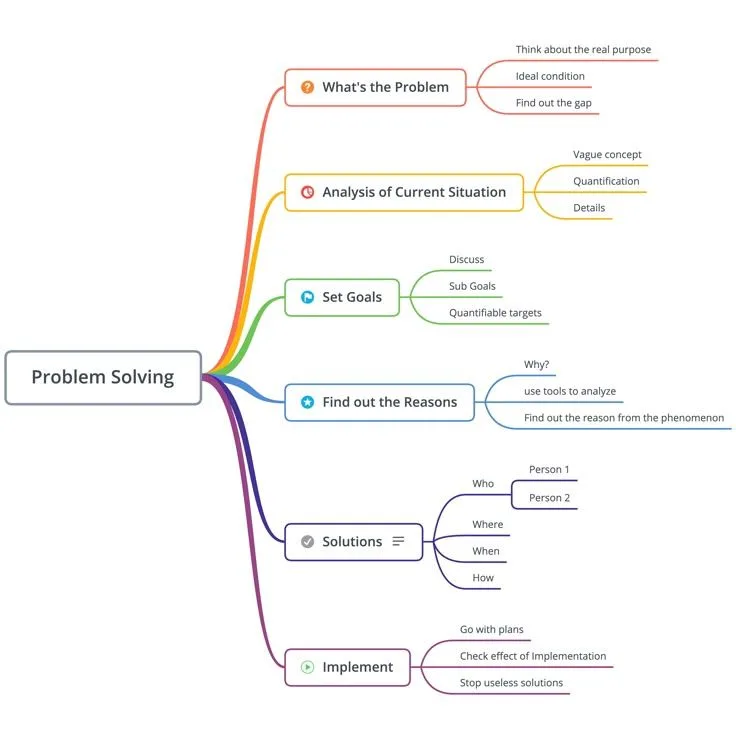
Experts solve problems faster and more effectively than novices. Not because they're smarter or work harder because they use structured frameworks that guide diagnosis, analysis, and solution design.
Novices approach problems haphazardly: try solutions randomly, jump to conclusions, miss root causes. Experts are systematic: they structure the problem, identify key questions, test hypotheses, work from logic not luck.
The difference isn't talent. It's method.
The Structure-First Principle
Why Experts Structure Before Solving
Novice approach:
- See problem
- Immediately brainstorm solutions
- Try first solution that sounds good
- If it doesn't work, try another
- Repeat until exhausted or lucky
Expert approach:
- Structure the problem first
- Identify root causes
- Generate solution options systematically
- Evaluate options against criteria
- Implement best solution
The distinction: Experts invest time upfront structuring. This feels slower initially but prevents wasted effort on wrong solutions.
"If I had an hour to solve a problem, I'd spend 55 minutes thinking about the problem and 5 minutes thinking about solutions." - attributed to Albert Einstein (apocryphal)
Example: Sales declining
| Novice Response | Expert Response |
|---|---|
| "Let's run a promotion" | "First, why are sales declining?" |
| "Hire more salespeople" | "Is it volume (fewer customers) or value (lower revenue per customer)?" |
| "Change the website" | "Is decline across all products or specific ones?" |
| Try solutions randomly | Map problem structure, then act |
Novice exhausts resources on trial and error. Expert finds right solution faster through structured thinking.
Framework 1: Root Cause Analysis
The 5 Whys Technique
Method: Ask "why" repeatedly to drill from symptoms to causes.
"If you can't describe what you are doing as a process, you don't know what you're doing." - W. Edwards Deming, statistician and quality pioneer
Structure:
| Why # | Question | Answer | Next Question |
|---|---|---|---|
| 1 | Why is [problem] happening? | Surface cause | Why is [surface cause] happening? |
| 2 | Why is [surface cause] happening? | Deeper cause | Why is [deeper cause] happening? |
| 3-5 | Continue... | ... | Until root cause revealed |
Example: Manufacturing defect rate increased
Why? → Defect rate rose from 2% to 8%
- Why? → Quality control caught more bad parts
Why? → Quality control caught more bad parts
- Why? → Machine calibration drifted
Why? → Machine calibration drifted
- Why? → Maintenance schedule wasn't followed
Why? → Maintenance wasn't followed
- Why? → Maintenance team was understaffed due to hiring freeze
Why? → Hiring freeze implemented
- Why? → Budget cuts in operations without adjusting maintenance priorities
Root cause: Budget allocation doesn't prioritize critical maintenance.
Solution: Not "inspect more" (treats symptom), but "reallocate budget to maintenance" or "adjust maintenance schedule to available staff."
When 5 Whys Fails
Limitations:
| Problem | Why It Fails |
|---|---|
| Multiple causes | 5 Whys assumes single causal chain; many problems have multiple contributing factors |
| Confirmation bias | You follow chain you expect, ignore alternative explanations |
| Surface stopping | You stop before reaching true root (often around why #2-3) |
| Causal ambiguity | In complex systems, "cause" is unclear |
Better for: Clear causal chains in technical/operational problems
Worse for:Complex adaptive systems, human behavior, emergent phenomena
Framework 2: Fishbone Diagram (Ishikawa)
Structure
Visual framework that organizes potential causes into categories.
Classic categories (manufacturing context):
- Man: People, skills, training
- Machine: Equipment, technology
- Material: Inputs, components, raw materials
- Method: Processes, procedures
- Measurement: Metrics, detection, monitoring
- Environment: Context, conditions, culture
Adapted categories vary by domain:
- Service: People, Process, Physical evidence, Place
- Software: People, Process, Product, Platform
- Healthcare: Patient, Provider, Process, Place, Policy
Example: Customer complaints rising
                   [Customer Complaints Increasing]
                             |
        ____________________/ \____________________
       /                      |
   People              Process               Product
     |                    |                     |
- Undertrained      - Long wait times      - Features confusing
- High turnover     - No escalation        - Bugs not fixed
- Low morale        - Unclear policies     - Poor documentation
     |                    |                     |
   Systems             Environment          Communication
     |                    |                     |
- CRM doesn't track  - High stress        - Unclear messaging
- No knowledge base  - Remote setup       - Language barriers
Value:
- Forces comprehensive consideration (don't miss categories)
- Reveals multiple contributing factors
- Collaborative (team can build together)
- Visual (easier to see relationships)
Limitation:
- Doesn't show which causes matter most (need additional analysis)
- Can become overwhelming (too many branches)
- Static (doesn't show feedback or dynamics)
Framework 3: MECE Principle
Mutually Exclusive, Collectively Exhaustive
Core concept: Break problems into categories that:
- Don't overlap (mutually exclusive)
- Cover everything (collectively exhaustive)
Why it matters:
- Prevents missing critical areas (comprehensive)
- Prevents redundant analysis (efficient)
- Creates clear structure (organized thinking)
Example: Why is revenue declining?
MECE breakdown:
Revenue = [Number of customers] → [Revenue per customer]
Then:
- Number of customers = New customers acquired - Customers lost
- Revenue per customer = Purchase frequency × Average order value
Now diagnosis is structured:
| Metric | Current | Prior | Change | Root Cause? |
|---|---|---|---|---|
| New customers | 1,000/mo | 1,000/mo | No change | ? |
| Customer churn | 200/mo | 100/mo | +100% | ? Investigate |
| Purchase frequency | 2.5x/mo | 2.5x/mo | No change | ? |
| Average order value | $80 | $80 | No change | ? |
MECE analysis identifies: Problem is churn, not acquisition or purchase behavior.
Now narrow focus: Why is churn doubling? (Use another framework to investigate)
Non-MECE breakdown (common mistake):
Breaking "revenue decline" into:
- Product quality
- Marketing effectiveness
- Customer satisfaction
- Pricing strategy
Problems:
- Not mutually exclusive (product quality affects satisfaction; pricing affects marketing effectiveness)
- Not collectively exhaustive (misses factors like competition, distribution)
- Hard to diagnose (factors overlap and interact)
MECE forces clean logic.
"Solving a problem simply means representing it so as to make the solution transparent." - Herbert Simon, Nobel laureate in Economics and cognitive scientist[7]
Framework 4: Issue Trees
Hierarchical Problem Decomposition
Structure: Break problem into sub-issues, then sub-sub-issues, creating tree structure.
Purpose:
- Organize complex problems
- Ensure comprehensive analysis
- Identify critical questions
- Assign investigation tasks
Example: Should we enter market X?
Should we enter market X?
├── Is the market attractive?
│   ├── What is market size?
│   ├── What is growth rate?
│   ├── What is profitability?
│   └── What is competitive intensity?
├── Can we win?
│   ├── Do we have competitive advantages?
│   ├── Can we scale distribution?
│   ├── Do we have necessary capabilities?
│   └── Can we defend market share?
└── Is it worth it?
    ├── What is required investment?
    ├── What is expected return?
    ├── What are risks?
    └── What are opportunity costs?
Each branch becomes analysis workstream. Team can divide work systematically.
Issue tree rules:
| Rule | Explanation | Example Violation |
|---|---|---|
| MECE at each level | Branches don't overlap, cover everything | Having "market size" and "growth" as overlapping categories |
| Actionable questions | Each node is answerable | "Is it good?" (too vague) |
| Appropriate depth | Stop when answer informs decision | Going 10 levels deep on minor issue |
| Logical flow | Parent question resolved by children | Children don't actually answer parent |
Framework 5: Hypothesis-Driven Problem Solving
Start with Hypotheses, Then Test
Traditional approach: Gather all data → analyze → form conclusion
Hypothesis-driven approach: Form hypothesis → gather data to test → iterate
Why it's better:
- Faster: Directed investigation, not open-ended
- Efficient: Collect only relevant data
- Clearer: Know what you're testing
- Iterative: Update hypotheses as you learn
Process:
| Step | Action | Example |
|---|---|---|
| 1. Form hypothesis | Best guess about problem cause or solution | "Churn increased because competitor launched cheaper product" |
| 2. Identify tests | What data would confirm/disconfirm? | "Check: Did churn spike after competitor launch? Did churned customers cite price?" |
| 3. Gather data | Collect only what tests hypothesis | Survey churned customers, analyze timing correlation |
| 4. Evaluate | Does data support hypothesis? | If yes, develop solution; if no, form new hypothesis |
| 5. Iterate | Refine or replace hypothesis | "Actually, churn spike preceded competitor launch-new hypothesis needed" |
Example: Website conversion rate dropped
Hypothesis 1: "Mobile experience degraded"
- Test: Check mobile vs. desktop conversion
- Result: Mobile unchanged; desktop dropped
- Conclusion: Reject hypothesis
Hypothesis 2: "Recent site redesign confused users"
- Test: A/B test old vs. new design
- Result: Old design converts 2x higher
- Conclusion: Support hypothesis
Action: Roll back redesign elements hurting conversion.
Without hypothesis-driven approach: Might have spent weeks analyzing everything, never isolating cause.
Framework 6: First Principles Breakdown
Question Assumptions, Rebuild from Fundamentals
Method:
- Identify problem as stated
- List all assumptions embedded in problem statement
- Question each assumption
- Rebuild understanding from fundamental truths
- Generate solutions unconstrained by false assumptions
"It is foolish to answer a question that you do not understand. It is sad to work for an end that you do not desire." - George Polya, mathematician and author of How to Solve It[10]
Example: "We need to reduce product cost"
Assumptions embedded:
- Reducing cost is best approach (vs. increasing value, changing pricing)
- Cost is the constraint (vs. production capacity, distribution)
- Current design is fixed (vs. redesign from scratch)
First principles questioning:
| Assumption | Question | Alternative |
|---|---|---|
| "We must use material X" | Must we? | Can we use different material? |
| "Manufacturing requires step Y" | Does it? | Can we eliminate step? |
| "We need feature Z" | Do we? | Would customers pay less for simpler version? |
Example result (SpaceX):
- Assumption: Rockets must cost $60M (industry standard)
- First principles: Rocket is aluminum, titanium, copper, carbon fiber-raw materials cost ~$2M
- Question: Why 30x markup? → Vertical integration, reusability, eliminating legacy assumptions
- Result: Reduced costs dramatically
Framework 7: Pre-Mortem Analysis
Imagine Failure, Work Backward
Method:
- Assume proposed solution failed completely
- Brainstorm reasons it failed
- Assess which failure modes are likely
- Design solution to prevent those failures
Why it works:
- Overcomes optimism bias: Easier to spot risks when you assume failure
- Psychological safety: "Imagine it failed" feels safer than "what's wrong with your plan?"
- Concrete: Specific failure stories more vivid than abstract risk
"A premortem is the hypothetical opposite of a postmortem... the team members' task is to generate plausible reasons for the project's failure." - Gary Klein, cognitive psychologist and naturalistic decision-making researcher[12][4]
Example: Launching new product
Traditional risk analysis: "What could go wrong?" → Generic answers ("market doesn't adopt," "competition")
Pre-mortem: "It's 18 months from now. The product failed spectacularly. Why?"
Team's failure stories:
- "We launched, but no one understood what it did" → Risk: Messaging clarity
- "Early adopters loved it, but it didn't scale technically" → Risk: Infrastructure readiness
- "Competitor launched similar product 3 months before us" → Risk: Speed to market
- "Channel partners didn't prioritize selling it" → Risk: Partner incentives
Now: Design solution to prevent each failure mode.
Result: More robust plan, specific risk mitigation, higher success probability.
Framework 8: 80/20 Analysis (Pareto Principle)
Focus on Vital Few, Not Trivial Many
Observation: ~80% of effects come from ~20% of causes.
Application to problem-solving:
- Identify potential causes/solutions
- Estimate impact of each
- Focus effort on high-impact factors
- Ignore low-impact factors (for now)
Example: Reducing customer support load
Data:
| Issue Type | Ticket Volume | % of Total |
|---|---|---|
| Password reset | 800 | 40% |
| Billing questions | 600 | 30% |
| Feature requests | 300 | 15% |
| Bug reports | 200 | 10% |
| Other | 100 | 5% |
80/20 insight: 70% of tickets are password reset + billing (two categories)
Action:
- Build self-service password reset → Eliminates 40% of tickets
- Create billing FAQ + self-service → Eliminates 20-30% more
Result: 60-70% reduction in support load with two focused solutions.
Alternative (non-Pareto) approach: Try to solve all issues equally → Diffused effort, minimal impact.
How Experts Choose Frameworks
Different problems need different frameworks.
| Problem Type | Best Framework(s) |
|---|---|
| Diagnosis (what's causing this?) | 5 Whys, Fishbone, Root Cause Analysis |
| Decomposition (how to structure this?) | MECE, Issue Trees |
| Resource allocation (where to focus?) | 80/20, Leverage points |
| Solution design (what to build?) | First Principles, Hypothesis-driven |
| Risk assessment (what could go wrong?) | Pre-mortem, Scenario planning |
| Prioritization (what matters most?) | Eisenhower matrix, Impact/Effort grid |
Experts match framework to problem. Novices force problems into familiar frameworks - a pattern explored in depth in mental models for decision-making.
Combining Frameworks
Most complex problems require multiple frameworks in sequence.
Example process: Product not meeting growth targets
MECE breakdown (structure problem)
- Growth = New users + Retained users
- Revenue = Users → Revenue per user
80/20 analysis (prioritize)
- 80% of revenue comes from 20% of users → Focus retention
5 Whys (diagnose cause)
- Why is retention declining?
- ? Feature adoption is low
- ? Onboarding doesn't teach key features
- ? Onboarding designed without user research
Hypothesis-driven (solution)
- Hypothesis: Better onboarding → Higher feature adoption → Better retention
- Test: A/B test new onboarding flow
- Result: Validates hypothesis
Pre-mortem (de-risk)
- Imagine new onboarding fails. Why?
- ? Users skip onboarding (make it required for trial conversion)
- ? Too long (keep under 3 minutes)
- ? Technical bugs (test extensively before launch)
Result: Systematic path from problem to solution, using right framework at each stage.**
Practical Execution Tips
Tip 1: Write It Down
Don't solve problems purely in your head.
Why writing helps:
- Externalizes thinking: Frees working memory
- Forces precision: Vague thoughts become clear when written
- Creates artifact: Team can review, refine, share
- Enables revision: Easy to restructure, spot gaps
Example:
- Building issue tree mentally → Miss branches, lose structure
- Drawing issue tree on whiteboard → Comprehensive, clear, improvable
Tip 2: Collaborate
Frameworks work better with diverse perspectives.
Benefits:
- Different domains: Engineer spots technical causes; marketer spots positioning issues
- Challenge assumptions: Others question what you take for granted
- Parallel processing: Team can investigate multiple branches simultaneously
Example:
- Individual fishbone diagram: 10 causes identified
- Team fishbone diagram: 30 causes identified, including categories individual missed
Tip 3: Time-Box Analysis
Frameworks can become analysis paralysis.
Solution: Set time limits.
| Analysis Stage | Time Limit | Output |
|---|---|---|
| Problem structuring | 1-2 hours | Issue tree or MECE breakdown |
| Hypothesis formation | 30 minutes | Top 3 hypotheses |
| Data gathering | 1-2 days | Sufficient data to test hypotheses |
| Synthesis | 1-2 hours | Decision recommendation |
Force yourself to act. Frameworks structure thinking; they don't replace action.
Tip 4: Start Simple
Don't use most sophisticated framework first.
Escalation ladder:
| Level | Approach | When to Use |
|---|---|---|
| 1. Simple question | "What's the root cause?" | Try first; often sufficient |
| 2. Basic framework | 5 Whys or MECE | If simple question doesn't resolve |
| 3. Comprehensive framework | Fishbone, Issue Tree, Hypothesis-driven | If problem is complex or multi-causal |
| 4. Multiple frameworks | Combine several | Only if necessary |
Don't over-engineer. Use minimum necessary structure.
Tip 5: Test Solutions Small
Framework gives you solution hypothesis. Test before full commitment.
Approach:
- Minimum viable test
- Small scale first
- Learn, iterate
- Scale what works
Example:
- Don't redesign entire onboarding (expensive, risky)
- Test key hypothesis with 10% of users
- Measure results
- Refine or pivot based on data
Common Mistakes
Mistake 1: Framework as Checklist
Problem: Mechanically applying framework without thinking.
Example:
- Building fishbone diagram
- Filling in all six categories because template has six
- But three categories are irrelevant to this problem
- Result: Wasted effort, diluted focus
Fix: Adapt framework to problem, don't force problem into framework.
Mistake 2: Analysis Without Action
Problem: Endless analysis, no decisions.
Symptoms:
- "We need more data"
- "Let's do another analysis"
- "What if we also looked at..."
Fix:
- Set decision deadline
- Define "sufficient" evidence threshold
- Bias toward action with learning loops
Mistake 3: Solving Wrong Problem
Problem: Jump to frameworks before confirming problem definition.
Example:
- Asked to "improve conversion rate"
- Build elaborate analysis using multiple frameworks
- Later discover: Actual problem was "increase revenue," and conversion rate isn't the constraint (pricing is)
- Wasted effort solving wrong problem
Fix: Validate problem definition before applying frameworks.
Mistake 4: Ignoring Context
Problem: Frameworks assume certain conditions; applying outside those conditions fails.
Example:
- 5 Whys works for clear causal chains
- Applied to complex adaptive system with multiple interacting causes
- Produces misleading single-cause explanation
Fix: Understand framework's assumptions and boundaries.
Research on Expert Problem-Solving: What Studies Show
The behavioral difference between expert and novice problem-solvers has been studied empirically across dozens of domains, producing a body of evidence that specifies which aspects of expert method produce the performance advantage.
Adriaan de Groot's classic study, published in Thought and Choice in Chess (1965), was the first rigorous investigation of expert problem-solving. De Groot showed chess positions to players of different skill levels and asked them to think aloud while finding the best move.
His key finding was counterintuitive: grandmasters did not search more extensively than weaker players - they searched fewer moves. The difference was in the quality of what they searched.
Grandmasters rapidly identified a small set of genuinely promising candidate moves and evaluated those deeply. Novices considered many moves, including obviously bad ones, and evaluated each more shallowly.
The framework lesson: expert problem-solving is characterized by effective scoping (identifying the right problem space) rather than exhaustive search.
This finding directly motivates the structure-first principle described in this article - experts invest effort in identifying what to analyze, not just analyzing everything.
Janet Davidson and Robert Sternberg at Yale, in a 1984 paper in Gifted Child Quarterly, investigated what they called "insight problem-solving" - the class of problems where a conceptual shift is required to reach the solution.
They found that insight problems were solved by a three-component process: selective encoding (noticing what is relevant in the problem statement), selective combination (combining relevant elements in a novel way), and selective comparison (recognizing relevant analogies from prior knowledge).
Crucially, the component that differentiated high-performing from low-performing solvers was selective encoding - correctly identifying what was relevant - rather than the quality of the subsequent analysis. Frameworks support selective encoding by specifying in advance what dimensions of a problem are likely to matter.
Karl Duncker's foundational work on functional fixedness, published in On Problem-Solving (1945), identified a specific barrier to expert performance: the tendency to represent objects and concepts in terms of their standard functions, inhibiting recognition of novel uses.
Duncker's "candle problem" and "box problem" studies showed that participants who had recently used an object in its standard function were significantly less likely to recognize its utility in a novel role.
For problem-solving frameworks, functional fixedness has a direct analog: practitioners who have a well-learned framework for a problem type tend to apply that framework even when the problem has features that would be better addressed by a different approach.
The remedy is deliberate cross-domain training - exposure to cases where familiar frameworks fail and novel approaches succeed - which frameworks like first principles reasoning and pre-mortem analysis are designed to support.
Real-World Case Studies: Frameworks Applied Under Pressure
The practical value of structured problem-solving frameworks is most visible in high-stakes domains where the cost of unstructured approaches is directly measurable.
The Apollo 13 mission in April 1970 required NASA's mission control team to solve a cascading series of unprecedented technical problems under extreme time pressure: an oxygen tank explosion had disabled the command module, leaving three astronauts with a damaged spacecraft, limited power, and roughly four days of return journey.
The problem-solving approach used by Flight Director Gene Kranz and his team followed precisely the expert structure described in this article.
Rather than generating solutions immediately (the novice approach), the team first structured the problem: what systems were affected, what consumables remained, what the timeline constraints were.
This MECE-style decomposition - separating the power problem from the oxygen problem from the navigation problem - allowed parallel workstreams to operate simultaneously.
The hypothesis-driven approach guided simulation: before implementing any procedure, the team ran it through physical and computational models to test whether it would work.
The pre-mortem logic was applied continuously - The phrase "failure is not an option" (from the 1995 film, later adopted by Kranz as a book title) was operationalized as "before every procedure, identify how it could fail and design around that failure mode." The mission returned all three astronauts safely.
Jim Lovell's account and the subsequent NASA investigation both credited the systematic problem structure - not improvisation - as the primary factor in mission success.
Toyota's application of the 5 Whys framework in the 1970s and 1980s produced measurable quality improvements documented in their production records. The Toyota Production System, as described by Taiichi Ohno in his 1978 book, used the 5 Whys as the primary diagnostic tool for production defects.
Internal Toyota data, published in subsequent case studies by the MIT International Motor Vehicle Program, showed that plants implementing rigorous 5 Whys analysis - where the full chain of causation was traced to systemic root causes, not just immediate mechanical causes - reduced defect recurrence rates by 65-80% compared to plants using symptomatic fixes.
The key was the framework's insistence on reaching causes at the system level (maintenance scheduling, budget allocation, supplier qualification processes) rather than stopping at component-level causes (this machine failed, this part was defective).
The 5 Whys framework forced the systematic structure that allowed systemic intervention.
McKinsey's adoption of MECE as its core analytical framework, systematized by Barbara Minto in The Pyramid Principle (1987), provides a large-scale natural experiment in framework effectiveness.
As documented by Ethan Rasiel in The McKinsey Way (1999) and by former McKinsey partners in subsequent accounts, the adoption of MECE as an explicit analytical standard transformed the quality of client deliverables by forcing analysts to identify and fill gaps in analysis rather than presenting whatever evidence happened to be available.
Engagement managers reported that teams trained in MECE-based issue trees completed client analyses in 30-40% less time than teams working without the framework, and delivered recommendations with fewer logical gaps that required client follow-up.
The time savings came from a specific mechanism: MECE forced early identification of what questions needed to be answered, which prevented late-stage discovery of missed dimensions that would otherwise require restarting substantial analysis.
About This Series: This article is part of a larger exploration of mental models, decision-making, and structured thinking. For related concepts, see Mental Models: Why They Matter, How to Choose the Right Mental Model, Strategic Frameworks That Actually Work, and Systems Thinking Models Explained.
Sources & Further Reading
Ishikawa, K. (1990). Introduction to Quality Control. 3A Corporation.
Minto, B. (1987). The Pyramid Principle: Logic in Writing and Thinking. Minto International.
Rasiel, E. M. (1999). The McKinsey Way: Using the Techniques of the World's Top Strategic Consultants. McGraw-Hill.
Klein, G. (1998). Sources of Power: How People Make Decisions. MIT Press.
Ohno, T. (1988). "Toyota Production System: Beyond Large-Scale Production." Productivity Press.
Juran, J. M. (1951). Quality Control Handbook. McGraw-Hill.
Simon, H. A. (1996). "The Sciences of the Artificial." MIT Press.
Dorner, D. (1996). The Logic of Failure: Recognizing and Avoiding Error in Complex Situations. Metropolitan Books.
Ackoff, R. L. (1978). The Art of Problem Solving. Wiley.
Polya, G. (1945). "How to Solve It: A New Aspect of Mathematical Method." Princeton University Press.
Kahneman, D., Lovallo, D., & Sibony, O. (2011). "Before You Make That Big Decision..." Harvard Business Review, 89(6), 50-60.
Klein, G. (2007). "Performing a Project Premortem." Harvard Business Review, 85(9), 18-19.
Kepner, C. H., & Tregoe, B. B. (1965). The Rational Manager: A Systematic Approach to Problem Solving and Decision Making. McGraw-Hill.
Roam, D. (2008). The Back of the Napkin: Solving Problems and Selling Ideas with Pictures. Portfolio.
Watanabe, K. (2009). Problem Solving 101: A Simple Book for Smart People. Portfolio.