
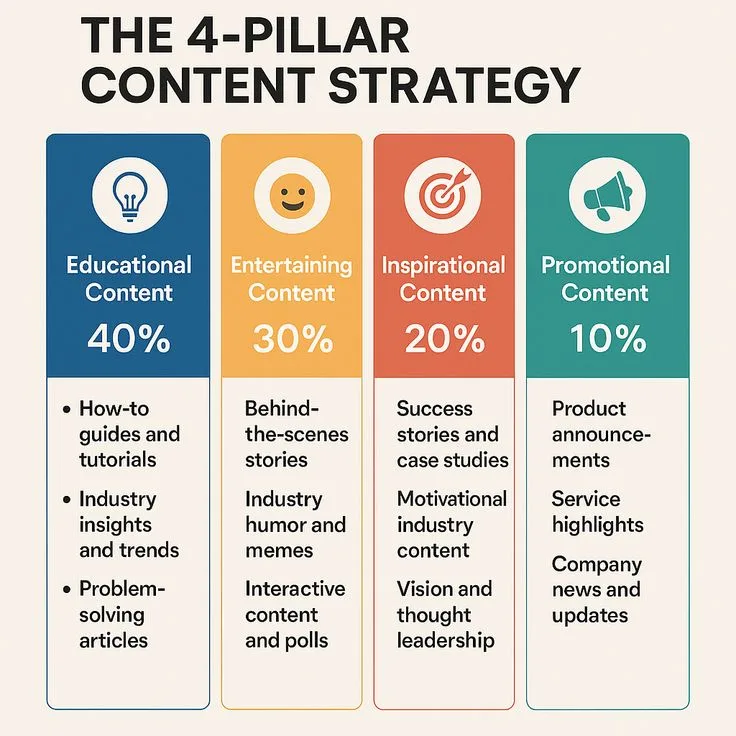
Producing more posts, videos, and campaigns does not create a strategy if an organisation cannot explain its audience, purpose, or measures of success. A content strategy checklist turns those questions into a documented plan, reducing the waste of content activity without coherent direction.
Content Marketing Institute research has repeatedly found that the large majority of B2B marketers use content marketing, but only a minority have a documented content strategy. Over the years and after enormous content spending, the gap persists.
Organizations produce enormous volumes of content-blog posts, videos, podcasts, whitepapers, social media posts, webinars, infographics, case studies, newsletters-without a coherent strategy for why they are creating it, who they are creating it for, or how they will know if it is working.
The result is what content strategist Joe Pulizzi has called the "content marketing deluge": a flood of content that is produced because "we should be creating content" rather than because it serves a defined audience need and a defined business objective.
Most of this content is never read, never shared, and never contributes to the business outcomes that justify its production cost.
A study by Moz and BuzzSumo analyzing over one million articles found that 75 percent of articles published online received zero external links and more than half received fewer than two social media interactions.
"Content marketing is the only marketing left." - Seth Godin (widely attributed)
Content strategy is not about producing more content. It is about producing the right content for the right audience through the right channels with the right measurement to achieve specific, articulated goals. This checklist provides a comprehensive framework for ensuring that every piece of content you create has a strategic reason for existing and a realistic path to reaching the people it is meant to serve.
Phase 1: Strategic Foundation
Check 1: Is the Audience Clearly Defined?
Why does most content fail? The most common reason is that it was created without a clear understanding of who it is for. Content that tries to reach everyone reaches no one.
Content that is created based on what the organization wants to say rather than what the audience needs to hear is content about the organization, not content for the audience.
This is the foundational tension at the heart of the creator economy: attention is scarce, audiences have infinite alternatives, and relevance is non-negotiable.
How to define your audience:
Demographic understanding. Who are they? What is their professional role, industry, career stage, geography, and organizational context? A checklist article for startup founders has different content needs than one for Fortune 500 executives, even if both address the same topic.
Psychographic understanding. What do they care about? What problems keep them up at night? What aspirations drive their professional behavior? What do they read, listen to, and share? What language do they use to describe their challenges?
Information needs. What questions are they asking? What problems are they trying to solve? What decisions are they trying to make? What information gaps do they have that your content could fill?
Content consumption patterns. How do they consume content? Do they read long-form articles or prefer video? Do they listen to podcasts during commutes? Do they scroll social media during breaks? Do they search Google with specific queries?
Understanding how your audience consumes content determines the format, length, and distribution channels for your content.
How to apply it: Create an audience profile that answers these questions with specificity. "Business professionals" is not an audience.
"Mid-career product managers at B2B SaaS companies who are responsible for feature prioritization and struggle with balancing customer requests against strategic product vision" is an audience.
Check 2: Are Content Goals Specific and Measurable?
How do you define content goals? Content goals should describe specific outcomes you want to achieve, not activities you want to perform. "Create content" is an activity, not a goal. "Publish two blog posts per week" is an activity metric, not a goal.
A goal describes the change in the world that content production is supposed to create.
"Strategy without tactics is the slowest route to victory. Tactics without strategy is the noise before defeat." - Attributed to Sun Tzu (not found in The Art of War)
Common content goals:
- Awareness: Increase the number of people who know your brand, product, or expertise exists. Measured by: organic traffic, social reach, brand mention volume, new visitor percentage.
- Lead generation: Attract potential customers and capture their contact information. Measured by: email sign-ups, form submissions, content download requests, demo requests attributed to content.
- Education: Help your audience understand something they need to know to use your product, make a decision, or develop their skills. Measured by: content completion rates, support ticket reduction, feature adoption, customer success metrics.
- Retention: Keep existing customers engaged and reduce churn. Measured by: engagement rates among existing customers, renewal rates, expansion revenue, customer satisfaction scores.
- Authority: Establish your organization or individuals within it as trusted experts in your domain. Measured by: speaking invitations, media mentions, inbound link growth, citation by industry peers.
How to apply it: For each piece of content or content program, complete this sentence: "This content will help us achieve [specific goal] by [mechanism], and we will know it is working when we see [specific metric] move from [current level] to [target level] within [timeframe]."
Check 3: What Is the Value Proposition?
Why should they care? This is the most important question in content strategy and the one most frequently unanswered. Every piece of content competes for attention with millions of other pieces of content, and the audience has no obligation to consume yours.
The value proposition is the answer to the question your audience is implicitly asking when they encounter your content: "What's in this for me?"
Understanding attention economics makes this imperative concrete: human attention is a finite, rivalrous resource, and every piece of content you publish is competing not just against direct competitors but against everything else vying for the same mental bandwidth.
Types of content value:
- Utility: The content helps the audience do something they need to do (a how-to guide, a template, a checklist)
- Insight: The content helps the audience understand something they need to understand (analysis, research, expert perspective)
- Inspiration: The content motivates, encourages, or energizes the audience (case studies, success stories, vision pieces)
- Entertainment: The content provides enjoyment or emotional engagement (stories, humor, cultural commentary)
- Connection: The content creates a sense of belonging or community (shared experience, identity-building, conversation)
How to apply it: For each piece of content, articulate the value proposition in one sentence: "After consuming this content, the reader will be able to [specific capability] or understand [specific insight] that they could not before." If you cannot complete this sentence, the content does not have a clear value proposition.
Phase 2: Content Planning
Check 4: Is There a Distribution Plan?
Should you create content without a distribution plan? No. Distribution is harder than creation, and content without distribution is a tree falling in an empty forest. The best-written, most insightful article in the world has zero impact if nobody reads it.
The distinction between audience building vs. buying matters here: paid distribution can accelerate reach but cannot substitute for an audience that actively seeks out your content. Owned audience is the most durable distribution asset.
Distribution channels:
Owned channels: Your website, email list, social media accounts, podcast, YouTube channel, app notifications. These are channels you control, and they are typically the most reliable for reaching your existing audience.
Earned channels: Media coverage, guest posts, social sharing, word-of-mouth, inbound links, influencer amplification. These channels extend your reach beyond your existing audience but are not directly controllable.
Paid channels: Search advertising, social media advertising, sponsored content, influencer partnerships, content syndication. These channels provide controllable reach to defined audiences but require budget.
How to apply it: Before investing in content creation, answer: "How will this content reach its intended audience?" If the answer is "we'll publish it on our blog and hope people find it," the content does not have a distribution plan.
Every piece of content should have at least two identified distribution channels with specific activation plans.
Check 5: Is the Content Calendar Sustainable?
How much content should you create? The answer is not "as much as possible." The answer is "as much as you can sustain at your desired quality level."
Content programs fail most commonly not from lack of ideas but from sustainability failure: the organization commits to a content cadence (daily posts, weekly newsletters, monthly whitepapers) that cannot be maintained with available resources.
The initial burst of enthusiasm produces high-quality content for a few weeks or months, followed by declining quality, missed deadlines, and eventual abandonment. The research on whether content calendars help or hurt suggests that rigid calendars often accelerate this failure by prioritizing cadence over quality.
How to apply it: Before committing to a content cadence, assess:
- Resource reality: How many person-hours per week can actually be dedicated to content creation, review, and distribution? Not theoretically available hours-actually available hours after meetings, operational work, and other commitments.
- Quality standard: What is the minimum quality level below which content should not be published? Publishing low-quality content is worse than publishing nothing, because it damages credibility and dilutes brand value.
- Sustainable cadence: Given available resources and quality standards, what publication frequency can be sustained indefinitely? Start with this cadence and increase only when additional resources become available.
Phase 3: Content Creation
Check 6: Does Each Piece Serve an Identified Audience Need?
Every piece of content should address a specific question, problem, or interest that the target audience actually has. Content that addresses the organization's desire to talk about itself ("We launched a new feature!") is marketing, not content strategy.
Content that addresses the audience's desire to solve a problem ("How to reduce customer onboarding time from 14 days to 3") is genuine value.
"Don't find customers for your products, find products for your customers." - Seth Godin
How to identify audience needs:
- Search data: What are people searching for in your domain? Google Search Console, keyword research tools, and autocomplete suggestions reveal the actual questions people are asking.
- Customer conversations: What questions do customers ask your sales, support, and success teams? These questions represent real information gaps that content can fill.
- Community engagement: What topics generate discussion in your industry's forums, social media groups, and communities? Active discussion indicates genuine audience interest.
- Competitive gaps: What topics are your competitors covering poorly or not at all? Gaps in the competitive content landscape represent opportunities to establish authority.
Check 7: Is the Content Format Appropriate?
Different content needs are best served by different formats:
| Audience Need | Best Format | Why |
|---|---|---|
| Quick answer to specific question | FAQ, glossary, short article | Rapid information retrieval |
| Step-by-step guidance | Tutorial, how-to guide, video walkthrough | Sequential instruction |
| Deep understanding of complex topic | Long-form article, whitepaper, podcast | Depth and nuance |
| Decision support | Comparison, pros/cons, evaluation framework | Structured analysis |
| Practical tool | Template, checklist, calculator, worksheet | Immediate utility |
| Inspiration and motivation | Case study, success story, interview | Narrative and emotional connection |
| Data and evidence | Research report, infographic, data visualization | Credible evidence presentation |
How to apply it: Match the content format to the audience need, not to your production preferences. If the audience needs a quick answer, a 5,000-word article is the wrong format. If the audience needs deep understanding, a 200-word social media post is the wrong format.
This is the same principle that governs technical documentation: format follows function, not convention.
Check 8: Is the Content Differentiated?
The internet does not need another generic article on any topic. If your content says the same things that the first page of Google search results already says, in the same way, at the same depth, it has no reason to exist. Content differentiation is what makes your content worth consuming instead of the alternatives.
Sources of differentiation:
- Original data or research: Content based on proprietary data, original research, or unique analysis that cannot be found elsewhere
- Expert perspective: Insights from genuine practitioners with real experience, not recycled advice from other content
- Depth: Going significantly deeper than available content on the topic
- Practical utility: Providing tools, templates, or frameworks that readers can immediately use
- Contrarian perspective: Challenging conventional wisdom with evidence-based alternative viewpoints
- Specific context: Addressing the topic within a specific context (industry, role, company size, geography) that generic content does not serve
Phase 4: Measurement
Check 9: What Metrics Matter for This Content?
What metrics matter for content depends entirely on the content's goals. Measuring the wrong things-or measuring everything without prioritization-produces data without insight.
The distinction between vanity metrics and meaningful metrics is nowhere more relevant than in content measurement: page views, follower counts, and likes are easy to accumulate and nearly useless for understanding whether content is actually achieving its purpose.
Metrics aligned with goals:
If the goal is awareness:
- Organic search traffic (are people finding the content?)
- Social shares and mentions (are people amplifying the content?)
- New visitor percentage (is the content reaching new audiences?)
- Referring traffic (are other sites linking to the content?)
If the goal is lead generation:
- Conversion rate (what percentage of readers take the desired action?)
- Email sign-ups attributed to content
- Content-assisted conversions (content in the conversion path even if not the last touch)
- Cost per lead from content vs. other channels
If the goal is education:
- Content completion rate (what percentage of people who start actually finish?)
- Return visits (are people coming back for more?)
- Support ticket reduction (is content answering questions that would otherwise generate support requests?)
- Feature adoption metrics (are people using features they learned about through content?)
If the goal is retention:
- Engagement rate among existing customers
- Content consumption patterns of retained vs. churned customers
- Customer satisfaction scores correlated with content engagement
- Expansion revenue correlated with content-engaged accounts
How to apply it: For each content program, identify three to five metrics that directly measure progress toward the program's goals. Avoid vanity metrics (total page views, total social followers) that look impressive but do not indicate whether the content is achieving its intended purpose.
"Not everything that can be counted counts, and not everything that counts can be counted." - William Bruce Cameron
Check 10: Is There an Iteration Process?
Content strategy is not a plan you create once and execute forever. It is a hypothesis-driven process where you create content based on your best understanding of your audience's needs, measure the results, learn from what works and what does not, and adjust your strategy accordingly.
How to apply it: Build a regular review cycle:
- Weekly: Review content performance metrics, identify content that is performing well or poorly, adjust distribution tactics
- Monthly: Analyze content program performance against goals, identify themes in what is working, adjust content calendar based on findings
- Quarterly: Review strategic alignment, assess whether content goals are still the right goals, evaluate resource allocation, plan the next quarter based on cumulative learning
Phase 5: The Complete Content Strategy Checklist
Strategic Foundation:
- Target audience is specifically defined (not "everyone")
- Content goals are specific, measurable, and tied to business outcomes
- Value proposition is articulated (why should the audience care?)
- Differentiation from existing content is identified
Planning:
- Distribution plan exists for each content type (not "publish and hope")
- Content calendar is sustainable given available resources
- Each piece addresses an identified audience need (not just organizational messaging)
- Content format matches the audience need
Creation:
- Content provides genuine value (utility, insight, or inspiration)
- Content is differentiated from readily available alternatives
- Quality standards are met consistently
- Brand voice and standards are maintained
Measurement:
- Metrics are aligned with content goals (not vanity metrics)
- Regular review and iteration process is in place
- Learnings are documented and applied to future content
- Underperforming content is analyzed and lessons extracted
What's the Difference Between Strategy and Tactics?
This distinction is fundamental but frequently confused:
Strategy answers the questions of why and what: Why are we creating content? What audience are we serving? What goals are we pursuing? What value are we providing? What topics and themes will we focus on? Strategy is about choices-choosing what to do and, equally important, choosing what not to do.
Tactics answer the question of how: How will we produce the content? How will we distribute it? How will we promote it? How will we measure it? Tactics are about execution-the specific actions taken to implement the strategy.
The most common content failure is jumping to tactics (let's start a podcast, let's post on TikTok, let's write a newsletter) without establishing strategy (who is this for, what goal does it serve, why would they care). Tactics without strategy produce activity without direction.
Strategy without tactics produces plans without execution. Effective content programs have both, in the right order: strategy first, then tactics that serve the strategy.
Content strategy is fundamentally about discipline: the discipline to define your audience before creating content, to set goals before choosing metrics, to establish a value proposition before selecting formats, to plan distribution before investing in production, and to measure results honestly rather than celebrating vanity metrics that look impressive but do not indicate genuine success.
The same clarity principle applies here as in all professional communication: eliminating signal vs.
The organizations that practice it consistently-that treat content as a strategic investment rather than an activity to be performed-achieve results that the content deluge, with all its volume and expense, cannot match.
What Research Shows About Content Strategy
Mark Schaefer, a marketing executive and adjunct professor at Rutgers University, introduced the concept of "content shock" in a 2014 blog post that was later expanded into academic analysis.
Schaefer's argument was that the volume of content was growing exponentially while human capacity to consume it remained fixed.
His framework concluded that organizations without documented audience-specificity strategies would face declining content ROI regardless of production quality, because content value is relative to competition for the same reader's attention.
Schaefer presented these findings at the Content Marketing World conference in 2014, and the concept became one of the most widely cited frameworks in content marketing strategy discussions.
Anita Elberse, a professor of business administration at Harvard Business School, published research including her 2013 book Blockbusters examining investment strategies across the entertainment industry - film studios, music labels, and sports franchises.
Her research found that organizations employing a "blockbuster" strategy - concentrating investment in fewer, higher-quality releases rather than spreading budgets thinly across many lower-investment projects - consistently outperformed the diversified approach, with a small share of releases generating a disproportionate majority of revenue (for example, Warner Bros.' top-performing films and Rhapsody's most-played songs each accounted for a highly concentrated share of total results).
The same underlying logic has been widely applied to content marketing by analogy: a small share of published content assets often accounts for a disproportionate share of total traffic, leads, and revenue attribution, arguing for concentrating resources on fewer, higher-quality pieces rather than maximizing publishing volume.
Research on social sharing has found that content carrying high emotional arousal whether positive emotions like awe and excitement or negative ones like anxiety and anger-tends to be shared more often than emotionally neutral content. This has implications for content strategy: utility-focused content that lacks emotional arousal can underperform emotionally resonant content even when the utility is objectively higher.
Jonah Berger and Eric Schwartz at the Wharton School of the University of Pennsylvania published "What Drives Immediate and Ongoing Word of Mouth?" in the Journal of Marketing Research (2011), studying what makes people talk about products both right after launch and long afterward.
Their research found that different content characteristics drive immediate attention versus sustained, ongoing conversation over time - content that is simply novel or surprising tends to generate a burst of immediate interest that fades quickly, while content that stays practically useful or interesting to revisit tends to keep generating engagement well after publication.
Applied to content strategy, the implication is that content built around durable, evergreen usefulness rather than time-sensitive novelty is more likely to keep attracting readers long after its publication date, and that this is a predictable property of how content is created rather than a matter of luck.
Real-World Case Studies in Content Strategy
HubSpot, the marketing software company headquartered in Cambridge, Massachusetts, built its entire go-to-market strategy on documented content strategy principles starting in 2006. Co-founder Dharmesh Shah and CEO Brian Halligan tracked organic traffic attribution quarterly and published the data in annual transparency reports.
HubSpot has publicly reported for years that inbound content marketing produces a substantially lower cost per lead than traditional outbound channels, a finding central to the company's own product positioning. HubSpot filed for its IPO in 2014, and its large, long-running content library became a widely cited example of content marketing as a durable, compounding business asset rather than a short-term campaign.
HubSpot's documented strategy included explicit audience persona definitions, publication frequency targets calibrated to team capacity, and quarterly distribution channel reviews-all elements of the content strategy framework described in this article.
Red Bull's content strategy, coordinated through its Vienna-based Red Bull Media House unit established in 2007, provides one of the clearest examples of content investment generating measurable brand value independent of product marketing.
Red Bull Media House has grown into a substantial, multi-market content operation producing publications, films, and live event coverage across many languages, with Red Bull's owned media properties reaching a large global audience independent of any single advertising campaign. The strategy is frequently cited as a case study in building brand association with a lifestyle and identity (excitement, extreme sports, energy) through owned media rather than relying solely on traditional paid advertising.
The Cleveland Clinic's Health Essentials blog, launched in 2012 under the direction of Chief Marketing Officer Paul Matsen, demonstrated that documented content strategy could transform a traditional institutional organization into a leading digital publisher.
Matsen implemented an audience-first editorial process: all content decisions were driven by search data showing what questions patients were actually asking, not by what the Cleveland Clinic wanted to communicate.
Within its first few years, Health Essentials grew from a modest audience to tens of millions of monthly visits, becoming one of the most-cited examples of a traditional institution building a large, engaged digital readership through an audience-first content strategy.
The Cleveland Clinic's strategy became a widely cited case study in content strategy literature, appearing in Joe Pulizzi's Content Inc. (2015) and in the Content Marketing Institute's 2016 Healthcare Content Marketing Report.
Sources & Further Reading
Pulizzi, J. (2014). Epic Content Marketing: How to Tell a Different Story, Break Through the Clutter, and Win More Customers by Marketing Less. McGraw-Hill. View source
Halvorson, K. & Rach, M. (2012). Content Strategy for the Web. 2nd ed. New Riders.
Content Marketing Institute. (2023). "B2B Content Marketing Benchmarks, Budgets, and Trends." View source
Moz & BuzzSumo. (2015). "Content, Shares, and Links: Insights from Analyzing One Million Articles." View source
Handley, A. (2014). Everybody Writes: Your Go-To Guide to Creating Ridiculously Good Content. Wiley. View source
Rose, R. & Pulizzi, J. (2011). Managing Content Marketing. CMI Books. View source
Kissane, E. (2011). The Elements of Content Strategy. A Book Apart. View source
HubSpot. (2023). "State of Content Marketing Report." View source
Cialdini, R.B. (2006). Influence: The Psychology of Persuasion. Harper Business. View source
Aaker, D.A. (2014). Aaker on Branding: 20 Principles That Drive Success. Morgan James Publishing.
Sharp, B. (2010). How Brands Grow: What Marketers Don't Know. Oxford University Press. View source
Godin, S. (2018). This Is Marketing: You Can't Be Seen Until You Learn to See. Portfolio. View source