
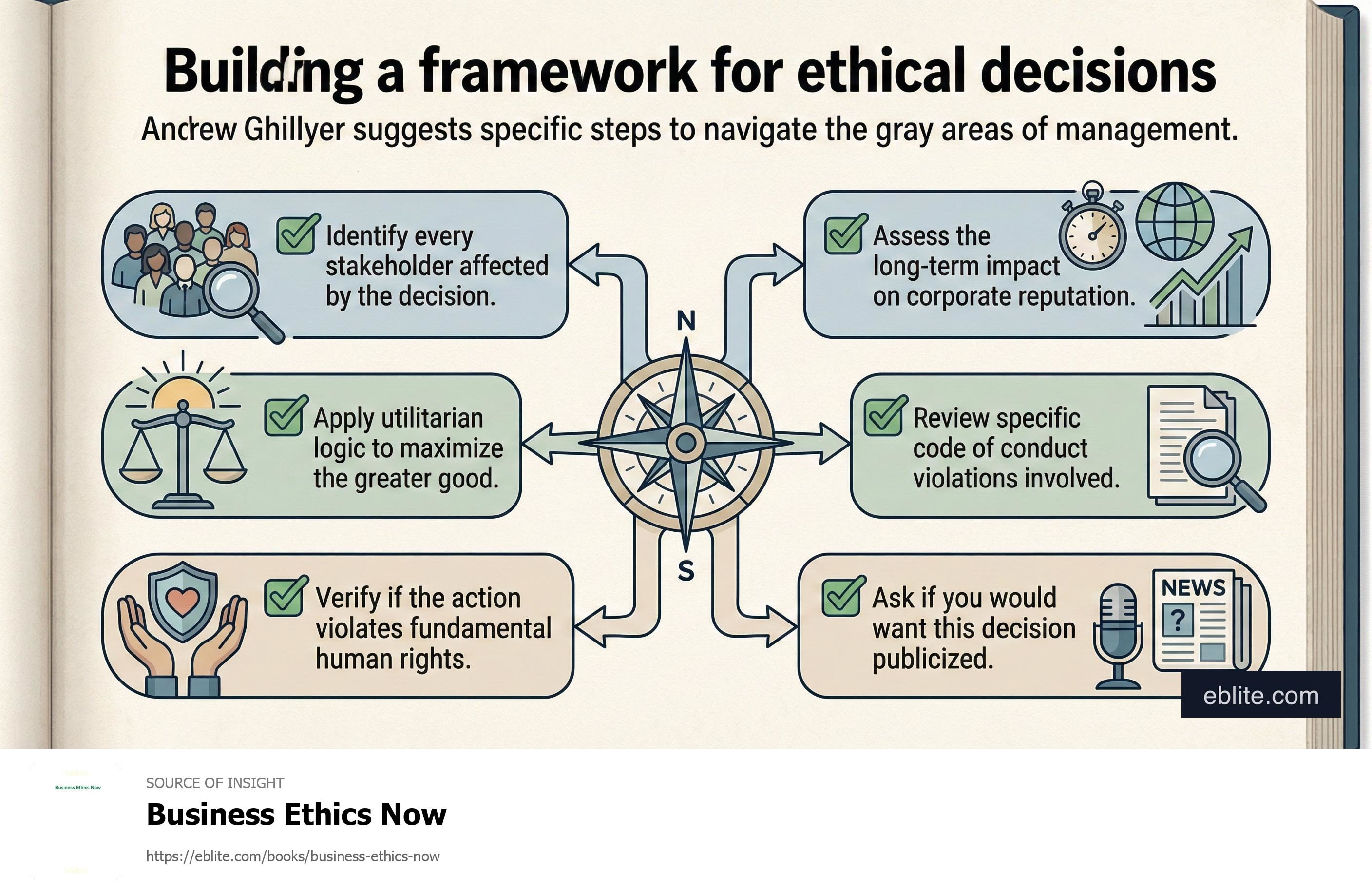
Ethical failures can be carried out by ordinary professionals when goals, pressure, and incentives make wrongdoing seem normal or necessary. An ethical decision checklist creates a pause for examining consequences, responsibilities, and rationalisations before a harmful action becomes routine practice.
In 2015, investigators discovered Volkswagen had installed defeat device software in roughly 11 million diesel vehicles worldwide. The software let those cars cheat emissions tests while actually emitting up to 40 times the legal limit of nitrogen oxides during normal driving.
The engineers, managers, and executives behind the scheme weren't evil people. Not by any ordinary measure.
They were professionals, many of them parents, community members, churchgoers, who made a string of decisions that each seemed like a small compromise on its own. Collectively, those decisions added up to one of the largest corporate frauds in history.
How does that happen? How do intelligent, experienced, generally decent people end up making decisions that cause this much harm?
Researchers in organizational ethics, behavioral psychology, and moral philosophy have documented the answer extensively: ethical failures are rarely the result of deliberate evil. They come from incremental compromise, cognitive biases, social pressure, inadequate ethical reasoning processes, and the absence of any systematic tool for identifying and weighing a decision's ethical dimensions before it actually gets made.
"The road to hell is paved with good intentions-and also with decisions that were never examined." - Hannah Arendt
An ethical decision checklist isn't a guarantee of ethical behavior. No tool can substitute for moral character. No process can prevent bad faith.
But a systematic ethical evaluation framework can do something individual moral intuition often can't: make sure a decision's ethical dimensions get considered, articulated, and weighed before the decision gets made. Not overlooked in the rush of operational pressure, cognitive bias, and social conformity.
This checklist provides a comprehensive framework for ethical decision-making that pulls together insights from moral philosophy, behavioral psychology, organizational behavior, and practical experience across industries and contexts.
Part 1: Recognizing the Ethical Dimension
Check 1: Does This Decision Have an Ethical Dimension?
The first and most commonly skipped step in ethical decision-making is recognizing that a decision has an ethical dimension at all. Many decisions with significant ethical implications are framed as purely technical, business, or operational decisions, which allows the ethical considerations to be ignored entirely.
Signals that a decision has an ethical dimension:
- Someone could be harmed (physically, financially, emotionally, professionally, or reputationally) by the decision
- The decision involves fairness-distributing benefits, burdens, opportunities, or risks
- The decision involves honesty-representing information accurately vs. selectively or misleadingly
- The decision involves trust-acting in accordance with expectations that others rely on
- The decision involves power-using authority or information asymmetry in ways that affect others
- The decision creates a precedent-establishing a pattern that will influence future decisions
How to apply it: Before making a significant decision, ask: "Could a reasonable person see an ethical issue here?" If the answer is anything other than a definitive no, the decision has an ethical dimension that warrants systematic evaluation.
The ethical fading phenomenon. Research by Ann Tenbrunsel and David Messick identifies a phenomenon called "ethical fading"-the process by which the ethical dimensions of a decision fade from awareness as the decision is framed in business, technical, or operational terms.
A decision to "optimize our testing procedures" sounds like an engineering decision. A decision to "install software that cheats emissions tests while exposing the public to illegal levels of toxic pollution" sounds like an ethical decision.
They can be the same decision, but the framing determines whether the ethical dimension is visible.
Check 2: Am I Under Pressure That Might Compromise My Judgment?
Ethical failures are most likely to occur under conditions that compromise judgment:
Time pressure. When decisions must be made quickly, systematic ethical evaluation is sacrificed in favor of rapid action. The "we'll figure it out later" mindset allows ethically problematic decisions to be made under the justification of urgency.
This connects directly to the problem of good intentions producing bad outcomes - urgency does not excuse the harm caused.
Financial pressure. When the decision-maker faces financial consequences (loss of bonus, loss of contract, loss of revenue, threat of termination), the financial pressure can overwhelm ethical considerations.
Wells Fargo employees created fake accounts not because they lacked moral awareness but because the alternative-missing quotas and losing their jobs-was personally devastating.
Social pressure. When colleagues, supervisors, or organizational culture normalize ethically questionable behavior, the social cost of dissent (being seen as difficult, uncommitted, not a team player) can exceed the perceived cost of compliance.
Stanley Milgram's famous obedience experiments demonstrated that ordinary people will administer what they believe to be dangerous electric shocks when instructed to do so by an authority figure.
Competitive pressure. When competitors are perceived to be gaining advantage through ethically questionable means, the pressure to match their behavior intensifies. "Everyone else is doing it" is one of the most common justifications for ethical compromise.
Situations like these are classic moral dilemmas where every available option carries a real cost.
How to apply it: Before making an ethical decision, honestly assess the pressures you are under. Name them explicitly. The act of making pressures explicit reduces their unconscious influence on judgment.
Part 2: Stakeholder Analysis
Check 3: Who Are the Stakeholders?
How do you actually identify stakeholders? They're everyone affected by the decision, anyone with a legitimate interest in it, or anyone whose rights or welfare get implicated by it. Ethical analysis means identifying all of them. Not just the most visible or powerful ones.
Start with directly affected parties: people who feel the immediate consequences of the decision. Customers, employees, patients, students, users, the people whose lives actually change because of what you do.
Then there are indirectly affected parties, the ones hit by the decision's second-order consequences. The families of employees who get laid off. The communities that depend on a factory that closes. The competitors affected by your pricing decision. The environment that absorbs the pollution from your production process.
Some parties have real stakes but no voice at all. Future generations inheriting environmental consequences. Communities in developing countries where products get manufactured. Vulnerable populations who may be disproportionately harmed. They're affected by the decision but have no ability to shape it.
And don't forget future stakeholders, people who'll be affected down the road but aren't identifiable yet. Future users of a product. Future employees of a company. Future residents of a community touched by today's environmental decisions.
How to apply it: For each decision, build a stakeholder map that covers at least five categories of affected parties. For each one, ask: "How are they affected? What do they stand to gain or lose? Do they have a voice in this decision? If not, who represents their interests?"
Check 4: Who Benefits and Who Is Harmed?
The distribution of benefits and harms is the core ethical dimension running through most decisions.
Ethical tradeoffs aren't always the ones producing the maximum total benefit. They're decisions where the distribution of benefits and harms is fair, the harms are justified, and the people bearing the harms aren't disproportionately the ones with the least power.
"The measure of a man is what he does with power." - Plato
How to apply it: For each stakeholder group, describe:
- What they gain from the decision
- What they lose from the decision
- Whether the gains and losses are proportional and fair
- Whether those who bear the greatest burdens have been consulted or compensated
- Whether vulnerable or powerless groups bear disproportionate harm
| Stakeholder | Benefits | Harms | Fair? |
|---|---|---|---|
| Shareholders | Higher short-term profits | Long-term reputation risk | Need to evaluate trade-off |
| Employees | Job security (if profitable) | Ethical compromise, personal risk | May be coerced by pressure |
| Customers | Lower prices (maybe) | Safety risks, deception | Not fair if uninformed |
| Community | Economic contribution | Pollution, health risks | Often unfair-no voice |
| Future generations | Inherited benefits | Environmental damage | Cannot consent or object |
Part 3: Ethical Analysis
Check 5: Is It Fair to Everyone?
Fairness is one of the most fundamental ethical principles out there, and one of the most complex. A few different conceptions of fairness matter for ethical decision-making.
Procedural fairness asks whether the decision came out of a fair process. Were affected parties consulted? Were decision criteria applied consistently? Were similar cases treated similarly?
Distributive fairness asks whether the outcomes themselves land fairly. Do the people bearing the greatest burdens also get the greatest benefits? Or do the burdens fall on the powerless while the benefits flow to the powerful?
And interactional fairness asks something more personal: were the people affected treated with dignity and respect? Were they given honest information? Were their concerns actually taken seriously?
Check 6: Would It Be Acceptable If Made Public?
The newspaper test, sometimes called the "publicity test," asks a simple question. If this decision and its full reasoning ran on the front page of a major newspaper, would you be comfortable with it? Would your organization?
This test works because it forces perspective-taking. You have to imagine how the decision would look to a neutral observer, someone who doesn't share your pressures, incentives, or rationalizations.
Decisions that feel perfectly reasonable inside the insular bubble of organizational decision-making often look very different once they hit public scrutiny.
How to apply it: Picture every piece of this decision, the reasoning, the pressures, the alternatives considered, the stakeholders affected, reported in full by a competent journalist. Would you be proud of it? Would you defend it publicly? If not, what would need to change to make it defensible?
Check 7: Does It Align with Stated Values?
Most organizations have stated values: integrity, respect, excellence, responsibility, innovation, customer focus. You'll find them on websites, in annual reports, painted on office walls. Few corporate values statements anywhere omit "integrity." The gap between that word on the wall and what actually happens in a given year is exactly the thing this check is built to expose.
How to apply it: List the organization's stated values. For each one, ask: "Does this decision align with this value? If not, are we willing to say so explicitly? Or are we compromising a value while pretending we're not?"
What makes this check powerful is that it exposes the gap between stated values and actual behavior. An organization that claims to value integrity while making dishonest decisions isn't just making bad decisions. It's undermining its own credibility, and eroding the trust of every employee who actually took those stated values seriously.
Part 4: Considering Consequences
Check 8: What Are the Short-Term and Long-Term Consequences?
Ethical analysis requires considering consequences across time horizons. Decisions that produce short-term benefits but long-term harms are frequently made because short-term consequences are vivid and immediate while long-term consequences are abstract and distant.
How to apply it:
- Short-term consequences (days to months): What happens immediately? Who benefits? Who is harmed? What operational changes result?
- Medium-term consequences (months to years): How do the short-term effects compound? What secondary effects emerge? How do stakeholder relationships change?
- Long-term consequences (years to decades): What precedent does this decision set? How does it affect organizational culture? What environmental, social, or systemic effects accumulate?
Example: A company that cuts safety corners to reduce costs experiences short-term financial benefit (lower costs, higher margins), medium-term risk (increased probability of accidents, regulatory scrutiny, employee anxiety), and potential long-term catastrophe (a major accident that costs lives, destroys the brand, and results in criminal liability).
Check 9: What If Everyone Made This Decision?
The universalizability test, derived from Immanuel Kant's categorical imperative, asks: "What would happen if everyone in a similar situation made the same decision?" This test identifies decisions that work only because they are exceptions to a general rule-decisions that depend on most other people behaving differently.
How to apply it: If every company in your industry made this decision, would the outcome be acceptable? If every employee in your organization behaved this way, would the organization function? If every person in society acted this way, would society be better or worse?
Tax evasion, for example, fails the universalizability test: it benefits the individual evader only because most other people pay their taxes. If everyone evaded taxes, the public services that the evader relies on would collapse.
Similarly, cutting safety corners benefits the individual company only because most competitors maintain safety standards, preserving the industry's credibility.
Part 5: What If Values Conflict?
When values genuinely conflict, say so out loud. Don't pretend the tension isn't there. Pull in established frameworks, draw out which value should actually win in this specific situation, stay transparent about your reasoning, and write the trade-off down so it can be reviewed and learned from later.
Check 10: How Do You Navigate Value Conflicts?
The hardest ethical decisions are the ones where values genuinely collide. Honesty against loyalty. Individual rights against collective welfare. Sometimes a little harm now prevents a lot more harm later. None of that is a failure of reasoning. It's just what ethical complexity actually looks like from the inside.
A few frameworks help cut through it.
Picture a factory manager who finds a safety defect the night before a product ships. Consequentialism asks one question: what produces the greatest overall good, or the least overall harm? Delay the launch, or risk the defect reaching customers? It's a useful lens when you can actually weigh the outcomes against each other. The danger is that it can justify real harm to a few people, as long as the math on aggregate benefit comes out positive.
Now picture a doctor who could save five patients by secretly harvesting organs from one healthy visitor. Deontological ethics says no, flatly, regardless of the math: some actions are simply wrong no matter what they produce. That protects individual rights in a way consequentialism can't. But it can also go rigid and ignore context that actually matters.
Virtue ethics asks something different again: what would a genuinely good person do, standing in this exact spot? A nurse debating whether to report a respected colleague's mistake might find more guidance here than in either framework above. It works when rules and consequences both go quiet. It leans hard, though, on a shared sense of what good character even looks like.
And Care ethics starts from relationships instead of principles. A manager deciding whether to lay off a struggling employee asks: who depends on me here, and what do I owe them? It shines in tangled interpersonal situations. It struggles to scale up to organization-wide or society-wide decisions.
How to apply it: Name the values actually in tension. Say why each one matters here. Decide which one takes priority in this specific case, stay honest about your reasoning, and write the trade-off down so it can be reviewed and learned from later.
Part 6: Organizational Ethics
Check 11: Should Organizations Have Shared Ethical Checklists?
Picture a meeting where three different managers each think they've handled an ethical question properly, and each one used a completely different standard to decide that. That's organizational ethical decision-making without a shared framework. It suffers from the same biases and pressures as individual decision-making, just amplified across more people.
Diffusion of responsibility means no single person feels accountable. Hierarchical pressure means subordinates defer to superiors instead of raising concerns. Cultural norms can normalize unethical behavior across an entire organization without anyone deciding that outright.
Shared ethical checklists push back against all of that in a few concrete ways.
They build a common language first. Once everyone uses the same framework for evaluating ethical decisions, ethical conversations get easier, faster, more productive. Terms like "stakeholder impact," "publicity test," "value alignment" give people a shared vocabulary instead of everyone improvising their own.
They set expectations too. A formal checklist tells everyone, loudly, that the organization takes ethics seriously and expects ethical evaluation baked into how decisions get made. That matters most for new employees, and for people at lower organizational levels who might otherwise not feel empowered to raise a concern at all.
They improve consistency. Without a shared framework, ethical decision-making swings wildly from team to team, situation to situation. A checklist pins down a minimum standard that applies everywhere, not just wherever a particularly conscientious manager happens to be in charge.
And they create real accountability. Document the evaluation, complete the checklist, write down the reasoning, and suddenly the decision is reviewable. If it later turns out to have been wrong, that paper trail enables actual learning. Not a scramble to figure out who to blame.
Check 12: Is Dissent Safe?
The single most important organizational condition for ethical decision-making is psychological safety, the belief that you can raise ethical concerns without fear of retaliation, marginalization, or career damage.
"In organizations where people cannot speak up, ethical violations are not prevented-they are merely hidden until they explode." - Amy Edmondson
Look at every major organizational ethical failure: Enron, Volkswagen, Boeing, Theranos, Wells Fargo. The pattern repeats itself exactly. Someone inside the building knew something was wrong. A junior accountant. An engineer. A line employee who saw the numbers didn't add up. They either couldn't speak up, or spoke up and got ignored.
Why does that keep happening? Because the conditions that kill ethical dissent are the same conditions that enable the failure in the first place. A hierarchical culture that punishes whoever brings bad news. An incentive system that rewards hitting the number over telling the truth. Leadership that signals, through what it actually does rather than what it says, that ethical concerns are an inconvenience.
How to apply it: Before relying on any ethical checklist, assess whether the organization actually supports ethical decision-making:
- Are people who raise ethical concerns protected or punished?
- Does leadership model ethical behavior or merely talk about it?
- Are ethical violations by powerful people addressed or excused?
- Is there a confidential mechanism for reporting ethical concerns?
- Have there been examples of people successfully raising ethical concerns without negative consequences?
Discouraging answers here mean one thing: the checklist won't work, no matter how good its content is. You can't paper over a culture that punishes honesty with a better form to fill out.
The Complete Ethical Decision Checklist
Recognizing the ethical dimension:
- I have identified that this decision has an ethical dimension
- I have assessed the pressures (time, financial, social, competitive) that might compromise my judgment
- I have separated the ethical evaluation from the business/technical evaluation
Stakeholder analysis:
- All stakeholders are identified (directly affected, indirectly affected, powerless, future)
- Benefits and harms for each stakeholder group are articulated
- Disproportionate burdens on vulnerable groups are identified
Ethical analysis:
- The decision is fair (procedurally, distributively, interactionally)
- The decision would be acceptable if made public (newspaper test)
- The decision aligns with stated organizational values
- The decision passes the universalizability test (what if everyone did this?)
Consequence analysis:
- Short-term, medium-term, and long-term consequences are considered
- Irreversible consequences are identified and given extra weight
- The decision does not create harmful precedents
Value conflicts:
- Any value conflicts are made explicit
- The reasoning for which value takes priority is documented
- The trade-offs are transparent and defensible
Organizational conditions:
- Dissent is safe (psychological safety exists)
- The decision is documented with its ethical reasoning
- A review mechanism exists for evaluating ethical decisions in retrospect
How Do You Improve Ethical Decision-Making Over Time?
Ethical decision-making isn't something you're just born good at. It's a skill. Like any skill, it gets better through practice, reflection, and time.
Run the checklist on routine decisions, not just the big, obvious ones. A manager who runs through it before every minor vendor contract, not just the headline-grabbing calls, builds the habit fast. Eventually the ethical dimension of a situation just jumps out at you, without any conscious effort at all.
Mistakes will happen. That's guaranteed, because ethical decision-making is imperfect by nature. When they do, run an honest post-mortem. Figure out what actually went wrong and what could have prevented it. Not who to blame.
The organizations that actually learn from ethical failures are the ones willing to report a failure out loud, dig into why it happened, and feed that back into how they operate next time.
Go looking for perspectives unlike your own, too. Your own ethical reasoning runs into your own blind spots, your own biases, your own narrow slice of experience. Put a team of people with different backgrounds and roles in the room, and they'll surface ethical considerations a more homogeneous group would simply never see.
Build the habit into everyday work, not just crisis moments. The most ethically solid organizations aren't the ones that dramatically resolve a scandal after the fact. They're the ones where a junior employee flags a weird invoice on a Tuesday afternoon without a second thought, because ethical consideration has become that routine, that unremarkable, that catching problems before they become crises is just how things work.
Ethical decision-making never really finishes. It's attention to what others walk right past. Analysis that actually weighs every stakeholder and every consequence. Courage to act on your conclusions even when they cost you something real. And humility to admit that certainty is rare, and that the decisions worth trusting most are often the ones you keep quietly re-examining, even after you've already made them.
"Integrity is choosing courage over comfort; choosing what is right over what is fun, fast, or easy; and choosing to practice our values rather than simply professing them." - Brene Brown
What Research Shows About Ethical Decision-Making
James Rest, a developmental psychologist at the University of Minnesota, spent two decades building an empirical model of how people actually make moral judgments. He published it as the Four-Component Model of Morality, summarized in his 1986 book Moral Development: Advances in Research and Theory.
He also developed the Defining Issues Test, or DIT, a psychometrically validated instrument used extensively across decades of moral development research worldwide.
His key finding: ethical decision-making breaks down at four distinct stages. Moral sensitivity comes first, recognizing a situation has an ethical dimension at all, the exact step a framing like "optimize our testing procedures" makes easy to skip. Moral judgment follows, actually reasoning about what's right.
Moral motivation comes next, prioritizing ethical concerns above self-interest, the stage where financial pressure or a missed quota starts to outweigh what you already know is wrong. And moral character closes it out: following through on ethical intentions once you've actually formed them.
Here's the surprising part. Rest found the biggest gap between intended and actual ethical behavior showed up at the motivation stage. Not the reasoning stage. Most people who acted unethically knew it was wrong. They just prioritized competing interests anyway. That challenges the common assumption that ethics training should focus mainly on reasoning skills.
Linda Trevino, a professor of organizational behavior at Pennsylvania State University's Smeal College of Business, spent two decades with colleague Michael Brown studying what organizational conditions produce or undermine ethical behavior.
Their research, including a widely cited 2005 paper in Organizational Behavior and Human Decision Processes on ethical leadership, found visible ethical leadership from top management was one of the strongest predictors of employee ethical conduct, at every level of the organization.
Trevino named something she called "ethical infrastructure," the combination of codes of conduct, reporting systems, and cultural norms. Organizations with strong ethical infrastructure see meaningfully fewer violations than ones with weak infrastructure, she argued, regardless of how good any individual employee's own moral reasoning is.
Her research helped shape the Sarbanes-Oxley Act's whistleblower protection provisions.
Ann Tenbrunsel at Notre Dame's Mendoza College of Business, working with Max Bazerman at Harvard Business School, developed the concept of "ethical fading," the process behind exactly the kind of reframing seen in "optimize our testing procedures": a decision's moral dimensions go invisible once the decision gets reframed in business or technical terms.
Tenbrunsel developed the concept with David Messick in a 2004 paper in Social Justice Research, then extended the broader argument with Bazerman in Blind Spots (Princeton University Press, 2011). Their experiments found identical decisions got evaluated very differently depending purely on framing. Show someone a decision framed in purely business or technical terms, and they were substantially more likely to pick the profit-maximizing option at others' expense.
Frame the exact same underlying decision explicitly as an ethical question, and the choice flipped.
Tenbrunsel and Bazerman's conclusion follows directly: standard ethical checklists for business decisions are valuable precisely because they counteract the reframing that ethical fading produces.
Real-World Case Studies in Ethical Decision-Making
Johnson and Johnson's response to the 1982 Tylenol poisoning crisis is the most studied example of systematic ethical decision-making under extreme pressure.
When seven people in the Chicago area died after ingesting cyanide-laced Tylenol capsules, J&J CEO James Burke convened an executive team and applied a structured stakeholder analysis directly based on the company's credo-a values document written by Robert Wood Johnson in 1943.
Burke and his team identified four stakeholder groups in explicit priority order: customers, employees, communities, and shareholders.
Within 48 hours, J&J made the decision to recall 31 million bottles of Tylenol at a cost of $100 million, despite FDA and FBI advice against a national recall.
Harvard Business School's 1984 case study on the crisis, authored by Francis Aguilar, documented that Tylenol's market share, which had been roughly 35 percent before the crisis, collapsed to around 7 percent immediately after the poisonings, then recovered to close to its pre-crisis level within about a year - and that the explicit stakeholder framework was the mechanism that enabled rapid, unified decision-making across a 100,000-person organization.
The case remains one of the most widely taught examples in MBA ethics curricula.
Patagonia's supply chain ethics program tells a different kind of story. CEO Yvon Chouinard set it up in 2007, later formalized through the company's Worn Wear and Fair Labor Association commitments. The lesson: embedded ethical checklists actually generate measurable outcomes in operational processes. Not just good intentions.
The company built mandatory ethical review into four stages of the supply chain. Fiber sourcing. Manufacturing. Transport. Retail. Every stage required written documentation of environmental and labor conditions, checked against explicit standards.
Patagonia has said publicly its cotton sourcing shifted heavily toward organic over this period. Supplier relationships get assessed through Fair Labor Association affiliation and Patagonia's own published standards. And here's the payoff: surveys of consumer behavior generally find ethical and sustainability practices move purchasing decisions more strongly for Patagonia's customer base than for the apparel industry as a whole.
Salesforce's Equal Pay Assessment tells yet another story, this one about compensation rather than supply chains. Chief People Officer Cindy Robbins and CEO Marc Benioff kicked it off in 2015. It shows what happens when an organization actually applies a systematic ethical checklist to internal pay decisions.
Robbins talked Benioff into commissioning an independent statistical analysis of pay equity, across gender, race, ethnicity. The first pass found unexplained pay gaps touching 6 percent of employees. That led to $3 million in compensation adjustments in year one alone.
Salesforce didn't stop there. They repeated the analysis every year and published the results each time. By 2019, four rounds in, the cumulative total hit $10.3 million in adjustments. Salesforce has said the whole repeated cycle, analysis after analysis, adjustment after adjustment, was part of a broader push to close unexplained pay gaps and help employees genuinely feel they were paid fairly.
Sources & Further Reading
Bazerman, M.H. & Tenbrunsel, A.E. (2011). Blind Spots: Why We Fail to Do What's Right and What to Do about It. Princeton University Press. View source
Milgram, S. (1963). "Behavioral Study of Obedience." Journal of Abnormal and Social Psychology, 67(4), 371-378. DOI: 10.1037/h0040525
Kidder, R.M. (1995). How Good People Make Tough Choices: Resolving the Dilemmas of Ethical Living. Fireside. View source
Edmondson, A.C. (2018). The Fearless Organization. Wiley. View source
Johnson, C.E. (2018). Meeting the Ethical Challenges of Leadership. 6th ed. Sage Publications.
Sandel, M.J. (2009). Justice: What's the Right Thing to Do?. Farrar, Straus and Giroux. View source
Singer, P. (2011). Practical Ethics. 3rd ed. Cambridge University Press. DOI: 10.1017/CBO9780511975950
Trevino, L.K. & Nelson, K.A. (2016). Managing Business Ethics. 7th ed. Wiley.
Ariely, D. (2012). The (Honest) Truth About Dishonesty. Harper.
Vaughan, D. (1996). The Challenger Launch Decision. University of Chicago Press. View source
Rawls, J. (1971). A Theory of Justice. Harvard University Press. View source
Rest, J.R. (1986). Moral Development: Advances in Research and Theory. Praeger. View source
Gentile, M.C. (2010). Giving Voice to Values: How to Speak Your Mind When You Know What's Right. Yale University Press. View source
Haidt, J. (2012). The Righteous Mind: Why Good People Are Divided by Politics and Religion. Vintage. View source