
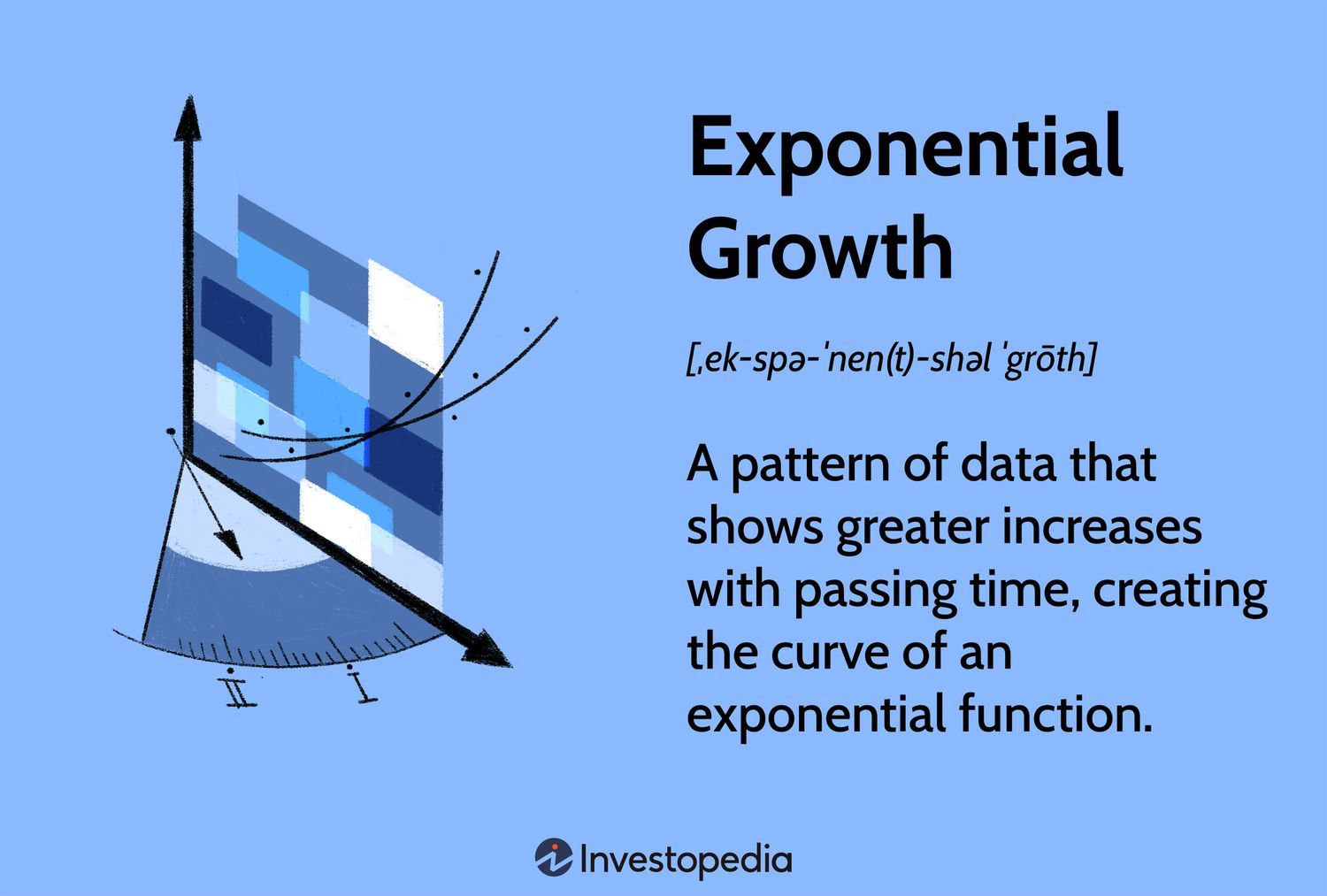
Exponential growth is a pattern of increase in which a quantity grows by a constant percentage of its current size during each time period, causing the absolute amount added to accelerate as the base expands.
Unlike linear growth, where the same fixed amount is added each period, exponential growth compounds on itself - making it deceptively slow at first and incomprehensibly fast later.
Understanding this pattern is essential for reasoning about compound interest, viral spread, technological progress, population dynamics, and dozens of other phenomena that shape modern life.
There is an old story about a king and a chess master. The king, so pleased with the game of chess that had been invented for him, offered the inventor any reward he wished. The inventor asked only for rice: one grain on the first square of the chessboard, two on the second, four on the third, doubling with each square.
The king laughed. He had expected jewels or land, not a modest pile of grain. He agreed immediately.
By the 10th square, the inventor would have 512 grains. By the 20th, about half a million. By the 32nd - halfway across the board - roughly 2 billion grains, on the order of a hundred tonnes of rice. By the 40th square, tens of thousands of tonnes.
By the 64th and final square, the amount would exceed 18 quintillion grains - more rice than has ever been produced in the history of human civilization. The king could not pay. In some versions of the story, he executed the inventor; in others, he made him a minister.
The story is a parable about exponential growth: a process that starts slowly, looks manageable for a long time, and then becomes incomprehensibly large.
The mathematician and educator Albert Bartlett spent decades lecturing on this concept at the University of Colorado, delivering his famous talk "Arithmetic, Population and Energy" over 1,700 times between 1969 and 2013.
He considered exponential illiteracy the single greatest intellectual failure of modern society.
"The greatest shortcoming of the human race is our inability to understand the exponential function." - Albert Bartlett, physicist and educator, University of Colorado (1976)
Understanding exponential growth is not just mathematically interesting. It is one of the most practically important cognitive skills for navigating the modern world - where compound interest, viral spread, technological progress, and ecological limits all operate on exponential dynamics that our intuition consistently misreads.
Developing this literacy is closely related to building stronger decision-making skills and recognizing the cognitive biases that distort our reasoning.
What Exponential Growth Actually Is
Exponential growth occurs when a quantity grows by a constant percentage of its current size over each time period. This is fundamentally different from linear growth, where a constant amount is added each period.
Linear growth: you earn $1,000 per month regardless of your account balance. After 10 years, you have $120,000.
Exponential growth: your $10,000 investment earns 8% per year. After 10 years, you have $21,589. After 20 years, $46,610. After 40 years, $217,245.
The key mechanism is compounding: each period's growth becomes part of the base for the next period's growth. Growth grows on growth. The absolute amount added each year keeps increasing even though the percentage stays constant.
This is usually represented as:
Final value = Initial value x (1 + growth rate)^time
Where growth rate is expressed as a decimal (8% = 0.08) and time is in consistent units (years, if rate is annual).
Mathematician Jacob Bernoulli first described the mathematical constant e (approximately 2.71828) while studying compound interest in 1683, making exponential growth one of the oldest formally described mathematical patterns.
The function e^x that bears his legacy is the only function in calculus that is its own derivative - a mathematical property that mirrors the real-world behavior of exponential processes, where the rate of change is proportional to the current value.
Doubling Time and the Rule of 72
A useful way to think about exponential growth is through doubling time - the time required for a quantity to double at a given growth rate.
The Rule of 72 provides a quick mental calculation: divide 72 by the annual growth rate (as a percentage) to get the approximate doubling time in years. This approximation was first documented by Luca Pacioli in his 1494 work Summa de arithmetica, making it over five centuries old.
It remains one of the most useful mental math shortcuts in finance and science.
| Growth Rate | Doubling Time (Rule of 72) | Real-World Example |
|---|---|---|
| 1% | ~72 years | Low-growth developed economy |
| 2% | ~36 years | US GDP long-run average |
| 3% | ~24 years | Emerging market economy |
| 5% | ~14.4 years | Aggressive stock portfolio |
| 7% | ~10.3 years | S&P 500 long-run real return |
| 10% | ~7.2 years | High-growth startup revenue |
| 12% | ~6 years | Venture capital target IRR |
| 25% | ~2.9 years | Hypergrowth SaaS company |
| 72% | ~1 year | Early viral social platform |
The rule illustrates a critical feature of exponentials: at seemingly modest growth rates, very large doublings happen within human-relevant timescales. An economy growing at 3% per year doubles in 24 years and quadruples in 48 - within a working lifetime.
Understanding these timescales helps with making decisions under uncertainty, because the compounding effect means small differences in growth rates produce enormous divergences over time.
The Linear Bias: Why Our Intuition Fails
Human intuition is extraordinarily good at linear extrapolation. If a tree is 3 meters tall today and has been growing 20 centimeters per year, you can reliably project it will be 3.4 meters tall in two years.
This skill served our ancestors well; most quantities that mattered in ancestral environments - food stores, distances, populations of small bands - changed roughly linearly or not at all.
Exponential dynamics were rare in that world. A human brain evolved to navigate the Pleistocene did not need to reason about compound interest, viral pandemics, or technological progress curves.
The linear bias - the tendency to assume future growth will follow a straight line from recent past trends - is the predictable result. Psychologist Daniel Kahneman documented this pattern extensively in his Nobel Prize-winning research on cognitive heuristics.
Building on his work with Amos Tversky, Kahneman described how people tend to anchor to recent rates of change and project them forward roughly linearly, even when given explicit information about compounding processes.
When we encounter the early phase of an exponential process, where growth looks slow and linear, our brains extrapolate that slow growth forward. When the exponential hits its accelerating phase, we are shocked.
Researchers Stango and Zinman published a landmark study in the Journal of Finance in 2009 titled "Exponential Growth Bias and Household Finance," demonstrating that this bias is not merely academic - it directly affects financial decisions.
They found that individuals who exhibited stronger exponential growth bias carried more credit card debt, saved less for retirement, and systematically underestimated the true cost of borrowing. The bias was remarkably persistent even among financially educated participants.
The Two Failure Modes
The linear bias produces predictable errors in opposite directions depending on where we encounter an exponential:
Underreaction in early stages: When a process is in its early, slow-looking exponential phase, we underestimate how large it will eventually become. We look at small current numbers, extrapolate linearly, and conclude the process is not important or threatening.
Shock at late stages: When we finally observe the accelerating phase, the sudden explosion of growth violates our linear expectations, creating surprise, alarm, and often overreaction.
These failure modes are closely related to other heuristics that shape our reasoning - mental shortcuts that work well in familiar environments but break down when the underlying dynamics are nonlinear.
COVID-19: An Exponential Teaching Case
The COVID-19 pandemic provided a high-stakes real-time demonstration of linear bias in action.
In early 2020, as case counts in most countries were still in the dozens or hundreds, the most common responses from policymakers and the public reflected linear extrapolation. The daily increases were absolute numbers: today 50, tomorrow 65, the day after 85.
That looks like manageable linear growth. Projected forward linearly, the outbreak seems concerning but containable.
In early Wuhan, Li et al. in the New England Journal of Medicine (2020) estimated an epidemic doubling time of about 7.4 days (95% CI 4.2-14) for the initial, largely uninhibited spread of SARS-CoV-2. This means:
- Week 1: 100 cases
- Week 2: 200-400 cases
- Week 3: 800-3,200 cases
- Week 4: 3,200-25,600 cases
- Week 5: 12,800-204,800 cases
By the time case counts were visibly accelerating, the exponential had been running for weeks and was carrying substantial momentum. Countries that acted when numbers appeared small - when the exponential was in its quiet early phase - fared much better than those that waited for visible proof of a major outbreak.
A natural experiment by Lyu and Wehby in Health Affairs (2020) examined U.S. state government mask mandates and found that mandates issued by 15 states and Washington, DC were associated with a slowdown in COVID-19 case growth, consistent with acting before the exponential reaches its steep phase.
Meanwhile, countries that delayed action until growth was visually alarming faced far worse outcomes. The difference was not resources or technology; it was whether decision-makers understood exponential dynamics.
Healthcare system modeling made this especially concrete: exponential case growth inevitably exceeds linear hospital capacity unless the growth rate is reduced. The inflection point where cases exceed beds is predictable in advance from the exponential curve; it is invisible if you are only looking at current numbers.
The Chessboard Problem: Where Intuition Completely Fails
The chessboard and rice problem exposes how profoundly our intuition fails with exponentials. Let us examine the actual numbers:
| Square | Grains on That Square | Cumulative Total | Physical Equivalent |
|---|---|---|---|
| 1 | 1 | 1 | A single grain |
| 10 | 512 | 1,023 | A small handful |
| 20 | 524,288 | ~1 million | About 40 kg |
| 32 | ~2 billion | ~4 billion | ~170 tonnes |
| 40 | ~550 billion | ~1.1 trillion | ~44,000 tonnes |
| 50 | ~562 trillion | ~1.1 quadrillion | ~44 million tonnes |
| 64 | ~9.2 quintillion | ~18.4 quintillion | ~736 billion tonnes |
The cumulative total on square 64 is approximately 18,446,744,073,709,551,615 grains.
World rice production in 2022 was approximately 520 million metric tonnes, according to the Food and Agriculture Organization of the United Nations. A metric tonne of rice contains roughly 25 million grains. Total world annual rice production: about 13 quadrillion grains. The chessboard's total exceeds that by more than 1,000 times.
When shown the first 20 squares, most people estimate that the final square will have a "very large" but humanly imaginable number - maybe a billion, maybe a trillion. The actual number is so far beyond everyday intuition that even people who calculate it correctly often do not fully feel its magnitude.
Wagenaar and Sagaria demonstrated this in a 1975 study published in Perception & Psychophysics, where participants were asked to extrapolate exponential sequences - subjects consistently underestimated the endpoint by orders of magnitude, even when told the growth was exponential.
This is the defining characteristic of exponential growth in its late stages: the numbers become literally incomprehensible without deliberate mathematical effort. The second half of the chessboard - a concept popularized by inventor and futurist Ray Kurzweil - is where exponential growth transitions from impressive to world-altering.
The first 32 squares are remarkable but within human comprehension. The last 32 squares exceed anything in human experience.
Compound Interest: The Slow-Building Explosion
Compound interest is perhaps the most practically consequential exponential process most people encounter directly, and one of the core reasons that understanding how to build a budget matters so much for long-term financial outcomes.
The mechanics are identical to exponential growth generally. At 7% annual return - roughly the long-run average real return of a diversified equity portfolio as documented by Jeremy Siegel in Stocks for the Long Run (2014, fifth edition) - money doubles approximately every 10 years (72/7 = 10.3).
| Starting Amount | Years | At 7% Compound | At 0% (No Return) | Difference |
|---|---|---|---|---|
| $10,000 | 10 | $19,672 | $10,000 | $9,672 |
| $10,000 | 20 | $38,697 | $10,000 | $28,697 |
| $10,000 | 30 | $76,123 | $10,000 | $66,123 |
| $10,000 | 40 | $149,745 | $10,000 | $139,745 |
| $10,000 | 50 | $294,570 | $10,000 | $284,570 |
A single $10,000 investment made at age 25 becomes $294,570 by age 75 - nearly 30 times the original amount - without adding another dollar.
The linear bias makes this hard to intuitively grasp in both directions. People chronically underestimate how much early investment will be worth at retirement; they also underestimate how much debt at high interest rates will grow if left unaddressed.
A Federal Reserve survey from 2023 found that only 34% of Americans could correctly calculate the effect of compound interest over a five-year period, even when given the formula.
The cost of delay is the mirror image. The investment that doubles in 10 years means that money invested 10 years later has lost an entire doubling. Every $1 invested at 25 becomes roughly $30 at 75; every $1 invested at 35 becomes roughly $15 at 75.
The 10-year delay costs half the final value. Benjamin Franklin understood this principle and left 1,000 pounds each to Boston and Philadelphia in his will in 1790, stipulating the money be invested for 200 years. By 1990, the Boston fund alone had grown to $5 million.
The Dark Side: Exponential Debt
The same mathematics that makes compound interest a wealth-building engine makes compound debt a wealth-destroying one. A credit card balance of $5,000 at 22% APR - the average US credit card rate as of 2024, according to the Federal Reserve - would roughly double in about 3.3 years if no payments were made and interest simply compounded.
In reality, making only the minimum payment slows this but stretches repayment over many years, during which a balance like this can still generate thousands of dollars in interest. The exponential works identically in both directions; the only question is which side of the equation you occupy.
Moore's Law: Technology on an Exponential
In 1965, Intel co-founder Gordon Moore observed that the number of transistors on a microchip was doubling approximately every year. He predicted this would continue.
His original paper, "Cramming More Components onto Integrated Circuits," published in Electronics magazine, became one of the most influential technology predictions ever made.
This observation - now called Moore's Law - described an exponential trajectory in computing power that held, with some modification, for roughly 60 years. The implications were extraordinary:
- The processor in a 2025 smartphone contains approximately 15 billion transistors
- The Intel 4004 processor of 1971 contained 2,300 transistors
- That is an increase of roughly 6.5 million times in 54 years
Purely exponential reasoning makes this intuitive: at a doubling every 2 years, 54 years represents 27 doublings, and 2^27 = 134 million. The actual transistor count increase is in that range.
The consumer implications of this sustained exponential were consistently underestimated.
In 1977, Ken Olsen (founder of Digital Equipment Corporation) said, "There is no reason for any individual to have a computer in their home." The projection of the then-current cost and size of computers forward linearly made home computers seem unreasonable.
The exponential trajectory made them inevitable and then ubiquitous.
The cost curve tells the same story in reverse. The cost per transistor has fallen exponentially. A megabyte of storage cost approximately $9,000 in 1980, $0.05 in 2010, and less than $0.00001 in 2024, according to data compiled by Our World in Data.
This relentless cost decline - driven by exponential improvement in manufacturing efficiency - is why technologies that were once luxuries become commodities within a generation.
Ray Kurzweil has built a career on extrapolating exponential technology trends, arguing in his 2005 book The Singularity Is Near that most people systematically underestimate future technology because they extrapolate linearly from the present.
Whether or not his specific predictions are accurate, the underlying claim - that intuition underestimates exponential technology trajectories - is well-supported by the historical record.
Ecological Limits and Exponential Populations
Exponential growth cannot continue forever in a finite world. Natural populations typically grow exponentially until they hit resource constraints, at which point growth slows and often collapses.
This principle was first articulated by Thomas Malthus in An Essay on the Principle of Population (1798) and later formalized mathematically by Pierre-Francois Verhulst in 1838 as the logistic growth equation.
This creates an S-curve (logistic growth): exponential growth in early stages, leveling off as the carrying capacity of the environment is approached.
The danger of linear intuition here is different: when a population or resource exploitation is in the early phase of an exponential, it can look sustainable because current levels are well below observed limits. The exponential dynamics mean that the approach to limits is sudden and the overshoot is severe.
This dynamic helps explain why complex systems often behave in unexpected ways - the nonlinear transition from growth to constraint catches observers off guard.
Bacteria in a bottle: A classic thought experiment used by Albert Bartlett in his lectures. You start with one bacterium that doubles every minute. The bottle will be full in one hour. At minute 59, the bottle is half full. At minute 58, a quarter full.
At minute 57, an eighth full. For most of the hour, the bottle looks empty by any practical measure. The transition from "mostly empty" to "completely full" happens in the last 4 minutes.
Bartlett would then ask his audiences: at what minute would the bacteria first notice they had a space problem? Even if they were incredibly far-sighted and noticed the issue at minute 55, when the bottle was only 3% full, they would have just 5 minutes to find a solution.
This explains why ecological warnings about overexploitation often appear alarmist until very late in the process: for most of the exploitation curve, the resource appears abundant. The exponential means there is very little time between "appears fine" and "catastrophic shortage."
The Donella Meadows team at MIT illustrated this principle at global scale in the 1972 report The Limits to Growth, commissioned by the Club of Rome. Their computer models showed that exponential economic and population growth would overshoot planetary resource limits within a century.
The report was controversial, but a 2008 review by Graham Turner at CSIRO found that 30 years of real-world data tracked closely with the study's standard scenario.
Negative Exponentials: Decay and Half-Life
Exponential dynamics also appear in decline. Exponential decay occurs when a quantity decreases by a constant percentage each period, rather than by a constant amount.
The most famous example is radioactive half-life - the time it takes for half of a radioactive material to decay. Carbon-14 has a half-life of approximately 5,730 years; this allows archaeologists to date organic material by measuring how much of the original carbon-14 remains.
Willard Libby developed radiocarbon dating in 1949, for which he received the Nobel Prize in Chemistry in 1960.
The same mathematics describes drug clearance in the body (why medication must be taken regularly), the cooling of objects (Newton's Law of Cooling), and the depreciation of assets whose value declines by a percentage each year rather than a fixed dollar amount.
A practically useful everyday application: the exponential decay of information relevance. Research by Ebbinghaus on the "forgetting curve" (1885) demonstrated that memory retention decays exponentially without reinforcement. His work suggested that a substantial share of newly learned material is forgotten within the first hours and days unless it is reinforced, though the exact rates vary with the material, the learner, and the study method.
This has practical implications for why most learning fails and why spaced repetition systems, which interrupt the exponential decay at optimal intervals, are among the most effective learning techniques ever documented.
Understanding that some things decay exponentially helps with prioritization: a time-sensitive opportunity that expires is not linearly less valuable over time - it may be mostly gone within the first 20% of the window.
How to Reason Better About Exponentials
Given that intuition reliably fails, deliberate reasoning strategies are required:
Use doubling time, not growth rates. Growth rates like "2% per year" are abstract. "Doubles every 36 years" is concrete enough to reason about. Convert growth rates to doubling times using the Rule of 72.
Draw the curve, do not describe it. Sketching an exponential curve and placing your current position on it makes the trajectory visceral in a way that numbers alone do not. Where are you on the curve - early slow phase or accelerating late phase?
Calculate two or three doublings forward. Rather than extrapolating linearly, explicitly calculate what the quantity will be after each doubling. This forces confrontation with exponential magnitudes.
Find comparables. When encountering a growth claim, find similar historical processes and observe their full trajectory. Viral spread, technology adoption curves, and compound investment growth all have historical examples that can calibrate intuition.
Question late-stage projections. When someone projects an exponential trend far into the future, ask what would have to be true for that trajectory to continue. Physical constraints, market saturation, and resource limits all eventually break exponential trends. Identifying those constraints locates where the S-curve kicks in.
Apply exponential thinking to risks as well as opportunities. Compound interest is financially beneficial; compound interest on debt is harmful. Viral growth of a pandemic is dangerous; viral growth of a useful technology may be beneficial.
The same mathematical structure appears in both contexts. Asymmetric attention to opportunities while ignoring exponential risks is a consistent human error.
The Practical Importance of Exponential Literacy
Exponential growth matters in more contexts than most people realize:
- Personal finance: Retirement savings, debt, and insurance all involve exponential dynamics. The difference between starting retirement savings at 25 vs. 35 is not 10 years of contributions - it is an entire doubling.
- Public health: Epidemic modeling, antibiotic resistance, and vaccination thresholds all depend on understanding exponential dynamics. The O'Neill Review on Antimicrobial Resistance: a widely cited 2016 UK-commissioned review (the O'Neill Review) projected that antimicrobial resistance could cause on the order of 10 million deaths annually by 2050 if resistance growth continues on its current trajectory.
- Technology adoption: Companies, careers, and investments that ride exponential technology adoption curves look very different from those caught in stagnant linear industries.
- Climate and ecology: Carbon concentration, species extinction rates, and ecosystem degradation can all exhibit exponential dynamics near tipping points. The Intergovernmental Panel on Climate Change (IPCC) Sixth Assessment Report (2021) documented several feedback loops in the climate system that could amplify warming, though it does not describe warming as following a simple exponential acceleration.
The story of the king and the chess master is instructive not just mathematically but strategically. The king agreed to the deal not because he was foolish, but because the early, linear-looking phase of the exponential gave him no intuitive warning of what was coming.
He looked at the first few squares, extrapolated, and was confidently wrong.
Being numerically literate about exponentials is not an academic exercise. It is a practical tool for avoiding the king's mistake - and for making better decisions in a world where the most consequential dynamics are rarely linear.
Sources & Further Reading
- Bartlett, A. A. (1978). "Forgotten Fundamentals of the Energy Crisis." American Journal of Physics, 46(9), 876-888.
- Stango, V., & Zinman, J. (2009). "Exponential Growth Bias and Household Finance." Journal of Finance, 64(6), 2807-2849.
- Wagenaar, W. A., & Sagaria, S. D. (1975). "Misperception of Exponential Growth." Perception & Psychophysics, 18(6), 416-422.
- Li, Q., et al. (2020). "Early Transmission Dynamics in Wuhan, China, of Novel Coronavirus-Infected Pneumonia." New England Journal of Medicine, 382(13), 1199-1207.
- Siegel, J. J. (2014). Stocks for the Long Run. 5th ed. McGraw-Hill Education.
- Moore, G. E. (1965). "Cramming More Components onto Integrated Circuits." Electronics, 38(8), 114-117.
- Kurzweil, R. (2005). The Singularity Is Near: When Humans Transcend Biology. Viking Press.
- Meadows, D. H., Meadows, D. L., Randers, J., & Behrens, W. W. (1972). The Limits to Growth. Universe Books.
- Turner, G. M. (2008). "A Comparison of The Limits to Growth with 30 Years of Reality." Global Environmental Change, 18(3), 397-411.
- Malthus, T. R. (1798). An Essay on the Principle of Population. J. Johnson.
- Ebbinghaus, H. (1885). Memory: A Contribution to Experimental Psychology. Teachers College, Columbia University (1913 translation).
- Our World in Data. "Technological Change." View source
- IPCC. (2021). Climate Change 2021: The Physical Science Basis. Cambridge University Press.