
Complex: In September 1998, the Federal Reserve orchestrated an emergency bailout of a hedge fund called Long-Term Capital Management. LTCM had been founded in 1994 by John Meriwether, legendary bond trader, with Myron Scholes and Robert Merton, who had recently shared the Nobel Prize in Economics for their work on options pricing.
The fund's models were state-of-the-art. Its risk management employed the most sophisticated mathematical tools available in finance. Its principals had the deepest expertise in their field of anyone in the world.
By August 1998, LTCM had lost $4.6 billion. The Federal Reserve determined that an unmanaged LTCM collapse posed a systemic risk to global financial markets and organized a $3.6 billion private bailout from Wall Street banks. The fund was dissolved in 2000.
The post-mortems examined what went wrong. The models had been tested against decades of historical data. The diversification strategy was sound in theory - LTCM held positions across many different asset classes that historical analysis showed were uncorrelated.
The leverage levels, while high, were within ranges that the models showed were manageable.
What the models could not capture was what actually happened: during a systemic crisis, correlations change. Assets that were historically uncorrelated become correlated when every market participant is simultaneously selling to cover losses elsewhere.
The system's behavior under extreme conditions was qualitatively different from its behavior under normal conditions - a non-linearity that is structurally invisible to models built from normal-condition data.
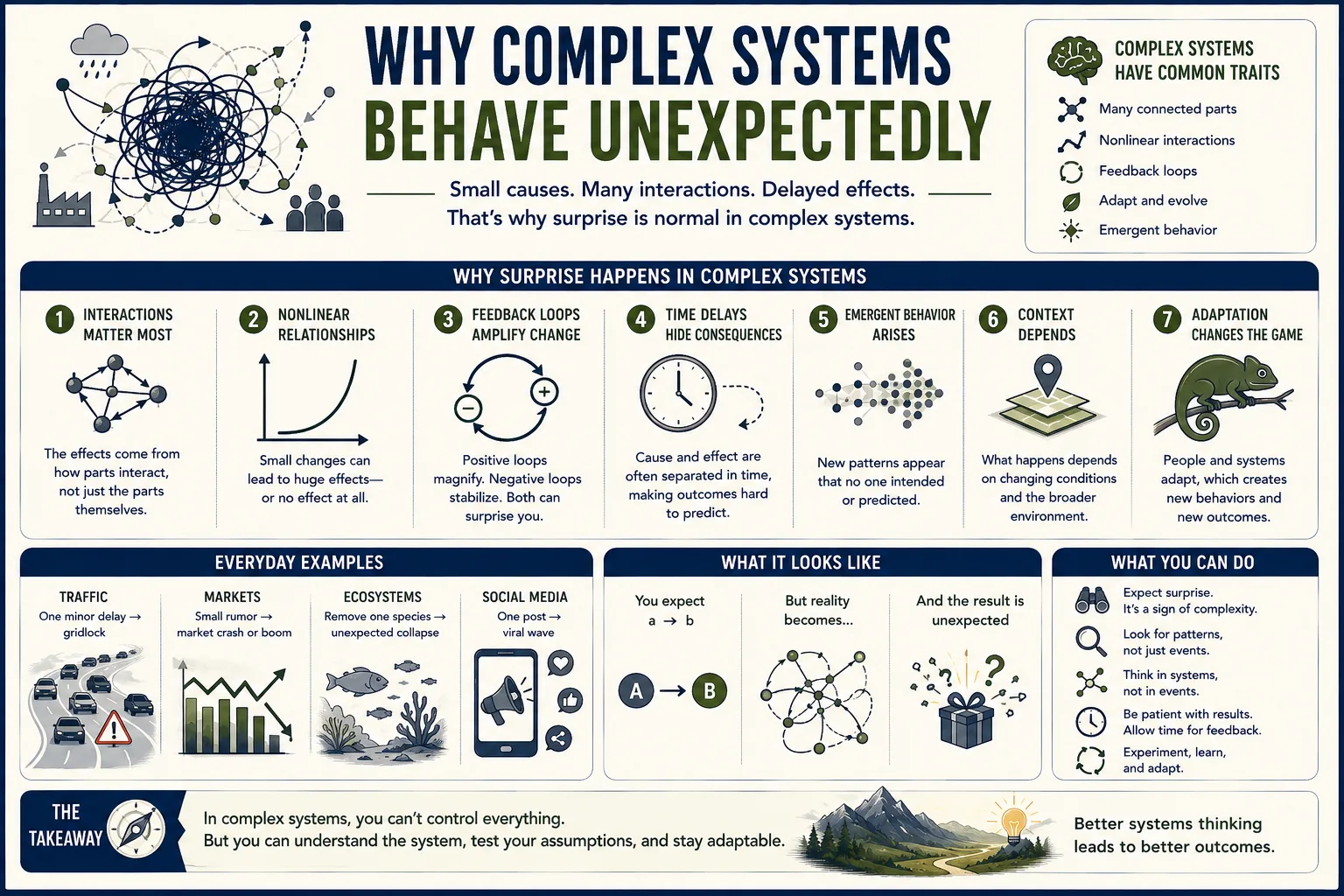
This is the central reason complex systems behave unexpectedly: the very features that make them complex - interconnection, feedback, non-linearity, and adaptation - produce behaviors that emerge from interactions rather than components, are often triggered by conditions outside the historical range, and are hard to predict from models built only on past behavior. This does not mean such systems are entirely unpredictable, but that models fit to normal conditions can badly miss rare, extreme events.[3]
"You cannot understand a system by analyzing its parts. Understanding comes from the relationships, the feedbacks, the delays, and the non-linearities - the things that are invisible when you break the system apart." - Donella Meadows, Thinking in Systems (2008)
The Five Structural Sources of Unexpected Behavior
| Source | Mechanism | Why It Surprises | Example |
|---|---|---|---|
| Emergence | System behavior arises from interactions, not components | Reductionist analysis misses it | 2003 Northeast blackout |
| Non-linearity | Effects are disproportionate to causes | Models assume proportionality | Lake eutrophication tipping point |
| Feedback and delay | Circular causation with time lags | Responses arrive after the moment has passed | Bullwhip effect in supply chains |
| Tight coupling | Failures propagate without buffer | No opportunity to intervene | Deepwater Horizon |
| Adaptation | Components change behavior in response to interventions | Pre-intervention models are invalidated | Rent control driving out rental supply |
Complex systems surprise observers not randomly but through specific structural mechanisms. Understanding these mechanisms transforms surprising behavior from mystery into recognizable pattern:
1. Emergence
Emergence is the production of system-level properties by component interactions that are not present in any component individually.
The water molecule's properties do not predict the properties of liquid water; individual neurons' properties do not predict consciousness; individual traders' behavior does not predict market dynamics at the system level.
Unexpected system behavior is often emergent in this sense: it arises from interactions, not components. Adding more components or analyzing components more carefully does not reveal it - you need to model the interactions.
This is why reductionist analysis (breaking the system into parts and analyzing each) systematically misses the most important sources of system behavior.
*Example*: The 2003 Northeast blackout began with a software bug in an Ohio utility's alarm system that silenced alerts about overloaded transmission lines. Because operators did not receive the alarms, they did not take corrective action.
The overloaded lines sagged and contacted trees below them, triggering more line shutdowns. Each shutdown increased load on remaining lines. Within hours, 55 million people in the northeastern United States and Canada lost power.
No single failure caused the blackout; it emerged from the interaction of a software bug, normal operational decisions, tree trimming schedules, grid topology, and power flows. None of these individually would have produced the blackout; their interaction did.
2. Non-Linearity
Non-linearity means that effects are not proportional to causes. Small causes can produce large effects (tipping points); large causes can produce small effects (saturation); and the same cause can produce dramatically different effects depending on the system's current state.
Linear models - which assume proportional relationships between inputs and outputs - systematically fail to capture tipping point dynamics, threshold effects, and saturation.
This is why interventions in systems that are near tipping points can produce wildly unexpected outcomes: a small additional perturbation crosses a threshold, and the system undergoes a qualitative shift in behavior.
*Example*: Lake eutrophication illustrates threshold non-linearity. A lake can absorb moderate nutrient loading (from agricultural runoff, septic systems) without dramatically changing its ecosystem state. The system has balancing feedback loops that absorb the pollution.
But past a threshold, the feedback loops flip: algae blooms increase turbidity, which reduces light penetration, which kills aquatic plants that compete with algae, which allows more algae, which increases turbidity further.
The lake flips from clear to turbid. This transition can be triggered by a small additional nutrient load - below what the system had previously absorbed without notable change - because it crosses the threshold.
Reversing the change is much harder than avoiding it: the hysteresis (path-dependence) means the lake must be returned to much lower nutrient levels to flip back.
3. Feedback Loops and Delay
Feedback loops create circular causation: effects loop back to influence causes. Delays between cause and effect mean that by the time feedback arrives, the system has moved to a different state - making the feedback appropriate for a past state, not the current one.
These features together produce oscillation, overshoot, and surprise. The system is responding to information that is no longer current, taking corrective action that arrives after the correction point has passed, and then overcorrecting in the other direction.
The bullwhip effect in supply chains is a well-documented instance.[8] A small increase in retail demand leads retailers to increase their orders from wholesalers by a bit more (to build inventory buffer). Wholesalers, seeing increased orders, order more from manufacturers.
Manufacturers, seeing increased orders from wholesalers, increase production and place larger orders for materials. By the time the production increase arrives, the original demand spike has dissipated, and now there is excess inventory throughout the chain.
The retail demand change was small; the manufacturing production swing is large. The amplification happened through a chain of feedback responses, each reasonable in isolation, that were collectively excessive because each actor in the chain was responding to delayed, already-obsolete demand information.
4. Tight Coupling
Tight coupling refers to the degree to which system components are directly and immediately connected such that failures propagate rapidly without opportunity for intervention.
Loosely coupled systems have buffers, slack, and delays between components that allow failures to be isolated before they cascade. Tightly coupled systems have no such buffers - failures propagate instantly.
Charles Perrow's analysis of major technological accidents found that tight coupling, combined with interactive complexity (non-linear and unexpected interactions among components), makes catastrophic accidents normal in the statistical sense - not frequent, but structurally inevitable given sufficient time.
You cannot prevent all accidents in tightly coupled complex systems; you can only manage their consequences.
*Example*: The 2010 Deepwater Horizon explosion and subsequent Gulf of Mexico oil spill exemplified tight coupling. The blowout preventer - the last-resort device designed to seal the well in an emergency - failed because of design flaws and damage from the initial blowout.
With the blowout preventer failed, no intermediate system could stop the flow. The tight coupling (no significant buffer between the wellhead failure and the ocean release) meant that once the primary containment failed, the consequence was immediate and catastrophic.
Subsequent engineering redesigns for deepwater drilling focused on coupling reduction: creating multiple independent failure containment systems with sufficient independence to prevent cascade.
5. Adaptation
Adaptation is the capacity of a system's components to observe the system's state and change their behavior in response.
When the components are human beings (or any adaptive agents), interventions change the incentive landscape, and agents adapt their behavior to the new incentives in ways that can reverse, circumvent, or amplify the intervention's intended effect.
This is structurally different from the other sources of surprise: it means that the system's behavior in response to an intervention is not predictable from the system's prior behavior, because the intervention changes the interaction rules. Models built on pre-intervention data cannot predict post-intervention behavior.
*Example*: The United Kingdom's attempt to manage housing costs in London through rent control (various forms from the 1940s through the 1980s) illustrates adaptive response. Rent controls were intended to reduce housing costs for tenants.
Landlords, observing that rental returns had become unattractive under controlled rents, responded by converting rental units to owner-occupied units (selling them), withdrawing properties from the rental market, or allowing rental properties to deteriorate (since rent revenue could not support maintenance).
The rental housing stock contracted and deteriorated. The control intended to make renting cheaper made it scarcer and worse.
The Difference Between Complicated and Complex Systems
A crucial distinction for understanding unexpected behavior is between complicated and complex systems:[7]
A complicated system (a jet aircraft, a computer processor, a legal code) can produce unexpected behavior when it fails, but its failure modes are in principle discoverable through analysis. With sufficient expertise and analysis, you can enumerate the ways a complicated system can fail and design against them.
A complex system (an economy, an ecosystem, a city, an immune system, a financial market) produces unexpected behavior not through failure but through normal operation under novel conditions.
The interactions are too numerous and non-linear to enumerate all possible states; adaptive components change the system's structure in response to conditions; and emergent properties arise from interactions that no component-level analysis can anticipate.
This is why the tools designed for complicated systems - detailed failure mode analysis, rigorous specification, hierarchical control - are insufficient for complex systems. Complex systems require different management approaches:
Observe rather than predict: Maintain rich monitoring of system state rather than relying on predictions. When behavior diverges from expectation, the divergence is information.
Probe rather than plan: Use small, reversible interventions to learn how the system responds before committing to large interventions. Let the system reveal its actual feedback structure through experimentation.
Resilience over efficiency: Maintain slack, redundancy, and flexibility rather than optimizing for efficiency in normal conditions. Resilience allows the system to absorb surprises; efficiency removes the buffers that enable resilience.
Distributed decision-making: Allow people close to the system's components to make decisions, rather than centralizing authority at levels too remote to observe system state in real time.[6] Distributed decision-making keeps responses close to where information originates.
Understanding why complex systems behave unexpectedly transforms the management challenge. Unexpected behavior is not a deviation to be prevented but a structural feature to be prepared for.
The goal is not to eliminate surprise - that is impossible in genuine complexity - but to develop the organizational capacity to detect surprise early, respond adaptively, and maintain the flexibility that prevents unexpected behavior from becoming catastrophic.
What Systems Theorists Found About Complexity
The formal scientific study of why complex systems behave unexpectedly emerged from multiple research traditions in the mid-twentieth century. Jay Forrester, a professor at MIT's Sloan School of Management, pioneered the field of system dynamics in the 1950s.
His foundational book Industrial Dynamics (1961) demonstrated mathematically that feedback structures - not individual component behavior - determine system-level outcomes.
Forrester's simulation models showed that seemingly reasonable management decisions, made without understanding the feedback structure of the system, routinely produced oscillation, overshoot, and counterintuitive results.
Donella Meadows, Forrester's student and collaborator, synthesized the core insights in Thinking in Systems (2008), written before her death in 2001 and published posthumously.
Meadows identified the precise structural reasons systems behave unexpectedly: bounded rationality (actors make decisions with only local information), delays between cause and effect, the distinction between stocks and flows, and the tendency of feedback loops to create behavior that no single actor intended or can fully anticipate.[2]
Charles Perrow, a Yale sociologist, approached the same problem from the study of industrial accidents.
In Normal Accidents: Living with High-Risk Technologies (1984), Perrow analyzed Three Mile Island, Bhopal, and other major industrial disasters and concluded that catastrophic accidents in tightly coupled, complexly interactive systems are "normal" in the statistical sense - not frequent, but structurally inevitable.
His core finding: the accidents were not caused by human error in the sense of deviation from good practice.
They were caused by interactions among system components that no one had designed, anticipated, or rehearsed, because the systems were too complex to model completely.
Stuart Kauffman at the Santa Fe Institute extended the analysis to biological and economic systems.[9]
His work on "fitness landscapes" and the "edge of chaos" showed that complex adaptive systems - ecosystems, economies, immune systems - operate in a regime between rigid order and complete randomness.[10]
This regime maximizes adaptability but also maximizes the potential for emergent, unpredictable behavior.
Historical Case Studies in System Surprise
The Chernobyl Disaster (1986): The explosion at the Chernobyl nuclear reactor Unit 4 is often attributed to operator error, and operators did violate procedures. But the more fundamental cause was system complexity that exceeded human comprehension.
The reactor was being tested in a low-power configuration that created an unstable dynamic: as power dropped, xenon buildup suppressed the reaction; as operators withdrew control rods to compensate, the reaction accelerated non-linearly; the positive void coefficient (a design flaw unique to RBMK reactors) meant that steam voids increased reactivity rather than reducing it.
The operators were making reasonable decisions within their understanding of the system. The system's actual feedback structure was different from their mental model of it. The gap between mental model and actual system is, as Meadows identified, a fundamental source of unexpected behavior.
The 2003 North American Blackout: On August 14, 2003, a software bug in FirstEnergy's alarm system in Ohio silenced alerts about overloaded transmission lines. Over ninety minutes, without alarms, operators missed opportunities to prevent overloads.
Lines sagged into trees and shorted out. Each failure increased load on neighboring lines. At 4:10 PM, the cascade became uncontrollable. Within seconds, 55 million people lost power across eight US states and Ontario, Canada.
The subsequent investigation found 11 distinct causes - no single one of which, in isolation, would have caused the blackout. The blackout was an emergent phenomenon, arising from the interaction of a software bug, tree trimming shortfalls, hot weather, high demand, and grid topology.
It is the paradigm case of emergence that Meadows, Perrow, and Holland all describe: system behavior that none of the components produced individually.[4]
Long-Term Capital Management (1998): LTCM's collapse illustrated non-linearity and the limits of models built on historical data.[5] The fund's Nobel laureate founders - Myron Scholes and Robert Merton - built models that were analytically sophisticated but could not capture the behavior of markets in the tail of the distribution.
During normal conditions, asset classes that were theoretically uncorrelated behaved as the models predicted. During the 1998 Russian debt crisis, correlations changed: every major bank and fund was simultaneously trying to sell the same assets to cover losses.
A structural feature of the system (correlation instability under stress) was invisible to models built on normal-condition data. The result was $4.6 billion in losses and a Federal Reserve-orchestrated bailout.
The 2010 Deepwater Horizon Explosion: The Deepwater Horizon disaster released an estimated 4.9 million barrels of oil into the Gulf of Mexico over about 87 days, according to the U.S. government estimate; the exact total was debated and other estimates were somewhat lower.
The post-accident investigation found that the blowout was the result of multiple simultaneous failures: a compromised cement job that failed to seal the well, a defective blowout preventer, pressure testing that was misinterpreted, and organizational decisions that prioritized schedule over safety signals.
Perrow's framework predicts this exactly: in tightly coupled, complexly interactive systems, multiple simultaneous failures that interact in unexpected ways are inevitable over sufficient time.[1]
From this perspective, an accident like Deepwater Horizon looks less like a freak aberration and more like the kind of failure that normal-accident theory expects to occur eventually when complex, tightly coupled systems operate at industrial scale. The theory offers a way to understand such accidents, not a precise prediction of any specific one.
Research Applications: Organizations Managing Complexity
The US Navy's development of High Reliability Organization (HRI) theory emerged from studying aircraft carrier flight deck operations - one of the most complex and dangerous operational environments in human experience.
Researchers Karl Weick and Kathleen Sutcliffe documented the practices that allowed carrier crews to operate for years without major accidents: collective mindfulness (continuous attention to weak signals), deference to expertise over hierarchy (junior crew members authorized to halt operations for safety concerns), and preoccupation with failure rather than success (routinely imagining how things could go wrong).
These practices directly address the structural sources of unexpected behavior: they compensate for the bounded rationality and information gaps that cause system surprises.
Toyota's Toyota Production System (TPS) implemented a counter-intuitive approach to complexity: every worker is empowered and expected to stop the production line (via the andon cord) when they observe a defect or anomaly. This creates a continuous feedback mechanism that surfaces unexpected system behavior in real time.
W. Edwards Deming, whose statistical process control methods heavily influenced Toyota's approach, argued that 94% of failures are system failures, not individual failures - a direct application of the complexity insight that behavior emerges from system structure, not component character.
Toyota's remarkable quality record relative to competitors reflects the organizational application of this principle.
The field of complexity-aware policy design has grown from these insights. Elinor Ostrom, the 2009 Nobel Prize winner in Economics, studied how communities manage shared resources (fisheries, forests, irrigation systems) that exhibit complex system behavior.
Her finding, documented in Governing the Commons (1990), was that effective resource governance requires feedback mechanisms that reflect the actual state of the system, rule-making that can adapt as conditions change, and local knowledge that formal models cannot capture.
These are direct applications of the management principles that complexity science predicts: observe rather than predict, probe rather than plan, and design for resilience rather than optimization.
Sources & Further Reading
- Perrow, C. Normal Accidents: Living with High-Risk Technologies. Basic Books, 1984.
- Meadows, D. Thinking in Systems: A Primer. Chelsea Green Publishing, 2008. View source
- Taleb, N.N. The Black Swan: The Impact of the Highly Improbable. Random House, 2007. View source
- Holland, J. Emergence: From Chaos to Order. Addison-Wesley, 1998. View source
- Lowenstein, R. When Genius Failed: The Rise and Fall of Long-Term Capital Management. Random House, 2000.
- Axelrod, R. & Cohen, M. Harnessing Complexity: Organizational Implications of a Scientific Frontier. Free Press, 1999. View source
- Snowden, D. & Boone, M. "A Leader's Framework for Decision Making." Harvard Business Review, November 2007. View source
- Lee, H. "The Bullwhip Effect in Supply Chains." Sloan Management Review, 38(3), 93-102, 1997. View source
- Kauffman, S. At Home in the Universe: The Search for Laws of Self-Organization and Complexity. Oxford University Press, 1995. View source
- Waldrop, M. Complexity: The Emerging Science at the Edge of Order and Chaos. Simon & Schuster, 1992. View source
Agent-Based Modeling Research: Simulating Complex System Surprises
The development of agent-based modeling (ABM) in the 1990s provided researchers with tools to study complex system behavior without requiring complete analytical solutions.
Rather than writing equations that describe the aggregate system, ABMs represent individual agents following local rules and simulate their interactions to observe emergent system-level outcomes.
This approach has been used to reproduce and predict surprising behaviors in financial markets, epidemics, traffic systems, and ecological collapses.
The most significant ABM research on financial system surprises came from J. Doyne Farmer and colleagues at the Santa Fe Institute. Farmer, a physicist who previously worked on chaotic systems, applied complexity science methods to financial markets starting in the mid-1990s.
His 2005 paper "The Price Dynamics of Common Trading Strategies" in the Journal of Economic Behavior and Organization used an ABM of market microstructure to reproduce features of stock market price dynamics - fat-tailed return distributions, volatility clustering, and intermittent liquidity crises - that standard economic models assumed away.
The surprise was not that market prices were unpredictable (that is well-established) but that specific structural features of market organization (the ratio of informed to uninformed traders, the response time of market makers, the concentration of positions) reliably produced specific pathological behaviors.
The ABM made the structural sources of market surprises visible in ways that empirical analysis alone could not.
Similarly, the epidemic modeling conducted by Neil Ferguson's group at Imperial College London during COVID-19 in early 2020 used structured stochastic agent-based models to project epidemic trajectories under different intervention scenarios.
The March 2020 report that estimated 510,000 deaths in the United Kingdom without intervention (and 2.2 million in the United States) was an ABM simulation of 66 million interacting agents, each following rules for contact patterns, infection transmission, and behavioral response to symptoms.
The model predicted that the system would exhibit non-linear threshold behavior: relatively modest reductions in contact rates (achieved through stay-at-home measures) could bend the epidemic curve dramatically, because the epidemic's exponential growth phase is highly sensitive to the reproduction number near its threshold of 1.
This threshold non-linearity was structurally invisible in simpler models that treated the epidemic as a smooth curve.
Resilience Research: How Systems Maintain Function Under Stress
The formal study of resilience - the capacity of a system to absorb disturbance and maintain its function - developed as a distinct research field in ecology following C.S. Holling's 1973 paper "Resilience and Stability of Ecological Systems" in the Annual Review of Ecology and Systematics.
Holling distinguished between two types of stability that are easily confused but reflect different system properties: engineering resilience (how quickly a system returns to equilibrium after disturbance) and ecological resilience (how large a disturbance the system can absorb before shifting to a different equilibrium state).
High engineering resilience and high ecological resilience are not the same thing - and pursuing one can undermine the other.
Holling's empirical case was spruce budworm outbreaks in Canadian boreal forests.
The budworm system alternates between decades-long periods of low budworm density (when parasitoids and birds control the population) and explosive outbreak periods (when budworm populations escape control, defoliate forests, and then collapse when the host tree population is depleted).
Aggressive spraying interventions achieved high engineering resilience - suppressing individual outbreaks quickly - but reduced ecological resilience by maintaining forest conditions that made eventual outbreaks more severe and more synchronized across larger geographic areas.
The system had good stability in one sense and poor stability in another, and the management intervention that improved the measured dimension of stability degraded the unmeasured dimension.
Brian Walker and colleagues at CSIRO in Australia extended this research to social-ecological systems, publishing the resilience management framework in the journal Ecology and Society in 2004.
Their analysis of 22 regional case studies - including the Goulburn-Broken catchment in Australia, the Kristianstads Vattenrike wetland in Sweden, and the Greater Kruger region in South Africa - found that the systems that maintained function through major disturbances shared structural features: diversity in both ecological and institutional dimensions, modularity in the network structure (so failures in one component did not cascade immediately to others), and feedback mechanisms that reflected the actual state of the ecological system rather than averaged or delayed indicators.
These properties correspond directly to the structural features Perrow identified as distinguishing loosely coupled from tightly coupled systems - the same features that determine whether failures in complex systems cascade into catastrophe or are contained.