
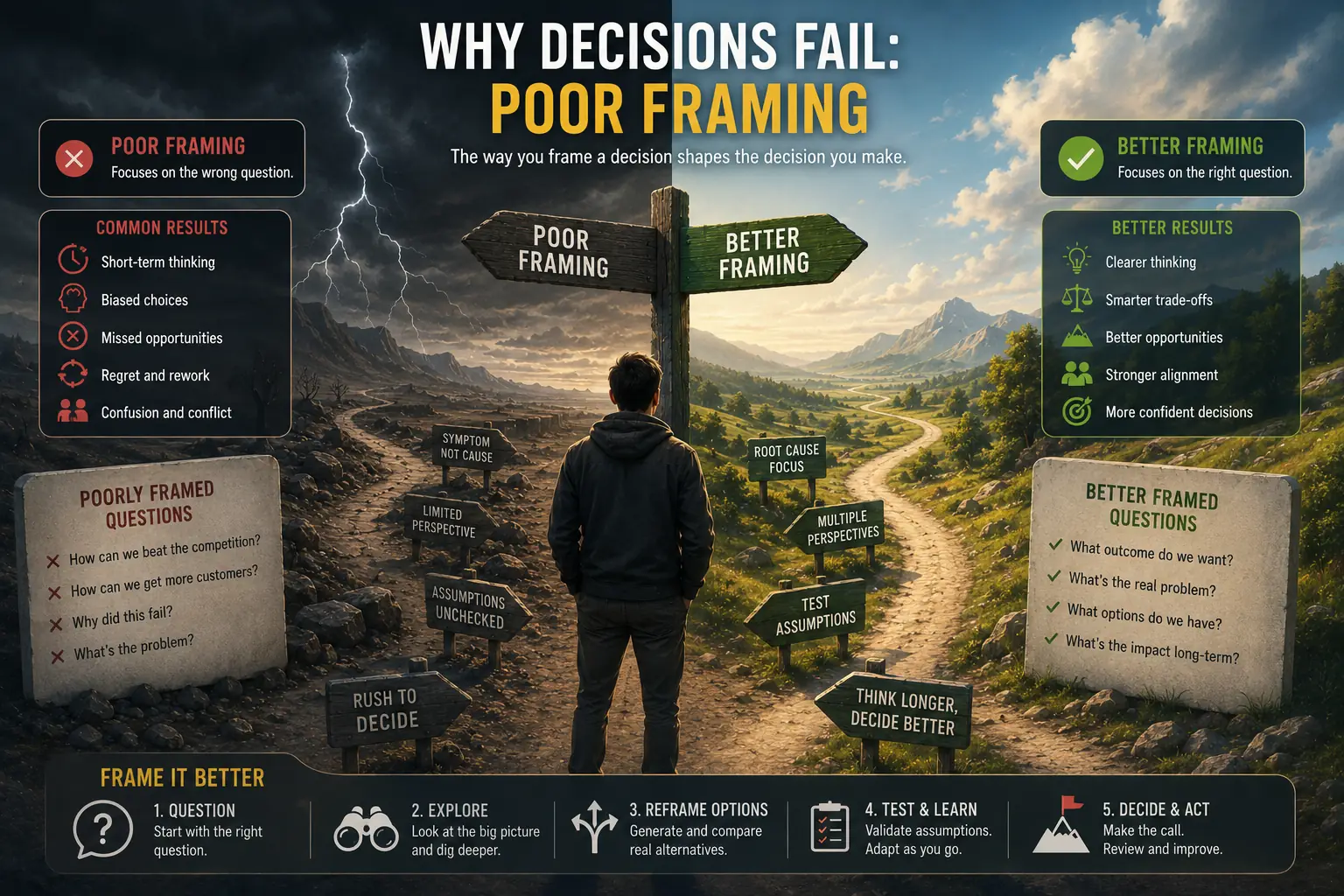
The Hidden Error That Ruins Good Analysis
Decisions: "A problem well stated is a problem half solved." - Charles Kettering
A major software company spent three months analyzing whether to build their product in React or Angular. Teams evaluated performance benchmarks, developer availability, ecosystem maturity, learning curves. They produced a 40-page comparison document. Executives made the "right" choice based on thorough analysis.
The product failed anyway.
The real problem? They were solving the wrong question entirely. The actual issue wasn't "Which framework?" but "Should we be building a web app at all when our users are primarily mobile?" Perfect analysis of a poorly framed problem produces perfect failure.
Framing determines what decision you're making. Analysis determines how to make it. Get the framing wrong, and no amount of analytical rigor saves you. You're climbing the wrong mountain efficiently.
Kahneman and Tversky (1981) demonstrated that identical choices produce opposite decisions depending purely on framing effects. Present surgery as "90% survival rate" versus "10% mortality rate": same facts, different frames, different choices.
The frame isn't neutral description; it's cognitive architecture that determines what you see and what remains invisible.
Most decision making advice focuses on how to analyze options. Almost none addresses how to ensure you're analyzing the right problem. This asymmetry is catastrophic: framing errors compound while analytical errors often cancel out.
Anatomy of Framing: What It Actually Is
The Frame Components
Every decision frame contains invisible structure:
1. Boundary definition → What's inside the problem, what's outside?
2. Option set → Which alternatives are considered? (many possible solutions never enter awareness)
3. Time horizon → Short-term choice or long-term strategy?
4. Success criteria → What constitutes a good outcome?
5. Constraints → What's treated as fixed versus negotiable?
6. Stakeholders → Whose preferences count?
None of these are "given" by the situation. They're constructed by how you frame the problem, often unconsciously, based on recent experience, organizational politics, or whoever spoke first in the meeting.
Example: Declining Sales
Same situation, three frames:
| Frame A: Sales Problem | Frame B: Product Problem | Frame C: Market Problem |
|---|---|---|
| Boundary: Sales team performance | Boundary: Product-market fit | Boundary: Market positioning |
| Options: New comp structure, more training, better tools | Options: Product features, pricing, positioning | Options: New market segments, rebrand, pivot |
| Success metric: Increased close rate | Success metric: User retention, NPS | Success metric: Market share growth |
| Constraints: Product is fixed | Constraints: Sales team is fixed | Constraints: Core offering is fixed |
All three frames are internally consistent. Each produces thorough analysis. Each arrives at confident conclusions. Yet they yield completely different decisions, and only one (at most) addresses the actual root cause.
The frame isn't describing reality neutrally. It's selecting which slice of reality to examine and which to ignore.
Common Framing Traps
"The frame through which you look at the world shapes what you see and what you miss." - George Lakoff
Trap 1: Symptom Framing (Treating Effects as Causes)
You frame the problem based on the most visible symptom rather than underlying cause. Classic mistake in medicine, business, relationships, policy.
Example - Employee retention:
Symptom frame: "How do we reduce turnover?"
- Install ping-pong tables
- Increase salary 10%
- Add remote work flexibility
- Better onboarding process
Result: Marginal improvement, then turnover resumes. Why? You were treating symptoms.
Causal reframe: "Why are good employees leaving?"
- Exit interviews reveal toxic middle management
- High performers feel growth is blocked
- Recognition systems reward seniority over contribution
Actual decision: Replace managers, restructure promotion path, redesign recognition, none of which emerged from the symptom frame.
How to detect symptom framing:
- Ask "Why?" five times (Toyota's 5 Whys)
- Distinguish correlation from causation
- Look for recurring problems that "solved" solutions don't fix
- Check if your solution addresses root cause or makes symptoms temporarily tolerable
Trap 2: False Dichotomy (Artificially Narrow Options)
You frame the decision as binary when multiple alternatives exist. The either/or structure blinds you to combined approaches or orthogonal solutions.
Classic example: "Should we prioritize quality or speed?"
This framing assumes quality and speed are incompatible. Often they're not, better process enables both. The false dichotomy prevents you from discovering that option.
Real-world impact:
| False Dichotomy Frame | What It Obscures |
|---|---|
| "Fire the underperformer or accept mediocrity?" | Coach them, change their role, restructure the team, redefine the job |
| "Cut costs or lose competitiveness?" | Increase prices, change cost structure, improve efficiency, exit unprofitable segments |
| "Work-life balance or career success?" | Redefine success, change jobs, build systems that reduce hours without reducing output |
Heath and Heath (2013) call this "narrow framing", the most common decision error. Research shows that considering just one more option improves decision quality substantially, regardless of which option you ultimately choose. The act of expanding the frame itself changes thinking.
Counter-technique: "Vanishing Options Test"
Imagine your current options all disappeared. What would you do? This forces generation of alternatives beyond the initial frame.
Trap 3: Confirmation Framing (Seeking Justification)
You frame the decision as "Should we do X?" when you've already decided to do X. The "analysis" is rationalization wearing analytical clothing.
Telltale signs:
- Question is "Should we?" rather than "What should we do?"
- Analysis starts after someone has publicly committed
- Contradictory evidence is treated as "concerns to address" not decision inputs
- Options are "Do X" versus "Do nothing"
Example: Leadership wants to acquire a company. The question becomes "Should we acquire TargetCo?" Analysis focuses on making the numbers work, adjusting assumptions, finding synergies, discounting risks. The frame ensures the answer.
Better frame: "How should we achieve growth in segment Y?" This admits acquisition as one option among several (organic growth, partnerships, adjacent markets), forcing genuine comparison.
Maya Angelou had it right for decisions too: "When someone shows you who they are, believe them the first time." When your framing shows it's seeking confirmation, believe it, and reframe.
Trap 4: Anchored Framing (Historical Lock-In)
You frame the decision based on past choices, treating previous decisions as constraints rather than examining whether they're still valid.
Example - Meeting structure:
Anchored frame: "Should our Monday meeting be 60 or 90 minutes?"
Assumptions hidden in the frame:
- We need a Monday meeting at all
- The meeting serves a valuable purpose
- Everyone currently attending needs to be there
- Meeting is the right format for the goals
Unanchored reframe: "How should we coordinate weekly priorities?"
This might reveal: Async document works better. Monday meeting unnecessary. Different people need different information. Format should be 5-minute standups, not hour-long discussions.
Path dependence creates organizational anchored framing everywhere. "We've always done it this way" becomes invisible frame boundary.
Trap 5: Self-Interest Framing (Optimization for Wrong Stakeholder)
You unconsciously frame the problem to optimize for your interests while claiming to optimize for the right stakeholders.
Example - Product manager deciding feature prioritization:
Self-interest frame: "Which features will executives notice in quarterly review?"
Actual stakeholder frame: "Which features will users value most?"
These produce different roadmaps. Self-interest frame leads to flashy features that demo well. User-centric frame leads to boring infrastructure improvements and workflow refinements that actually matter.
This isn't conscious dishonesty, it's how framing works. Your frame naturally reflects your incentives unless you deliberately counteract it.
Test: If you switched roles with another stakeholder, would you frame the problem differently? If yes, your current frame embeds your interests, not neutral problem structure.
Reframing Techniques That Actually Work
"If I had an hour to solve a problem, I'd spend 55 minutes thinking about the problem and 5 minutes thinking about solutions." - Albert Einstein
Multi-Perspective Framing
Technique: Deliberately frame the same problem from 3-5 different perspectives before analyzing.
Application - Product launch decision:
| Perspective | Frame | Key Question |
|---|---|---|
| Customer | Value delivery | "What job are customers hiring this product to do?" |
| Competitive | Market positioning | "How does this change our competitive position?" |
| Financial | Resource allocation | "What's the opportunity cost of capital and team time?" |
| Strategic | Long-term optionality | "What doors does this open or close?" |
| Operational | Execution risk | "Can we actually deliver this well?" |
After generating all five frames, patterns emerge:
- Where frames agree → Robust insight (likely important)
- Where frames conflict → Critical trade-off to resolve
- What one frame sees that others miss → Hidden risk or opportunity
You don't "pick the best frame." You synthesize across frames to understand the problem more completely than any single perspective permits.
Constraint Relaxation
Technique: List everything you're treating as fixed. Then systematically challenge each constraint.
Example - Hiring decision:
Initial frame: "Should we hire a senior engineer or two junior engineers?"
Hidden constraints:
- Must hire full-time employees
- Must hire immediately
- Must hire engineers (not contractors, agencies, or other solutions)
- Must expand team (rather than eliminating work)
- Must hire where we're located
Relaxed frame: "How do we increase engineering capacity?"
New options revealed:
- Contract work for the project
- Partner with external dev shop
- Eliminate low-value work
- Improve tools/process (2x productivity with same team)
- Hire remotely in lower-cost regions
- Hire one senior engineer who can 10x others
The constraint relaxation didn't give you the answer. It expanded the solution space enough that better answers became visible.
Temporal Reframing
Technique: Examine the decision from multiple time horizons simultaneously.
Example - Career decision:
| Time Horizon | Frame | Insight |
|---|---|---|
| 1 month | "Which job makes me happier right now?" | Company A (better team, easier commute) |
| 1 year | "Which accelerates skill development?" | Company B (more challenging, better learning) |
| 5 years | "Which builds valuable career capital?" | Company B (industry connections, reputation) |
| 20 years | "Which aligns with what matters long-term?" | Company C (mission-driven, sustainable pace) |
Different time horizons surface different values. One-month frame emphasizes comfort. Twenty-year frame emphasizes meaning. Both are valid, the question is which time horizon should dominate for this particular decision.
Most framing errors involve implicitly choosing the wrong time horizon. Relationships decisions made with 1-month frames. Career decisions made with 1-week frames. Infrastructure investments made with quarterly frames.
Outcome to Action Reframing
Technique: Flip from "What outcome do we want?" to "What actions are we capable of taking?"
Example - Revenue growth:
Outcome frame: "How do we reach $10M ARR?"
- This generates fantasy plans based on desired outcomes
- "If we capture 5% market share..." (assumes capturing is easy)
- "If conversion rate improves to 8%..." (assumes you know how)
Action frame: "What actions can we take that reliably increase revenue?"
- Launch new pricing tier (concrete, testable)
- Expand sales team in proven segments (clear action)
- Reduce churn through onboarding improvement (specific intervention)
Outcome frames feel strategic but often produce wishful thinking. Action frames feel tactical but force grappling with reality: what can you actually do, not what would be nice if it happened.
Jeff Bezos's "working backwards" is action reframing. Start with the outcome (press release), then work back to "What actions would need to be true to get there?" This surfaces implausibility early instead of hiding it in outcome-focused optimism.
The Meta-Frame: Deciding How to Frame
You can't frame without a frame. Every reframing operates within a higher-level frame that determines which reframings seem reasonable.
Example:
You're unhappy at work. Possible frames:
- "Which company should I join?"
- "What career should I pursue?"
- "How should I find meaning?"
- "What matters in life?"
Each frame is nested in the next. Which level is appropriate?
Frame scope guidelines:
| Situation | Appropriate Frame Scope |
|---|---|
| Reversible, low stakes | Narrow frame (specific options) |
| Irreversible, high stakes | Broader frame (examine assumptions) |
| Recurring problem | Very broad frame (systemic causes) |
| Novel situation | Exploratory frame (hypothesis generation) |
The meta-skill isn't "perfect framing" (impossible). It's frame fluidity: ability to zoom in and out, trying multiple frames quickly, recognizing when your current frame is failing.
Failure indicators:
- Analysis produces no clear winner (frame might be wrong)
- "Solution" feels unsatisfying despite scoring well (optimizing wrong thing)
- Problem keeps recurring after "solving" it (symptom framing)
- Stakeholders fundamentally disagree on approach (different implicit frames)
These aren't always framing problems, but they often are, and checking the frame costs little.
Frame Ownership in Organizations
"Culture eats strategy for breakfast." - Peter Drucker
The First-Mover Advantage in Framing
Whoever frames the problem first usually wins. Once a frame is established, tremendous inertia fights reframing, people have invested analysis, formed opinions, staked positions.
Example - Budget allocation meeting:
Finance frames it as: "How do we cut 15% from costs?"
- Departments compete for protection
- Politics determines winners
- Innovation projects get killed first
- Everyone leaves unhappy
Alternative frame: "How do we increase value by 20% with current resources?"
- Encourages creative solutions
- Focuses on opportunity not scarcity
- Surfaces efficiency improvements
- Some projects get killed, but framed as value-maximization not loss
Same underlying situation (resource constraint), radically different decision process.
Practical implication: In organizational settings, fight for framing rights. Don't accept the first frame offered, especially if it embeds assumptions favoring other stakeholders' interests.
The Devil's Advocate Reframe
Standard devil's advocate: "I'll argue against the proposed solution."
Frame-focused devil's advocate: "I'll argue we're solving the wrong problem."
Much more valuable. Solution devil's advocates improve analysis quality. Frame devil's advocates surface problems that analysis never sees.
Implementation: Before major decisions, assign someone to:
- Generate 3 alternative frames for the same situation
- Identify hidden assumptions in the current frame
- Point out whose interests the current frame serves
- Suggest what the frame makes invisible
This role should rotate, it's a skill everyone needs, and perspective is easier from outside the initial framing.
Frame Documentation
Organizations document decisions but rarely document how the problem was framed. This prevents learning from framing errors.
Better decision record includes:
| Standard Record | Frame-Aware Record |
|---|---|
| Decision made | Decision made + how problem was framed |
| Options considered | Options considered + which options weren't considered and why |
| Analysis results | Analysis results + frame assumptions |
| Final choice | Final choice + which frame dominated and why |
Reviewing failed decisions without reviewing framing is like doing an autopsy that ignores cause of death. You learn "the patient died" (yes, we know) but not why the treatment failed (frame was wrong).
Applied Framing Across Domains
Hiring: From "Who?" to "What?"
Weak frame: "Should we hire Candidate A or Candidate B?"
This assumes:
- Hiring someone is the right solution
- These are the relevant candidates
- The role as defined makes sense
- Hiring happens now
Stronger frame: "How should we address the capacity gap in [function]?"
Reveals options invisible in hiring frame:
- Eliminate work (do we need this function?)
- Restructure team (redistribute responsibilities)
- Upskill existing team
- Change process (makes capacity sufficient)
- Hire, but different role than initially defined
The weak frame guarantees you hire someone (analysis just picks who). The strong frame might reveal hiring is wrong move entirely.
Strategy: From "Plan" to "Uncertainty"
Weak frame: "What's our 3-year strategic plan?"
Creates false confidence through detailed forecasting in inherently uncertain environments. You generate intricate plans that are wrong but precise.
Stronger frame: "What capabilities and options do we need to thrive across multiple possible futures?"
Shifts from prediction to adaptation:
- Scenario planning (multiple futures, not single forecast)
- Capability building (robust across scenarios)
- Option creation (preserved flexibility)
- Early indicators (recognize which future is unfolding)
Tech companies that frame strategy as "plans to execute" get disrupted. Those that frame it as "options to preserve" adapt successfully.
Relationships: From "Decision Point" to "Ongoing Negotiation"
Weak frame: "Should we get married / have kids / move to city X?" (binary, one-time decision)
Stronger frame: "How do we navigate this transition in our relationship?" (process, ongoing)
Binary frames create pressure and anxiety, you must "decide" the entire future now. Process frames acknowledge that:
- Preferences evolve
- Circumstances change
- Decisions can be revisited
- There are intermediate options
"Should we have kids?" is terrifying framed as irreversible single choice. "How do we explore whether parenthood fits our lives?" is manageable, you can date the idea before marrying it.
Personal Development: From "Goal" to "System"
Weak frame: "What should my goals be?" (outcome focus)
Stronger frame: "What systems should I build?" (process focus)
James Clear's distinction: Goals are about results you want to achieve. Systems are about processes you follow.
Example frames:
| Goal Frame | System Frame |
|---|---|
| "Lose 20 pounds" | "Eat only during 8-hour window daily" |
| "Write a book" | "Write 500 words every morning before work" |
| "Get promoted" | "Learn one new skill per quarter that advances my function" |
Goal frames generate motivation but little action. System frames generate action that produces results. The frame shift, from future outcome to present process, completely changes what you actually do.
When Reframing Goes Too Far
Reframing isn't always better framing. You can reframe yourself into paralysis.
Analysis Paralysis Through Infinite Reframing
Every frame excludes something. You can always find another perspective that surfaces new considerations. At some point, additional reframing costs exceed its benefits.
Diminishing returns indicators:
- Fifth reframe reveals nothing new
- Frames are getting increasingly abstract
- You're reframing to delay deciding
- Time pressure makes additional framing costly
- Stakeholders have lost patience
Most decisions need 2-4 frames, not 20. The goal is multi-perspective clarity, not exhaustive enumeration.
Reframing as Avoidance
Sometimes poor framing isn't the problem, execution is. Reframing becomes sophisticated procrastination.
Test: "If we had perfect framing, could we execute successfully?"
- If no → Reframing might help
- If yes → Stop reframing, start executing
The decision to reframe is itself a framed decision. Don't let reframing become your new "productive" way to avoid hard choices.
Framing Absolutism
No frame is "correct" in absolute sense. Frames are tools: useful or not useful for specific purposes, not true or false.
Mistake: Treating your preferred frame as objective reality and others' frames as bias.
Reality: Multiple frames can simultaneously be useful. The CFO's financial frame isn't "wrong" just because the CTO's technical frame reveals different priorities. Both are incomplete but valid slices of a complex situation.
Integration across frames beats winning frame battles.
Developing Frame Awareness: Practical Calibration
Daily Frame Logging
Track framing patterns for 2 weeks:
Each time you face a non-trivial decision, note:
- How did you initially frame it?
- What assumptions were embedded?
- What options did the frame exclude?
- Whose interests did the frame serve?
- Could you generate an alternative frame?
After 20-30 logged decisions, patterns emerge in how you habitually frame. Most people discover they:
- Default to action frames or outcome frames (rarely both)
- Optimize for specific time horizons
- Unconsciously embed self-interest
- Accept false dichotomies from others
Awareness of your framing defaults is first step to frame flexibility.
The Reversal Test
Before committing to a frame, deliberately reverse key elements:
| Original Frame | Reversed Frame | What It Reveals |
|---|---|---|
| "How do we increase revenue?" | "How would we decrease revenue?" | Actions that might accidentally reduce revenue |
| "Should we hire more people?" | "Should we reduce headcount?" | Whether team size is actually the constraint |
| "How do we move faster?" | "How do we slow down?" | Whether speed is the real issue or code quality/tech debt matters more |
Reversals aren't necessarily better frames, they're frame-breaking exercises that reveal assumptions you didn't know you were making.
Frame Diversity in Information Diet
Your framing range is constrained by the frames you've encountered. If everyone you read frames entrepreneurship as "venture-backed growth," you won't naturally generate "profitable lifestyle business" frames.
Deliberate frame expansion:
- Read thinkers who frame problems differently than you do
- Consult people from different functions, cultures, backgrounds
- Study historical decisions framed in now-obsolete ways
- Explore fields that use unusual frames (design thinking, systems thinking, etc.)
This isn't about "being open-minded" as vague virtue. It's about expanding your frame repertoire so you have more tools available when facing novel problems.
What Framing Mastery Actually Looks Like
It's not having one perfect frame. It's fluid movement between frames: trying multiple lenses quickly, recognizing which reveals most signal for the specific decision, synthesizing across perspectives.
High performers frame decisions like skilled photographers frame shots:
- They quickly try multiple angles
- They recognize which angle captures the essential elements
- They zoom in and out appropriately
- They reframe when the first attempt doesn't work
- They know technical rules but break them when needed
The meta-skill is frame self-awareness. Recognizing "I'm inside a frame right now" creates distance that enables frame evaluation and adjustment. Most people are so immersed in their frame they can't see it's a frame at all, they think it's reality.
Experts maintain lightness about frames. "Let's try framing this as X" rather than "It is X." The linguistic distinction matters, it preserves frame as tool rather than confusing map with territory.
The Irreducible Role of Judgment
"Change the way you look at things and the things you look at change." - Wayne Dyer
Better framing improves decision quality dramatically. But it doesn't eliminate the need for judgment.
Framing clarifies what you're deciding. Judgment makes the actual choice.
You can frame a career decision perfectly, understanding it's about long-term meaning, not short-term comfort; recognizing it's a two-way door with built-in reevaluation points; generating multiple non-obvious options through constraint relaxation. Perfect frame clarity.
You still have to choose. The frame doesn't make the decision for you, it makes the decision better informed by ensuring you're addressing the right question and considering relevant alternatives.
This is why decision-making remains hard even with excellent framing. Framing eliminates one major failure mode (solving the wrong problem). It doesn't eliminate genuine trade-offs, uncertainty, or the need to decide despite incomplete information.
The promise of better framing: You might still make wrong choices, but at least you'll be making wrong choices about the right problems. That's much better than making right choices about wrong problems, which most decision failures actually are.
What Research Shows About Decision Failure From Poor Framing
The systematic study of why decisions fail, not how to improve decision quality, but why smart, well-resourced organizations repeatedly make bad decisions, reveals framing errors as a primary driver, often more significant than analytical errors.
Paul Nutt's decision failure research is the most direct empirical foundation. Nutt, a management professor at Ohio State University, spent 20 years studying roughly 400 strategic decisions made by organizations across the public and private sectors.
His findings, reported in Why Decisions Fail (2002), showed that roughly half of all major organizational decisions ended in failure, measured by implementation abandonment, poor performance outcomes, or costly reversals.
His central finding: the most common cause was not poor analysis but poor problem formulation.
Decision-makers rushed to evaluate options before adequately defining the problem, accepted the first formulation offered without examining alternatives, and treated the initial frame as reality rather than as one perspective on a complex situation.
Russo and Schoemaker's decision trap research extended this analysis. J. Edward Russo (Cornell) and Paul Schoemaker (Wharton School, University of Pennsylvania) identified what they called "decision traps" in their 1989 book of the same name: systematic errors that derail organizational decisions.
The most consequential trap they documented was "plunging in": starting to collect information and analyze options before clarifying what kind of decision is actually being made.
Organizations that plunged in allocated analytical resources to answering questions that were downstream of the real question, accumulating expertise on the wrong problem.
Kahneman and Tversky's framing experiments (1981) provided the laboratory foundation.
Their "Asian disease problem", showing that identical choices produce opposite decisions depending on whether outcomes are framed as lives saved or deaths avoided, was replicated hundreds of times across cultures, professional groups, and decision domains.
A particularly striking replication: Marteau (1989) showed that physicians recommended different treatments for identical patient situations when outcomes were described in survival vs. mortality terms, with effect sizes comparable to those found in general population studies. The professionals were not immune; they were equally susceptible.
The bounded awareness literature (Max Bazerman and Dolly Chugh, 2006) documented a related phenomenon: decision-makers systematically fail to see information that falls outside their current frame.
Studies showed that people miss easily visible information, fail to seek available information, and fail to use received information, not because of limited intelligence but because their current frame defines what counts as relevant.
This phenomenon parallels the concept of "inattentional blindness" from perceptual psychology (Mack and Rock, 1998), applied by Bazerman and Chugh to organizational decision-making as "bounded awareness."
Real-World Case Studies in Framing-Driven Decision Failure
Kodak's digital photography failure (1975-2012): The canonical organizational framing failure of the late 20th century. Kodak engineer Steven Sasson invented the first digital camera in 1975.
He presented it to management, who responded positively to the technology but framed the strategic question incorrectly: "Does digital photography threaten our film business?" rather than "Does digital photography replace film as the primary medium for image capture?" The first frame pointed toward protecting the film business from cannibalization.
The second frame pointed toward building the next generation of photography infrastructure. Kodak spent decades optimizing the first answer while competitors answered the second question. The company filed for bankruptcy in 2012.
George Fisher, Kodak's CEO in the 1990s, later acknowledged the framing error explicitly: the company managed digital photography as a threat to contain rather than an opportunity to lead.
Nokia's smartphone response (2007-2013): When Apple launched the iPhone in 2007, Nokia's internal framing of the competitive threat shaped a catastrophic response.
Nokia's engineering leadership framed iPhone as "a premium segment entry with limited functionality", accurate at launch, but wrong as a characterization of trajectory. The frame implied a competitive response at the premium tier of existing phone market segments.
The alternative frame, "a computing platform that happens to make calls", implied a response in the computing platform market, where Nokia had no position. Nokia's analysis within the wrong frame was rigorous; the conclusions were devastating.
The company went from controlling 40% of global mobile phone market share in 2007 to selling its devices division to Microsoft in 2013 for $7.2 billion, a fraction of its prior value.
The 2008 financial crisis and risk framing: Multiple post-mortems of the 2008 financial crisis identified framing errors as central to institutional failures.
Risk management teams at major financial institutions framed their exposure question as "What is our value-at-risk given current market conditions?" rather than "What happens to our portfolio if the underlying assumptions about housing price correlations are wrong?" The first frame produced sophisticated quantitative models that gave false precision.
The second frame would have revealed that the entire CDO market depended on a single assumption: that US housing prices did not fall simultaneously across regions, that had never been tested.
Alan Greenspan's congressional testimony in 2008 acknowledged this framing failure directly: "I made a mistake in presuming that the self-interests of organizations... were such that they were best capable of protecting their own shareholders."
British Petroleum and Deepwater Horizon (2010): Post-accident investigations found that multiple warning signs were interpreted through a frame that assumed the well was secure, causing decision-makers to dismiss contradictory data. A negative pressure test at 9:49 PM on April 20, 2010, produced anomalous results.
Engineers framed the anomaly as a "bladder effect", an alternative explanation that fit the assumption that the well was sealed, rather than reframing the entire situation as "the well may not be sealed." The Presidential Commission's report cited this framing-driven misinterpretation as a direct cause of the blowout, explosion, and oil spill.
The reframing that occurred after the accident took minutes; the misinterpretation that preceded it took hours, because the initial frame was never explicitly challenged.
The Science Behind Why Framing Captures Judgment
Understanding why frames are so difficult to escape requires understanding the neurological and psychological mechanisms that make initial framings sticky.
Reference point dependence: Kahneman and Tversky's Prospect Theory (1979) established that people evaluate outcomes relative to a reference point rather than in absolute terms, and that losses from the reference point loom larger than equivalent gains.
This means the frame that establishes the reference point exerts disproportionate influence over all subsequent evaluation.
Changing a frame requires changing the reference point, which triggers loss aversion in the person being asked to reframe, because abandoning an established perspective feels like losing something, not gaining clarity.
Cognitive consistency mechanisms: Research by Leon Festinger on cognitive dissonance (1957) established that people experience psychological discomfort when holding contradictory beliefs and reliably reduce that discomfort by selectively processing information to restore consistency.
A frame that has been adopted and communicated creates a consistency pressure: information that fits the frame is processed fluently, while information that contradicts it requires effortful processing.
Over time, this selective attention compounds, the frame becomes self-reinforcing not because it is correct but because it shapes what information gets noticed and retained.
Language and framing entrenchment: George Lakoff's research on conceptual metaphor (1980, Metaphors We Live By, with Mark Johnson) showed that the language used to describe a situation activates conceptual frameworks that go beyond the literal content of the words.
Describing immigration as a "flood" activates different cognitive associations, and different policy intuitions, than describing it as a "flow" or a "community" or a "workforce." In organizational contexts, the vocabulary that establishes itself around a problem space shapes which solutions feel natural and which require justification.
This linguistic entrenchment makes reframing difficult even when decision-makers intellectually accept that their current frame may be wrong.
Kuhn's paradigm research applied to organizational decisions: Thomas Kuhn's The Structure of Scientific Revolutions (1962) documented that paradigm shifts in science, the replacement of one dominant explanatory framework with another, do not occur through accumulation of contradictory evidence within the old framework.
They occur through crisis, when contradictions accumulate to a point where the old framework can no longer accommodate them, followed by rapid adoption of an alternative.
The same mechanism appears in organizational decision-making: frames rarely shift incrementally under pressure; they shift abruptly when the costs of maintaining the current frame become undeniable. This suggests that organizations benefit from creating structured processes for frame examination before crisis forces the shift.
Sources Worth Exploring
- Tversky, A., & Kahneman, D. (1981). "The Framing of Decisions and the Psychology of Choice." Science, 211(4481), 453-458. DOI: 10.1126/science.7455683
- Kahneman, D. (2011). Thinking, Fast and Slow. New York: Farrar, Straus and Giroux.
- Sunstein, C. R. (2020). Too Much Information: Understanding What You Don't Want to Know. Cambridge, MA: MIT Press.
- Dorst, K. (2015). Frame Innovation: Create New Thinking by Design. Cambridge, MA: MIT Press.
- Schön, D. A. (1983). The Reflective Practitioner: How Professionals Think in Action. New York: Basic Books.
- Rittel, H. W., & Webber, M. M. (1973). "Dilemmas in a General Theory of Planning." Policy Sciences, 4(2), 155-169.
- Heath, C., & Heath, D. (2013). Decisive: How to Make Better Choices in Life and Work. New York: Crown Business. [WRAP framework]
- Liedtka, J., & Ogilvie, T. (2011). Designing for Growth: A Design Thinking Tool Kit for Managers. New York: Columbia Business School Publishing.
- Meadows, D. H. (2008). Thinking in Systems: A Primer. White River Junction, VT: Chelsea Green Publishing.
- Senge, P. M. (1990). The Fifth Discipline: The Art and Practice of the Learning Organization. New York: Doubleday.
- Clear, J. (2018). Atomic Habits. New York: Avery. [Systems vs. goals framing]
- March, J. G., & Simon, H. A. (1958). Organizations. New York: Wiley. [Problem formulation in organizations]
- Weick, K. E. (1995). Sensemaking in Organizations. Thousand Oaks, CA: Sage.