
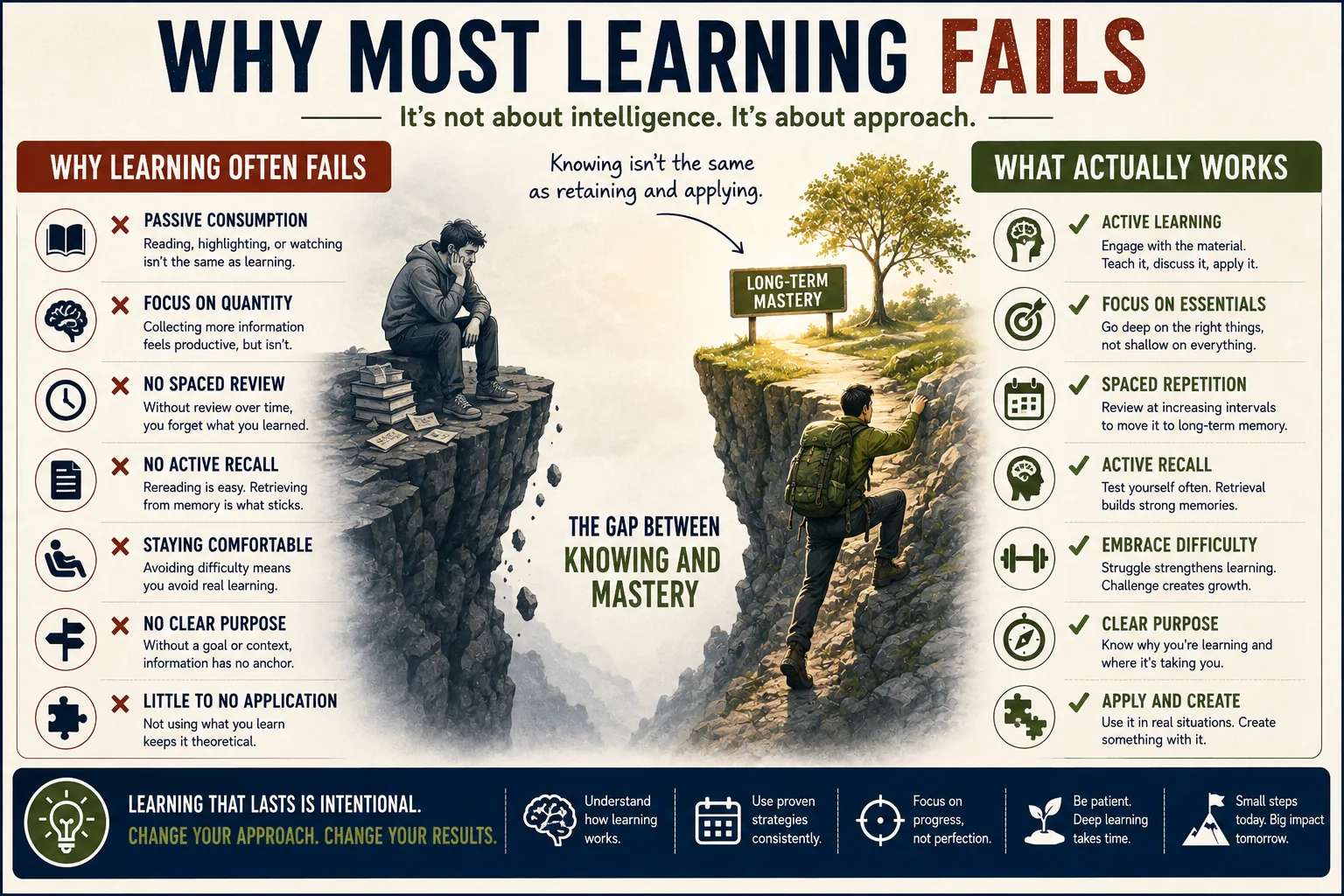
Why most learning fails is that passive reading, highlighting, review, and cramming create familiarity without the recall, understanding, or transfer needed later. Recognition feels fluent but does not prove knowledge. Learning improves when people actively process material, retrieve it from memory, explain it, and space practice over time. These methods feel harder than re-exposure precisely because they expose gaps and strengthen durable memory.
You sit through lectures, read textbooks, take notes, review before exams. You put in hours. You feel like you're learning. Then the test comes, or you need to apply the knowledge in real situations, and it's gone. You can't recall facts, can't solve problems, can't explain concepts you thought you understood.
This isn't a personal failure. It's the predictable outcome of how most people learn. The default methods-passive reading, highlighting, re-reviewing notes, cramming-feel productive but produce minimal lasting learning. They create illusions of mastery while knowledge quietly evaporates.
Understanding why learning fails reveals what actually works. The gap between ineffective and effective learning isn't about intelligence or effort-it's about method. Small changes in approach produce dramatically different outcomes.
The Core Problem: Passive Consumption vs. Active Processing
The Passive Learning Trap
What most learning looks like:
- Read textbook chapter
- Highlight important parts
- Review notes before exam
- Watch video lectures
- Listen to podcast
Common factor: Information flows in. You're a passive recipient.
Result: Weak encoding, poor retention, no understanding.
Why Passive Consumption Fails
| Passive Activity | What It Creates | What It Doesn't Create |
|---|---|---|
| Reading | Familiarity, recognition | Recall ability, understanding |
| Highlighting | Colorful pages | Memory, comprehension |
| Listening | Exposure to information | Integration, application |
| Watching | Entertainment, engagement | Lasting knowledge, skill |
Research (Chi et al., 1989): Students who passively read perform dramatically worse than students who actively self-explain while reading.[1]
The illusion: Passive consumption feels like learning. Information enters your brain. Surely that counts?
The reality: Without active processing, information doesn't consolidate into long-term memory. You're creating the sensation of learning without the substance.
"The mind is not a vessel to be filled but a fire to be kindled." - Plutarch, Moralia
Failure Mode 1: The Illusion of Fluency
What Fluency Feels Like
After repeated exposure to material:
- "I've seen this before"
- Fast, easy recognition
- Comfortable, familiar feeling
- Processing feels smooth
Student conclusion: "I know this material."
Actual state: You can recognize it, but you can't recall it.
The Recognition vs. Recall Gap
Recognition test (easy):
- Multiple choice
- True/false
- "Which of these is correct?"
Recall test (hard):
- Short answer
- Essay
- "Explain this concept"
- "Solve this problem"
Performance gap:
| After Passive Review | Recognition Performance | Recall Performance |
|---|---|---|
| Typical student | 70-80% | 20-40% |
The trap: Recognition creates confidence, but recall is what you need in real applications.
Example:
- You recognize the formula when you see it (recognition)
- You can't remember the formula during an exam (recall failure)
- You can't apply the formula to solve a problem (transfer failure)
Kornell & Bjork's Research (2008)
Experiment:
- Students studied material either massed (repeated immediately) or spaced (distributed over time)
- Massed practice felt easier, more effective
- Students predicted better performance from massed practice
Actual results:
- Spaced practice produced dramatically better retention
- Students were wrong about what worked
As Robert Bjork observed after decades of research on human memory and learning, "The relation between learning and performance is not the same-conditions that enhance performance during practice often fail to support long-term retention and transfer." This mismatch between what feels effective and what actually works is the central trap of the fluency illusion.
Lesson: Feelings of fluency and ease don't predict learning. In fact, they often inversely correlate-easier feels better but produces worse learning.
Failure Mode 2: No Retrieval Practice
The Critical Missing Ingredient
What most students do:
- Input, input, input (read, review, re-review)
- Minimal retrieval (testing yourself)
What cognitive science shows:
- Retrieval is more powerful than re-exposure
- Testing yourself strengthens memory more than reviewing again[3]
The Testing Effect (Roediger & Karpicke, 2006)
Experiment:
| Condition | Activity | Retention After 1 Week |
|---|---|---|
| SSSS | Study 4 times | 40% |
| STTT | Study once, test 3 times | 61% |
Same total time. Dramatically different retention.
Mechanism:
- Retrieval strengthens memory traces
- Exposes gaps in knowledge
- Creates multiple retrieval pathways
- Requires effortful processing
But most students avoid testing themselves:
- Feels harder
- Exposes ignorance (uncomfortable)
- Seems less "productive" than reading more
Result: Missing the single most effective learning technique.
"Retrieval practice-recalling facts or concepts from memory-is a more effective learning strategy than reviewing material." - Mark McDaniel, co-author of Make It Stick: The Science of Successful Learning (2014)
Failure Mode 3: Massed Practice (Cramming)
Why Students Cram
| Reason | Reality Check |
|---|---|
| "I work better under pressure" | No-you're more motivated, but performance is worse |
| "I don't have time" | Poor planning created time pressure |
| "It worked in high school" | High school tests were easier; also, did it really work? |
| "I need to see everything before exam" | False-distributed practice with testing works better |
Why Cramming Fails
Short-term memory does not equal long-term learning
| Cramming | Spaced Practice |
|---|---|
| 8 hours night before exam | 1 hour per week for 8 weeks |
| Good immediate recall (test tomorrow) | Weaker immediate, stronger long-term |
| 20% retention after 1 week | 80% retention after 1 week |
| No understanding, only recognition | Understanding develops over time |
| Exhaustion, stress | Manageable, sustainable |
Research (Cepeda et al., 2006): Meta-analysis of 254 studies confirms spacing effect-distributed practice consistently outperforms massed practice, often by 100-200%.[4]
The Spacing Effect
Why spacing works:
- Allows modest forgetting
- Retrieval becomes effortful (more beneficial)
- Time for consolidation
- Multiple encoding contexts
Why massing fails:
- No retrieval effort (information still active)
- No consolidation time
- Interference from rapid repetition
- Only one encoding context
Implication: Same total hours, distributed over time = dramatically better learning.
Failure Mode 4: Lack of Elaboration
Shallow Processing
What most students do:
- Read definitions
- Memorize facts
- Copy notes
Result: Surface-level encoding, weak memory.
Depth of Processing (Craik & Lockhart, 1972)
| Processing Level | Activity | Example | Retention |
|---|---|---|---|
| Shallow | Structural features | "Word is capitalized" | Very low |
| Moderate | Phonetic features | "Word rhymes with 'bat'" | Low |
| Deep | Semantic meaning | "Word fits sentence meaning how?" | High |
Key finding: Memory depends on depth of processing, not repetition.[5]
"If students don't learn it the first time, why would we think they will learn it the second time if we do it the same way?" - David Ausubel, Educational Psychology: A Cognitive View (1968)
What Elaboration Looks Like
Instead of passive reading, active processing:
| Passive | Active (Elaboration) |
|---|---|
| Read definition | Explain in your own words |
| Copy notes | Generate examples |
| Memorize fact | Ask "Why is this true?" |
| See concept | Connect to existing knowledge |
| Accept information | Question and probe |
Chi et al. (1989) self-explanation research:
- Students who self-explained while learning performed 30-50% better
- Self-explanation forces deep processing
- Exposes gaps immediately
Failure Mode 5: No Application
Knowledge Without Use
Learning in isolation:
- Read theory
- Memorize concepts
- Never apply
Problem: Knowledge that isn't used isn't really knowledge.
Transfer Failure
Research finding: Practicing specific examples improves performance on those examples but doesn't guarantee transfer to new situations.
| What You Practice | What You Can Do |
|---|---|
| Solve Type A math problems | Solve Type A problems |
| Memorize history facts | Recall those facts |
| Read programming examples | Recognize those examples |
What's missing: Ability to apply to novel situations.
Why Application Matters
Application forces:
- Understanding (can't fake it)
- Integration with existing knowledge
- Flexible retrieval
- Problem-solving in context
Without application:
- Information remains inert
- Can't use it when needed
- "Knowing" without "doing"
Ericsson's expertise research: Expertise requires extensive practice applying knowledge, not just acquiring it.[13]
Failure Mode 6: No Feedback
Learning in a Vacuum
Typical approach:
- Study on your own
- No checks on understanding
- Discover gaps only during exam
Problem: Can't correct what you don't know is wrong.
Why Feedback is Critical
| Without Feedback | With Feedback |
|---|---|
| Can hold incorrect beliefs | Errors corrected |
| Don't know what you don't know | Gaps exposed |
| False confidence | Calibrated confidence |
| No course correction | Adjust understanding |
Types of feedback:
| Feedback Type | Source | Value |
|---|---|---|
| Outcome | Did answer work? | Tells you what's wrong |
| Process | Expert review of reasoning | Tells you why it's wrong |
| Self-generated | Test yourself, check answer | Immediate, frequent |
| Peer | Study groups, peer review | Exposes blind spots |
As John Hattie wrote after synthesizing over 800 meta-analyses of education research, "The biggest effects on student learning occur when teachers become learners of their own teaching, and when students become their own teachers." Feedback sits at the center of that loop-without it, neither teachers nor students can correct course.
Research (Hattie, 2009):Feedback is one of the most powerful influences on learning (effect size: 0.70+).
Failure Mode 7: Overconfidence and Metacognitive Errors
Poor Judgment of Own Learning
Dunning-Kruger effect:
- Incompetent people overestimate competence
- Don't know what they don't know
Applied to learning:
- Students think they know material
- Actual performance reveals they don't
- Misalignment between confidence and competence
Metacognitive Failures
Common misjudgments:
| Student Belief | Reality |
|---|---|
| "I've read it 3 times, I know it" | Fluency does not equal learning |
| "It makes sense when I read it" | Understanding during reading does not equal recall later |
| "I can recognize correct answer" | Recognition does not equal recall |
| "I'll remember when I need to" | No, you won't |
Research (Kornell & Bjork, 2009): Students are poor judges of their own learning, often predicting the opposite of actual outcomes.[11]
"Students tend to be bad at judging how well they've learned something.
After rereading, everything seems familiar and fluent, but that feeling of familiarity is a very weak cue for whether you're actually going to remember it later." - John Dunlosky, Improving Students' Learning With Effective Learning Techniques (2013)[9]
Calibration Through Testing
Solution: Test yourself to calibrate.
| Before Testing | After Testing |
|---|---|
| Overconfident | Realistic |
| Don't know gaps | Gaps exposed |
| Illusion of mastery | Accurate assessment |
Self-testing provides metacognitive feedback: "I thought I knew this, but I can't recall it-need to study more."
Failure Mode 8: Single Context/Single Modality
The Context Problem
Learning in one context:
- Same room
- Same time
- Same format
Problem: Memory becomes tied to context. Retrieval outside that context is harder.
Encoding Specificity
Research (Godden & Baddeley, 1975):
- Divers learned words either underwater or on land
- Tested in same or different environment
- Performance better when learning and testing contexts matched[12]
Implication: Learning in only one context limits retrieval flexibility.
Solution: Varied Practice
Vary:
- Study locations
- Times of day
- Problem formats
- Application contexts
Effect: Decontextualizes knowledge, makes it more flexibly accessible.
Failure Mode 9: No Interleaving
Blocked Practice
Typical study approach:
- Study all Chapter 1, then all Chapter 2, then all Chapter 3
- Practice all Type A problems, then all Type B, then all Type C
Feels: Organized, logical, efficient
Result: Weaker learning, poor discrimination between types
Why Blocking Fails
Problem:
- Context tells you which approach to use
- Real-world doesn't provide this cue
- Don't practice discriminating between strategies
Example:
- Practice 20 quadratic equations in a row → know to use quadratic formula
- Real test mixes quadratic, linear, exponential → can't identify which type
Interleaving Solution
Interleaving: Mix different types during practice
| Blocked | Interleaved |
|---|---|
| A A A A B B B B C C C C | A B C A C B A B C |
| Easy during practice | Harder during practice |
| Poor test performance | Better test performance |
Research (Rohrer & Taylor, 2007): Interleaving improves discrimination and transfer.[7]
Why it works:
- Forces you to identify problem type
- Prevents autopilot
- Builds flexible knowledge
What Actually Works: The Correctives
Replace Passive with Active
| Stop Doing (Passive) | Start Doing (Active) |
|---|---|
| Rereading | Testing yourself |
| Highlighting | Self-explanation |
| Reviewing notes | Retrieval practice without notes |
| Passive listening | Teaching others |
Implement Retrieval Practice
How:
- Close book, write what you remember
- Flashcards (but test before flipping)
- Practice problems without looking at solutions
- Explain to someone else
Frequency: After initial learning, test yourself multiple times over increasing intervals
Space Your Practice
Replace:
- 8 hours in one night
With:
- 1 hour per week for 8 weeks
Schedule:
- Day 1, Day 3, Day 7, Day 14, Day 30
- Each review includes retrieval practice
Elaborate and Connect
Ask:
- Why is this true?
- How does this connect to what I already know?
- What's an example?
- What would happen if X changed?
Effect: Deep processing, multiple retrieval cues, integrated knowledge
Apply Knowledge
Don't just read:
- Solve problems
- Create projects
- Teach others
- Use in real situations
Application forces understanding and reveals gaps
Seek Feedback
Sources:
- Test yourself (immediate feedback)
- Check answers/solutions
- Ask experts
- Study groups (peer feedback)
Result: Correct errors before they consolidate
Interleave Topics
Mix:
- Different chapters
- Different problem types
- Different subjects
Benefit: Forces discrimination, builds flexible knowledge
Vary Contexts
Study:
- Different locations
- Different times
- Different formats
Result: Decontextualized, flexibly accessible knowledge
The Effort Paradox Revisited
Easy Feels Good, Hard Works Better
Counterintuitive findings:
| Feels Effective | Actually Effective |
|---|---|
| Fluent, easy processing | Effortful, challenging processing |
| Massed practice | Spaced practice |
| Blocked practice | Interleaved practice |
| Rereading | Testing |
| Familiarity | Retrieval challenge |
Bjork's "desirable difficulties": Conditions that slow initial learning but enhance long-term retention and transfer.[6]
Why Difficulty Helps
Mechanism:
| Type of Difficulty | How It Helps |
|---|---|
| Retrieval effort | Strengthens memory more than easy retrieval |
| Spacing (modest forgetting) | Forces effortful reconstruction |
| Interleaving | Prevents mindless repetition, forces discrimination |
| Generation | Active production creates stronger encoding |
Key insight: If learning feels too easy, you're probably not learning much.[14] This is why, as Bjork has noted, "desirable difficulties" are the engine of durable learning-they feel unpleasant but produce results that passive review cannot.
The Motivation Question
Can Motivation Compensate for Poor Methods?
Short answer: No.
Reality:
- Motivation increases effort
- But effort applied to ineffective methods still produces poor results
- Motivated students using passive methods often fail
- Less motivated students using effective methods often succeed
Formula:
- Ineffective method + high motivation = wasted effort
- Effective method + moderate motivation = strong results
Both Necessary
Optimal:
- Effective, evidence-based methods
- Sufficient motivation to apply them
Motivation matters: But only if channeled through effective techniques.
Systemic Failures: Why Schools Perpetuate Ineffective Learning
Institutional Problems
| Problem | Effect |
|---|---|
| Lecture-heavy instruction | Passive consumption, no retrieval practice |
| Cramming incentivized | Tests scheduled to reward massed practice |
| Coverage over mastery | Race through material, no time for spaced practice |
| Recognition-based tests | Multiple choice rewards recognition, not deep understanding |
| No metacognitive training | Students never learn how to learn |
Result: Students use ineffective methods because that's what school implicitly teaches.
See also: Learning Myths That Refuse to Die for a breakdown of persistent misconceptions that schools reinforce.
Individual Responsibility
Even in broken system, individuals can:
- Use retrieval practice (self-testing)
- Space review sessions
- Elaborate and self-explain
- Apply knowledge
- Seek feedback
Agency matters: You control your learning methods, even if school doesn't teach them.
The Good News: Small Changes, Big Results
High-Leverage Interventions
Simple shifts with massive impact:
| Shift | Impact |
|---|---|
| Read once carefully, then test yourself 3 times | 50-100% improvement vs. reading 4 times |
| Space reviews over weeks | 100-200% improvement vs. cramming |
| Interleave topics | 40-70% improvement in discrimination/transfer |
| Self-explain while learning | 30-50% improvement vs. passive reading |
None of these require more time. Just different method.
The Compound Effect
Using multiple effective strategies together:
- Retrieval practice + spacing + elaboration + application
- Multiplicative, not additive
Example:
- Student using passive methods: 20% long-term retention
- Student using retrieval + spacing + elaboration: 70-80% retention
4x improvement from method alone.
The PISA Pattern: Why Students Who Study More Sometimes Know Less
Research using Programme for International Student Assessment data has produced a result that confused educational researchers: across countries, students who reported spending more hours on individual study and homework sometimes performed no better, or worse, than students who reported studying less.
Economists Daniela Kuehn and Leire Landeras, analyzing PISA data in their study "Study Time and Scholarly Achievement in PISA," found that individual study time, homework and private lessons in particular, related negatively to achievement across countries, even though total learning time including classroom instruction did not show the same clean negative relationship.
The resolution lies in what counts as "studying." John Hattie's synthesis of hundreds of meta-analyses, published in Visible Learning (2009), ranked common educational interventions by effect size.[10] Homework overall showed an effect size of about 0.29, below the average impact of all interventions studied.
But homework quality varies enormously, and Hattie's synthesis treats retrieval practice and practice testing as a distinct category of influence in its own right, with a considerably larger effect size, commonly cited around 0.5 to 0.7, well above the homework average.
The PISA pattern likely reflects this quality divide. Students who study for long hours but spend that time reading and re-reading material are engaging in activities that create a feeling of engagement while producing little durable learning.[15] Students who study more efficiently are more likely engaging in problem-solving, working through practice questions, and receiving feedback. The difference is not hours: it is method.
Jeffrey Karpicke and Janell Blunt at Purdue University demonstrated this directly in a widely cited 2011 study published in Science.[8] Students were assigned to different study conditions, including repeated reading, elaborative concept mapping, and retrieval practice (recalling everything they could remember, then restudying, then recalling again).
On a test given about a week later, the retrieval practice group scored around 67% correct, compared to roughly 45% for the concept mapping group, with the repeated-reading condition scoring lower still.
The repeated-reading students, in this and other related studies, typically rate their own learning as higher, the illusion of fluency intact, while retaining dramatically less.
The Failure of Passive Learning in Professional Settings
The failure modes documented in cognitive science laboratories appear with equal force in professional training environments, where the stakes of learning failure extend beyond academic grades to organizational performance and safety.
Donald Kirkpatrick's four-level model for evaluating training effectiveness, developed in the 1950s and still widely used, measures reaction (did trainees like it?), learning (did they gain knowledge?), behavior (did they change on the job?), and results (did performance improve?).
Research on this model has repeatedly found that trainee satisfaction is a poor proxy for actual learning. A well-known meta-analysis by Alliger and colleagues, examining dozens of training studies, found the correlation between trainee reaction and measured learning to be close to zero, in the range of roughly 0.08 to 0.10; later meta-analytic work by researchers including Traci Sitzmann and colleagues has reported similarly weak reaction-learning correlations.
Trainees who rate their training highly do not reliably learn more than those who rate it poorly. Yet most organizations continue to evaluate training effectiveness primarily through satisfaction surveys because they are easy to administer and produce uniformly positive results. Organizations are measuring the wrong thing: comfort rather than learning.
The rapid decay of compliance and technical training has been studied extensively in regulated industries where regulatory requirements mandate training but do not specify pedagogical method.
Studies of knowledge retention after one-time annual training sessions, across fields from healthcare to safety-critical industries, consistently find sharp declines within months of training, often falling close to chance levels within a year, while comparable content delivered through spaced retrieval practice distributed across the year shows meaningfully better retention at the same follow-up points.
The training calendar gets satisfied even when the training itself has functionally failed.
Janet Metcalfe at Columbia University, working with collaborators including Nate Kornell and Lisa Son, has studied why learners preferentially choose to restudy material they already know rather than material they have not yet mastered, a phenomenon sometimes called the "labor-in-vain effect": studying what you already know while avoiding what you need to learn.
Metcalfe's research on self-regulated study time and the "region of proximal learning" has found that learners left to their own devices often allocate study time close to randomly between mastered and unmastered material, and that explicit guidance to focus on unmastered items measurably improves outcomes, a fundamental feature of self-regulated learning that requires deliberate structural correction.
Structural Failures: How Institutions Perpetuate Ineffective Learning
The individual failure modes documented by cognitive science are enabled and amplified by institutional structures that systematically reward ineffective learning methods.
Measurement and assessment researchers have long pointed out a fundamental misalignment in much large-scale educational assessment: many high-stakes tests are better suited to measuring recognition and surface recall, the skills that passive learning and cramming develop, than transfer and application, the skills that deliberate practice and spaced retrieval develop.
When assessment drives instruction, as it inevitably does in high-stakes environments, optimizing for measurable assessment performance can mean optimizing for the wrong cognitive skills. Schools that successfully raise scores on recognition-based standardized tests are not necessarily developing the transferable cognitive capabilities that predict job performance or lifelong learning.
Surveys of corporate learning and development professionals have repeatedly found that lecture-style delivery remains the dominant method for skill training in many organizations, despite thin evidence for its effectiveness at building transferable skills. When asked why, learning professionals commonly cite familiarity, scalability to large groups, and the fact that lectures look like training in a way that distributed practice does not.
The gap between known best practice and actual practice in organizational learning mirrors the gap between known best practice and actual practice in individual study: the comfortable method persists over the effective method.
John Hattie at the University of Melbourne, in the same Visible Learning synthesis discussed above, found that the average effect size across all educational interventions is around 0.40, a widely used benchmark above which an intervention is considered to be adding real value beyond ordinary maturation and experience.
Passive instructional methods, lectures, textbooks without retrieval practice, educational films, tend to cluster below this line, while active methods, retrieval practice, direct instruction with immediate feedback, and mastery learning, cluster well above it.
Educators broadly continue to rely on below-average methods and underuse the above-average ones, not typically because they lack information but because the more effective methods are more demanding to implement and produce less immediately visible evidence of learning in progress.
The Neuroscience of Why Retrieval Practice Works
The testing effect is not merely a behavioral phenomenon. It has a neurobiological explanation that clarifies why retrieval practice produces more durable encoding than re-exposure.
When a memory is formed, the neurons involved in that experience form synaptic connections. When the memory is subsequently retrieved, those same synaptic connections are reactivated and then undergo a process called reconsolidation: the memory trace is temporarily destabilized and then restabilized in a strengthened form.
This reconsolidation process is the mechanism that makes retrieval more powerful than re-exposure. Re-exposure activates the trace but does not destabilize and reconsolidate it in the same way effortful retrieval does.
Jeffrey Karpicke at Purdue University has documented this across numerous experiments, including the 2011 Science study described above comparing repeated reading, concept mapping, and retrieval practice.
The specific form of retrieval matters less than the act of retrieval itself. Free recall (writing down everything you remember), cued recall (flashcards), practice tests, and the Feynman technique (explaining a topic to an imaginary novice until you cannot continue, then going back to fill gaps) all produce large effects compared to passive re-study.
The common mechanism is the effortful reconstruction of memory traces, which, counter to intuition, strengthens those traces more than smooth re-exposure does.
This explains one of the most persistent paradoxes in education: why students who feel confident after studying often perform poorly on tests. The re-reading that produces fluency does not exercise the retrieval pathways that tests require.
Students have trained recognition (which re-reading develops) rather than recall (which tests demand). The subjective experience of learning and the objective fact of learning have come apart.
Conclusion: Predictable Failure, Fixable Problem
Why most learning fails:
- Passive consumption (not active retrieval)
- Illusions of fluency (mistaking recognition for knowledge)
- Massed practice (not spaced)
- Shallow processing (not deep elaboration)
- No application (knowledge remains inert)
- No feedback (errors uncorrected)
- Overconfidence (poor metacognition)
- Blocked practice (not interleaved)
None of these are mysterious or unfixable.
The fix:
- Test yourself frequently
- Space practice over time
- Explain concepts in your own words
- Apply knowledge to problems
- Seek feedback
- Interleave topics
- Embrace productive difficulty
Same effort. Dramatically better results.
Learning doesn't have to fail. It fails when we use methods that feel good instead of methods that work. Choose evidence over intuition. The research is clear.
Sources & Further Reading
Chi, M. T. H., Bassok, M., Lewis, M. W., Reimann, P., & Glaser, R. (1989). "Self-Explanations: How Students Study and Use Examples in Learning to Solve Problems." Cognitive Science, 13(2), 145-182.
Kornell, N., & Bjork, R. A. (2008). "Learning Concepts and Categories: Is Spacing the 'Enemy of Induction'?" Psychological Science, 19(6), 585-592.
Roediger, H. L., & Karpicke, J. D. (2006). "Test-Enhanced Learning: Taking Memory Tests Improves Long-Term Retention." Psychological Science, 17(3), 249-255.
Cepeda, N. J., Pashler, H., Vul, E., Wixted, J. T., & Rohrer, D. (2006). "Distributed Practice in Verbal Recall Tasks: A Review and Quantitative Synthesis." Psychological Bulletin, 132(3), 354-380.
Craik, F. I. M., & Lockhart, R. S. (1972). "Levels of Processing: A Framework for Memory Research." Journal of Verbal Learning and Verbal Behavior, 11(6), 671-684.
Bjork, R. A. (1994). "Memory and Metamemory Considerations in the Training of Human Beings." In J. Metcalfe & A. Shimamura (Eds.), Metacognition: Knowing About Knowing (pp. 185-205). MIT Press.
Rohrer, D., & Taylor, K. (2007). "The Shuffling of Mathematics Problems Improves Learning." Instructional Science, 35(6), 481-498.
Karpicke, J. D., & Roediger, H. L. (2008). "The Critical Importance of Retrieval for Learning." Science, 319(5865), 966-968.
Dunlosky, J., Rawson, K. A., Marsh, E. J., Nathan, M. J., & Willingham, D. T. (2013). "Improving Students' Learning With Effective Learning Techniques." Psychological Science in the Public Interest, 14(1), 4-58.
Hattie, J. (2009). "Visible Learning: A Synthesis of Over 800 Meta-Analyses Relating to Achievement." Routledge.
Kornell, N., & Bjork, R. A. (2009). "A Stability Bias in Human Memory: Overestimating Remembering and Underestimating Learning." Journal of Experimental Psychology: General, 138(4), 449-468.
Godden, D. R., & Baddeley, A. D. (1975). "Context-Dependent Memory in Two Natural Environments: On Land and Underwater." British Journal of Psychology, 66(3), 325-331.
Ericsson, K. A., Krampe, R. T., & Tesch-Rmer, C. (1993). "The Role of Deliberate Practice in the Acquisition of Expert Performance." Psychological Review, 100(3), 363-406.
Brown, P. C., Roediger, H. L., & McDaniel, M. A. (2014). Make It Stick: The Science of Successful Learning. Harvard University Press.
Willingham, D. T. (2009). Why Don't Students Like School? A Cognitive Scientist Answers Questions About How the Mind Works and What It Means for the Classroom. Jossey-Bass.
About This Series: This article is part of a larger exploration of learning, thinking, and expertise. For related concepts, see Why Repetition Alone Does Not Create Knowledge, Spaced Repetition Explained, Learning Myths That Refuse to Die, How Memory Retention Works, and How to Build Real Expertise.