
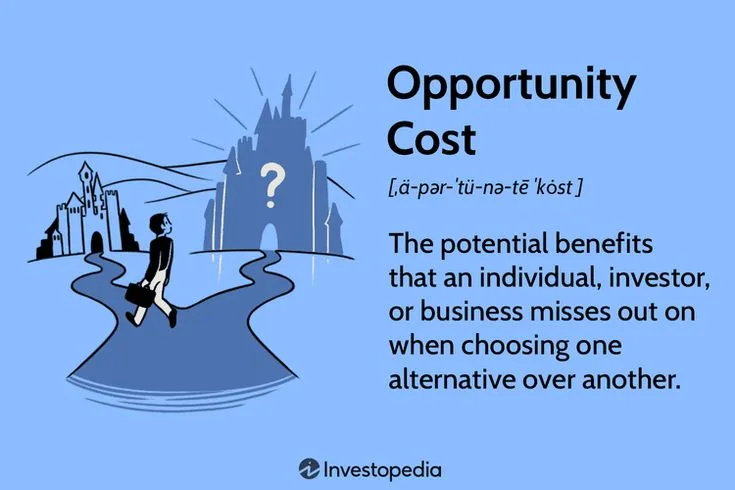
What is opportunity cost? It is the value of the best alternative lost when limited time, money, attention, or capital is committed elsewhere. A decision's full economic cost includes both direct payments and implicit foregone value. Because alternatives are less visible than a price tag, people often neglect them, but naming the tradeoff can materially change personal, business, and public choices.
Every decision you make has a hidden price tag. When you choose to spend a Saturday afternoon watching television, you are not just choosing television: you are also choosing not to exercise, not to call a friend, not to work on a side project. The value of whatever you gave up is the opportunity cost of your choice.
Economists often call opportunity cost the single most important concept in all of economics. Understanding it changes how you evaluate every decision, from what career to pursue to whether to accept a job offer to how a country should allocate its resources.
And yet research in behavioral economics consistently shows that people systematically ignore opportunity cost when making real decisions, not occasionally, but as a predictable cognitive default.
What Is Opportunity Cost? The Definition
Opportunity cost is the value of the next best alternative you forgo when you make a choice. Because resources, time, money, attention, capital, are limited, every use of them rules out other uses. The cost of any choice includes not just what you pay or expend, but what you give up, and that tradeoff is what economists mean by opportunity cost.
The formal definition from economics is:
Opportunity cost is the value of the next-best alternative foregone as a result of making a decision.
Several elements of this definition deserve attention:
- Next best, not all alternatives. Opportunity cost refers to the single best option you did not choose, not every possible option.
- Value, not just money. Opportunity cost applies to time, attention, social capital, and any other scarce resource, not only financial assets.
- Foregone, meaning it is the cost whether you recognize it or not. The cost exists even when nobody charges you for it.
The concept was formalized in the 19th century by the Austrian school of economics, particularly through the work of Friedrich von Wieser, who coined the term "opportunity cost" (Alternativkosten in German) in his 1914 work Theorie der gesellschaftlichen Wirtschaft.
But the underlying insight is older: Adam Smith's discussion of the cost of labor in The Wealth of Nations (1776) implicitly recognizes that the value of any resource use depends on what it could produce elsewhere.
The Full Cost of Any Decision
Economists distinguish between two types of costs that together constitute opportunity cost:
Explicit costs are direct monetary payments, such as tuition, rent, the purchase price of an asset, wages paid to employees. These appear in accounting records.
Implicit costs are the foregone values of alternatives not chosen: the salary you could have earned if you had not started a business, the interest you forgo by keeping money in a low-yield account, the time value of unpaid owner labor. These do not appear in accounting records but are just as real economically.
The economic cost of any choice is the sum of explicit and implicit costs. Standard accounting records only explicit costs, which is why accounting profit and economic profit diverge, and why businesses that appear profitable by accounting standards may actually be earning below their cost of capital.
Why Opportunity Cost Is Usually Invisible
Psychologists and behavioral economists have documented a powerful bias called opportunity cost neglect: the tendency to focus on the explicit costs of a decision while ignoring the implicit value of what is being given up.
In a landmark experiment, economist Shane Frederick and colleagues (2009, published in the Journal of Consumer Research) asked participants whether they would buy a new video game console for $25. A second group was told that buying it meant they could not spend the money on something else.
The second group was significantly less likely to buy. Simply making the trade-off explicit changed behavior.
In a follow-up study, Frederick's team found that fewer than 25% of participants spontaneously mentioned opportunity costs when evaluating a purchase decision, even highly educated participants with economics training.
When the opportunity cost was explicitly stated in the problem description, it dramatically changed decisions. When it was not stated, it was almost universally ignored.
The invisibility problem is structural. When you hand over money, the payment is concrete and immediate. When you forgo an investment return or a free afternoon, there is nothing to see. The road not taken leaves no footprint.
This has real consequences. People evaluate medical treatments by their direct risks and benefits without adequately weighing what else the healthcare dollars could accomplish.
Businesses evaluate new projects on their own metrics without rigorously accounting for what other projects they are not funding. Voters support spending programs without weighing opportunity costs to other programs or taxpayers.
Everyday Examples of Opportunity Cost
Time and Career
Consider the decision to pursue an advanced degree. The explicit costs are tuition, fees, and living expenses. But the opportunity cost is the income you could have earned working full-time for those two or three years, plus the career experience and professional relationships you would have built.
For someone who would have earned $65,000 per year, a two-year master's degree has an opportunity cost of approximately $130,000 in foregone wages, on top of whatever tuition costs. This does not mean the degree is wrong: it means the full cost of the investment is much larger than the tuition bill suggests.
A 2021 study by economists at the Federal Reserve Bank of New York found that the wage premium for college graduates over high school graduates in the United States had stabilized at approximately 80%, but that this premium varied dramatically by field of study.
Engineering and computer science graduates captured large premiums; arts and humanities graduates, much smaller ones. The opportunity cost calculation for any specific degree program is therefore specific to the career path it enables, not just the generic college premium.
Money and Investment
Holding cash in a checking account that pays 0.01% interest while a money market account offers 4.5% is not "free." The opportunity cost of that cash is the difference in return. On $50,000, that difference is roughly $2,245 per year, real money that disappears silently.
Similarly, homeowners who own their homes outright often say they live "rent-free." They do not. They have the equivalent of a large investment tied up in a house. The opportunity cost of that equity is the return they could have earned by investing it in equities or bonds.
A $500,000 paid-off home represents an opportunity cost of perhaps $25,000-$35,000 per year in foregone investment returns.
This is not an argument against homeownership: a house provides housing services, psychological benefits, and potential appreciation. It is an argument for computing the full cost rather than the comfortable illusion that owning outright is free.
Business and Capital Allocation
Corporations face opportunity cost in every capital allocation decision. A company with $200 million to invest must choose among dozens of possible projects. Choosing Project A is simultaneously choosing not to fund Projects B, C, and D.
The hurdle rate (the minimum acceptable return on a project) exists precisely to account for opportunity cost.
If a project cannot beat the return achievable through other uses of capital, the opportunity cost of funding it exceeds its value.
Warren Buffett has written about this explicitly in Berkshire Hathaway's annual letters. He maintains what he calls a mental "hurdle rate" based on the opportunity cost of deploying capital, and he has described how the existence of attractive investment opportunities changes the hurdle rate for any specific decision.
When excellent alternatives exist, the opportunity cost of a mediocre investment is high. When alternatives are scarce, the same investment may be the right choice.
Government Policy
Public spending always involves opportunity cost. Building a new highway means that those tax dollars are not available for education, healthcare, or tax reduction.
Infrastructure debates often ignore this because "creating jobs" through construction is visible and celebrated, while the jobs not created by the foregone alternatives are invisible.
The 2009 American Recovery and Reinvestment Act (ARRA) allocated approximately $831 billion in stimulus spending. Economists debated the multiplier effect of different spending categories: that is, which uses of the stimulus dollar produced the highest economic output per dollar.
The debate was fundamentally about opportunity cost: which allocation produced the most value from a scarce pool of fiscal capacity?
The Congressional Budget Office estimated that the Act increased GDP by 1.4 to 4.1 percentage points relative to what it otherwise would have been (CBO, 2012), but the range was wide precisely because the opportunity cost calculations involved genuine uncertainty.
Comparative Advantage: Opportunity Cost Applied to Trade
One of the most powerful applications of opportunity cost is the principle of comparative advantage, developed by economist David Ricardo in his 1817 work On the Principles of Political Economy and Taxation. It explains why trade creates mutual benefit and why specialization increases total production.
The core insight is that even if one person (or country) is absolutely better at producing everything, both parties still gain from trading if each specializes in what they produce at the lowest opportunity cost.
A Simple Example
| Producer | Cost to produce 1 shirt | Cost to produce 1 computer |
|---|---|---|
| Country A | 5 labor hours | 10 labor hours |
| Country B | 15 labor hours | 20 labor hours |
Country A is absolutely better at producing both goods. But look at comparative advantage:
- Country A's opportunity cost of 1 computer: 2 shirts (10/5)
- Country B's opportunity cost of 1 computer: 1.33 shirts (20/15)
Country B has the lower opportunity cost for computers. Country A has the lower opportunity cost for shirts. If A specializes in shirts and B specializes in computers, total production rises, and both can trade to get more of both goods than if each tried to produce everything.
This is why economists broadly support free trade despite the intuitive appeal of the zero-sum view that another country's exports cost domestic workers their jobs. When measured in opportunity costs rather than absolute outputs, voluntary trade creates value rather than simply redistributing it.
Ricardo's comparative advantage principle remains one of the most elegant and counterintuitive results in all of economics. Paul Samuelson, the Nobel-winning economist, was once challenged by a mathematician to name one proposition in social science that is both true and non-obvious.
Samuelson's response: comparative advantage. It is true. It is not obvious. And it follows directly from opportunity cost reasoning.
Why People Systematically Ignore Opportunity Cost
Several cognitive tendencies combine to produce opportunity cost neglect:
1. Concreteness bias. Direct payments are concrete and real; foregone alternatives are hypothetical and abstract.
The mind weights concrete things more heavily than abstract equivalents of the same value, a phenomenon documented extensively by Kahneman and Tversky in their research on cognitive heuristics (Tversky and Kahneman, 1974, Science).
2. Focusing illusion. When evaluating an option, attention narrows to the features of that option. The full landscape of alternatives fades from view.
Kahneman described this as "nothing in life is as important as you think it is, while you are thinking about it," a tendency that, applied to decision-making, systematically crowds out consideration of alternatives.
3. Loss aversion asymmetry. Kahneman and Tversky's research established that losses feel roughly twice as painful as equivalent gains. But opportunity costs are foregone gains, not losses, so they trigger less emotional response than direct costs of equal magnitude.
A $500 purchase feels more painful than missing a $500 investment gain, even though both leave you $500 worse off.
4. Effort justification. When significant effort has already been invested in a path, people evaluate it more favorably, not less: a dynamic that partly explains the sunk cost fallacy (confusing past costs with present opportunity costs).
5. Status quo bias. Continuing the current path feels safe because the opportunity cost of action is visible, while the opportunity cost of inaction is not. The cost of staying in a poorly suited career is not visible the same way that the cost of quitting and searching for something new is visible.
How to Actually Factor Opportunity Cost Into Your Decisions
To factor opportunity cost into a decision, name the realistic alternatives you would give up, assign each one a rough value in money, time, or benefit, then compare that value against the option you are leaning toward. Repeat this for both money and time, since time is the resource most often ignored, and revisit the comparison as circumstances change.
Step 1: Name the alternatives explicitly
Before deciding, list the most plausible things you would do with those resources otherwise. Not every option, just the next best two or three. Making alternatives explicit is the single most effective intervention for reducing opportunity cost neglect, as documented by Frederick et al.
(2009). Simply writing down the next best use of money before making a purchase has been shown to change spending behavior even when the written alternative is obvious.
Step 2: Assign value to the best alternative
What would the next best option produce? In money, time saved, career advancement, personal wellbeing? This does not need to be precise: a rough estimate outperforms zero.
Step 3: Compare total costs, not just explicit costs
The real cost of your chosen option is its explicit price plus the value of the next-best alternative. Only when both are included is the comparison meaningful. A job offer that pays $85,000 is not worth $85,000 to you: it is worth $85,000 minus the opportunity cost of the career path it forecloses.
Step 4: Apply the question to time, not just money
Time is the resource for which opportunity cost neglect is most damaging and hardest to see. Before committing to any significant time use, ask: what am I not doing if I do this?
The cost of a low-value three-hour meeting is not zero: it is three hours of the next-best use of your professional time. For knowledge workers, that opportunity cost is often substantial.
Step 5: Revisit regularly
Opportunity costs change as circumstances change. An investment that had no compelling alternative two years ago may now have excellent alternatives. Regular portfolio reviews, of time, career commitments, and financial allocation, apply opportunity cost thinking systematically.
A Practical Decision Framework
| Decision Type | Key Opportunity Cost Question |
|---|---|
| Major purchase | What would investing this money return over 10 years? |
| Career choice | What career capital am I not building by taking this path? |
| Time commitment | What high-value activity am I displacing? |
| Business investment | What is the return on the next-best project I could fund? |
| Holding an asset | What could this capital earn deployed elsewhere? |
Opportunity Cost in Professional Decision-Making
Hiring and Talent
Every hiring decision has an opportunity cost. Choosing Candidate A means not hiring Candidate B or C, and not spending that salary budget on other inputs. More subtly, an organization that hires heavily for one type of talent forgoes the cognitive diversity that comes with different profiles.
Research by McKinsey & Company (2020) found that companies in the top quartile for ethnic and cultural diversity were 36% more likely to achieve above-average profitability. The opportunity cost of homogeneous hiring is therefore not just aesthetic: it is a concrete reduction in organizational performance that can be measured.
Strategic Planning
When companies commit to a strategic direction, entering a new market, building a particular product, they are simultaneously foreclosing other directions. Opportunity cost of strategy is the value of the strategic options abandoned.
This is why optionality is genuinely valuable: organizations that preserve choices have lower opportunity costs from strategic commitment.
Clayton Christensen's research on disruptive innovation (The Innovator's Dilemma, 1997) identified opportunity cost as a key structural reason why established companies fail to respond to disruptive competitors.
Large companies have high opportunity costs for pursuing small, initially unprofitable markets: those resources are needed to serve profitable existing customers.
Start-ups with no existing revenue streams have low opportunity costs for pursuing the same markets. The asymmetry in opportunity costs drives the pattern of disruption.
Personal Finance
The personal finance implications of opportunity cost are enormous:
- Every dollar spent on a depreciating asset (a luxury car, unnecessary consumption) is a dollar that does not compound in an investment account
- Every year of delayed saving compounds the opportunity cost of starting late: due to compounding, a dollar invested at 25 is worth roughly twice as much at 65 as a dollar invested at 35
- High-interest debt carries an opportunity cost equal to the debt interest rate, which typically far exceeds investment returns
A 2014 study by Lusardi and Mitchell published in the Journal of Economic Literature found that households with greater financial literacy (which included better understanding of opportunity costs) accumulated significantly more wealth by retirement.
The researchers estimated that financial literacy explained approximately one-third of the variance in retirement wealth accumulation in their sample.
The Opportunity Cost of Credentials and Signaling
The economics of education involves a particularly rich set of opportunity cost calculations. Higher education can be valuable because it builds genuinely useful skills and knowledge (human capital theory, associated with Gary Becker's 1964 work).
But it can also be valuable primarily as a signal of pre-existing ability, conscientiousness, and conformity (signaling theory, associated with Michael Spence's 1973 Nobel-winning work).
If a significant portion of the return to a degree is signaling rather than skill-building, the opportunity cost calculation changes. A degree that costs four years and $200,000 in foregone wages produces the same signal value as a degree that costs two years and $100,000 in foregone wages, but the latter has half the opportunity cost.
This helps explain the persistent economic appeal of associate degrees, vocational credentials, and professional certifications in fields where signaling value is specifically attached to those credentials.
The rise of self-taught software engineering and coding bootcamps represents a direct response to the opportunity cost of traditional four-year computer science degrees.
For motivated individuals in a field where ability can be demonstrated directly through portfolio work and hiring tests, the opportunity cost of forgoing four years of income for a traditional degree is high relative to the incremental benefit.
Common Misconceptions About Opportunity Cost
Misconception: Opportunity cost only applies to money. Reality: Opportunity cost applies to any scarce resource: time, attention, social capital, political capital, energy.
Misconception: Opportunity cost means you chose wrong. Reality: High opportunity cost does not mean the choice was mistaken. A career that requires forgoing other careers might still be the right one. Opportunity cost is information for better decisions, not a verdict on past choices.
Misconception: Sunk costs are opportunity costs. Reality: Sunk costs are already spent and irretrievable. Opportunity costs are prospective: they refer to what could be done with resources going forward. Confusing the two (continuing to hold a bad investment to "avoid a loss") is a common and costly error.
The distinction was formalized by Arkes and Blumer (1985) in their classic paper "The Psychology of Sunk Cost" in the Organizational Behavior and Human Decision Processes, which documented that prior investment in a failing course of action led people to escalate their commitment rather than cut their losses.
Misconception: Opportunity cost is only relevant to big decisions. Reality: The cumulative opportunity cost of thousands of small decisions, such as where you spend your evenings, how you allocate your attention each day, may exceed the impact of most major decisions.
The hours lost to low-value habitual activities compound over years into a substantial fraction of a career.
The Deepest Application: Opportunity Cost of Attention
In an information economy, attention has become perhaps the most important resource subject to opportunity cost. Every hour spent on social media is an hour not spent reading, creating, exercising, or in conversation. Every meeting attended is a potential deep work session abandoned.
Cal Newport, in Deep Work (2016), argues that the opportunity cost of shallow, distracted work is not just the time spent: it is the compound effect of never developing the deep concentration skills that produce the most valuable professional output.
The opportunity cost is not one meeting; it is the career of high-value work that never gets done because the capacity for sustained focus was never built.
Research by Mark, Gonzalez, and Harris (2005, CHI Conference Proceedings) found that knowledge workers are interrupted approximately every three minutes during their workday, and that it takes an average of 23 minutes to fully return to a task after interruption.
The opportunity cost of interruption is therefore not the interruption itself but the 23 minutes of deep work that fail to occur after it.
Research on information consumption suggests the opportunity cost of passive media consumption is particularly high because the activities foregone, deliberate practice, meaningful relationships, generative thinking, are the ones most strongly associated with career achievement, skill development, and subjective wellbeing.
Angela Duckworth's research on grit (Grit: The Power of Passion and Perseverance, 2016) identified the consistent, deliberate investment of time in skill-building, at the direct expense of other time uses, as the primary differentiator between high and average performers in virtually every domain studied.
Applying opportunity cost to attention does not mean optimizing every minute. Rest and leisure have genuine value. It means being honest that the choice to spend three hours scrolling is not a cost-free default: it is a choice with a real price.
Conclusion
Opportunity cost is not an abstract economic concept. It is a lens that makes visible the true cost of every decision you make. By naming your alternatives, assigning value to them, and comparing total costs rather than just explicit prices, you make decisions with full information rather than partial accounting.
The research in behavioral economics is unambiguous: people who explicitly consider opportunity costs make better financial decisions, accumulate more wealth, and experience less decision regret than those who evaluate choices in isolation.
The habit of asking "and what am I giving up?" before every significant resource allocation is not a habit of pessimism: it is a habit of clarity.
The hardest application, and the most valuable, is to time. Time spent on one thing is time not spent on another, and unlike money, time cannot be earned back. Holding that reality consistently in mind is what separates genuinely strategic thinking from the comfortable illusion that choosing one path costs nothing at all.