
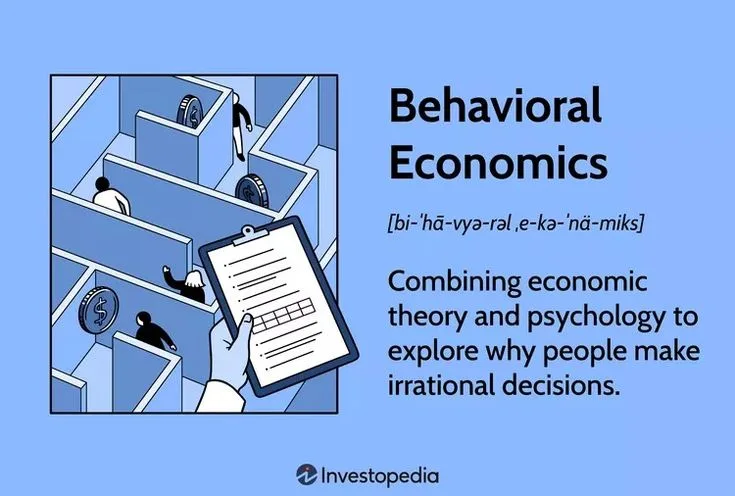
Behavioral economics studies systematic departures from the rational-choice model, showing how framing, loss aversion, defaults, anchoring, social norms, present bias, and mental accounting shape decisions. These patterns are predictable rather than random, so they inform policy and choice architecture without assuming people optimize every option. Prospect theory explains how gains and losses are judged relative to reference points and why equivalent descriptions can produce different choices.
In the 1970s, Daniel Kahneman and Amos Tversky ran a study where they asked physicians whether they would recommend a particular surgical procedure.
The procedure was described to one group of doctors as having a "90 percent survival rate." An identical procedure was described to a second group as having a "10 percent mortality rate." The two descriptions are mathematically identical. They are not psychologically identical.
When framed as survival, 84 percent of physicians recommended the surgery.
When framed as mortality, only 50 percent did. Same surgery, same statistical outcome, same professionally trained decision-makers - completely different decisions depending only on whether the number was attached to the word "survive" or the word "die."
This was not an anomaly they had stumbled upon by accident. It was a demonstration of something they had been systematically mapping since the late 1960s: that human decision-making is not the output of a rational calculator optimizing expected utility, but a much messier process governed by psychological mechanisms that produce systematic, predictable departures from rationality.
And more: that these departures were not random noise that washed out across large populations, but structured biases that pointed consistently in identifiable directions.
The research program that Kahneman and Tversky pursued together, and that Tversky's collaborator Richard Thaler extended into economics, became behavioral economics - the field that replaced homo economicus with a more accurate, more complicated, and ultimately more useful picture of how people actually make choices.
It earned multiple Nobel Prizes, changed how governments design policy, and overturned assumptions that had been foundational to economic theory for more than a century.
"The rational model of choice has dominated social science for the past thirty years... The major thrust of this research has been to demonstrate that human choices are not well described by the standard economic model." - Amos Tversky and Daniel Kahneman, Science (1981)
Core Behavioral Economics Concepts and Policy Applications
| Concept | Classic Demonstration | Real-World Policy Application | Effect Size |
|---|---|---|---|
| Loss aversion | Framing identical surgical procedure as 90% survival vs. 10% mortality changes recommendation rate by 34% | Pension opt-out framing; energy efficiency "loss" framing outperforms "savings" framing | ~2:1 loss-to-gain sensitivity ratio |
| Default / status quo bias | Changing 401k default from opt-in to opt-out raised enrollment from ~40% to 90%+ | UK pension auto-enrollment; organ donation opt-out registries | 30-50 percentage point participation difference |
| Present bias | Gym memberships paid in lump sum used less than if paid per visit | Commitment devices (Save More Tomorrow); front-loaded health warnings | Strong; varies by domain |
| Anchoring | First number offered in negotiation dominates final settlement | Suggested tip percentages; reference prices in retail | Adjustments insufficient by ~50% |
| Social norms | "Most guests reuse their towels" 26% more effective than environmental message | Tax compliance letters (HMRC); energy use comparisons (Opower) | 5-15% behavior change vs. standard messaging |
| Nudge / choice architecture | Placing fruit at eye level in cafeteria increases healthy choice by 18% | UK Behavioral Insights Team; US OIRA nudge work | Varies; often 10-30% for targeted behaviors |
| Mental accounting | House money effect; budget constraints by category | Labeled accounts (emergency fund vs. spending) | Significant; varies |
Key Definitions
Prospect theory: Kahneman and Tversky's (1979) model of decision-making under risk, which shows that people evaluate outcomes as gains or losses relative to a reference point, are loss averse, exhibit diminishing sensitivity, and distort probabilities.[1]
Loss aversion: The empirical finding that losses are psychologically more impactful than equivalent gains - the standard estimate is that losses hurt approximately twice as much as equivalent gains feel good.
Endowment effect: The tendency to value objects more once you own them than before you own them, driven by loss aversion: giving something up feels like a loss.
Framing effect: The finding that how a choice is presented - as a gain or loss, as a survival rate or mortality rate - affects preferences even when the underlying options are objectively identical.
Anchoring: The tendency to be disproportionately influenced by an initial piece of information, even when that information is arbitrary or irrelevant.
Status quo bias: The preference for the current state of affairs, driven by loss aversion: changes from the status quo feel like losses.
Present bias: The tendency to place disproportionate weight on immediate costs and benefits relative to future ones, producing time-inconsistent preferences.
Hyperbolic discounting: A formal model of present bias in which the discount rate declines as the time horizon grows - people discount the near future at a higher rate than the distant future.
Mental accounting: The implicit categorization of money into separate mental accounts that are treated as non-fungible, even though money is fully fungible.
Sunk cost fallacy: The tendency to continue an investment or project because of costs already incurred, rather than on the basis of expected future costs and benefits.
Nudge theory: The approach, developed by Thaler and Sunstein, of using choice architecture - the design of decision environments - to predictably influence choices without restricting options or changing financial incentives.
Libertarian paternalism: Thaler and Sunstein's description of nudge-based policy: paternalistic in guiding people toward better choices, libertarian in preserving the right to opt out.
Dual-process theory (System 1/System 2): The model, associated most prominently with Kahneman's "Thinking, Fast and Slow" (2011), distinguishing fast, automatic, associative thinking (System 1) from slow, deliberate, effortful thinking (System 2).
Homo economicus: The idealized rational actor of neoclassical economics, characterized by stable preferences, consistent choices, perfect information processing, and utility maximization.
Bounded rationality: Herbert Simon's (1955) concept that real decision-makers operate under constraints of cognitive capacity and time, and therefore "satisfice" (find a good-enough solution) rather than maximize.[10]
The Rational Actor Model and Its Limits
To understand behavioral economics, you first need to understand what it is arguing against.
Neoclassical economics built its analytical framework on a particular model of human choice.
The model is elegant, tractable, and extraordinarily powerful: it assumes that economic agents have consistent, stable preferences; that they gather and process all available information; that they update beliefs according to Bayes's theorem when new evidence arrives; and that they make choices that maximize their expected utility given their beliefs and preferences.
This model - the rational actor - is not meant to describe any particular person; it is a simplifying assumption about aggregate behavior that allows economists to derive precise, testable predictions.
For many purposes, the rational actor model works well. Financial markets, where large sums of money create strong incentives for rationality, approximately satisfy some of its predictions. Large aggregate data on consumer behavior often follows the model's predictions for average behavior.
In competitive markets with repeated transactions, firms that behave irrationally tend to go out of business, so the surviving firms look roughly rational.
But the model fails systematically in other domains, and the failures are not random. They are structured - meaning they point consistently in identifiable directions - and they are predictable based on the specific psychological mechanisms underlying them.
Herbert Simon was the first major economist to insist on this. His 1955 paper "A Behavioral Model of Rational Choice" (Quarterly Journal of Economics) introduced the concept of bounded rationality: the idea that real decision-makers have limited cognitive capacity, limited time, and limited information, and that they cope with these limitations by using simplified decision procedures - "satisficing" (finding a good-enough option) rather than maximizing.
Simon won the Nobel Prize in Economics in 1978 for this work. His insight was prescient but relatively low-impact: he pointed to the problem without providing the detailed psychological map of how real decisions actually went wrong.
That map was what Kahneman and Tversky provided.
Prospect Theory: The Central Breakthrough
Kahneman and Tversky's 1979 Econometrica paper, "Prospect Theory: An Analysis of Decision Under Risk" (doi: 10.2307/1914185), is one of the most-cited papers in economics and psychology, with over 100,000 citations.
It replaced expected utility theory - the dominant model of decision under risk since von Neumann and Morgenstern's 1947 formalization - as the descriptive account of how people actually choose.
The critique of expected utility theory was empirical. Expected utility theory made specific predictions about how rational agents should choose between gambles, and those predictions were falsified by experimental data that Kahneman and Tversky systematically collected.
The Allais paradox (1953) had already shown that people violated expected utility axioms under certain conditions; Kahneman and Tversky demonstrated that the violations were systematic and explainable by a coherent alternative model.
Prospect theory rests on four key departures from expected utility:
Reference dependence: People evaluate outcomes not in terms of their absolute level of wealth but as gains or losses relative to a reference point, typically the status quo. Losing $100 does not simply reduce your utility by whatever utility $100 provides; it registers as a loss from where you are now, which is psychologically different.
Loss aversion: The same change in wealth feels roughly twice as bad when framed as a loss as it feels good when framed as a gain. This is the most empirically robust finding in behavioral economics, and it has been replicated in hundreds of studies across many cultures.
The loss aversion coefficient - typically estimated at around 2 - means that people are unwilling to accept bets where they stand to lose $100 and gain $200, even though the expected value is positive.
Diminishing sensitivity: People's psychological responses to gains and losses diminish as those gains and losses grow larger. The difference between gaining $10 and $20 feels larger than the difference between gaining $110 and $120.
This produces the characteristic S-shape of the prospect theory value function: concave in the gains domain (risk aversion for gains) and convex in the losses domain (risk seeking for losses).
Probability weighting: People do not treat probabilities as objective frequencies.
They overweight small probabilities (which is why people buy lottery tickets and expensive insurance for unlikely disasters) and underweight moderate to high probabilities (which helps explain why people underestimate the probability of common risks).
The probability weighting function is an inverted S: steep at the extremes and relatively flat in the middle range.
These four features jointly explain a wide range of phenomena that expected utility theory cannot: the preference for sure gains over risky ones with higher expected value (the "certainty effect"); and the preference for risky losses over sure smaller losses (risk-seeking in the loss domain, explaining why people hold losing investments "waiting for them to recover").
They also explain the extreme aversion to symmetric gambles (loss aversion) and the framing effects that the medical study demonstrated.
Heuristics and Biases: Three Ways Thinking Goes Wrong
Tversky and Kahneman's 1974 paper in Science, "Judgment Under Uncertainty: Heuristics and Biases" (doi: 10.1126/science.185.4157.1124), identified three cognitive shortcuts that humans use ubiquitously and that produce systematic errors.[2]
Availability: People estimate the probability or frequency of events by how easily relevant examples come to mind. When vivid, memorable events are also frequent, this works well. When memorability is decoupled from frequency - as it is for dramatic, emotional, or media-covered events - the heuristic produces systematic errors.
People dramatically overestimate their risk of death from shark attacks (vivid, media-covered) and underestimate their risk from heart disease (common but undramatic).
People overestimate the murder rate after watching crime news. The availability heuristic also underlies the "what you see is all there is" phenomenon: people base judgments on the information available to them without adequately correcting for what they do not know.
Representativeness: People estimate the probability that something belongs to a category by how similar it is to the prototype of that category, neglecting base rates.
The Linda problem is the classic demonstration: given a description of Linda as a politically active, philosophically inclined feminist, most people judge it more probable that she is a feminist bank teller than that she is a bank teller - even though the conjunction must be less probable than either element alone.
The error is so robust that it persists even when the logical structure is pointed out, because the representativeness judgment - "Linda sounds like a feminist bank teller" - overrides the logical inference.
Anchoring: People's numerical judgments are disproportionately influenced by initial numbers, even arbitrary ones. Ariely, Loewenstein, and Prelec (2003) had participants write down the last two digits of their Social Security numbers, then bid on various products.[7]
Those with higher Social Security numbers bid 60-120 percent more on identical products than those with lower numbers - because the arbitrary number anchored their sense of what was reasonable. The effect is robust in salary negotiation, legal judgments, property valuations, and medical diagnoses.
Mental Accounting: Why Money Is Not Fungible
One of Richard Thaler's most important contributions was demonstrating that people do not treat money as economists assume - as fully fungible, with every dollar equivalent to every other.[5]
Instead, people maintain implicit mental accounts: budgets for different categories of spending (food, entertainment, savings) that they treat as separate and non-transferable.
The house money effect illustrates this: people are more willing to take risks with money they have just won (it is in the "winnings" account) than with equivalent amounts of their own money (which is in the "savings" account).
A gambler who has just won $500 at a casino treats subsequent bets differently than the money he arrived with, even though the net worth is the same either way.
The sunk cost fallacy - continuing to invest in a project because of past investment, regardless of future prospects - is among the most costly manifestations of mental accounting. Companies continue to develop failing products because so much has already been spent.
Governments continue wars because of the casualties already suffered. Individuals stay in bad relationships or bad jobs because of the years already invested.
The rational analysis - ignore sunk costs; evaluate only expected future costs and benefits - conflicts with the psychological reality that the sunk investment feels like a debt that must be repaid.
The endowment effect, documented by Kahneman, Knetsch, and Thaler in a 1990 study published in the Journal of Political Economy, showed that people demand approximately twice as much to give up an object they own as they would pay to acquire the same object.
In their experiment, participants were randomly assigned a coffee mug; the market price for exchanging mugs was approximately $7.12 for sellers but only $3.12 for buyers - even though the mugs were identical.[9] Loss aversion explains this: giving up the mug feels like a loss, and losses loom larger than gains of equivalent magnitude.
Present Bias and the Problem of Self-Control
Standard economic theory assumes that people have time-consistent preferences: if you prefer outcome A at time T to outcome B at time T, you should make the same preference when deciding from time T-1. But human time preferences are systematically inconsistent.
People want to exercise tomorrow but not today. They want to save more starting next month but not this month. They prefer to eat healthily next week but not at the current meal.
David Laibson's 1997 paper in the Quarterly Journal of Economics (doi: 10.1162/003355397555253) formalized this with the beta-delta model of hyperbolic discounting.[6] The model adds a present-bias parameter beta (between 0 and 1) to the standard exponential discount factor delta.
When beta is less than 1, the model predicts that the discount rate between now and any future period is higher than the discount rate between any two future periods - creating the time-inconsistency that behavioral observation reveals.
The practical consequence is a gap between intended and actual behavior. People set intentions they do not follow through on, make commitments they break, and systematically underestimate how much their future self will be subject to the same present bias as their current self.
This "projection bias" - the assumption that future preferences will resemble current ones - compounds the problem.
Commitment devices are one solution. Dan Ariely and Klaus Wertenbroch (2002) showed that students with present bias could improve their performance by self-imposing spaced deadlines rather than submitting all work at the end of a semester.[8]
The classic literary commitment device is Odysseus binding himself to the mast before sailing past the Sirens: he knew his future self could not be trusted, so he constrained future behavior from the present.
Modern equivalents include automatic enrollment in retirement savings plans, "temptation bundling" (allowing yourself to watch your favorite show only while exercising), and financial commitment devices where you pay a penalty if you do not follow through on stated intentions.
Nudge Theory: Behavioral Economics in Policy
Thaler and Sunstein's 2008 book "Nudge" brought behavioral economics explicitly into policy design.[3]
Its central argument was that people's choices are always made within a context - a "choice architecture" - and that this context affects what people choose in ways that should not matter to a rational actor.
Since choice architecture is unavoidable, the question is not whether to have one but whether to design it well.
The default effect is the most powerful lever. Johnson and Goldstein's 2003 Science paper (doi: 10.1126/science.1091721) analyzed organ donation rates across 11 European countries.[4]
The variation was dramatic: effective donation rates in opt-in countries (where becoming a donor requires active registration) averaged around 15 percent, while effective donation rates in opt-out countries (where you are a donor unless you actively withdraw consent) averaged around 97 percent.
The countries were otherwise comparable in demographics, medical infrastructure, and stated attitudes toward organ donation. The difference was entirely attributable to the default.
Save More Tomorrow, designed by Thaler and Shlomo Benartzi and described in their 2004 Journal of Political Economy paper, applied the same insight to retirement savings.[11]
Rather than asking employees to save more now - which triggers present bias and loss aversion - the program asked them to commit, in advance, to contributing a fraction of future salary increases to their retirement account.
Since the contribution came from a raise rather than current income, it did not feel like a loss.
Enrollment was high, and savings rates increased substantially over several years without participants feeling financial pain.
The UK Behavioural Insights Team (the "nudge unit"), established in 2010, has applied these principles systematically across government: sending personalized letters with social norm comparisons ("9 out of 10 people in your street have already paid their taxes") increased tax compliance significantly, and adding "implementation intentions" prompts ("when will you do this?") to appointment reminders reduced missed healthcare appointments.
Default enrollment in pension schemes increased participation from around 30 percent to over 90 percent.
Nobel Prizes: A Field's Validation
The Nobel Prize in Economics has recognized behavioral economics three times in ways that reflect the field's scope.
Daniel Kahneman received the 2002 Nobel Prize "for having integrated insights from psychological research into economic science, especially concerning human judgment and decision-making under uncertainty." Amos Tversky, Kahneman's closest collaborator and the intellectual equal who had died of metastatic melanoma in 1996 at age fifty-nine, was ineligible (the Nobel is not awarded posthumously).
The prize was widely understood as honoring work the two had done together.
Richard Thaler received the 2017 Nobel Prize "for his contributions to behavioral economics," recognizing specifically his work on bounded rationality, mental accounting, and nudge theory.
Thaler is also known for his ongoing documentation of "anomalies" - departures from rational behavior - in a long-running column in the Journal of Economic Perspectives that began in 1987.
Robert Shiller, who shared the 2013 Nobel Prize with Eugene Fama and Lars Peter Hansen, was recognized for his behavioral finance work.
His "Irrational Exuberance" (2000) warned of the dot-com bubble before its collapse; his work on narrative economics (how stories spread through populations and drive economic behavior) extended behavioral economics from individual to collective phenomena.
Critiques and Open Questions
The success of behavioral economics has generated both enthusiastic policy adoption and rigorous intellectual pushback.
Gerd Gigerenzer's critique is the most substantive. Gigerenzer argues that the "heuristics and biases" program systematically misidentifies adaptive behavior as error.[12]
The availability heuristic exploits a genuine correlation between memorability and frequency in natural environments; it only appears biased when tested against artificial laboratory problems.
His program of "ecological rationality" - studying how heuristics perform in the environments they evolved for - has produced evidence that simple heuristics frequently outperform complex optimization algorithms when information is limited and the environment is uncertain.
Gigerenzer's "fast and frugal" heuristics are not biased shortcuts but intelligent adaptations.
The replication crisis in psychology has reached behavioral economics. Some celebrated findings have replicated poorly or with substantially reduced effect sizes. Studies of "priming" effects - the idea that subtle environmental cues unconsciously influence behavior - have been particularly difficult to replicate.
Ego depletion (the idea that willpower is a depletable resource, which had influenced thinking about present bias) failed large-scale replication. The specific numerical estimates of loss aversion have proven less stable across contexts than initially suggested.
There are also principled political objections to nudge policy. If the government can predict people's biases and exploit them to produce preferred outcomes, it is exercising a form of paternalistic power with potentially serious implications for autonomy.
Thaler and Sunstein's "libertarian" qualifier - nudges preserve the option to opt out - addresses part of this concern, but critics note that default effects work precisely by exploiting inertia, and inertia is a behavioral bias.
A government that nudges toward its preferred outcomes while claiming to preserve freedom is exploiting the same cognitive limitations it is claiming to correct for.
These critiques do not overturn the field's core findings - loss aversion, present bias, framing effects, and default effects are among the most robustly replicated findings in social science.
But they are reminders that any model of human cognition is a simplification, and that the gap between laboratory findings and policy applications requires careful navigation.
Related Articles
- What is game theory?
- How the brain makes decisions
- Cognitive biases explained
Sources & Further Reading
- Kahneman, Daniel, and Amos Tversky. "Prospect Theory: An Analysis of Decision Under Risk." Econometrica 47(2): 263-291, 1979. doi: 10.2307/1914185
- Tversky, Amos, and Daniel Kahneman. "Judgment Under Uncertainty: Heuristics and Biases." Science 185(4157): 1124-1131, 1974. doi: 10.1126/science.185.4157.1124
- Thaler, Richard H., and Cass R. Sunstein. Nudge: Improving Decisions About Health, Wealth, and Happiness. Yale University Press, 2008.
- Johnson, Eric J., and Daniel Goldstein. "Do Defaults Save Lives?" Science 302(5649): 1338-1339, 2003. doi: 10.1126/science.1091721
- Thaler, Richard H. "Toward a Positive Theory of Consumer Choice." Journal of Economic Behavior and Organization 1(1): 39-60, 1980.
- Laibson, David. "Golden Eggs and Hyperbolic Discounting." Quarterly Journal of Economics 112(2): 443-478, 1997. doi: 10.1162/003355397555253
- Ariely, Dan, George Loewenstein, and Drazen Prelec. "Coherent Arbitrariness: Stable Demand Curves Without Stable Preferences." Quarterly Journal of Economics 118(1): 73-106, 2003.
- Ariely, Dan, and Klaus Wertenbroch. "Procrastination, Deadlines, and Performance." Psychological Science 13(3): 219-224, 2002.
- Kahneman, Daniel, Jack L. Knetsch, and Richard H. Thaler. "Experimental Tests of the Endowment Effect and the Coase Theorem." Journal of Political Economy 98(6): 1325-1348, 1990.
- Simon, Herbert A. "A Behavioral Model of Rational Choice." Quarterly Journal of Economics 69(1): 99-118, 1955.
- Thaler, Richard H., and Shlomo Benartzi. "Save More Tomorrow: Using Behavioral Economics to Increase Employee Saving." Journal of Political Economy 112(S1): S164-S187, 2004.
- Gigerenzer, Gerd. Rationality for Mortals: How People Cope with Uncertainty. Oxford University Press, 2008.