
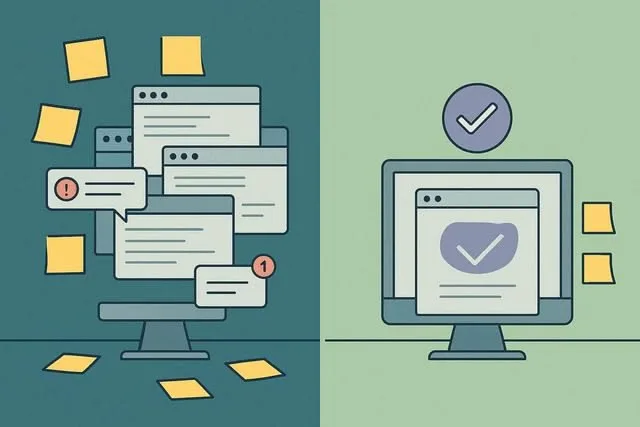
Switching tasks leaves part of the prior task active in working memory, which can degrade performance even after the interruption has ended. Attention residue explains why constant messaging, open offices, and other interruptions make sustained cognitive work harder: the mind is still processing what it was asked to leave behind.
Attention residue is the cognitive phenomenon in which thoughts, concerns, and mental processing from a previous task persist in working memory after you switch to a new task, degrading your performance on the new task even when the old task is no longer relevant.
Coined by organizational psychologist Sophie Leroy in 2009, the concept explains why the modern knowledge work environment - built around constant interruption, open offices, and real-time messaging - systematically undermines the quality of the thinking it depends on.
Understanding attention residue is essential for anyone who wants to do focused, high-quality cognitive work in a world designed to fragment attention.
You are halfway through a difficult analysis when a colleague sends an instant message asking you to look at something quickly. You glance at it, give a brief answer, then return to the analysis. But something feels off. Your train of thought is gone.
You reread the last paragraph you wrote and it feels distant. You find yourself thinking about the colleague's question even as you try to reconstruct your reasoning.
This is not a failure of willpower. It is not a character flaw. It is a specific, documented cognitive mechanism that operates beneath conscious awareness and affects virtually everyone who works in an environment that demands frequent task switching.
The cost is not the thirty seconds spent reading the message. The cost is the invisible degradation of everything you do for the next ten to twenty minutes as your brain struggles to fully disengage from one cognitive context and load another.
"People need to stop thinking of attention as a resource to be split, and start thinking of it as a resource that, when fragmented, loses most of its value." - Daniel Levitin, The Organized Mind (2014)
The Research That Named the Problem
Sophie Leroy's Foundational 2009 Study
The term "attention residue" was introduced by Sophie Leroy, then at the University of Minnesota, in a 2009 paper published in Organizational Behavior and Human Decision Processes titled "Why Is It So Hard to Do My Work?
The Challenge of Attention Residue When Switching Between Work Tasks." The paper has since become one of the most cited works in productivity research, accumulating over 1,200 citations by 2025 according to Google Scholar.
Leroy's central insight was deceptively simple: when you switch from Task A to Task B, your cognitive system does not cleanly disengage from Task A. Instead, cognitive resources continue to be consumed by the prior task - particularly if that task was incomplete or unresolved.
This residual cognitive activity reduces the resources available for Task B, producing measurable performance degradation.
Her experimental design was elegant. Participants worked under two conditions. In one condition, they were allowed to finish a task before switching to a new one. In the other, they were interrupted before completing the first task and directed to begin the new one.
Leroy measured performance on the second task and assessed the degree to which thoughts about the first task intruded during work on the second.
The results were unambiguous: participants who had been interrupted before completing the first task performed significantly worse on the second task. They also showed more intrusive thoughts about the first task, as measured by cognitive probes inserted during work on the second task.
The unfinished first task was still consuming cognitive resources even as participants worked on something entirely different.
Leroy identified two key variables that modulated the severity of attention residue. First, task completion: finishing a task before switching substantially reduced residue compared to switching mid-task.
Second, time pressure: when participants felt that the first task was urgent and time-limited, the residue was worse, because the cognitive system maintained a heightened alert state about the unresolved obligation.
The Zeigarnik Effect: Why Incomplete Tasks Haunt Us
Leroy's work builds on a much older observation in psychology. In the 1920s, Soviet psychologist Bluma Zeigarnik noticed that waiters in a Vienna coffee house could remember unpaid orders perfectly but forgot orders completely once the bill was settled.
She designed controlled experiments confirming this pattern and published her findings in 1927: people remember incomplete tasks approximately twice as well as completed ones.
Zeigarnik interpreted this as evidence that the brain maintains an active mental representation of unresolved goals, keeping them in a heightened state of accessibility until they are resolved.
The underlying mechanism is motivational: unfinished tasks trigger a kind of cognitive alarm system that keeps the goal active in working memory so you do not forget to return to it.
This system serves an important evolutionary purpose. In ancestral environments, abandoning a half-completed task often had direct survival consequences - an unfinished shelter, an unpreserved food supply, a predator not fully evaded. The cognitive system that keeps incomplete tasks active helps ensure follow-through on goals that matter.
In the modern knowledge work environment, however, this system becomes counterproductive. Instead of one or two unfinished tasks generating gentle urgency, a typical knowledge worker juggles dozens of incomplete tasks simultaneously.
A 2019 study by Rescue Time analyzing data from over 50,000 knowledge workers found that the average worker checks email or messaging apps every 6 minutes during the workday.
Each check potentially activates the Zeigarnik effect for a new incomplete thread, producing a constant low-level chatter of intrusive thoughts that erodes the quality of every individual task.
Subsequent Replications and Extensions
Leroy's original findings have been replicated and extended by multiple research groups. A 2014 study by Leroy and Glomb published in Organization Science found that attention residue was worse when the interrupted task involved high cognitive load - complex analysis, creative problem-solving, or strategic decision-making.
Routine tasks generated less residue, suggesting that the phenomenon is particularly damaging for the kind of work organizations value most.
In 2020, Leroy, Schmidt, and Madjar published follow-up research examining attention residue in realistic work settings rather than laboratory conditions.
They found that the effects were, if anything, larger in naturalistic settings than in the lab, because real workplaces involve emotional and social dimensions that amplify the stickiness of interrupted tasks - a tense email exchange or an unresolved disagreement with a colleague generates more residue than an abstract laboratory puzzle.
The True Cost of Task Switching
Gloria Mark's 23-Minute Recovery Finding
Gloria Mark and colleagues at the University of California, Irvine, conducted extensive observational research on knowledge workers in their natural office environments throughout the 2000s and 2010s.
Their most frequently cited finding: after an interruption, it takes workers on average 23 minutes and 15 seconds to return to their original task.
A 2008 paper by Mark, Daniela Gudith, and Ulrich Klocke published in the Proceedings of the SIGCHI Conference on Human Factors in Computing Systems also found that workers who experienced more interruptions exhibited higher levels of stress, frustration, and time pressure.
Mark's 2023 book Attention Span: A Groundbreaking Way to Restore Balance, Happiness and Productivity synthesized decades of this research for a general audience, documenting how the average attention span on a single screen had decreased from 2.5 minutes in 2004 to just 47 seconds by 2020.
The 23-minute figure is sometimes misinterpreted. The actual finding is that the average time before returning to the original work context, including all intermediate tasks undertaken before coming back, is 23 minutes.
During that time, the worker is not idle - they are processing other tasks - but each of those tasks is contaminated by residue from the original interrupted work and from each subsequent switch. The compounding effect is what makes fragmented workdays so cognitively expensive.
The 40 Percent Productivity Tax
Laboratory studies of task switching have documented the switch cost: a measurable increase in response time and error rate immediately after switching tasks.
A landmark 2001 paper by Joshua Rubinstein, David Meyer, and Jeffrey Evans in the Journal of Experimental Psychology: Human Perception and Performance estimated that mental blocks created by task switching can cost as much as 40 percent of productive time.
This is not a marginal cost. It represents a potential doubling of effective work time if task switching could be substantially reduced.
For a knowledge worker earning $80,000 per year, a 40 percent productivity loss from fragmented attention represents $32,000 in lost cognitive output annually - not through laziness or incompetence, but through an environment that systematically fragments the attention required for high-quality work.
| Metric | Finding | Source |
|---|---|---|
| Average recovery time after interruption | 23 minutes 15 seconds | Mark, Gudith, and Klocke (2008) |
| Productivity loss from task switching | Up to 40% of productive time | Rubinstein, Meyer, and Evans (2001) |
| Average time on one screen before switching | 47 seconds (2020) | Gloria Mark (2023) |
| Percentage of population that can truly multitask | 2.5% | Strayer and Watson (2010) |
| Increase in meeting time during pandemic remote work | 252% | Microsoft WorkLab (2021) |
| Percentage of US office space that is open-plan | ~70% | Gensler Workplace Survey (2019) |
Context Switching in Software Development
The software development community has been particularly attentive to attention residue research, partly because the cost of context switching in programming is intuitively obvious to practitioners.
Loading a complex software problem into working memory - understanding the architecture, the code path, the bug or feature - takes 10 to 30 minutes of uninterrupted work. An interruption that breaks this loaded context means the entire loading process must begin again.
Paul Graham's influential 2009 essay "Maker's Schedule, Manager's Schedule" made this distinction widely known in the technology industry: creators and builders need long uninterrupted blocks to do productive work, while managers operate effectively on a schedule of one-hour meetings.
Scheduling a single one-hour meeting in the middle of a developer's afternoon does not cost one hour - it can cost the entire afternoon's productive output, because the meeting creates two fragments too short to load complex context into.
A 2018 study by Andre Meyer, Gail Murphy, Thomas Zimmermann, and Thomas Fritz at Microsoft Research found that software developers reported only 1 to 2 hours of uninterrupted "deep work" per day, despite working 8 to 10 hour days.
The remaining hours were consumed by meetings, email, messaging, and the recovery time between these interruptions. The researchers estimated that even modest reductions in fragmentation could increase developer productivity by 20 to 30 percent.
The Multitasking Myth
What Multitasking Actually Is
The term "multitasking" is borrowed from computer science, where it describes a processor's ability to manage multiple processes simultaneously through rapid alternation. When people describe themselves as multitaskers, they typically mean something similar - working on multiple things at once or in rapid alternation.
True simultaneous cognitive processing of two demanding tasks is not possible for the human brain. What people experience as multitasking is rapid task switching - alternating between tasks with each task receiving brief attention before the switch occurs. Each switch deposits a layer of attention residue.
Research from David Strayer and Jason Watson at the University of Utah, published in Psychonomic Bulletin and Review in 2010, found that approximately 2.5 percent of the population shows minimal dual-task interference - these "supertaskers" are genuinely able to maintain performance across simultaneous demanding tasks.
For the remaining 97.5 percent, performance on both tasks suffers when attempted simultaneously, and the subjective experience of successfully multitasking is systematically overconfident.
This overconfidence is itself well-documented. A 2013 study by Sanbonmatsu, Strayer, Medeiros-Ward, and Watson published in PLOS ONE found that the people who reported the highest confidence in their multitasking ability were, on average, the worst actual multitaskers.
The Dunning-Kruger effect applies directly: those most impaired by task switching are least aware of the impairment, because the very cognitive resources needed to evaluate their own performance are the resources being consumed by attention residue and cognitive bias.
Open Offices and the Interruption Factory
The open-plan office design, which by 2019 accounted for approximately 70 percent of U.S. office space according to Gensler's Workplace Survey, was designed in part on the theory that spontaneous interaction improves collaboration. A large body of research challenges this assumption.
A landmark 2018 study by Ethan Bernstein and Stephen Turban at Harvard Business School, published in the Philosophical Transactions of the Royal Society B, found that transitioning to open offices actually reduced face-to-face interaction by approximately 70 percent as workers adopted acoustic and visual shields against constant distraction.
Workers wore headphones, avoided eye contact, and shifted communication to email and messaging - precisely the opposite of the intended effect.
The relevant point for attention residue is that open offices dramatically increase the frequency of unplanned interruptions, which maximizes task-switching rates and therefore attention residue accumulation throughout the workday.
A 2014 study published in the Scandinavian Journal of Work, Environment and Health by Jan Pejtersen, Helene Feveile, Karl Christensen, and Hermann Burr found that workers in open offices took 62 percent more sick days than those in private offices, suggesting that the stress of constant interruption has physiological consequences beyond cognitive performance.
How Attention Residue Affects Working Memory
Laboratory research on working memory capacity provides the mechanistic explanation for why attention residue is so costly.
Working memory - the cognitive workspace where current thoughts are held and manipulated - holds approximately four chunks of information at a time in most adults, as established by Nelson Cowan's influential 2001 review in Behavioral and Brain Sciences.
When residue from a prior task occupies one or two of these slots, the available capacity for current work is reduced by 25 to 50 percent. This is not a small degradation.
Studies of working memory and cognitive performance find consistent relationships between working memory capacity and performance on complex problem-solving, reading comprehension, reasoning, and decision-making.
A 25 to 50 percent reduction in available working memory capacity during a demanding cognitive task is a substantial impairment - comparable to the cognitive effects of mild sleep deprivation.
Research by Matthew Walker and others, summarized in his 2017 book Why We Sleep, has established that a person who has slept 6 hours per night for two weeks performs as poorly on cognitive tasks as someone who has gone 24 hours without sleep, while consistently reporting feeling only "slightly tired."
Accumulated sleep debt is invisible to the person experiencing it. Accumulated attention residue through a fragmented workday may be similarly invisible: you feel busy, you feel that you worked hard, but the actual quality of the cognitive work done is substantially lower than it could have been under conditions of sustained focus.
The parallel is instructive because it suggests that self-assessment of attention quality is unreliable - you cannot feel the residue in the same way you cannot feel the cognitive impairment from chronic mild sleep deprivation.
Strategies to Reduce Attention Residue
Complete Tasks Before Switching
Leroy's own research suggests the most direct intervention: reach a natural stopping point before switching. This does not mean never being interrupted; it means restructuring work so that planned transitions occur at task boundaries rather than in the middle of complex cognitive work.
In practice, this means:
- Finishing a section of writing or analysis before checking messages
- Completing a code function or test before attending a meeting
- Working through an email thread completely before switching to another
- Closing a decision loop - even provisionally - before moving to the next issue
When a genuine interruption occurs mid-task, Leroy's research suggests that writing a brief transition note - recording where you are and what the next step is - provides partial closure that reduces residue.
The act of externalizing the task state allows the cognitive system to partially "close" the loop, because the information is now stored externally rather than needing to be maintained in active memory.
This leverages the same mechanism that resolved the Zeigarnik effect for the Viennese waiters: once the information is externalized (the bill is paid, the note is written), the brain releases its grip.
A practical implementation is the "parking lot" method: keep a physical notepad or single text file open during focused work. When an intrusive thought about another task arises, write it in the parking lot and return to the current task.
The note serves as a commitment device - the thought has been captured and will not be lost - which reduces the urgency the cognitive system assigns to it.
Time Blocking and Deep Work
Time blocking - structuring the workday into defined periods for specific types of work - reduces task switching by creating environmental commitment to sustained attention. During a blocked period, unrelated demands are deferred.
Because the deferral is bounded and predictable, the Zeigarnik effect is partially addressed: the task or message is registered as something that will receive attention at a specific future time, which reduces the urgency of the intrusive thought.
Cal Newport's deep work framework, articulated in his 2016 book Deep Work: Rules for Focused Success in a Distracted World, formalizes this approach: schedule long blocks for cognitively demanding work and short, contained blocks for administrative demands.
The key insight is that "deep work" is not simply working hard - it is working with the undivided attention that attention residue dynamics make increasingly rare and therefore increasingly valuable.
Newport identifies four depth philosophies for structuring deep work:
- Monastic: Eliminate or drastically reduce shallow obligations entirely (suitable for academics and writers)
- Bimodal: Dedicate defined seasons or days to deep work and others to shallow work
- Rhythmic: Block the same hours every day for deep work (most practical for knowledge workers)
- Journalistic: Fit deep work into any available gap (requires high skill in task-switching discipline)
For most knowledge workers, the rhythmic approach is most sustainable. Blocking the first two to three hours of the workday for deep work, before opening email or attending meetings, exploits the natural decision-making clarity of a mind that has not yet accumulated residue from the day's interruptions.
Communication Norms That Reduce Interruption Frequency
Individual strategies have limited effect if the organizational norm demands immediate responsiveness to every message.
Research by Kostadin Kushlev and Elizabeth Dunn, published in Computers in Human Behavior in 2015, found that checking email on a constrained schedule (three specific times daily) significantly reduced stress and slightly improved task performance compared to habitual checking, without meaningful cost to responsiveness.
Organizations that set explicit norms around expected response times - distinguishing between messages that require immediate attention and those that can wait hours - reduce the interruption pressure that drives task switching.
Basecamp (now 37signals) has been particularly vocal about this approach, establishing company-wide norms that include: no real-time chat expectations, office hours for questions rather than on-demand availability, and meeting-free days.
| Strategy | Effect on Attention Residue | Practical Barrier | Implementation Difficulty |
|---|---|---|---|
| Complete tasks before switching | High reduction | Requires schedule control | Medium |
| Transition notes when interrupted | Moderate reduction | Requires discipline in the moment | Low |
| Time blocking (deep work blocks) | High reduction | Requires organizational support | Medium |
| Constrained email checking | Moderate reduction | Conflicts with culture of immediacy | Medium |
| Notification silencing during focus | Moderate reduction | Social pressure to be available | Low |
| Meeting-free mornings or days | High reduction | Requires team-wide adoption | High |
| Parking lot method for intrusive thoughts | Moderate reduction | Must become habitual | Low |
Cognitive Restoration Between Tasks
Even with discipline around task switching, the modern workday involves transitions. Brief cognitive restorative activities between task blocks - a short walk, five minutes of non-work conversation, exposure to natural light - can help clear residue before beginning a new task.
The Attention Restoration Theory of Rachel and Stephen Kaplan, first proposed in 1989 and developed through subsequent publications, proposes that the directed attention required by demanding cognitive tasks is a limited resource that depletes with use and restores through exposure to natural environments and low-demand activities.
A 2008 study by Marc Berman, John Jonides, and Stephen Kaplan published in Psychological Science found that a 50-minute walk in a natural setting improved directed attention performance by approximately 20 percent compared to a walk in an urban environment.
Applied to attention residue, brief restorative breaks between major tasks may reduce the amount of residue carried forward by allowing working memory to partially consolidate and clear.
Even five minutes of looking out a window at natural scenery, rather than immediately switching from one screen-based task to another, provides a cognitive reset that reduces residue carryover.
Attention Residue in Remote and Hybrid Work
The shift to remote and hybrid work accelerated by 2020 produced mixed effects on attention residue. On one hand, many remote workers reported fewer spontaneous physical interruptions and more control over their work environment.
On the other hand, video conferencing tools and messaging platforms created a new and in some ways more persistent vector of interruption.
A 2021 Microsoft WorkLab study analyzing collaboration patterns across 60,000 Microsoft employees found that meeting time had increased by 252 percent during the first year of the pandemic, and that long synchronous meetings had been partially replaced by a higher volume of short, fragmented communication.
This pattern maximizes task-switching and therefore attention residue accumulation.
The phenomenon of "Zoom fatigue" - documented by Jeremy Bailenson at Stanford's Virtual Human Interaction Lab in a 2021 paper in Technology, Mind, and Behavior - adds an additional cognitive load to remote work.
Video calls require sustained gaze, exaggerated nonverbal signaling, and constant self-monitoring (seeing your own face on screen), all of which consume cognitive resources that are then unavailable for task performance after the call ends.
The attention residue from a 30-minute video call may therefore be greater than that from an equivalent in-person meeting, because more cognitive resources were consumed during the call itself.
The research implication is clear: remote work's potential benefit for deep cognitive work is only realized if remote workers actively manage their communication environment to protect sustained attention blocks.
Without this management, remote work simply relocates the interruption pattern from physical space to digital channels, with no net improvement - and potentially a net worsening - of attention residue accumulation.
Tools like workflow automation can help reduce the volume of low-value interruptions that fragment remote workers' attention.
Organizational Implications: The Hidden Tax on Knowledge Work
Attention residue research is, at its core, a critique of how knowledge work environments are typically structured.
Organizations optimize for responsiveness - fast replies, open doors, continuous availability - and implicitly treat cognitive capacity as a renewable resource that can be divided freely across any number of simultaneous demands.
The evidence suggests the opposite: cognitive capacity for demanding work is a finite, depletable resource that requires sustained, uninterrupted application to yield its full value.
Structures that fragment this resource - constant messaging norms, open offices, meeting-heavy cultures - impose a cost far larger than the visible time of the interruptions themselves.
The visible cost is the 30 seconds to read a message. The invisible cost is the 10 to 23 minutes of degraded performance that follows.
Peter Drucker recognized this dynamic as early as 1967 in The Effective Executive: "If the knowledge worker is to produce results, he must use large and growing blocks of time... The knowledge worker cannot easily be supervised.
He can only be productive if he is allowed to work at something for long stretches." More than fifty years later, the organizational structures of most companies have moved in precisely the opposite direction from Drucker's prescription.
Measuring Attention Residue in Practice
At the individual level, attention residue is subjectively recognizable once you know what to look for. A practical self-assessment: at the end of any hour in which you switched tasks, rate on a 1-to-10 scale how fully you were able to focus on each task during the period. Consistently low scores indicate high residue accumulation.
More formally, Leroy's research paradigm used cognitive probe tasks - brief response-time tasks inserted during work on Task B - to measure the degree to which thoughts about Task A intruded.
A self-administered version: pause periodically while working on a task and note whether you are thinking about something from a prior task. The frequency of such intrusions provides a rough index of your current residue level.
At the organizational level, attention residue can be estimated through analysis of meeting patterns, messaging volume, and task-switching rates from collaboration software data.
Tools like Microsoft Viva Insights and similar platforms aggregate individual behavior patterns into team-level metrics, including measures of fragmented workdays (days with fewer than two uninterrupted hours) that correlate with attention residue accumulation.
Organizations that have used this data to redesign communication norms - establishing focus-hours blocks, reducing default meeting lengths, limiting synchronous communication channels - report measurable improvements in self-reported focus quality and output metrics.
The Broader Framework: Attention as the Scarce Resource
The economist Herbert Simon wrote in 1971: "A wealth of information creates a poverty of attention." This observation has only become more relevant.
In an information-rich environment, the scarce resource is not information, data, or even talent - it is the sustained, undivided attention required to transform information into insight, analysis, and creative work.
Attention residue research provides the mechanistic explanation for Simon's observation. Each piece of information that demands attention - each email, each notification, each unresolved task - deposits residue that reduces the cognitive resources available for everything else.
The cumulative effect across a workday of constant interruption is not a series of minor costs but a fundamental transformation of the kind of thinking that is possible.
The individual worker who wants to reduce attention residue is ultimately working against ambient organizational pressure.
The most effective improvements involve both individual strategies and organizational change: protecting time for deep work requires explicit cultural and structural support, not just personal discipline applied in an environment designed to undermine it.
Sophie Leroy's 2009 paper framed a specific cognitive mechanism. The broader takeaway is that what organizations call "collaboration" and "availability" often functions as a systematic tax on the quality of the work they most need done well.
Understanding attention residue is the first step toward building work environments and frameworks that protect the cognitive conditions required for genuinely excellent thinking.
Sources & Further Reading
- Leroy, Sophie. "Why Is It So Hard to Do My Work? The Challenge of Attention Residue When Switching Between Work Tasks." Organizational Behavior and Human Decision Processes 109, no. 2 (2009): 168-181. DOI: 10.1016/j.obhdp.2009.04.002
- Mark, Gloria, Daniela Gudith, and Ulrich Klocke. "The Cost of Interrupted Work: More Speed and Stress." Proceedings of the SIGCHI Conference on Human Factors in Computing Systems (2008): 107-110. DOI: 10.1145/1357054.1357072
- Mark, Gloria. Attention Span: A Groundbreaking Way to Restore Balance, Happiness and Productivity. Hanover Square Press, 2023.
- Rubinstein, Joshua S., David E. Meyer, and Jeffrey E. Evans. "Executive Control of Cognitive Processes in Task Switching." Journal of Experimental Psychology: Human Perception and Performance 27, no. 4 (2001): 763-797.
- Newport, Cal. Deep Work: Rules for Focused Success in a Distracted World. Grand Central Publishing, 2016.
- Zeigarnik, Bluma. "On Finished and Unfinished Tasks." Psychologische Forschung 9 (1927): 1-85.
- Strayer, David L., and Jason M. Watson. "Supertaskers: Profiles in Extraordinary Multitasking Ability." Psychonomic Bulletin and Review 17, no. 4 (2010): 479-485.
- Bernstein, Ethan S., and Stephen Turban. "The Impact of the 'Open' Workspace on Human Collaboration." Philosophical Transactions of the Royal Society B 373, no. 1753 (2018). DOI: 10.1098/rstb.2017.0239
- Cowan, Nelson. "The Magical Number 4 in Short-Term Memory: A Reconsideration of Mental Storage Capacity." Behavioral and Brain Sciences 24, no. 1 (2001): 87-114.
- Bailenson, Jeremy N. "Nonverbal Overload: A Theoretical Argument for the Causes of Zoom Fatigue." Technology, Mind, and Behavior 2, no. 1 (2021). DOI: 10.1037/tmb0000030
- Walker, Matthew. Why We Sleep: Unlocking the Power of Sleep and Dreams. Scribner, 2017.
- Levitin, Daniel J. The Organized Mind: Thinking Straight in the Age of Information Overload. Dutton, 2014.