
Signal: In August 2003, the Columbia Accident Investigation Board released its report on the Space Shuttle Columbia disaster, which killed seven astronauts when the orbiter broke apart during reentry on February 1, 2003.[2]
Investigators later determined that foam shed from the external tank during launch had breached the reinforced carbon-carbon panels protecting the left wing's leading edge, allowing superheated gas to enter the wing structure during reentry. During the mission itself, the extent and consequence of that damage were not established.
Among the board's findings was a concern about communication: during the debris assessment, Boeing engineers prepared slides summarizing their analyses of the foam strike. The investigation criticized those slides for obscuring assumptions, uncertainty, and potentially serious implications rather than presenting the risk clearly to decision-makers.
Edward Tufte's analysis of those specific slides, discussed in the board's report, described how detail is progressively lost as material moves upward: as information gets passed up an organizational hierarchy, key explanations and supporting information tend to be filtered out, until a senior manager might read a slide title without realizing it reported a serious problem.[3]
It would be wrong to reduce the accident to slide design. The board examined a chain of technical and organizational failures including uncertain damage modeling, inadequate on-orbit imagery, the normalization of repeated foam strikes, schedule pressure, hierarchy, and weak risk escalation. Presentation format was one manifestation of that larger failure, not a standalone cause.
Still, the underlying dynamic is a routine feature of professional communication: material that matters can be obscured by the material surrounding it. This article is about noticing and reducing that.
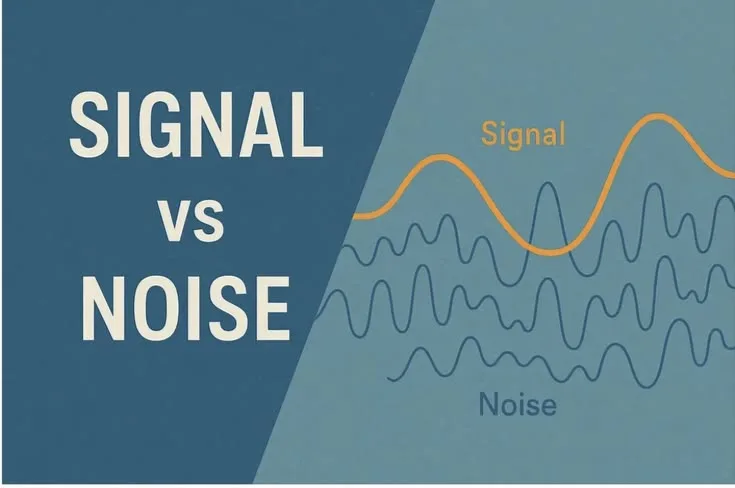
Signal and Noise: A Useful Metaphor, Not a Theory
The signal/noise distinction originates in electrical engineering and information theory. Claude Shannon's 1948 paper "A Mathematical Theory of Communication" established the mathematical treatment, where noise refers to disturbances introduced through the channel that interfere with transmission.[1]
That is a narrower idea than the one used here. Verbose prose, excessive background, and defensive hedging are not "noise" in Shannon's mathematical sense. In this article, noise is used more broadly as an editorial metaphor for material that obstructs a particular audience's ability to identify or interpret what matters.
The metaphor is useful, but it is an analogy rather than a direct extension. Human communication involves ambiguity, shared context, pragmatics, relationships, inference, goals, emotion, and feedback, none of which reduce cleanly to channel noise and signal recovery.
A workable definition for practical purposes: communication noise is material or interference that makes it harder for a particular audience to reach the intended understanding or action in a particular context.
Note what that definition builds in. The same information can be signal for one audience and noise for another. Supporting evidence that is unnecessary for an executive making a quick call may be exactly what a reviewer, auditor, or future reader needs. Relevance is a relationship between content and purpose, not a property of the content itself.
Six Types of Communication Noise
"Noise" gets used for several distinct problems that need different remedies. Separating them makes the diagnosis more useful.
| Type | What it is | Typical remedy |
|---|---|---|
| Channel | Interference in transmission itself: a bad line, a lost message, an unread email | Confirm receipt; use a more reliable channel |
| Semantic | Jargon, ambiguity, or terms the audience reads differently than intended | Define terms; remove ambiguity; confirm interpretation |
| Structural | Organization that hides the point: buried conclusions, deep bullet hierarchies | Lead with the conclusion; flatten the structure |
| Relevance | Content that does not serve this audience's purpose | Cut, or move to an appendix |
| Relational | Tone or framing that changes how the content is received | Address the relationship explicitly |
| Cognitive overload | Demands exceeding the audience's available processing capacity | Chunk; sequence; reduce simultaneous new elements |
Common Sources of Noise at Work
| Noise Type | What It Looks Like | Why It Accumulates | Remedy |
|---|---|---|---|
| Throat-clearing | "Today I'd like to share some thoughts on..." | Feels polite; signals preparation | Lead with the point |
| Context inflation | Twenty slides of history before the current situation | Confuses what the writer needed to know with what the reader needs | Give context needed to act; link the rest |
| Redundant restatement | "In summary, to recap, the key takeaways are..." | Feels thorough; pads content | State once, clearly |
| Defensive hedging | "This is just one perspective and reasonable people could disagree..." | Reduces the writer's exposure | Quantify real uncertainty; cut performative hedging |
| Irrelevant precision | Ten decimal places in a strategic market estimate | Precision reads as rigor | Match precision to the decision |
| Filler language | "At the end of the day," "needless to say" | Habit; fills pauses | Remove in editing |
The contrast worth internalising: "I'm going to take a few minutes to share some thoughts about our Q3 performance and what it might mean for planning" announces that a point is coming. "Q3 revenue was down 8% and the trend is likely to continue unless we address two structural issues" is the point.
Why Noise Accumulates
Several dynamics push in the direction of more rather than less.
Length can read as effort. In many organizational cultures a thirty-page report is received as more serious than a one-page summary. This is a widely observed workplace tendency rather than a documented research finding, but it is worth naming because it shapes incentives. Blaise Pascal made the underlying point in 1657, apologising in a letter for writing at length because he lacked the time to be brief: concision usually costs more work than verbosity.
Ambiguity can reduce exposure. A confident claim that proves wrong is more costly to its author than the same claim buried in qualifications. Ambiguous or overqualified communication can sometimes protect the sender from accountability, whether deliberately or as a by-product of genuine uncertainty, poor editing, fear, inexperience, organizational norms, or conflicting stakeholder demands.
Drafting is thinking. Early drafts often contain the exploratory material through which the writer worked out what they wanted to say. Noise accumulates when that process is handed to the reader rather than edited out first.
Tools favour production. Presentation and email software make it easy to add material and offer little friction against it. This is a WNF observation about defaults rather than a documented design principle, but the practical effect is familiar: adding a slide is easier than justifying one.
The Economics of Attention
Every communication competes for a finite resource. The important feature is an asymmetry: noise is cheap for the sender to produce and expensive for the receiver to process.[7] The person bearing the cost is not the person making the decision to include it.
That asymmetry explains a good deal of persistent organizational verbosity. It also suggests the useful question is not "what is potentially relevant?" but "what does this reader need in order to make the decision or reach the understanding this communication exists to serve?"
Amazon offers a well-known example of designing against the asymmetry. Its senior leadership meetings replaced slide decks with six-page narrative memos, read silently at the start of the meeting. Jeff Bezos's stated reasoning was that bullet-point format fragments reasoning in ways that make it hard to tell whether a coherent argument exists. Amazon also uses a related Working Backwards process for new products, often involving a prospective press release and FAQ.
The page limit can function as a constraint that forces prioritisation, which is a reasonable interpretation rather than a documented design goal. What the narrative format demonstrably does is make reasoning explicit enough to evaluate.
The WNF Signal Test
The following four-part check is a WhenNotesFly editorial framework, not a research instrument. It is intended for sorting material before sending.
1. What does the reader need to do or understand afterward? If you cannot state this, you have not identified the point yet, and no amount of editing will substitute.
2. Sort each element into one of four categories. Rather than asking only whether something is necessary, decide where it belongs: part of the main message; supporting evidence a careful reader will want; appendix or reference material that must exist but need not be read now; or genuinely removable. Most content that feels like it must stay is really appendix material.
3. Would removing it reduce comprehension, decision quality, trust, safety, or necessary documentation? If not, it can probably be cut or moved down a layer. Note the trap in the simpler version of this test: a reader may not notice that a limitation, an excluded group, or a safety exception is missing. Absence going unnoticed does not prove the material was useless.
4. Who bears the cost? If a section demands substantial reader effort for minimal reader benefit, that effort has been externalised. This is worth distinguishing from inherent difficulty: some subjects genuinely require work from the reader, and that is not the same as an unedited draft.
When Repetition Is the Point
An article about cutting material has to be honest about when material should stay.
Redundancy is not automatically waste. It earns its place when the channel is unreliable, when the audience has mixed background knowledge, when the message is heard rather than read, when something must be remembered under pressure, when safety depends on it, or when accessibility requires more than one format.
High-stakes fields make this explicit. Aviation read-backs, surgical checklists, and structured clinical handoffs such as SBAR (Situation, Background, Assessment, Recommendation) all add structured repetition on purpose, because reliability matters more than brevity.[12] Closed-loop confirmation, where the receiver states back what they understood, exists precisely because assuming successful transmission is dangerous.
So the goal is not minimal information. It is controlled, decision-relevant information, with deliberate redundancy where the cost of a missed message is high. Useful formats that build this in include BLUF (bottom line up front), SBAR, decision memos, incident updates, and executive summaries paired with a full appendix.
What the Research Does and Does Not Say
Several research traditions are relevant here, and it is worth being careful about how far each reaches.
Working memory. George Miller's 1956 paper "The Magical Number Seven, Plus or Minus Two" proposed limits around seven units in certain tasks.[4] Later work often estimates a more restricted focus of roughly three to four meaningful chunks, depending on the task and how information is grouped.
These limits matter most when an audience must hold several unfamiliar elements at once; reading allows rereading, note-taking, and reference to prior knowledge, so memory-span findings do not translate directly into a general rule about all messages.
Multimedia learning. Richard Mayer's research programme distinguishes two principles that are easy to conflate.[5] The coherence principle concerns removing extraneous material, and is a well-established finding in multimedia-learning research.
The redundancy principle is narrower: in some experiments, presenting full duplicate on-screen text alongside narration and graphics reduced learning compared with narration and graphics alone. That effect depends on text length, pacing, learner knowledge, and visual complexity, and it does not mean on-screen text is generally harmful.
Concise labels and accessibility captions can be essential, particularly for people who are deaf or hard of hearing, non-native speakers, or anyone in a noisy environment.
Information as difference. Gregory Bateson, in Steps to an Ecology of Mind (1972), described information as "a difference that makes a difference." That is a broad cybernetic formulation rather than an editing rule, but borrowing the phrase, communicators can usefully ask whether a given detail makes a meaningful difference to the reader's understanding or decision.[9]
Content and relationship. Paul Watzlawick and colleagues, in Pragmatics of Human Communication (1967), emphasised that messages carry both content and information about the relationship between the participants.[10] A technically accurate message delivered with condescension may be interpreted through the perceived condescension, weakening acceptance of the substance.
Psychological distance. Work by Yaacov Trope and Nira Liberman connects greater psychological distance with more abstract mental representation.[8] Thinking of an audience as a distant, generalised group can therefore encourage more abstract communication. That becomes a problem when the reader needs concrete instructions or examples, though abstraction is valuable when the goal is to convey patterns or principles.
Each inferential step the reader must take creates another opportunity for misunderstanding, even though inference is a normal and necessary part of comprehension.
Expertise. Experts routinely underestimate how much background their explanations assume, a tendency Raymond Nickerson reviewed in detail as the imputing of one's own knowledge to others.[6]
Technical vocabulary and implicit references that feel natural to a specialist can read as dense interference to a newcomer. We cover this in depth in the curse of knowledge.
Narrative. Nassim Nicholas Taleb's The Black Swan (2007) describes the narrative fallacy: coherent causal stories constructed from limited or retrospective evidence can feel more certain than the evidence warrants.[11] This is not an argument that explanation is noise or that raw data speaks for itself.
Data is rarely self-explanatory, and interpretation, method, and stated uncertainty are necessary. The practical lesson is to distinguish observed data from causal explanation and to state assumptions explicitly.
Ambiguity Is a Different Problem from Clutter
In 1977 the deadliest accident in commercial aviation history occurred at Tenerife, killing 583 people. Among many contributing factors, one was a communication failure: the KLM crew's transmission "We are now at takeoff" could be read as reporting position at the runway or as announcing the takeoff roll.
That case is worth separating from the rest of this article. The problem was not a clear message buried in surrounding clutter; the message itself was underspecified, and the confirmation that would have caught it did not occur. The accident also involved fog, a runway diversion, simultaneous radio transmissions, non-standard phraseology, an authority gradient, and misunderstanding of clearance. It is a case about ambiguous encoding and failed confirmation, not about volume.
The reforms that followed, standardised phraseology and mandatory read-backs, address exactly that: they reduce ambiguity and close the loop.
Crew Resource Management, which developed in commercial aviation from around the late 1970s and evolved across several generations, addressed a broader set of issues including teamwork, leadership, decision-making, workload management, situational awareness, and threat and error management. Hierarchy and communication failures were important motivations, but CRM was never solely a communication protocol.
Evaluating its effect at the level of accident rates is methodologically difficult, with evidence stronger for behavioural and attitudinal outcomes than for direct accident-rate comparisons.
Too Little Is Also a Failure
The counterpart failure to excess is a message so stripped that the reader cannot interpret it. A one-word email reading "No" is maximally concise and frequently unclear.
The calibration is between context that enables interpretation, which must be present, and context that merely surrounds the point, which is worth questioning.
Most miscommunication is not a transmission failure but a mismatch of interpretive context: readers reconstruct meaning using what they already know, and where that differs from the sender's assumptions, the reconstruction diverges. See why miscommunication happens for more on that mechanism.
Organizational Practices
Individuals can edit their own output. Organizations can change what the default looks like.
State the required response. "For your information" sets no target. "For decision: [specific decision]" creates something against which relevance can be judged.
Lead with the conclusion. Requiring the conclusion before the evidence removes the load of processing a narrative that reveals its point only at the end.
Make questioning normal. Where readers can ask "what decision does this serve?" without friction, senders adjust. Where every message is absorbed without feedback, nothing corrects.
Review patterns, not just instances. Recurring noise usually attaches to particular formats, forums, or reporting lines, and is better addressed there than message by message.
Sources & Further Reading
- Shannon, C. E. & Weaver, W. The Mathematical Theory of Communication. University of Illinois Press, 1949. (Origin of the signal/noise distinction.)
- Columbia Accident Investigation Board. Columbia Accident Investigation Board Report, Vol. 1. NASA, 2003. View source(Columbia findings and organizational context.)
- Tufte, E. The Cognitive Style of PowerPoint. Graphics Press, 2003. (Analysis of the Boeing debris-assessment slides.)
- Miller, G. A. "The Magical Number Seven, Plus or Minus Two: Some Limits on Our Capacity for Processing Information." Psychological Review, 63(2), 81-97, 1956. DOI: 10.1037/h0043158(Working-memory limits.)
- Mayer, R. E. Multimedia Learning. Cambridge University Press, 2001. DOI: 10.1017/CBO9781139164603(Coherence and redundancy principles.)
- Nickerson, R. S. "How We Know - and Sometimes Misjudge - What Others Know: Imputing One's Own Knowledge to Others." Psychological Bulletin, 1999. DOI: 10.1037/0033-2909.125.6.737(Curse of knowledge.)
- Kirsh, D. "A Few Thoughts on Cognitive Overload." Intellectica, 30, 19-51, 2000. DOI: 10.3406/intel.2000.1592(Conceptual account of workplace cognitive overload.)
- Trope, Y. & Liberman, N. "Construal-Level Theory of Psychological Distance." Psychological Review, 117(2), 440-463, 2010. DOI: 10.1037/a0018963(Distance and abstraction.)
- Bateson, G. Steps to an Ecology of Mind. Chandler, 1972. (Information as a difference that makes a difference.)
- Watzlawick, P., Bavelas, J. B. & Jackson, D. D. Pragmatics of Human Communication. W. W. Norton, 1967. (Content and relationship levels.)
- Taleb, N. N. The Black Swan. Random House, 2007. (Narrative fallacy.)
- Gawande, A. The Checklist Manifesto: How to Get Things Right. Metropolitan Books, 2010. View source(Purposeful redundancy in high-stakes work.)