
Mastering: In 2012, computer science professor Cal Newport had a problem he found difficult to explain to colleagues. He was a tenured professor at Georgetown, publishing academic research and writing books for general audiences, while also teaching a full course load.
His colleagues asked how he managed it. Newport's answer was not what they expected: he said he almost never worked in the evenings. He left campus in the early to mid afternoon most days.
He did not have social media accounts. He was, by the standards of contemporary knowledge work culture, radically underworked - and yet his output exceeded that of colleagues who routinely worked twelve-hour days and were perpetually available on email and messaging platforms.
Newport's explanation was that he had organized his work life around a practice he called deep work: sustained, uninterrupted concentration on cognitively demanding tasks.[1]
The contrast was with what he called shallow work - the emails, meetings, scheduling, administrative tasks, and quick responses that fill most knowledge workers' days.
Newport's observation was that shallow work expands to fill all available time if not deliberately constrained, and that deep work - the kind that actually produces the research breakthroughs, the well-reasoned proposals, the genuinely creative solutions - requires conditions that most modern workplaces actively undermine.
His 2016 book "Deep Work" synthesized this observation into a framework, drawing on research from cognitive science, neuroscience, and organizational behavior to argue that the ability to perform deep work is both increasingly rare and increasingly valuable in the modern economy.
Newport's framework arrived at a moment when the organizational costs of constant connectivity were becoming measurable.[11]
Gloria Mark at the University of California, Irvine, was publishing research on workplace interruptions showing that it takes an average of twenty-three minutes and fifteen seconds to return to full concentration after an interruption.[2]
Neuroscientists were documenting the cognitive costs of task-switching. Organizational researchers were finding that open-plan offices, adopted in the 1990s and 2000s on the premise that proximity would increase collaboration, were actually reducing the frequency and quality of face-to-face interaction while increasing the volume of electronic communication.
The evidence was converging: modern work had been designed, largely by accident, to make the most cognitively demanding and valuable work nearly impossible to do.
"To produce at your peak level you need to work for extended periods with full concentration on a single task free from distraction. Put another way, the type of work that optimizes your performance is deep work." - Cal Newport
Key Definitions
Deep work: Professional activity performed in a state of distraction-free concentration that pushes cognitive capabilities to their limit. Deep work creates new value, improves skill, and is hard to replicate. Newport's term for cognitively demanding, uninterrupted cognitive effort.
Shallow work: Non-cognitively demanding, logistical-style tasks, often performed while distracted. These efforts tend not to create much new value and are easy to replicate, including email management, scheduling, and routine meetings.
Ultradian rhythm: The approximately 90-minute cycles of high and low alertness identified by sleep researcher Nathaniel Kleitman. These cycles, which continue through the waking day, are thought to underlie the natural rhythm of sustainable deep work sessions.
Flow state: The psychological experience of deep absorption in a challenging activity, characterized by loss of self-consciousness, distorted time perception, and intrinsic motivation, as described by psychologist Mihaly Csikszentmihalyi.[8] Flow is the experiential correlate of what deep work produces structurally.
Attention residue: The cognitive phenomenon, documented by Sophie Leroy at the University of Washington, in which thinking about an incomplete task persists and impairs performance on a new task, even when the person has deliberately switched their focus.
| Deep Work Schedule Philosophy | Description | Best For | Key Requirement |
|---|---|---|---|
| Monastic | Eliminate shallow obligations entirely; dedicated solely to deep work | Authors, researchers with no coordination role | Ability to cut off from accessibility completely |
| Bimodal | Divide time into long deep-work periods and shallow-work periods (days or weeks) | Academics, some executives, consultants | Minimum 1 full day per deep-work block |
| Rhythmic | Daily deep-work blocks at consistent scheduled times | Most knowledge workers with ongoing responsibilities | Protecting the same time slot every day |
| Journalistic | Deep work whenever schedule gaps allow; requires rapid transition into deep focus | Journalists; experienced deep-work practitioners | Practice transitioning quickly; not for beginners |
What Deep Work Actually Is - and Is Not
The Distinction From Mere Busyness
One of Newport's central contributions is a clean analytic distinction between deep and shallow work - a distinction that most knowledge workers resist because it requires honest assessment of how much of their day is actually spent on cognitively demanding tasks.
Email management is shallow work. So is attending meetings where your presence is informational rather than decision-making. So is updating project management software, coordinating schedules, reviewing and reformatting documents, and most of the other activities that fill a typical professional's calendar.
This does not mean these activities are worthless - they are often necessary infrastructure - but they do not, by themselves, produce the insight, the analysis, the creative problem-solving, or the skill development that makes knowledge workers valuable.
Deep work is the thinking that produces a well-reasoned strategy document that changes how an organization understands its market. It is the code that solves a genuinely difficult architectural problem. It is the rigorous research synthesis that produces a defensible recommendation where the evidence was genuinely ambiguous.
It is the kind of thinking that takes sustained effort, that cannot be done in the ten-minute gaps between meetings, and that produces outputs that could not have been produced by a person thinking less hard.
The career implication Newport draws is significant: in a knowledge economy, competitive differentiation depends almost entirely on the quality of the ideas, analyses, and creative outputs a person produces. Shallow work can be done adequately by almost anyone.
Deep work, done well, cannot. The professionals who develop the capacity for deep work over time build skills and produce outputs that are genuinely difficult to replicate.
Deep Work Versus Flow State
The distinction between deep work and Mihaly Csikszentmihalyi's concept of flow is worth clarifying because the two are frequently conflated.
Csikszentmihalyi, the Hungarian-American psychologist who developed the concept through decades of experience-sampling research (asking people to report their psychological state at random intervals throughout their day), defined flow as a psychological state of complete absorption in a challenging activity, where the difficulty of the task is matched to the skill level of the performer, intrinsic motivation is high, and self-consciousness disappears.
Flow is something you experience. Deep work is something you do. The relationship between them is that deep work, practiced consistently, creates conditions under which flow states are more likely to occur - but deep work does not require flow and flow does not require deep work.
A professional can be in flow during a highly engaging but shallow activity (an animated conversation, a fast-paced but routine task they have mastered). And a professional can do genuinely valuable deep work without experiencing flow, especially in early skill development stages when the work is effortful and unrewarding.
Newport's framework is more prescriptive than Csikszentmihalyi's. Csikszentmihalyi documented flow as a naturally occurring experience. Newport prescribes deep work as a deliberate practice to be scheduled, protected, and developed over time.
The Neuroscience of Sustained Concentration
Ultradian Rhythms and Optimal Session Length
The biological basis for optimal deep work session length comes from sleep researcher Nathaniel Kleitman, who first identified both circadian rhythms (the approximately 24-hour sleep-wake cycle) and ultradian rhythms - 90-minute cycles of high and low physiological alertness that continue through the waking day.[6]
Kleitman's research, initially focused on REM sleep cycles, was extended by subsequent researchers including Peretz Lavie at the Technion and by the clinical work of performance consultant Jim Loehr, who documented how elite athletes use these 90-minute cycles to structure training and recovery.
The practical implication for knowledge work: most people can sustain full cognitive engagement for approximately 90 minutes before their brain begins signaling for a break.
The signal is often misread as boredom, loss of interest, or distraction-seeking, but the underlying mechanism is physiological. Working through the signal by sheer effort degrades the quality of thinking without extending the productive window.
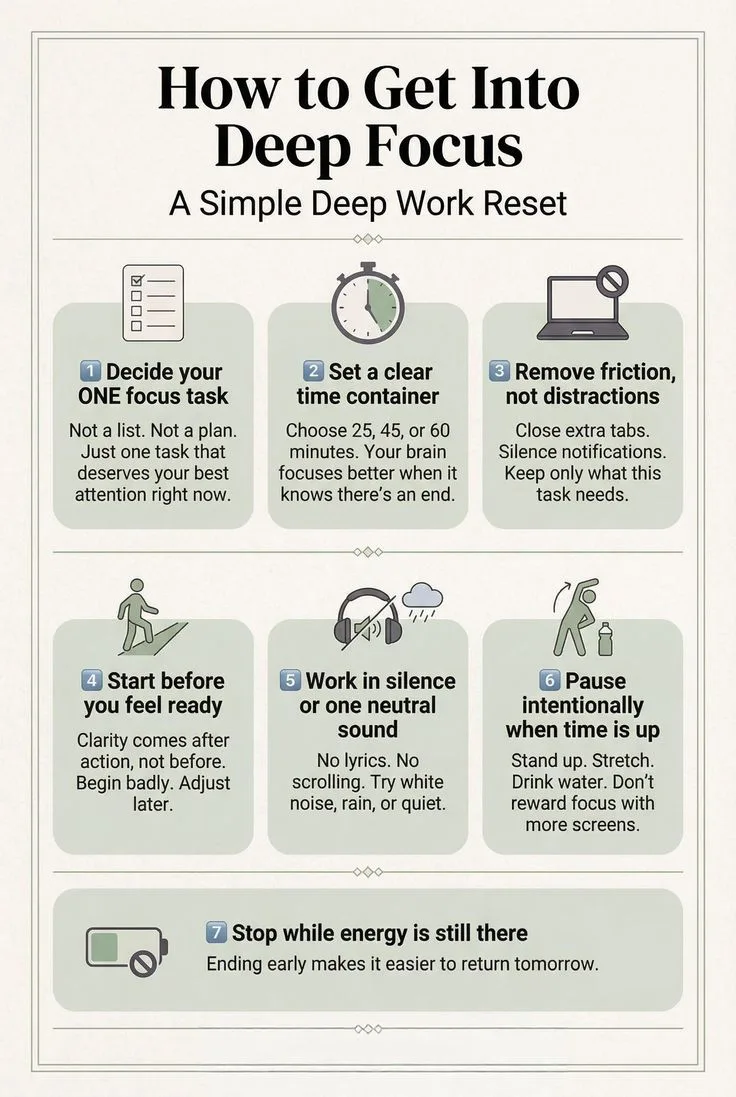
Newport recommends 90-minute to four-hour sessions of deep work as the practical optimum. Beginners to deliberate deep work practice often find that 45 to 60 minutes is a more realistic starting point, because sustained concentration is a trainable skill and most people have not practiced it systematically.
The number four hours represents an approximate daily ceiling on high-quality deep work for most people, consistent with research on deliberate practice by Anders Ericsson at Florida State University, who found that elite performers in cognitively and technically demanding domains rarely exceeded four hours of deliberate practice per day, even at the peak of their development.[7]
The take-away is not that more time in deep work is always better. It is that the quality and structure of deep work sessions matters as much as their duration, and that sustainable deep work requires rest and recovery between sessions.
The Cost of Interruption: Gloria Mark's Research
Gloria Mark, a professor of informatics at the University of California, Irvine, has produced the most-cited quantitative research on workplace interruption.
In a series of studies beginning in the mid-2000s, Mark and her colleagues observed knowledge workers in their actual work environments using direct observation, experience sampling, and digital activity logging.
The headline finding - that it takes an average of twenty-three minutes and fifteen seconds to return to full focus on a task after being interrupted - has been widely cited, sometimes to the point of oversimplification.
The fuller picture from Mark's research is more nuanced and more alarming. Mark found that the majority of interruptions in modern workplaces are self-generated: people interrupt themselves. They switch from a work task to check email, scan a news site, look at social media, or respond to a non-urgent notification.
Mark's research documented the frequency of these self-interruptions increasing over time in her longitudinal samples, coinciding with the proliferation of notification-generating platforms.
Mark also found that frequent interruptions correlated with higher self-reported stress, exhaustion, and frustration, and that workers systematically underestimated how often they switched tasks. The subjective experience of being focused and the objective reality of constant task-switching diverge significantly.
Sophie Leroy at the University of Washington has documented the mechanism through the concept of "attention residue": when a person shifts attention from Task A to Task B before Task A is fully resolved, cognitive resources continue to be deployed on Task A.[3]
Performance on Task B is impaired from the start. The more frequently a person switches tasks, the more residue accumulates, and the lower the quality of thinking on any single task.
Environment and the Science of Distraction
Silence Versus Ambient Noise
A commonly cited research finding from Ravi Mehta, Rui Zhu, and Amar Cheema, published in the Journal of Consumer Research in 2012, found that moderate ambient noise - approximately 70 decibels, the level typical of a busy coffee shop - can enhance creative cognition relative to both quiet (50 decibels) and loud environments (85 decibels).[4]
The proposed mechanism is that moderate noise induces a mild degree of cognitive disfluency, which promotes abstract thinking and creative connection-making.
This finding has been widely interpreted as justification for working in coffee shops or using ambient noise apps. The important qualification is that Mehta et al. were studying creative ideation tasks - tasks that benefit from broad, associative thinking.
The finding does not apply equally to all types of deep work. Tasks requiring precise logical reasoning, sustained mathematical thinking, close reading, or careful writing benefit from quiet rather than moderate noise. The coffee shop effect is real but specific to a particular type of cognitive task.
The type of noise matters as much as the volume. Linguistic interruptions - speech, podcast voices, notification chimes that trigger reading - compete directly with language-based thinking.
The auditory language processing system is not well-designed for parallel operation: comprehending speech and generating written argument use overlapping cognitive resources.
Instrumental music without lyrics, by contrast, is broadly neutral for most people on most cognitive tasks, and some research suggests it can provide a mild benefit by raising arousal slightly above the fatigue threshold.
Open-Plan Offices: The Evidence
In 2018, Ethan Bernstein and Stephen Turban at Harvard Business School published a study in the Philosophical Transactions of the Royal Society that directly tested the premise underlying open-plan office design.[5]
Two organizations that transitioned from traditional closed offices to open-plan layouts were studied before and after the transition using electronic communication data and sociometric sensors measuring face-to-face interaction.
The results contradicted the stated rationale for open-plan offices. Face-to-face interaction fell by approximately 70% after the transition to open-plan. Electronic communication - email and messaging - increased proportionally.
The proposed mechanism is that in open-plan environments, people develop coping strategies - headphones, avoiding eye contact, limiting physical movement - to manage the constant potential for interaction. These coping strategies reduce spontaneous collaboration rather than increasing it.
From a deep work perspective, the Bernstein and Turban finding confirms what many knowledge workers experience directly: open-plan offices create a persistent low-level threat of interruption that prevents the full cognitive engagement deep work requires.
The practical response is to treat the open office as a shallow-work environment and seek alternative locations - conference rooms, home offices, libraries - for sessions requiring sustained concentration.
Many experienced deep workers develop a consistent focus signal that colleagues learn to interpret as unavailability, reducing the frequency of interruptions even in open environments.
Building the Deep Work Habit
Scheduling: Protecting the Blocks
Newport describes four scheduling approaches: monastic (eliminating shallow work almost entirely), bimodal (alternating deep and shallow periods across days or weeks), rhythmic (a fixed daily deep work block as a non-negotiable appointment), and journalistic (fitting deep work into available gaps).
For most professionals in organizational settings, the rhythmic approach is most practical: identifying the time of day when cognitive energy is highest - typically a two to three-hour morning window - and treating it as a protected daily appointment.
The negotiation required to protect this block is real. It requires a direct conversation with a manager, not simply refusing meeting invitations. The conversation is best framed in terms of output quality and project milestones: "I do my most effective analytical work in the morning.
I would like to block 8 to 10:30 am on most days for that work. I can be available for meetings and responses starting at 10:30. This will let me produce better quality analysis on the [specific project] by [specific deadline]."
Newport notes that managers almost always respond positively to this framing because it is outcome-focused and specific.
The resistance is typically not from managers but from the worker's own internalized expectations about availability - knowledge workers have been conditioned to treat immediate responsiveness as a professional virtue, even when it comes at the direct cost of the substantive work the organization hired them to do.
Starting Small and Extending Gradually
Beginning a deep work practice with ambitious three-hour sessions often fails because concentrated attention is a trainable capacity, and most people who have worked in interrupt-driven environments for years have allowed that capacity to atrophy.
Starting with 30 to 45-minute sessions and extending the duration gradually by 10-15 minutes per week builds the capacity sustainably.
The key variable during early-stage practice is not the quality of thinking but the absence of interruption. The goal in the first few weeks is to sit with the discomfort of sustained focus without giving in to distraction.
Quality improves as the habit establishes; the discomfort diminishes as the brain relearns what sustained concentration feels like.
A concrete starting point: set a 45-minute timer, close all communication applications entirely (not just muted), write the specific task in one sentence before starting, and take a genuine off-screen break at the end before deciding whether to run another session.
Deep Work and ADHD
For professionals with ADHD, the standard deep work prescriptions require adaptation.
The dopamine regulation differences associated with ADHD impair executive function in ways that directly affect sustained attention: greater sensitivity to environmental stimulation, stronger pull toward novelty, time blindness that makes future deadlines feel abstract, and higher variability in day-to-day cognitive engagement.
Shorter sessions - 25 to 45 minutes rather than 90 minutes - are more realistic for many people with ADHD and still represent genuine deep work if truly uninterrupted. Body doubling is well-documented as effective for ADHD, likely because social presence activates accountability mechanisms that stabilize attention.
Platforms like Focusmate offer virtual body doubling. Working on the most cognitively engaging aspects of a task first helps reach the engagement threshold necessary for sustained focus. Visual timers that show time as a physical change address time blindness directly.
Social Media and the Fragmented Brain
Platform Design and Attention Training
Newport devotes considerable attention in his writing to social media not primarily as a time sink - though the time costs are real - but as an attention training problem.
Social media platforms are designed to deliver variable reward on short intervals: scrolling produces occasional engaging content amid largely unremarkable content, and the variability itself is what drives compulsive use. This is the same reinforcement schedule that makes slot machines addictive.
The cognitive consequence Newport argues is not simply that social media consumes time. It is that regular use trains the brain to expect stimulation and novelty at short intervals, making the experience of sitting with a single demanding problem for extended periods increasingly uncomfortable.
Gloria Mark's longitudinal research supports this: she found that the average duration of a continuous work session before self-interruption has decreased over the past two decades, in a pattern that correlates with smartphone adoption and social media use.
The implication is that reducing social media use improves deep work capacity not just by creating more available time but by allowing the brain's tolerance for low-stimulation sustained concentration to recover.
Newport's recommendation is not necessarily permanent deletion of social media accounts but deliberate, scheduled use with clear time limits - treating social media as a tool with a specific purpose and a specific scheduled window, rather than as a background channel available throughout the working day.
The Notification Architecture
Independent of social media specifically, the architecture of notifications - most smartphones and applications default to interrupting the user with every message and update - accumulates into a sustained reduction in cognitive capacity through the attention residue effect Sophie Leroy documented.
The most effective single change many professionals can make is a full notification audit: turning off all non-essential alerts, checking communication applications at scheduled intervals rather than monitoring them continuously, and moving the phone out of the workspace entirely.
Research by Adrian Ward at the University of Texas at Austin, published in the Journal of the Association for Consumer Research in 2017, found that the mere presence of a smartphone on a desk - face down, silent - reduced performance on cognitive tasks compared to having the phone in another room.[9]
The cognitive cost did not require the device to be actively used.
Rest, Recovery, and the Shutdown Ritual
The Role of Rest in Cognitive Performance
Newport's framework includes a concept he calls the "shutdown ritual" - a deliberate end-of-day practice of reviewing open tasks, confirming that everything has been captured in a trusted system, and explicitly marking the end of the workday with a phrase like "shutdown complete."
The purpose is not mystical but practical: to interrupt the planning and worrying function that otherwise continues into the evening and impairs both the quality of rest and the cognitive capacity available the following morning.
Attention restoration theory, developed by Rachel and Stephen Kaplan at the University of Michigan, proposes that environments and activities that allow the directed attention system to disengage - particularly time in natural environments, but also any genuinely restful activity - restore the cognitive resources that sustained concentration requires.[10]
Newport cites research on the default mode network - the brain network active during mind-wandering and apparent rest - as evidence that passive mental states contribute actively to the integration and consolidation of thinking produced during deep work sessions.
The evening walk, the long shower, and the restful weekend are not simply pleasant - they are part of the deep work cycle.
Checking work email in the evening activates the planning and problem-solving networks that should be resting, generating attention residue that reduces the quality of sleep and depletes the cognitive resources available the following morning.
Building the Practice: A Summary
Deep work is not a productivity hack. It is a long-term professional development practice with compounding returns.
The research reviewed in this article converges on a practical prescription: identify the time of day when your cognitive energy is consistently highest, protect that window through explicit scheduling and reduced notification exposure, and begin with sessions short enough to be sustainable, extending them gradually.
Build in genuine rest and shutdown rituals, and reduce the ambient distraction tools - open-plan environments, always-on notifications, reflexive social media checking - that train the brain away from sustained focus.
The competitive implication is real. As shallow work becomes increasingly automatable, the value of genuinely difficult cognitive output rises. Professionals who develop deep work capacity become both rarer and more valuable simultaneously.
The investment is available to anyone willing to protect the blocks, build the habit, and manage the environment.
See also: How to Stop Procrastinating for the emotional regulation strategies that underlie beginning hard cognitive tasks, and How to Write Better Emails for managing the shallow-work communication demands that compete with deep work time.
Sources & Further Reading
Newport, C. "Deep Work: Rules for Focused Success in a Distracted World." Grand Central Publishing, 2016.
Mark, G., Gudith, D., & Klocke, U. "The Cost of Interrupted Work: More Speed and Stress." CHI Conference Proceedings, 2008.
Leroy, S. "Why Is It So Hard to Do My Work? The Challenge of Attention Residue When Switching Between Work Tasks." Organizational Behavior and Human Decision Processes, 109(2), 168-181, 2009.
Mehta, R., Zhu, R., & Cheema, A. "Is Noise Always Bad? Exploring the Effects of Ambient Noise on Creative Cognition." Journal of Consumer Research, 39(4), 784-799, 2012.
Bernstein, E. S., & Turban, S. "The Impact of the Open Workspace on Human Collaboration." Philosophical Transactions of the Royal Society B, 373(1753), 2018.
Kleitman, N. "Sleep and Wakefulness." University of Chicago Press, 1939.
Ericsson, K. A., Krampe, R. Th., & Tesch-Romer, C. "The Role of Deliberate Practice in the Acquisition of Expert Performance." Psychological Review, 100(3), 363-406, 1993.
Csikszentmihalyi, M. "Flow: The Psychology of Optimal Experience." Harper & Row, 1990.
Ward, A. F., Duke, K., Gneezy, A., & Bos, M. W. "Brain Drain: The Mere Presence of One's Own Smartphone Reduces Available Cognitive Capacity." Journal of the Association for Consumer Research, 2(2), 140-154, 2017.
Kaplan, R., & Kaplan, S. "The Experience of Nature: A Psychological Perspective." Cambridge University Press, 1989.
Newport, C. "A World Without Email: Reimagining Work in an Age of Communication Overload." Portfolio/Penguin, 2021.
Further Reading
Crum, A. J., & Langer, E. J. "Mind-Set Matters: Exercise and the Placebo Effect." Psychological Science, 18(2), 165-171, 2007.