
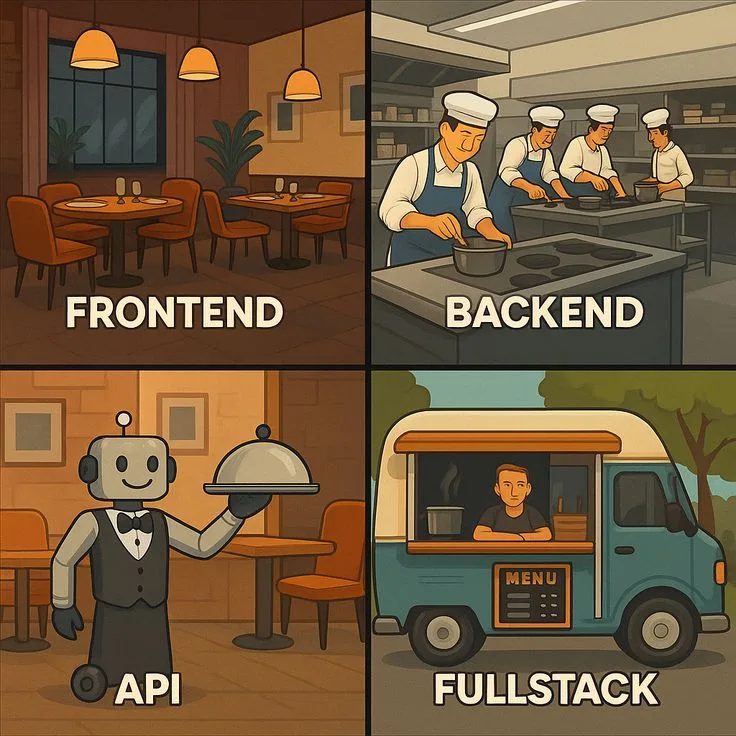
Frontend engineering, backend engineering, and fullstack engineering are three distinct specializations within software development that differ in technical domain, daily work, career trajectory, and compensation - though the boundaries between them have blurred significantly with the rise of JavaScript-everywhere architectures, server-side rendering frameworks, and AI coding assistants.
A frontend engineer builds the user-facing layer of applications: what you see and interact with in a browser or mobile app.
A backend engineer builds the server-side systems: APIs, databases, business logic, and the infrastructure that processes data at scale. A fullstack engineer works across both layers, trading depth for breadth.
Understanding these distinctions matters for career planning because each path develops different cognitive muscles, leads to different senior roles, and commands different compensation premiums. The engineer who chooses the wrong specialization - or fails to specialize at the right time - risks years of misaligned effort.
The engineer who understands all three domains well enough to make an informed choice, and then invests deeply, builds a career with both optionality and impact.
"The line between frontend and backend has been dissolving for fifteen years. The engineers who have thrived are the ones who understood systems well enough to work across it, but knew enough about user experience to care about what they were building." - Lea Verou, CSS Working Group member and MIT CSAIL researcher, JSConf 2023
Key Definitions
Frontend engineering: Development of the user-facing layer of software - typically web browsers or mobile clients.
The core domain includes HTML, CSS, JavaScript/TypeScript, UI frameworks (React, Vue, Angular, Svelte), accessibility, performance optimization, and the increasingly complex interface between client-side rendering and server-side rendering.
Backend engineering: Development of server-side systems - APIs, data processing, business logic, database interactions, authentication, and the infrastructure that handles application state at scale.
The core domain includes server-side languages (Python, Go, Java, Node.js, Rust, Ruby), databases (relational and non-relational), API design, caching strategies, and distributed systems.
Fullstack engineering: An engineer who can competently work across both the frontend and backend layers of an application. The term is genuinely ambiguous and means materially different things at a 10-person startup versus a 5,000-person company.
DevOps/Platform engineering: A related but distinct domain covering infrastructure automation, CI/CD pipelines, container orchestration, and cloud resource management. Increasingly recognized as a fourth specialization rather than a subset of backend - explored in detail in our article on what DevOps is.
TypeScript: A statically typed superset of JavaScript that compiles to JavaScript. Its adoption across both frontend and backend (via Node.js, Deno, Bun) has created more skill overlap between the two specializations than ever before. The State of JavaScript 2024 survey found that 89% of respondents used TypeScript, up from 63% in 2020.
Specialization Comparison at a Glance
| Dimension | Frontend | Backend | Fullstack |
|---|---|---|---|
| Primary environment | Browser, mobile client | Server, database, cloud | Both |
| Core languages | HTML, CSS, JavaScript/TypeScript | Python, Go, Java, Node.js, Rust | JS/TS + one server language |
| Database knowledge | Limited (reads from APIs) | Deep (design, optimization, scaling) | Working knowledge |
| System design depth | UI architecture, state management | Distributed systems, data modeling | Feature-level architecture |
| Performance focus | Rendering speed, bundle size, Core Web Vitals | Throughput, latency, scalability | Both at feature level |
| Security focus | XSS prevention, CSP, input validation | AuthN/AuthZ, OWASP, data protection | Both at feature level |
| Entry difficulty | Lower (immediate visual feedback) | Moderate (abstract concepts) | Moderate (breadth required) |
| Junior salary (US, 2025) | $85,000-$110,000 | $90,000-$120,000 | $85,000-$115,000 |
| Senior salary (US, 2025) | $170,000-$250,000 | $180,000-$280,000 | $160,000-$240,000 |
| Top-tier total comp | $280,000-$450,000 | $300,000-$500,000+ | $250,000-$400,000 |
Sources: Levels.fyi (2025), Hired State of Software Engineers (2024), Stack Overflow Developer Survey (2024).
The Frontend Engineering Domain
What Frontend Engineers Actually Build
Frontend engineering has undergone a dramatic transformation since the introduction of JavaScript frameworks in the mid-2000s.
What began as relatively straightforward HTML and CSS work has become a sophisticated engineering discipline encompassing component architecture, state management at scale, client-side routing, performance optimization, accessibility engineering, and the growing complexity of server-side rendering patterns.
A senior frontend engineer at a company like Airbnb or Stripe does not simply "make things look nice." They design component systems used by dozens of engineers across multiple product teams.
They optimize Core Web Vitals - Largest Contentful Paint (LCP), Cumulative Layout Shift (CLS), and Interaction to Next Paint (INP) - metrics that Google has used as ranking signals since 2021 and that directly affect both user experience and search visibility.
They implement accessibility to WCAG 2.2 standards, ensuring applications are usable by people with visual, motor, cognitive, and auditory disabilities. They architect state management solutions that keep complex application data consistent across dozens of components without performance degradation.
The shift toward meta-frameworks - Next.js (React-based), Nuxt (Vue-based), SvelteKit (Svelte-based), Remix, and Astro - has moved server-side rendering, data fetching, and even API routes back into the frontend engineer's domain.
A Next.js application can render pages on the server, stream HTML progressively, run API endpoints, interact with databases directly, and deploy to edge networks - all within what is technically a "frontend" framework.
This blurring has made the frontend domain significantly more complex than it was even five years ago.
The Technical Stack in Detail
React remains dominant, with an estimated 75-80% of frontend job postings requiring or preferring React experience (State of JavaScript Survey, 2024). Vue.js holds significant market share, particularly in enterprise environments and in Asia-Pacific markets.
Angular remains common in large enterprise applications, especially in financial services. Svelte has strong developer satisfaction ratings and growing adoption for new projects.
Beyond framework knowledge, senior frontend engineers need proficiency in:
- CSS architecture: CSS modules, Tailwind CSS, styled-components, or CSS-in-JS patterns
- Build tooling: Vite (now dominant), webpack, esbuild, SWC
- Testing: Jest, Vitest, React Testing Library, Playwright or Cypress for end-to-end testing
- Performance: Chrome DevTools profiling, Lighthouse audits, bundle analysis, lazy loading strategies
- Accessibility: Screen reader testing (NVDA, VoiceOver), ARIA attributes, keyboard navigation, color contrast
- Browser APIs: Web Workers, Service Workers, Intersection Observer, Web Components
What Frontend Engineering Is Not
Frontend engineering is not design. The confusion between "frontend" and "UX" persists across the industry, but they are distinct disciplines. Frontend engineers implement design systems; they do not create them.
A frontend engineer may collaborate closely with designers and provide technical feedback on feasibility, but the visual and interaction design itself is the domain of UX designers and UI designers.
Frontend engineering is also not exclusively JavaScript. WebAssembly allows languages like Rust, C++, and Go to run in the browser at near-native speed. Edge functions run JavaScript or WASM at CDN nodes around the world.
Server components in React and other frameworks execute on the server rather than the client. The frontier of frontend engineering increasingly includes server-side concerns.
Career Trajectory
Levels.fyi 2024 data shows senior frontend engineers at top-tier companies earning $280,000-$450,000 total compensation - broadly comparable to backend engineers at the same level, though the very highest compensation (staff engineer and above at FAANG) still skews slightly toward backend and infrastructure specializations.
The path to staff and principal roles for frontend engineers has historically been harder to navigate than for backend engineers, partly because frontend scope was perceived as narrower.
This is changing as frontend platform engineering (design systems, component libraries, build toolchain ownership, developer experience) has emerged as a clearer high-scope domain.
Spotify, Meta, and Airbnb all have staff-level frontend platform engineers who own systems used by hundreds of engineers.
The Backend Engineering Domain
What Backend Engineers Actually Build
Backend engineering covers the layer where data lives, business logic executes, and the rules of the application are enforced.
A user clicking "Buy Now" on an e-commerce site triggers a cascade of backend operations: validate the cart contents against current inventory, calculate taxes and shipping, process the payment through a payment gateway, create an order record in the database, enqueue fulfillment notifications, update inventory counts, and emit events for analytics and recommendation systems.
All of this must complete within 2-3 seconds, handle concurrent requests from thousands of users, and never lose money or create phantom orders even when individual components fail.
Core backend skills include:
- API design: REST (still the most common), GraphQL (growing, particularly for client-driven applications), gRPC (for high-performance inter-service communication). Understanding API versioning, rate limiting, pagination, and error handling is essential.
- Database design: Relational modeling (PostgreSQL, MySQL), NoSQL patterns (MongoDB, DynamoDB, Redis, Elasticsearch), query optimization, indexing strategies, and understanding when to use which type.
- Application security: Authentication (OAuth 2.0, JWT, session management), authorization (RBAC, ABAC), OWASP Top 10 vulnerabilities, input validation, and secure coding practices. See our article on authentication vs authorization for a deeper explanation.
- Reliability engineering: Error handling, circuit breaking, retry policies, observability (structured logging, distributed tracing, metrics), and graceful degradation.
- Cloud services: AWS, GCP, or Azure services for compute, storage, messaging, and networking.
Language Landscape
The specific languages valued in backend roles vary by industry and use case:
- Python: Dominant in startups, data-adjacent applications, and rapid prototyping. Frameworks: Django, FastAPI, Flask.
- Go: The language of choice for performance-critical services and infrastructure tools at Google, Uber, Cloudflare, Docker, and Kubernetes-ecosystem companies. Valued for its simplicity, performance, and built-in concurrency primitives.
- Java/Kotlin: Dominant in financial services, large enterprises, and Android development. The JVM ecosystem (Spring Boot, Gradle, Maven) remains the most mature enterprise backend environment.
- Node.js/TypeScript: Increasingly used for backend services, particularly at companies standardizing on TypeScript across the stack. Frameworks: Express, Fastify, NestJS.
- Rust: Growing in systems programming and performance-critical applications. Used at Discord, Cloudflare, and Figma for services where nanosecond-level performance matters.
- Ruby: Ruby on Rails remains the framework of choice for many B2B SaaS companies (Shopify, GitHub, Basecamp) that value developer productivity and rapid iteration.
Distributed Systems: The Premium Domain
The backend engineering specialization that commands the highest compensation premium is distributed systems and data infrastructure.
Engineers who understand consensus algorithms (Raft, Paxos), distributed transaction models (2PC, Saga pattern), eventual consistency, CAP theorem tradeoffs, and the operational properties of systems at thousands of requests per second are rare and expensive.
This knowledge is not developed through tutorials or bootcamps. It accumulates through years of operating production systems and reading foundational texts.
Martin Kleppmann's Designing Data-Intensive Applications (O'Reilly, 2017) remains the single most recommended book for engineers seeking to understand distributed systems - it has sold over 250,000 copies and consistently appears on "must-read" lists from engineering leaders at Google, Meta, and Stripe.
As Werner Vogels, CTO of Amazon, wrote in his influential 2007 paper on Amazon's architecture: "Everything fails all the time. The question is not whether your systems will fail - it is whether they are designed to recover gracefully when they do."
The Fullstack Engineering Reality
What Companies Actually Mean
The term "fullstack" carries materially different meanings depending on company size and engineering maturity:
At a 10-50 person startup: "Fullstack" means you build everything. Write the React frontend, build the Node.js or Python API, design the database schema, write migration scripts, configure the AWS infrastructure, set up the CI/CD pipeline, and handle whatever else needs doing.
There is no platform team, no infrastructure team, no dedicated frontend or backend engineers. You are the team.
At a 200-500 person company: "Fullstack" means a feature engineer who can write frontend components and backend API endpoints for a specific product area, within architectures and patterns that platform and infrastructure teams have already established.
You are not designing the database from scratch; you are adding tables and endpoints to an existing system.
At a 2,000+ person company: "Fullstack" is rare as a formal title but exists as a capability expectation for some product engineering roles.
It means you can pick up tickets on either side of the stack for your team's feature area, reducing the coordination overhead of having separate frontend and backend engineers for every feature.
The Depth-Breadth Tradeoff
Research from LinkedIn Talent Insights and Hired's annual State of Software Engineers reports consistently shows that specialist skills command higher compensation premiums than generalist fullstack skills at the senior level.
A senior backend engineer specializing in distributed systems earns 15-30% more than a senior fullstack engineer with equivalent total experience at the same company.
The generalist premium comes in employability (more roles accept fullstack profiles) and career flexibility (you can move between frontend and backend teams), not in peak compensation within a specific role.
Stack Overflow's 2024 Developer Survey found that 46% of respondents identified as fullstack developers, making it the single largest self-identified category.
But when asked to rate their proficiency, the median fullstack engineer rated themselves meaningfully lower in both frontend and backend specialization compared to dedicated specialists - a quantitative confirmation of the depth-versus-breadth tradeoff.
The conventional career wisdom that has emerged from engineering communities: go fullstack early in your career for breadth and employability, then specialize as you reach senior level if you want to maximize compensation and depth of impact.
How the Day-to-Day Differs: A Concrete Example
Consider building a dashboard chart that shows users their monthly activity over the past year. This single feature illustrates how differently each specialization approaches the same problem.
The frontend engineer's work:
- Design the component hierarchy (chart wrapper, data provider, tooltip component, legend, responsive container)
- Select and integrate a charting library (D3.js, Recharts, Chart.js, or Visx)
- Implement loading states (skeleton screens, spinners), error states (retry buttons, error messages), and empty states (no data illustration)
- Ensure the chart is accessible: provide text alternatives for screen readers, support keyboard navigation for interactive elements, maintain sufficient color contrast
- Test across browsers (Chrome, Firefox, Safari, Edge) and screen sizes
- Optimize rendering so the chart does not cause layout shift (CLS) or block the main thread (INP)
The backend engineer's work:
- Design the SQL query to aggregate monthly activity data efficiently at scale (consider that this query might run for millions of users)
- Add appropriate database indexes to prevent the aggregation from becoming a full table scan
- Expose a REST or GraphQL endpoint with the right data shape, pagination, and caching headers
- Implement caching (Redis, CDN-level) so the expensive aggregation query does not execute on every page load
- Write tests for edge cases: users with no activity, users who joined mid-year, timezone handling, leap years
- Add observability: logging, latency metrics, error tracking
The fullstack engineer does both - which in a startup context is often the right economic choice, but at the cost of depth in either direction. An engineer who spends two weeks on this feature builds a working version.
A dedicated frontend or backend specialist spending the same time on their half builds something significantly more robust, performant, and maintainable.
The Impact of AI Coding Tools on Specialization
GitHub Copilot, Cursor, Claude, and other AI coding assistants have materially changed what it means to be a fullstack engineer, and the implications deserve careful analysis rather than hype or dismissal.
What AI Tools Actually Change
Tasks that previously required moderate domain knowledge - scaffolding a REST API endpoint, writing database migration scripts, generating boilerplate React components, creating CSS layouts, writing unit tests - can now be produced in seconds with appropriate prompting.
GitHub's own research (Kalliamvakou et al., 2022) found that developers using Copilot completed tasks 55% faster than those without it, with the strongest gains in routine, well-patterned code.
This has two implications:
First, the floor of competence is lower for generalists. An engineer with moderate backend knowledge can now produce reasonable API code with AI assistance, making the "fullstack" claim more credible for a wider range of engineers.
This is genuinely useful for individual productivity and for small teams where hiring specialists for every domain is impractical.
Second, the value of deep specialization has increased relative to surface-level breadth. AI tools excel at generating conventional code within known patterns.
They are significantly less useful at designing novel architectures, debugging complex distributed system failures, optimizing database query plans for specific workload characteristics, making defensible tradeoffs in high-stakes systems, or identifying subtle performance regressions that manifest only under production traffic patterns.
These tasks require judgment that develops through years of deep domain experience.
As Gergely Orosz wrote in The Pragmatic Engineer (2024): "AI tools are making the 'T-shaped' engineer more valuable than ever. You need broad understanding to use AI effectively across domains, and deep expertise in at least one area where AI-generated code is not sufficient."
The engineers most affected by AI coding tools are those whose primary value was productivity at routine implementation tasks.
The engineers least affected are those whose value comes from system design judgment, deep debugging expertise, and the architectural instincts that develop only through sustained practice in a specific domain.
Understanding how AI is changing software engineering is essential context for career planning in this field.
Market Demand Through 2026
LinkedIn's Jobs on the Rise reports (2023, 2024) and Hired's State of Software Engineers data reveal clear trends:
Fullstack roles represent the largest volume of job postings - approximately 40-45% of software engineering positions. This reflects the reality that most companies, especially startups and mid-size firms, want engineers who can own features end-to-end.
Backend roles, particularly in cloud, AI/ML infrastructure, and distributed systems, are the fastest-growing demand category. The explosion of AI applications has created enormous demand for backend engineers who can build the serving infrastructure, data pipelines, and API layers that make ML models useful in production.
Frontend-only roles have declined as a share of postings but have not disappeared. The decline reflects companies preferring engineers with enough backend knowledge to own features completely.
However, specialized frontend engineering - performance optimization, accessibility engineering, design systems, frontend platform engineering - continues to command premium compensation at companies with large user-facing products.
DevOps/Platform engineering has emerged as a distinct fourth category with strong demand and compensation. Engineers who understand Kubernetes, CI/CD pipelines, and cloud infrastructure are in consistently short supply.
How to Choose Your Direction
The most practical guidance is to start where the feedback loops are fastest for you. Learning programming is hard; motivation is the scarce resource, not information.
If you find immediate visual feedback satisfying - seeing a UI change when you modify CSS, watching a button animation come to life, making a form work - frontend will be more motivating to learn.
If you find modeling data, designing APIs, and understanding how systems work under the hood more intellectually engaging than visual interfaces, backend will hold your attention through the long learning curve.
Decision Framework
| If you... | Consider... | Because... |
|---|---|---|
| Enjoy visual feedback and user interaction | Frontend | Immediate feedback loops sustain motivation |
| Think in data structures and system flows | Backend | Aligns with how you naturally reason |
| Want maximum early-career employability | Fullstack | More roles available, especially at startups |
| Want highest senior-level compensation | Backend (distributed systems) | Scarcity premium for deep infrastructure expertise |
| Have strong design sensibility | Frontend | Rare skill combination that commands premium pay |
| Want to work on AI/ML infrastructure | Backend | The serving and data layer is backend territory |
| Are career-switching and need a job fast | Frontend | Lower barrier to first job; visual portfolio helps |
Do not choose based on salary data alone. The compensation differences between frontend and backend at mid-level are small enough (5-15%) that they should not override genuine preference.
The engineer deeply engaged with their domain outperforms the engineer who chose a specialization for a marginal salary premium over a decade-long career.
As Cal Newport argues in So Good They Can't Ignore You (2012), career satisfaction comes from developing rare and valuable skills, not from matching passion - and you develop skills fastest in a domain you find genuinely interesting.
Practical Takeaways
Learn enough of the other side to be effective. Even a dedicated frontend engineer benefits from understanding database query performance and API design patterns; even a dedicated backend engineer benefits from understanding how API response shapes affect UI rendering and user experience.
"T-shaped" competence - deep in one area, working knowledge across others - is the most consistently valued profile.
If entering the field, JavaScript/TypeScript and Python are the most strategically valuable first languages. TypeScript covers both frontend (React, Vue, Svelte) and backend (Node.js, Deno), while Python dominates in data, AI/ML, and rapid backend prototyping. Together, they cover the widest possible range of job opportunities.
The fullstack identity is most valuable early in career and at smaller companies. As you gain experience and move to larger organizations, the specialist identity - senior frontend engineer, senior backend engineer, distributed systems engineer - becomes more valuable for compensation and scope of contribution.
Build projects, not just skills. A portfolio demonstrating end-to-end capability - a deployed application with a React frontend, a REST API, a database, and CI/CD pipeline - is worth more than certifications in the hiring process at most companies.
The software engineer interview process article covers how to convert projects into interview success.
Invest in fundamentals that transcend frameworks. React will be replaced. Django will evolve. AWS services will change. But understanding HTTP, TCP/IP, database indexing, algorithmic complexity, concurrency, and caching will remain relevant for your entire career.
The engineers who navigate technology shifts most smoothly are those with the strongest fundamentals, not those with the most framework-specific knowledge.
Sources & Further Reading
- State of JavaScript Survey. (2024). State of JavaScript 2024. View source
- Stack Overflow. (2024). Developer Survey 2024. View source
- Levels.fyi. (2025). Software Engineer Compensation by Specialization. View source
- Hired. (2024). State of Software Engineers 2024. View source
- LinkedIn Talent Insights. (2024). Jobs on the Rise 2024: Technology Roles. View source
- Orosz, G. (2024). The Pragmatic Engineer Newsletter: Frontend vs Backend vs Fullstack Demand. View source
- Kleppmann, M. (2017). Designing Data-Intensive Applications: The Big Ideas Behind Reliable, Scalable, and Maintainable Data Systems. O'Reilly Media.
- Newport, C. (2012). So Good They Can't Ignore You: Why Skills Trump Passion in the Quest for Work You Love. Grand Central Publishing.
- Kalliamvakou, E., et al. (2022). Research: Quantifying GitHub Copilot's Impact on Developer Productivity and Happiness. GitHub Blog.
- Verou, L. (2023). Talk at JSConf. View source
- W3C Web Accessibility Initiative. (2023). Web Content Accessibility Guidelines 2.2. View source
- Chrome Developer Blog. (2024). Core Web Vitals and Interaction to Next Paint. View source
- Vogels, W. (2007). Amazon's Dynamo: Architecture and Design. All Things Distributed. View source
- TIOBE Index. (2025). Programming Language Popularity Rankings. View source
- Thoughtworks Technology Radar. (2024). Volume 31. View source
- GitHub. (2024). The State of the Octoverse: AI and Developer Productivity. View source