
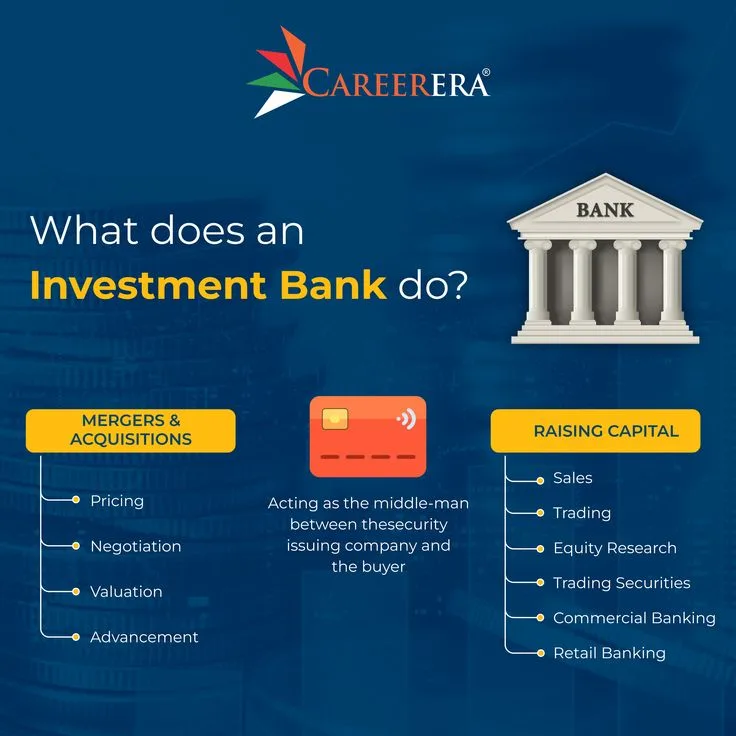
Banks advise clients on transactions such as acquisitions, share offerings, debt issuance, and restructurings, earning fees rather than investing their own capital in the deal. Investment banking careers are sharply hierarchical: analysts build models, materials, and diligence support, while senior staff manage clients and win mandates. The path combines accelerated transaction exposure, compensation, and demanding hours.
Investment banking has a peculiar reputation: simultaneously envied for its compensation and pitied for its demands. The stories of 100-hour work weeks, analyst pitch books completed at 3am, and relentless client pressure are not myth.
But neither is the compensation, the professional network, nor the accelerated exposure to high-stakes financial transactions that analysts receive in their first two years.
Understanding what investment bankers actually do - and what they trade to do it - is essential for anyone seriously considering the path.
The term 'investment banking' covers several meaningfully distinct activities that are frequently conflated.[3] An investment banker could be an M&A adviser structuring the sale of a $4 billion industrial conglomerate.
They could be an ECM banker managing a company's IPO, pricing and allocating shares worth hundreds of millions.
They could be a DCM banker arranging a high-yield bond issuance to finance a leveraged buyout. They could be a restructuring adviser helping a retailer negotiate with its creditors while avoiding Chapter 11.
In all these cases, the bank acts as an expert intermediary, earning fees for facilitating transactions rather than risking its own capital - distinguishing investment banking advisory from proprietary trading, which is a separate business.
This article examines the full mechanics of the investment banking career: what analysts and associates actually produce day-to-day, how every major deal type works, the anatomy of the models built to support transactions, how fees are structured, the differences between bulge bracket banks, elite boutiques, and middle market firms, salary progression, and what exit opportunities arise for those who complete the analyst programme.
"Investment banking is a place where smart, ambitious people are willing to be treated terribly for a few years in exchange for a credential that opens almost every door in finance." - Anonymous former Goldman Sachs analyst, widely circulated in industry forums
Key Definitions
Bulge Bracket: The largest global, full-service investment banks - Goldman Sachs, Morgan Stanley, JP Morgan, Bank of America, Citigroup, Barclays, UBS, Deutsche Bank. Characterised by coverage across all deal types, global footprint, large balance sheets, and significant market share in league tables.[8]
Elite Boutique: Independent advisory firms focused exclusively on advisory services without the balance sheet lending and capital markets distribution businesses of bulge brackets. Lazard, Evercore, Centerview, PJT Partners, and Moelis are the main US examples.
Often pay as well as or better than bulge brackets per banker while offering more concentrated exposure to complex advisory work.
Middle Market: Regional and mid-size banks (Jefferies, William Blair, Baird, Houlihan Lokey, Piper Sandler) serving companies with enterprise values typically between $100 million and $1 billion. Less competitive to enter, with somewhat lower all-in compensation but often stronger deal volume exposure for junior bankers.
Enterprise Value (EV): The total value of a business - equity value plus net debt. Used as the basis for most deal valuations and multiples (EV/EBITDA, EV/Revenue).
EBITDA: Earnings Before Interest, Taxes, Depreciation, and Amortisation. The most commonly used proxy for operating cash flow in valuation work and deal negotiation.
Mandate: A formal agreement under which a bank is retained to advise on a transaction. Winning mandates - origination - is the core activity of senior investment bankers.
What Investment Bankers Do Day-to-Day
The day-to-day work is determined almost entirely by seniority level. Investment banking has a clear, steep hierarchy with very different role definitions at each level.[2]
| Level | Years in Role | Primary Activities | Client Contact |
|---|---|---|---|
| Analyst | 1-2 years | Financial modelling, pitch book production, due diligence support, data room management | Minimal; occasional calls with counterparty junior team |
| Associate | 2-4 years | Model review, project management, client communication on execution matters, analyst oversight | Regular on execution; limited on origination |
| Vice President | 3-5 years | Day-to-day client relationship management, transaction coordination, business development support | Significant; own client relationships developing |
| Director / Executive Director | 2-4 years | Mandate origination support, senior client relationships, deal leadership | Primary relationship holder for mid-tier clients |
| Managing Director | Indefinite | Revenue generation, senior client relationships, pitching for mandates, internal resource allocation | Owns senior client relationships entirely |
The analyst experience in detail: Analysts are the production engine of investment banking. A typical week during a live M&A process: Monday might involve updating a discounted cash flow (DCF) model after the target company releases updated projections, rebuilding three scenarios, and formatting the output for an MD review meeting.
Tuesday might be spent building a comparable companies analysis, pulling revenue multiples from Capital IQ for 15 peer companies, and preparing a 12-slide market position section for a pitch book.
Wednesday might be an all-nighter after a senior banker decides the pitch book needs a full restructure at 9pm for a 7am presentation. Thursday might be a data room review for a live process - reading through 200 pages of due diligence materials and flagging items for the deal team.
Friday is a catch-up day that becomes a Saturday when a client calls with questions about the model.
This is not the exception. It is the pattern during busy periods, which are not infrequent.
Deal Types: How Every Major Transaction Works
Mergers and Acquisitions (M&A)
M&A is the deal type most associated with investment banking in public perception and represents the highest-margin advisory work.
Sell-side M&A: A company or private equity fund retains a bank to manage the sale of a business.
The bank runs a structured sales process: preparing a Confidential Information Memorandum (CIM), identifying and approaching potential buyers, running a first-round and second-round bid process, facilitating management presentations and due diligence, negotiating the sale and purchase agreement, and closing.
Timeline: 4-9 months. Fees: 1-2% of transaction value for mid-market deals ($250M-$1B), declining to 0.25-0.75% for large transactions above $5B.
Buy-side M&A: A strategic acquirer or PE fund retains a bank to identify and advise on acquisition targets, conduct valuation, structure the bid, and negotiate the deal. The bank helps the buyer avoid overpaying, constructs the valuation and synergy case, and manages the execution process.
Timeline: similar. Fees: typically lower than sell-side (0.5-1%) because the bank is not running the process.
A $500 million sell-side deal at 1% generates $5 million in advisory fees. A $10 billion deal at 0.4% generates $40 million. The economics of the business are driven entirely by deal flow at the top of the size distribution.
Equity Capital Markets (ECM)
ECM helps companies raise equity capital from public markets.
IPO (Initial Public Offering): A private company lists shares on a public exchange for the first time.
The bank (acting as bookrunner) helps set the IPO price, builds the order book from institutional investors, manages the road show (where management presents to hundreds of investors over two weeks), stabilises the share price after listing, and provides aftermarket analyst coverage.
ECM fees on IPOs typically run 3.5-7% of gross proceeds - a $500 million IPO generates $17-35 million in fees distributed across the syndicate. Timeline: 3-6 months from mandate to listing.
Follow-on offerings: Additional share issuances from already-listed companies to raise capital for acquisitions or debt reduction. Faster and cheaper than IPOs; fees are 2-4% of proceeds.
Convertible bonds: Debt instruments that convert to equity under specified conditions. A hybrid instrument used by growth companies seeking lower-cost debt with some equity upside for investors.
Debt Capital Markets (DCM)
DCM arranges debt financing for corporations and governments.
Investment-grade bond issuance: A corporation issues bonds to institutional investors. The bank structures the deal, pitches terms to the market, builds the order book, and prices the bonds. Fees: 0.2-0.4% of proceeds - lower margin than equity or M&A but extremely high volume.
A national bank might run dozens of investment-grade bond deals in a month.
High-yield (leveraged) bonds: Issued by sub-investment-grade companies, typically to finance acquisitions or recapitalisations. Fees run 1.5-3.5% of proceeds. Closely tied to leveraged buyout activity.
Leveraged Finance
A specialised DCM sub-division arranging debt specifically for private equity-backed leveraged buyouts.
The leveraged finance team structures a debt package (term loans, revolving credit facilities, high-yield bonds) that finances the acquisition and sits against the target company's assets and cash flows. This desk is the primary feeder into PE careers from the DCM side.
Restructuring
The counter-cyclical deal type. Advises companies experiencing financial distress - debt levels they cannot service, covenant breaches, or outright insolvency - on options: debt restructuring, distressed debt exchanges, Chapter 11 bankruptcy reorganisation, or liquidation.
Also advises creditors (lenders and bondholders) in contested restructurings. Activity increases during economic downturns when M&A and ECM markets slow. Restructuring bankers develop expertise in bankruptcy law, credit analysis, and negotiation dynamics that is distinct from standard M&A or capital markets work.
Financial Models: What Analysts Actually Build
Financial modelling is the core technical skill of investment banking. The models analysts build daily are the quantitative foundation for deal advice, valuation opinions, and pitch books.
| Model Type | Purpose | Key Inputs | Key Outputs |
|---|---|---|---|
| DCF (Discounted Cash Flow) | Intrinsic value of a business | Revenue projections, margins, capex, WACC, terminal growth rate | Enterprise value; equity value per share |
| Comparable Companies Analysis (Comps) | Relative valuation vs peers | Revenue, EBITDA, EV multiples for peer group | Implied valuation range for target |
| Precedent Transactions Analysis | Valuation based on similar past deals | Transaction multiples (EV/EBITDA) from comparable M&A | Implied valuation range; acquisition premium assessment |
| LBO Model (Leveraged Buyout) | Returns analysis for private equity acquisition | Purchase price, debt structure, operational assumptions, exit multiple | IRR and MoIC for PE fund at various exit scenarios |
| Merger Model (Accretion/Dilution) | Impact of acquisition on acquirer's EPS | Target financials, deal structure (stock vs cash), synergies | EPS accretion/dilution; break-even synergies required |
| Sum-of-the-Parts (SOTP) | Valuation of a diversified conglomerate | Individual business unit valuations using appropriate methods | Total enterprise value; implied discount/premium to market cap |
The DCF is the most conceptually important model but often the least decisive in practice.[10] Small changes to WACC or terminal growth rate assumptions produce enormous changes in valuation output - a quality that makes the model useful for framing a valuation range but unreliable as a precise number.
Experienced bankers use DCF to sense-check valuation and present range scenarios rather than defend a point estimate.
The LBO model is the test of technical competence most frequently administered in investment banking interviews.
It requires understanding the deal's capital structure (debt-to-equity mix), modelling debt paydown over a hold period, calculating exit equity value at various EBITDA multiples, and working backwards to implied returns.
Mastery of the LBO model is effectively prerequisite for private equity interviews.
Comparable companies analysis (comps) is the most heavily used method in pitch books and fairness opinions. It is faster to run than a DCF and anchors to observable market data, which clients and counterparties find more persuasive than discounted cash flow projections that depend on assumptions no one can verify.
The Pitch Book: Anatomy of the Primary Work Product
The pitch book is a presentation deck, typically 30-80 slides, prepared by a bank to win or support a transaction mandate. Pitch book production is the activity that consumes most of an analyst's late-night hours.
A typical M&A pitch book for a sell-side mandate contains:
- Executive summary: The investment thesis for selling now; market conditions; headline valuation range
- Industry overview: Market size, growth, trends, competitive dynamics, comparable transaction activity
- Company overview: Business description, revenue and earnings history, strategic positioning, management team
- Valuation analysis: Comparable companies analysis, precedent transactions, DCF analysis, football field chart showing the valuation range from each method
- Process recommendation: Proposed sale process structure (broad auction vs targeted process), timeline, key considerations
- Bank credentials: League table rankings, relevant deal tombstones, relevant team member profiles
- Appendices: Detailed financial model exhibits, expanded comparable company data, additional due diligence exhibits
The football field chart - a horizontal bar chart showing the valuation range from each methodology side by side - is the most important single exhibit in a sell-side pitch book. It presents the range of possible valuations and typically shows where different methodologies agree and diverge.
Bank Tiers: Bulge Bracket vs Elite Boutique vs Middle Market
The distinction between bank types matters for compensation, deal exposure, and exit opportunities.
| Dimension | Bulge Bracket | Elite Boutique | Middle Market |
|---|---|---|---|
| Examples | Goldman, Morgan Stanley, JP Morgan, Barclays | Evercore, Lazard, Centerview, PJT Partners | Jefferies, Houlihan Lokey, William Blair, Baird |
| Deal size | $500M+ (typically much larger) | $250M-$50B+ (varies by firm) | $50M-$500M primarily |
| Products covered | Full service: M&A, ECM, DCM, LevFin, S&T, Research | Advisory only (M&A, restructuring) | M&A, some ECM/DCM |
| Analyst all-in comp (US, 2024) | $190,000-$230,000 | $200,000-$260,000 | $130,000-$180,000 |
| Brand for PE recruiting | Maximum (Goldman, Morgan Stanley top-ranked) | Very strong (Evercore, Centerview highly regarded) | Moderate; regional PE access |
| Deal exposure for analysts | Can be relegated to process management on large deals | Higher advisory responsibility per deal | Often more direct deal exposure |
| Work intensity | Extremely high; 80-100hr average | High; similar or worse than BB | Moderate-high; 60-80hr average |
Elite boutiques represent an interesting counterpoint to bulge bracket banks. Because they have no balance sheet lending business or capital markets distribution, they compete for mandates purely on advisory quality.
This creates a culture where advisory skill is more purely rewarded - senior bankers at Centerview or Evercore who consistently win mandates command significant compensation - and where analysts may work on higher-ratio deal volume to total headcount than at bulge brackets, giving more concentrated learning.
How Investment Banking Fees Work
The fee structures in investment banking are percentage-based, creating enormous leverage on deal size.[6]
Retainer fees: Monthly fees paid to keep the bank on retainer during an active process, typically $50,000-$200,000/month for mid-market deals, credited against the success fee.
Success fees: The primary revenue event. Paid only upon transaction completion. The percentage declines on a sliding scale as deal size increases (because even a small percentage of a very large deal is a very large absolute number).
Break fees: Sometimes negotiated when a deal terminates before completion for reasons outside the bank's control.
Tombstones: Public announcements of completed deals. Banks use these aggressively in marketing materials and pitch books; they are the industry's equivalent of a portfolio.
The fee structure aligns bank incentives with deal completion, which serves clients in most cases but creates an inherent tension: banks are paid more when deals close than when they do not, regardless of whether closing was optimal for the client.
This tension is managed through reputation - a bank that consistently advises on value-destructive deals loses mandates - but it is real.
Division Comparison: IBD, S&T, Research, Asset Management, Private Wealth
'Investment bank' is an umbrella. The major divisions have entirely different cultures, compensation structures, and career paths.
| Division | What It Does | Culture | Comp Structure | Exit Opportunities |
|---|---|---|---|---|
| IBD (Investment Banking Division) | M&A, ECM, DCM advisory | Hierarchical, deal-driven, very long hours | Base + large annual bonus | PE, VC, corporate development, MBA |
| S&T (Sales and Trading) | Buying and selling securities for clients and proprietary book | Fast, market-driven, less hierarchical | Base + performance-based bonus, often daily P&L driven | Hedge funds (most natural exit), prop trading |
| Research | Analysing companies and industries; producing equity/credit research | Analytical, writing-intensive; market hours | Base + bonus (lower than IBD at junior levels) | Buy-side research, fundamental equity hedge funds |
| Asset Management | Managing investment portfolios for institutional and retail clients | Longer-term investment orientation, less deal pressure | Base + AUM-linked bonus | Institutional investing, endowments |
| Private Wealth Management | Managing portfolios and financial planning for high-net-worth individuals | Client relationship focus; sales orientation | Base + revenue share on AUM | RIA firms, family offices |
IBD is the highest-compensation division at junior levels and the one most associated with 'investment banking' in public discourse. S&T offers faster feedback loops (you know within hours if a trade worked) and more meritocratic compensation structures where individual performance is more directly visible.
Research is the most intellectually focused division but has seen headcount cuts following MiFID II unbundling in Europe and similar pressures in the US.[7]
Culture and the Analyst Experience
The analyst experience has been extensively documented, publicly debated, and modestly reformed following high-profile burnout reports.[5] In 2021, a leaked Goldman Sachs survey of 13 first-year analysts reported working averages of 95 hours per week with consistent sleep deprivation.[9]
The bank's response - modest adjustments to protected time policies and base salary increases - acknowledged the problem without fundamentally restructuring the model.
What remains true in 2024:
- 80-100 hour weeks during active deal periods are standard at bulge brackets
- Last-minute pitch book revisions and overnight model updates are routine features of live transactions
- 'Face time' culture persists in many groups - being visibly present signals commitment
- The work is primarily execution at junior levels, not strategy
What has improved:
- Base salaries increased dramatically in 2021: Year 1 analyst bases went from $85,000 to $110,000 across bulge brackets following competitive pressure[1]
- Some banks formally protect one weekend day per week during non-deal periods
- Remote work flexibility has been partially maintained at some firms and groups
- Mental health resources and reporting lines are more visible, though cultural pressure to avoid using them remains
The cultural experience varies significantly by group, bank, and geography. Restructuring groups, healthcare, and technology coverage groups have distinct reputations that are worth researching specifically through network conversations before accepting an offer. The group matters as much as the bank.
Salary and Compensation
US Bulge Bracket and Elite Boutique (2024 Estimates, WSO Survey Data)
| Level | Base | Typical Bonus | Total All-In |
|---|---|---|---|
| Analyst Year 1 | $110,000 | $80,000-$120,000 | $190,000-$230,000 |
| Analyst Year 2 | $110,000 | $90,000-$150,000 | $200,000-$260,000 |
| Associate Year 1 (post-MBA) | $175,000-$200,000 | $100,000-$175,000 | $275,000-$375,000 |
| Vice President | $250,000-$350,000 | $200,000-$400,000 | $450,000-$750,000 |
| Director / Executive Director | $350,000-$450,000 | $400,000-$700,000 | $750,000-$1,150,000 |
| Managing Director | $500,000-$800,000 | $1,000,000-$5,000,000+ | Highly variable |
London (UK) all-in compensation typically runs approximately 30-40% below US figures at analyst and associate levels. Year 1 analyst all-in in London: approximately 90,000-130,000.[11] The discount reflects lower cost of living in non-London locations, different banking market structures, and lower fee volumes in European M&A.
Elite boutiques (Centerview, Evercore, PJT Partners) often pay more than bulge brackets at analyst and associate levels. Their higher per-banker revenue and simpler cost structure allow them to pay competitive or superior compensation while maintaining smaller headcounts and more focused cultures.
Exit Opportunities
Investment banking analyst programmes are, for many participants, a deliberate 2-year credential before transitioning into a more desirable role elsewhere. The banking exit is well-understood and the pathways are structured.
Private equity (most sought-after): 2-year IBD analysts are the primary recruiting target for LBO-focused PE funds.[12] The analytical skills transfer directly - PE firms want analysts who can build LBO models, conduct due diligence, and manage deal processes.
On-cycle recruiting (beginning in September of Year 1 for roles starting in Year 3) for top funds is intensely competitive. Goldman and Morgan Stanley M&A analysts feed into Blackstone, KKR, Apollo, and Carlyle; boutique analysts into mid-market and growth equity funds.
Hedge funds: Event-driven and credit-focused hedge funds (Citadel, Millennium, Point72, Sculptor) recruit directly from IBD. Fundamental equity hedge funds prefer analysts from industry coverage groups (technology, healthcare, consumer) with strong sector research exposure.
Venture capital: Less common directly from banking than PE. VC firms value operational insight and market judgment more than financial modelling skill. Technology coverage bankers and healthcare bankers are best positioned. Many VC associates complete a PE stint before transitioning.
Corporate development: M&A roles within operating companies - managing acquisitions, divestitures, and strategic investments from the corporate side.
Lower compensation than banking (typically $120,000-$180,000 all-in at Fortune 500 companies) but more strategic work, far better hours, and meaningful equity or long-term incentive compensation.
MBA: A top MBA (Wharton, Harvard, Columbia, LBS, INSEAD) is highly accessible following 2 years of IBD experience and opens broad post-MBA career options across consulting, technology, PE, and general management.
How to Break In
The standard route: Target university undergraduate degree (economics, finance, mathematics, engineering) competitive summer analyst internship after the penultimate year convert to full-time analyst offer. The vast majority of full-time analyst positions go to returning interns.
Applications at bulge brackets typically open in September for internships starting the following June - a year in advance.
The MBA route: For career changers and non-target university candidates, a top-school MBA provides a structured re-entry. Banks hire associates primarily through MBA programmes at target schools (Wharton, Harvard, Booth, Kellogg, Columbia, LBS, INSEAD).
The non-target route: Possible but requires exceptional grades, relentless proactive networking, and often starting at a regional boutique or middle-market firm before lateral movement to a larger platform.
Technical preparation: Excel modelling proficiency is expected on day one. Accounting basics (income statement, balance sheet, cash flow statement linkage) should be command knowledge. Familiarity with EV, EBITDA multiples, and the concept of M&A synergies signals genuine preparation.
Most banks use structured technical interviews testing model construction and valuation concepts alongside competency-based questions.[4]
Practical Takeaways
Investment banking is a legitimate career for those who find deal-making, financial analysis, and client relationship dynamics genuinely interesting - and an expensive 2-year detour for those who are primarily motivated by compensation and prestige and find the work itself unrewarding.
Start networking with bankers on LinkedIn and through alumni connections a full year before applications open. Prepare a stock pitch and a current M&A market opinion - both come up in almost every interview.
Build your Excel and accounting foundations to command level before applying. If a bulge bracket is not accessible from your university, starting at a regional boutique and moving laterally after 12-18 months of deal experience is a well-travelled path.
The exit opportunities are real and valuable; what you trade for them is also real and should be weighed accordingly.
Sources & Further Reading
- Wall Street Oasis. Investment Banking Salary Survey (2024). wallstreetoasis.com
- Bureau of Labor Statistics. Financial Analysts Occupational Outlook (2023). bls.gov
- Mergers and Inquisitions. Investment Banking Industry Guide (2024). mergersandinquisitions.com
- Breaking Into Wall Street. Investment Banking Interview Guide (2024). breakingintowallstreet.com
- Roose, Kevin. Young Money: Inside the Hidden World of Wall Street's Post-Crash Recruits. Grand Central Publishing, 2014.
- Liaw, K. Thomas. The Business of Investment Banking. Wiley, 2011.
- Financial Conduct Authority. Investment Banking Market Report (2023). fca.org.uk
- Dealogic. Global M&A League Tables (2024). dealogic.com
- Goldman Sachs. First-Year Analyst Survey on Working Conditions (2021). goldmansachs.com
- Damodaran, Aswath. Investment Valuation: Tools and Techniques. Wiley, 2012.
- Bloomberg. Investment Banking Analyst Pay Survey (2024). bloomberg.com
- Harvard Business School. Investment Banking Career Statistics (2023). hbs.edu