
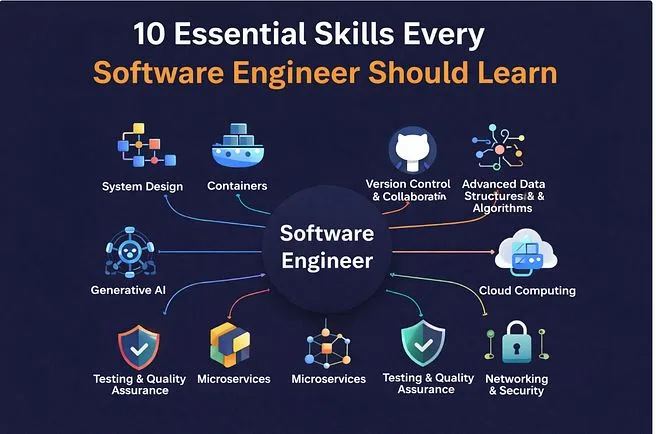
Software engineering skills fall into two broad categories: the technical abilities required to write, test, and deploy code, and the non-technical capabilities - communication, judgment, estimation, and organizational navigation - that determine whether an engineer's technical work actually reaches its potential.
The most important insight from decades of research on engineering effectiveness is that technical skill alone is necessary but never sufficient.
What separates high-performing engineers from average ones, at every level beyond junior, is the combination of deep technical competence with the ability to communicate clearly, make sound tradeoffs under uncertainty, and work effectively within human organizational systems.
This is not a beginner's checklist of programming languages to learn. It is a comprehensive map of the full skill set required across a software engineering career, organized by career level, with specific attention to what distinguishes each stage from the one below it - and what the research says about which skills actually predict career success.
"I have never seen a software engineer fail because they did not know an algorithm. I have seen many fail because they could not write clearly, could not work through conflict with a colleague, or could not explain a technical decision to a non-technical stakeholder."
- Dan Na, engineering director, "Pushing Through Friction" blog, 2022
Key Definitions
Technical judgment: The ability to identify the appropriate solution for a specific context, weighing technical quality against pragmatic constraints like timeline, team capability, and maintenance burden. Distinguished from technical knowledge by the element of situational reasoning - knowing not just what is possible but what is wise.
Systems thinking: The ability to reason about how components interact within a larger whole - how a change in one part of a system affects others, how failure modes propagate, how technical decisions made today constrain choices available in the future.
Engineers with strong systems thinking catch problems that no amount of local code quality can prevent.
Engineering scope: The breadth of impact an engineer is expected to own. At junior level, a single feature. At senior level, a full service or product area. At staff level, multiple teams and product areas. Scope expansion is the defining characteristic of career growth in software engineering.
Technical debt: Accumulated shortcuts, suboptimal architectural decisions, and deferred maintenance in a codebase that increase the cost of future development. Managing technical debt is a core senior engineer responsibility, not an engineering manager concern.
The test pyramid: A framework for structuring automated tests - many unit tests (fast, isolated), fewer integration tests (service interactions), minimal end-to-end tests (full stack user journeys). Departing from the pyramid produces slow, brittle test suites that hinder rather than help development velocity.
Software Engineer Skills by Career Level
| Skill | Junior | Mid-Level | Senior | Staff / Principal |
|---|---|---|---|---|
| Programming language mastery | 1 language (developing) | 1-2 languages (fluent) | 1-2 languages (deep) + breadth | Deep + architectural awareness |
| Data structures & algorithms | Interview ready | Applied daily | Applied + mentors others | Guides team choices |
| System design | Basic understanding | Design features end-to-end | Design services and APIs | Cross-team architecture influence |
| Testing practices | Unit tests | Full test pyramid | Drives team testing culture | Defines testing strategy |
| Cloud / infrastructure | Aware | Deploys and debugs | Owns operational health | Architectural decisions |
| Written communication | PR descriptions | Design docs | Polished technical proposals | Org-level technical strategy |
| Estimation | Learning | Reliable within a sprint | Estimates across quarters | Scope management across teams |
| Stakeholder communication | Minimal | Collaborates with PM/design | Presents to VP+ | Influences cross-org decisions |
| Mentorship | Receives mentoring | Mentors interns | Mentors mid-level engineers | Sets engineering culture |
Understanding this progression is critical because most engineers overinvest in the skills that got them hired and underinvest in the skills that would get them promoted.
The Stack Overflow Developer Survey (2024) found that 72% of developers spend their self-study time on new programming languages and frameworks, while less than 15% deliberately practice writing, estimation, or stakeholder communication - the very skills that engineering managers consistently cite as promotion differentiators.
Technical Skills: The Foundation
Programming Language Mastery
Every software engineer needs deep mastery in at least one programming language - not surface familiarity, but the kind of understanding that includes the language's memory model, its standard library, its idiomatic patterns, and its performance characteristics.
The difference between knowing a language and mastering it is the difference between being able to write code that works and being able to write code that is readable, maintainable, and performant.
Consider the case of a mid-level Python developer who knows the syntax well but has never studied Python's Global Interpreter Lock (GIL).
When their web service starts dropping requests under load, they reach for multithreading - a reasonable instinct in most languages - only to discover that CPU-bound Python threads do not actually execute in parallel.
An engineer with deep language knowledge would have reached for multiprocessing or async I/O immediately, saving days of debugging and architectural rework.
The most strategically valuable languages as of 2025, based on job market demand and compensation data from the Stack Overflow Developer Survey (2024) and LinkedIn Talent Insights: Python (dominant in data engineering, ML, and startup backend work), JavaScript/TypeScript (the only language that works natively in browsers, and increasingly the default for Node.js backend and modern React frontend), Java and Kotlin (dominant in Android development and financial services backend), and Go (the preferred language for performance-critical infrastructure at companies including Google, Uber, and Cloudflare).
Rust is growing in importance for systems programming, and the 2024 Stack Overflow survey placed it as the most admired language for the ninth consecutive year.
The mistake most early-career engineers make is breadth over depth - skimming multiple languages without reaching the level of fluency in any one that enables productive development without constant reference-checking.
As the authors of The Pragmatic Programmer (Hunt and Thomas, 2019) recommend: learn one language well enough to think in it, then add breadth strategically.
Data Structures and Algorithms
Data structures and algorithms (DSA) knowledge serves two distinct purposes that are often conflated: enabling technical interviews at top-tier companies, and enabling effective reasoning about the performance characteristics of code in production.
For interview purposes, the required knowledge clusters around: arrays and string manipulation, linked lists, stacks and queues, trees (binary trees, binary search trees, heaps), graphs (BFS, DFS), hash tables, and the dynamic programming patterns that appear most frequently in FAANG interviews.
The expected proficiency: given a medium-difficulty LeetCode problem, arrive at a correct O(n log n) or better solution within 30-35 minutes while communicating the approach clearly.
For daily work purposes, DSA knowledge matters when choosing data structures for specific access patterns and recognizing when a performance problem is structural (the algorithm is wrong) versus implementation-level (the code is inefficient).
A real example: an engineer at a fintech company noticed their transaction matching service was taking 45 seconds to process daily batches. The root cause was a nested loop comparing each transaction against every possible match - an O(n^2) approach.
Replacing it with a hash-map-based lookup reduced processing to under two seconds. This is the kind of DSA reasoning that matters in production, and it is needed less frequently than interviews would suggest - but when it is needed, the absence of the knowledge is expensive.
System Design
System design is the skill most underinvested in by engineers below senior level and most critical for promotion above it.
It encompasses: API design (REST, GraphQL, gRPC), database design (schema normalization, indexing strategies, query optimization), distributed system patterns (load balancing, caching, message queues, event-driven architecture), scalability reasoning (stateless services, horizontal scaling, database sharding), and reliability engineering (monitoring, alerting, circuit breaking, graceful degradation).
At junior and mid level, system design means understanding the systems your team uses well enough to work within them. At senior level, it means being able to design new services or modify existing ones with appropriate tradeoff analysis. At staff level, it means influencing system architecture across the organization.
The canonical reference for building system design knowledge is Martin Kleppmann's Designing Data-Intensive Applications (2017), which covers the fundamental concepts with more rigor and clarity than any other single source.
Alex Xu's System Design Interview volumes (2020, 2022) are more interview-focused but serve as excellent primers for common architectural patterns.
What makes system design difficult is not the individual components - most engineers can understand caching, load balancing, or database indexing in isolation.
The difficulty is reasoning about how these components interact under real-world constraints: latency requirements, consistency guarantees, failure modes, operational complexity, and the skills of the team that will maintain the system. This is where technical judgment becomes essential.
Testing and Quality Engineering
Testing competency is frequently underemphasized in bootcamps and self-study curricula, which is unfortunate because testing skill has an outsized impact on long-term productivity.
The essential testing skills: unit testing (isolated component behavior), integration testing (service-to-service interactions), end-to-end testing (user-facing behavior through the full stack), and test-driven development (TDD) as an optional but productivity-enhancing practice.
The research on TDD's effectiveness is nuanced. A meta-analysis by Rafique and Misic (2013) found that TDD consistently improves code quality (measured by defect density) but has mixed effects on productivity, with experienced practitioners gaining speed and novices losing it.
The takeaway is that TDD is a skill that pays compound returns once mastered, not a silver bullet that works immediately.
Beyond the mechanics of writing tests, quality engineering includes understanding the test pyramid: many unit tests, fewer integration tests, minimal E2E tests. Engineers who invert the pyramid produce test suites that are slow, brittle, and create barriers to code changes rather than enabling them.
Google's internal engineering practices documentation, published as Software Engineering at Google (Winters, Manshreck, and Wright, 2020), estimates that poorly structured test suites cost the company millions in lost engineering hours annually.
Cloud and Infrastructure
Cloud platform proficiency has become practically required for backend and fullstack engineers. The essential cloud skills are: compute (EC2/Cloud Run/App Service), managed databases (RDS, Cloud SQL), object storage (S3/GCS), container services (ECS, EKS, Cloud Run), and serverless functions (Lambda, Cloud Functions).
Monitoring and observability (CloudWatch, Datadog, Prometheus/Grafana) are essential operational skills that many engineers learn too late - typically after their first production incident.
Docker and basic Kubernetes understanding have moved from "nice to have" to expected for engineers owning backend services at most product companies. The 2024 Stack Overflow survey found that 59% of professional developers use Docker regularly, making it the most widely used non-language development tool.
Version control with Git extends well beyond basic add/commit/push - professional Git usage includes branching strategies, interactive rebasing, conflict resolution, and using git bisect for debugging. Engineers who cannot use Git fluently create friction for their entire team.
Security Fundamentals
A skill category that has grown significantly in importance over the past five years is application security.
The OWASP Top 10 (2021 edition) describes the most common web application vulnerabilities, and every software engineer should understand injection attacks, broken authentication, cross-site scripting, and insecure direct object references well enough to avoid introducing them.
The 2023 Verizon Data Breach Investigations Report found that web application attacks were involved in 26% of all breaches, and the majority exploited vulnerabilities that are well-understood and preventable by engineers with basic security knowledge.
Non-Technical Skills: The Differentiators
Written Communication
Written communication is the most impactful non-technical skill in software engineering and the one most underestimated by engineers entering the profession.
Google's Project Oxygen (2018) - a multi-year internal study of what makes effective engineering managers and, later, effective individual contributors - found that communication quality was among the top predictors of engineering effectiveness at every level.
The writing that matters in engineering: pull request descriptions that provide context and rationale (not just a list of changes), design documents that lay out the problem and the alternatives considered, incident post-mortems that diagnose root causes without blame, and technical proposals that persuade decision-makers with evidence.
At junior level, the minimum standard is clear PR descriptions and commit messages. At senior level, design documents need to be polished enough to guide engineers who were not part of the original discussion.
At staff level, written communication becomes the primary instrument of organizational influence - staff engineers who cannot write persuasively cannot do their jobs, regardless of their technical brilliance.
A practical illustration: two senior engineers at a mid-size company both proposed architectural changes to the same system. Engineer A wrote a three-paragraph Slack message.
Engineer B wrote a structured design document with a problem statement, three alternatives evaluated against explicit criteria, a recommendation with supporting evidence, and a section on risks and mitigations.
Engineer B's proposal was adopted. The technical quality of both proposals was comparable - the difference was entirely in the communication.
Estimation and Scope Management
The ability to estimate how long work will take and manage the scope of commitments is underrated and frequently cited by engineering managers as a key differentiator between mid-level and senior engineers.
Estimation is not about predicting the future with precision - it is about communicating uncertainty clearly, identifying dependencies that make a task take longer than the code writing alone, and escalating early when estimates prove wrong.
The systematic failure mode - optimistic deadlines compounded by accumulating technical debt and unexpected integration problems - has been documented since Fred Brooks' The Mythical Man-Month (1975) and remains the most consistent source of project failure.
Brooks' observation that "adding manpower to a late software project makes it later" is as true today as it was fifty years ago, and engineers who internalize this understanding make fundamentally better estimates than those who treat estimation as a simple function of lines of code.
The research on software estimation accuracy is sobering. A study by Molokken-Ostvold and Jorgensen (2003) found that software projects overrun their estimates by an average of 30-40%, with the largest projects showing the greatest variance.
Senior engineers learn to account for this by building in explicit buffers, communicating ranges rather than point estimates, and breaking large tasks into smaller, more estimable pieces.
Stakeholder Communication
Software engineers interact with product managers, designers, data analysts, customer success teams, and executives.
The ability to translate between technical and non-technical perspectives - to explain why a feature request has significant technical implications without being dismissive, to give an honest timeline estimate without alarming stakeholders - is one of the highest-leverage skills at senior and above levels.
At many companies, engineers who cannot communicate with non-technical stakeholders are explicitly limited in their promotion track, regardless of technical excellence.
The 2024 Hired State of Software Engineers report found that 68% of hiring managers rank "ability to communicate technical concepts to non-technical audiences" as a top-three skill for senior engineering hires.
Conflict Navigation and Influence Without Authority
Software engineering involves persistent low-grade conflict: disagreements about technical approaches in design reviews, tension between product velocity and technical quality, differing opinions about prioritization.
Engineers who cannot navigate these conflicts constructively create organizational friction and limit their own effectiveness.
Staff-level engineering amplifies this requirement dramatically. Staff engineers regularly need to influence technical decisions across teams where they have no formal authority.
Will Larson's Staff Engineer (2021) describes this as the core challenge of the role: the ability to present evidence, build coalitions of opinion, and make the organizational cost of a decision visible without being threatening.
This is fundamentally a leadership skill, exercised through technical credibility and persuasion rather than positional power.
Mentorship and Teaching
An often-overlooked non-technical skill is the ability to teach and mentor effectively. Senior engineers are expected to elevate the performance of their teams, not just deliver individual contributions.
This means conducting productive code reviews that teach rather than just gatekeep, creating onboarding documentation that reduces ramp-up time, and having difficult conversations about code quality with empathy and specificity.
Research by Forsgren, Humble, and Kim in Accelerate (2018) found that teams with strong learning cultures - where knowledge sharing and mentorship are valued - consistently outperform teams focused solely on individual output, as measured by deployment frequency, lead time, and change failure rate.
The Junior-to-Senior Transition in Skill Terms
The most common misunderstanding about what distinguishes senior from junior engineers is that it is a matter of technical depth alone. Technical depth is necessary but not sufficient. The distinguishing behavioral characteristics are:
Judgment over instruction-following: Junior engineers execute tasks as specified. Senior engineers evaluate whether the specification is correct and push back when it is not. This requires both technical knowledge (to recognize flawed specifications) and communication skill (to push back constructively).
Ownership over contribution: Junior engineers complete assigned work. Senior engineers own the outcome - which includes the work, the quality, the operational properties, and the downstream implications.
When a senior engineer's feature causes a production incident at 2 AM, they own the incident response and the post-mortem, not just the original code.
Proactive problem identification: Junior engineers solve the problems they are assigned. Senior engineers identify problems that have not yet been assigned, including problems that nobody has noticed yet. This is the skill that makes senior engineers disproportionately valuable - they prevent problems rather than just fixing them.
Complexity management: Senior engineers recognize when a system is accumulating technical debt at an unsustainable rate and advocate for remediation before it becomes a crisis. This requires both technical awareness (to see the debt accumulating) and organizational influence (to secure time and resources for remediation).
Trade-off articulation: Perhaps the most underappreciated senior skill is the ability to articulate trade-offs explicitly. Every engineering decision involves trade-offs - speed versus quality, simplicity versus flexibility, short-term velocity versus long-term maintainability.
Senior engineers make these trade-offs visible to stakeholders, enabling informed decisions rather than implicit compromises.
What the Research Says About Engineering Effectiveness
Several large-scale studies have attempted to identify what actually makes software engineers effective, as distinct from what interviews test for.
Google's Project Aristotle (2015) studied 180 Google teams over two years and found that the strongest predictor of team effectiveness was not the technical skill of team members but psychological safety - whether team members felt safe taking interpersonal risks.
Technical skill was a necessary baseline, but the variance in team performance was driven by interpersonal dynamics.
The DORA (DevOps Research and Assessment) program, which began in 2014 and was later acquired by Google, has conducted the largest longitudinal study of software delivery performance.
Their key finding, published in Accelerate (Forsgren, Humble, and Kim, 2018): four metrics - deployment frequency, lead time for changes, change failure rate, and time to restore service - predict both organizational performance and individual job satisfaction.
Engineers who work in environments optimized for these metrics report higher satisfaction and lower burnout.
Research on programmer productivity going back to early studies suggests that the variance in individual output is real but often smaller than the legendary 10x figure, with more careful estimates pointing to a few-fold difference between typical lower and higher performers rather than an order of magnitude.
More importantly, the study found that the highest-performing engineers' advantage came primarily from better task selection and problem decomposition, not from faster typing or more algorithmic knowledge.
Practical Takeaways
Invest in writing before you think you need to. The engineers whose careers accelerate fastest are rarely those with the deepest technical knowledge - they are those who communicate clearly enough that their technical knowledge is visible to the people making promotion and project decisions.
Study design documents, not just code. If you are trying to grow from mid to senior level, study the design documents of your most respected senior colleagues. The writing is the thinking. Understanding how they frame tradeoffs and justify decisions teaches the reasoning pattern faster than direct instruction.
Prioritize depth over breadth. One well-understood programming language, one cloud platform understood deeply, and a solid system design foundation enable more than surface-level familiarity with a dozen tools. Breadth comes naturally with experience; depth requires deliberate investment.
Build estimation skill deliberately. After every project, compare your original estimate to the actual time spent. Track what categories of work you consistently underestimate. Over time, this practice creates a personal calibration that no amount of theoretical knowledge can replace.
Treat your career as a portfolio of skills, not a sequence of jobs. The engineers who navigate market downturns, layoffs, and industry shifts most successfully are those who have invested in a diverse skill portfolio - deep technical skill in at least one domain, strong communication, and enough business context to understand how their work creates value.
Sources & Further Reading
- Google Re:Work. Project Oxygen: What Makes a Good Manager? Project Aristotle: What Makes a Good Team? rework.withgoogle.com, 2018.
- Brooks, F.P. The Mythical Man-Month: Essays on Software Engineering, Anniversary Edition. Addison-Wesley, 1995.
- Kleppmann, M. Designing Data-Intensive Applications. O'Reilly Media, 2017.
- Larson, W. Staff Engineer: Leadership Beyond the Management Track. Staffeng.com Press, 2021.
- Na, D. "Pushing Through Friction: What Engineering Leaders Do Differently." blog.danielna.com, 2022.
- Xu, A. System Design Interview: An Insider's Guide, Volumes 1 and 2. Independently published, 2020, 2022.
- Hunt, A. & Thomas, D. The Pragmatic Programmer: 20th Anniversary Edition. Addison-Wesley, 2019.
- Martin, R.C. Clean Code: A Handbook of Agile Software Craftsmanship. Prentice Hall, 2008.
- Stack Overflow. Developer Survey 2024: Technologies and Skills. survey.stackoverflow.co/2024.
- Forsgren, N., Humble, J., & Kim, G. Accelerate: The Science of Lean Software and DevOps. IT Revolution Press, 2018.
- Winters, T., Manshreck, T., & Wright, H. Software Engineering at Google: Lessons Learned from Programming Over Time. O'Reilly Media, 2020.
- Molokken-Ostvold, K. & Jorgensen, M. "A Review of Surveys on Software Effort Estimation." IEEE International Symposium on Empirical Software Engineering, 2003.
- Rafique, Y. & Misic, V. "The Effects of Test-Driven Development on External Quality and Productivity: A Meta-Analysis." IEEE Transactions on Software Engineering, 2013.
- Hired. State of Software Engineers Report 2024. hired.com.
- LinkedIn Talent Insights. Top Technical Skills for Software Engineers 2024.
- Thoughtworks Technology Radar. Vol. 31: Recommended Technologies and Practices. thoughtworks.com/radar, 2024.
- Verizon. Data Breach Investigations Report 2023. verizon.com/dbir.