
Job titles in digital design overlap, but they signal different centers of responsibility and can shape scope, compensation, and career paths. Understanding design roles means separating UX research and product structure from UI visual execution, while recognizing that product designers commonly span both and take part in strategy and outcomes. Actual duties still depend heavily on each company's organization.
A UX designer focuses on research, information architecture, and the overall user experience. A UI designer focuses on visual execution - color, typography, and component design. A product designer typically owns the full spectrum, from research through final interface, embedded in a product team.
These three titles represent the most common - and most confusing - job classifications in the design industry, and understanding the real differences between them is essential for anyone entering the field, hiring designers, or evaluating a career move.
The confusion is not trivial. According to LinkedIn Talent Insights (2024), job postings using "product designer" pay a median of 20-25% more than postings using "UX designer" for equivalent years of experience. Glassdoor (2024) data shows that "UI designer" postings sit lower still.
The title on the posting is not just a label - it shapes compensation, scope, career trajectory, and the kind of work you will actually do every day. But the same title means radically different things at different companies, and that is where the real difficulty begins.
"Design is not just what it looks like and feels like. Design is how it works."
- Steve Jobs, as quoted in The New York Times (2003)
That quote captures the fundamental tension these titles try to resolve: is design about how something looks, how it works, or both? The answer, of course, is both - but companies slice that responsibility differently, and the titles they use reflect those organizational choices.
Defining the Three Roles
What Is UX Design?
User Experience (UX) design is the practice of designing products and services based on a systematic understanding of user needs, mental models, and behavior.
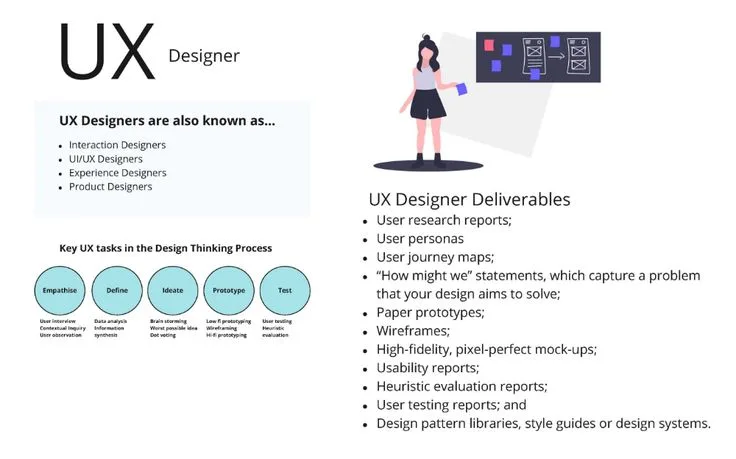
The discipline encompasses user research, information architecture, interaction design, usability testing, and content strategy - the full scope of how a product feels and functions from the user's perspective.
The term was coined by Don Norman in 1993 while he was at Apple, where his official title was "User Experience Architect." Norman later co-founded the Nielsen Norman Group (NNg) with Jakob Nielsen, and together they established many of the foundational principles and research methods that define UX practice today.
Norman's 1988 book The Design of Everyday Things remains one of the most widely cited works in the field, arguing that good design makes the conceptual model of a product match the user's mental model of how it should work.
In practice, a UX designer's daily work might include conducting user interviews, building journey maps and personas, creating wireframes and user flows, running usability tests, synthesizing research findings into design recommendations, and collaborating with product managers on feature prioritization.
The emphasis is on understanding problems before jumping to solutions.
What Is UI Design?
User Interface (UI) design is the practice of designing the visual and interactive elements of a digital product - color palettes, typography, iconography, component design, visual hierarchy, micro-interactions, and animation.
UI design is a subset of the broader UX work, focused on the execution and presentation layer rather than the strategic and research layer.
UI design has deep roots in graphic design and visual communication. The shift to digital interfaces brought new constraints - responsive layouts, accessibility requirements, interaction states, design tokens - but the core craft remains visual: making interfaces that are clear, consistent, aesthetically coherent, and aligned with brand identity.
A dedicated UI designer's daily work typically involves designing high-fidelity screens in Figma or Sketch, maintaining and extending component libraries, specifying interaction behaviors and animations, collaborating closely with front-end engineers on implementation fidelity, and ensuring visual consistency across platforms and screen sizes.
What Is Product Design?
Product design, in the technology industry context, is a title that emerged from companies like Facebook (Meta), Airbnb, Stripe, and Google to describe designers who are embedded in cross-functional product teams and own design work from initial research through final production handoff.
The title signals that design is not a service function downstream of product decisions but a strategic function integrated into the decision-making process itself.
Aarron Walter, former VP of Design Education at InVision and author of Designing for Emotion (2011), described the product designer as someone who "thinks in systems, not screens" - a designer whose primary concern is the overall product strategy, not just the interface artifacts that implement it.
In practice, product designers do much of what UX designers and UI designers do, but they also participate in roadmap planning, communicate design decisions in terms of business metrics, run or commission research to validate product hypotheses, and operate as co-owners of product outcomes alongside engineers and product managers.
Title Comparison at a Glance
| Factor | UX Designer | UI Designer | Product Designer |
|---|---|---|---|
| Primary focus | Research, IA, user flows, usability | Visual execution, component design, brand | Full spectrum: research through final UI |
| Research involvement | High | Low | Moderate to high |
| Visual design depth | Moderate | High | High |
| Strategy involvement | Moderate | Low | High |
| Business metrics ownership | Rare | Rare | Common |
| Typical employer | Enterprise, agency, healthcare, gov | Agency, startup, studio | Tech company, scale-up, SaaS |
| US median total comp (2024) | ~$112,000 | ~$95,000-$105,000 | ~$138,000 |
| Common tools | Miro, FigJam, Maze, UserTesting | Figma, Sketch, After Effects, Zeplin | Figma, Amplitude, Maze, Dovetail |
| Career ceiling | Head of UX, VP Design | Design Systems Lead, Art Director | VP Product Design, CPO |
| Competition level (2026) | Moderate | High (at generalist level) | Highest (at top tech) |
The History: How We Got Three Titles for Overlapping Work
The proliferation of design titles is a product of how the profession evolved. In the 1990s, web design was a single discipline - one person designed the layout, chose the colors, wrote the HTML, and sometimes wrote the copy. As websites became web applications in the 2000s, the work split.
Visual design (what it looks like) separated from interaction design (how it behaves), and both separated from user research (understanding what to build).
Jesse James Garrett formalized this layered model in his 2002 book The Elements of User Experience, which described five planes of design - strategy, scope, structure, skeleton, and surface - each with distinct concerns and methods.
The UX/UI split maps roughly onto Garrett's model: UX designers work primarily on the strategy, scope, and structure planes, while UI designers work on skeleton and surface.
The "product designer" title arrived later, driven by a different organizational insight. In the early 2010s, companies like Facebook found that separating UX strategy from UI execution created handoff problems, communication overhead, and a loss of design coherence.
Julie Zhuo, former VP of Product Design at Facebook (now Meta), wrote extensively about this transition in her 2019 book The Making of a Manager:
"The problem with design titles is that companies use them to describe what they want someone to do, not what the role actually requires. A job posting for a UX designer that lists Figma proficiency but no mention of research is usually a UI design role with ambitious branding."
- Julie Zhuo, The Making of a Manager (2019)
Facebook's solution was to collapse UX and UI into a single "product designer" role embedded in each product team, with a separate "UX researcher" function for deep qualitative and quantitative research. Airbnb, Spotify, Stripe, and most of Silicon Valley followed.
By 2020, "product designer" had become the dominant title at technology companies, while "UX designer" persisted in enterprise, healthcare, government, and agency contexts.
What the Research Says About Title Inflation
The gap between job titles and actual role content has been studied by UXPA International and the Nielsen Norman Group, both of which run large-scale surveys of UX practitioners.
NNg's 2024 UX Career Survey found that among practitioners calling themselves "UX designers," roughly 35% spent more than half their time on visual or UI work, while only 28% spent more than half their time on research or strategy.
The title had less predictive value than the company type: agency UX designers skewed toward execution, while in-house UX designers at tech companies skewed toward research.
The UXPA 2024 Practitioner Survey found a strong correlation between company size and role differentiation:
- Companies under 100 employees used "UX designer" to describe roles encompassing research, strategy, wireframing, visual design, and prototyping
- Companies over 1,000 employees increasingly distinguished between UX research, interaction design, visual design, and content design as separate functions
- Companies over 5,000 employees had an average of 4.2 distinct design role types, compared to 1.3 at companies under 50
A 2023 study by the Interaction Design Foundation surveyed 2,800 design professionals and found that 62% had changed their job title at least once without changing their actual responsibilities - simply because they moved to a company that used different terminology for the same work.
For job seekers, this data has a practical implication: the title on a job posting tells you less about the role than the list of required deliverables, the tools mentioned, and the reporting structure described.
How Job Titles Vary by Company Type
Understanding which type of organization is posting a job tells you more about what the role actually involves than the title alone.
Large Tech Companies (Google, Meta, Airbnb, Stripe)
Roles are highly differentiated: product designers (generalist, embedded in product teams), UX researchers (dedicated research function), content designers (UX writing), design systems designers, and interaction designers are all distinct roles with distinct hiring criteria and compensation bands.
A "product designer" at Google is expected to handle both research synthesis and high-fidelity visual work, but not to be the primary researcher.
Mid-Size SaaS Companies (Series B through pre-IPO)
Typically use product designer or UX designer titles for generalists who do everything. May have one or two dedicated UX researchers. The designer-to-engineer ratio is often 1:8 to 1:12, meaning each designer covers a large surface area and must be comfortable with ambiguity.
Digital Agencies
Use UX designers, UI designers, and sometimes service designers, with roles organized by project phase rather than product team membership. Agency designers tend to work on multiple clients simultaneously, producing deliverables that are handed off rather than iterated continuously. The work skews heavily toward execution.
Non-Tech Enterprise (Banks, Retailers, Healthcare)
Often have the most traditional and most fragmented design structures: UX designers (research and wireframing), UI designers (visual execution and brand alignment), and interaction designers. Compensation tends to be lower than tech, but job stability and work-life balance are often better.
Enterprise UX often involves design systems governance, accessibility compliance, and stakeholder management at a scale that tech startups rarely encounter.
The Salary Reality
Compensation differences between these titles are real and well-documented. The gap reflects not just the title itself but the types of companies that use each title and the scope expectations embedded in them.
| Title | US Median Base (2024) | US Median Total Comp (2024) | Top 10% Total Comp |
|---|---|---|---|
| UI Designer | $88,000 | $95,000-$105,000 | ~$145,000 |
| UX Designer | $102,000 | ~$112,000 | ~$165,000 |
| Product Designer | $120,000 | ~$138,000 | ~$210,000+ |
| Senior Product Designer (FAANG) | $155,000-$180,000 | $220,000-$320,000 | $350,000+ |
Sources: LinkedIn Salary (2024), Glassdoor (2024), Levels.fyi (2024)
The premium for "product designer" at top tech companies is substantial.
Levels.fyi (2024) data shows that senior product designers at companies like Airbnb, Stripe, and Meta earn total compensation packages (base + equity + bonus) of $250,000 to $350,000 - comparable to senior software engineers at the same companies.
This parity is itself a signal of how these companies value design.
However, compensation is driven more by company tier than by title. A "UX designer" at a well-funded Series C startup may earn more than a "product designer" at a small agency. The title opens doors, but the company determines the paycheck.
The Impact of AI Tools on Design Roles
AI-assisted design tools - including Figma's AI features, Adobe Firefly, Galileo AI, and generative UI prototyping tools - are reshaping the skill mix required across all design titles.
The clearest early impact has been on UI production: repetitive visual work that previously required manual component creation, color application, and asset generation can now be partially automated.
NNg's 2024 report on AI in UX practice found that practitioners who could fluently describe user research findings, synthesize behavioral patterns, and communicate design rationale in terms of user needs and business outcomes were the most insulated from displacement by AI-assisted workflows.
These are the skills associated with UX designer and product designer titles rather than pure UI designer roles.
This shift has two strategic implications:
- Pure UI production skill - the ability to create visually consistent screens quickly - is worth less as a differentiator than it was three years ago. The floor has risen; competent-looking UI is now faster to produce for everyone.
- Research, strategy, and cross-functional communication skills have increased in relative value. The designers who understand why something should be built, not just how it should look, are harder to replace with automation.
For career planning, this suggests that investing in research and strategy skills is a stronger long-term bet than doubling down on visual production speed alone.
Which Title Should You Aim For?
The right title depends on your career stage and goals, not a single universal answer. Early career, prioritize design culture over title. Mid-career aiming at technology companies, target product designer roles since that is the language of that market. Specialists should target research or design-systems titles directly, and career changers should match the title to their prior background.
Early Career (0-3 Years)
The most important factor is not the title but the quality of the design culture at the target company.
A junior "UX designer" at a company with strong design leadership, regular critique sessions, and research investment will develop faster than a junior "product designer" at a company where design is under-resourced and isolated.
Look for these signals in interviews:
- Does the company have a design manager or director (not just individual contributors)?
- How often do designers participate in user research?
- Is there a design critique practice?
- What is the designer-to-engineer ratio?
Mid-Career (3-7 Years)
If you want to work at technology companies, targeting product designer roles is a practical necessity - it is the language of that market. Build a portfolio that demonstrates end-to-end ownership: problem identification, research, design exploration, final execution, and impact measurement.
Specialist Track
For designers who want to specialize in research, target "UX researcher" or "design researcher" roles specifically. For those drawn to visual systems, target "design systems designer" roles at companies with established systems practices.
Specialist roles at product companies are better-paid, more rigorous, and more professionally respected than the same work done as a side function of a generalist role.
Career Transitions
If you are coming from software engineering or product management, the product designer title is the most natural landing point because it values systems thinking and business context that transferees bring.
If you are coming from graphic design or visual arts, UI designer roles provide the most accessible entry point before broadening into product design.
How to Read a Job Posting
Since titles are unreliable, here is a practical framework for decoding what a role actually involves:
If the posting emphasizes Figma, Zeplin, animation, visual design systems, and brand guidelines - it is primarily a UI role, regardless of what the title says.
If the posting emphasizes usability testing, user research, journey mapping, personas, and information architecture - it is primarily a UX research/strategy role.
If the posting emphasizes working with product managers, owning a product area, metrics, A/B testing, and cross-functional collaboration - it is a product design role with strategic scope.
If the posting emphasizes everything above in a single listing - it is likely a small team where one designer does everything. Evaluate the salary and support structure carefully.
During interviews, ask: "Can you walk me through a recent project from first brief to ship? What was the designer's role at each stage?" This question surfaces the reality of the role more reliably than any job description.
The Titles Are Converging
The long-term trend is toward convergence. As AI changes design workflows, the distinction between someone who researches and someone who executes visuals is becoming less meaningful. The tools are making execution faster, which means the scarce resource is not production capacity but judgment: knowing what to build, for whom, and why.
Peter Merholz and Kristin Skinner, in Org Design for Design Orgs (2016), predicted this convergence, arguing that the most effective design organizations would move toward generalist designers with deep T-shaped skills - broad competence across research, strategy, and execution, with deep expertise in one area.
The data supports this prediction. The Indeed Hiring Lab (2024) found that job postings for "product designer" grew 34% year-over-year from 2022 to 2024, while "UX designer" postings declined 12% and "UI designer" postings declined 18%. The market is voting for the generalist title.
Practical Takeaways
Mirror the language of your target companies on your portfolio and resume. Use "product design" for tech, "UX design" for agencies and enterprise. This is not misrepresentation - it is recognizing that the same work has different labels in different markets.
Do not accept a company's description of their design culture at face value. Ask to speak with other designers. Ask the design manager when the last time a design recommendation influenced a product decision was.
Invest in the skills that compound across all three titles: research synthesis, clear communication of design rationale, systems thinking, and the ability to connect design work to business outcomes.
The title matters less than the trajectory. A UX designer who builds research skills, ships impactful work, and can articulate business value will out-earn a product designer who only produces screens, regardless of the words on the business card.
Negotiate title during the offer stage if it matters for your next move. Many companies are flexible on title when the level and compensation are already agreed.
Sources & Further Reading
- Zhuo, J. (2019). The Making of a Manager: What to Do When Everyone Looks to You. Portfolio/Penguin.
- Norman, D. (1988). The Design of Everyday Things. Basic Books. (Revised edition 2013, also published as The Psychology of Everyday Things.)
- Garrett, J. J. (2002). The Elements of User Experience: User-Centered Design for the Web and Beyond. New Riders. (2nd edition 2010.)
- Merholz, P., & Skinner, K. (2016). Org Design for Design Orgs: Building and Managing In-House Design Teams. O'Reilly Media.
- Walter, A. (2011). Designing for Emotion. A Book Apart.
- LinkedIn Talent Insights. (2024). Product and UX Designer Compensation Report 2024. linkedin.com/salary
- Nielsen Norman Group. (2024). Job Titles in UX: What Different Design Roles Actually Mean.nngroup.com/articles
- Nielsen Norman Group. (2024). AI Tools in UX Practice: Impact on Design Careers.nngroup.com/articles
- Glassdoor. (2024). UX Designer vs Product Designer Salary Comparison.glassdoor.com
- Levels.fyi. (2024). Design Compensation Data.levels.fyi
- UXPA International. (2024). UX Practitioner Survey: Titles and Roles 2024.uxpa.org
- Interaction Design Foundation. (2023). UX Designer vs Product Designer: What is the Difference?interaction-design.org
- Indeed Hiring Lab. (2024). Design Job Title Trends 2024.indeed.com/career
- Buley, L. (2013). The User Experience Team of One: A Research and Design Survival Guide. Rosenfeld Media.
- Portigal, S. (2023). Interviewing Users: How to Uncover Compelling Insights. 2nd Edition. Rosenfeld Media.