
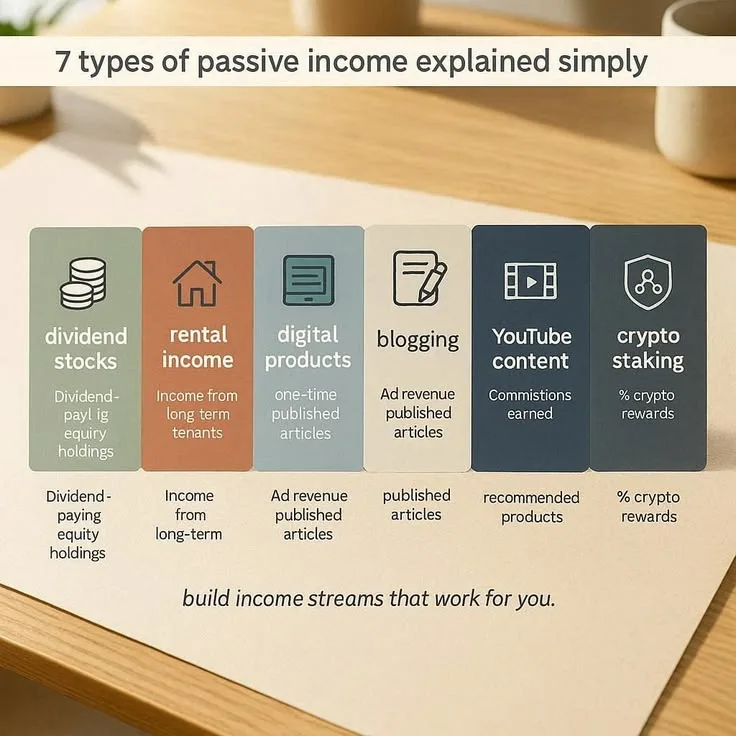
Passive income is earnings generated from an asset, investment, or business venture that requires minimal ongoing active effort from the earner after an initial investment of time, money, or both.
It is the income that arrives whether you work on a given Tuesday or not - dividends deposited quarterly, rent checks collected monthly, royalties earned from a course someone purchased at midnight.
The concept is real, the mechanisms are well-documented, and millions of people derive meaningful income from passive sources.
What is not real is the version promoted across social media: that meaningful passive income is accessible quickly, with little capital or work, to anyone willing to follow a system.
The gap between passive income marketing and passive income reality is one of the widest in personal finance.
Understanding where that gap lies - which income streams are genuinely passive, which are semi-passive, which require enormous upfront investment, and what realistic numbers look like - is the difference between building actual wealth and chasing an expensive illusion.
"Wealth is the ability to fully experience life. It is not about money per se - it is about the freedom that money can provide. And passive income, at its core, is about buying back your time." - Naval Ravikant, The Almanack of Naval Ravikant, 2020
What Passive Income Actually Means
The IRS has a specific legal definition that matters for your tax return: passive activity income is income from rental activities or from businesses in which the taxpayer does not materially participate - generally fewer than 500 hours per year of active involvement (Internal Revenue Code Section 469).
This definition is narrow and consequential because passive losses can only be used to offset passive income, not ordinary income, with limited exceptions for real estate professionals.
In everyday usage, passive income has a broader meaning encompassing any income stream that does not require direct hour-for-hour labor:
- Investment returns: dividends, interest, capital gains
- Rental property income: residential, commercial, short-term
- Royalties: book, music, patent, software licensing
- Digital product sales: courses, ebooks, templates, apps
- Affiliate marketing and advertising revenue: blogs, YouTube, podcasts
- Business income from non-participating ownership: silent partnerships, franchise ownership
The critical truth that passive income marketers consistently understate: none of these are completely passive. Every income stream requires some ongoing attention, and most require either substantial capital or substantial upfront work.
The question is not whether an income source is passive or active - it is where it falls on the spectrum.
The Passive Income Spectrum
It is more accurate to think of income on a continuum from fully active to nearly passive. The table below reflects realistic assessments based on actual practitioner data, not marketing claims.
| Income Type | Upfront Requirement | Ongoing Effort | True Passivity | Typical Monthly Income Per $100K Invested |
|---|---|---|---|---|
| High-yield savings / CDs | Capital only | Minimal (rate monitoring) | Very high | $350-$450 |
| Index fund dividends | Capital only | Minimal (annual rebalancing) | Very high | $125-$300 |
| Individual dividend stocks | Capital + research | Low (quarterly monitoring) | High | $200-$500 |
| REITs | Capital only | Minimal | High | $300-$500 |
| Rental property (managed) | Capital + acquisition | Moderate (oversight, decisions) | Medium | $300-$700 (on equity) |
| Rental property (self-managed) | Capital + ongoing labor | High (5-15 hrs/month) | Low-medium | $400-$900 (on equity) |
| Digital products (established) | Months of creation | Low-moderate (updates, support) | Medium | Highly variable |
| Online courses (new) | Significant time | High initially, then moderate | Low initially | Highly variable |
| Content (YouTube/blog) | Years of consistent work | High and ongoing | Low | Highly variable |
| Affiliate marketing | Months-years of content | Ongoing content and SEO | Low-medium | Highly variable |
The pattern is consistent: the top of the list requires the most capital but the least effort. The bottom requires the most effort but the least capital. There is no income source that requires neither.
Investment Income: The Most Reliably Passive
Dividend Investing
Dividend investing involves holding stocks, ETFs, or mutual funds that pay regular cash distributions from corporate earnings. Once the capital is invested, dividends arrive quarterly with essentially no effort beyond keeping the account open.
Research by Professors Elroy Dimson, Paul Marsh, and Mike Staunton at the London Business School, published in their Global Investment Returns Yearbook (2023), found that dividends have contributed approximately 50% of the total real return from US equities since 1900.
Dividends are not a small side benefit of stock ownership - they are historically half the point.
Realistic yield ranges (2024-2025):
- S&P 500 average dividend yield: approximately 1.3-1.5%
- Dividend-focused ETFs (Vanguard High Dividend Yield ETF/VYM, Schwab US Dividend Equity/SCHD): approximately 2.5-3.8%
- High-dividend individual stocks (utilities, REITs, telecoms, consumer staples): 3.5-6%
- High-yield bond funds: 5-8% (with meaningfully higher credit and interest rate risk)
What this means in actual dollar terms:
| Target Monthly Income | Required Capital at 1.5% Yield (S&P 500) | Required Capital at 3.5% Yield (Dividend ETFs) | Required Capital at 5% Yield (High-Yield) |
|---|---|---|---|
| $500/month | ~$400,000 | ~$171,000 | ~$120,000 |
| $1,000/month | ~$800,000 | ~$343,000 | ~$240,000 |
| $2,000/month | ~$1,600,000 | ~$686,000 | ~$480,000 |
| $5,000/month | ~$4,000,000 | ~$1,714,000 | ~$1,200,000 |
These numbers explain why "live off dividends" is a multi-decade wealth-building goal, not a near-term income strategy. It is achievable - but it requires years of consistent saving, reinvestment, and compound growth.
The people who achieve it typically started investing in their twenties or thirties and let compounding work for twenty to forty years.
Tax advantage: Qualified dividends from US corporations held for the required period (60 days around the ex-dividend date) are taxed at 0%, 15%, or 20% depending on taxable income - significantly lower than ordinary income rates for most taxpayers.
For someone in the 32% ordinary income bracket, this tax preference is worth thousands of dollars annually on a large dividend portfolio.
Index Funds and Total Return Investing
Many financial planners, including Vanguard's research team and the late John Bogle, favor total return investing over dividend-focused investing.
Instead of targeting high dividend yield, you invest in a broad index fund (like the Vanguard Total Stock Market Index Fund or an S&P 500 index fund) and withdraw funds as needed by selling shares.
The logic: total return (dividends plus price appreciation) often outperforms high-dividend strategies over long time horizons because companies that pay high dividends are sometimes lower-growth companies.
The dividend is not "free money" - it comes directly from the company's value, and on the ex-dividend date, the stock price drops by approximately the dividend amount.
The 4% rule, derived from William Bengen's 1994 study and later expanded by the Trinity Study (Cooley, Hubbard, and Walz, 1998), suggests that a diversified portfolio of roughly 50-75% stocks and 25-50% bonds can sustain a 4% annual withdrawal rate for 30+ years without depletion in most historical scenarios.
Updated research by Wade Pfau and others has suggested that 3.3-3.5% may be more appropriate given current bond yields and longer retirement horizons.
At a 4% withdrawal rate, generating $1,000/month ($12,000/year) requires approximately $300,000 in investments. That is still substantial - but more accessible than the dividend-only calculations above.
High-Yield Savings and CDs
In the 2023-2025 interest rate environment, high-yield savings accounts offered 4.0-5.5% APY - the most genuinely risk-free passive income available. $100,000 in a 5% HYSA generates approximately $5,000/year ($416/month) with zero effort, zero risk (up to the $250,000 FDIC insurance limit), and complete liquidity.
The limitation is that these rates are directly tied to the Federal Reserve's federal funds rate. When the Fed eventually cuts rates, HYSA yields fall with them. Certificates of deposit lock in rates for 1-5 years, providing some protection against rate declines, at the cost of liquidity.
For building an emergency fund or parking capital while deciding on longer-term investments, high-yield savings remains one of the smartest low-effort financial moves available.
Rental Real Estate: Semi-Passive with Real Returns
Rental real estate is the most common path to meaningful passive income for people without large investment portfolios, because it allows the use of leverage (mortgage debt) to control assets worth far more than the down payment.
A $60,000 down payment can control a $300,000 property - a 5:1 leverage ratio that amplifies both gains and losses.
How the Numbers Actually Work
Consider a property purchased for $300,000 with 20% down ($60,000) at a 7% mortgage rate:
- Monthly mortgage payment (P&I, 30-year): ~$1,596
- Property tax (estimated at 1.2% of value): $300/month
- Insurance: $100-$150/month
- Maintenance (budgeted at 1% of value/year): $250/month
- Vacancy (budgeted at 5-8% of gross rent): $75-$120/month
- Property management (if used, at 8-12% of rent): $120-$180/month at $1,500 rent
- CapEx reserves (roof, HVAC, appliances): $100-$200/month
- Total monthly expenses: approximately $2,541-$2,796
For positive cash flow at these numbers, the property needs to rent for at least $2,800/month - which at a $300,000 purchase price requires a price-to-rent ratio that only exists in certain markets. This is why location is the single most important variable in real estate investing.
Markets with high price-to-rent ratios (major coastal cities like San Francisco, New York, Boston) often produce negative cash flow. Markets with lower ratios (Memphis, Indianapolis, Kansas City, Cleveland) produce positive cash flow more readily.
The 1% rule - a screening heuristic suggesting the monthly rent should equal at least 1% of the purchase price - has become difficult to achieve in many markets since 2020. A more realistic threshold in the current rate environment is 0.7-0.8%, accepting that appreciation and tax benefits contribute to total return alongside cash flow.
The Tax Advantages of Rental Real Estate
Real estate offers tax benefits that no other passive income source matches:
Depreciation: The IRS allows you to deduct the cost of the building (not the land) over 27.5 years for residential property, even as the property may be appreciating in value.
On a $300,000 property with $240,000 of building value, this is approximately $8,727/year in phantom deductions that reduce taxable rental income without reducing actual cash flow.
1031 exchanges: When you sell an investment property, you can defer all capital gains taxes by reinvesting the proceeds into a "like-kind" replacement property within specific time limits (45 days to identify, 180 days to close).
This allows investors to trade up to larger properties indefinitely, compounding returns tax-deferred.
Mortgage interest deduction: Interest paid on investment property mortgages is deductible against rental income.
These advantages are why many sophisticated investors - including those profiled in Thomas Stanley and William Danko's The Millionaire Next Door (1996) - disproportionately hold real estate relative to their net worth.
Is Rental Income Truly Passive?
No. Even with a property manager handling tenant communication, maintenance coordination, and rent collection, a landlord must evaluate and approve major repairs, handle vacancies, manage the property manager relationship, deal with insurance claims, maintain accurate tax records (Schedule E, depreciation schedules), and occasionally handle difficult situations that exceed the manager's authority.
Self-managed properties require meaningfully more time: 5-15 hours per month on average, with significant spikes during tenant turnovers, evictions, or major repairs.
BiggerPockets, the largest real estate investing community, surveys its members annually and consistently finds that self-managing landlords spend 8-12 hours per month per property on average.
Real estate is better described as a semi-passive business than passive income. The returns can be excellent - historical average total returns of 8-12% annually including appreciation, cash flow, and tax benefits according to the National Council of Real Estate Investment Fiduciaries - but the "passive" label undersells the ongoing involvement.
Digital Products: High Variance, High Upfront Work
Digital products - online courses, ebooks, templates, software tools, stock photography, printables - can generate ongoing income after creation. This category is the one most aggressively marketed as "passive income" and the one with the widest gap between marketing claims and median outcomes.
The Honest Data
A 2022 analysis of Teachable platform data found that the median revenue for course creators was under $250/month. The distribution was extremely skewed: the top 3% earned the vast majority of total platform revenue, while most creators earned very little.
Podia, a competing platform, published similar findings: the median course creator earned less than $300/month.
Amazon Kindle Direct Publishing data shows a similar pattern. According to Written Word Media's 2023 self-publishing survey, the median self-published author earned less than $1,000 per year from book sales. The top 1% earned six figures. The bottom 50% earned effectively nothing.
What Separates Success from Failure
Research and practitioner data consistently identify the same factors:
Existing audience: Creators who launch products to an established email list, social media following, or professional community dramatically outperform cold launches.
Pat Flynn, who documented his income reports publicly from 2008 to 2017, showed that his digital product revenue was directly correlated with email list size - products launched to 50,000+ subscribers generated 10-50x the revenue of identical products launched to 1,000 subscribers.
Specificity of problem solved: Products that address a narrow, urgent problem for an identifiable audience ("Excel templates for real estate investors calculating cash-on-cash returns") consistently outperform broad topics ("learn to use Excel").
Ongoing marketing: The "upload and forget" model almost never works. Successful digital product businesses require ongoing content marketing, email sequences, paid advertising, or platform optimization. This ongoing work is the reason "passive" is a misleading descriptor.
Platform dynamics: Amazon, Udemy, Etsy, Gumroad, and other platforms have their own search algorithms, competitive landscapes, and terms of service that change over time. A product ranking well on Udemy today may be buried by algorithm changes next quarter.
Realistic Expectations
- An ebook with no existing audience: $0-$100/month, potentially growing with reviews and SEO over 6-12 months
- An online course with an existing email list of 5,000+: $500-$5,000/month for a quality course in a specific niche
- A Notion template or Canva template shop built over 1-2 years: $200-$2,000/month for consistent creators
- A stock photo/illustration portfolio built over 2-3 years: $500-$3,000/month for high-volume, high-quality creators
These are ranges, not guarantees. Most people who attempt digital product income earn significantly less than the opportunity cost of their creation time.
The people who succeed tend to have domain expertise, marketing skills, and persistence through 6-18 months of minimal returns before the compounding effects of reviews, SEO, and word-of-mouth take hold.
Content Monetization: The Slowest Path
YouTube, blogging, podcasting, and newsletter writing can generate income through advertising, sponsorships, affiliate links, and premium subscriptions. But describing this as "passive" fundamentally misrepresents what is required.
YouTube
The YouTube Partner Program requires 1,000 subscribers and 4,000 watch hours in the past 12 months for ad monetization. According to Influencer Marketing Hub's 2024 analysis, the average time to reach this threshold is 15-24 months of consistent weekly uploads. Most creators never reach it.
Average RPM (revenue per 1,000 views) varies dramatically by niche: personal finance channels average $12-$30 RPM, technology channels average $5-$15, entertainment channels average $2-$5.
A channel generating 100,000 views per month in the personal finance niche earns $1,200-$3,000/month in ad revenue - but generating 100,000 monthly views typically requires 2-4 years of consistent, high-quality content production.
Blogging and SEO Content
A blog generating meaningful organic traffic takes 12-24+ months to rank in Google search results, according to Ahrefs' 2023 study of 2 million newly published pages. Affiliate income from blogging typically requires 50-150+ articles targeting specific commercial-intent keywords.
Many blogs never reach $1,000/month; some reach $10,000+/month after 3-5 years of consistent work.
Content creation is better understood as a long-term asset-building strategy than a passive income stream.
The income becomes increasingly passive once established - evergreen articles continue generating traffic and affiliate revenue for years - but the path requires years of active work that looks nothing like passive income during the building phase.
If you are interested in how the creator economy works or want to understand why most creators fail, those topics provide important context for evaluating content as an income strategy.
Why "Passive Income" Is So Often Misleading
Several structural biases explain the persistent gap between passive income marketing and reality:
Survivorship bias: The people writing about passive income success are overwhelmingly those who succeeded. The much larger population who tried and failed does not produce content about their experience.
When you read "I make $15,000/month from my Etsy shop," you are looking at a real data point - but one drawn from the far right tail of the distribution.
Daniel Kahneman and Amos Tversky's foundational work on judgment under uncertainty (1974) showed that humans systematically overweight vivid, available examples and underweight base rates. The base rate for most passive income ventures is modest returns.
Selection bias in platforms: Udemy, Teachable, and Amazon have incentives to publicize their most successful creators, not their median creators. "Our top instructor earned $2 million last year" is a real statistic that tells you almost nothing about what you should expect.
Opportunity cost blindness: Hours spent building a Shopify dropshipping store, filming YouTube videos, or writing an ebook are hours not spent elsewhere.
If those hours could be spent on freelance consulting at $75-$150/hour, on skill development that increases your salary by $20,000, or on building career capital, the opportunity cost is substantial.
As economists consistently point out, the true cost of any choice includes the value of the best alternative foregone - a concept explored in depth in our article on what opportunity cost means.
The "passive" label mischaracterizes most streams: The marketing industry has expanded "passive income" to include almost any non-hourly income stream, including businesses that require 40+ hours per week of active work.
A dropshipping business is a business. A YouTube channel is a media production operation. Calling them "passive" is like calling a restaurant "effortless dining."
What a Realistic Passive Income Strategy Looks Like
For most working professionals, an honest passive income strategy combines disciplined saving, tax-efficient investing, and patience:
1. Maximize tax-advantaged accounts first. 401(k) contributions (up to $23,500 in 2025), IRA contributions ($7,000), and HSA contributions ($4,300 individual / $8,550 family) should be filled before pursuing taxable passive income strategies. Employer 401(k) matches are immediate 50-100% returns that no passive income stream can match.
2. Build an emergency fund in high-yield savings. 3-6 months of expenses earning 4-5% APY. This is genuinely passive income while also serving its primary purpose as a financial safety net.
3. Invest consistently in low-cost index funds. The unsexy truth that the data overwhelmingly supports: consistent contributions to a diversified, low-cost index fund over a career is more likely to produce meaningful financial independence than most "passive income" strategies.
At 7% average real return, $500/month invested for 30 years grows to approximately $567,000. At $1,000/month, approximately $1.13 million. The mechanism is compound interest - the most powerful force in personal finance.
4. Consider real estate if you have the capital and risk appetite. The leverage, tax advantages (depreciation, 1031 exchanges), and inflation hedging of real estate make it genuinely attractive for many investors.
But enter with clear eyes about the ongoing involvement, the illiquidity, and the concentration risk of tying significant capital to individual properties in specific markets.
5. Build digital products or content only if you have genuine expertise and an existing or buildable audience. Not as a primary income strategy initially, but as a long-term asset that may compound over time.
The most successful digital product creators started by providing free value - blog posts, YouTube videos, social media content - for 1-3 years before monetizing.
The Compounding Timeline: What Patience Actually Looks Like
The most honest framing of passive income: it is the goal that active income funds. You build capital through active work, invest it wisely, and over time the passive income from that capital grows from negligible to supplementary to potentially life-changing.
Here is what that timeline actually looks like for someone investing $1,500/month at a 7% average real return with a 3.5% dividend yield:
| Year | Portfolio Value | Annual Dividend Income | Monthly Passive Income |
|---|---|---|---|
| Year 5 | ~$104,000 | ~$3,640 | ~$303 |
| Year 10 | ~$246,000 | ~$8,610 | ~$718 |
| Year 15 | ~$441,000 | ~$15,435 | ~$1,286 |
| Year 20 | ~$714,000 | ~$24,990 | ~$2,083 |
| Year 25 | ~$1,097,000 | ~$38,395 | ~$3,200 |
| Year 30 | ~$1,700,000 | ~$59,500 | ~$4,958 |
At year 30, this investor would receive nearly $5,000/month in dividend income alone - genuinely passive, requiring no ongoing work beyond periodic rebalancing. But it took thirty years of consistent, disciplined investing to get there.
There are no shortcuts to this outcome; there are only different timelines depending on how much you save and how early you start.
As Morgan Housel wrote in The Psychology of Money (2020): "The highest form of wealth is the ability to wake up every morning and say, 'I can do whatever I want today.' That is what financial assets can buy: independence." Building that independence through passive income is real and achievable.
It just takes long-term thinking, discipline, and an honest assessment of what the data actually shows.
Sources & Further Reading
- Bengen, W. P. (1994). Determining Withdrawal Rates Using Historical Data. Journal of Financial Planning, 7(4), 171-180.
- Cooley, P. L., Hubbard, C. M., & Walz, D. T. (1998). Retirement Savings: Choosing a Withdrawal Rate That Is Sustainable. AAII Journal, 20(2), 16-21.
- Dimson, E., Marsh, P., & Staunton, M. (2023). Global Investment Returns Yearbook 2023. Credit Suisse Research Institute.
- Housel, M. (2020). The Psychology of Money: Timeless Lessons on Wealth, Greed, and Happiness. Harriman House.
- Kahneman, D., & Tversky, A. (1974). Judgment Under Uncertainty: Heuristics and Biases. Science, 185(4157), 1124-1131.
- Pfau, W. (2018). How Much Can I Spend in Retirement? A Guide to Investment-Based Retirement Income Strategies. Retirement Researcher Media.
- Ravikant, N. (2020). The Almanack of Naval Ravikant. Magrathea Publishing.
- Stanley, T. J., & Danko, W. D. (1996). The Millionaire Next Door. Longstreet Press.
- IRS. (2024). Publication 925: Passive Activity and At-Risk Rules. View source
- Teachable. (2022). Creator Economy Report: Revenue and Growth Data.
- Written Word Media. (2023). Self-Publishing Income Survey.
- Ahrefs. (2023). How Long Does It Take to Rank in Google? A Study of 2 Million Keywords. View source
- BiggerPockets. (2024). State of Real Estate Investing Survey. View source