
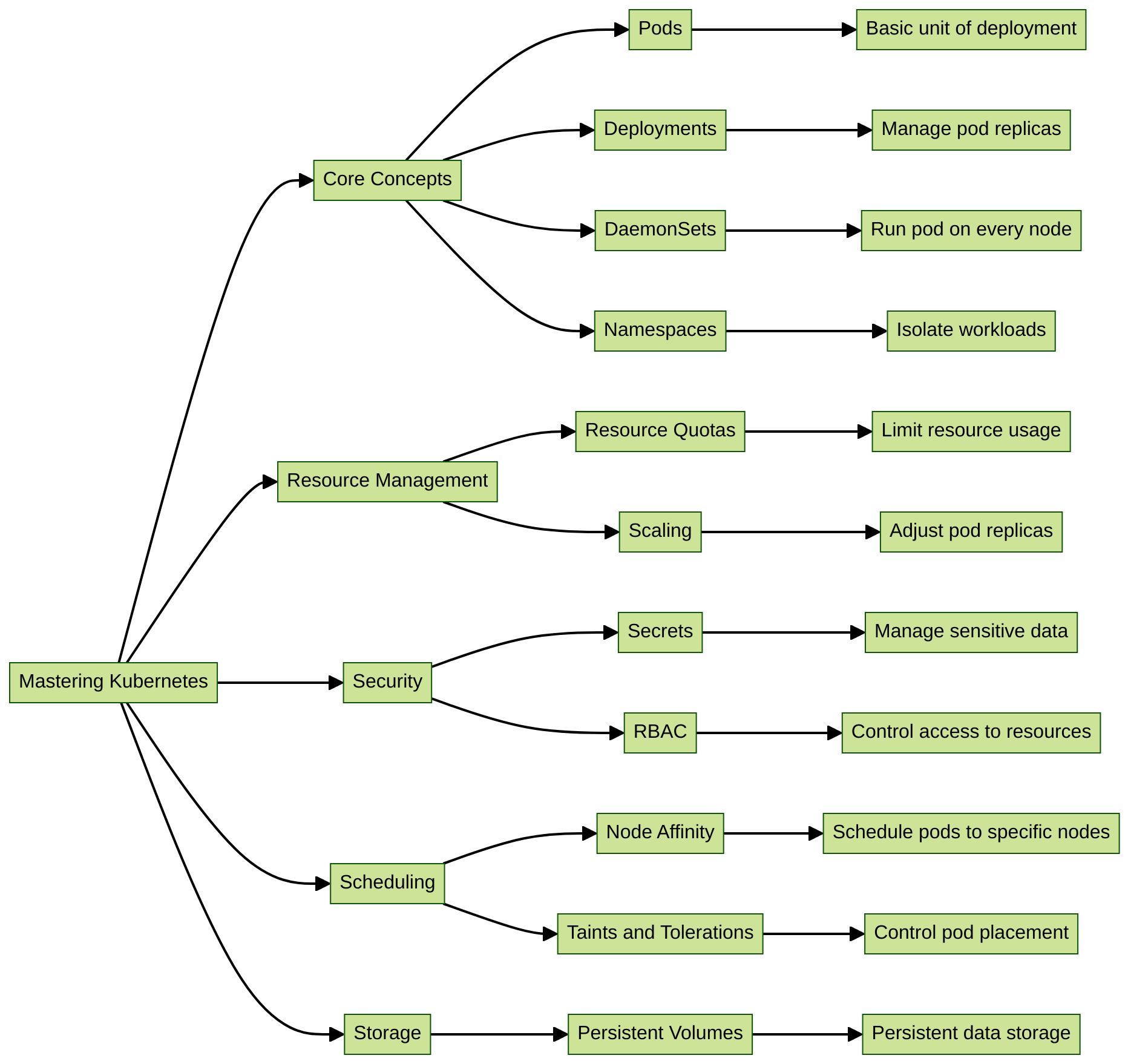
Kubernetes is an open-source container orchestration platform that automates the deployment, scaling, and management of containerized applications across clusters of machines.
Originally developed at Google and open-sourced in 2014, Kubernetes - often abbreviated as K8s - has become the industry standard for running distributed software systems in production.
It works by letting you declare the desired state of your applications (how many replicas, how much memory, which ports), and then continuously reconciles the actual state of the cluster to match that declaration, handling failures, scaling, and updates automatically.
If you have ever wondered why companies with hundreds of microservices do not drown in operational chaos every time a server goes down at 3 AM, the answer is almost always some form of container orchestration - and in the vast majority of cases, that means Kubernetes.
"We wanted to take the ideas from Borg - ideas that had been battle-tested at Google for over a decade - and make them available to everyone. The goal was not to build another Google-internal tool but to change how the entire industry thinks about running software." - Joe Beda, co-creator of Kubernetes, KubeCon keynote, 2018
Key Definitions
Container: An isolated, lightweight unit of software that bundles an application with all its dependencies - libraries, configuration files, runtime - so it behaves identically regardless of where it runs. Unlike virtual machines, containers share the host operating system's kernel, making them far more resource-efficient.
Docker popularized containers starting in 2013, but the underlying Linux kernel features (cgroups and namespaces) date back to 2006-2008.
Pod: The smallest deployable unit in Kubernetes. A pod encapsulates one or more containers that share a network namespace (meaning they share an IP address and can communicate via localhost), storage volumes, and lifecycle.
Pods are ephemeral by design: they are created, run, and destroyed, never updated in place. When a pod fails, Kubernetes does not repair it - it replaces it with a new one.
Node: A physical or virtual machine in a Kubernetes cluster that runs pod workloads. Each node runs three essential components: a container runtime (typically containerd), a kubelet (the agent that communicates with the control plane), and kube-proxy (which handles network routing for Services).
Cluster: The complete Kubernetes environment consisting of a control plane (the management brain) and a set of worker nodes (the machines that run your applications). A production cluster might have three control plane nodes for high availability and dozens or hundreds of worker nodes.
Deployment: A Kubernetes object that declaratively manages a set of identical pod replicas. You specify the desired number of replicas, the container image, resource limits, and update strategy; the Deployment controller ensures that reality matches your specification at all times.
Service: A stable network abstraction that provides a consistent IP address and DNS name for accessing a group of pods. Because individual pods are ephemeral and their IP addresses change constantly, Services solve the problem of "how do I reliably send traffic to my application?"
Namespace: A logical partition within a Kubernetes cluster that provides scope for names and can be used to divide cluster resources between multiple teams or projects. A single cluster might have namespaces for production, staging, and development.
Reconciliation loop: The core mechanism that makes Kubernetes work. Controllers continuously compare the desired state (what you declared in YAML configuration files) against the actual state (what is currently running in the cluster) and take corrective action to close the gap.
This is sometimes called the "control loop" or "observe-diff-act" pattern.
etcd: A distributed, strongly consistent key-value store that serves as the single source of truth for all cluster state. Every Kubernetes object - every pod, service, deployment, secret - is stored in etcd. If etcd goes down, the cluster cannot function.
Kubernetes Components at a Glance
| Component | Location | Role | Failure Impact |
|---|---|---|---|
| API server | Control plane | Central communication hub; all kubectl commands, controller actions, and node reports flow through it | Cluster becomes unmanageable; existing workloads continue running |
| etcd | Control plane | Distributed key-value store; the single source of truth for cluster state | Total loss of cluster state; catastrophic if not backed up |
| Scheduler | Control plane | Assigns newly created pods to appropriate nodes based on resource availability, constraints, and affinity rules | New pods cannot be scheduled; existing pods unaffected |
| Controller manager | Control plane | Runs reconciliation loops (ReplicaSet, Deployment, Node, Job controllers) | Cluster stops self-healing; desired state no longer enforced |
| Cloud controller manager | Control plane | Integrates with cloud provider APIs for load balancers, storage, and node management | Cloud-specific features (load balancers, persistent disks) stop working |
| kubelet | Worker node | Receives pod specs from API server, runs and monitors containers, reports status | Node's pods stop being managed; eventually marked NotReady |
| kube-proxy | Worker node | Implements Service networking rules using iptables or IPVS | Service traffic routing fails on that node |
| Container runtime | Worker node | Actually runs containers (containerd, CRI-O) | No containers can start on that node |
Why Kubernetes Exists: The Problem It Solves
The Gap Between Docker and Production
When Solomon Hykes demonstrated Docker at PyCon in March 2013, he showed the world how to package an application into a portable container in about five minutes. Docker solved the "works on my machine" problem brilliantly. But Docker on a single machine is a development tool, not a production operations platform.
Consider what happens when you need to run a real application in production. Your e-commerce platform consists of fifteen microservices: an API gateway, authentication service, product catalog, search engine, shopping cart, payment processor, order manager, notification service, recommendation engine, inventory tracker, image processor, review system, analytics collector, admin dashboard, and a background job runner.
Each service needs at least three replicas for redundancy. That is forty-five containers minimum, running across perhaps a dozen servers.
Now the questions multiply. Which server should each container run on? What happens when server #7 loses its network connection at 2 AM? How do you deploy a new version of the payment service without downtime? How do you scale the search engine from three replicas to twenty during a flash sale and back down afterward?
How does the API gateway know which IP addresses to route requests to when containers are constantly being created and destroyed?
With bare Docker, the answer to each of these questions is "write a custom script." Kubernetes answers all of them through a single, standardized, declarative interface.
Google's Borg: The System That Inspired Kubernetes
Kubernetes did not emerge from a whiteboard. It emerged from over a decade of operational experience running one of the largest computing infrastructures in human history.
Borg, Google's internal cluster management system, had been running since approximately 2003-2004.
By the time the Borg paper was published by Abhishek Verma and colleagues at EuroSys in 2015, the system was managing hundreds of thousands of jobs across tens of thousands of machines in dozens of clusters worldwide.
Every Google service you have ever used - Search, Gmail, YouTube, Maps - ran on Borg.
The three engineers credited with creating Kubernetes - Joe Beda, Brendan Burns, and Craig McLuckie - had all worked extensively with Borg at Google.
Their insight was that the principles behind Borg (declarative configuration, reconciliation loops, automatic scheduling, built-in failure recovery) were not Google-specific. They were universal principles for managing distributed systems, and the broader industry needed access to them.
The key design principles that Kubernetes inherited from Borg include:
- Declarative over imperative: You describe what you want, not how to get there. The system figures out the "how."
- Reconciliation over one-shot execution: Instead of running a deployment script once, controllers continuously ensure desired state matches actual state.
- Immutable infrastructure: Pods are not patched in place; they are replaced. This eliminates configuration drift.
- Labels and selectors: Flexible, user-defined metadata for organizing and selecting groups of objects, rather than rigid hierarchies.
As Burns, Grant, Oppenheimer, Brewer, and Wilkes wrote in their 2016 ACM Queue paper: "Perhaps the most important thing Borg did was to change the way Google's developers thought about software systems - from thinking about machines to thinking about applications."
Core Architecture: How the Pieces Fit Together
The Control Plane
The Kubernetes control plane is the management brain of the cluster. It does not run your application workloads; it observes, decides, and acts to maintain the state you have declared. In production, the control plane runs on dedicated nodes (typically three, for high availability) or is fully managed by a cloud provider.
The API server (kube-apiserver) is the front door to the cluster. Every interaction - whether from kubectl on your laptop, a CI/CD pipeline deploying new code, a kubelet reporting pod status, or a controller requesting state changes - passes through the API server as a REST request.
It validates requests, authenticates and authorizes them via RBAC (Role-Based Access Control), and persists changes to etcd.
etcd is the memory of the cluster. It is a distributed key-value store developed by CoreOS (now part of Red Hat) that uses the Raft consensus algorithm to maintain strong consistency across its replicas. Every Kubernetes object - its specification and its current status - lives in etcd.
Losing etcd without backups means losing the entire cluster's state. Production clusters typically run etcd across three or five nodes with regular automated backups.
The scheduler (kube-scheduler) watches for newly created pods that have no node assignment and decides where to place them. This is not a simple round-robin assignment.
The scheduler considers CPU and memory requests, node affinity and anti-affinity rules (e.g., "do not place two replicas of this service on the same physical host"), taints and tolerations (e.g., "this node has a GPU; only schedule GPU workloads here"), and topology spread constraints (e.g., "distribute replicas across availability zones").
The controller manager runs the reconciliation loops that are the heart of Kubernetes. Each controller watches a specific type of object and ensures reality matches the desired state. The ReplicaSet controller ensures the right number of pod replicas are running.
The Deployment controller manages rolling updates and rollbacks. The Node controller monitors node health and evicts pods from unhealthy nodes. The Job controller ensures batch jobs run to completion. There are dozens of controllers, each responsible for one narrow concern.
Worker Nodes
Worker nodes are where your application actually runs. Each node runs:
The kubelet, an agent that receives pod specifications from the API server, instructs the container runtime to start the specified containers, monitors their health via liveness probes (is the process still running?) and readiness probes (is the application ready to accept traffic?), and reports status back to the control plane.
If a container fails a liveness probe, the kubelet restarts it. If it fails a readiness probe, the kubelet removes it from the Service's load balancer rotation.
kube-proxy, a network component that implements the Service abstraction on each node. When you create a Service, kube-proxy programs network rules (using iptables, IPVS, or eBPF depending on the CNI plugin) so that traffic addressed to the Service's virtual IP is distributed across the healthy pods backing that Service.
A container runtime - the software that actually pulls images and runs containers. Docker-shim was removed from Kubernetes in version 1.24 (May 2022). The standard runtimes are now containerd (the most common) and CRI-O (used in some cloud computing environments, particularly OpenShift).
Key Abstractions That Make Kubernetes Powerful
Services and Networking
The fundamental networking challenge in Kubernetes is that pods are ephemeral. A pod might have IP address 10.244.3.17 right now, but in five minutes that pod could be destroyed and replaced with a new one at 10.244.5.42. Any system that tries to communicate with pods by IP address will break constantly.
Services solve this by providing a stable virtual IP address and DNS name that persists regardless of which pods are running behind it. A Service uses label selectors to identify its target pods: any pod with matching labels is automatically included in the Service's endpoint list.
| Service Type | Accessibility | Use Case |
|---|---|---|
| ClusterIP | Internal to the cluster only | Service-to-service communication within the cluster |
| NodePort | External via a static port on each node | Development, simple external access |
| LoadBalancer | External via cloud provider load balancer | Production external-facing services |
| ExternalName | Maps to an external DNS name | Connecting to external databases or APIs |
For HTTP traffic routing, the Ingress resource (and its successor, the Gateway API) provides path-based and host-based routing, TLS termination, and rate limiting through a single entry point. An Ingress controller (such as NGINX Ingress, Traefik, or Envoy-based implementations) must be deployed to process Ingress resources.
The Kubernetes networking model requires that every pod can communicate with every other pod without NAT - a "flat" network. This is implemented by Container Network Interface (CNI) plugins. Calico provides network policy enforcement and BGP routing.
Cilium uses eBPF for high-performance networking, observability, and security. Flannel is simpler and commonly used in smaller clusters.
ConfigMaps, Secrets, and Configuration Management
Kubernetes separates application configuration from application code through two resource types. ConfigMaps store non-sensitive configuration - environment variables, feature flags, configuration file contents - that can be injected into pods as environment variables or mounted as files.
Secrets store sensitive data: database passwords, API keys, TLS certificates. Secrets are base64-encoded (not encrypted) by default, which is a common source of confusion.
In production, Secrets should be encrypted at rest in etcd (using EncryptionConfiguration) and often integrated with external secret management systems like HashiCorp Vault, AWS Secrets Manager, or Azure Key Vault.
The External Secrets Operator is a popular open-source solution for synchronizing external secret stores with Kubernetes Secrets.
Persistent Storage
Pods are stateless by default. Any data written to a container's filesystem vanishes when the pod is destroyed. For stateful workloads - databases, message queues, file storage - Kubernetes provides:
PersistentVolumes (PV): Cluster-level storage resources, either pre-provisioned by administrators or dynamically provisioned through StorageClasses. A PV might represent an AWS EBS volume, a Google Persistent Disk, or an NFS share.
PersistentVolumeClaims (PVC): A pod's request for storage. The PVC specifies the amount of storage, access mode (ReadWriteOnce, ReadOnlyMany, ReadWriteMany), and optionally a StorageClass. Kubernetes binds the PVC to an appropriate PV automatically.
StatefulSets: A workload controller designed for stateful applications that need stable network identities, ordered deployment and scaling, and persistent storage that follows the pod across rescheduling. Databases like PostgreSQL, MySQL, and MongoDB typically run as StatefulSets in Kubernetes.
Auto-Scaling: How Kubernetes Adapts to Load
One of the most powerful capabilities Kubernetes provides is multi-layered automatic scaling. In a well-configured cluster, the application and the infrastructure underneath it scale together without human intervention.
Horizontal Pod Autoscaler (HPA)
The HPA watches metrics for a set of pods and adjusts the replica count to maintain a target value.
The classic configuration targets CPU utilization: "maintain average CPU usage across all replicas at 60%, scaling between 3 and 50 replicas." When average CPU rises above 60%, the HPA creates additional replicas. When it drops below, replicas are removed.
Modern HPA configurations use custom metrics from Prometheus or the Kubernetes Metrics API: requests per second, queue depth, response latency, or any application-specific metric.
The HPA evaluates metrics every 15 seconds by default and applies stabilization windows to prevent thrashing - the pathological behavior of rapidly scaling up and down as metrics oscillate around the target.
Cluster Autoscaler
The Cluster Autoscaler operates at the infrastructure layer. When the HPA wants to create new pods but no node has sufficient available resources to schedule them, the Cluster Autoscaler provisions new nodes from the cloud provider.
When nodes are underutilized for an extended period (typically 10 minutes), it cordons and drains them, moving their pods to other nodes, and then removes the empty nodes.
The interaction between HPA and Cluster Autoscaler is crucial. HPA says "I need 30 replicas." If the cluster only has capacity for 20, the remaining 10 pods enter a Pending state.
The Cluster Autoscaler detects unschedulable pods, calculates how many additional nodes are needed, and provisions them. Once the new nodes are ready (typically 2-5 minutes on major cloud providers), the scheduler places the pending pods.
KEDA: Event-Driven Autoscaling
KEDA (Kubernetes Event-Driven Autoscaling), a graduated CNCF project, extends HPA to support scaling based on external event sources: message queue length (Kafka, RabbitMQ, SQS), HTTP request rate, database query results, cron schedules, and dozens of other scalers.
Critically, KEDA supports scaling to zero - something standard HPA cannot do - making it ideal for batch processing, event-driven workloads, and cost optimization for services with intermittent traffic.
According to the CNCF's 2023 Annual Survey, 56% of organizations using Kubernetes reported using some form of auto-scaling in production, up from 37% in 2020. The shift reflects both improved tooling and growing confidence in automated scaling decisions.
Pod Disruption Budgets
Pod Disruption Budgets (PDBs) prevent auto-scaling, rolling updates, and cluster maintenance from simultaneously removing too many replicas of a critical service. A PDB specifies the minimum number of pods (or maximum number unavailable) that must be maintained during voluntary disruptions.
Without PDBs, a cluster upgrade that drains nodes one by one could temporarily take down a service if all its replicas happen to be on the same node.
Rolling Updates and Deployment Strategies
Kubernetes Deployments support rolling updates by default: when you change the container image or configuration, Kubernetes creates new pods with the updated specification and gradually terminates old pods, maintaining a minimum number of available replicas throughout the transition.
The maxSurge and maxUnavailable parameters control how aggressively the rollout proceeds.
If the new version fails health checks or error rates spike, kubectl rollout undo reverts to the previous ReplicaSet immediately. The old ReplicaSet is preserved (by default, the last 10 revisions), making rollback a near-instantaneous operation.
For more sophisticated deployment strategies - canary deployments (routing a small percentage of traffic to the new version), blue-green deployments (running two complete environments and switching traffic), or A/B testing (routing based on request headers or user segments) - teams typically use service mesh tools like Istio or Linkerd, or progressive delivery controllers like Argo Rollouts or Flagger.
The Kubernetes Ecosystem and CNCF
Kubernetes itself is a platform for building platforms. The core system provides scheduling, networking, storage, and configuration management. The broader ecosystem - curated largely through the Cloud Native Computing Foundation (CNCF) - provides everything else.
Key ecosystem projects include:
- Helm: The Kubernetes package manager. Helm Charts are parameterized templates that package complex Kubernetes applications (databases, monitoring stacks, message queues) into installable units.
- Prometheus: The standard monitoring and alerting toolkit for Kubernetes, using a pull-based metrics collection model and the PromQL query language.
- Grafana: Dashboarding and visualization, typically paired with Prometheus.
- Istio/Linkerd: Service meshes that provide mutual TLS encryption, traffic management, and observability between services.
- ArgoCD/Flux: GitOps continuous deployment tools that synchronize cluster state with Git repositories.
- cert-manager: Automated TLS certificate management using Let's Encrypt or other certificate authorities.
- Open Policy Agent (OPA)/Kyverno: Policy engines for enforcing security and compliance rules on Kubernetes resources.
The CNCF's 2023 survey reported that 84% of organizations were using or evaluating Kubernetes, with 61% running Kubernetes in production - up from 44% in 2019. The ecosystem has grown from a handful of tools to over 200 CNCF projects across graduated, incubating, and sandbox tiers.
When Kubernetes Is Overkill - and When You Need It
Kubernetes introduces significant operational complexity. Understanding when that complexity is justified is arguably more important than understanding how Kubernetes works.
Kubernetes is likely overkill when:
- You run a single application or a small number of services
- Your team has fewer than five engineers and no Kubernetes experience
- Your traffic patterns are predictable and do not require dynamic scaling
- Managed platforms like Railway, Render, Fly.io, or Heroku can handle your workload with less operational overhead
- Your organization cannot invest in the observability tooling (Prometheus, Grafana, structured logging, distributed tracing) that makes Kubernetes debuggable
Kubernetes becomes appropriate when:
- You run many independent services that need separate scaling, deployment, and resource management
- Traffic is highly variable and auto-scaling provides real cost savings
- Multiple teams need to deploy independently to shared infrastructure
- You are using managed Kubernetes (GKE, EKS, AKS) where the cloud provider handles control plane operations
- Regulatory or compliance requirements demand infrastructure-level isolation, audit logging, and policy enforcement
- You need multi-cloud or hybrid-cloud portability
A useful heuristic from Kelsey Hightower, one of Kubernetes' most prominent advocates: "Kubernetes is not for developers. Kubernetes is for platform teams.
Developers should interact with a platform built on top of Kubernetes, not with Kubernetes directly." The organizations that succeed with Kubernetes are those that build internal developer platforms that abstract away the complexity, presenting developers with simple deployment interfaces while the platform team manages the underlying Kubernetes infrastructure.
Learning Path and Getting Started
For engineers beginning their Kubernetes journey, a structured approach prevents the overwhelm that the system's breadth can cause.
Phase 1: Local experimentation. Install minikube or kind (Kubernetes in Docker) on your laptop. Deploy a simple application using kubectl. Create a Deployment, expose it with a Service, and scale it up and down. Break things intentionally - delete pods, crash containers - and watch Kubernetes recover.
Phase 2: Core concepts. Work through the official Kubernetes documentation tutorials. Understand Deployments, Services, ConfigMaps, Secrets, PersistentVolumeClaims, and Namespaces. Write YAML manifests by hand (not just copy-paste) to build muscle memory for the object structure.
Phase 3: Production patterns. Learn Helm for packaging applications. Set up Prometheus and Grafana for monitoring. Implement Ingress for HTTP routing. Configure HPA for auto-scaling. Practice rolling updates and rollbacks.
Phase 4: Certification and depth. The Certified Kubernetes Administrator (CKA) and Certified Kubernetes Application Developer (CKAD) certifications from the CNCF provide structured, hands-on preparation that covers troubleshooting, security, and networking in depth.
Both exams are performance-based (you solve problems in a live cluster), making them genuinely useful for building practical skills.
For production use, start with managed Kubernetes services - Google Kubernetes Engine (GKE), Amazon Elastic Kubernetes Service (EKS), or Azure Kubernetes Service (AKS) - which handle control plane operations and simplify node management.
The most important practical advice for Kubernetes adoption: invest heavily in observability, build familiarity with failure modes before running critical production traffic, and resist the temptation to migrate everything to Kubernetes simultaneously.
Related topics that deepen your understanding of the Kubernetes ecosystem include CI/CD pipelines, infrastructure as code, DevOps practices, and cloud security fundamentals.
Sources & Further Reading
- Burns, B., Grant, B., Oppenheimer, D., Brewer, E., & Wilkes, J. (2016). Borg, Omega, and Kubernetes. ACM Queue, 14(1), 70-93. View source
- Verma, A., Pedrosa, L., Korupolu, M., Oppenheimer, D., Tune, E., & Wilkes, J. (2015). Large-scale cluster management at Google with Borg. Proceedings of EuroSys 2015. View source
- Burns, B., Beda, J., Hightower, K., & Evenson, L. (2022). Kubernetes: Up and Running (3rd ed.). O'Reilly Media.
- Luksa, M. (2024). Kubernetes in Action (2nd ed.). Manning Publications.
- Rice, L. (2020). Container Security: Fundamental Technology Concepts that Protect Containerized Applications. O'Reilly Media.
- Cloud Native Computing Foundation. (2024). CNCF Annual Survey 2023. View source
- Kubernetes Documentation. (2024). View source
- Hausenblas, M., & Schimanski, S. (2019). Programming Kubernetes: Developing Cloud-Native Applications. O'Reilly Media.
- Ibryam, B., & Huss, R. (2023). Kubernetes Patterns (2nd ed.). O'Reilly Media.
- Sridharan, C. (2018). Distributed Systems Observability. O'Reilly Media.
- CNCF. (2024). Helm: The Package Manager for Kubernetes. View source
- KEDA. (2024). Kubernetes Event-Driven Autoscaling. View source