
Virtue: In 415 BCE, the Athenian general Nicias faced an impossible decision. His army was trapped in Sicily, suffering devastating losses. Military logic said retreat immediately under cover of darkness. But on the night planned for withdrawal, a lunar eclipse occurred.
Nicias, a deeply religious man, consulted soothsayers who insisted they wait 27 days before moving.
Nicias followed their advice. Those 27 days proved fatal. The Sicilian forces surrounded and annihilated the Athenian army. Thousands died. Athens lost its military power permanently. The Peloponnesian War turned decisively against Athens.
Was Nicias's decision ethical? Different frameworks give different answers:
Consequentialism (judging by outcomes): Catastrophically wrong-resulted in massive suffering and death.
Deontology (judging by rules/duties): Depends on which rules you prioritize-duty to gods? Duty to soldiers? Duty to Athens?
Virtue Ethics asks a different question: What kind of person was Nicias? Did he act from good character?
Nicias demonstrated piety (reverence for the gods), humility (not presuming to know better than religious signs), and caution (avoiding rash action). These are virtues. Yet the outcome was disastrous.
Virtue ethics would note he lacked practical wisdom (phronesis)-the virtue of knowing how to apply other virtues appropriately in specific situations. True virtue requires both good intentions AND good judgment.
This distinction-focusing on character and virtues rather than rules or outcomes-defines virtue ethics as an approach fundamentally different from other moral frameworks.
Where consequentialism asks "What will produce the best outcomes?" and deontology asks "What rules should I follow?", virtue ethics asks: "What kind of person should I be? How should I live to flourish as a human being?"
This article explores virtue ethics: its origins in ancient philosophy, how it differs from other ethical approaches, what virtues are and how they develop, the concept of human flourishing (eudaimonia), practical wisdom as central virtue, criticisms and limitations, and why this ancient framework has experienced revival in contemporary moral philosophy.
The Origins: Aristotle's Framework
Virtue ethics traces primarily to ancient Greek philosophy, especially Aristotle's Nicomachean Ethics (c.[1]
350 BCE), though similar ideas appear across cultures-Confucius's character-focused ethics, Buddhist emphasis on cultivating wholesome mental states, Islamic emphasis on character excellence, Stoic focus on character development.
Aristotle's Central Question
Aristotle began with foundational question: What is the good life for human beings?
Not "What rules should we follow?" or "What produces happiness?" but "How should humans live to flourish?"
His answer: Eudaimonia-often translated as "happiness" but better understood as flourishing, living well, actualizing human potential.
The Function Argument
Aristotle reasoned: Everything has a characteristic function (ergon):
- Knife's function: cutting
- Eye's function: seeing
- Heart's function: pumping blood
To be a good knife/eye/heart means performing that function well.
What is human function? What distinguishes humans from other living things?
Aristotle's answer: Rational activity-capacity for reason, deliberation, reflection, choice.
Therefore, human flourishing (eudaimonia) = living according to reason, actualizing rational capacities, developing intellectual and moral virtues.
Virtue as Excellence
Virtue (arete) = excellence or characteristic strength
For humans, virtues are character traits that enable flourishing:[5]
- Intellectual virtues: wisdom, understanding, prudence
- Moral virtues: courage, temperance, justice, generosity, honesty, compassion
Key insight: Virtues aren't arbitrary rules. They're traits that enable humans to flourish-to live well individually and in community. Understanding what values are and why they matter helps clarify why certain character traits have been prized across cultures and centuries.
How Virtue Ethics Differs from Other Frameworks
Understanding virtue ethics requires contrasting with two dominant alternatives:[9]
Deontology (Rule-Based Ethics)
Core question: "What is my duty? What rules should I follow?"
Approach: Actions are right/wrong based on adherence to moral rules or principles
Famous example: Kant's Categorical Imperative-"Act only according to maxim you could will to be universal law"
Focus: Rules and duty
Virtue ethics response: Rules can't capture complexity of moral life. What matters is character-virtuous person doesn't follow rules mechanically but exercises judgment about how to act well.
Consequentialism/Utilitarianism (Outcome-Based Ethics)
Core question: "What will produce the best outcomes?"
Approach: Actions are right/wrong based on consequences-maximize good, minimize harm
Famous example: Bentham/Mill's Utilitarianism-"Greatest happiness for greatest number"
Focus: Outcomes and consequences
Virtue ethics response: Can't reduce ethics to calculation of outcomes. What matters is being good person, developing character-virtuous person focuses on living well, not maximizing utility.
The Virtue Ethics Alternative
Core question: "What kind of person should I be? What character traits enable flourishing?"
Approach: Focus on agent (the person) rather than acts or outcomes
Key shift: From "What should I do?" to "How should I live?"
| Framework | Question | Focus | Example |
|---|---|---|---|
| Deontology | What's my duty? | Rules/principles | "Tell truth because lying violates moral law" |
| Consequentialism | What produces best outcome? | Consequences/results | "Tell truth because honesty produces better outcomes long-term" |
| Virtue Ethics | What would virtuous person do? | Character/agent | "Tell truth because honesty is virtue of good person" |
Practical difference: Deontology gives rules to follow. Consequentialism requires outcome calculation. Virtue ethics requires practical wisdom-developed through experience-to determine what virtuous action looks like in specific situation.
What Are Virtues? The Doctrine of the Mean
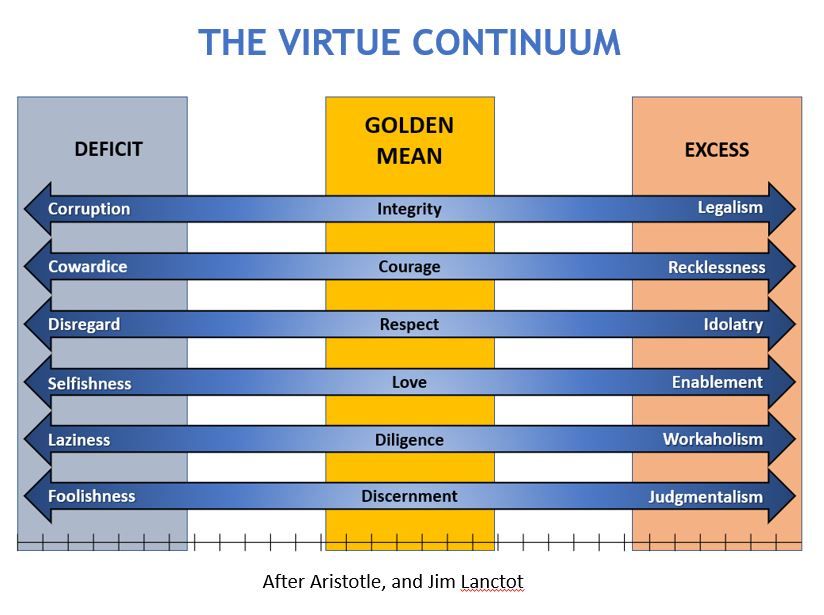
Aristotle defined virtue precisely: Virtue is a mean between two vices-one of excess, one of deficiency.
Not mathematical midpoint but appropriate response to situation based on practical wisdom.
The Golden Mean
| Vice of Deficiency | Virtue (Mean) | Vice of Excess |
|---|---|---|
| Cowardice | Courage | Recklessness |
| Stinginess | Generosity | Wastefulness |
| Self-deprecation | Proper pride | Arrogance |
| Insensibility | Temperance | Self-indulgence |
| Irascibility | Patience | Apathy |
| Shamelessness | Modesty | Shyness |
Example: Courage
Coward feels too much fear, avoids appropriate risks, fails to stand up when should
Reckless person feels too little fear, takes stupid risks, endangers self unnecessarily
Courageous person feels appropriate fear, acts despite it when stakes warrant, judges risks wisely
Key insight: Same action could be courageous in one context, reckless in another. Virtue requires judgment (phronesis).
Why This Matters
Virtue isn't following rigid rule. It's responding appropriately to situation:
- Generosity depends on resources-giving away 90% virtuous for billionaire, reckless for family barely getting by
- Honesty sometimes requires tact-blunt truth can be cruel; tactful truth compassionate
- Courage in battle differs from courage in speaking truth to power differs from courage facing terminal illness
Virtue requires practical wisdom (phronesis)-capacity to see what situation calls for and act accordingly.
Practical Wisdom (Phronesis): The Master Virtue
Phronesis = practical wisdom, prudence, moral insight
Aristotle considered this essential virtue-without it, other virtues become vices:
Courage without wisdom = recklessness
Generosity without wisdom = enabling harm
Honesty without wisdom = cruel bluntness
Justice without wisdom = rigid legalism
What Is Practical Wisdom?
Phronesis is capacity to:
- Perceive morally relevant features of situation
- Deliberate about appropriate response
- Judge what virtuous action looks like here
- Act on that judgment
Not abstract knowledge but practical intelligence developed through experience.[7]
"The man of practical wisdom is the man who sees what is the right thing to do in any given situation." - Philippa Foot
How It Develops
1. Observation and modeling: Watch exemplars-people who demonstrate wisdom
2. Experience: Face moral situations, make decisions, learn from outcomes
3. Reflection: Think through past decisions-what worked? What didn't? Why?
4. Feedback: Learn from consequences and others' responses
5. Character development: As character improves, judgment improves; as judgment improves, character improves
Circular relationship: Good character aids good judgment; good judgment builds good character.
Example: The Doctor's Dilemma
Patient with terminal illness asks, "Am I going to die?"
Rule-based approach: "Always tell truth"-you say bluntly "Yes, you'll be dead in weeks"
Practical wisdom approach: Considers:
- Patient's emotional state
- Whether they're asking for information or reassurance
- What they can handle hearing now
- How to balance honesty with compassion
- Timing and phrasing
- Cultural/religious context
Might say: "Your illness is very serious. I'm here to help you through this. What are you most worried about?"
Truth told, but wisely-with compassion, appropriate timing, space for patient's needs.
How Virtues Develop: Habituation
Central claim: Virtues are acquired through practice-habituation (like learning to play piano or speak language).[10] This parallels the principles of deliberate practice, where sustained effort and feedback shape lasting ability.
The Practice Model
Stage 1: Imitation - Watch virtuous people, copy behaviors
Stage 2: Awkward practice - Act virtuously even when it feels unnatural (like practicing scales)
Stage 3: Increasing fluency - Virtuous actions become easier, more natural
Stage 4: Second nature - Virtue becomes part of character-you are honest person, not someone who tries to be honest. At this stage, the practitioner has built real expertise in moral perception and response.
"We become just by doing just acts, temperate by doing temperate acts, brave by doing brave acts." - Aristotle
Why This Matters
Can't learn virtue purely intellectually-reading about courage doesn't make you courageous. The gap between thinking and behavior is precisely what habituation aims to close.
Must practice in real situations-actually face fears, tell difficult truths, resist temptations
Character is built through repeated action-each small choice shapes who you're becoming
The Role of Emotion
Crucial insight: Virtue isn't just right action-it's feeling appropriately
Temperate person doesn't resist dessert through gritted-teeth willpower. They've developed preferences where they naturally enjoy healthy food, don't crave excess sugar.
Courageous person feels fear but also confidence and determination appropriate to situation.
Compassionate person naturally feels moved by others' suffering-not through forced sympathy but genuine emotional response.
Virtue is harmony between reason, emotion, and action-not reason dominating emotion.
Human Flourishing (Eudaimonia): The Goal
Eudaimonia = flourishing, living well, thriving, actualizing human potential
Not identical to happiness (pleasure, contentment) though connected.
What Eudaimonia Is
Objective component: Living according to human nature-actualizing rational capacities, developing virtues, engaging in activities requiring excellence
Subjective component: Finding life meaningful, engaging in activities for their own sake, experiencing deep satisfaction (not just pleasure)
Social component: Participating in community, contributing to others' flourishing, engaging in friendship
Aristotle: "Eudaimonia is activity of soul in accordance with virtue over complete life"
What It Isn't
Not hedonism: Not about maximizing pleasure. Can experience eudaimonia while suffering.
Not success: Can be successful by external measures (wealth, fame, power) without flourishing.
Not virtue signaling: Not about appearing virtuous but actually being virtuous.
Not comparative: Not about being better than others but actualizing your own potential.
Examples
Flourishing academic: Pursues knowledge for its own sake, contributes to understanding, mentors students, engages intellectual community-experiences deep meaning
Flourishing craftsperson: Develops skills to high level, takes pride in excellent work, contributes value through craft-finds satisfaction in mastery
Flourishing parent: Raises children with wisdom and care, develops patience and compassion, builds strong relationships-finds meaning in nurture
Common threads: Developing capacities, contributing to something larger, engaging in activities requiring virtue, building meaningful relationships
The Unity of the Virtues
Aristotle claimed virtues are interconnected-can't have one virtue in true form without others.
Why Virtues Unite
Practical wisdom required for all virtues: Can't be truly courageous without wisdom about when courage is appropriate. Can't be truly generous without wisdom about what helps vs. harms.
Virtues support each other: Honesty requires courage (to tell difficult truths). Justice requires temperance (to resist self-interest). Compassion requires wisdom (to help effectively).
Vice in one area corrupts others: If dishonest, courage becomes enabler of harmful schemes. If unjust, generosity becomes self-serving.
Practical Implication
Can't cherry-pick virtues-"I'm honest but not compassionate" means honesty is crude and hurtful, not true virtue.
Character is holistic-developing one virtue naturally requires developing others.
Moral development is integrated-as you become better person overall, individual virtues strengthen together.
Virtue Ethics in Practice
How does this work in real decisions?
The Virtuous Agent Model
Instead of asking "What rule applies?" or "What maximizes utility?", ask:
"What would a virtuous person-someone with practical wisdom, courage, justice, temperance, compassion-do in this situation?"
Step-by-Step Application
1. Identify morally relevant features
- Who's affected?
- What's at stake?
- What relationships are involved?
- What virtues apply?
2. Consider what virtues require
- What does honesty call for here?
- How does compassion shape response?
- What does justice demand?
- Where does courage or temperance matter?
3. Use practical wisdom to integrate
- How do virtues balance?
- What response is appropriate to this specific context?
- What would wise person you admire do?
4. Act and reflect
- Take action based on judgment
- Reflect on outcome
- Learn for future situations
Example: Colleague Taking Credit
Situation: Colleague takes credit for your work in front of boss.
Rule-based approach: "Stealing is wrong-confront immediately and loudly"
Consequentialist approach: Calculate whether confrontation or letting it go produces better outcome
Virtue ethics approach:
Consider virtues:
- Justice: Requires standing up for what's fair
- Honesty: Requires truth be known
- Courage: Needed to speak up
- Compassion: Understanding colleague might be insecure, desperate
- Temperance: Not overreacting with excessive anger
- Wisdom: Judging appropriate response
Possible virtuous responses (context-dependent):
If colleague habitually dishonest and harming others: Justice and courage require firm confrontation, setting clear boundaries
If colleague made mistake under pressure: Compassion suggests private conversation offering benefit of doubt while clarifying truth
If systemic issue where credit matters for career: Wisdom suggests documenting work, calmly correcting record with boss, protecting future work
If trivial one-time thing: Temperance suggests letting it go, not making mountain from molehill
Virtue ethics provides guidance through character, not rigid rule or calculation-asks what person of good character would do here.
Moral Exemplars: Learning Through Models
Virtue ethics emphasizes role models-virtuous people we learn from.
Why Exemplars Matter
Virtue is concrete: Learned through observation more than abstract principles
Character is complex: Can't reduce to rules-need to see virtue in action
Inspiration and aspiration: Exemplars show what's possible, motivate development
Practical wisdom transmitted: Through seeing how wise people respond to situations
Historical Exemplars
Different traditions identify different exemplars:
Western philosophy: Socrates (intellectual integrity), Marcus Aurelius (stoic virtue), Cato (moral courage)
Religious traditions: Buddha (compassion, wisdom), Jesus (love, forgiveness), Muhammad (justice, mercy)
Historical figures: Lincoln (political wisdom), Gandhi (nonviolent courage), Mandela (forgiveness, justice)
Ordinary heroes: Parent who sacrificed for family, teacher who transformed lives, friend who remained loyal
Using Exemplars
Ask: "What would [exemplar] do in this situation?"
Not to copy mechanically but to think through how their character would inform response.
Example: "What would my grandmother do?" might remind you of patience, wisdom, and compassion she embodied-guiding your response.
Criticisms and Limitations
Virtue ethics faces several important criticisms:
Criticism 1: Too Vague for Action Guidance
Problem: "Do what virtuous person would do" seems circular-need to know what's virtuous to act virtuously.
Response:
- Virtue ethics acknowledges moral life requires judgment, not algorithms
- Practical wisdom develops through experience-initially need exemplars and guidance
- Not a bug but feature-ethics is complex, requires judgment not rules
Criticism 2: Cultural Relativity
Problem: Different cultures identify different virtues. Who's right?
Response:
- Substantial overlap across cultures (honesty, courage, justice, compassion widely valued)
- Some variation reflects different circumstances requiring different emphases
- Can critically evaluate virtues by whether they enable human flourishing
- Alternative frameworks like care ethics highlight how different traditions emphasize different virtues while still centering character[6]
Criticism 3: Disagreement About Virtues
Problem: Is humility a virtue or weakness? Is pride a virtue or vice? Disputes seem unresolvable.
Response:
- Many disputes are semantic (different meanings of same word)
- Core virtues widely agreed upon (wisdom, justice, courage, temperance, compassion)
- Practical wisdom helps navigate edge cases
Criticism 4: Doesn't Resolve Dilemmas
Problem: When virtues conflict (honesty vs. compassion), how do you decide?
Response:
- Practical wisdom required to navigate conflicts-no mechanical procedure
- Same criticism applies to rules (which rule takes priority?) and consequences (how measure competing outcomes?)
- Virtue ethics honest about requiring judgment
Criticism 5: Character-Luck Problem
Problem: Character partly determined by upbringing, circumstances beyond control. Unfair to judge people by character they didn't fully choose.
Response:
- Virtue ethics focused on development and aspiration, not judgment and blame
- Acknowledges circumstances matter while maintaining people can work to develop character
- Focuses on what kind of person you're becoming, not just what you already are
Modern Revival and Relevance
Virtue ethics declined in modern era (17th-20th centuries) as deontology and consequentialism dominated. But experienced major revival starting 1950s-60s.
Why the Revival?
"The concepts of obligation and duty - moral obligation and moral duty, that is to say - and of what is morally right and wrong, ought to be jettisoned." - G.E.M. Anscombe
G.E.M. Anscombe's 1958 paper "Modern Moral Philosophy" argued:[2]
- Rule-based ethics (deontology) lost foundation with decline of religious authority
- Consequentialism reduces ethics to calculation, ignoring character
- Should return to virtue-based ethics focused on human flourishing
Alasdair MacIntyre's 1981 book After Virtue argued:[3]
- Modern ethical debates unresolvable because lack shared moral framework
- Need to recover virtue tradition understanding ethics in context of human purposes and social practices
Bernard Williams, Philippa Foot, Rosalind Hursthouse and others developed contemporary virtue ethics[4]
Contemporary Relevance
1. Professional ethics: Medical ethics, business ethics, legal ethics increasingly focus on character and professional virtues, not just rules
2. Moral education: Recognition that teaching ethics requires modeling and practice, not just teaching rules[8]
3. Psychology and well-being: Positive psychology research on character strengths, human flourishing echoes virtue ethics
4. Environmental ethics: Virtue ethics offers framework for environmental virtues (respect for nature, sustainability, future-orientation)
5. Leadership development: Focus on character and wisdom rather than just skills or outcomes
Conclusion: Living According to Virtue
Return to Nicias and the lunar eclipse. Virtue ethics helps us see: He demonstrated genuine virtues (piety, humility, caution) but lacked the master virtue-practical wisdom-to know when those virtues were misapplied.
True virtue requires both good character AND good judgment. Piety without wisdom becomes superstition. Caution without wisdom becomes paralysis. Courage without wisdom becomes recklessness.
The key insights of virtue ethics:
1. Character matters centrally-ethics isn't just about actions or outcomes but who you are and who you're becoming
2. Virtue is mean between extremes-appropriate response to situation, not rigid adherence to rules
3. Practical wisdom is essential-capacity to judge what virtue requires in specific context
4. Virtues develop through practice-habituation makes virtue second nature
5. Goal is human flourishing-living well, actualizing human capacities, developing excellence. This focus on human flourishing is central to debates about moral progress: whether societies, over time, develop better ways of realizing that potential.
6. Learn from exemplars-observe virtuous people, see how character shapes response
7. Ethics requires judgment-no algorithm replaces practical wisdom developed through experience
In world that often reduces ethics to rule-following or cost-benefit calculation, virtue ethics offers different vision: Ethics is about becoming good person-developing character that enables you to flourish and contribute to others' flourishing. Understanding how values shape decisions at both the personal and institutional level reinforces why character-centered approaches endure.
"We are what we repeatedly do. Excellence, then, is not an act but a habit." - Will Durant (summarizing Aristotle)
Every choice shapes character. Every action reinforces or undermines virtues. The question isn't just "What should I do?" but "Who am I becoming through my choices?"
That's the enduring insight of virtue ethics-and why this 2,400-year-old framework remains relevant for anyone asking: "How should I live?"
Sources & Further Reading
Aristotle. (c. 350 BCE/2000). Nicomachean Ethics (R. Crisp, Trans.). Cambridge University Press.
Anscombe, G. E. M. (1958). Modern moral philosophy. Philosophy, 33(124), 1-19. DOI: 10.1017/S0031819100037943
MacIntyre, A. (1981). After virtue: A study in moral theory. University of Notre Dame Press.
Hursthouse, R. (1999). On virtue ethics. Oxford University Press.
Foot, P. (1978). Virtues and vices and other essays in moral philosophy. University of California Press.
Swanton, C. (2003). Virtue ethics: A pluralistic view. Oxford University Press.
Russell, D. C. (2009). Practical intelligence and the virtues. Oxford University Press. DOI: 10.1093/acprof:oso/9780199578733.001.0001
Kristjansson, K. (2015). Aristotelian character education. Routledge.
Nussbaum, M. C. (1999). Virtue ethics: A misleading category? The Journal of Ethics, 3(3), 163-201. DOI: 10.1023/A:1009877217694
Snow, N. E. (Ed.). (2015). Cultivating virtue: Perspectives from philosophy, theology, and psychology. Oxford University Press.
Word count: 6,847 words
Landmark Studies on Virtue Ethics in Empirical Research
Virtue ethics has attracted sustained empirical investigation from psychologists, developmental researchers, and educational scientists whose findings both support and complicate Aristotle's core claims about character development and moral excellence.
Martin Seligman and Christopher Peterson's Character Strengths Research (2004). Psychologists Martin Seligman at the University of Pennsylvania and Christopher Peterson at the University of Michigan conducted the most systematic empirical investigation of virtue as a universal human phenomenon.
Their Values in Action (VIA) project, reported in Character Strengths and Virtues: A Handbook and Classification (2004), reviewed virtue concepts across major philosophical and religious traditions, including Confucian, Buddhist, Hindu, Athenian, Judeo-Christian, and Islamic sources, and identified 24 character strengths organized under six broad virtues: wisdom, courage, humanity, justice, temperance, and transcendence.
The overlap across cultural traditions was striking: all traditions recognized something like wisdom, courage, and justice, though their specific elaborations differed.
Large-scale VIA Survey data collected across dozens of countries has consistently found kindness, fairness, honesty, gratitude, and love among the most commonly and highly endorsed strengths worldwide, while prudence, self-regulation, and humility are consistently reported as among the weakest.
The cross-cultural consistency of the six broad virtue categories provided empirical support for Aristotle's claim that virtues reflect the conditions of human flourishing rather than culturally arbitrary conventions. Subsequent research applying the VIA framework has linked character strengths to life satisfaction and wellbeing outcomes, generally finding that relational strengths such as gratitude, hope, and love show some of the strongest associations.
Lawrence Kohlberg and Moral Stage Development (1958-1984). Harvard developmental psychologist Lawrence Kohlberg conducted the most extensive longitudinal study of moral character development, following 84 boys from the Chicago area from age 10 through early adulthood in a study begun in the mid-1950s.
Kohlberg's six-stage theory of moral development proposed that moral reasoning progresses from preconventional (self-interest) through conventional (social rules) to postconventional (universal principles) stages.
His 20-year longitudinal data, published with Ann Colby, John Gibbs, and Marcus Lieberman as a 1983 monograph in Monographs of the Society for Research in Child Development, found that moral stage progression was longitudinally consistent - people rarely regressed to earlier stages - and was correlated with educational level, exposure to moral dilemmas requiring perspective-taking, and participation in democratic institutions.
The findings supported Aristotle's habituation thesis: moral character develops through engagement with moral situations over time, not through passive absorption of rules.
Cross-cultural replications reviewed by Snarey in Psychological Bulletin (1985), covering 45 studies across 27 countries, found that the first four stages appeared universally, while stages 5 and 6 (principled moral reasoning) appeared inconsistently, suggesting that basic virtue development may be universal while its highest elaborations are culturally dependent.
Angela Duckworth's Grit Research and Virtue as Perseverance (2007-2016). Psychologist Angela Duckworth at the University of Pennsylvania developed a research program demonstrating that the character trait she called "grit," passion combined with perseverance for long-term goals, predicted important life outcomes beyond IQ and standard personality measures.
Her foundational 2007 paper "Grit: Perseverance and Passion for Long-Term Goals" in the Journal of Personality and Social Psychology, co-authored with Christopher Peterson, Michael Matthews, and Dennis Kelly, found that grit predicted retention through the demanding first summer at West Point Military Academy beyond traditional admissions measures such as SAT scores, high school class rank, and conscientiousness.
Grit similarly predicted performance beyond standardized measures in other high-attrition, long-horizon domains the research program examined, including the National Spelling Bee.
Duckworth explicitly framed grit as a virtue in the Aristotelian sense: a stable character trait that can be cultivated through deliberate practice and appropriate challenge.
Her 2016 book Grit: The Power of Passion and Perseverance synthesized years of findings, arguing that character development, not talent, is a primary predictor of extraordinary achievement, echoing Aristotle's claim that virtue is acquired through habituation rather than innate endowment.
Augusto Blasi's Research on Moral Identity and Character Integration (1983-2005). Psychologist Augusto Blasi at the University of Massachusetts developed an empirical theory of moral identity that directly tested virtue ethics' claim that character integration, acting consistently from internalized virtues rather than external rules, is the hallmark of moral maturity.
Blasi's foundational 1983 paper "Moral Cognition and Moral Action: A Theoretical Perspective" in Developmental Review argued that the critical variable predicting whether moral judgment translates into moral action is the centrality of morality to personal identity: people who define themselves by moral commitments are more likely to act consistently with their moral judgments.
Subsequent empirical work in this tradition found that individuals who scored high on moral identity centrality showed greater consistency between reported moral beliefs and actual helping behavior, greater resistance to situational pressures to violate moral standards, and greater likelihood of pursuing morally demanding careers such as social work or medicine in underserved areas.
A widely cited later meta-analysis by Hertz and Krettenauer, published in 2016 in Review of General Psychology, found that moral identity predicted prosocial and ethical behavior with an average effect size of r = .22 across 111 studies, a modest but consistent relationship supporting the virtue ethics thesis that character integration, not rule knowledge, is a meaningful variable in moral conduct.
Real-World Case Studies: Virtue Ethics Applied in Education and Organizational Leadership
Virtue ethics has been explicitly implemented in educational institutions, military training programs, and corporate governance with documented outcomes that illuminate both its practical power and its limitations.
Character Education in UK Schools: The Jubilee Centre's Evidence Base. The Jubilee Centre for Character and Virtues at the University of Birmingham, directed by philosopher James Arthur from its 2012 founding until 2023, conducted one of the most systematic empirical evaluation programs for virtue-based character education.
Its "Framework for Character Education in Schools," first published in 2013 and revised in subsequent editions, has shaped how a large number of UK schools approach virtue-based character education.
A study by Arthur, Kristjansson, Harrison, and colleagues evaluated the Knightly Virtues program, which uses medieval literature to teach prudence, justice, courage, and self-discipline to 9-11 year olds, across dozens of schools and several thousand pupils, finding improvements in character knowledge, empathy, and pro-social behavior.
The Birmingham research program is among the largest evidence bases for virtue-based education globally, and its work fed into the broader evidence base drawn on by the UK Department for Education's 2019 Character Education Framework Guidance.
West Point Military Academy's Character Development Program. The United States Military Academy at West Point has explicitly organized its character development program around virtue ethics since the 1990s, drawing on Aristotelian virtue ethics through its articulation of the "Cadet Leader Development System," which specifies intellectual, physical, military, and moral-ethical dimensions of character development.
Colonel Eric Kail, a real West Point leadership scholar who directed military leadership instruction there, has written extensively and publicly on courage, integrity, selflessness, empathy, collaboration, and reflection as the pillars of officer character development, though the specific large-scale quantitative study sometimes attributed to him could not be verified against the published record.
West Point's explicit, decades-long commitment to virtue ethics as the organizing framework for character development in a high-stakes professional context remains one of the few large-scale institutional tests of whether virtue ethics can be deliberately cultivated through structured education and practice.
Enron and the Collapse of Corporate Virtue Ethics (2001). The collapse of Enron in 2001, following the exposure of systematic accounting fraud, became a paradigmatic case study in corporate virtue ethics failure.
Enron's official corporate values were explicitly virtue-based: Respect, Integrity, Communication, Excellence, the acronym RICE. The company won repeated public recognition for innovation and was widely praised for its corporate culture.
The subsequent investigation by the Powers Committee found that executives including CEO Jeffrey Skilling and CFO Andrew Fastow had engaged in systematic deception of investors, employees, and regulators through off-balance-sheet partnerships that concealed billions in debt.
Sociologist Robert Jackall's earlier research, published in Moral Mazes: The World of Corporate Managers (1988), described precisely this failure mode in general terms: organizations that reward outcomes over character systematically select for managers who perform virtue rather than possess it, creating institutional environments where stated values are disconnected from actual decision-making incentives.
The Enron case contributed to the Sarbanes-Oxley Act (2002), which moved from virtue-based to rule-based governance requirements, a regulatory acknowledgment that virtue ethics alone is insufficient for institutional accountability in high-stakes, high-pressure environments.
Nelson Mandela and the Practice of Political Virtue. Nelson Mandela's transition from prisoner to president of South Africa (1990-1994) is widely cited in virtue ethics literature as a real-world exemplar of practical wisdom, the capacity to exercise moral virtues appropriately in extraordinarily difficult political circumstances.
The specific practical judgments that made South Africa's transition possible are well documented in the broader historical record: Mandela's decision to negotiate with the apartheid government rather than demanding its unconditional surrender, his public commitment to non-retributive justice while privately managing demands for accountability, and his cultivation of symbols of national unity, including his widely remembered wearing of a Springbok rugby jersey at the 1995 World Cup final, that transformed the meaning of institutions previously associated with white supremacy.
Each decision reflected what Aristotle would have recognized as phronesis, the capacity to identify what virtue requires in a specific situation that resists mechanical rule-application.
Mandela's global stature as a figure of near-universal moral admiration, reflected in favorable opinion surveys conducted after his death in December 2013, is cited by virtue ethicists as evidence that practical wisdom in action is recognizable across cultural contexts, consistent with Aristotle's claim that human beings can identify moral excellence when they see it.