
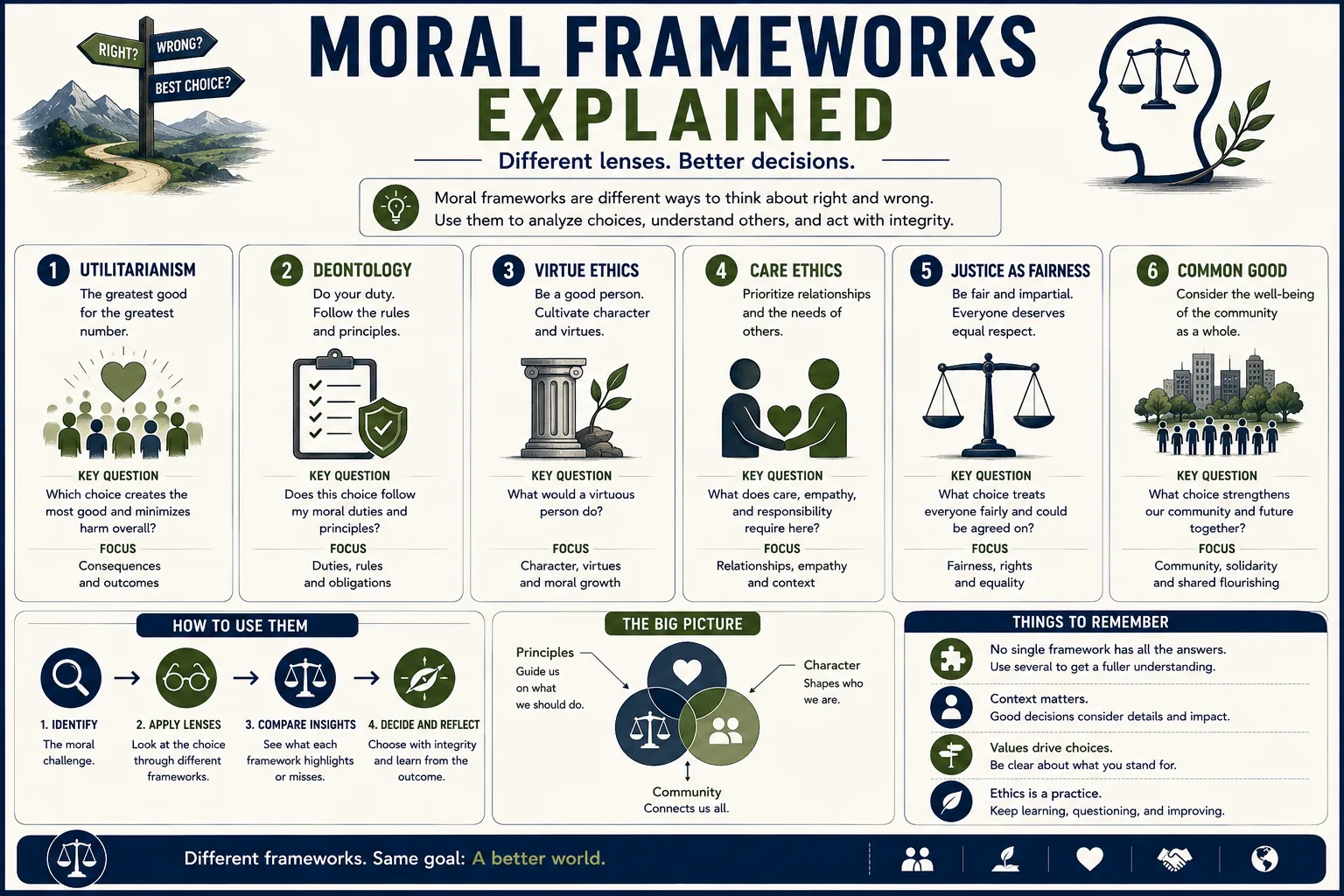
When facing an ethical dilemma, how do you decide what's right? Most people rely on intuition-a gut feeling. But intuition is inconsistent, culturally embedded, and breaks down in novel situations.
Moral frameworks are systematic approaches to ethical reasoning. They're not absolute truths-they're tools that structure moral thinking, reveal blind spots, and help you justify decisions. They are the building blocks of ethical decision making: understanding which framework you are applying is the first step to applying it well.
Understanding the major frameworks-consequentialism, deontology, virtue ethics, care ethics, and others-makes you a better moral reasoner, even if you don't adopt one exclusively.[9]
Table of Contents
- Why Frameworks Matter
- Consequentialism: Judge by Outcomes
- Deontology: Judge by Duties and Rules
- Virtue Ethics: Judge by Character
- Care Ethics: Judge by Relationships
- Other Frameworks
- Comparing Frameworks
- Using Multiple Frameworks
- Practical Applications
- References
Why Frameworks Matter
The Problem with Pure Intuition
Intuition is your immediate sense of right and wrong. It's fast, automatic, and often accurate in familiar contexts.
But intuition has problems:
| Problem | Why It Matters |
|---|---|
| Inconsistency | Your intuition changes based on mood, framing, who's watching |
| Cultural bias | What feels "obviously right" to you may be culturally specific |
| Manipulation | Intuition is easily swayed by rhetoric, emotion, and social pressure |
| Novelty failure | Breaks down in new situations (e.g., AI ethics, bioengineering) |
| Conflict resolution | When intuitions clash, no way to adjudicate |
Example: The Trolley Problem
A runaway trolley will kill five people. You can pull a lever to divert it, killing one person instead.[12] What do you do?
- Intuition A: Pull the lever (saving five lives is better than saving one)
- Intuition B: Don't pull it (actively killing someone feels worse than letting people die)
Both intuitions are common. Frameworks help you think through why you lean one way or the other.
What Frameworks Provide
| Benefit | Description |
|---|---|
| Structure | Systematic way to reason through dilemmas |
| Consistency | Apply the same logic across cases |
| Justification | Explain your moral judgment to others |
| Prediction | Anticipate what framework X would recommend |
| Diagnosis | Identify why people disagree (different frameworks) |
Frameworks don't give you "the answer." They clarify your decision-making.
Consequentialism: Judge by Outcomes
Core Idea
An action is right if it produces the best consequences. Morality is about maximizing good outcomes and minimizing bad ones.
| Principle | Description |
|---|---|
| Focus | Outcomes, results, consequences |
| Question | "What produces the best results?" |
| Measurement | Good vs. bad outcomes (utility, welfare, happiness, etc.) |
| Judgment | Act that maximizes net good is right |
Utilitarianism (Most Common Form)
Maximize overall happiness or welfare.
- Classical utilitarianism (Bentham, Mill): Maximize pleasure, minimize pain[1]
- Preference utilitarianism: Satisfy the most preferences
- Rule utilitarianism: Follow rules that, if generally followed, maximize utility
Core formula:The greatest good for the greatest number.
As utilitarian philosopher John Stuart Mill wrote, "The creed which accepts as the foundation of morals utility, or the greatest-happiness principle, holds that actions are right in proportion as they tend to promote happiness, wrong as they tend to produce the reverse of happiness."
Examples
| Scenario | Consequentialist Reasoning |
|---|---|
| Lying to protect someone | Right if it prevents greater harm |
| Sacrificing one to save many | Right if net welfare increases |
| Stealing food to feed starving family | Right if starvation harm > theft harm |
| Breaking a promise to help in emergency | Right if helping produces better outcome |
Strengths
| Strength | Why It Matters |
|---|---|
| Intuitive appeal | "Doing the most good" resonates widely |
| Measurable | Can (in theory) calculate outcomes |
| Flexible | No absolute rules; adapt to circumstances |
| Impartial | Everyone's welfare counts equally |
Weaknesses
| Weakness | Why It's Problematic |
|---|---|
| Measurement problem | How do you quantify and compare outcomes? |
| Uncertainty | Outcomes are often unpredictable |
| Rights violations | Can justify terrible acts if outcomes are good (e.g., torture one to save many) |
| Demandingness | Requires constant sacrifice for greater good |
| Ignores intent | Same outcome = same morality, even if one actor was malicious |
As philosopher Bernard Williams argued, consequentialism can demand too much of us: "It is not permissible for a man to do anything at all, however outrageous, merely because the utilitarian arithmetic comes out in favour of it." His critique remains one of the sharpest challenges to purely outcome-based moral reasoning.[14]
Classic objection: Would you harvest one healthy person's organs to save five dying patients?
- Consequentialist logic: Yes, if it maximizes lives saved
- Intuition: No, that violates the healthy person's rights
Variations
| Type | Key Difference |
|---|---|
| Act consequentialism | Judge each action individually by outcomes |
| Rule consequentialism | Follow rules that generally produce best outcomes |
| Two-level consequentialism | Intuitive rules day-to-day; consequentialist reflection for edge cases |
Deontology: Judge by Duties and Rules
Core Idea
Some actions are inherently right or wrong, regardless of consequences. Morality is about fulfilling duties and following rules.
| Principle | Description |
|---|---|
| Focus | Duties, rules, rights |
| Question | "What is my duty?" or "What rule applies?" |
| Measurement | Adherence to moral law |
| Judgment | Act is right if it follows duty/rule, wrong if it violates |
Kantian Ethics (Most Influential Form)
Immanuel Kant: Act only according to rules you'd will to be universal laws.[2] Treat people as ends in themselves, never merely as means.
"Act only according to that maxim whereby you can at the same time will that it should become a universal law." - Immanuel Kant, Grounding for the Metaphysics of Morals (1785)
Categorical Imperative (simplified):
- Universalizability: Would you want everyone to act this way?
- Humanity as end: Don't use people as mere tools
Example:
- Lying: Wrong, because if everyone lied, trust would collapse (universalizability fails)
- Using someone: Wrong to manipulate people for your benefit (treats them as mere means)
Examples
| Scenario | Deontological Reasoning |
|---|---|
| Lying to protect someone | Wrong, because lying violates duty of honesty |
| Sacrificing one to save many | Wrong, because you're using the one as a mere means |
| Stealing food to feed starving family | Wrong, because theft violates property rights |
| Breaking a promise to help in emergency | Complicated-depends on whether duty to promise or duty to aid is higher |
Strengths
| Strength | Why It Matters |
|---|---|
| Respects rights | Protects individuals from being sacrificed for the greater good |
| Clarity | Clear rules provide guidance |
| Intention matters | Judges moral character, not just outcomes |
| Universality | Applies equally to everyone |
Weaknesses
| Weakness | Why It's Problematic |
|---|---|
| Rigidity | Rules can produce terrible outcomes in edge cases |
| Conflict of duties | What if two duties clash? (e.g., honesty vs. preventing harm) |
| Abstraction | Hard to apply universalizability to complex real-world situations |
| Outcomes ignored | Seems wrong to follow a rule that causes massive harm |
Classic objection: If a murderer asks where your friend is hiding, should you tell the truth?
- Strict Kantian: Yes, lying is always wrong
- Intuition: No, protecting life matters more
Variations
| Type | Key Difference |
|---|---|
| Kantian ethics | Universal moral law; categorical imperative |
| Rights-based ethics | Focus on inviolable rights (life, liberty, property) |
| Divine command theory | Right/wrong defined by God's commands |
| Social contract theory | Moral rules arise from rational agreement |
Virtue Ethics: Judge by Character
Core Idea
Focus on becoming a good person rather than following rules or calculating outcomes. Morality is about cultivating virtues-character traits that enable human flourishing.[7]
| Principle | Description |
|---|---|
| Focus | Character, virtues, flourishing |
| Question | "What would a virtuous person do?" |
| Measurement | Wisdom, courage, justice, temperance, etc. |
| Judgment | Act is right if it's what a virtuous person would do |
Aristotelian Virtue Ethics
Aristotle: Cultivate virtues through practice.[3] Find the "golden mean"-balance between extremes.
As Will Durant summarized Aristotle's view, "We are what we repeatedly do. Excellence, then, is not an act but a habit." This insight is central to virtue ethics: moral character is built through sustained practice, not singular choices.
Core virtues:
- Wisdom (phronesis): Practical judgment
- Courage: Right amount of fear (not recklessness or cowardice)
- Temperance: Moderation in pleasure (not indulgence or asceticism)
- Justice: Fairness and giving others their due
Goal:Eudaimonia (flourishing, living well)
Examples
| Scenario | Virtue Ethics Reasoning |
|---|---|
| Lying to protect someone | A wise person would judge context-honesty is a virtue, but so is compassion |
| Sacrificing one to save many | Depends on whether action reflects courage and justice or cruelty |
| Stealing food to feed starving family | A just person might balance property rights with care for dependents |
| Breaking a promise to help in emergency | Wisdom determines right balance of loyalty, compassion, and integrity |
Strengths
| Strength | Why It Matters |
|---|---|
| Holistic | Considers character, intent, context, outcomes |
| Practical | Asks "What would a wise person do?" rather than applying abstract rules |
| Development-focused | Emphasizes growth and practice, not just judgment |
| Context-sensitive | Recognizes that right action depends on situation |
Weaknesses
| Weakness | Why It's Problematic |
|---|---|
| Vagueness | "Be virtuous" isn't actionable guidance |
| Cultural relativity | What counts as a virtue varies by culture |
| Circular | Defines right action as what virtuous person does, but who is virtuous? |
| Conflict | Virtues can conflict (e.g., honesty vs. compassion) |
Classic objection: Virtue ethics doesn't give clear answers in dilemmas-it just says "be wise," which is the question, not the answer.[10]
Modern Variants
| Type | Key Difference |
|---|---|
| Aristotelian | Focus on eudaimonia, golden mean, practical wisdom |
| Confucian | Emphasizes roles, relationships, ritual propriety |
| Buddhist | Virtues include compassion, mindfulness, non-attachment |
Care Ethics: Judge by Relationships
Core Idea
Morality arises from relationships and responsibilities to care for others. Emphasizes context, connection, and attentiveness to needs over abstract principles.
| Principle | Description |
|---|---|
| Focus | Relationships, care, context |
| Question | "How do I maintain and nurture relationships?" |
| Measurement | Quality of care, responsiveness to needs |
| Judgment | Act is right if it preserves relationships and responds to particular needs |
Origins and Key Ideas
Carol Gilligan: Criticized traditional ethics as male-biased (focused on justice, rights, autonomy).[4] Proposed care ethics emphasizing connection, empathy, and responsibility.[8]
Core commitments:
- Particularity: Focus on specific people in specific contexts, not abstract principles
- Responsiveness: Attend to actual needs, not hypothetical duties
- Relationality: Moral life is fundamentally about interdependence, not autonomy
Examples
| Scenario | Care Ethics Reasoning |
|---|---|
| Lying to protect someone | Right if it preserves relationship and protects vulnerable person |
| Sacrificing one to save many | Wrong if it disregards the particular relationship and needs of the one |
| Stealing food to feed starving family | Right because care for family's immediate needs is primary responsibility |
| Breaking a promise to help in emergency | Right if emergency involves someone you have care responsibility for |
Strengths
| Strength | Why It Matters |
|---|---|
| Context-sensitive | Recognizes that abstract rules ignore particularity |
| Relationship-focused | Morality isn't just about strangers; it's about those we're connected to |
| Inclusivity | Emphasizes emotional and relational dimensions of ethics |
| Practical | Attends to real needs, not hypothetical scenarios |
Weaknesses
| Weakness | Why It's Problematic |
|---|---|
| Partiality | Prioritizing those close to you can produce injustice |
| Scope limits | Doesn't handle impersonal moral issues (e.g., policy, strangers) |
| Vagueness | "Care" doesn't provide clear decision criteria |
| Exploitation risk | "Care" can be used to justify oppressive relationships |
Classic objection: What about duties to strangers or abstract justice (e.g., climate change, human rights violations in distant countries)?
Variations
| Type | Key Difference |
|---|---|
| Feminist care ethics | Emphasizes gender and power dimensions |
| Ubuntu (African ethics) | "I am because we are"-communal identity and mutual care |
| Confucian relationality | Care structured by roles (parent-child, ruler-subject, etc.) |
Other Frameworks
Contractarianism
Core idea: Moral rules arise from rational agreements among self-interested agents.
Key figures: Thomas Hobbes, John Rawls
Logic: What rules would rational people agree to if they didn't know their position in society?
Example (Rawls' "veil of ignorance"): You'd agree to rules that protect the worst-off, because you might be them.[5]
"Each person possesses an inviolability founded on justice that even the welfare of society as a whole cannot override." - John Rawls, A Theory of Justice (1971)
This principle directly challenges consequentialism: justice is not simply a matter of maximizing aggregate welfare.
Strength: Grounds morality in self-interest and rationality, not altruism.
Weakness: Excludes those who can't reciprocate (animals, future generations, cognitively disabled).
Rights-Based Ethics
Core idea: Individuals have inviolable rights that must be respected.
Key figures: John Locke, Robert Nozick
Core rights: Life, liberty, property, autonomy
Logic: Rights constrain what can be done to individuals, even for greater good.
Strength: Strong protection for individuals against oppression.
Weakness: Rights conflict (e.g., free speech vs. protection from harm); unclear how to prioritize.
Ethical Egoism
Core idea: Act in your own self-interest.
Logic: If everyone pursues their own interest, best outcomes emerge (related to market logic).
Strength: Honest about human motivation.
Weakness: Produces bad outcomes when interests conflict; undermines cooperation.
Moral Pluralism
Core idea: Multiple sources of moral value exist; no single framework captures all.
Key figure: Isaiah Berlin, W.D. Ross
Logic: Consequentialist, deontological, virtue considerations all matter; they can conflict, and there's no universal hierarchy.
Strength: Recognizes complexity of moral life.
Weakness: Doesn't resolve conflicts when frameworks disagree.
Comparing Frameworks
Summary Table
| Framework | Focus | Right Action Is... | Strengths | Weaknesses |
|---|---|---|---|---|
| Consequentialism | Outcomes | Produces best consequences | Measurable, flexible, impartial | Hard to predict, ignores rights, demanding |
| Deontology | Duties/rules | Follows moral law | Respects rights, clear, universal | Rigid, ignores outcomes, duties conflict |
| Virtue Ethics | Character | What virtuous person would do | Holistic, practical, context-sensitive | Vague, circular, cultural variance |
| Care Ethics | Relationships | Maintains care and responds to needs | Context-sensitive, relational, practical | Partial, scope limits, vague |
Classic Dilemmas and Framework Responses
Dilemma 1: Self-Driving Car Crash
A self-driving car must choose: swerve and kill the passenger, or stay course and kill five pedestrians.
| Framework | Response |
|---|---|
| Consequentialism | Kill passenger (saves more lives) |
| Deontology | Don't actively kill passenger (using them as means); maybe stay course (letting pedestrians die vs. killing passenger) |
| Virtue Ethics | What would a wise, just person program? Balance all considerations |
| Care Ethics | Consider relationships-who is the passenger to the programmer? Who are the pedestrians? |
Dilemma 2: Snowden's NSA Leaks
Edward Snowden leaked classified information revealing mass surveillance. Right or wrong?
| Framework | Response |
|---|---|
| Consequentialism | Right if transparency benefits > harm to security |
| Deontology | Wrong (violated oath, betrayed trust, broke law) OR right (exposed rights violations) |
| Virtue Ethics | Did Snowden act with courage and integrity? Or recklessness? |
| Care Ethics | Did he fulfill responsibility to public? Or betray colleagues and country? |
No consensus-each framework highlights different considerations.
Using Multiple Frameworks
Why Pluralism Often Works Best
Single frameworks have blind spots. Using multiple frameworks:
- Reveals hidden considerations (e.g., consequentialism ignores rights; deontology ignores outcomes)
- Strengthens decisions (convergence across frameworks = robust)[11]
- Diagnoses disagreement (people using different frameworks)
The Convergence Test
If multiple frameworks agree, the decision is likely sound.
Example: Don't torture innocent people
- Consequentialism: Creates fear, undermines trust, bad precedent
- Deontology: Violates human dignity and rights
- Virtue Ethics: Cruel, unjust, not what a virtuous person would do
- Care Ethics: Disregards relationship and humanity of victim
Convergence = strong moral case.
When Frameworks Diverge
If frameworks disagree, the situation is genuinely difficult.
Example: Whistleblowing on employer misconduct
- Consequentialism: Right if public harm prevented > personal/organizational harm
- Deontology: Conflicts between duty to truth and duty to loyalty
- Virtue Ethics: Courage to speak up vs. loyalty and prudence
- Care Ethics: Responsibility to colleagues vs. responsibility to affected public
Divergence signals complexity, not wrong frameworks.
Practical Approach
- Start with intuition (fast, default)
- When uncertain, apply multiple frameworks (structured reasoning)
- Look for convergence (strong signal)
- If divergence, clarify values (which framework matches your deepest commitments?)
- Justify decision (explain reasoning to others)
Practical Applications
For Personal Dilemmas
| Situation | Framework to Try |
|---|---|
| Career choice with ethical tradeoffs | Virtue ethics (what kind of person do I want to be?) + Care ethics (relationships affected) |
| Lying to protect someone | Deontology (duty to honesty) vs. consequentialism (outcome of lie vs. truth) |
| Sacrificing personal goals for family | Care ethics (responsibilities) vs. virtue ethics (flourishing) |
For Organizational/Policy Decisions
| Situation | Framework to Try |
|---|---|
| Resource allocation | Consequentialism (maximize welfare) + rights-based (protect vulnerable) |
| Whistleblower policy | Deontology (duty to truth) + care ethics (protection of whistleblowers) |
| AI ethics | Consequentialism (outcomes) + deontology (rights, dignity) + virtue ethics (what does responsible deployment look like?) |
Questions to Ask
To apply consequentialism:
- What are all the likely outcomes?
- Who is affected, and how much?
- How do I weigh different types of outcomes?
To apply deontology:
- What duties or rules apply?
- Would I want this to be a universal rule?
- Am I treating anyone merely as a means?
To apply virtue ethics:
- What would a wise, courageous, just person do?
- What does this decision reveal about my character?
- Am I acting from virtue or vice?
To apply care ethics:
- Who will be affected in my relationships?
- What are their actual needs?
- How do I maintain connection while responding?
Research Evidence: How Different Frameworks Activate Different Neural and Psychological Processes
Moral psychology research over the past two decades has moved beyond philosophical analysis to empirical study of how people actually reason morally-and the findings have important implications for understanding when and why different frameworks are applied.
The dual-process model of moral cognition, developed primarily by Joshua Greene through neuroimaging studies published in Science (2001) and Neuron (2004), provides the most influential account of the cognitive architecture underlying moral framework use.
Greene's trolley problem experiments (Greene et al., 2001 in Science; 2004 in Neuron) used functional MRI to compare brain activation patterns when participants considered impersonal moral dilemmas (the standard trolley problem: pull a lever to divert a trolley from five people to one) versus personal moral dilemmas (the "footbridge" variant: push a large man off a bridge to stop the trolley with his body, saving five).[13]
The finding: personal dilemmas activated emotion-associated brain regions (the medial prefrontal cortex, posterior cingulate cortex) significantly more strongly, and participants were much more reluctant to endorse the "harmful" act in personal scenarios even when the outcomes were structurally identical.
Impersonal dilemmas produced responses more consistent with consequentialist reasoning; personal dilemmas produced responses more consistent with deontological constraints.
Greene interpreted this as evidence that deontological intuitions are driven by evolved emotional responses to direct physical harm, while consequentialist reasoning involves more deliberate, controlled cognition.
This architecture has practical implications: when decisions are emotionally loaded (involving visible, identifiable victims), deontological intuitions are likely to dominate unless explicitly overridden by deliberate consequentialist analysis.
When decisions are emotionally distant (policy affecting statistical rather than identified lives), consequentialist reasoning dominates. Understanding which framework is activated by which decision context helps predict where moral reasoning is likely to go wrong-and where explicit framework application can correct it.
Jonathan Haidt's social intuitionist model, first presented in his 2001 Psychological Review paper "The Emotional Dog and Its Rational Tail," challenges the assumption that moral reasoning drives moral judgment.
Haidt's core finding, replicating across multiple studies: people typically form moral judgments rapidly and emotionally, then construct post-hoc reasoning that justifies those judgments.
When the post-hoc reasoning is challenged, people maintain their original judgment while generating new rationalizations rather than revising their judgment.
Haidt called this "moral dumbfounding"-the inability to articulate reasons for moral positions that are nonetheless maintained with confidence.
The finding does not imply that moral reasoning is useless, but it does imply that explicit framework application is most valuable precisely when it runs against initial intuition: frameworks can correct intuitions rather than merely rationalize them.
Research by Piercarlo Valdesolo and David DeSteno (2006), published in Psychological Science, found that inducing positive mood increased willingness to endorse "utilitarian" choices in personal moral dilemmas-pushing the large man off the bridge.
The finding suggests that which moral framework is applied is partially determined by affective state, which is itself shaped by factors entirely external to the moral decision (the weather, a prior social interaction, a piece of news).
The practical implication: organizations seeking consistent moral reasoning should build decision processes that reduce affective variability-using structured frameworks and requiring explicit justification reduces the extent to which mood-driven variation in framework preference determines outcomes.
Two Historical Cases Where Framework Choice Determined Outcome
Philosophy teaches moral frameworks as abstract systems, but their practical influence becomes visible in cases where different actors applying different frameworks to the same situation reached different conclusions that produced measurably different outcomes.
The Nuremberg Doctors' Trial and the development of research ethics: The 1946-1947 Nuremberg Doctors' Trial prosecuted 23 Nazi physicians for conducting lethal medical experiments on concentration camp prisoners without consent.
The defense argument invoked a form of crude consequentialism: the research produced medical knowledge, some prisoners would have died anyway, and the doctors were following legal orders from the state.
The prosecution's response-and the foundation of the Nuremberg Code issued in 1947-was deontological: human beings have inviolable rights that cannot be overridden by consequentialist calculations, however large the claimed benefits.
Principle 1 of the Nuremberg Code states unequivocally: "The voluntary consent of the human subject is absolutely essential."
The Nuremberg Code's deontological foundation was directly at odds with consequentialist research ethics that had governed (and would continue to influence) medical research practice.
The Tuskegee syphilis study, begun in 1932 and continuing until 1972-decades after Nuremberg-denied treatment to Black men with syphilis to observe disease progression, rationalizing the harm through consequentialist appeals to the medical knowledge gained.
The Public Health Service physicians who designed and maintained the Tuskegee study were not ignorant of the Nuremberg Code; they applied a consequentialist framework that the Code's deontological constraints should have overridden.
When the study was exposed by investigative journalist Jean Heller in 1972, the consequentialist defense collapsed immediately under public scrutiny that applied intuitive deontological standards: you do not experiment on people without their knowledge or withhold available treatment to observe them die.
The ongoing influence of this case on research ethics is measurable. The 1979 Belmont Report-which established autonomy (informed consent), beneficence (doing good), and justice (fair distribution of research burdens) as the foundational principles of American research ethics-built a hybrid framework that attempts to integrate consequentialist and deontological considerations.
The institutional review board (IRB) system that now governs all federally funded human subjects research in the United States is its institutional expression: a structural mechanism to ensure that framework application occurs before harm, not after.
Peter Singer, animal welfare, and the limits of moral circle expansion: Peter Singer's 1975 book Animal Liberation applied utilitarian framework logic to a conclusion that most contemporaneous moral intuitions rejected: if sentient beings capable of suffering deserve moral consideration, and animals are sentient beings capable of suffering, then animal suffering deserves the same moral weight as equivalent human suffering.[6]
Singer's consequentialist framework led him to conclusions that virtue ethics and care ethics frameworks, which ground moral consideration in relationships and social roles, did not reach: factory farming is a massive moral atrocity comparable in scale to the worst human ethical failures.
The measurable influence of Singer's framework application is significant. A 2015 Gallup survey found that 32% of Americans believed animals should have the same rights as people, up from 25% in 2008.
Plant-based food market revenues exceeded $29 billion globally in 2020 (Good Food Institute data), a market that substantially reflects the spread of Singer's moral framework beyond academic philosophy into consumer behavior.
Several countries-Switzerland (1992), Germany (2002), Austria (2004), New Zealand (1999)-have extended constitutional or statutory protections to animals, with New Zealand (1999) restricting research on great apes that reflect the framework Singer articulated.
The case illustrates that moral frameworks, rigorously applied, can expand moral circles in ways that produce measurable behavioral and policy change over generational timescales-even when the initial conclusions violate widespread moral intuitions.
Moral Frameworks in Applied Ethics: Case Studies
Abstract framework comparisons gain their full analytical power only when applied to specific cases where the frameworks produce different recommendations and force examination of which underlying values the decision-maker actually holds. Two cases with historical depth illustrate how frameworks operate in practice.
The Milgram experiments and the obedience problem: Stanley Milgram's famous 1961-1963 experiments at Yale University demonstrated that ordinary participants would administer what they believed were dangerous electric shocks to strangers when instructed by an authority figure.
Approximately 65% of participants administered the maximum shock level of 450 volts despite hearing the "victim" (actually an actor) scream and go silent.
The experiments were designed to understand how ordinary Germans could have participated in Nazi atrocities, and they produced disturbing evidence that obedience to authority overrides individual moral judgment for most people in most conditions.
The four major frameworks analyze this situation differently. A consequentialist asks whether Milgram was right to conduct the experiments.
The knowledge gained has been substantial-the research fundamentally changed understanding of obedience and authority, and has been cited in policies requiring institutional review of research ethics, military training on refusing illegal orders, and organizational design to reduce pressure on employees.
Against this must be weighed the psychological distress experienced by participants who believed they had harmed someone.
Pure outcome calculation requires assigning weights to these competing harms and benefits that no algorithm can supply.
A deontological analysis focuses on whether Milgram violated participants' rights by deceiving them about the experiment's true nature, exposing them to psychological stress without informed consent, and creating conditions where they acted against their own values.
Kant's categorical imperative asks whether deceptive research could be universalized: if all researchers deceived participants whenever useful, the institution of voluntary research participation would collapse-a strong argument against the practice regardless of outcomes produced.
A virtue ethics analysis asks what kind of researcher Milgram was and what kind of person the research made him. Did he show the courage to pursue important truth or the callousness to exploit participants? Did he demonstrate the practical wisdom to recognize where scientific curiosity requires ethical limits?
Care ethics emphasizes the particular relationships at stake: Milgram's responsibility to the individuals who trusted his institutional authority enough to participate, the relationships they believed they were harming during the experiment, and the long-term pastoral duty to participants who were distressed.
The abstract question of knowledge gains sits less comfortably with the care ethics focus on particular persons and their actual experiences.
The Milgram case has no clean answer-but working through each framework's analysis illuminates what values are at stake and makes apparent that different ethical commitments produce genuinely different conclusions, not merely different routes to the same conclusion.
Reparations and backward-looking justice: The question of reparations for historical injustices-most prominently, reparations for American chattel slavery and its aftermath-tests the frameworks' handling of temporal distance, collective responsibility, and competing claims of justice.
Consequentialist analysis asks whether reparations policies would produce better outcomes than alternatives. Research by William Darity Jr. and Kirsten Mullen, summarized in From Here to Equality (2020), attempts to quantify the wealth gap attributable to slavery and its aftermath and model the macroeconomic effects of wealth transfers.
Consequentialists who accept the empirical premises can assess the policy by comparing projected outcomes: reduction in the racial wealth gap, effects on intergenerational poverty cycles, potential economic stimulus from wealth redistribution, versus costs to taxpayers and potential social conflict from the policy process.
Deontological analysis raises questions about whether present-day non-descendants of slaveholders bear duties for historical wrongs, and whether present-day descendants of enslaved people have rights-based claims against present-day institutions.
Philosopher Jeremy Waldron argued in "Superseding Historic Injustice" (1992) that the circumstances in which historical wrongs were committed have changed so radically that original ownership claims may have been superseded.
This is contested: others argue that rights-based claims can be inherited and that ongoing structural inequalities represent continuing rather than merely historical injustice.
Virtue ethics focuses on what kind of society a just polity would be: would a society that acknowledges and seeks to repair historical wrongs demonstrate justice, compassion, and integrity?
Or would selective application of remedies for some historical wrongs while ignoring others demonstrate inconsistency that undermines the virtue claim?
The frameworks do not resolve the reparations debate. They clarify what kind of question it is: partly empirical (what would the effects be), partly rights-based (who has claims against whom), and partly character-based (what kind of society do we want to be).
Recognizing which dimension of the argument each participant is engaging is itself a contribution to more productive discussion.
Conclusion
Moral frameworks are not "the answer." They're tools for structuring ethical reasoning.
Key takeaways:
- Intuition is necessary but insufficient for complex moral decisions
- Each framework has strengths and blind spots
- Consequentialism asks about outcomes; deontology about duties; virtue ethics about character; care ethics about relationships
- Using multiple frameworks reveals hidden considerations and strengthens decisions
- Convergence across frameworks = robust moral case
- Divergence signals genuine moral complexity
The goal isn't to pick one framework and apply it rigidly. The goal is to think more clearly about difficult decisions.
Frameworks help you:
- Clarify what's at stake
- Justify your reasoning
- Understand why others disagree
- Avoid moral blind spots
Moral reasoning is hard. Frameworks make it less hard.
Sources & Further Reading
Mill, J. S. (1861). Utilitarianism. Parker, Son, and Bourn.
Classic defense of consequentialism.Kant, I. (1785/1993). Grounding for the Metaphysics of Morals. Hackett.
Foundational work in deontological ethics.Aristotle (4th century BCE/2000). Nicomachean Ethics. Cambridge University Press.
Classic virtue ethics text.Gilligan, C. (1982). In a Different Voice: Psychological Theory and Women's Development. Harvard University Press.
Origins of care ethics.Rawls, J. (1971). A Theory of Justice. Harvard University Press.
Modern contractarian framework.Singer, P. (2011). Practical Ethics (3rd ed.). Cambridge University Press.
Applied consequentialist reasoning.MacIntyre, A. (1981). After Virtue: A Study in Moral Theory. University of Notre Dame Press.
Modern revival of virtue ethics.Noddings, N. (1984). Caring: A Feminine Approach to Ethics and Moral Education. University of California Press.
Development of care ethics.Sandel, M. J. (2009). Justice: What's the Right Thing to Do? Farrar, Straus and Giroux.
Accessible introduction to multiple frameworks.Hursthouse, R., & Pettigrove, G. (2018). "Virtue Ethics." Stanford Encyclopedia of Philosophy.
Comprehensive overview of virtue ethics.Parfit, D. (2011). On What Matters. Oxford University Press.
Sophisticated exploration of convergence among frameworks.Foot, P. (1967). "The Problem of Abortion and the Doctrine of Double Effect." Oxford Review, 5, 5-15.
Introduces the trolley problem and double effect reasoning.Thomson, J. J. (1985). "The Trolley Problem." Yale Law Journal, 94(6), 1395-1415.
In-depth analysis of trolley problem variants.Williams, B. (1973). "A Critique of Utilitarianism." In J. J. C. Smart & B. Williams, Utilitarianism: For and Against. Cambridge University Press.
Influential critique of consequentialism.
Further Reading
Nussbaum, M. C. (1999). Sex and Social Justice. Oxford University Press.
Applies virtue ethics and care ethics to practical issues.
About This Series: This article is part of a larger exploration of ethics, decision-making, and reasoning. For related concepts, see Ethical Decision-Making Explained, How Values Shape Decisions, Ethical Tradeoffs in Organizations, Virtue Ethics, and Consequentialism vs Deontology.