
Moral: In 1947, the American Anthropological Association submitted a remarkable statement to the United Nations Commission on Human Rights, which was then drafting the Universal Declaration of Human Rights. The anthropologists argued against the very idea of universal human rights.
"Standards and values are relative to the culture from which they derive," the statement read, "so that any attempt to formulate postulates that grow out of the beliefs or moral codes of one culture must to that extent detract from the applicability of any Declaration of Human Rights to mankind as a whole."
The anthropologists were raising a genuine and still-unresolved challenge. They had spent careers studying the extraordinary moral diversity of human cultures, from matrilineal societies in Melanesia where inheritance passes through the mother's line to patriarchal societies in the Middle East where women's movement is severely restricted.
They saw cultures where elderly parents are cared for at home as a sacred duty and cultures where leaving aging parents in institutional care carries no stigma, societies where revenge killing is a moral obligation and societies where capital punishment is considered barbaric.
Confronted daily with this diversity, they questioned whether any moral claim could genuinely apply to all human beings everywhere.
The UN commission went ahead anyway. The Universal Declaration of Human Rights, adopted in 1948, asserts that "all human beings are born free and equal in dignity and rights" and enumerates rights that supposedly apply to every person regardless of nationality, culture, religion, or any other distinction.
Eleanor Roosevelt, who chaired the drafting committee, acknowledged the philosophical difficulties but argued that the practical urgency of preventing atrocities like the Holocaust demanded universal moral standards, whatever the theoretical objections.
This disagreement between those who insist that moral standards are culturally determined and those who insist that some moral truths hold everywhere-defines one of the oldest and most consequential debates in moral philosophy.
Moral relativism holds that ethical standards are products of particular cultures, times, and contexts, with no moral framework objectively superior to any other.
Moral universalism holds that certain moral principles are valid for all people at all times, regardless of cultural context.
The tension between these positions shapes debates about human rights, international law, cultural intervention, tolerance, and the very possibility of moral progress.
Neither position is as straightforward as it initially appears. Relativism, taken seriously, leads to consequences that most relativists find difficult to accept. Universalism, taken seriously, requires foundations that are surprisingly hard to establish.
Understanding both positions-their genuine insights, their internal tensions, and the space between them-is essential for navigating a world where moral disagreement across cultures is an inescapable reality.
What Moral Relativism Actually Claims
Moral relativism is not a single position but a family of related claims that range from modest and widely accepted to radical and deeply controversial. Distinguishing these different claims is essential because much confusion in the debate stems from conflating them.
Descriptive Moral Relativism
Descriptive moral relativism is the empirical observation that different cultures hold different moral beliefs and practices. This is not a philosophical thesis but a factual claim supported by overwhelming anthropological evidence.
Cultures differ dramatically in their moral codes regarding:
Sexual morality: Some cultures practice strict monogamy; others practice polygamy, polyandry, or various forms of accepted non-monogamy. Attitudes toward premarital sex, homosexuality, and sexual display vary enormously.
Family obligations: The scope of family duty varies from nuclear family responsibility in much of the individualist West to extended kinship obligations that govern economic life, marriage decisions, and political allegiance across much of Asia, Africa, and the Middle East.
Property and sharing: Norms around property range from societies with strong individual property rights to societies where communal ownership is the default and individual accumulation is viewed with suspicion or outright hostility.
Violence and retribution: Some cultures maintain elaborate honor codes that demand violent response to insults. Others have developed restorative justice practices aimed at reconciliation rather than punishment. Attitudes toward corporal punishment, capital punishment, and warfare vary substantially.
Treatment of the elderly and dead: Practices range from ancestor veneration to euthanasia for the terminally ill, from elaborate funeral rites to sky burial, from filial piety as the highest virtue to institutional eldercare as the practical norm.
Descriptive relativism is essentially uncontroversial. Cultures do differ in their moral beliefs and practices. The question is what, if anything, this diversity implies about the nature of morality itself. As the anthropologist Clifford Geertz observed:
"The Western conception of the person as a bounded, unique, more or less integrated motivational and cognitive universe is, however incorrigible it may seem to us, a rather peculiar idea within the context of the world's cultures." - Clifford Geertz
Understanding why cultures think differently about even the most basic categories of personhood and duty is essential for grasping the force of the relativist position.
Metaethical Moral Relativism
Metaethical moral relativism moves beyond description to the philosophical claim that there are no objective, culture-independent moral truths.
Moral statements like "slavery is wrong" or "generosity is good" are not objectively true or false; they are true or false only relative to a particular moral framework, culture, or tradition.
On this view, when a 19th-century American slaveholder said "slavery is morally acceptable" and an abolitionist said "slavery is morally wrong," neither was making an objectively correct or incorrect claim. Each was expressing a judgment that was true within their respective moral frameworks.
There is no neutral, framework-independent standpoint from which to judge which framework is correct, because moral frameworks are not the kind of thing that can be objectively correct or incorrect.
This is a far stronger and more controversial claim than descriptive relativism. It implies that moral disagreement across cultures is not a matter of one side being right and the other wrong but of different frameworks that cannot be ranked against each other.
Normative Moral Relativism
Normative moral relativism adds a prescriptive claim: we ought not to judge or interfere with the moral practices of other cultures. Since no moral framework is objectively superior, imposing one culture's moral standards on another is a form of cultural imperialism-an exercise of power masquerading as moral authority.
This position often motivates calls for tolerance, cultural sensitivity, and respect for diversity. It opposes missionary activity, cultural intervention, and the universal application of Western moral and legal standards to non-Western societies.
Understanding what values are and why they matter to different communities is central to this normative stance.
What Moral Universalism Actually Claims
Moral universalism, like relativism, encompasses a range of positions from modest to ambitious.
Minimal Universalism
Minimal universalism claims that a small number of fundamental moral principles hold across all cultures. These typically include prohibitions on gratuitous cruelty, unprovoked killing of community members, and systematic deception within cooperative relationships.
This position is compatible with acknowledging enormous cultural variation in how these minimal principles are interpreted and applied.
Substantive Universalism
Substantive universalism claims that a fairly robust set of moral principles-including individual rights, gender equality, freedom of conscience, prohibitions on torture and slavery-apply universally regardless of cultural context. The Universal Declaration of Human Rights embodies this position.
Foundational Universalism
Foundational universalism not only claims that universal moral principles exist but provides a theoretical foundation for them-typically grounded in human nature, reason, divine command, or the requirements of social cooperation.
Kant's ethics, natural law theory, and various forms of consequentialism all represent foundational universalism, each offering different grounds for universal moral claims.
Arguments for Moral Relativism
Relativism draws support from several powerful lines of argument.
The Argument from Disagreement
The most intuitive argument for relativism begins with the sheer scale of moral disagreement across cultures. If objective moral truths existed, one might expect human societies to converge on them over time, just as they converge on scientific truths. But moral disagreement persists and in some areas seems to deepen rather than resolve.
This argument has force but also significant weaknesses. Disagreement does not prove the absence of truth. Cultures have historically disagreed about empirical facts-the age of the Earth, the causes of disease, the shape of the cosmos-without that disagreement implying there is no fact of the matter.
Moral disagreement might reflect genuine difficulty in accessing moral truths rather than the nonexistence of such truths.
Furthermore, the degree of moral disagreement may be overstated. Anthropological research reveals not only dramatic differences but also striking commonalities. Every known culture prohibits unprovoked murder of community members. Every culture has norms of reciprocity.
Every culture recognizes some form of obligation to care for dependent children. Every culture distinguishes between legitimate and illegitimate uses of force. The disagreements, while real, often concern the application of shared principles rather than the principles themselves.
The Argument from Humility
Relativism draws moral force from the historical record of cultural imperialism. Western powers have repeatedly imposed their moral standards on other cultures through colonialism, missionary activity, and military intervention, often with catastrophic consequences.
The conviction that one's own moral framework is objectively correct and that others' frameworks are objectively wrong has historically served as a justification for domination, exploitation, and cultural destruction.
Relativism, on this argument, represents moral humility-an acknowledgment that one's own moral convictions, however deeply held, may reflect cultural conditioning rather than objective truth, and that imposing them on others is presumptuous and potentially harmful.
The Argument from Social Function
A sophisticated relativist argument holds that moral systems are best understood as functional adaptations to particular social, economic, and ecological circumstances rather than as attempts to track universal moral truths.
Honor cultures developed in environments where state enforcement of law was weak and individuals needed to deter aggression through reputation.
Communal property norms developed in environments where shared resources were essential for survival. Strict sexual morality developed in contexts where paternity certainty mattered for inheritance and alliance systems.
On this view, different moral systems are not more or less correct but more or less well-adapted to their environments. Judging another culture's morality by your own standards is like judging a desert cactus by the standards of a rainforest orchid-applying criteria that are irrelevant to the conditions the organism actually faces.
Arguments for Moral Universalism
Universalism responds with equally powerful arguments.
The Argument from Moral Criticism
The most potent argument for universalism is that relativism appears to make moral criticism of other cultures impossible-and that this consequence is unacceptable.
If morality is entirely relative to cultural frameworks, then the Nazi genocide was not objectively wrong; it was merely wrong by the standards of other frameworks while being consistent with (or at least accepted within) the framework of Nazi ideology.
Most people-including most self-described relativists-find this conclusion intolerable. As the philosopher James Rachels argued:
"If we took cultural relativism seriously, we would have to admit that these social practices are also immune from criticism." - James Rachels
The conviction that genocide, slavery, and systematic torture are wrong-not merely disapproved of by our culture but genuinely, objectively wrong-seems too deep and too important to surrender.
If relativism requires abandoning the ability to condemn atrocities committed within other cultural frameworks, that counts as a powerful reason to reject relativism.
The Argument from Internal Reform
Relativism also struggles to account for moral reformers within cultures. When abolitionists in the American South argued that slavery was wrong, they were not merely expressing the norms of an alternative culture-they were members of the slaveholding culture arguing that their own culture's practices were morally wrong.
On a strictly relativist view, this claim is incoherent: if morality is determined by cultural norms, then slavery was right within that culture, and the abolitionists were simply wrong by their own culture's standards.
Yet moral reform movements are among the most important phenomena in moral history. They depend on the ability to stand within a culture and argue that the culture's current practices violate moral standards that transcend cultural convention.
Universalism provides the philosophical ground for this kind of internal moral criticism; relativism does not.
The Argument from Shared Humanity
Universalism argues that certain features of the human condition-the capacity to suffer, the need for cooperation, the dependence of children on adults, the fact of mortality, the requirements of social trust-create moral demands that apply wherever human beings exist.
If suffering is bad (not just disapproved of but genuinely bad), then causing unnecessary suffering is wrong regardless of cultural attitudes toward it.
The philosopher Martha Nussbaum has developed a capabilities approach that grounds universal moral standards in the conditions necessary for human flourishing.
Every human being, she argues, needs certain capabilities to live a recognizably human life: bodily health, bodily integrity, the ability to think and reason, emotional development, social affiliation, and others.
Practices that systematically deprive people of these capabilities are wrong regardless of whether they are culturally sanctioned.
The Comparison: Relativism vs. Universalism on Key Questions
| Question | Moral Relativism | Moral Universalism |
|---|---|---|
| Are there objective moral truths? | No-moral truths are relative to cultural frameworks | Yes-some moral principles hold regardless of culture |
| Can we judge other cultures' practices? | No, or only with extreme caution | Yes, when practices violate fundamental moral principles |
| What explains moral disagreement? | Different cultures have different valid moral frameworks | Moral truth is difficult to access; cultures can be mistaken |
| Is tolerance required? | Yes-no culture's morality is objectively superior | Tolerance is a value but does not extend to atrocities |
| What grounds morality? | Cultural conventions, social practices, shared traditions | Human nature, reason, shared conditions of existence |
| Can moral progress occur? | No genuine "progress"-only change | Yes-societies can move closer to moral truth |
| How should we handle cultural conflict? | Respect difference; avoid imposing values | Engage in dialogue; defend universal human rights |
| What about internal moral reformers? | Difficult to explain; reformers challenge their own culture's standards | Reformers appeal to moral truths that transcend cultural convention |
Problems with Relativism: The Self-Defeating Trap
Moral relativism faces several internal problems that even sympathetic philosophers have struggled to resolve.
The Self-Refutation Problem
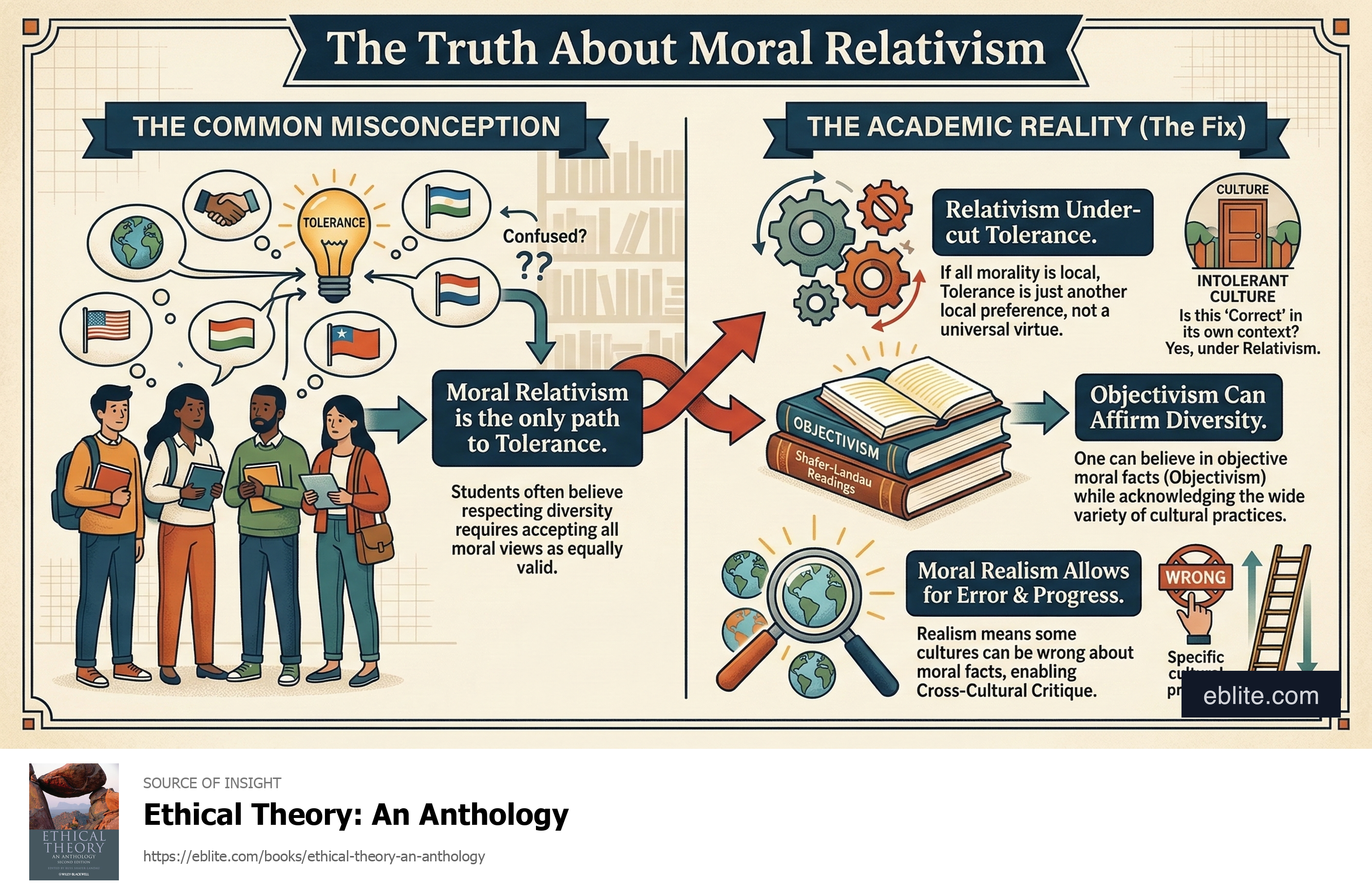
If all moral claims are relative to cultural frameworks, what about the claim that "we ought to be tolerant of other cultures"? This is itself a moral claim.
If it is relative, then it applies only within cultures that happen to value tolerance-and cultures that value intolerance are equally "right" by their own standards.
If it is universal-if tolerance really is a duty that applies to everyone regardless of cultural context-then relativism has undermined itself by producing a universal moral principle.
This is not merely a logical trick. It reveals a genuine tension at the heart of the relativist position. The moral motivation for relativism-respect for cultural difference, opposition to cultural imperialism-depends on values (respect, equality, humility) that relativism itself cannot justify as universally binding.
The Boundary Problem
Relativism claims that morality is relative to a "culture" or "society." But what counts as a culture? National boundaries? Ethnic groups? Subcultures within nations? Families? Individuals?
Within any society, there are deep moral disagreements. Were American abolitionists part of the same "culture" as slaveholders? Is the feminist movement within Saudi Arabia part of "Saudi culture" or a foreign imposition?
When a culture is internally divided on a moral question, relativism has no principled way to determine which group's moral beliefs constitute the culture's actual moral framework.
If we draw the boundaries narrowly enough, relativism collapses into individual subjectivism-the view that moral truth is relative to each individual, which makes moral disagreement meaningless and moral persuasion pointless.
The Moral Progress Problem
If moral frameworks cannot be objectively ranked, then the claim that societies have made moral progress over time becomes incoherent. We cannot say that the abolition of slavery represented moral improvement, only that moral standards changed.
We cannot say that extending rights to women was progress, only that cultural norms shifted. For most people, the inability to affirm that these changes were genuine improvements-not merely changes-is a devastating consequence.
Problems with Universalism: The Foundation Challenge
Universalism faces its own serious difficulties, primarily concerning the grounds for universal moral claims.
The Grounding Problem
If some moral principles are universally true, what makes them true? Possible answers include:
Divine command: God establishes universal moral law. This grounds universalism but only for those who share the relevant religious beliefs, and different religious traditions disagree about what God commands.
Human nature: Universal moral truths are grounded in features shared by all humans. This is promising but faces the "is-ought" problem-the difficulty of deriving moral conclusions from factual claims about human nature.
Reason alone: Pure rational reflection can establish universal moral truths. Kant pursued this approach through what became known as deontological ethics, but critics argue that rational argument alone underdetermines moral conclusions-the same starting premises can support different moral frameworks depending on how they are weighted and applied.
Overlapping consensus: Universal moral principles emerge from the convergence of different moral traditions. This pragmatic approach avoids deep metaphysical commitments but may yield thinner universalism than advocates want.
The Imperialism Worry
Even if universal moral principles exist, the question of who gets to identify and enforce them is politically charged. In practice, "universal" moral standards have often turned out to be the standards of powerful Western nations imposed on less powerful societies.
The language of human rights has been used both to challenge genuine oppression and to justify military interventions, economic sanctions, and cultural domination that served Western interests.
Universalists must take this worry seriously. The existence of universal moral truths does not automatically legitimize any particular culture's claim to have identified and properly understood those truths.
Epistemic humility is compatible with moral universalism-you can believe that universal truths exist while acknowledging that your own understanding of them is partial and fallible.
The Application Problem
Even when cultures agree on abstract moral principles, they often disagree profoundly on how to apply them. Nearly everyone agrees that "harming the innocent is wrong." But cultures disagree about who counts as innocent, what constitutes harm, and what justifications override the general prohibition.
Nearly everyone agrees that "fairness matters." But cultures disagree about whether fairness means equal treatment, proportional treatment, need-based treatment, or merit-based treatment.
These disagreements about application are not peripheral-they are where most real moral conflict lives. Agreement on abstract principles may create less practical convergence than universalists hope.
The Middle Ground: Pluralism and Moderate Positions
Most contemporary moral philosophers occupy territory between strict relativism and strict universalism, recognizing valid insights in both positions while rejecting the extreme forms of each.
Moral Pluralism
Moral pluralism holds that there are multiple legitimate moral values that cannot be reduced to a single supreme principle and that may conflict with one another in ways that admit no unique resolution. Different cultures may legitimately emphasize different values within this plural set.
A culture that prioritizes communal solidarity is not wrong; neither is a culture that prioritizes individual liberty. Both are responding to genuine moral values that cannot be hierarchically ordered.
Isaiah Berlin, who developed this position most influentially, captured the core insight in a memorable passage:
"The notion of the perfect whole, the ultimate solution, in which all good things coexist, seems to me to be not merely unattainable-that is a truism-but conceptually incoherent." - Isaiah Berlin
Some trade-offs between values between equality and freedom, between security and liberty, between individual rights and collective welfare-are genuinely tragic: choosing either option involves real moral loss. The study of cultural dimensions reveals how different societies resolve these trade-offs in systematically different ways.
Thick and Thin Morality
The philosopher Michael Walzer distinguished between thin morality-a minimal set of moral principles shared across cultures (prohibitions on murder, gratuitous cruelty, and systematic deception)-and thick morality-the rich, detailed, culturally specific moral systems that give meaning and structure to particular ways of life.
On Walzer's view, thin morality is universal and provides legitimate grounds for cross-cultural moral criticism. Thick morality is culturally specific and should be respected rather than imposed.
This framework preserves the universalist ability to condemn atrocities while maintaining the relativist insistence on respecting cultural difference in domains where genuine moral pluralism exists.
The Capabilities Approach
Martha Nussbaum's capabilities approach attempts to ground universal moral standards in a substantive but culturally sensitive way.
Rather than specifying particular moral rules, Nussbaum identifies a set of central human capabilities-life, bodily health, bodily integrity, the ability to use senses and imagination, emotional development, practical reason, affiliation, relation to other species, play, and control over one's environment-that every society should secure for its members.
As Nussbaum herself put it:
"To say that people have a right to a certain level of capability is not to say that there is only one way of providing it." - Martha Nussbaum
This approach allows for significant cultural variation in how capabilities are realized while maintaining universal standards about what must be secured.
It provides grounds for criticizing practices like forced marriage, female genital cutting, or caste-based discrimination without requiring that all cultures organize their social lives identically.
Real-World Implications: How the Debate Shapes Policy
The relativism-universalism debate is not merely academic. It directly shapes consequential policy decisions about human rights, international intervention, immigration, and law.
Human Rights Discourse
The international human rights framework is built on universalist assumptions-that certain rights belong to every person by virtue of their humanity, not by grant of any government or culture. The relativist challenge to this framework has real consequences.
When governments invoke "cultural values" or "national sovereignty" to deflect human rights criticism, they are making a relativist argument.
When human rights organizations insist that practices like child marriage, political repression, or torture are wrong regardless of local cultural approval, they are making a universalist argument.
Immigration and Multiculturalism
Multicultural societies face the relativism-universalism tension practically every day.
When immigrant communities bring practices that conflict with host society norms-arranged marriages for very young people, corporal punishment practices, gender-segregated social spaces-the question arises: should the host society tolerate these practices in the name of cultural respect, or prohibit them in the name of universal values?
Most democratic societies have settled on a pragmatic compromise: tolerance for cultural practices that do not cause serious harm, combined with enforcement of fundamental rights (physical safety, freedom of movement, access to education) that are treated as non-negotiable.
This compromise reflects neither pure relativism nor pure universalism but a negotiated position that most citizens find workable, even if philosophers find it theoretically unsatisfying.
International Development
Development organizations must navigate this terrain constantly. Promoting girls' education in societies where it is culturally disfavored raises the question: is this legitimate promotion of universal human development, or illegitimate imposition of Western values?
The answer often depends on whether the initiative grows from internal demand within the society or is imposed entirely from outside, and whether it respects local agency or treats local cultures as obstacles to be overcome.
What Both Sides Get Right
The enduring power of this debate reflects the fact that both positions capture genuine moral insights that cannot be dismissed.
Relativism is right that moral humility is a virtue, that cultural imperialism is a genuine danger, that moral diversity reflects genuine differences in social circumstances and legitimate ways of organizing human life, and that confidence in the superiority of one's own moral framework has historically been used to justify terrible things.
Universalism is right that some moral standards transcend cultural boundaries, that the ability to condemn atrocities regardless of cultural approval is morally essential, that moral progress is real and depends on standards that transcend any particular cultural moment, and that shared humanity creates genuine moral obligations that cross cultural lines.
The philosopher Kwame Anthony Appiah has offered a compelling framing for this productive tension:
"There will be cases where there is no consensus on the right answer, and we will need the resources to live with this disagreement. But this is not the same as saying that there are no wrong answers." - Kwame Anthony Appiah
The most productive moral thinking does not choose sides in this debate but holds both insights in productive tension-maintaining universal commitments to human dignity and the prevention of serious harm while approaching cultural difference with genuine respect, epistemic humility, and awareness of the complex social influence on behavior and the historical relationship between moral certainty and the exercise of power.
What is needed is not a final resolution to the debate which may be impossible-but the wisdom to navigate its tensions thoughtfully: defending universal principles when genuine human welfare is at stake, respecting cultural difference when legitimate moral pluralism is in play, and maintaining the intellectual honesty to acknowledge when we are uncertain which category a given case falls into.
What Philosophers and Researchers Found
The relativism-universalism debate drew rigorous contributions from researchers across philosophy, anthropology, and psychology in the twentieth century, producing findings that reshaped how both positions are understood.
John Rawls addressed the international dimension of the debate in his 1999 book The Law of Peoples.
Rather than defending full liberal universalism globally, Rawls argued for a more modest "law of peoples" that tolerates what he called "decent hierarchical societies"-non-liberal societies that nonetheless honor basic human rights and follow a common law of peoples.
This was a significant concession toward pluralism while retaining universal minimum standards.
Critics like Martha Nussbaum found the threshold too low; critics from the relativist side found even this minimal universalism too demanding.
Richard Shweder, an anthropologist at the University of Chicago, conducted decades of fieldwork in Orissa, India, comparing moral reasoning across cultures.
His central finding, published in a landmark 1987 paper in Ethos co-authored with Manamohan Mahapatra and Joan Miller, was that the Kantian/liberal notion of the autonomous individual as the fundamental unit of morality was itself culturally specific-a Western Enlightenment artifact, not a universal baseline.
Shweder identified three distinct "ethics" operative across cultures-autonomy, community, and divinity-and argued that different cultures weight these differently in ways that are not reducible to error or backwardness.
This research directly challenged the universalist assumption that Western liberal morality represents the endpoint of moral development.
Jonathan Haidt, drawing on Shweder's framework and his own empirical research with colleagues including Jesse Graham and Brian Nosek, developed Moral Foundations Theory as a systematic account of how moral diversity arises from a common set of evolved intuitive foundations.
Their 2009 paper "Liberals and Conservatives Rely on Different Sets of Moral Foundations" in the Journal of Personality and Social Psychology showed that political groups within a single culture differ dramatically in which moral foundations they prioritize-a finding with obvious implications for the relativism-universalism debate.
If even people within one culture disagree this profoundly about which moral dimensions matter most, the universalist project faces challenges that go beyond cross-cultural comparison.
Kwame Anthony Appiah, a philosopher at New York University with roots in Ghana and Britain, developed what he calls "partial cosmopolitanism" or "rooted cosmopolitanism" in works including Cosmopolitanism: Ethics in a World of Strangers (2006) and The Honor Code: How Moral Revolutions Happen (2010).
Appiah's empirical research into the history of moral revolutions-the abolition of dueling in Britain, footbinding in China, Atlantic chattel slavery-found that these transformations were rarely driven by purely abstract philosophical argument.
Instead, they depended on changes in honor codes: practices became intolerable not because of new ethical reasoning but because engaging in them came to be seen as shameful. This finding complicates both relativism (the changes were experienced as genuine progress) and universalism (the mechanism was social rather than purely rational).
Paul Bloom, a psychologist at the University of Toronto, has argued in Just Babies: The Origins of Good and Evil (2013) that certain moral capacities-fairness intuitions, in-group preferences, rudimentary empathy-appear in human infants before any cultural learning could have shaped them.
His experimental studies with 3- and 6-month-old infants showed preferences for "helpers" over "hinderers" in simple social scenarios, suggesting that some moral responsiveness is innate rather than culturally constructed. This provides empirical support for at least a thin moral universalism based in human nature.
Real-World Applications and Case Studies
The philosophical debate between relativism and universalism plays out in consequential real-world contexts where the stakes are not merely academic.
The Female Genital Cutting Controversy. Few cases have tested the relativism-universalism divide more intensely than female genital cutting (FGC), practiced in parts of sub-Saharan Africa, the Middle East, and Southeast Asia.
Universalists argue that FGC violates women's bodily integrity, causes significant health harm, and is often performed on girls too young to consent-making it a clear human rights violation regardless of its cultural meaning.
Relativists respond that Western denunciations ignore the complexity of the practice's meanings within communities, the agency of women who support it, and the history of colonial moral policing that makes Western intervention inherently suspect.
The empirical record cuts both ways. Research by the WHO and others documents serious health consequences including infections, complications in childbirth, and lifelong pain.
But ethnographic research by Bettina Shell-Duncan and others has found that the practice is internally contested in many communities, with women-led reform movements emerging from within cultures rather than being imposed from outside-a finding that complicates the simple universalist narrative of external intervention on behalf of victims.
International Criminal Law and the Rwandan Genocide. The Rwandan genocide of 1994, in which approximately 800,000 Tutsi and moderate Hutu were killed in approximately 100 days, posed the relativism-universalism question with fatal urgency.
The international community's failure to intervene was defended partly on grounds of sovereignty and non-interference in internal conflicts-arguments with clear relativist overtones.
The subsequent creation of the International Criminal Tribunal for Rwanda (ICTR) and the development of the "Responsibility to Protect" doctrine represented a strong universalist response: some moral violations are so severe that sovereignty cannot shield them from international accountability.
Philosopher Allen Buchanan of Duke University examined the philosophical foundations of international intervention in Justice, Legitimacy, and Self-Determination (2004), arguing that a minimal universalism is logically required for any coherent international legal order.
Without the premise that some human rights violations are wrong regardless of who commits them, international law collapses into mere power politics.
The Asian Values Debate. In the 1990s, political leaders including Singapore's Lee Kuan Yew and Malaysia's Mahathir Mohamad argued that Western liberal human rights frameworks were culturally specific to the individualist West and inappropriate for Asian societies that valued community, hierarchy, and social harmony over individual rights.
This "Asian values" argument was a direct invocation of normative moral relativism in international political discourse.
The argument lost credibility partly through the Asian financial crisis of 1997-98, which revealed that appeals to "Asian values" had been used partly to justify governance arrangements that concentrated power and limited accountability.
But it also faced philosophical challenges from thinkers like Amartya Sen, who argued in Development as Freedom (1999) that the evidence for distinctively "Asian" values favoring authoritarianism was thin, and that democratic and individual rights traditions could be found throughout Asian history alongside communitarian ones.
The Research Evidence: Empirical Studies on Cultural Moral Variation
Psychological and anthropological research has produced increasingly fine-grained evidence about both the universality and the variability of moral cognition.
The WEIRD Problem. One of the most consequential findings for the relativism-universalism debate came from a 2010 paper by Joseph Henrich, Steven Heine, and Ara Norenzayan titled "The Weirdest People in the World" in Behavioral and Brain Sciences.
The authors documented that an extraordinary proportion of psychological research-including research on moral judgment-had been conducted on subjects who were Western, Educated, Industrialized, Rich, and Democratic (WEIRD).
They showed that WEIRD populations are outliers on numerous psychological dimensions, including those relevant to morality: fairness norms, punishment behavior, and individualism.
Their survey of cross-cultural data found massive variation in fairness behavior across societies. In ultimatum game experiments (where one player proposes a split of money and the other accepts or rejects), WEIRD populations showed strong fairness norms and willingness to reject "unfair" offers even at personal cost.
But populations in small-scale societies showed much more variable behavior, with some groups routinely rejecting very equal offers and others accepting very unequal ones without distress.
This variation directly challenges the universalist assumption that WEIRD moral intuitions reflect universal human nature.
Haidt's Cross-Cultural Moral Foundations Research. Jonathan Haidt and colleagues collected moral intuition data from participants in over 130 countries using the Moral Foundations Questionnaire.
The data consistently showed that individualist Western populations rely primarily on harm and fairness foundations, while populations from more collectivist and religiously traditional backgrounds also strongly invoke loyalty, authority, and purity foundations.
This cross-cultural variation in which moral concerns feel most important is precisely what Shweder's three-ethics framework would predict, and it poses a challenge to universalists who ground their claims in a particular weighting of moral concerns.
Paul Rozin's Research on Moral Domains. Psychologist Paul Rozin at the University of Pennsylvania has studied how different cultures categorize behaviors as matters of moral concern versus personal choice versus social convention.
His research, conducted across multiple cultures including the United States, Brazil, India, and Japan, found that behaviors that American undergraduates classified as matters of personal choice (what to eat, how to dress, whom to socialize with) were classified as moral matters in more traditional communities-and vice versa.
This expansion or contraction of the "moral circle" of concern across cultures has direct implications for the universalism-relativism debate: if the very boundary between "moral" and "personal" varies culturally, then the content of universal morality becomes harder to specify.
Landmark Studies on Cultural Moral Variation and Universalism
The relativism-universalism debate has attracted sustained empirical investigation from anthropologists, psychologists, and political scientists whose findings have refined both positions without resolving the underlying philosophical dispute.
Joseph Henrich, Steven Heine, and Ara Norenzayan's WEIRD Research (2010). The most consequential empirical intervention in the relativism-universalism debate came from a 2010 paper by Henrich, Heine, and Norenzayan in Behavioral and Brain Sciences titled "The Weirdest People in the World."
The authors documented that roughly 96% of subjects in behavioral science studies, including moral psychology research, came from Western, Educated, Industrialized, Rich, and Democratic (WEIRD) populations who constitute only 12% of the global population.
Their survey of cross-cultural data found that WEIRD populations are consistent outliers on multiple morally relevant psychological dimensions.
In ultimatum game experiments measuring fairness norms, WEIRD populations rejected "unfair" monetary offers (below 30%) approximately 50% of the time, treating fairness as a moral requirement worth personal cost.
But populations from small-scale societies in Papua New Guinea, East Africa, and the Amazon showed highly variable behavior: some groups accepted any offer, others made hypergenerous offers that contradicted straightforward self-interest.
These findings directly challenged universalist claims that Western liberal moral intuitions - particularly about individual fairness and rights - reflect universal human nature rather than culturally specific conditioning.
Richard Shweder's Three Ethics Research Program (1987-2003). Anthropologist Richard Shweder at the University of Chicago conducted decades of comparative fieldwork in Orissa, India, documenting systematic differences in how Brahmin Indian and American participants organized moral concerns.
His foundational 1987 paper in Ethos, co-authored with Manamohan Mahapatra and Joan Miller, found that Indian participants classified as moral obligations many behaviors American participants classified as matters of personal choice or cultural convention - including proper dress after widowhood, addressing relatives by appropriate titles, and food prohibitions during mourning.
Shweder developed a three-ethics framework - Autonomy (harm and individual rights), Community (role duties and social hierarchy), and Divinity (purity and sacred order) - to organize this variation.
His 1997 paper "The 'Big Three' of Morality" in Morality and Health argued that all cultures have access to all three registers but weight them differently, providing an empirical grounding for moderate cultural relativism: moral variation is real and systematic, but the underlying dimensions of moral concern are universal.
This framework directly influenced Jonathan Haidt's Moral Foundations Theory, which operationalized Shweder's ethnographic observations into a quantitative research instrument used across 130+ countries.
Kwame Anthony Appiah's Historical Research on Moral Revolutions (2010). Philosopher Kwame Anthony Appiah at New York University conducted historical research on how and why societies change their moral practices, published in The Honor Code: How Moral Revolutions Happen (2010).
Appiah studied three cases: the abolition of the duel in early 19th-century Britain, the abandonment of footbinding in late 19th-century China, and the abolition of Atlantic chattel slavery.
His central finding challenged both relativism and universalism: moral revolutions were rarely driven by pure philosophical argument, nor were they purely internal cultural developments.
Instead, they depended on changes in what Appiah called "honor codes" - the practices became intolerable not primarily because of new ethical reasoning but because engaging in them came to be seen as shameful by people whose honor judgments mattered.
The abolition of footbinding in China accelerated dramatically after 1895 not because Chinese reformers suddenly discovered it caused pain - this was always known - but because engagement with the international community made the practice a source of national shame.
Appiah's research suggests that both pure relativism (moral change is purely internal) and pure universalism (moral reform is driven by universal reason) fail to capture the actual mechanisms of moral transformation.
James Gibson's Empirical Study of the South African TRC (2004). Political scientist James Gibson at Washington University published Overcoming Apartheid: Can Truth Reconcile a Divided Nation? (2004), a systematic empirical evaluation of the Truth and Reconciliation Commission's effects on South African political culture.
Using survey data from 3,727 South Africans collected in 2000-2001, Gibson tested whether exposure to TRC proceedings had changed attitudes toward political tolerance, reconciliation, and democratic legitimacy.
His findings were striking: Black respondents who were more exposed to TRC testimony showed significantly higher political tolerance - measured as willingness to allow formerly adversarial groups to hold meetings, give speeches, and stand for election - than those with less exposure.
The effect was substantial (15-20 percentage points) and robust to controls for education, political affiliation, and prior attitudes.
Gibson interpreted the findings as evidence that truth-telling processes informed by restorative justice values - care-ethics rather than retributive-justice approaches - can produce political outcomes that purely punitive approaches cannot achieve.
The study provided rare longitudinal empirical evidence bearing on practical moral universalism: that acknowledgment of specific human rights violations (a universalist category) can produce measurable improvements in democratic political culture across cultural differences.
Real-World Case Studies: The Relativism-Universalism Tension in Policy and Law
The philosophical debate between moral relativism and moral universalism is not merely academic - it shapes consequential decisions in international law, development policy, and multicultural governance.
The Female Genital Cutting Controversy and the Limits of Both Positions. Female genital cutting (FGC), practiced in approximately 30 countries across sub-Saharan Africa, the Middle East, and parts of Asia, has become the central test case for the relativism-universalism debate in applied ethics.
The World Health Organization documented in a 2008 report that FGC affects approximately 200 million women globally, with documented health consequences including infections, complications in childbirth, and chronic pain.
The universalist position, articulated by organizations including Amnesty International and the UN Special Rapporteur on Violence Against Women, holds that FGC constitutes a human rights violation regardless of cultural meaning, because it causes serious harm to people who cannot meaningfully consent (girls are typically cut between infancy and age 15).
The relativist response, developed by anthropologists including Bettina Shell-Duncan at the University of Washington, argues that external condemnation is counterproductive and culturally imperialist, and that Shell-Duncan's own fieldwork in Kenya and Senegal documented that communities were more likely to abandon the practice when change was led internally by community members rather than externally by Western NGOs.
Her 2005 paper in Social Science and Medicine, "The Medicalization of Female Genital Cutting," documented a shift from traditional FGC to clinical procedures in some communities, raising questions about whether harm-reduction approaches to internally contested practices are preferable to categorical prohibition.
The case illustrates how both positions, taken absolutely, produce unsatisfactory outcomes: pure relativism cannot account for the documented harm and non-consent; pure universalism risks counterproductive external imposition that slows internal reform movements.
The Asian Values Debate and the Limits of Cultural Moral Claims (1990s). In the 1990s, political leaders including Singapore Prime Minister Lee Kuan Yew, Malaysian Prime Minister Mahathir Mohamad, and former Indonesian President Suharto articulated what they called "Asian values" - a cluster of Confucian-influenced values prioritizing community over individual, social harmony over personal rights, and economic development over liberal political freedoms.
These leaders argued that Western liberal human rights frameworks were culturally specific to the individualist West and inappropriate impositions on Asian societies.
The argument was a direct invocation of normative moral relativism in international political discourse, and it influenced debates about the 1993 Vienna Declaration and Programme of Action, where several Asian governments resisted language affirming the universality of human rights.
Amartya Sen at Harvard University systematically challenged the empirical basis of the Asian values claim in Development as Freedom (1999), arguing that the historical record of Asian political thought was far more diverse than the Asian values proponents acknowledged - including robust traditions of individual rights, democratic governance, and tolerance of dissent in Chinese, Indian, Japanese, and Southeast Asian history.
The Asian values debate lost credibility after the 1997-98 Asian financial crisis, which exposed that appeals to cultural distinctiveness had been used partly to insulate authoritarian governance structures from accountability.
The episode illustrates how descriptive moral relativism can be strategically deployed to protect power arrangements from universal moral scrutiny.
The Responsibility to Protect Doctrine and Moral Universalism in Practice (2001-2011). The International Commission on Intervention and State Sovereignty, established by the Canadian government and chaired by Gareth Evans and Mohamed Sahnoun, published the Responsibility to Protect (R2P) doctrine in 2001, subsequently endorsed by the UN World Summit in 2005.
R2P holds that sovereignty is not a shield against international accountability when a state commits or fails to prevent genocide, war crimes, ethnic cleansing, or crimes against humanity.
The doctrine represents one of the most ambitious attempts to institutionalize moral universalism in international law: it asserts that certain acts are morally impermissible regardless of cultural context or national sovereignty, and that the international community has both the right and the obligation to intervene when states fail to protect their populations.
The 2011 NATO intervention in Libya, authorized under R2P principles, provided an early real-world test.
A 2013 assessment by political scientists Alan Kuperman at the University of Texas and Vijay Prashad at Trinity College found that the NATO intervention had prevented a significant massacre in Benghazi - consistent with the universalist case for intervention - but had also contributed to state collapse and ongoing civil war that produced greater overall harm than a negotiated settlement might have achieved.
The Libya case illustrates the practical difficulty of the universalism the doctrine assumes: universal agreement on the wrongness of atrocities does not translate easily into universal agreement on effective and proportionate responses.
Corporate Human Rights Standards and the UN Guiding Principles (2011). John Ruggie at Harvard University, serving as the UN Special Representative for Business and Human Rights, developed the UN Guiding Principles on Business and Human Rights, adopted unanimously by the UN Human Rights Council in 2011.
The Guiding Principles represent the most systematic attempt to apply moral universalism to corporate conduct across cultural and legal contexts, establishing that corporations have a responsibility to respect human rights wherever they operate, regardless of local legal requirements or cultural norms.
The framework holds that cultural relativism cannot justify corporate complicity in human rights violations: a company cannot defer to local customs that permit child labor, forced labor, or persecution of workers who organize.
By 2020, over 1,000 companies had adopted human rights due diligence policies aligned with the Guiding Principles, according to the Business and Human Rights Resource Centre.
Independent assessments, including a 2021 evaluation by Columbia University's Institute for the Study of Human Rights, found that while adoption was widespread, enforcement mechanisms remained weak and corporate performance varied substantially.
The most significant compliance gains came in companies whose home countries had enacted mandatory due diligence legislation, suggesting that moral universalism in business ethics depends on legal institutionalization rather than voluntary adoption alone.
Sources & Further Reading
Rachels, J. (2003). "The Challenge of Cultural Relativism." In The Elements of Moral Philosophy, 4th ed. McGraw-Hill. View source
Nussbaum, M. (2000). Women and Human Development: The Capabilities Approach. Cambridge University Press. View source
Berlin, I. (1969). "Two Concepts of Liberty." In Four Essays on Liberty. Oxford University Press. View source
Walzer, M. (1994). Thick and Thin: Moral Argument at Home and Abroad. University of Notre Dame Press. View source
Moody-Adams, M. (1997). Fieldwork in Familiar Places: Morality, Culture, and Philosophy. Harvard University Press. View source
Gowans, C. (2021). "Moral Relativism." Stanford Encyclopedia of Philosophy. View source
Appiah, K.A. (2006). Cosmopolitanism: Ethics in a World of Strangers. W.W. Norton.
Geertz, C. (1983). Local Knowledge: Further Essays in Interpretive Anthropology. Basic Books. View source
Wong, D. (2006). Natural Moralities: A Defense of Pluralistic Relativism. Oxford University Press. View source
Donnelly, J. (2003). Universal Human Rights in Theory and Practice, 2nd ed. Cornell University Press. View source