
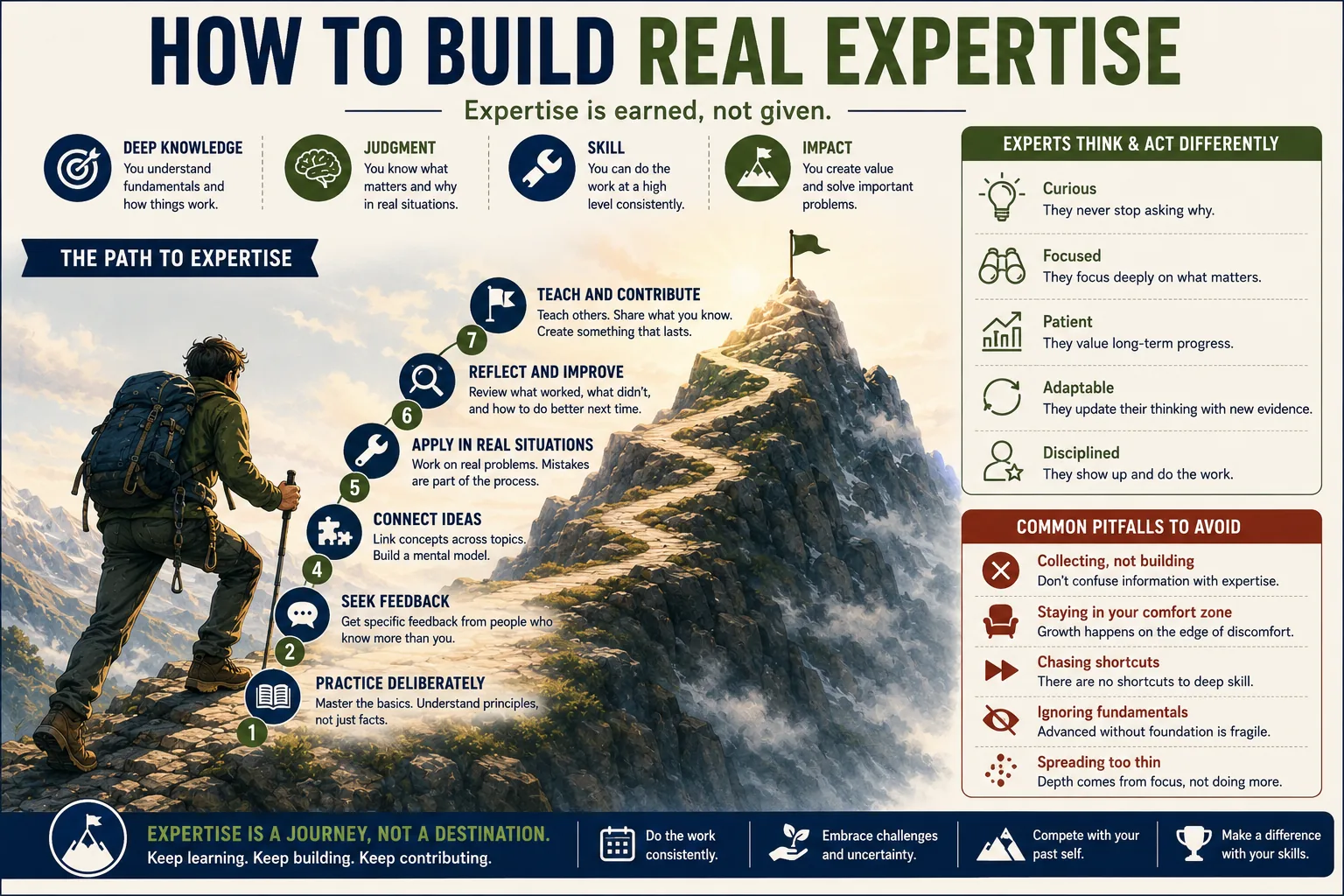
Build: In 1985, Benjamin Bloom published the results of a remarkable five-year study.[3] He and his colleagues had interviewed 120 world-class performers in six fields - mathematics, neurology, tennis, swimming, piano, and sculpture - along with their parents, teachers, and coaches.
The study sought to understand how exceptional performers became exceptional. What Bloom found contradicted the dominant narrative of talent: almost none of the world-class performers had shown early extraordinary ability.
Most were unremarkable children who showed moderate interest in their field. What distinguished them was not talent but a long, structured developmental process that Bloom called the three phases of talent development: an early phase of playful exploration, a middle phase of intensive instruction and deliberate practice, and a later phase of self-directed mastery with the guidance of master teachers.
Bloom's finding launched a generation of expertise research that converged on a conclusion both more democratic and more demanding than the talent narrative: most people can achieve expert-level performance in most domains, but the path requires years of specific, uncomfortable work.
Understanding that path - what deliberate practice actually involves, how expertise is structured cognitively, where most people go wrong, and what accelerates development - is the most practically useful insight in learning science.
"The differences between expert performers and normal adults reflect a life-long period of deliberate effort to improve performance in a specific domain." - K. Anders Ericsson, Ralf Th. Krampe, and Clemens Tesch-Romer, Psychological Review (1993)
Experience vs. Expertise: The Key Differences
| Dimension | Experience | Expertise |
|---|---|---|
| Time requirement | Accumulates passively over time | Requires years of deliberate, structured work |
| Practice quality | Naive repetition; often in comfort zone | Deliberate practice at edge of ability with feedback |
| Mental representations | Loose, disconnected knowledge | Rich, structured, automatically deployed representations |
| Performance trajectory | Plateaus after initial learning | Continues improving with structured practice |
| Feedback dependence | May perform without feedback | Built through feedback-guided correction |
| Domain sensitivity | Can transfer surface experience across domains | Highly domain-specific; expert in one area, novice in another |
| Diagnosis accuracy | Often no better than novice after 10+ years | Demonstrably better with deliberate practice history |
The Fundamental Distinction: Experience vs. Expertise
The most common misconception about expertise is that it is a product of experience. Decades of research show this to be wrong in a precise way: experience is necessary but not sufficient. Time spent in a domain does not produce expertise; the quality of that time determines whether expertise develops.
K. Anders Ericsson, whose career-long research program on expert performance is the foundation of modern expertise science, documented this distinction across dozens of domains.[1]
In medicine, he found that physicians with twenty years of clinical experience were often no more accurate diagnostically than physicians with five years, once measured carefully against objective outcomes.
In X-ray reading, experienced radiologists performed no better than residents on many diagnostic tasks despite decades more practice.
In chess, players who had been members of their local chess clubs for thirty years performed at similar levels to those who had been members for ten, because both groups practiced in the same way - playing games, not doing the focused work of building specific skills.
The crucial variable was not years logged but the structure of practice. This is what Ericsson labeled deliberate practice: a specific mode of training characterized by focused effort on skill components at the edge of current ability, with immediate feedback that enables correction.[2]
Everything else - including most of what people call "practice" - is what Ericsson called naive practice (repetition without structure) or purposeful practice (more intentional but lacking the expert guidance and structured feedback of deliberate practice).
The Architecture of Deliberate Practice
Deliberate practice has a specific structure that distinguishes it from ordinary experience. The components are individually familiar but rarely combined in the way that produces expertise:
Working at the Edge of Current Ability
Deliberate practice requires operating just beyond current capability - in what psychologist Lev Vygotsky called the zone of proximal development: the region between what you can do independently and what you cannot yet do at all.[7]
Work within your comfort zone produces no improvement; work far beyond your ability produces breakdown and frustration without learning. The narrow zone between is where skill development occurs.
This is why expertise development is inherently uncomfortable. A swimmer working on turn technique who practices only techniques already mastered is not developing; a swimmer who is so far beyond current ability that turns are failing completely is also not developing.
The deliberate practice zone is the uncomfortable middle where the swimmer can sometimes execute the improved technique but not reliably, and where focused effort produces incremental improvement.
*Example*: Nathan Milstein, one of the twentieth century's greatest violinists, was once asked by a student how many hours per day he should practice. Milstein responded: "It doesn't really matter how many hours you practice - if you practice with your fingers, no amount is enough.
If you practice with your head, two hours is plenty." The distinction between "practicing with fingers" (comfortable repetition) and "practicing with head" (focused attention to specific aspects of performance) is exactly what separates deliberate from naive practice.
Immediate and Accurate Feedback
Deliberate practice requires rapid feedback that allows the learner to distinguish correct from incorrect execution and to calibrate subsequent attempts. Without feedback, practice reinforces whatever the learner is doing - including errors.
With delayed, inaccurate, or absent feedback, the learner cannot detect and correct the specific deficiencies that limit performance.
The feedback requirement explains why expert coaching is so much more effective than self-directed practice, particularly in early and middle stages of development.[10]
An expert coach has the mental representations of correct performance that allow them to observe a learner's performance, identify the specific deficiencies invisible to the learner, and provide targeted feedback that the learner can act on immediately.
Without that expert perspective, learners often practice errors, or work on aspects of performance that are not limiting their development, or set the difficulty level incorrectly.
Focused Repetition on Specific Weaknesses
Deliberate practice targets specific components of performance rather than running through complete performances from beginning to end.
A pianist who practices a difficult passage fifty times while carefully attending to finger placement, timing, and dynamics is developing differently from a pianist who plays entire pieces from beginning to end repeatedly.
The former is doing deliberate practice; the latter is doing performance run-throughs, which are valuable for integration but insufficient for skill development.
The targeting of specific weaknesses is particularly important and particularly uncomfortable. Most people naturally gravitate toward practicing what they are already good at - it feels smooth, it provides positive reinforcement, it is enjoyable.
Deliberate practice requires the reverse: identifying the specific components of performance that are limiting overall performance and focusing concentrated effort there.
*Example*: The Budapest String Quartet, one of the most celebrated chamber music groups of the twentieth century, maintained a practice regime that quartet members described as almost entirely focused on passages they played badly.
They would rehearse difficult passages dozens of times in a session, ignoring the passages they could already play well.
Outside observers sometimes found this dispiriting - the quartet spent most of its rehearsal time apparently struggling.
But the method produced a level of precision and consistency in difficult passages that distinguished their performances from competitors.
The Cognitive Mechanism: Building Mental Representations
Deliberate practice works by building mental representations - the internal cognitive structures through which experts perceive, organize, and process domain information. This is the cognitive mechanism underlying what behavioral improvements are visible in performance.
A chess grandmaster who can play twenty simultaneous blindfold games is not performing a superhuman memory feat.[5] They are holding the positions as structured patterns - meaningful chunks encoding piece relationships, tactical patterns, and strategic formations - rather than as a list of individual piece positions.[4]
The expert's mental representation of a chess position might contain five meaningful patterns that collectively encode the positions of twenty-five pieces; the novice's representation of the same position contains twenty-five individual piece locations.
In every domain of expertise, this pattern of increasingly rich, structured, and automatically deployed mental representations is what distinguishes expert from novice cognition.
Expert musicians hear differently: they perceive harmonic structures, melodic patterns, and rhythmic relationships as chunks, where novices hear a sequence of individual notes.
Expert physicians read medical images differently: they perceive organized patterns - typical presentations of disease, anomalous features that stand out against a background of normal variation - where residents see a collection of visual elements that require effortful interpretation.
Deliberate practice builds these representations through systematic, feedback-guided experience with the meaningful patterns of a domain.
The 10,000-hour estimate associated with Ericsson's work reflects the time required to accumulate enough meaningful pattern experience to reach elite expert level - not 10,000 hours of any experience, but 10,000 hours of the deliberate practice that builds these representations.[6]
The Three Phases of Expertise Development
Bloom's three-phase framework has been refined by subsequent research but remains the most accurate description of how expert performance actually develops over time:
Phase One: Playful Exploration and Initial Instruction
World-class performers in Bloom's study typically began with playful, relatively unstructured exposure to their eventual domain. They did not begin with rigorous practice; they began with discovery - enjoying the activity for its own sake before the demands of systematic development began.
This phase is cognitively important: it builds the foundational interest and intrinsic motivation that will sustain the years of demanding deliberate practice that follow.
Performance research consistently shows that intrinsic motivation - engagement for the activity's own sake rather than for external rewards - correlates with the sustained practice required for expertise.
Attempting to begin development with rigorous, demanding practice before intrinsic motivation has developed typically produces early dropout.
The initial instruction in this phase is characteristically supportive, encouraging, and focused on enjoyment and basic competence rather than excellence. Parents and early teachers of future world-class performers were typically warm and encouraging rather than demanding.
Phase Two: Intensive Instruction and Deliberate Practice
The transition to the second phase is marked by the engagement of a more demanding teacher or coach who introduces systematic training. The character of the work changes: it becomes more effortful, more focused on specific skill components, more demanding of concentrated attention.
This is the phase in which deliberate practice dominates. Future experts typically practice two to four hours per day, in concentrated sessions of no more than an hour to ninety minutes (longer sessions produce declining returns as concentration falters).
They practice six days per week, with one day for rest and recovery. They sleep more than average - the elite violinists in Ericsson's 1993 study averaged about 8.6 hours of sleep per night, compared to about 7.8 hours for the music-education students.
The engagement of increasingly expert teachers and coaches is characteristic of this phase.
Bloom found that world-class performers consistently had access to teachers who had themselves achieved high levels of performance, who were focused on the specific developmental needs of the student rather than teaching general principles, and who structured practice around the student's specific weaknesses.
Phase Three: Self-Directed Mastery
In the final phase, the expert takes primary responsibility for directing their own development.
They have internalized enough understanding of their domain, their own performance, and the requirements of deliberate practice to identify their own weaknesses, design their own practice, and evaluate their own progress without continuous external direction.
This phase is marked by the development of sophisticated self-monitoring: the ability to perceive one's own performance with accuracy comparable to that of an expert observer.
Expert performers can hear or see their own mistakes with precision that allows accurate self-diagnosis; they can feel the difference between correct and incorrect execution; they can identify the specific technical issue underlying a performance failure.
Where Development Goes Wrong: Five Common Failure Modes
Most people who attempt skill development fail to develop expertise, not because the domain is beyond their ability but because they fall into predictable patterns that prevent the development that deliberate practice would produce:
1. The Plateau Problem: After initial rapid improvement, most learners plateau at an acceptable level of performance. They can now do the thing adequately - play the guitar well enough for enjoyment, write well enough for communication, make decisions well enough for competence.
The plateau feels stable because it is. The brain has automated the skills required for adequate performance, and additional repetition reinforces the plateau without developing it.
Escaping the plateau requires identifying the specific aspects of performance that are limiting further improvement and returning those aspects to conscious attention and deliberate work - which is uncomfortable precisely because comfortable automaticity must be temporarily disrupted.
*Example*: Most adults who drive a car reach a plateau within two to three years of learning. They can drive safely and adequately, and they drive for thirty subsequent years without improving.
The additional thirty years of experience do not produce expertise because they involve no deliberate practice - just repetition of already-automated skills.
A driving instructor who deliberately targets specific aspects of advanced technique (heel-toe braking, threshold braking, vision placement) for months with regular feedback from an expert coach would develop significantly in that time.
2. Naive Practice Mistaken for Deliberate Practice: Most people who believe they are practicing are doing something closer to what Ericsson called naive practice - repetition without structure, feedback, or focused attention to specific weaknesses.
Musicians who practice by playing pieces from beginning to end repeatedly; writers who practice by producing complete drafts without targeted attention to the specific elements of prose that limit their writing; salespeople who practice by making calls without systematic reflection on what distinguishes their successful from unsuccessful calls - all are engaging in naive practice that produces minimal development.
3. Talent Mysticism and Self-Limitation: The belief that exceptional performance requires exceptional inborn talent functions as a self-fulfilling prophecy that prevents deliberate practice from beginning.
Research consistently shows that innate ability explains a much smaller fraction of expert performance variance than deliberate practice hours.[8]
In Ericsson's violin studies, the amount of deliberate practice was strongly correlated with performance level; no claim about general intelligence explaining less than 4% was made.
The implication is not that talent matters nothing but that most people underestimate the extent to which deliberate practice can compensate for lack of extraordinary native ability, and overestimate the extent to which extraordinary native ability can compensate for lack of deliberate practice.
4. Premature Specialization: Bloom's research found that forcing specialization too early - demanding rigorous domain-specific practice before intrinsic motivation has developed - typically reduces long-term development.
Children pushed into intensive performance training before they have developed intrinsic interest typically drop out earlier than those given more exploratory early exposure. The counterintuitive finding: the world-class performers had more varied early experience, not less.
5. Absence of Expert Feedback: Self-directed practice without expert feedback is substantially less effective than practice with expert feedback, for a simple reason: novices and intermediate performers cannot accurately perceive their own errors.
Without the mental representations of expert performance, they cannot detect deviations from what they are attempting to produce. They may practice errors intensively, or practice correctly without knowing it, or identify the wrong component as limiting performance.
The Role of Coaching and Mentorship
Expert coaching accelerates development in ways that self-directed practice cannot replicate.
The mechanism is the coach's possession of expert mental representations: a coach who has achieved high performance can observe a learner's performance, perceive the discrepancy between current and ideal performance, identify the specific technical issue producing the discrepancy, communicate that diagnosis in terms the learner can act on, and verify whether the subsequent attempt shows improvement.
This sequence - observe, diagnose, communicate, verify - produces feedback loops of a quality unavailable through self-directed practice.
The most important coaches are those who have the expert representations to make accurate diagnoses, not those who were themselves the greatest performers (elite performers often make poor coaches because their performance was so automated that they cannot articulate what they do or what others are doing wrong).
*Example*: Steffi Graf, one of tennis's greatest players, was coached throughout her career by her father Peter Graf, a former club-level player with no professional playing career.
Her technical excellence was built through Peter Graf's meticulous attention to her specific technical development, not through the example of a great player.
Meanwhile, Ivan Lendl's eight Grand Slam titles did not make him a great coach for every player - he was highly effective coaching Andy Murray specifically because of his analytical approach to preparation, not because of his playing excellence.
The Structure of a Deliberate Practice Session
What does deliberate practice actually look like in practice? The structure is surprisingly consistent across domains:
Define a specific goal: Not "practice the piece" but "work on the transition from the development section to the recapitulation, targeting smooth finger placement on the ascending C-major scale." Not "practice presentation skills" but "work on reducing filler words (um, uh) in spontaneous speech under pressure."
Work in concentrated periods: One to ninety minutes of full concentration is the functional range. Mental fatigue degrades the quality of deliberate practice; session length should be limited to what concentration allows. Multiple shorter sessions in a day are more productive than one extended session.
Get immediate feedback: For music, audio or video recording followed by careful listening/watching. For sports, a coach watching and commenting in real time. For intellectual skills, a trusted expert reviewing specific work products. The feedback must be tied to the specific goal of the session to be effective.
Reflect on performance: At the end of each session, the learner should assess what improved, what did not, and what should be targeted in subsequent sessions. This meta-cognitive reflection is what converts practice experience into calibrated understanding of one's own development.
Rest and recover: Sleep is when the brain consolidates the neural changes produced by deliberate practice. Studies of expert performers consistently find that sleep duration is above average. Ericsson's best violinists napped more than the other groups, and their total sleep, including naps, averaged about 8.6 hours daily.
Domain-Specific Considerations
Expertise development follows the same general principles across domains, but the specific form varies in important ways:
In cognitive domains (mathematics, chess, medical diagnosis, writing), deliberate practice centers on building the mental representations that allow rapid pattern recognition and flexible problem-solving.
The primary tool is worked examples in early stages - observing expert performance to understand the patterns - followed by increasingly independent problem-solving with expert feedback.
In perceptual-motor domains (sports, music performance, surgery), deliberate practice involves both the physical skill development and the perceptual representations that guide execution.
In music, ear training - developing the ability to hear and identify harmonic structures, melodic patterns, and rhythmic relationships - is as important as technical instrument practice.
In interpersonal domains (teaching, therapy, negotiation, leadership), deliberate practice faces the complication that performance occurs in dyadic interaction where the other party's behavior is not controlled. Simulation, role-playing, video review of recorded interactions, and structured reflection are the primary tools.
Implications for Learning Design
Understanding deliberate practice has direct implications for how learning environments should be structured - and why most are not structured optimally:
Most educational systems favor breadth over depth: Survey courses that cover many topics briefly produce declarative knowledge (knowing that X is true) without the deep mental representations that allow flexible application. Expertise in any domain requires extended, intensive engagement with a narrower range of material.
Feedback loops are typically too slow: In most educational and professional development contexts, feedback arrives days, weeks, or months after performance. Deliberate practice requires feedback within minutes of performance to allow immediate correction.
When feedback is delayed, the learner has typically moved on to new content, and the feedback cannot be applied to the practice that produced it.
Practice is under-valued relative to instruction: Most educational contexts allocate far more time to instruction (receiving information) than to deliberate practice (developing skills through feedback-guided exercise).
Information without practice produces passive knowledge; deliberate practice converts information into active capability.[9]
The path to genuine expertise is more demanding, more structured, and more uncomfortable than the popular conception of "getting good at something through experience." It requires systematic attention to specific weaknesses, expert feedback, deliberate concentration over extended time, and the willingness to remain in the uncomfortable zone of near-failure where development actually occurs.
But it is also more widely accessible than the talent narrative suggests.
The door to expert performance is open to most people in most domains - but it requires the deliberate practice that turns time into expertise rather than just experience.
The Early Specialization Question: Bloom Revisited
Benjamin Bloom's 1985 finding that world-class performers began with playful exploration rather than early intensive training has been repeatedly confirmed, but also complicated, by subsequent research.
Research on elite athletes, such as Moesch et al. (2011) in the Scandinavian Journal of Medicine and Science in Sports, found that elite athletes tended to have accumulated more practice in other sports and to have specialized later than near-elite athletes.
Professional athletes had, on average, delayed specialization to their primary sport until age 15. Athletes who had specialized before age 12 reached initial peak performance earlier but were more likely to retire young due to overuse injuries and burnout.
This "early specialization paradox" - where early specialization produces earlier peaks but worse long-term outcomes - has now been replicated across multiple sports and countries.
David Epstein documented these findings in Range (2019), arguing that Bloom's playful early phase is not merely motivationally useful but cognitively valuable: early sampling builds the varied mental representations and flexible problem-solving dispositions that later support innovation and adaptation within a chosen specialty.
The exception to the delayed-specialization finding is instructive: domains with an early biological window - gymnastics, figure skating, diving - do require early specialization because the physical development trajectory narrows the window in which certain skills can be acquired.
Ericsson himself noted this distinction, arguing that most cognitive and many physical domains remain open to deliberate practice well into adulthood, while biomechanical constraints create genuine early windows in a small subset of physical disciplines.
Roger Federer's developmental trajectory has become a canonical example. Federer played multiple sports through his early teens - skiing, wrestling, swimming, badminton, basketball, and soccer before settling on tennis.
He was not a prodigy by tennis standards: his first Grand Slam title came at age 21, later than many eventual champions.
But he reached world number one at 22 and maintained championship-level performance into his late 30s. His coach Peter Lundgren credited the varied early athletic background with developing body coordination, competitive resilience, and tactical flexibility that purely tennis-focused early specialists lacked.
Cross-Domain Expertise Transfer: What Actually Carries Over
The conventional wisdom that expertise is narrowly domain-specific - that chess skill does not transfer to checkers, or that musical expertise does not support language learning - is partially true but more nuanced than often presented.
Stuart Brown at the National Institute for Play documented extensive evidence that early play involving diverse physical and social challenges produces the flexible, adaptive cognitive structures that accelerate later expertise development in any domain the person undertakes.
Brown has argued that play is important for adaptive, flexible thinking.
The proposed mechanism was not specific skill transfer but the development of what Brown called "play circuits" - neural flexibility that accelerates pattern acquisition in new domains.
Researchers such as Patel and others have studied musical expertise transfer to language processing, finding that musically trained adults often show advantages on speech pitch tasks.
The transfer was specific: musicians outperformed on aspects of language processing that parallel musical structure (tonality, temporal patterns) but not on aspects with no musical parallel (semantic associations).
The finding demonstrates that at least some aspects of musical expertise - specifically, the refined perceptual representations built through deliberate practice - do transfer to structurally similar domains.
Adam Grant at Wharton documented a related phenomenon in creative expertise. Studying architects, scientists, and engineers who were recognized as highly creative, Grant found that breadth of reference - familiarity with domains outside one's primary expertise - was a stronger predictor of creative output than depth of expertise alone.
The most creative architects had diverse cultural interests; the most creative scientists had non-science avocations.
Grant proposed that cross-domain exposure provides the raw material for creative recombination: novel solutions often arise from recognizing structural parallels between domains and applying solutions from one to problems in another.
The expertise required for this recombination is narrowly domain-specific in its technical depth but broadly domain-general in its perceptual repertoire.
The practical implication for expertise development is that the recommendation to focus intensely on one domain for maximum performance needs qualification by time horizon and creativity requirements.
For narrow technical performance in stable domains over a defined time period, early specialization and intensive focused practice produces the fastest expertise development.
For long careers in evolving domains that reward innovation, broader early exposure appears to produce more adaptable and ultimately more capable practitioners.
What Research Shows About Building Real Expertise
The empirical literature on expertise development has produced precise and often counterintuitive findings about what actually produces expert-level performance.
K. Anders Ericsson at Florida State University conducted the foundational study of expertise development in the 1993 paper "The Role of Deliberate Practice in the Acquisition of Expert Performance," published in Psychological Review (co-authored with Ralf Krampe and Clemens Tesch-Romer).
The researchers studied violin students at the Music Academy of West Berlin, dividing them into three groups based on faculty assessments: those with potential for international solo careers, those headed for positions in professional orchestras, and those likely to become music teachers.
When the researchers reconstructed each student's complete practice history from age three onward through detailed interviews, the best violinists had accumulated approximately 10,000 hours of deliberate practice by age 20; the good violinists approximately 7,800 hours; the music-education group approximately 3,400 hours.
More importantly, there was no overlap at the top: every student assessed as having international solo potential had accumulated more practice hours than any student in the lower groups.
The researchers found no evidence that any student had reached the highest group with fewer hours, or that any student with many hours had failed to advance. The finding was not that talent was irrelevant but that no evidence for talent as a separator appeared once deliberate practice hours were accounted for.
Macnamara, Hambrick, and Oswald at Case Western Reserve University and Michigan State University published a large-scale meta-analysis in Psychological Science in 2014 examining 88 studies of deliberate practice across music, sports, games, education, and professional domains.
Practice accounted for 26% of performance variance in games, 21% in music, and 18% in sports - substantial effects, but leaving most variance unexplained by practice alone.
The researchers argued that working memory capacity, starting age, and rate of learning from practice also contributed independently.
Their finding challenged the "practice is everything" interpretation of Ericsson's work while confirming that practice is the largest single measured contributor to expertise in most studied domains.
A subsequent 2016 meta-analysis by Platz, Kopiez, Lehmann, and Wolf at institutions in Germany and the United States, focused specifically on music, found practice accounting for about 30% of variance in music performance - consistent with Macnamara's findings and confirming that other factors account for the majority of variance even when practice effects are large.
Gobet and Campitelli at Brunel University studied chess players' career records to quantify the variability in practice requirements for achieving master level.
Their 2007 study, analyzing 104 chess players, found that the minimum hours to reach master level was approximately 3,000 hours, the maximum exceeded 23,000 hours, and the mean was approximately 11,000 hours.
The enormous variability - a factor of roughly eight between minimum and maximum - suggests that "talent" (capturing all factors other than practice hours that accelerate skill development) is a real and substantial variable, even as it confirms that exceptional practice investment is the most reliable path available to most learners.
Some players in the dataset never reached master level despite decades of practice, suggesting there may be genuine ceiling effects for some individuals in some domains, though identifying these prospectively remains impossible with current research methods.
Gary Klein's naturalistic decision-making research at the Klein Associates firm documented the endpoint of expertise development in real-world conditions: what expert performance looks like in high-stakes professional settings.
Klein accompanied experienced fireground commanders, intensive care nurses, and military commanders through actual situations, interviewing them afterward about their decision processes.
His 1998 synthesis in Sources of Power documented that experts in these settings virtually never generated multiple options and compared them analytically.
Instead, they recognized situations as belonging to familiar categories, which directly generated a course of action. They then mentally simulated that action to check its viability, and either executed it or moved to the next recognized option.
The pattern - recognition-primed decision-making - represented the behavioral product of tens of thousands of hours of deliberate practice: a vast, automatically-deployed library of situation-action associations that required no conscious deliberation to access.
Klein estimated that experienced commanders recognized situations as familiar approximately 90% of the time, with the remaining 10% representing genuinely novel situations requiring analytical processing.
Real-World Case Studies in Expertise Development
Research on deliberate practice has been tested and applied in several high-stakes professional domains where expertise development has measurable consequences.
The Singapore Armed Forces redesigned its officer development program in 2008 based on deliberate practice principles, in collaboration with researchers at the National Institute of Education Singapore. The previous program followed a traditional curriculum of classroom instruction followed by field exercises.
The redesigned program introduced structured after-action reviews following each field exercise, requiring officers to identify specific decisions they had made and the situational cues that had triggered those decisions - a deliberate attempt to make implicit pattern recognition explicit and thereby accelerate its development.
Reportedly, officers completing the redesigned program scored higher on tactical decision simulations than historical cohorts.
The military cited the program's emphasis on structured reflection over additional practice volume as the critical design element.
Pixar Animation Studios implemented a deliberate practice approach to developing animation talent through its internal university, Pixar University, founded in 1994.
Rather than simply giving animators access to tools and assigning projects, Pixar University provided structured courses in drawing, painting, and storytelling - skills adjacent to but distinct from digital animation - to build the perceptual representations that digital tools cannot substitute for.
Ed Catmull, Pixar's president, documented in Creativity Inc. (2014) that animators who had gone through classical drawing and painting training showed dramatically superior control over digital animation output, because they had developed the ability to perceive what was wrong with an animation before they could articulate why.
This perceptual expertise - built through deliberate drawing practice, not through additional animation practice - produced measurable differences in the quality of output on production films.
Films produced after the university program was fully established won significantly more awards than those produced before, though Catmull cautioned against attributing all improvement to the training program.
The Royal Ballet School in London conducted a systematic analysis of its training program in 2006, published in Research in Dance Education, examining what differentiated students who developed into principal dancers from those who did not.
The study found that the critical variable was not total training hours but the structure of early training: students who spent more time in their first five years on targeted technical exercises (barre work, center exercises, specific skill development) than on performance rehearsal developed significantly higher technical standards by age 18 than those whose early training was weighted toward performance.
The finding contradicted the intuition that performance experience develops performance skill, confirming that deliberate technical practice on specific components produces more robust skill development than integrated performance experience - consistent with Ericsson's model.
The Royal Ballet School subsequently restructured its junior program to reduce performance events and increase targeted technical practice in the critical 8-14 age range.
Mayo Clinic's surgical training program was redesigned by David Farley and colleagues based on deliberate practice principles after analysis of surgeon performance data revealed that surgical complication rates varied enormously among surgeons at equivalent career stages.
The redesign, implemented in 2009, introduced simulation-based training with explicit performance metrics before residents performed procedures on patients.
Residents were required to meet specific performance standards in simulation before advancing to supervised patient procedures, and received detailed feedback comparing their performance metrics against expert benchmarks.
Simulation-based training with explicit proficiency benchmarks has been associated with improved resident performance in surgical education research.
The Mayo Clinic has since extended the deliberate-practice-based simulation approach to 23 distinct surgical procedures, with consistent improvements in both training efficiency and patient outcomes.
Sources & Further Reading
- Ericsson, K.A., Krampe, R.T. & Tesch-Romer, C. "The Role of Deliberate Practice in the Acquisition of Expert Performance." Psychological Review, 100(3), 363-406, 1993. DOI: 10.1037/0033-295x.100.3.363
- Ericsson, K.A. & Pool, R. Peak: Secrets from the New Science of Expertise. Houghton Mifflin Harcourt, 2016.
- Bloom, B.S. (Ed.). Developing Talent in Young People. Ballantine Books, 1985. View source
- Chase, W.G. & Simon, H.A. "Perception in Chess." Cognitive Psychology, 4(1), 55-81, 1973. DOI: 10.1016/0010-0285(73)90004-2
- Ericsson, K.A. & Kintsch, W. "Long-Term Working Memory." Psychological Review, 102(2), 211-245, 1995. DOI: 10.1037/0033-295x.102.2.211
- Gladwell, M. Outliers: The Story of Success. Little, Brown, 2008. View source
- Vygotsky, L.S. Mind in Society: The Development of Higher Psychological Processes. Harvard University Press, 1978. View source
- Colvin, G. Talent Is Overrated: What Really Separates World-Class Performers from Everybody Else. Portfolio, 2008.
- Brown, P., Roediger, H. & McDaniel, M. Make It Stick: The Science of Successful Learning. Harvard University Press, 2014. View source
- Kalyuga, S., Ayres, P., Chandler, P. & Sweller, J. "The Expertise Reversal Effect." Educational Psychologist, 38(1), 23-31, 2003. DOI: 10.1207/s15326985ep3801_4
This article is part of How Learning Works: A Research Guide to Learning Science - our complete guide to the evidence on how people actually learn.