
In 1975, researchers at Stanford University conducted a study that revealed something disturbing about the relationship between belief and behavior. They told participants that a university student either had passed or failed an exam, then later told them the results had been made up.
The participants acknowledged the debriefing. They said they understood the results were false. And then, when asked to guess the student's actual academic performance, they rated it higher or lower - consistent with the false information they had been told to discard.
Knowing something is false did not prevent that information from influencing judgment. The belief and the behavior diverged at a point that the person was not aware of.
This is one manifestation of a broader phenomenon that has become one of the most heavily researched questions in social psychology: why do people behave inconsistently with what they think, believe, and intend?
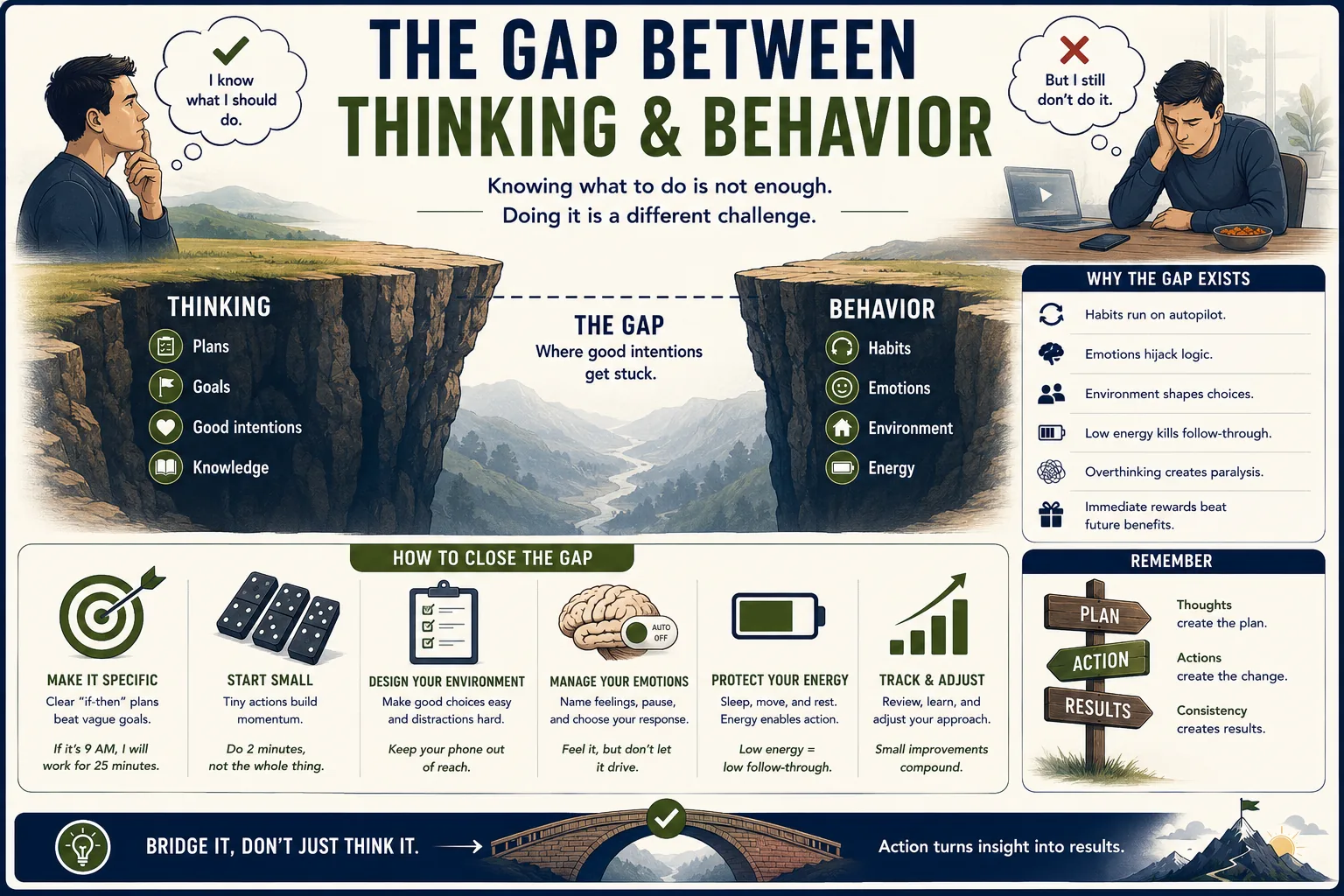
The gap between thinking and behavior is not a curiosity. It is a structural feature of human psychology that affects health decisions, organizational behavior, interpersonal relationships, learning, and every domain in which good intentions and competent analysis are supposed to produce good outcomes.
Understanding the mechanisms behind this gap is essential to understanding why individuals and organizations fail to act on what they know and believe.
"Intentions formed by deliberate reasoning must compete with automatic responses at the moment of action - and automatic responses usually win." - Daniel Kahneman, 2011
The Dual-Process Architecture
The most influential framework for understanding the thinking-behavior gap is dual-process theory, most famously articulated by Daniel Kahneman in his 2011 book Thinking, Fast and Slow, but developed across decades of research by Kahneman, Tversky, Keith Stanovich, and many others.[6]
The framework distinguishes two modes of cognitive processing:
| Gap Type | Mechanism | Intervention That Works |
|---|---|---|
| Intention-behavior gap | Present bias; System 1 overrides System 2 at moment of action | Implementation intentions; commitment devices |
| Attitude-behavior gap | Situational factors override stated attitudes at moment of behavior | Environmental design; reduce friction for desired behavior |
| Knowledge-behavior gap | Knowing what is right does not produce the behavior | Habit formation; identity alignment; default restructuring |
| Values-behavior gap | Cognitive dissonance; ethical fading in organizational framing | Structural accountability; explicit ethical framing |
System 1 is fast, automatic, effortless, associative, and largely unconscious.[1] It operates continuously in the background, generating impressions, intuitions, and behavioral impulses. System 1 cannot be turned off; it runs automatically in response to environmental stimuli.
It is the system that drives you home on autopilot while your conscious attention is elsewhere, that makes you flinch at sudden movement, that produces instant liking or disliking of strangers.
System 2 is slow, deliberate, effortful, logical, and conscious. It is what most people think of when they think of "thinking" - explicit reasoning, step-by-step analysis, conscious consideration of options.
System 2 is limited in capacity; it can only handle a small number of items simultaneously, and it tires with extended use.
The gap between thinking and behavior occurs partly because System 2 produces the thinking - the deliberate analysis, the explicit beliefs, the articulated intentions - while System 1 drives much of the behavior.
When the situation activates automatic responses (habit, emotional reaction, social compliance), those responses emerge from System 1 without System 2 having an opportunity to intervene.
The practical implication: intentions formed by System 2 reasoning must compete with automatic responses from System 1 at the moment of behavior, and System 1 often wins because it is faster, more activated by situational cues, and does not require the effort that System 2 demands.
Intention-Behavior Gaps: The Research Evidence
The gap between stated intention and actual behavior is among the most replicated findings in social psychology.
Meta-analyses examining hundreds of studies find that intention-behavior correlations in health behavior (exercise, diet, medication adherence, smoking cessation) typically cluster around r = 0.4-0.5 - meaning intention explains roughly 20-25% of behavior variance.[8]
The other 75-80% is explained by other factors.
Peter Gollwitzer and Paschal Sheeran's 2006 meta-analysis examined what bridged the intention-behavior gap.[3]
They found that implementation intentions - specific if-then plans ("When I get home on Monday, I will immediately change into exercise clothes and go for a run") - dramatically increased behavior following from intentions, roughly doubling the intention-behavior correlation.
The implementation intention works by delegating the behavior from System 2 (which forms the intention) to System 1 (which executes automatically when the specified cue occurs), removing the moment-of-action decision that normally allows competing impulses to win.
The Attitude-Behavior Inconsistency
A distinct but related gap exists between attitudes (evaluative beliefs about objects, people, or actions) and behavior. Richard LaPiere's 1934 study is the classic demonstration: he traveled the United States with a Chinese couple in an era of overt anti-Asian prejudice, visiting 251 restaurants and hotels.[5]
They were refused service once. But when LaPiere subsequently wrote to all 251 establishments asking whether they would serve "members of the Chinese race," 90% said they would not.
The same people who had served Chinese customers in person had articulated attitudes that contradicted their behavior.
The attitude ("we don't serve Chinese people") and the behavior (they did) were inconsistent, and the attitude was what was expressed verbally while the behavior reflected situational factors that the actual encounter produced: the couple was well-dressed and accompanied by a confident white man, they arrived in person making refusal socially awkward, and the practical situation activated hospitality norms that overrode prejudiced attitudes.
This demonstrates a structural feature of attitude-behavior relations: attitudes predict behavior imperfectly because many other factors - situational pressures, habit, social norms, immediate feelings, the effort required to act consistently with the attitude - influence behavior at the moment it occurs.
Measuring attitudes tells you about one input to behavior; it does not tell you which input will dominate.
Present Bias and Hyperbolic Discounting
One of the most robust explanations for the intention-behavior gap is present bias: the systematic overweighting of immediate costs and benefits relative to future ones. People's stated preferences for future outcomes are often inconsistent with their choices when the future arrives.
The classic experimental demonstration: offer people a choice between $100 today and $110 in a week. Most prefer $100 today, even though this implies a preference for a 10% return over one week that they would not accept in equivalent form over longer time horizons (most people would not choose $100 over $10,000 in two years).
This is hyperbolic discounting - the discount rate for future values is much higher for near-future delays than for far-future delays, producing inconsistent time preferences.
The behavioral consequences are pervasive:
Health behaviors: People value good health in the future (they intend to exercise, eat well, and avoid smoking) but when the choice is immediate - exercise now or rest now, salad or burger - the immediate cost or pleasure dominates.[9]
The future health benefit is real and believed; it is just discounted heavily against the immediate alternative.
Savings behavior: People intend to save more for retirement and consistently fail to do so because saving requires immediate sacrifice for future benefit.
Richard Thaler and Shlomo Benartzi's "Save More Tomorrow" program addressed this by asking people to commit now to increasing their savings rate at future pay raises - when the sacrifice would be less immediate.[4] Participation rates far exceeded those of simple savings encouragement.
Learning and development: People intend to invest in skills, knowledge, and professional development but consistently choose immediate comfort (passive entertainment, routine work) over the effortful learning that would serve future goals. The immediate effort of learning is costly and certain; the future benefit is delayed and uncertain.
Social Desirability and the Gap Between Said and Done
A systematic source of thinking-behavior inconsistency is social desirability bias: the tendency to report beliefs, attitudes, and intentions that are socially acceptable rather than those that actually guide behavior.
In survey research, self-reports on sensitive topics (racial attitudes, health behaviors, sexual behavior, charitable giving) consistently diverge from behavioral measures. Actual voting behavior diverges from stated voting intentions. Actual charitable giving diverges from stated charitable intentions.
People report eating healthier, exercising more, and holding more socially acceptable views than their behavior reveals.
The divergence is not simple dishonesty. Social desirability operates through multiple mechanisms:
Impression management: Deliberate presentation of oneself in socially favorable ways, driven by the desire to be seen positively by others (and by research interviewers).
Self-deception: Genuine belief in the socially desirable self-concept, with limited awareness of the gap between self-image and actual behavior.
People who believe themselves to be generous may genuinely not notice how rarely they give; people who believe themselves to be open-minded may genuinely not perceive how consistently they dismiss evidence challenging their views.
Aspiration confusion with description: Reporting what you intend or aspire to do rather than what you actually do, without clearly distinguishing between the two.
The practical consequence for managers and researchers: stated preferences are poor predictors of actual choices. When the two diverge, revealed preferences - what people actually choose when consequences are real - provide more accurate information about actual values and behavioral tendencies than stated preferences do.
*Example*: Netflix's recommendation algorithm initially tried to learn from user ratings of movies they had watched. Users consistently gave higher ratings to documentaries and foreign films and lower ratings to reality television and popular comedies - reflecting aspirational viewing preferences.
But what people actually chose to watch (revealed preference) was much more weighted toward popular entertainment. Netflix eventually shifted to learning from actual viewing behavior rather than ratings, dramatically improving recommendation quality.
Cognitive Dissonance and its Resolution
Leon Festinger's 1957 theory of cognitive dissonance provides a mechanism for how people manage the gap between thinking and behavior when it becomes conscious.[2] When a person's behavior conflicts with their beliefs or self-concept, they experience psychological discomfort - dissonance - that motivates resolution.
But the resolution is often not behavior change. More commonly, it is belief change or rationalization: adjusting the belief system to accommodate the behavior that has already occurred.
The smoker who knows smoking causes cancer experiences dissonance. The resolution is rarely quitting - it is more often rationalizing ("my grandfather smoked and lived to 95"), minimizing ("I only smoke occasionally"), or shifting attribution ("the stress of quitting would be worse for my health").
The belief system deforms to accommodate the behavior.
This mechanism means that the thinking-behavior gap is often not stable: it generates pressure that typically resolves through belief revision rather than behavior change.
People tend to convince themselves that what they are doing is reasonable, justified, or at least not inconsistent with their values - which means their explicit beliefs shift to match their behavior, creating the appearance of consistency that makes the original gap invisible.
The implication for behavior change: changing behavior is often more effective than changing beliefs, because behavior change forces belief revision.
Environments and systems that make the desired behavior the default (automatic enrollment, pre-commitment, friction reduction) produce behavior change without requiring the person to first change their explicit beliefs - and the behavior change then produces belief change.
Closing the Gap: Evidence-Based Approaches
Understanding the mechanisms behind the thinking-behavior gap points to evidence-based interventions:
Implementation intentions: Translating abstract intentions into specific if-then plans ("If X happens, I will do Y") delegates execution from effortful System 2 deliberation to automatic System 1 responses, dramatically improving follow-through.
Commitment devices: Mechanisms that bind future behavior to current intentions - deadlines, financial penalties for non-compliance, public commitments - raise the cost of behavioral inconsistency and make it harder for in-the-moment impulses to override intentions.
Environmental design: Changing the physical and social environment to make intended behaviors easier and unintended behaviors harder reduces the gap without requiring willpower. Placing healthy food at eye level and placing unhealthy food out of sight reduces junk food consumption without changing anyone's stated health preferences.
Identity alignment: People whose behavioral intentions are integrated into their self-concept ("I am a runner" rather than "I want to exercise more") show better behavioral follow-through because behavior inconsistent with identity creates stronger dissonance than behavior inconsistent with mere intention.
Habit formation: Behaviors that become habitual are executed automatically by System 1 without requiring System 2 deliberation, removing the moment of competition between intention and impulse.[10]
The research on how the mind works consistently shows that habit formation - through consistent repetition in consistent contexts - is the most robust mechanism for sustained behavior change.[7]
The gap between thinking and behavior is not a character flaw or a failure of intelligence. It is a structural feature of a dual-process cognitive system in which explicit reasoning and automatic behavior operate on different timescales, in response to different inputs, and with different degrees of access to conscious control.
Understanding this structure is the first step toward designing environments, systems, and interventions that bridge the gap effectively.
The Organizational Scale of the Thinking-Behavior Gap
The intention-behavior gap documented at the individual level scales directly into organizational failure patterns, with consequences that are more costly and harder to correct.
Corporate ethics scandals - Enron, Theranos, Wells Fargo - are frequently analyzed as failures of leadership character, but a more precise analysis reveals them as large-scale manifestations of the same dual-process architecture that causes individuals to behave inconsistently with their stated values.
Employees at these organizations did not, in most cases, explicitly decide to act unethically. They made locally rational decisions within organizational structures that systematically activated behavior inconsistent with explicitly stated values.
Ann Tenbrunsel and David Messick, organizational behavior researchers at Notre Dame and Northwestern, published research in Administrative Science Quarterly (1999) documenting what they call "ethical fading": the process by which the moral dimensions of a decision fade from awareness as the framing shifts.
In their experiments, the same decision presented in financial framing rather than ethical framing produced substantially different behavior - participants were less likely to recognize ethical violations as ethical violations when the decision was framed as a business calculation.
At Wells Fargo, the account-opening targets were framed as sales performance goals; the ethical dimension of opening accounts without customer consent was not activated in the framing employees encountered daily, even among employees who would have clearly recognized the ethical violation if asked directly whether falsifying customer accounts was acceptable.
The organizational implication is that systems and environments - not individual character - are the primary determinants of whether the thinking-behavior gap produces ethical behavior or ethical failure.
James Reason's "Swiss Cheese Model" of organizational accidents, developed in safety-critical industries, captures this: failures occur not because one person's character failed but because multiple layers of systemic defense aligned in a way that permitted failure.
Designing organizations that close the thinking-behavior gap requires examining the framing, incentive structures, social norms, and decision architectures that shape what System 1 produces at the moment of action - not just the explicit values stated in mission documents or ethics training.
Structural Interventions That Actually Narrow the Gap
The research on behavior change has converged on a counterintuitive principle: attempts to close the thinking-behavior gap by changing beliefs, intentions, or motivation are substantially less effective than attempts to change the environment in which behavior occurs.
This is because the gap arises from the architecture of dual-process cognition, not from deficits in motivation or understanding.
Telling people why they should exercise more rarely produces durable exercise behavior; designing buildings with prominent staircases and inconvenient elevators reliably increases stair use without any attitude change.
Richard Thaler and Cass Sunstein's work on choice architecture, synthesized in Nudge (2008), provides the most influential framework for translating this principle into institutional design.
Their research on default effects is particularly striking: the same pension plan with opt-in enrollment (participants must actively choose to join) versus opt-out enrollment (participants are enrolled unless they actively withdraw) shows participation rates differing by 30-50 percentage points, with no change in stated preferences about retirement saving.
The behavior - saving - tracks the default, not the intention. The mechanism is that most people, most of the time, take the path of least resistance; changing which path is least resistant changes behavior without requiring any change in attitudes or intentions.
Google's People Operations team documented a specific application of this principle in its cafeteria design.
By placing healthy foods at eye level and in prominent positions, while placing less healthy options in less convenient locations, Google reduced average calorie consumption per employee lunch by 200 calories without any nutritional education program or stated policy change.
The intervention worked because it changed what System 1 reached for automatically in an environment where food choice is made rapidly and with minimal deliberation.
For individuals seeking to apply this framework: the question is not "how do I make myself want to do the right thing?" but "how do I design my environment so that the automatic behavior is the desired behavior?" The answers to these questions are structurally different, and only the second question reliably produces durable behavior change.
Sources & Further Reading
- Kahneman, D. Thinking, Fast and Slow. Farrar, Straus and Giroux, 2011. View source
- Festinger, L. A Theory of Cognitive Dissonance. Stanford University Press, 1957. View source
- Gollwitzer, P. & Sheeran, P. "Implementation Intentions and Goal Achievement: A Meta-Analysis of Effects and Processes." Advances in Experimental Social Psychology, 38, 69-119, 2006. DOI: 10.1016/S0065-2601(06)38002-1
- Thaler, R. & Benartzi, S. "Save More Tomorrow: Using Behavioral Economics to Increase Employee Saving." Journal of Political Economy, 112(S1), S164-S187, 2004. DOI: 10.1086/380085
- LaPiere, R.T. "Attitudes vs. Actions." Social Forces, 13(2), 230-237, 1934. DOI: 10.2307/2570339
- Stanovich, K. What Intelligence Tests Miss: The Psychology of Rational Thought. Yale University Press, 2009. View source
- Duhigg, C. The Power of Habit: Why We Do What We Do in Life and Business. Random House, 2012. View source
- Ajzen, I. "The Theory of Planned Behavior." Organizational Behavior and Human Decision Processes, 50(2), 179-211, 1991. DOI: 10.1016/0749-5978(91)90020-T
- Loewenstein, G. "Out of Control: Visceral Influences on Behavior." Organizational Behavior and Human Decision Processes, 65(3), 272-292, 1996. DOI: 10.1006/obhd.1996.0028
- Wood, W. & Neal, D.T. "A New Look at Habits and the Habit-Goal Interface." Psychological Review, 114(4), 843-863, 2007. DOI: 10.1037/0033-295X.114.4.843