
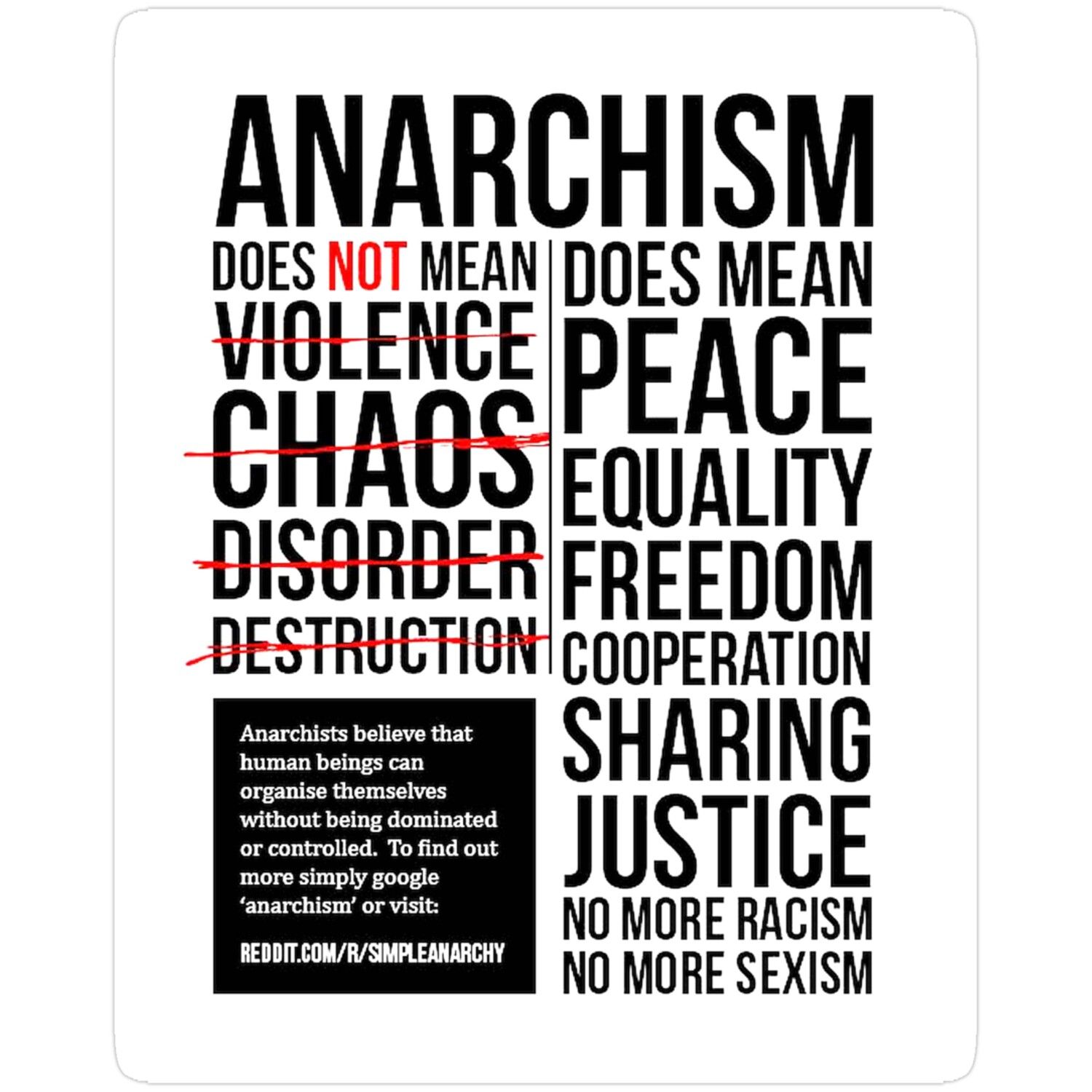
Anarchism opposes coercive hierarchy rather than social organization itself, arguing for voluntary cooperation, self-governance, and mutual aid in place of the state and other dominant institutions. Understanding anarchism requires separating its political meaning, without rulers, from the idea of chaos. Its traditions differ in their views on property, labor, ecology, individual freedom, and tactics.
In the summer of 1936, a region of several million people did something that political theorists had said was impossible.
The military coup of Francisco Franco had triggered a social revolution in Catalonia and Aragon, and the anarchist and syndicalist workers affiliated with the CNT-FAI - the Confederation of National Labour and the Iberian Anarchist Federation - moved with extraordinary speed.
Within days of the coup's failure in Barcelona, workers had collectivized approximately seventy percent of the economy in Republican-held territory.
Factories came under workers' control. Agricultural collectives spread across Aragon, encompassing hundreds of thousands of peasants. Trams ran, telephones worked, hospitals operated - all under horizontal self-governance.
George Orwell arrived in Barcelona in December 1936 to fight fascism and found himself in a city transformed beyond recognition.[5]
He wrote in Homage to Catalonia (1938): "The working class was in the saddle." Hotels and restaurants were collectivized, tipping was forbidden as degrading, and the elaborate deferences of class society had apparently evaporated.
Orwell was not an anarchist, and he was too honest an observer to romanticize what he saw. But he reported something he had never encountered before - a town where ordinary people had taken charge of their own lives.
The experiment lasted until May 1937. It ended not primarily through Franco's military advance, though that would come, but through the violent suppression organized by Stalinist communists acting under instructions from Moscow's NKVD.
Stalin's agents feared anarchist success almost as much as they feared Franco: a successful anarchist revolution would demonstrate that workers could organize without a vanguard party, without a state, without the guiding wisdom of the Communist Party of the Soviet Union.
The Barcelona May Days of 1937 - when communist and anarchist forces fought each other in the streets - marked the effective end of the experiment. To understand what was destroyed in those streets, and why it frightened so many powerful forces, is to understand what anarchism actually is.
"In Barcelona, for the first time in my life, I was in a town where the working class was in the saddle." - George Orwell, Homage to Catalonia (1938)
| Anarchist Tradition | Core Emphasis | Key Thinkers |
|---|---|---|
| Anarcho-communism | Stateless communal ownership | Kropotkin, Bakunin, Emma Goldman |
| Anarcho-syndicalism | Workers' direct action and control | Sorel, IWW, Spanish CNT |
| Individualist anarchism | Maximum individual liberty; minimal coercion | Stirner, Thoreau, Tucker |
| Green anarchism | Anti-state and anti-industrial ecology | Murray Bookchin, primitivists |
| Anarcho-capitalism | Abolish state; retain private property and markets | Murray Rothbard (disputed as anarchist) |
| Post-left anarchism | Anti-organizational; immediate liberation | Bob Black, Hakim Bey |
| Anarcha-feminism | Intersectional critique of patriarchy and state | Emma Goldman, Voltairine de Cleyre |
Key Definitions
Anarchism: The political philosophy holding that hierarchical authority - the state, capitalism, organized religion - is both coercive and unnecessary, and should be replaced by voluntary cooperation and self-governance.
The state: For anarchists, not merely a government but any institution that claims a monopoly on legitimate violence within a territory and governs through coercion rather than consent.
Mutual aid: A principle, theorized by Peter Kropotkin, that cooperation rather than competition is a primary driver of evolution and social life, and that voluntary mutual assistance forms the natural basis for social organization.
Direct action: The anarchist practice of achieving goals through one's own immediate efforts rather than through petitioning representatives or working within state institutions.
Prefigurative politics: The principle that the means of organizing must embody the ends being sought - that a free society cannot be built through authoritarian methods.
Anarcho-syndicalism: The strategy that industrial unions, organized horizontally and governed by workers themselves, can be both the vehicle for revolutionary transformation and the organizational basis of a post-capitalist society.
Propaganda of the deed: The anarchist tactic of using dramatic acts - whether strikes, occupations, or historically, political assassinations - to demonstrate that the existing order is vulnerable and inspire others to action.
Associated with a violent period in anarchist history in the 1880s-1900s that led to widespread repression of anarchist movements.
What Anarchism Actually Claims
The most fundamental and persistent misunderstanding of anarchism is the conflation of "anarchy" in its political sense (without rulers) with "anarchy" in its colloquial sense (chaos, disorder).
Anarchists have spent nearly two centuries arguing against this confusion, and the confusion persists - partly because it is actively cultivated by those who benefit from existing hierarchies.
The anarchist argument is not that human beings do not need social organization. It is that the particular forms of hierarchical organization that dominate modern life - the state, capitalism, organized religion, patriarchy - are coercive rather than consensual, harmful rather than beneficial, and contingent rather than inevitable.
Human beings organized complex societies long before the modern state existed. The question is not organization versus chaos but what forms of organization serve human freedom and flourishing.
Pierre-Joseph Proudhon, the French political economist who was the first person to call himself an anarchist, set out the basic claim in 1840.[1] His What is Property? - the text containing the famous answer "property is theft" - argued that both state authority and capitalist property rights rest on force disguised as right.
Proudhon was not calling for the abolition of personal possessions but for the abolition of the right to extract income from property one does not personally use.
His "property is theft" paradox is deliberately provocative: theft presupposes a law of property to be violated, so the phrase implies that the law itself is the thief.
Proudhon envisioned instead a system of mutualism: workers would exchange the products of their labor directly, through cooperative credit institutions that charged only cost-price, without the extraction of interest, rent, or profit.
The Conflict with Marx
The split between anarchists and Marxists is one of the foundational events in the history of the left, and understanding it clarifies what anarchism distinctively claims.
Mikhail Bakunin and Karl Marx were both leading figures in the First International (the International Workingmen's Association, founded 1864), and they agreed on much: capitalism was exploitative, class struggle was the motor of history, the goal was a classless society.
The disagreement was strategic and philosophical, and it proved irreconcilable.
Marx argued that workers must first seize state power - establish a "dictatorship of the proletariat" - and use it to dismantle capitalism, after which the state would "wither away." Bakunin replied that this was a dangerous fantasy.[2]
Power corrupts, he argued. A revolutionary state will not wither; it will consolidate. The people who manage the transition will become a new ruling class.
Bakunin predicted, with remarkable accuracy, what would happen in Russia: the Communist Party, claiming to represent the proletariat, would in fact represent a new bureaucratic elite governing through coercion as brutal as any previous ruling class.
Writing to a friend in 1872, Bakunin articulated what remains the most prescient critique ever written of what would become Soviet communism: "If you took the most ardent revolutionary, vested him in absolute power, within a year he would be worse than the Czar himself." The prediction was validated not once but repeatedly - in Russia, China, Cuba, Cambodia - wherever Marxist revolutionary vanguards seized state power in the twentieth century.
The philosophical disagreement runs deeper. For Marx, history moves through deterministic stages, and the industrial proletariat is the privileged revolutionary subject whose historical destiny is to overthrow capitalism. Anarchists reject both the determinism and the privileging of a single class.
They are more attentive to the diversity of the oppressed - peasants, artisans, women, ethnic minorities, the lumpenproletariat Marx dismissed - and more skeptical of grand historical theories that claim to know in advance what freedom requires.
And crucially, anarchists insist that the means must prefigure the ends: an authoritarian revolution cannot produce a free society, because the institutional forms established in the revolutionary period will shape what comes after.
The First International dissolved in 1876 after a bitter factional struggle that ended with the expulsion of Bakunin and his followers.[10] The split between anarchists and Marxists has defined the left ever since.
The Classical Thinkers
Peter Kropotkin and Mutual Aid
Peter Kropotkin (1842-1921) was a Russian prince who became the most systematic and scientifically ambitious theorist of anarchist communism.
His Mutual Aid: A Factor of Evolution (1902) was a direct challenge to Social Darwinism - the popular misreading of Darwin that portrayed evolution as a ruthless struggle of all against all, and that was used to justify both capitalism and imperialism as expressions of natural law.
Kropotkin, drawing on his years of field observation in Siberia as a naturalist, argued that cooperation within species was at least as important as competition between individuals in evolutionary success.[3] Social insects, bison, wolves, and human beings had all evolved complex cooperative behaviors that enhanced group survival.
Mutual aid - voluntary assistance among members of a community - was not a utopian sentiment but an evolutionary fact. If this was so, then the competitive individualism of capitalism was not an expression of natural law but a distortion of it, imposed by force and maintained by propaganda.
Contemporary evolutionary biology has provided substantial empirical support for Kropotkin's central intuition, though not necessarily in the form he expected.
Martin Nowak's (2006) synthesis of mechanisms for the evolution of cooperation - kin selection, direct reciprocity, indirect reciprocity, network reciprocity, and group selection - confirms that cooperation is ubiquitous in nature and evolves through multiple pathways.[15]
Samuel Bowles's research on the evolutionary history of human altruism (2006) suggests that intergroup conflict may have functioned as a selection pressure for within-group solidarity, lending evolutionary support to the idea that human beings are naturally cooperative within communities, though the scale and conditions under which cooperation operates remain contested.[16]
Kropotkin's anarchist communism envisioned a society of federated communes, each organized around cooperative production and distribution according to need, linked voluntarily with others through mutually agreed arrangements. There would be no state, no wages, no money - only free agreements among free individuals and communities.
This vision was explicitly distinguished from the forced collectivism of Marxist socialism: the commune would not compel any individual, and no central authority would plan from above.
Emma Goldman and American Anarchism
Emma Goldman (1869-1940) arrived in the United States from Russia in 1885 at age sixteen and became the most prominent anarchist in American history. Her anarchism was inseparable from feminism, free love, labor organizing, and opposition to militarism.
She edited the journal Mother Earth (1906-1917), lectured across the country to audiences of thousands, and was arrested repeatedly for distributing birth control information, opposing conscription, and organizing workers.
Goldman's anarchism was practical and personal as well as theoretical. She argued that personal liberation - from conventional marriage, from sexual repression, from religious guilt - was inseparable from political liberation.
"If I can't dance, I don't want to be part of your revolution" is a sentiment often attributed to her, though the exact formulation is apocryphal; the spirit is authentic.
Her 1910 collection Anarchism and Other Essays remains one of the most readable introductions to anarchist thought.[4]
In 1919, Goldman and Alexander Berkman were deported to Russia as "alien radicals" - along with 247 others on what the press called the "Red Ark." What she found in Russia disillusioned her profoundly.
Her My Disillusionment in Russia (1923) was an early and honest account of how Bolshevik authoritarianism had betrayed the revolution, published at a time when most Western leftists were defending the Soviet experiment.
Goldman's willingness to criticize the Soviet Union from the left - not from a reactionary position but from an anarchist commitment to genuine liberation - gave her analysis a moral authority that defenses of the Soviet experiment conspicuously lacked.
Voltairine de Cleyre (1866-1912) is a less well-known but important figure in American anarchism.
De Cleyre, born in Michigan, developed her anarchism through a rigorous engagement with individualist anarchism before moving toward more communistic positions - she described herself as an "anarchist without adjectives," open to multiple economic forms in a free society.
Her essay "Anarchism and American Traditions" (1908) argued that the true legacy of the American Revolution - the individualist, anti-authoritarian tradition of Jefferson, Paine, and the Anti-Federalists - was anarchist in spirit, and had been betrayed by the centralizing tendencies of American capitalism and government.[17]
The Haymarket Affair
The relationship between anarchism and labor in the United States was dramatically shaped by the Haymarket affair of 1886. On May 4, in Haymarket Square in Chicago, a bomb exploded at a labor rally organized by anarchists and labor activists calling for an eight-hour workday.
Seven police officers and at least four workers died. Eight prominent anarchists were tried for murder despite no evidence connecting them to the bomb; four were hanged.
The affair became an international cause, and May 1 - International Workers' Day - commemorates it worldwide, though not in the United States, where the government moved Labor Day to September precisely to avoid this association.
The Haymarket affair shaped the trajectory of American anarchism for a generation, associating the movement in the public mind with violence even as the actual evidence against the convicted men was transparently manufactured.
Governor John Peter Altgeld of Illinois pardoned the surviving defendants in 1893 in a document that meticulously documented the miscarriage of justice - and destroyed his political career in the process.
Strands of Anarchism
Anarchism is not a single doctrine but a family of related positions united by opposition to unjustified hierarchy and commitment to voluntary organization.[8] The major strands differ substantially in their visions of a free society.
Anarcho-Communism
The tradition of Kropotkin and Goldman, anarcho-communism envisions the abolition of both the state and private property, replaced by federated communes distributing resources according to need. It is the largest and most historically influential strand.
Anarcho-Syndicalism
Anarcho-syndicalism developed primarily in France, Spain, and the United States in the early twentieth century, seeing industrial unions organized on anarchist principles as both the vehicle for revolution and the skeleton of the new society.
The Industrial Workers of the World (the "Wobblies"), founded in Chicago in 1905, represented American anarcho-syndicalism - organizationally democratic, committed to industrial unionism across craft divisions, hostile to electoral politics.
In Spain, the CNT (Confederacion Nacional del Trabajo) became the organizational basis for the Catalonian experiment.
At its peak in 1917-1920, the IWW claimed approximately 100,000 members and led major strikes in mining, lumber, and textile industries across the United States.
Its commitment to organizing all workers regardless of race, ethnicity, or skill level - unusual in a labor movement otherwise deeply segregated - made it both a practical and ideological challenge to the AFL's craft unionism.
Anarcho-Capitalism
Murray Rothbard (1926-1995) developed anarcho-capitalism as a position that rejects the state while defending free markets and private property.
This places it entirely outside the classical anarchist tradition: most anarchist thinkers explicitly identify capitalism itself - the extraction of profit from workers by owners who did not labor - as a system of coercion no different in kind from the state.
Anarcho-capitalists call themselves anarchists; most classical anarchists reject the label as a contradiction in terms.
As the anarchist theorist David Graeber (2004) wrote, "For the most part, 'anarcho-capitalism' is an oxymoron: anarchism has always been defined by opposition to hierarchy and exploitation, and capitalism is nothing if not a system of hierarchy and exploitation."
Green Anarchism and Bookchin's Libertarian Municipalism
Murray Bookchin (1921-2006) developed social ecology - the argument that the domination of nature and the domination of human beings are rooted in the same hierarchical social structures.[6]
His libertarian municipalism proposed the re-empowerment of local municipalities, organized as participatory democratic assemblies and confederated at regional and national levels, as the vehicle for both social and ecological transformation.
Bookchin's ideas became unexpectedly influential: the Kurdish movement in northern Syria, working under Abdullah Ocalan, translated them into the practice of democratic confederalism.
The connection between Bookchin's theoretical anarchism and the lived political experiment in Rojava is one of the most extraordinary intellectual-political transmission stories of the twenty-first century.
Ocalan, reading Bookchin while in solitary confinement in a Turkish prison, revised his entire political framework from Marxist-Leninist nationalism to democratic confederalism - and the movement he led implemented those ideas in a territory the size of Switzerland, governing millions of people under conditions of active warfare.
Post-Left Anarchism
Post-left anarchism, associated with figures like Bob Black (The Abolition of Work, 1985) and Hakim Bey, criticizes the classical anarchist tradition for its residual moralism, its valorization of work and labor organizing, and its organizational formalism.
Post-left anarchists tend toward insurrectionism and lifestyle politics, emphasizing the immediate creation of free life in the present rather than long-term revolutionary strategy.
Anarchism in the Twentieth and Twenty-First Centuries
After the destruction of the Spanish anarchist experiment in 1937-1939, anarchism entered a prolonged decline as a mass political force. The Cold War tended to reduce political debate to capitalism versus Soviet-style communism, marginalizing the anarchist critique of both.
New Left movements of the 1960s revived anarchist ideas without always naming them: the participatory democracy of Students for a Democratic Society, the decentralized organizing of the civil rights movement's SNCC, the communes and collectives of the counterculture all drew on anarchist practices.
The global justice movement of the 1990s and 2000s brought explicit anarchist organizational forms to prominence. The Direct Action Network, which coordinated the 1999 Seattle protests against the WTO through affinity groups and spokescouncils, introduced a new generation to anarchist practice.
Occupy Wall Street (2011) applied these methods at scale, generating the general assembly model adopted from New York to Madrid to Cairo.
Contemporary anarchism's most ambitious real-world experiment is Rojava - the Autonomous Administration of North and East Syria, which has governed approximately 3 to 5 million people in northern Syria since 2012.
Drawing explicitly on Bookchin's democratic confederalism, Rojava established federated communes with mandatory gender co-presidency, ecological principles embedded in governance, and a militia structure (the YPG and YPJ) organized on democratic rather than hierarchical lines.
The experiment has survived a war on multiple fronts - including the Islamic State's genocidal campaign against the Yazidi people, Turkish military incursions, and Syrian government pressure - and has attracted significant scholarly and activist attention as a serious attempt to implement anarchist principles under conditions of extreme pressure.
A 2018 study by Thomas Schmidinger in Rojava: Revolution, War and the Future of Syria's Kurds documented both the genuine achievements of the Rojava experiment - significant advances in women's equality, functional governance under wartime conditions, successful military resistance to ISIS - and its tensions with Kurdish nationalist impulses that sit uncomfortably alongside universal anarchist principles.[13]
The experiment remains ongoing, contested, and significant.
Anarchism and Contemporary Social Theory
One of the most significant intellectual developments in anarchist thought in recent decades has been the engagement with feminist theory, postcolonial thought, and the broader question of intersecting hierarchies.
Classical anarchism, despite Goldman's feminism, was often dominated by male theorists whose critique of the state and capitalism did not always extend to a thorough critique of patriarchy.[7]
Contemporary anarcha-feminism, associated with thinkers like Cindy Milstein and drawing on the broader influence of bell hooks, argues that the domination of women by men is as fundamental a hierarchy as the domination of workers by capitalists or subjects by the state, and that anarchism is incoherent unless it addresses all these hierarchies together.
The anarchist critique of representation has also been theoretically productive. Classical democratic theory holds that large populations can govern themselves through elected representatives who act on their behalf.
Anarchists point to the consistent empirical finding that representatives develop interests distinct from those of their constituents, that the process of election favors those with money, social capital, and willingness to exercise power over others, and that the representation relation systematically distances governing from governed.
The alternatives anarchists have developed - direct democracy, sortition (selection by lot rather than election), federated assemblies with binding mandates and immediate recall - have gained new attention as disillusionment with representative systems has spread.
David Van Reybrouck'sAgainst Elections (2013) drew extensively on anarchist critiques to argue for replacing elected legislatures with citizen assemblies selected by lot - a proposal now implemented in several national and regional deliberative processes in Ireland, France, and elsewhere.[14]
The anthropologist James Scott's influential work on "seeing like a state" and everyday forms of resistance has provided anarchism with important intellectual resources.[12]
Scott's Seeing Like a State (1998) argues that modern states systematically simplify, standardize, and make legible the complex, local, tacit knowledge of communities, with often catastrophic results - Soviet collectivization, colonial land registration, "scientific" forestry - because the simplified, legible version is more administrable than the real thing.[11]
His Two Cheers for Anarchism (2012) explicitly acknowledges the anarchist tradition as the political philosophy that takes small-scale practice, local knowledge, and the costs of hierarchy most seriously.
"I believe that the anarchist critique of the state and of hierarchy deserves a more serious hearing than it has received in mainstream political philosophy." - James C. Scott, Two Cheers for Anarchism (2012)
David Graeber (1961-2020), whose death was mourned across the political left, was perhaps the most important anarchist intellectual of the early twenty-first century.
His Debt: The First 5,000 Years (2011) combined deep anthropological scholarship with anarchist political economy to challenge the standard narrative of money, markets, and debt - arguing that moral claims embedded in debt relations have functioned historically as instruments of domination and that much of what we call "capitalism" is better understood as a system of debt-enforced hierarchy than of free exchange.
Graeber was also a key organizer of Occupy Wall Street, embodying the anarchist commitment to prefigurative politics: the general assembly model he helped develop became the most recognizable organizational form of the global Occupy movement.
The Enduring Questions
Anarchism raises questions that do not disappear regardless of whether one accepts the anarchist answers. Can genuinely complex societies - with millions of people, sophisticated technical infrastructure, global trade, and competing interests - be organized without hierarchical authority?
Anarchists point to the Spanish collectives, the kibbutz movement, the Rojava experiment, cooperative enterprises, and the open-source software movement as demonstrations that complexity does not require hierarchy.
Critics argue that these examples remain small-scale, temporary, or dependent on external conditions that cannot be generalized.
Does the absence of the state mean the absence of order, or merely the absence of institutionalized coercion?
Anarchists argue the latter, and point to the empirical literature on self-organizing systems, common pool resource management (Elinor Ostrom's Nobel Prize-winning work), and the history of communities that governed shared resources without state authority.[9] The question is not settled.
What is the relationship between personal liberation and structural change? Goldman's insistence that they are inseparable remains a vital contribution. But the history of anarchist movements also shows how easily a politics of personal liberation can become a politics of individual lifestyle that leaves structural power untouched.
The tension between prefigurative politics - building free relationships in the present - and strategic politics - changing the structural conditions that constrain freedom - is not resolved by embracing one side or the other, but must be held in productive tension.
These are not abstract questions. They are asked every time a social movement debates whether to engage with electoral politics or maintain its independence; every time a collective debates decision-making procedures; every time people try to build institutions that embody the values they seek to realize.
In that sense, anarchism is not a historical curiosity but an ongoing conversation about the conditions of genuine freedom.
For related discussion of voluntary cooperation and collective self-governance, see What Is Collective Action, and for comparison with the socialist tradition that shares anarchism's critique of capitalism, see What Is Socialism.
The social contract tradition that anarchism explicitly rejects is examined in What Is the Social Contract.
Sources & Further Reading
- Proudhon, P.J. (1840). What is Property? An Inquiry into the Principle of Right and of Government. Translated by Benjamin Tucker (1876). Available at:
- Bakunin, M. (1873). Statism and Anarchy. Cambridge University Press (1990 edition). DOI: 10.1017/CBO9781139167055
- Kropotkin, P. (1902). Mutual Aid: A Factor of Evolution. Heinemann. Available at:
- Goldman, E. (1910). Anarchism and Other Essays. Mother Earth Publishing. Available at:
- Orwell, G. (1938). Homage to Catalonia. Secker and Warburg.
- Bookchin, M. (1991). The Ecology of Freedom: The Emergence and Dissolution of Hierarchy. Black Rose Books.
- Ackelsberg, M. (1991). Free Women of Spain: Anarchism and the Struggle for the Emancipation of Women. Indiana University Press.
- Graham, R. (ed.) (2005). Anarchism: A Documentary History of Libertarian Ideas, Volume 1. Black Rose Books.
- Graeber, D. (2004). Fragments of an Anarchist Anthropology. Prickly Paradigm Press.
- Leier, M. (2006). Bakunin: The Creative Passion. Thomas Dunne Books.
- Scott, J. C. (1998). Seeing Like a State: How Certain Schemes to Improve the Human Condition Have Failed. Yale University Press.
- Scott, J. C. (2012). Two Cheers for Anarchism. Princeton University Press.
- Schmidinger, T. (2018). Rojava: Revolution, War and the Future of Syria's Kurds. Pluto Press.
- Van Reybrouck, D. (2013). Against Elections: The Case for Democracy. Seven Stories Press.
- Nowak, M. A. (2006). Five rules for the evolution of cooperation. Science, 314(5805), 1560-1563. DOI: 10.1126/science.1133755
- Bowles, S. (2006). Group competition, reproductive leveling, and the evolution of human altruism. Science, 314(5805), 1569-1572. DOI: 10.1126/science.1134829
- De Cleyre, V. (1908). Anarchism and American traditions. Mother Earth, December 1908. Reprinted in: Ehrlich, H. J. (ed.) (1996). Reinventing Anarchy, Again. AK Press.
Further Reading
- Graeber, D. (2011). Debt: The First 5,000 Years. Melville House.