
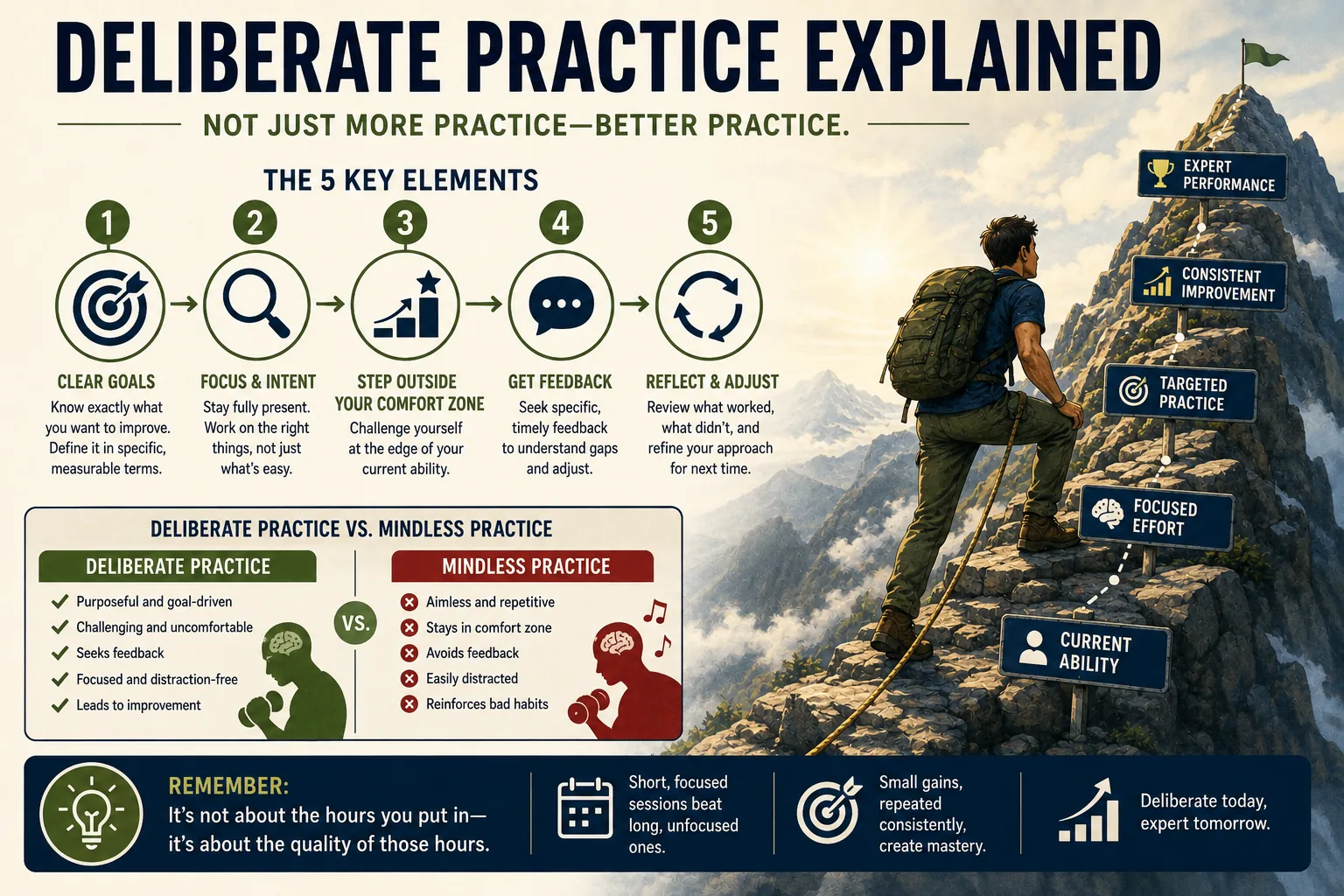
Deliberate: Repetition alone does not guarantee improvement. Millions of amateur chess players remain mediocre despite thousands of games. Weekend golfers play for decades without approaching professional competence. Casual musicians perform the same pieces hundreds of times while technical mastery eludes them.
The hours accumulate, yet performance plateaus persist. This gap between time invested and skill acquired reveals a crucial distinction: practice activity does not automatically produce practice effects. The quality of practice determines developmental trajectory far more than quantity.
Deliberate practice-the systematic, effortful engagement with performance improvement-accounts for the difference between expertise and mere experience. Research by K.
Anders Ericsson and colleagues demonstrates that elite performers across domains achieve superiority not through innate talent alone, but through structured training that exhibits specific characteristics.
These characteristics differentiate deliberate practice from casual repetition, naive training, and even serious but unstructured engagement.
Understanding deliberate practice matters because it transforms skill acquisition from mysterious talent development into engineering problem: What specific activities, structured how, pursued with what feedback mechanisms, will most efficiently improve targeted performance dimensions?
The answers provide actionable strategies applicable across domains where expertise proves valuable.
"Deliberate practice is not what most people mean when they say practice. It requires effort, it's not inherently enjoyable, and it's specifically designed to improve performance." - K. Anders Ericsson, Peak: Secrets from the New Science of Expertise (2016)
Core Characteristics of Deliberate Practice vs. Naive Practice
| Dimension | Deliberate Practice | Naive Practice |
|---|---|---|
| Goal specificity | Precise targets for specific performance dimensions | Vague aim to "get better" or simply to practice |
| Difficulty level | Maintained at the edge of current ability (stretch zone) | Often in comfort zone; rarely uncomfortable |
| Feedback | Immediate and informative; informs next action | Delayed or absent; performance evaluated globally |
| Concentration | Full, effortful focus on the task | Can be performed while distracted or on autopilot |
| Mental representations | Explicitly building and refining internal models | No systematic model development |
| Expert guidance | Usually supervised or informed by expert coaching | Usually self-directed without external structure |
| Result | Continued improvement at all skill levels | Plateau after initial learning; may degrade |
Defining Characteristics
Well-Defined, Specific Goals
Deliberate practice targets precisely specified improvement objectives rather than vague aspirations like "get better" or "practice more." Effective goals identify particular performance dimensions requiring enhancement: faster sight-reading, cleaner transitions between positions, improved endgame calculation, smoother legato phrasing.
Specificity enables measurement. Vague intentions like "improve writing" provide no feedback mechanism.
Specific targets like "reduce passive voice constructions to under 10% of sentences" or "increase information density to 5+ concrete examples per 1000 words" permit objective evaluation of progress. This measurement creates the feedback loops that drive improvement.
Granular decomposition further enhances practice effectiveness. Rather than "work on basketball shooting," deliberate practice identifies "elbow positioning during release phase" or "foot plant timing on catch-and-shoot situations." This decomposition isolates improvable components from the complex, integrated performance that characterizes actual competition.
Research on learning consistently demonstrates that general, undirected practice produces minimal gains beyond early learning stages.
Ericsson and Pool (2016) documented that physicians with 20 years of experience often perform worse than recent graduates on diagnostic tasks-accumulated experience without deliberate improvement focus leads to stagnation or regression as bad habits consolidate.
Operation at the Edge of Current Ability
Effective practice maintains difficulty calibration where tasks stretch current capabilities without exceeding them entirely. Vygotsky's "zone of proximal development" describes this region: activities too difficult to perform independently but achievable with guidance, feedback, or concentrated effort.
Performance psychologists distinguish three practice zones:
Comfort zone: Activities well within current capability, executable with minimal conscious attention. These maintain existing skills but drive little improvement.
Experienced musicians playing familiar pieces, programmers implementing routine algorithms, or writers producing standard content operate in comfort zones-fluent but not developing.
Learning zone (stretch zone): Activities that demand full concentration, expose current limitations, and require problem-solving during execution. This region generates improvement through error correction and capability extension.
Musicians tackle technically challenging passages slowly, programmers implement unfamiliar algorithms, writers experiment with new rhetorical structures.
Panic zone: Activities so far beyond current ability that productive learning becomes impossible. Cognitive overload, emotional overwhelm, or coordination breakdown prevents the focused analysis that drives improvement.
Attempting advanced techniques before mastering prerequisites consigns learners to flailing rather than productive struggle.
"The sweet spot is an uncomfortable place-not so difficult that it causes panic, not so easy that it allows comfort. It's the place where you're reaching just beyond your ability and feel the discomfort of genuine struggle." - Daniel Coyle, The Talent Code (2009)
Deliberate practice maintains challenge calibration in the learning zone through progressive difficulty adjustment. As capabilities expand, practice complexity increases correspondingly.
Plateaus emerge when practice remains in comfort zones-performers continue activities they've mastered rather than stretching into unfamiliar territory.
Immediate, Informative Feedback
Improvement requires accurate perception of what's working, what's failing, and why. Feedback provides this information, enabling mental model refinement and error correction. The most effective practice structures incorporate feedback mechanisms that:
Operate immediately: Delay between action and feedback weakens learning. Real-time correction during performance enables adjustment before errors consolidate into habits. Music teachers stop students mid-phrase when technique breaks down. Athletic coaches interrupt drills when form degrades.
Programming environments flag syntax errors before compilation.
Specify what's wrong and why: Generic feedback like "that wasn't good" provides insufficient information for correction. Effective feedback identifies specific deficits: "You're dropping your shoulder during the backswing, causing the ball to slice right" pinpoints correctable elements.
Hattie and Timperley (2007) distinguish feed-up (goal clarification), feedback (progress toward goal), and feed-forward (future action suggestions)-comprehensive improvement requires all three.
Enable self-monitoring: Expert performers develop internal feedback systems through metacognitive awareness. They perceive their own errors during performance and make real-time corrections. Deliberate practice cultivates this self-monitoring by teaching practitioners to attend to performance cues that indicate quality.
Musicians develop pitch and rhythm accuracy through ear training. Writers recognize verbose constructions through rereading. Programmers spot code smells through pattern recognition.
Domains vary in natural feedback provision. Chess, music performance, and athletic competition provide clear, immediate feedback through outcomes. Writing, teaching, and management provide delayed, ambiguous feedback that requires active construction.
In low-feedback domains, deliberate practice demands artificial feedback structure creation-recording performances for review, soliciting expert critique, or constructing objective assessment protocols.
Focused Attention and Mental Representation Building
Deliberate practice cannot occur mindlessly. It demands sustained concentration on task execution and outcome evaluation. Ericsson documented that elite performers across domains practice intensely for 3-5 hours daily maximum-their concentration capacity limit.
Beyond this threshold, fatigue degrades focus, transforming deliberate practice into mere repetition.
The concentration requirement stems from practice objectives beyond motor pattern automation. Deliberate practice builds mental representations-cognitive structures that organize domain knowledge, enable pattern recognition, and guide expert performance. These representations distinguish experts from experienced non-experts.
"The right sort of practice carried out over a sufficient period of time leads to improvement. Nothing else will do." - K. Anders Ericsson & Robert Pool, Peak: Secrets from the New Science of Expertise (2016)
Chase and Simon (1973) demonstrated this through chess position memory tests. Masters reproduced complex board positions from tournament games after 5-second exposures with >90% accuracy. Novices recalled <30%.
However, when positions consisted of randomly arranged pieces violating legal game patterns, master advantage disappeared. Expert memory superiority derived from meaningful pattern recognition, not general memory capacity.
Mental representation development requires active cognitive engagement during practice:
- Anticipating what should happen next
- Comparing intended versus actual outcomes
- Analyzing why discrepancies occurred
- Adjusting mental models based on feedback
- Extracting principles that apply across situations
Passive repetition builds motor patterns but not conceptual understanding. Deliberate practice cultivates both, creating expertise that transfers flexibly across contexts rather than remaining bound to trained situations.
Domain-Specific Implementation
Music Performance
Music education research provides extensive deliberate practice documentation. Ericsson, Krampe, and Tesch-Römer (1993) studied violinists at Berlin's Academy of Music, finding that:
- Elite performers accumulated ~10,000 hours of solitary practice by age 20
- Practice hour accumulation predicted performance level better than "naturalness" ratings
- Top performers emphasized deliberate practice activities while average performers engaged more in casual playing
Effective musical practice exhibits:
Micro-segment repetition: Isolating difficult measures or phrases for focused work rather than playing through entire pieces. Williamon and Valentine (2000) found that better performers spent more time on hard sections, while weaker performers practiced easy and difficult sections equally.
Slow practice: Reducing tempo to enable attention to technical details obscured at performance speed. This allows conscious correction of fingering, articulation, dynamics, and timing before habit formation solidifies errors.
Recording and self-critique: Audio or video recording enables objective assessment of performance quality. Students who regularly record and analyze their playing show faster improvement than those relying on immediate perception alone.
Mental practice: Expert musicians practice internally-hearing passages in imagination, visualizing fingering patterns, mentally rehearsing performances. Pascual-Leone et al. (1995) demonstrated that mental practice produces measurable cortical reorganization similar to physical practice.
Athletics
Sports training literature distinguishes deliberate practice (structured drills targeting specific skills) from deliberate play (informal scrimmages emphasizing enjoyment) and competition (performance evaluation contexts). While all contribute to development, deliberate practice proves most efficient for skill acquisition.
Key principles:
Skill isolation: Breaking complex movements into teachable components. Basketball shooting decomposes into stance, grip, elbow position, release timing, and follow-through-each trainable independently before integration.
Repetition with variation: Practicing skills under diverse conditions to build adaptability. Soccer players practice passing from multiple distances, angles, and pressure levels rather than identical repetitions.
Video analysis: Recording performances enables detailed movement analysis, revealing technical flaws invisible during execution. Sprinters study starting block mechanics frame-by-frame. Divers analyze body positioning during rotation.
Progressive overload: Gradually increasing difficulty through speed, resistance, complexity, or fatigue. Weightlifters incrementally add load. Distance runners extend mileage systematically. This principle prevents stagnation while avoiding injury from excessive progression.
Cognitive and Professional Skills
Deliberate practice extends beyond physical performance to intellectual and professional domains, though implementation becomes less standardized.
Medical expertise: Ericsson collaborated with physicians to develop deliberate practice approaches for clinical skills. Effective interventions include:
- Diagnostic case libraries with immediate feedback on accuracy
- Simulated patient interactions with expert critique
- Procedure practice on realistic models before patient application
- Regular recertification testing to maintain rather than just acquire competence
Writing: Professional writers engage deliberate practice through:
- Imitation exercises mimicking admired authors' style and structure
- Constraint-based writing (eliminating certain words/constructions to build alternatives)
- Revision cycles focused on specific weaknesses (clarity, concision, flow)
- Seeking critical feedback from skilled editors rather than general readers
Programming: Software developers improve deliberately through:
- Coding kata-small, repeatable challenges focusing on specific patterns or techniques
- Code review emphasizing learning from superior examples
- Refactoring exercises transforming poor code to clean implementations
- Algorithm practice on progressively difficult computational problems
Common Misconceptions
The 10,000-Hour Rule
Malcolm Gladwell's popularization in Outliers (2008) suggests that 10,000 practice hours suffice for expertise across domains. This oversimplifies Ericsson's research substantially. The original study found that elite violinists had accumulated approximately 10,000 hours by age 20-but this was:
- Average across population, not a threshold requirement
- Domain-specific to classical violin performance
- Deliberate practice specifically, not total playing time
- Necessary but not sufficient for elite performance
"The 10,000-hour rule is wrong and I know this because I was one of the researchers whose work Gladwell cited. He took the data and misinterpreted it." - K. Anders Ericsson, interview with The Guardian (2016)
Macnamara, Hambrick, and Oswald (2014) conducted meta-analysis across domains, finding practice hours explained:
- 26% of variance in games (chess, go)
- 21% in music
- 18% in sports
- 4% in education outcomes
- 1% in professional performance
Practice quality, starting age, instruction quality, and domain-relevant individual differences (particularly cognitive abilities for intellectual domains) all significantly impact expertise development. Hours alone predict little.
"The thing that distinguishes one performer from another is how hard they work. That's it. And what's more, the people at the very top don't work just harder or even much harder than everyone else. They work much, much harder." - Geoff Colvin, Talent Is Overrated (2008)
Talent Is Irrelevant
A contrary misinterpretation suggests that deliberate practice renders innate ability irrelevant-anyone can achieve expertise through sufficient effort. Ericsson himself never made this claim, though some interpretations suggest it.
Evidence indicates:
Domain-dependent talent effects: Physical characteristics strongly predict performance in sports with biomechanical constraints (height in basketball, endurance physiology in marathon running). Cognitive abilities predict learning rates in intellectually demanding domains.
Rate versus ceiling effects: Talent may primarily affect how quickly deliberate practice produces improvement rather than ultimate achievable level. Those with greater initial aptitude require fewer practice hours to reach competence but still require deliberate practice for expertise.
Sampling effects: Elite performers may possess both talent and practice dedication. Attempting to separate these through statistical analysis faces selection bias-those lacking aptitude exit domains early, never accumulating practice hours.
Tucker and Collins (2012) argue that talent versus practice debates present false dichotomy. Expertise requires both appropriate practice and enabling attributes, with their relative importance varying by domain.
More Is Always Better
If deliberate practice drives improvement, maximizing practice duration should maximize development. However, deliberate practice's intensity creates sustainability constraints.
Ericsson found elite performers practice deliberately for 3-5 hours daily, often distributed across multiple sessions. Attempts to exceed this consistently produce:
- Burnout: Physical and psychological exhaustion from excessive demands
- Injury: Overuse injuries from insufficient recovery
- Diminishing returns: Fatigue degrades concentration, converting deliberate practice to mindless repetition
- Motivation erosion: Chronic overwork destroys the enjoyment and commitment sustaining long-term engagement
Periodization-systematic variation in training intensity and volume-prevents these problems in athletic training. The same principle applies across domains: alternating intense practice blocks with recovery periods sustains improvement over years and decades.
Designing Effective Practice
Identifying Weakness Areas
Improvement requires accurate self-assessment to target practice activities appropriately. Practitioners often resist this, preferring to practice strengths (which is enjoyable and confidence-building) over weaknesses (frustrating and threatening to self-concept).
Strategies for weakness identification:
Performance recording: Video, audio, or written artifacts enable objective review, revealing patterns invisible during execution.
Expert evaluation: Coaches, teachers, and mentors provide external assessment uncolored by self-serving bias.
Competition results: Tournament performance, standardized tests, or peer comparisons reveal competencies relative to relevant reference groups.
Deliberate error analysis: Systematically cataloging mistakes reveals patterns indicating specific skill deficits rather than random performance variation.
Constructing Training Exercises
Once weakness areas are identified, effective practice requires exercises that:
Isolate target skills: Remove confounding factors to focus attention on specific improvement areas. Musicians practice scales separately from musicality. Writers practice paragraph construction separate from overall argumentation.
Provide rapid feedback loops: Enable many attempts with immediate knowledge of results. Language learners benefit from flashcard systems that immediately confirm or correct responses. Programmers benefit from test-driven development where code changes instantly pass or fail specifications.
Adjust difficulty progressively: Begin at achievable challenge level and increase as competence grows. Spaced repetition systems implement this for memory-intensive learning by scheduling reviews at intervals optimizing retention while preventing excessive difficulty.
Enable measurement: Quantifiable performance permits tracking improvement over time, providing motivation and validating practice effectiveness. Writers track reading ease scores. Musicians track metronome speeds for technical passages. Athletes track times, distances, or accuracy percentages.
Maintaining Motivation
Deliberate practice's difficulty creates motivation challenges. Unlike casual practice (which can be inherently enjoyable) or performance (which provides social rewards and achievement satisfaction), deliberate practice involves sustained discomfort with delayed gratification.
Intrinsic motivation cultivation:
Purpose connection: Linking practice activities to meaningful goals sustains effort through difficulty. Understanding why particular skills matter motivates their development.
Progress visibility: Maintaining performance logs demonstrates improvement that day-to-day engagement obscures. Graphing progress reveals trajectories that encourage persistence.
Optimal challenge: Maintaining difficulty in learning zone keeps engagement high-too easy becomes boring, too hard becomes discouraging.
Social structures: Practice partners, accountability groups, or teacher relationships provide external motivation when internal drive flags.
Deci and Ryan's self-determination theory emphasizes autonomy, competence, and relatedness as core psychological needs supporting intrinsic motivation. Effective practice structures satisfy these needs while maintaining improvement focus.
Limitations and Boundary Conditions
Domain Differences
Deliberate practice applies most straightforwardly in:
- Stable domains with established best practices and performance standards
- Domains with immediate feedback where results clearly indicate quality
- Teachable domains where experts can articulate and demonstrate effective techniques
Application becomes problematic in:
- Rapidly evolving domains where best practices constantly change (some areas of technology)
- Ill-defined domains lacking clear performance criteria (creative writing quality, business strategy effectiveness)
- Domains where feedback is ambiguous or delayed (parenting, long-term investment)
Even within applicable domains, deliberate practice effectiveness varies. Macnamara et al. (2014) found that practice explains more variance in stable, predictable activities (games, music, athletics) than in probabilistic domains or contexts requiring social interaction.
Transfer Limitations
Expertise developed through deliberate practice often transfers narrowly. Chess grandmasters possess exceptional memory for legal game positions but ordinary memory otherwise. Musicians master their instruments but struggle with others. Programmers fluent in one language face learning curves in new paradigms.
This specificity suggests that deliberate practice builds domain-specific mental representations rather than general cognitive enhancement. Broad expertise requires deliberate practice across multiple related domains, not just intensive focus in one area.
The Plateau Problem
Even with deliberate practice, performance improvement eventually slows dramatically. Elite performers reach ability ceilings where further improvement requires disproportionate effort. These plateaus reflect:
- Fundamental limits: Physical, cognitive, or practical constraints that training cannot overcome
- Diminishing returns: Early practice hours produce rapid improvement; advanced development requires vast effort for marginal gains
- Method exhaustion: Existing training approaches have extracted all available improvement; breakthroughs require methodological innovation
Breakthroughs past plateaus often emerge from changes in training method, not just increased effort. Dick Fosbury's high jump revolution came from abandoning orthodox techniques for his eponymous flop.
Joshua Waitzkin documented in The Art of Learning how chess progress resumed after adopting martial arts training that developed transferable performance principles.
The Berlin Violin Study: What the Original Research Actually Found
The foundational deliberate practice study is frequently cited and almost as frequently misunderstood.
Ericsson, Krampe, and Tesch-Romer (1993) examined violinists at the Hochschule der Kunste in Berlin, sorting them into three groups: students nominated by professors as having the potential for international careers, students nominated as good but unlikely to reach the top tier, and music education students training to become teachers rather than soloists.
The researchers asked participants to estimate how they had spent their time each week across different activities: formal practice alone, informal practice, music lessons, performance, listening to music, and leisure. They also had participants keep daily diary logs for a week to verify memory accuracy.
The critical finding was not simply that elite players practiced more. It was that they practiced differently. The top group accumulated approximately 10,000 hours of solitary deliberate practice by age 20, compared to around 7,800 hours for the second group and 3,420 hours for the music education students.
But the composition of those hours diverged sharply. Elite students rated solitary practice as highly effortful and only moderately enjoyable. They scheduled it in morning sessions when concentration was highest, then rested, then did secondary practice later. They also slept more than the other groups.
The education students, by contrast, spent far more of their hours in group rehearsal, informal playing, and performance - activities rated as more enjoyable and less effortful. Total hours with an instrument were similar between groups, but hours of concentrated, goal-directed solo practice differed by a factor of two.
This finding has a sharp implication: time with a skill does not equal time developing a skill. The physician who has seen 10,000 patients over a career may have practiced procedures many times without ever deliberately targeting weaknesses.
Ericsson later documented that physicians with greater clinical experience do not consistently outperform less experienced colleagues on diagnostic accuracy - and in some domains, more experienced physicians perform worse, because experience without deliberate correction allows errors to consolidate.
Slowing Down to Speed Up: The Mechanics of Micro-Segment Practice
The most counterintuitive finding from music pedagogy research concerns tempo. Expert musicians overwhelmingly report that slow practice - far below performance tempo - is their primary technique for mastering difficult passages. This seems paradoxical: if you need to play at 120 beats per minute, why practice at 60?
The answer lies in what deliberate practice is actually building. At performance tempo, the passage moves too quickly for conscious attention to identify and correct the specific muscular errors producing technical problems. Fingers land in approximately the right position but not exactly the right position.
Articulation is roughly correct but not precisely so. At slow tempo, the performer can attend to each element in isolation: where exactly is the finger landing on the string? What is the bow pressure at the moment of contact? Is the elbow position stable or drifting?
Noa Kageyama, performance psychologist at the Juilliard School, has described the standard ineffective practice approach: students play through a passage, stumble on a difficult section, restart from the beginning, play through to the difficult section again, stumble again.
This repetition does not target the problem. It practices everything up to the problem at full speed (consolidating those patterns, which may include errors) and then collides repeatedly with the same obstacle.
Effective practice identifies the exact measure, or even the exact beat, where the breakdown occurs. That unit - which may be two or three notes - becomes the target. It is practiced slowly until each element is correct, then slightly faster, then faster again, with each speed increment only taken when the preceding speed is clean.
The difficult unit is then connected to what precedes it, then to what follows it, until it is integrated back into the whole.
Ericsson documented that the best violinists in the Berlin study spent substantially more practice time on hard sections than weaker students.
Weaker students distributed practice time more evenly across easy and difficult material - partly because easy material feels productive and difficult material is uncomfortable. Deliberate practice requires directing effort toward what resists, not toward what flows.
Practical Implementation
For those seeking expertise in valuable domains, deliberate practice provides actionable principles:
Assess current performance objectively through recording, testing, or expert evaluation. Identify specific weaknesses rather than vague improvement desires.
Design focused exercises that isolate and train weak skills. Ensure feedback mechanisms provide immediate, informative results.
Maintain challenge calibration in learning zone-difficult but achievable. Adjust exercise complexity as skills improve.
Practice intensely but sustainably. 3-5 hours of focused practice beats 10 hours of distracted repetition. Build recovery into schedules.
Seek expert guidance where available. Coaches, teachers, and mentors accelerate improvement by providing feedback, suggesting exercises, and preventing ineffective habit formation.
Cultivate patience and persistence. Expertise requires years of sustained effort. The compound returns on deliberate practice accumulate slowly but inevitably exceed casual engagement's returns.
The distance between amateur and expert reflects not mystical talent but accumulated, structured improvement effort. Deliberate practice provides the structure that transforms effort into expertise.
What Research Actually Shows About Deliberate Practice
Ericsson's original research program has been both confirmed in important ways and challenged in others.
Ericsson, Krampe, and Tesch-Romer's 1993 Berlin violin study established the core finding: accumulated hours of deliberate practice predicted performance level better than any other measured variable. But the study had important limitations that Ericsson later acknowledged.
It was a retrospective design - participants estimated past practice hours from memory - and it studied only one domain (classical violin) at one institution.
The finding that the best students had accumulated approximately 10,000 hours was an average, not a threshold, and the hours represented deliberate solitary practice specifically, not total time with an instrument.
Macnamara, Hambrick, and Oswald's 2014 meta-analysis across 88 studies examined practice effects in music, sports, games, education, and professional domains. Practice accounted for 26% of performance variance in games (chess, go), 21% in music, 18% in sports, 4% in education, and 1% in professional domains.
These are substantial effects - especially for games and music - but they leave most of the variance unexplained. The researchers concluded that deliberate practice is necessary but insufficient for expert performance, and that individual differences in working memory, starting age, and learning rate contribute independently.
Hambrick, Macnamara, Draheim, and Kim (2019) at Michigan State University investigated the role of working memory capacity in acquiring chess skill. They found that players with higher working memory learned chess faster under equivalent deliberate practice conditions.
At lower levels of accumulated practice, working memory advantage was large. At higher levels (10,000+ hours), the advantage diminished - suggesting that working memory's effect is largest in early learning and that sufficient practice can partially compensate for lower initial capacity.
The finding supports a model in which both practice and individual differences matter, with their relative importance shifting across the learning trajectory.
Gobet and Campitelli (2007) at Brunel University analyzed the records of 104 chess players over their careers. The study found enormous variability in practice hours required to reach master level: the minimum was approximately 3,000 hours, the maximum exceeded 25,000 hours.
Some players never reached master level despite tens of thousands of practice hours. The researchers concluded that there is likely a genuine talent threshold below which no amount of deliberate practice will produce elite performance - though identifying this threshold prospectively is not yet possible.
Real-World Applications of Deliberate Practice Principles
Deliberate practice principles have been applied deliberately in domains ranging from surgery to music education to athletics coaching.
The Scottish National Tennis Association redesigned its youth development program in 2009 based on deliberate practice principles. The previous program emphasized match play and competition; the redesigned program reduced match time by 40% and increased structured skills drills targeting specific weaknesses.
Over a six-year period, Scottish players advanced further in international junior rankings than at any point in the previous 30 years.
The Tennis Association's technical director cited Ericsson's research directly as the basis for the redesign, noting that the shift from competitive play (which is inherently enjoyable) to structured weakness-targeting drills (which is deliberately uncomfortable) was the most difficult cultural change to implement.
Dr. Atul Gawande, surgeon and writer, documented his own deliberate practice approach to surgical skill development in Complications (2002).
After identifying that his complication rates for a specific thyroid procedure were above the national average, Gawande sought out the surgeon with the lowest complication rates in the country - a physician in Pittsburgh who had performed over 2,000 thyroid procedures - and spent time observing and receiving feedback on specific technique elements.
Gawande's complication rate dropped from approximately 7% to under 2% within a year. He has subsequently written about how surgery lacks the feedback mechanisms that make deliberate practice effective in other domains, and has advocated for mandatory video review of surgical procedures as a feedback mechanism.
The KIPP (Knowledge is Power Program) school network in the United States applies deliberate practice principles to academic skill development. KIPP schools extend the school day by two to three hours and use the additional time for targeted, feedback-intensive practice of specific academic skills - not general extended instruction.
An independent evaluation by Tuttle, Gill, Nichols-Barrer, Teh, and Gleason (2013) for Mathematica Policy Research found KIPP students showed significantly larger gains in mathematics and reading than demographically similar students at traditional schools.
The evaluation noted that KIPP's extended time was more effective than comparable extended-time interventions because it was specifically structured around targeted weakness-addressing practice rather than additional instruction.
Benjamin Franklin's writing practice, documented in his autobiography, is one of the earliest and most detailed accounts of deliberate practice for an intellectual skill.
Franklin identified good writing as a valued skill, found exemplars in The Spectator essays, and designed explicit drills: he would read an essay, write notes on its key points, set the notes aside for several days, then reconstruct the essay from the notes - and compare his reconstruction against the original.
He also converted essays to verse and back to prose, to force himself to find alternative words and constructions.
The explicit comparison of his output against an expert model - with immediate identification of discrepancies - is precisely the feedback loop that Ericsson identified as central to effective deliberate practice, applied two centuries before Ericsson named the phenomenon.
Deliberate Practice in Medical Training: Evidence from Surgical Education
One of the most consequential applications of deliberate practice principles has been in surgical and medical training, where performance deficits have life-or-death consequences.
William McGaghie at Northwestern University Feinberg School of Medicine has spent two decades building what he calls "mastery learning" systems for clinical skills - essentially deliberate practice with explicit performance standards that trainees must meet before advancing.
In a 2009 study published in Archives of Internal Medicine, McGaghie's team compared residents trained through mastery learning on central venous catheter insertion against residents trained through the traditional observe-and-practice approach.
The mastery learning group achieved proficiency rates of 100% on standardized checklists; the traditional group achieved 75%.
More importantly, when actual patient outcomes were tracked, the mastery learning group produced zero catheter-related bloodstream infections in a three-month period, compared to 3.2 infections per 1,000 catheter-days in the traditional group.
The deliberate practice intervention translated directly into reduced patient mortality.
Ericsson collaborated with surgeon Teodor Grantcharov at the University of Toronto to study how surgical skill develops in laparoscopic procedures.
Grantcharov's research used motion analysis systems that track instrument movements during laparoscopic surgery, creating objective measures of economy of movement, path length, and error rate.
The data showed that surgeons who completed a structured simulation curriculum - performing specific procedures on box trainers with immediate metric feedback - reduced their error rate on live patients by 47% compared to a control group who received only traditional training.
The feedback mechanism was key: surgeons could see exactly where their instrument path deviated from optimal, something impossible to perceive during actual surgery.
A 2019 meta-analysis by Cook, Brydges, Zendejas, Hamstra, and Hatala in Academic Medicine synthesized 182 studies comparing simulation-based deliberate practice against traditional clinical training.
Simulation produced learning effect sizes of 1.2 standard deviations above traditional approaches for procedural skills - among the largest effect sizes ever recorded in medical education research.
The authors concluded that the critical ingredient was not simulation per se but the deliberate practice structure it enabled: clear goals, immediate quantified feedback, repeated attempts at progressively difficult scenarios, and performance standards that trainees had to meet before advancement.
Deliberate Practice and the Development of Expert Intuition
A persistent question in expertise research concerns how deliberate practice produces not just improved performance but the rapid, apparently effortless intuition that characterizes genuine experts - the radiologist who spots the anomaly in seconds, the chess grandmaster who sees the winning combination immediately.
Gary Klein at the Klein Associates research firm spent twenty years studying expert decision-making in firefighters, intensive care nurses, and military commanders.
His 1998 book Sources of Power documented what he called recognition-primed decision-making: experts in high-stakes situations rarely generate multiple options and compare them analytically.
Instead, they perceive the current situation, match it to a pattern stored in memory, and generate a course of action directly from that pattern.
If the action survives a brief mental simulation, they execute it. The process is fast, feels intuitive, and is largely invisible to the expert themselves.
Klein's account seems to conflict with the deliberate practice framework until you examine its developmental origins. The expert firefighter's recognition-primed decisions are not innate intuitions - they are the accumulated product of thousands of fire situations processed deliberately over careers.
Each fire where the commander attended carefully to what the situation looked like before an unexpected development, then reflected on the relationship between the cues and the outcome, added to the pattern library. Deliberate practice built the library; the library enables intuition.
Kahneman and Klein collaborated in 2009 to reconcile their perspectives on expert intuition, publishing a joint paper in American Psychologist titled "Conditions for Intuitive Expertise: A Failure to Disagree." Their conclusion: expert intuition is reliable when two conditions are met - the environment is regular enough that patterns repeat (chess, firefighting, medical diagnosis), and the expert has had extensive, feedback-rich experience with that environment.
Domains without regularities (stock market prediction, long-range political forecasting) do not support genuine intuition regardless of experience, because there are no patterns to learn. Deliberate practice builds expertise only where there is meaningful structure to discover.
Robin Hogarth at Universitat Pompeu Fabra in Barcelona described this distinction as "kind" versus "wicked" learning environments. In kind environments, patterns repeat reliably and feedback is accurate and immediate - chess, athletics, music.
In wicked environments, patterns are irregular and feedback is misleading or absent. Expert intuition develops in kind environments through deliberate practice; it fails to develop in wicked environments no matter how much experience accumulates.
The implication for practitioners: identifying whether your domain is kind or wicked determines whether deliberate practice will produce reliable expert intuition or merely confident-seeming heuristics.
The Science Behind Expertise Development
Research has converged on the neural and cognitive mechanisms through which deliberate practice produces expertise.
Myelin sheathing - the process by which glial cells wrap neural pathways in a fatty insulating sheath - has been identified by neuroscientist George Bartzokis at UCLA as a physical substrate for skill development.
Myelinated pathways transmit signals approximately 10 to 100 times faster than unmyelinated ones and with significantly lower error rates. Deliberate practice stimulates myelination of the specific pathways involved in the practiced skill.
Daniel Coyle'sThe Talent Code (2009) documented this mechanism and its implications: skills acquired through deep, repetitive practice are literally wired into the brain's structure in a way that superficial exposure is not.
MRI studies of London taxi drivers by Eleanor Maguire at University College London (2000) confirmed that acquiring and maintaining a large body of spatial knowledge (the "Knowledge" - the complete map of London streets) produces measurable structural changes in the hippocampus, with experienced drivers showing significantly larger posterior hippocampi than both novice drivers and non-drivers.
Chase and Simon's (1973) chunking theory, developed through chess research, established the cognitive mechanism underlying expert pattern recognition. Experts do not process individual pieces of information faster; they perceive meaningful patterns - chunks - that encode large amounts of information as single units.
An expert chess player perceives a complex position as three or four familiar structures (a King's Indian pawn formation, a typical queen's side attack pattern), while a novice perceives 32 individual pieces.
This chunking allows experts to evaluate positions rapidly not by calculating more deeply but by recognizing familiar structures and their implications from memory. Gobet and Simon (1998) estimated that grand masters possess on the order of 300,000 stored chess chunks.
Deliberate practice is, at its core, the systematic acquisition of such patterns - first in explicit, conscious form, and through repetition in the implicit, rapid-access form that characterizes expertise.
Anders Ericsson's concept of mental representations integrates the chunking framework into a broader account of expertise.
As practitioners develop through deliberate practice, they build increasingly sophisticated and domain-specific representations that allow them to detect errors in their own performance, anticipate consequences of actions, and evaluate options rapidly without exhaustive analysis.
The mental representation of an expert surgeon anticipating tissue response to different instruments, or an expert teacher reading a classroom's engagement level, or an expert programmer recognizing a code smell - all of these are accumulated structures built through deliberate practice with feedback.
Ericsson argued that building these representations, not simply accumulating experience, is what deliberate practice accomplishes and why naive experience without feedback produces stagnation.
This article is part of How Learning Works: A Research Guide to Learning Science - our complete guide to the evidence on how people actually learn.
Sources & Further Reading
Foundational Research:
- Ericsson, K. A., Krampe, R. T., & Tesch-Römer, C. (1993). "The Role of Deliberate Practice in the Acquisition of Expert Performance." Psychological Review, 100(3), 363-406. DOI: 10.1037/0033-295X.100.3.363 [The seminal paper establishing deliberate practice framework]
- Ericsson, K. A., & Pool, R. (2016). Peak: Secrets from the New Science of Expertise. Boston: Houghton Mifflin Harcourt. [Comprehensive, accessible explanation of expertise development]
Empirical Studies:
- Chase, W. G., & Simon, H. A. (1973). "Perception in Chess." Cognitive Psychology, 4(1), 55-81. DOI: 10.1016/0010-0285(73)90004-2 [Expert mental representation research]
- Williamon, A., & Valentine, E. (2000). "Quantity and Quality of Musical Practice as Predictors of Performance Quality." British Journal of Psychology, 91(3), 353-376. DOI: 10.1348/000712600161871
Meta-Analyses:
- Macnamara, B. N., Hambrick, D. Z., & Oswald, F. L. (2014). "Deliberate Practice and Performance in Music, Games, Sports, Education, and Professions: A Meta-Analysis." Psychological Science, 25(8), 1608-1618. DOI: 10.1177/0956797614535810 [Critical evaluation of practice effects across domains]
Alternative Perspectives:
- Tucker, R., & Collins, M. (2012). "What Makes Champions? A Review of the Relative Contribution of Genes and Training to Sporting Success." British Journal of Sports Medicine, 46(8), 555-561. DOI: 10.1136/bjsports-2011-090548 [Genetic factors in expertise]
- Hambrick, D. Z., et al. (2014). "Deliberate Practice: Is That All It Takes to Become an Expert?" Intelligence, 45, 34-45. DOI: 10.1016/j.intell.2013.04.001
Practical Applications:
- Colvin, G. (2008). Talent is Overrated: What Really Separates World-Class Performers from Everybody Else. New York: Portfolio. [Business-oriented explanation of deliberate practice]
- Coyle, D. (2009). The Talent Code: Greatness Isn't Born. It's Grown. Here's How. New York: Bantam. [Neurological basis and practical implementation]
- Waitzkin, J. (2007). The Art of Learning: An Inner Journey to Optimal Performance. New York: Free Press. [Personal account of deliberate practice in chess and martial arts]
Supporting Theory:
- Deci, E. L., & Ryan, R. M. (2000). "The 'What' and 'Why' of Goal Pursuits: Human Needs and the Self-Determination of Behavior." Psychological Inquiry, 11(4), 227-268. DOI: 10.1207/S15327965PLI1104_01 [Motivation in sustained practice]
- Hattie, J., & Timperley, H. (2007). "The Power of Feedback." Review of Educational Research, 77(1), 81-112. DOI: 10.3102/003465430298487 [Effective feedback characteristics]