
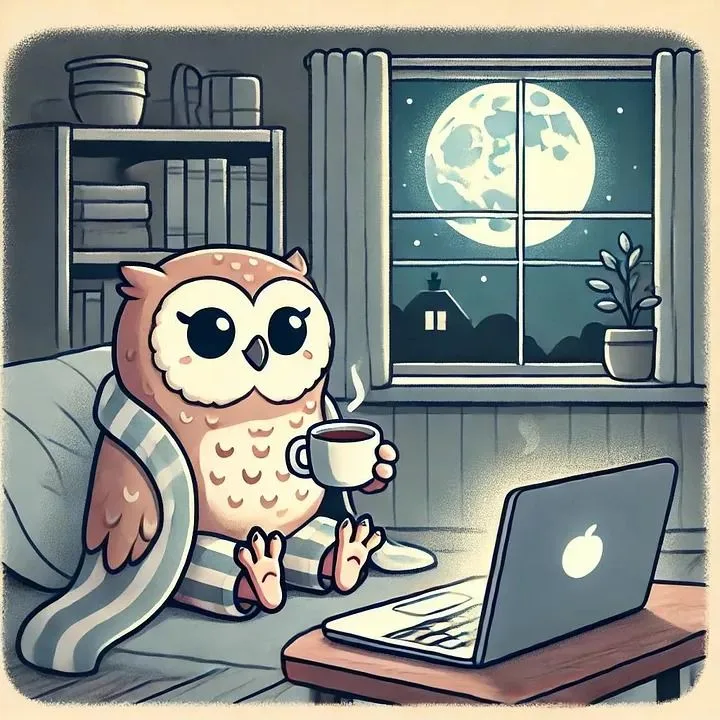
Understanding night owls means recognizing chronotype as a biological tendency toward earlier or later sleep timing, not simply a lifestyle choice or lack of effort. Circadian clocks, genetics, light exposure, age, and a person's natural free-running period influence this spectrum. Social schedules favoring early wake times can create social jetlag, particularly for evening types, who accumulate sleep debt while trying to match workday demands.
In 2007, Till Roenneberg at Ludwig Maximilian University in Munich published the largest study of human sleep timing ever conducted.
He had collected data on the sleep patterns of 55,000 people across Germany and Europe, asking them simple questions: when do you go to bed, when do you wake up, and - critically - when is this different on weekends versus workdays?
What he found was not a population divided into neat morning larks and evening owls.
It was a continuous distribution - a bell curve of sleep timing that stretched from people who naturally wake at 5 AM and can't keep their eyes open past 9 PM to people who can't fall asleep until 3 AM and whose natural waking time, if left undisturbed, is noon or later.
He also discovered something that has profound public health implications. On workdays, the evening types - those whose natural sleep timing was later - were waking up significantly earlier than their bodies required, accumulating a chronic sleep debt that they tried to repay on weekends with later wake times.
He named the gap between biological sleep timing and social schedule "social jetlag," and calculated that about two-thirds of the population experienced it to a meaningful degree - with evening types suffering the most.
The discovery that chronotype is primarily a biological trait, not a moral failing or lifestyle choice, was not culturally convenient. The world runs on a schedule built for morning types. "The early bird catches the worm." Benjamin Franklin's moralizing about early rising.
The corporate culture of 8 AM meetings. Every one of these cultural practices assumes that early rising is virtuous and achievable - and that night owls are simply failing to make the effort.
The biology says otherwise.
"We are not free to choose our chronotype. It is written in our genes." - Till Roenneberg
Key Definitions
Chronotype - The individual predisposition toward earlier or later preferred sleep and wake times, reflecting the phase of the person's circadian clock relative to the external day. Varies on a continuous spectrum from extreme morning types (larks) to extreme evening types (owls).
Approximately 50% heritable; influenced by dozens of identified genetic variants.
Circadian rhythm - A biological cycle of approximately 24 hours, generated by a molecular feedback loop within cells and coordinated by the suprachiasmatic nucleus (SCN) in the hypothalamus. Regulates sleep-wake timing, hormone release, body temperature, metabolic rate, immune function, and virtually every other physiological process.
| Factor | Night Owls | Morning Larks |
|---|---|---|
| Circadian phase | Delayed (peaks later in day) | Advanced (peaks earlier) |
| Core body temperature nadir | Occurs later (e.g., 6-8am) | Occurs earlier (e.g., 3-5am) |
| Melatonin onset | 2-3 hours later than larks | Earlier onset |
| Cognitive peak | Late morning to evening | Morning |
| Genetic heritability | ~50% - multiple clock genes involved | ~50% |
| Age trend | More common in teens/young adults | More common after age 50 |
Suprachiasmatic nucleus (SCN) - A pair of tiny nuclei in the hypothalamus, each containing approximately 10,000 neurons, that constitute the master biological clock. Receives direct light input from the retina and coordinates all other tissue clocks in the body. Damage to the SCN eliminates circadian rhythmicity.
Free-running period - The natural period of the circadian clock when isolated from all external time cues (constant dim light, no time information). Varies between individuals from approximately 23.5 to 24.5 hours.
Those with shorter free-running periods tend toward morning types; those with longer free-running periods tend toward evening types.
Entrainment - The process by which the circadian clock synchronizes to external time cues (Zeitgebers - "time givers"). The primary Zeitgeber is light; others include food timing, exercise, temperature, and social cues.
Light entrainment occurs through intrinsically photosensitive retinal ganglion cells (ipRGCs) containing melanopsin, which project to the SCN.
Clock genes - The molecular components of the cellular circadian clock: CLOCK, BMAL1, PER1, PER2, PER3, CRY1, CRY2, and others. Form a transcription-translation feedback loop that generates approximately 24-hour oscillations. Genetic variants in these genes are associated with chronotype differences.
Social jetlag - The chronic misalignment between an individual's biological sleep timing and social/work schedule demands. Equivalent in physiological impact to weekly travel across multiple time zones.
Associated with sleep deprivation, metabolic dysregulation, elevated inflammatory markers, increased depression risk, and higher all-cause mortality in evening types.
Phase advance/delay - Shifts in circadian timing relative to clock time. Phase advance = earlier sleep onset and wake; phase delay = later sleep onset and wake. Morning light exposure produces phase advance; evening light exposure (including artificial light) produces phase delay.
Sleep homeostasis - The drive to sleep that accumulates during wakefulness (Process S in Alexander Borbély's two-process model). Adenosine builds up in the basal forebrain during waking, creating increasing sleep pressure. Sleep clears adenosine, resetting sleep drive.
The rate of adenosine build-up and the threshold for sleep initiation vary between individuals and change across the lifespan.
The Molecular Clock: How Your Body Keeps Time
Every cell in your body contains a molecular clock. Not metaphorically - literally: a biochemical feedback loop that generates approximately 24-hour oscillations in gene expression.
The core loop operates through four proteins:
- CLOCK and BMAL1: transcription factors that, when dimerized, activate the transcription of Per and Cry genes
- PER (Period) and CRY (Cryptochrome) proteins: accumulate over hours, then form a complex that re-enters the nucleus and inhibits CLOCK/BMAL1 activity - turning off their own production
- Degradation: PER/CRY complexes are progressively phosphorylated by casein kinase enzymes and degraded over several hours
- Reset: once PER/CRY concentrations fall, CLOCK/BMAL1 inhibition is released and the cycle begins again
The period of this loop - the time it takes to complete one cycle - is the molecular basis of the circadian period. Genetic variants that alter clock protein stability, degradation rate, or transcriptional efficiency change the period, producing the individual differences in chronotype.
Mutations in CRY1 that increase protein stability lengthen the clock period - carriers have free-running periods of 24.5 hours and tend toward extreme evening types, sometimes with familial delayed sleep phase disorder (DSPD).
Mutations in PER2 that accelerate protein phosphorylation shorten the clock period, producing familial advanced sleep phase disorder (ASPD) in carriers - these people are extremely morning types, unable to stay awake past 8 PM and waking naturally at 4 AM.
These are the extreme ends of a continuous distribution. The more common variants in PER3, CLOCK, CRY2, and other clock genes produce smaller effects that combine to place individuals across the normal chronotype spectrum.
The Genetics of Night Owls
GWAS (genome-wide association studies) of chronotype have identified hundreds of genetic loci associated with morning or evening preference.
The largest study (Jones et al., 2019, Nature Communications, n=697,828) identified 351 independent loci, collectively explaining approximately 12-13% of chronotype variance - consistent with a highly polygenic trait.[4]
Among the best-characterized genetic associations:
PER3 VNTR (variable number tandem repeat): The PER3 gene contains a variable repeat region that exists in 4-repeat or 5-repeat forms.
The PER3^5/5 genotype (two copies of the longer repeat) is strongly associated with morning preference, earlier sleep timing, more slow-wave sleep, and better cognitive performance during sleep deprivation (PER3^5/5 individuals suffer more from sleep deprivation - they need their sleep - but perform well when adequately rested).
PER3^4/4 individuals show the opposite pattern: evening preference, later sleep timing, less slow-wave sleep, and better tolerance of sleep deprivation.[7]
CRY1 indel: A deletion variant in CRY1 that stabilizes the CRY1 protein and lengthens the circadian period. Carriers have approximately 30-minute longer free-running periods and substantially later chronotypes. Heterozygotes have intermediate effects.
RGS16: A gene involved in regulating SCN signaling that emerged as one of the most significant GWAS hits for chronotype. The mechanism involves modulation of the strength of circadian entrainment.
What this genetics tells us: chronotype is not determined by a single gene but by hundreds of variants with small effects that aggregate into a continuous phenotype. The extreme morning and evening types are at the tails of this polygenic distribution - not broken in some way, but at the ends of normal human variation.
The Lifespan Trajectory: Puberty and Its Consequences
One of the most practically important findings in chronotype research is the developmental trajectory: most people start as morning types, shift to evening preference during adolescence, and gradually shift back toward morningness through adulthood.
Mary Carskadon's longitudinal research tracked children through puberty with in-lab polysomnography and found that as puberty progressed, the timing of melatonin secretion (the hormonal signal of circadian night) shifted substantially later - a genuine biological change in circadian phase position, not a behavioral choice.[6]
Till Roenneberg's large-scale population data confirmed this trajectory: the sleep mid-point (midpoint between sleep onset and wake time) shifts approximately 2 hours later between age 10 and age 20, then shifts progressively earlier from the early 20s through the 70s.[1]
The age of peak eveningness is around 19-21 for both males and females, with males staying later slightly longer.
The mechanisms driving the adolescent phase delay are still being fully characterized. Contributing factors include:
- Changes in sleep homeostasis: slower accumulation of sleep pressure during puberty, so adolescents don't feel sleepy until later
- Direct hormonal effects: puberty-related hormonal changes may affect clock gene expression
- Increased light sensitivity in the evening (light-induced phase delay)
- Reduced sensitivity to morning light (less phase advance)
The school start time implications are obvious and well-documented. Adolescents forced to wake at 6-7 AM for school are waking 2-3 hours before their biological wake time. This is the equivalent of an adult being required to wake at 3-4 AM for work every day.
The chronic sleep deprivation this produces has measurable consequences for academic performance, mental health, driving safety, and metabolic health.
Social Jetlag: The Invisible Health Crisis
Roenneberg's concept of social jetlag quantifies the mismatch between biological and social time. He calculates it as the difference between sleep mid-point on workdays versus free days.
For strong evening types with early work schedules, this difference can be 3-4 hours - equivalent to regularly flying from New York to London and back each week.
The health consequences of social jetlag parallel those of actual jet lag:
Sleep deprivation: Evening types who must rise early accumulate chronic sleep debt, sleeping substantially less than their biological requirement on workdays and attempting to compensate on weekends.
Metabolic effects: Roenneberg's research found that greater social jetlag was associated with a higher likelihood of being overweight.[2] The disruption of circadian-aligned metabolic processes (glucose homeostasis, insulin sensitivity, fat oxidation timing) by circadian misalignment produces measurable metabolic dysregulation.
Mood and mental health: Social jetlag is associated with substantially elevated rates of depression. Natasha Bhattacharyya and colleagues found that social jetlag of 2+ hours was associated with a 2-fold increase in depression risk compared to <1 hour.
The mechanism likely involves both the effects of chronic sleep deprivation on mood regulation and the direct effects of circadian misalignment on the serotonergic and dopaminergic systems that regulate mood.
Mortality: Knutson and von Schantz's 2018 study of 433,268 UK Biobank participants found that being a definite evening type was associated with a 10% higher all-cause mortality risk compared to morning types, adjusting for sleep duration.[5]
This association appeared strongest for psychological, behavioral, and metabolic causes of death - consistent with social jetlag rather than chronotype per se being the mechanism.
Crucially: when evening types are allowed to sleep on their own schedule - as happens on vacation, with flexible work arrangements, or in research studies with self-selected schedules - their health markers improve. The health disadvantage is a consequence of social structure, not of being an evening type per se.
Can You Change Your Chronotype?
This is the practical question most night owls ask, often with some desperation. The answer: somewhat, with sustained effort.
Elise Facer-Childs and colleagues conducted the most rigorously controlled attempt to advance chronotype in evening types, published in Sleep Medicine in 2019.[3] They recruited 22 confirmed evening types (average sleep onset: 2:30 AM) and subjected them to a 3-week protocol designed to advance their circadian phase by 2 hours:
- Wake up 2-3 hours earlier than usual, with immediate bright light exposure (10,000 lux lamp for 30 minutes)
- Breakfast immediately upon waking
- Lunch at fixed noon time
- Outdoor exercise mid-afternoon
- No caffeine after 3 PM
- Avoid bright light in the evening
- Fixed bedtime 2-3 hours earlier than usual
- Maintain consistent timing including weekends (no sleeping in)
After 3 weeks, participants had advanced their sleep timing by approximately 2 hours. Their performance on cognitive and reaction time tasks improved, particularly on tasks performed in the morning (previously their worst time). Self-reported depression, stress, and anxiety measures improved. Sleepiness decreased.
What this protocol requires - and why it's difficult to maintain:
- Consistent weekend timing (no sleeping late on Saturday, which would partially undo the advancement)
- Morning bright light (which requires either outdoor light or a light therapy lamp)
- Evening light restriction (conflicting with normal social and entertainment activities)
- Sustained commitment, because the circadian clock's resistance to phase change means reversal occurs when the protocol lapses
The fundamental genetic chronotype remains unchanged; the behavioral protocol shifts the phenotypic expression within a range. Think of it as a gene x environment interaction: the genetic tendency toward evening preference is still there, but its expression can be partially modified by sustained environmental manipulation.
The Night Owl's Advantage
The "early bird catches the worm" morality story around chronotype is culturally ubiquitous and biologically unfounded. When performance is tested across the full day for each chronotype, evening types show equivalent peak performance to morning types - just at different times of day.
For evening types, peak cognitive performance (working memory, reaction time, executive function) occurs in the late afternoon to evening - roughly 6-8 PM for extreme owls. Morning types peak earlier (9-11 AM). Neither is superior; they peak at different times.
Some research suggests specific advantages for evening types:
Creativity and divergent thinking: Marina Giampietro's research found that evening types scored higher on measures of creative thinking, including divergent thinking tasks that require generating multiple novel solutions.
The mechanism may involve reduced inhibitory control in the evening state, which can facilitate novel associations.
Tolerance for sleep deprivation: PER3^4/4 evening types show less cognitive impairment from sleep deprivation than PER3^5/5 morning types - they cope better with the disrupted sleep that modern society imposes.
Adaptive vigilance in low-light conditions: Purely speculative, but evolutionary arguments for night-owl advantages in group vigilance during evening and nighttime hours have been proposed.
Professional flexibility: Many high-creativity, entrepreneurial, and academic careers allow schedule flexibility that lets evening types operate on their natural schedule - producing all the performance and health benefits of circadian alignment without the morning-world penalties.
The most accurate statement may be: there is no chronotype advantage in a world that accommodates both. The disadvantages of evening types are primarily social penalties - the world is structured for morning types, and evening types pay for that structural mismatch in sleep, health, and performance on morning tasks.
What Society Could Do Differently
The public health implications of social jetlag are substantial. A significant fraction of depression, obesity, metabolic disease, and workplace accidents can be attributed to chronic circadian misalignment imposed by fixed early-morning social schedules on a population with genuinely varied biological sleep timing.
Specific evidence-based changes:
- School start times: Shifting middle and high school start times to 8:30 AM or later (as recommended by the American Academy of Pediatrics) has been shown in natural experiments to improve attendance, grades, mental health, and adolescent car accident rates
- Flexible work schedules: Allowing chronological-type-matched work start times reduces social jetlag and associated health impacts
- Daylight saving time elimination: The twice-annual clock shift amplifies social jetlag effects and produces documented spikes in heart attacks, traffic accidents, and mood disorders in the days following each transition
- Occupational shift scheduling: Matching shift timing to worker chronotype improves alertness, reduces errors, and improves worker health in industrial settings
These are not merely quality-of-life improvements - they address a genuine public health burden imposed by assuming that human biology is uniform when the evidence overwhelmingly shows it is not.
For related concepts, see how sleep works, how to fix your sleep, what happens when you don't sleep, and what the science of longevity shows.
Sources & Further Reading
- Roenneberg, T., et al. (2007). Epidemiology of the Human Circadian Clock. Sleep Medicine Reviews, 11(6), 429-438. DOI: 10.1016/j.smrv.2007.07.005
- Roenneberg, T., et al. (2012). Social Jetlag and Obesity. Current Biology, 22(10), 939-943. DOI: 10.1016/j.cub.2012.03.038
- Facer-Childs, E. R., et al. (2019). Resetting the Late Timing of 'Night Owls' Has a Positive Impact on Mental Health and Performance. Sleep Medicine, 60, 236-247. DOI: 10.1016/j.sleep.2019.05.001
- Jones, S. E., et al. (2019). Genome-Wide Association Analyses of Chronotype in 697,828 Individuals Provides Insights into Circadian Rhythms. Nature Communications, 10(1), 343. DOI: 10.1038/s41467-018-08259-7
- Knutson, K. L., & von Schantz, M. (2018). Associations Between Chronotype, Morbidity and Mortality in the UK Biobank Cohort. Chronobiology International, 35(8), 1045-1053. DOI: 10.1080/07420528.2018.1454458
- Carskadon, M. A., et al. (1998). Circadian Rhythm and Sleep-Wake Schedule in Adolescence. Sleep, 21(S1), 241-247.
- Dijk, D. J., & Archer, S. N. (2010). PERIOD3, Circadian Phenotypes, and Sleep Homeostasis. Sleep Medicine Reviews, 14(3), 151-160. DOI: 10.1016/j.smrv.2009.07.002