
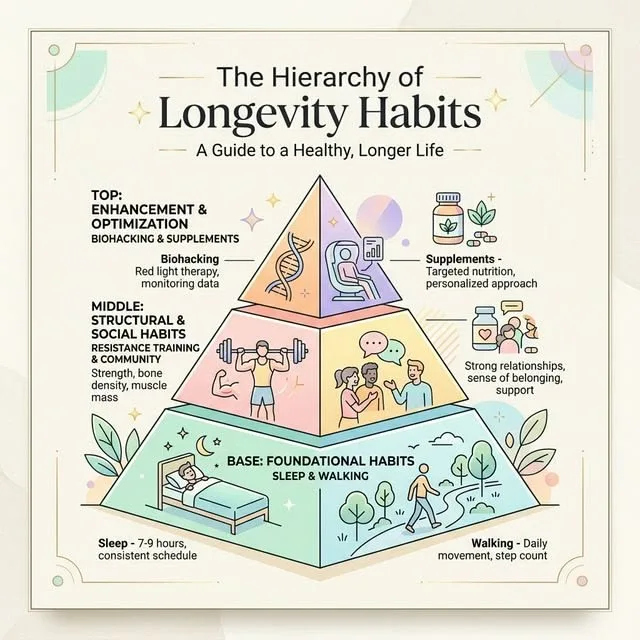
What Is the Science of Longevity?
The science of longevity is the interdisciplinary study of the biological, behavioral, and environmental factors that determine how long organisms live and how well they function with age.
It spans molecular biology - examining the cellular mechanisms that drive aging, such as DNA damage, mitochondrial decline, and cellular senescence - and epidemiology, which identifies which lifestyle patterns correlate with longer, healthier lives in human populations.
The field distinguishes between lifespan (total years lived) and healthspan (years lived in good health), and its practical goal is not merely to extend life but to compress the period of decline at the end of it.
In 1997, Jeanne Calment of Arles, France died at the age of 122 years and 164 days - the oldest verified age ever reached by a human being.
She had met Vincent van Gogh as a teenager in her father's art supply shop and described him as "dirty, badly dressed, and disagreeable." She attributed her long life to olive oil, port wine, and chocolate. She smoked until age 117.
Calment's case fascinates longevity researchers not because her lifestyle habits were instructive - they clearly were not - but because they illustrate a fundamental challenge in aging science: with a sample size of one, any variable correlates perfectly with the outcome.
The science of longevity requires thinking carefully about populations, mechanisms, and the distinction between correlation and causation in a field where the gold standard (randomized controlled trials of lifespan as the endpoint) is essentially impossible in humans.
What has emerged from the past 30 years of aging research is nevertheless substantial. The molecular biology of aging has been characterized in unprecedented detail. The interventions that extend lifespan in model organisms are being systematically tested for human translation.[7]
And the epidemiological literature on human longevity - despite its methodological challenges - has converged on a consistent picture.
The good news is that most of the evidence-supported longevity interventions are the same behaviors that make life healthier and more enjoyable in the near term. The bad news is that most people already know what they are and are not doing them.
"Aging is not lost youth but a new stage of opportunity and strength." - Betty Friedan
Key Definitions
Lifespan - Total years lived from birth to death. The endpoint most often used in animal longevity research and in epidemiological studies of mortality.
Healthspan - Years lived in good health - with preserved physical capacity, cognitive function, and wellbeing. Compression of morbidity (James Fries, 1980) refers to postponing serious illness and disability until the very end of a long life, rather than extending the years of decline.[4]
Hallmarks of aging - The cellular and molecular mechanisms that drive biological aging, identified by Lopez-Otin and colleagues (2013, updated 2023): genomic instability, telomere attrition, epigenetic alterations, loss of proteostasis, disabled macroautophagy, deregulated nutrient-sensing, mitochondrial dysfunction, cellular senescence, stem cell exhaustion, altered intercellular communication, dysbiosis (microbiome changes), and chronic inflammation.[1]
Cellular senescence - A state in which damaged cells stop dividing but remain metabolically active, secreting pro-inflammatory cytokines (the SASP - senescence-associated secretory phenotype). Accumulation of senescent cells is a primary driver of age-related tissue dysfunction and chronic inflammation.
mTOR (mechanistic target of rapamycin) - A central nutrient-sensing protein that, when active, promotes cell growth and protein synthesis; when inhibited, promotes autophagy (cellular recycling) and longevity in model organisms. The primary target of rapamycin's life-extending effects.
AMPK - An energy-sensing kinase activated by low cellular energy states (exercise, caloric restriction, metformin). Promotes mitochondrial biogenesis, autophagy, and longevity pathways; opposes mTOR.
Sirtuins - NAD+-dependent enzymes involved in DNA repair, gene silencing, and metabolic regulation. Activated by caloric restriction and resveratrol in some contexts; associated with longevity in multiple species.
Epigenetic clock - A computational model that estimates biological age from DNA methylation patterns. Current clocks (Horvath, PhenoAge, GrimAge) predict mortality and healthspan outcomes beyond chronological age and can detect biological aging effects of interventions.
Senolytic - A compound that selectively eliminates senescent cells. Dasatinib + quercetin is the best-studied senolytic in humans; early clinical trials show promising results for age-related conditions.
Blue Zones - Five regions identified by Dan Buettner as having unusual concentrations of centenarians: Sardinia, Italy (Barbagia region); Okinawa, Japan; Ikaria, Greece; Loma Linda, California (Adventist community); and the Nicoya Peninsula, Costa Rica.
Evidence-Based Longevity Interventions: What the Science Actually Shows
| Intervention | Human evidence quality | Effect on lifespan/healthspan | Key mechanism | Current status |
|---|---|---|---|---|
| Not smoking | Very strong (RCT/cohort) | +10 years average | Removes #1 modifiable mortality risk | Established clinical recommendation |
| High cardiorespiratory fitness (VO2 max) | Very strong (large cohorts) | 5x mortality difference lowest vs. highest fit | Reduces senescence, inflammation, insulin resistance | Established |
| 7-9 hours sleep | Strong (cohort, RCT) | Lower all-cause mortality; dementia risk 30% | Glymphatic clearance, immune function, hormonal repair | Established |
| Mediterranean/whole food diet | Moderate (cohort) | Reduced CVD and all-cause mortality | Lower inflammatory burden, microbiome support | Established |
| Social connection | Strong (meta-analysis) | 50% survival advantage vs. isolated | HPA axis regulation, immune effects | Established |
| Caloric restriction (moderate) | Moderate (CALERIE RCT) | Improved biomarkers; biological clock slowed | mTOR inhibition, autophagy, AMPK activation | Promising |
| Rapamycin (mTOR inhibitor) | Strong in mice; minimal human data | 10-25% lifespan extension in mice | mTOR inhibition | Off-label only; trials underway |
| NAD+ precursors (NMN/NR) | Weak human evidence | Raises NAD+ in humans; longevity unclear | Sirtuin activation, mitochondrial function | Commercially available; evidence limited |
| Senolytics (dasatinib + quercetin) | Early human trials | Dramatic healthspan improvement in mice | Clears senescent cells, reduces SASP | Clinical trials underway |
| Metformin | Observational (diabetics outlive non-diabetics) | Suggestive; TAME trial ongoing | AMPK activation | TAME trial ongoing |
The Molecular Biology of Aging
For most of history, aging was understood as essentially inevitable - "wear and tear," the unavoidable running down of a biological machine. This view has been substantially overturned.
The demonstration that simple interventions - caloric restriction, activation of specific genetic pathways - could extend lifespan in organisms from yeast to mice established that aging is, at least partly, regulated rather than random.
The implication: there are specific biological processes that determine the rate of aging, and these processes are potentially modifiable.[5]
The hallmarks framework organizes what is now known about these processes. Each hallmark represents a category of molecular damage that accumulates with age and contributes to tissue dysfunction and disease:
Genomic instability: DNA damage from replication errors, oxidative stress, and environmental insults accumulates across a lifetime. DNA repair systems become less efficient with age. Accumulated mutations in non-dividing cells contribute to tissue dysfunction; in dividing cells, they contribute to cancer.
Telomere attrition: telomeres shorten with each cell division (the Hayflick limit). When telomeres reach a critical length, cells enter replicative senescence or apoptosis. Telomere shortening is accelerated by chronic stress, smoking, poor sleep, obesity, and sedentary behavior - and reduced by exercise and certain lifestyle factors.
Epigenetic alterations: the epigenetic programs that regulate which genes are active in each cell type drift with age, causing cells to lose their characteristic function and assume intermediate states.
This epigenetic aging is what epigenetic clocks measure, and it is increasingly seen as a primary - perhaps the primary - mechanism of biological aging.
Loss of proteostasis: the cell's systems for maintaining protein quality - the heat shock response, the ubiquitin-proteasome system, autophagy - decline with age. Misfolded proteins accumulate, aggregate, and disrupt cellular function.
The amyloid aggregates of Alzheimer's disease and the tau tangles of neurodegeneration represent extreme manifestations of proteostatic failure.
Disabled macroautophagy: autophagy is the cellular recycling process that clears damaged organelles and misfolded proteins. It is activated by caloric restriction, exercise, and mTOR inhibition. Autophagy declines with age, contributing to the accumulation of cellular damage.
Deregulated nutrient-sensing: the insulin/IGF-1 pathway, mTOR, AMPK, and sirtuins form an integrated network that calibrates cell growth, metabolism, and repair to nutrient availability.
With age, this calibration becomes dysregulated - promoting growth-signaling and suppressing repair even in nutrient-scarce conditions that would normally activate repair pathways.
Cellular senescence: the accumulation of senescent cells - damaged cells that have stopped dividing but remain metabolically active - is one of the best-supported causal mechanisms of aging. Clearing senescent cells in mice using genetic or pharmacological senolysis dramatically improves healthspan markers and extends lifespan.
The SASP (senescence-associated secretory phenotype) - the pro-inflammatory cocktail that senescent cells secrete - is a primary driver of the chronic inflammation (inflammaging) that underlies most age-related disease.
Blue Zones: What They Actually Show
Dan Buettner's identification of Blue Zones has generated enormous popular attention and several well-known books. What does the science actually support?
The consistent features across Blue Zone populations:
- Predominantly plant-based diets with legumes as a staple. Not necessarily vegan - moderate consumption of fish, dairy, and occasionally meat is common - but meat is not the protein foundation.
- Caloric moderation: Okinawan practice of "hara hachi bu" - eating to 80% fullness - is the most explicit formulation; moderate caloric intake is common across zones.
- Movement built into daily life: Blue Zone populations walk extensively, farm, garden, and maintain physical activity as a normal part of daily routine rather than as discrete exercise sessions.
- Strong social connection: family structures, tight community ties, and daily social interaction are consistent features.
- Sense of purpose: the Okinawan concept of "ikigai" (reason for being) and the Costa Rican "plan de vida" (life plan) represent cultural framings of purposeful daily engagement that are consistent across zones.
- Managed stress: specific stress-reduction practices vary (napping in Sardinia, ancestor veneration in Okinawa, prayer in Loma Linda Adventists) but low chronic stress and clear stress management rituals appear consistent.
A significant caveat: in 2019, Saul Justin Newman published an analysis finding that many extreme longevity claims in Blue Zones and similar high-centenarian regions correlated with administrative characteristics - poor record-keeping, high rates of rural poverty - that would be consistent with birth certificate errors or fraud rather than genuine extreme longevity.[6]
The Nicoya Peninsula data, the Greek island data, and parts of the Sardinian data may partly reflect administrative artifact.
This does not mean the lifestyle observations are invalid - they are consistent with independent research on diet, exercise, social connection, and purpose. It means the specific centenarian statistics may be less reliable than widely presented.
The Strongest Human Evidence for Longevity Interventions
Distinguishing interventions with genuine human longevity evidence from those with compelling mechanisms but limited human data:
Exercise: The Strongest Intervention
VO2 max - cardiovascular fitness - is the single most powerful predictor of all-cause mortality available from routine testing. The JAMA 2018 study of 122,000 patients found a five-fold mortality difference between the least and most fit individuals.[2]
Moving from the "poor" fitness category to "below average" fitness produced mortality risk reduction comparable in magnitude to quitting smoking.
What makes this particularly compelling is the dose-response relationship (lower mortality at every increasing fitness level), the plausible mechanisms (multiple aging hallmarks addressed), and the consistency across populations and study designs.
Exercise directly reduces cellular senescence, promotes autophagy, improves insulin sensitivity, reduces chronic inflammation, and maintains telomere length.
High VO2 max is more accurately predictive of healthy longevity than any currently available genetic profile, biomarker panel, or longevity supplement.
Sleep: The Neglected Variable
7-9 hours of sleep per night is associated with substantially lower all-cause mortality than either shorter or longer duration. The U-shaped association - both short and long sleep associated with higher mortality - is robust across large cohort studies.
Short sleep accelerates virtually every aging hallmark: impairs cellular repair processes; reduces autophagy; elevates inflammatory markers; impairs glucose metabolism; disrupts hormonal rhythms.
The glymphatic clearance of amyloid and tau that occurs during deep sleep represents one of the most direct connections between sleep and neurodegeneration.
Not Smoking
Still the single largest modifiable contributor to premature death in the developed world. Average life years lost: 10+ for regular smokers. The effects of smoking on cancer, cardiovascular disease, COPD, and accelerated biological aging are as well-established as any finding in medicine.
Diet Quality
No single dietary pattern has demonstrated life-extension in rigorous human trials. The most consistent epidemiological evidence favors Mediterranean and DASH diet patterns - associated with reduced cardiovascular and all-cause mortality in large cohort studies.
The likely mechanisms: reduced inflammatory burden from high fiber, polyphenol, and omega-3 content; metabolic benefits from Mediterranean macronutrient profile.
The consistently harmful dietary factor: ultra-processed food consumption, associated with increased all-cause mortality dose-dependently in multiple large studies.
Social Connection
Holt-Lunstad's meta-analysis: 50% survival advantage for people with adequate social relationships over those with inadequate ones.[3] Larger effect size than obesity or physical inactivity. The mechanisms are biologically substantiated (see why loneliness is deadly).
The Supplement Question: Where the Science Actually Is
The longevity supplement market is enormous, growing, and largely ahead of the evidence.
NMN and NR (NAD+ precursors): NAD+ declines with age and is required for sirtuins and mitochondrial function. NMN and NR raise NAD+ levels in humans - this is documented. Whether raising NAD+ extends healthy lifespan in humans is not known.
David Sinclair's advocacy (and financial conflicts of interest as a company founder) has generated enormous attention. The human trial evidence for NMN's health effects is mixed and limited. The mechanisms are plausible; the human longevity evidence is not established.
Resveratrol: Showed dramatic results in early cell culture and animal studies. David Sinclair's work activated enormous commercial interest. Subsequent large-scale human trials have been largely disappointing; the core sirtuin-activation mechanism has been disputed.
Resveratrol's commercial form has poor bioavailability. Current evidence does not support resveratrol supplementation for longevity.
Rapamycin (mTOR inhibitor): The single pharmaceutical agent with the most consistent and dramatic animal longevity data. Extends lifespan in mice by 10-25%, even when started late in life (equivalent to starting in a 60-year-old human). Is FDA-approved for transplant rejection and certain cancers.
Some longevity-focused physicians (including Peter Attia) use it off-label in low intermittent doses. Human trial data on aging endpoints does not yet exist. The mechanism is compelling; the human evidence is entirely from off-label use without controlled trials.
Metformin (AMPK activator): Observational data shows that diabetic patients taking metformin live longer than non-diabetic patients not taking it - a remarkable finding suggesting possible life-extension effects.
The TAME (Targeting Aging with Metformin) trial is specifically testing metformin for longevity endpoints in non-diabetic humans. This is the most scientifically credible longevity pharmacological trial currently underway.
Senolytics (dasatinib + quercetin, navitoclax, fisetin): Clearing senescent cells extends healthspan and lifespan in mice. Early human clinical trials for age-related conditions (diabetic kidney disease, pulmonary fibrosis, Alzheimer's disease) are underway.
Too early for conclusions in humans; mechanistically among the most compelling longevity targets.
Genetic Luck vs. Lifestyle: The Contribution of Each
Heritability of lifespan is estimated at 25-33% - meaning genetics explains roughly a quarter to a third of the variation in lifespan between individuals.
This is both more and less than commonly believed:
More than commonly believed: genetic differences do matter substantially. The FOXO3 gene (multiple variants, longevity associations in many populations), APOE (E2 allele protective; E4 allele increases Alzheimer's risk), and genes in the insulin/IGF-1 pathway all contribute meaningfully.
Exceptional longevity (reaching 95+) has higher heritability than average longevity.
Less than commonly believed: the majority of lifespan variation - 67-75% - is determined by non-genetic factors, primarily behavior, environment, and chance. The lifestyle factors discussed in this article operate across this large non-genetic component.
The practical implication: genetic predispositions are not destiny. People with family histories of heart disease who maintain excellent cardiovascular fitness, healthy diet, non-smoking status, and adequate sleep have better outcomes than the population average.
People with longevity-associated genes who smoke, sleep poorly, and remain sedentary do not reliably outlive the population.
Healthspan vs. Lifespan: The More Important Goal
The most important conceptual development in longevity science over the past two decades is the shift from lifespan to healthspan as the primary objective.
Adding years to life while maintaining years of disease and decline is not the goal of aging medicine. Compressing the years of morbidity - maintaining function, cognition, and independence until very late in a long life - is.
The evidence that this compression is achievable is some of the most encouraging in longevity research.
Hypertable studies of healthy lifestyle populations show not just longer life but qualitatively different aging trajectories: people with excellent lifestyle profiles have dramatically shorter periods of serious illness before death - they spend more years healthy and fewer years ill.
Dana Goldman and colleagues estimated that a combination of non-smoking status, BMI <25, regular exercise, moderate alcohol, and healthy diet produced approximately 14 additional years of life after age 50, almost entirely free of chronic disease - the diseases appearing compressed into the final few years rather than accumulated over decades.
This is not a distant biotech promise. It is what the current evidence supports, accessible through choices available to most people - exercise, sleep, social connection, diet quality, not smoking. The Jeanne Calments of the world may have additional genetic luck. The rest of us have the interventions in this list.
For related concepts, see why loneliness is deadly, why exercise is good for the brain, and what happens when you don't sleep.
Sources & Further Reading
- Lopez-Otin, C., et al. (2023). Hallmarks of Aging: An Expanding Universe. Cell, 186(2), 243-278. DOI: 10.1016/j.cell.2022.11.001
- Mandsager, K., et al. (2018). Association of Cardiorespiratory Fitness with Long-term Mortality Among Adults Undergoing Exercise Treadmill Testing. JAMA Network Open, 1(6), e183605. DOI: 10.1001/jamanetworkopen.2018.3605
- Holt-Lunstad, J., Smith, T. B., & Layton, J. B. (2010). Social Relationships and Mortality Risk: A Meta-Analytic Review. PLoS Medicine, 7(7), e1000316. DOI: 10.1371/journal.pmed.1000316
- Fries, J. F. (1980). Aging, Natural Death, and the Compression of Morbidity. New England Journal of Medicine, 303(3), 130-135. DOI: 10.1056/NEJM198007173030304
- Partridge, L., Deelen, J., & Slagboom, P. E. (2018). Facing Up to the Global Challenges of Ageing. Nature, 561(7721), 45-56. DOI: 10.1038/s41586-018-0457-8
- Newman, S. J. (2019). Supercentenarians and the Oldest-Old Are Concentrated Into Regions with No Birth Certificates and Short Lifespans. bioRxiv. DOI: 10.1101/704080
- Mattison, J. A., et al. (2017). Caloric Restriction Improves Health and Survival of Rhesus Monkeys. Nature Communications, 8, 14063. DOI: 10.1038/ncomms14063