
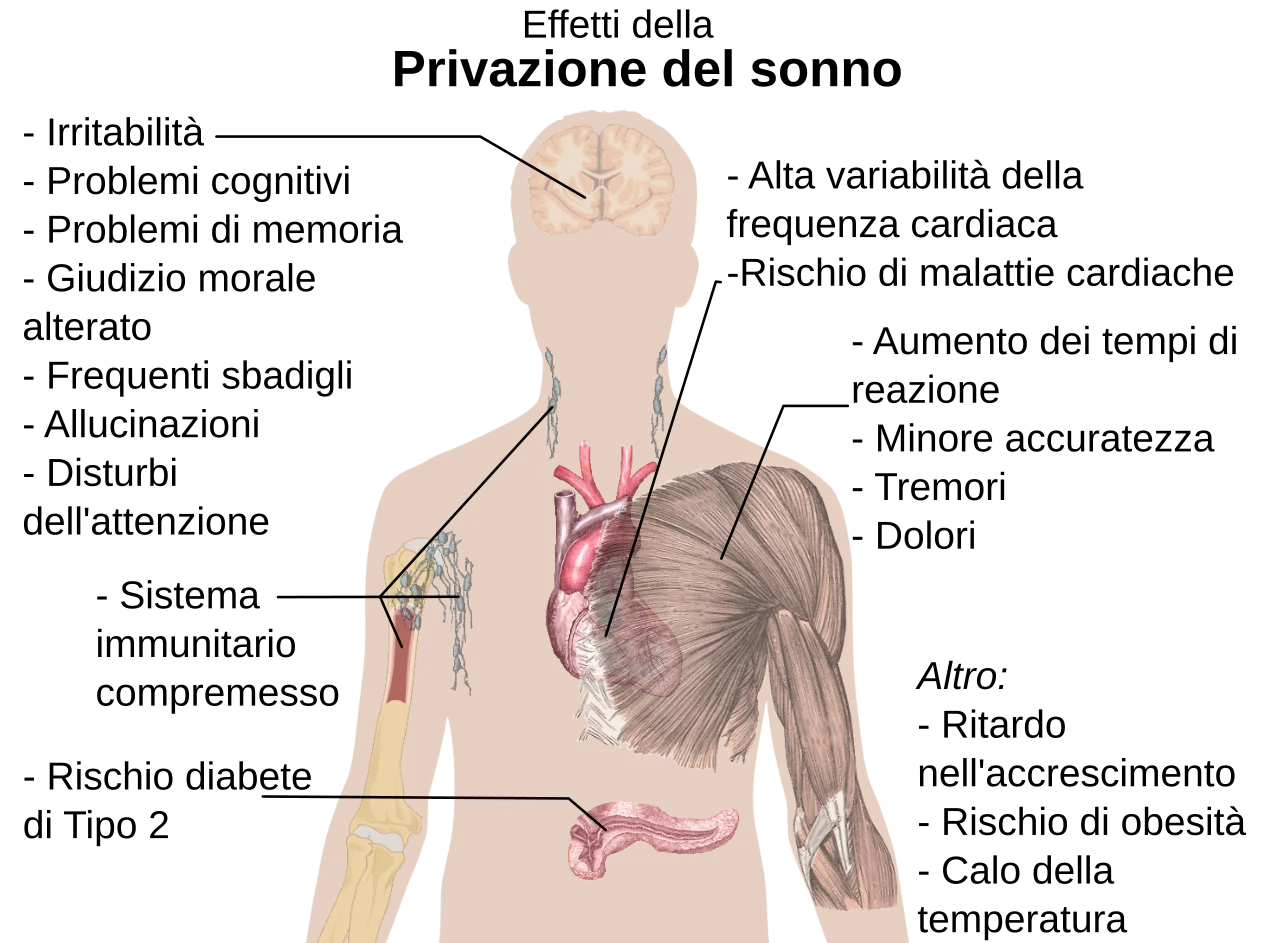
Insufficient sleep accumulates as a biological burden that can impair attention, reaction time, emotional control, immunity, metabolism, and cardiovascular health. The effects of sleep deprivation are especially risky because people often adapt to feeling impaired without recovering objective performance. Caffeine masks sleep pressure rather than removing it, and short recovery periods may not fully reverse chronic restriction.
Sleep deprivation is the condition of not obtaining adequate sleep, either acutely (staying awake for extended periods) or chronically (consistently sleeping fewer hours than the body requires).
When you do not sleep, your brain accumulates neurotoxic waste, your immune system weakens, your emotional regulation deteriorates, your metabolism shifts toward insulin resistance, and your cardiovascular risk climbs measurably - all within days.
The effects are cumulative, and the most dangerous aspect is that the chronically sleep-deprived lose the ability to perceive their own impairment.
In 1965, a 17-year-old high school student named Randy Gardner stayed awake for 11 days and 25 minutes - 264.4 hours - to win a science fair competition in San Diego. By day four he was hallucinating, seeing a road sign as a person. By day six he was slurring his speech and experiencing paranoia.
William Dement, the Stanford sleep researcher monitoring the experiment, described him as awake but displaying features of delirium. Gardner recovered fully after sleeping for 14 hours and 40 minutes.
His experiment became famous partly because he survived relatively intact - but also because ethics boards subsequently made it progressively harder to repeat. Modern human sleep deprivation studies are limited to a few days maximum; beyond that, the documented neurological and physiological damage raises serious consent issues.
What happens in the extremes matters less, however, than what happens in the mundane middle: the 30-50% of adults in developed countries who chronically sleep five to six hours per night instead of the seven to nine their biology requires.
According to the Centers for Disease Control and Prevention (CDC), one in three American adults does not get enough sleep on a regular basis.
For this majority, the harms are cumulative, measurable, and largely invisible - the chronically sleep-deprived do not experience themselves as impaired because they have adapted to impairment and no longer have a baseline for comparison.
Sleep neuroscientist Matthew Walker of the University of California, Berkeley, summarizes the situation with disarming bluntness: "Every major disease killing people in developed nations - Alzheimer's, cancer, obesity, diabetes, anxiety, depression - all of them have causal relationships with insufficient sleep."
"Sleep is the single most effective thing we can do to reset our brain and body health each day - Mother Nature's best effort yet at contra-death." - Matthew Walker, Why We Sleep (2017)
Key Definitions
Sleep debt is the cumulative deficit between sleep obtained and sleep needed. Whether sleep debt is fully recoverable via catch-up sleep or produces lasting damage remains debated. Evidence from Depner et al.
(2019) suggests that acute sleep debt can be partially resolved but that chronic sleep restriction produces lasting cognitive and metabolic impairment not fully reversed by short periods of recovery sleep.
Homeostatic sleep pressure (Process S) refers to the progressive build-up of adenosine and other sleep-promoting substances during wakefulness that creates increasing pressure to sleep. The longer you remain awake, the stronger the homeostatic sleep drive becomes.
Coffee works by blocking adenosine receptors - it does not remove the accumulated adenosine; it merely masks the signal. When caffeine's effects wear off, the accumulated adenosine produces the familiar "crash."
Circadian rhythm is the approximately 24-hour biological clock governed by the suprachiasmatic nucleus (SCN) in the hypothalamus. It orchestrates the timing of virtually all physiological processes: hormone release, metabolism, immune function, body temperature, and sleep.
Chronic sleep deprivation often disrupts circadian alignment, compounding the direct effects of insufficient sleep.
Social jetlag describes the mismatch between social schedules (work, school) and biological chronotype (natural sleep timing). People whose natural sleep onset is 1-2am but who must wake at 6am experience chronic social jetlag - equivalent to crossing time zones every week.
Research by Till Roenneberg at Ludwig Maximilian University of Munich (2012) demonstrated that social jetlag independently predicts metabolic disease, mood disorders, and cognitive impairment.
Glymphatic system is the brain's waste-clearance system, primarily active during slow-wave sleep. Cerebrospinal fluid flushes through perivascular channels surrounding arteries, sweeping interstitial waste products - including amyloid-beta and tau - into the venous drainage.
Research led by Maiken Nedergaard at the University of Rochester (2013) showed that glymphatic clearance is 10-60 times more active during sleep than wakefulness. Sleep deprivation impairs this clearance, leading to accumulation of neurotoxic waste products.
REM rebound is the phenomenon by which total nightly REM sleep increases after periods of REM deprivation, as the brain attempts to recover lost REM.
REM rebound is particularly pronounced after alcohol-disrupted sleep (alcohol suppresses REM in the first half of the night; REM rebounds intensely in the second half, often producing vivid, disturbing dreams) and after certain medications including SSRIs.
Psychomotor vigilance task (PVT) is a standard test of sustained attention widely used in sleep deprivation research: subjects press a button when a counter appears and are scored on reaction time and lapses.
PVT performance degrades predictably with sleep loss and does not show significant tolerance over days of restriction - the person performs worse each day, even while feeling they have adapted.
Cognitive and Neurological Effects
Attention and Reaction Time
The most immediately apparent cognitive effect of sleep deprivation is degraded sustained attention and reaction time.
Research by Dawson and Reid (1997) at the University of South Australia established that after 17 hours without sleep, psychomotor vigilance task performance is equivalent to a blood alcohol level of 0.05%. After 24 hours, it equals 0.10% - legally drunk in every jurisdiction.
Critically, subjective sleepiness (how tired you feel) diverges from objective performance after several days of restriction.
In the landmark studies by Van Dongen et al. (2003), published in Sleep, subjects restricted to six hours of sleep per night for two weeks showed progressive deterioration in attention, working memory, and reaction time - similar to subjects who had been awake for 24 hours straight.
But the six-hour subjects reported minimal sleepiness by day 12; they had adapted to the feeling of impairment while their actual performance continued to decline.
This is why "I feel fine on five hours" is almost never accurate. You feel adapted to impairment, not genuinely unimpaired. The National Sleep Foundation estimates that well under 1% of the population carries a genetic variant of the DEC2 gene that permits genuine function on six hours or less.
The Prefrontal Cortex Disconnects
The prefrontal cortex (PFC) - governing executive function, rational decision-making, impulse control, and working memory - is disproportionately sensitive to sleep loss.
Neuroimaging studies by Yoo et al. (2007) at Harvard Medical School showed reduced prefrontal glucose metabolism and activity after sleep deprivation while emotional-reactivity circuits in the amygdala showed increased responsiveness of approximately 60%.
The practical consequences are severe:
- Impaired judgment and risk assessment (sleep-deprived people rate risky decisions as less risky)
- Reduced impulse control (increased tendency toward immediate reward, impulsive behavior)
- Impaired working memory (holding multiple pieces of information in mind simultaneously)
- Slower and less flexible thinking
- Reduced creativity and insight
Studies of medical errors provide a sobering real-world consequence: research by Landrigan et al. (2004), published in the New England Journal of Medicine, found that medical interns working extended shifts of 24 hours or more made 36% more serious medical errors and 460% more diagnostic errors than those working shorter shifts.
The FAA's pilot rest requirements, truckers' logbook hours, and medical resident work-hour restrictions all address the same underlying biology.
Memory Consolidation Failure
Memory consolidation requires sleep. The mechanisms are specific to different memory types:
- Declarative memory (facts, events) consolidates during slow-wave sleep via hippocampal-neocortical dialogue
- Procedural and motor memory consolidates during NREM stage 2 (sleep spindles)
- Emotional memory processing occurs during REM sleep
Students who stay up all night before an exam are preventing the consolidation of everything they studied the previous days. The studying creates new hippocampal encodings that require sleep to transfer to long-term cortical storage. The all-nighter depletes the very sleep that would have consolidated everything.
This is not a marginal effect. Walker's research at UC Berkeley showed that sleep after learning improves recall by 20-40% compared to equivalent wakefulness after learning.
A 2014 study by Rasch and Born, published in Physiological Reviews, confirmed that sleep-dependent memory consolidation is a universal biological mechanism, not an artifact of reduced interference during sleep.
Emotional Regulation
Sleep deprivation produces a characteristic emotional signature: increased negative affect, increased irritability, reduced tolerance for frustration, and reduced prosocial behavior. The mechanism is the PFC-amygdala disconnection described above.
Walker's neuroimaging research found 60% greater amygdala reactivity to negative emotional stimuli in sleep-deprived subjects compared to rested controls.
The "emotional escalation" response - where minor frustrations produce disproportionate reactions - is a direct neurological consequence of sleep deprivation, not a personal failing.
Sleep-deprived people also show impaired ability to accurately read facial emotions, particularly subtle emotional expressions and threatening faces.
Research by Goldstein-Piekarski et al. (2015) demonstrated that the sleep-deprived brain is simultaneously more reactive to negative stimuli and less accurate in interpreting them - a dangerous combination for interpersonal functioning, workplace relationships, and parenting.
Physical Health Effects
Cardiovascular Disease
Epidemiological studies consistently find that sleeping less than six hours per night is associated with significantly increased cardiovascular disease risk:
- A meta-analysis by Cappuccio et al. (2010), published in Sleep and covering 1.3 million participants across 16 studies, found short sleep associated with 48% increased risk of coronary heart disease and 15% increased risk of stroke
- A 2019 study in the Journal of the American College of Cardiology by Dominguez et al. found that sleeping fewer than six hours increased atherosclerosis risk by 27% compared to those sleeping seven to eight hours
- Short sleepers have higher resting blood pressure, higher resting heart rate, and less heart rate variability - all established cardiovascular risk markers
- Inflammatory markers (C-reactive protein, IL-6) are elevated in chronic short sleepers, contributing to arterial plaque development
The mechanisms are well-documented: sleep deprivation activates the sympathetic nervous system, raising blood pressure and heart rate; increases cortisol (pro-inflammatory and pro-hypertensive); reduces growth hormone (which is anti-atherosclerotic); and impairs endothelial function (the arterial lining's ability to dilate appropriately).
A striking natural experiment occurs every spring: the Monday after the shift to daylight saving time, when most people lose one hour of sleep, sees a 24% increase in heart attacks according to a 2014 study in Open Heart by Sandhu et al. The autumn shift, when an hour is gained, shows a corresponding decrease.
Metabolic Disease and Obesity
Two nights of sleep restriction to four hours produces measurable metabolic impairment:
Hormonal dysregulation: Sleep deprivation increases ghrelin (the "hunger hormone" that promotes appetite) and decreases leptin (the satiety hormone that signals fullness), producing increased appetite, particularly for calorie-dense, high-carbohydrate foods.
Research by Taheri et al. (2004) in the Wisconsin Sleep Cohort Study found that participants sleeping five hours had 14.9% higher ghrelin and 15.5% lower leptin than those sleeping eight hours.
Insulin resistance: Restricted sleep increases insulin resistance within days. Spiegel et al. (1999), in a landmark study published in The Lancet, showed that six days of four-hour sleep produced a state of glucose regulation resembling prediabetes in young, healthy men.
After recovery sleep, glucose tolerance normalized - but the finding demonstrates how rapidly sleep restriction impairs metabolic function.
Weight gain: Studies restricting sleep in controlled conditions show increased caloric intake of 300-400 kcal/day over rested controls, driven by increased appetite and greater consumption of late-night snacking. Combined with reduced physical activity (tired people move less), chronic sleep restriction is a direct driver of weight gain.
Epidemiological data show a clear dose-response relationship: sleep duration below six hours is associated with 30% higher obesity prevalence.
Immune Suppression
Sleep deprivation directly impairs every branch of immunity measured:
- NK cell activity: reduced up to 70% after one night of sleep deprivation (Irwin et al., 1996)
- Vaccine antibody responses: halved in sleep-deprived subjects (Spiegel et al., 2002)
- Cold susceptibility: 4.2 times higher with fewer than six hours versus seven or more hours (Prather et al., 2015, Sleep)
- T cell function: impaired by sleep deprivation through reduced integrin activation (Dimitrov et al., 2019)
- Inflammatory balance: disrupted toward a pro-inflammatory state
For a deeper exploration of how the immune system functions, see how the immune system works.
Alzheimer's Disease Risk
The glymphatic connection is the most mechanistically compelling link between sleep and neurodegeneration.
Amyloid-beta peptides, produced normally by synaptic activity, accumulate in the interstitial space during wakefulness. During deep sleep, glymphatic flow clears these peptides.
Sleep deprivation impairs this clearance: one night of acute sleep deprivation increases amyloid-beta concentrations in human cerebrospinal fluid by approximately 25-30% (Shokri-Kojori et al., 2018, Proceedings of the National Academy of Sciences).
Chronic sleep deprivation would theoretically produce chronic amyloid accumulation - a direct contribution to the pathological deposits (amyloid plaques) characteristic of Alzheimer's disease. This mechanism may explain why:
- Epidemiological studies find 30-40% higher dementia risk in chronic short sleepers
- Midlife sleep disorders (particularly obstructive sleep apnea) predict later Alzheimer's diagnosis
- Alzheimer's patients show glymphatic dysfunction and amyloid accumulation decades before symptoms appear
The directionality is partially bidirectional (Alzheimer's also disrupts sleep architecture), but the mechanistic case for sleep deprivation contributing to Alzheimer's pathology is strong and growing. For related reading on how the brain processes information, see how memory works.
Sleep Deprivation Effects by Duration
| Duration Without Sleep | Equivalent BAC | Key Effects |
|---|---|---|
| 17-18 hours | 0.05% | Impaired judgment, attention lapses, reduced reaction time |
| 20-21 hours | 0.08% | Performance at legal DUI limit in most US states |
| 24 hours | 0.10% | Severely impaired cognition, hallucination onset possible |
| 36 hours | - | Emotional instability, microsleeps, significant perceptual distortions |
| 48 hours | - | Psychosis-like symptoms, paranoia, severe motor impairment |
| 72+ hours | - | Hallucinations, delusions, extreme neurological impairment |
| Chronic 6 hrs/night x 14 days | 0.10% equivalent | Same cognitive deficit as 24hr acute deprivation, but unrecognized by the person |
The Social Jetlag Problem
For millions of workers and students, the problem is not inability to sleep but schedule misalignment. Natural chronotype - the timing of biological sleep propensity - varies widely and is substantially genetic: approximately 25% of people are morning chronotypes (larks), 25% are evening chronotypes (owls), and 50% are intermediate.
School start times (typically 7-8am) and standard work hours (typically 8-9am start) are systematically misaligned with adolescent and evening chronotype biology.
Adolescent circadian rhythms shift approximately two to three hours later at puberty - a feature of normal neurodevelopment documented by Mary Carskadon at Brown University, not a behavioral choice.
A teenage owl forced to wake at 6am for school is experiencing the biological equivalent of a 3am wake-up for an extreme morning type.
Studies of school start time changes show dramatic effects: when Seattle high schools shifted start time from 7:50am to 8:45am in the 2016-2017 school year, a study by Dunster et al. (2018) published in Science Advances found that average sleep duration increased by 34 minutes and median grade point average rose by 4.5%.
Attendance improved, tardiness fell, and student-reported mental health improved. The American Academy of Pediatrics recommends middle and high school start times no earlier than 8:30am - a recommendation that, as of 2022, California became the first US state to mandate by law.
Understanding how biases form can help explain why societies have been slow to act on clear evidence about sleep timing despite decades of research.
Can You Catch Up on Lost Sleep?
The appealing concept of "banking" sleep or fully paying off a sleep debt via weekend catch-up is not supported by biology.
A 2019 study by Depner et al., published in Current Biology, found that weekend recovery sleep restored some metabolic markers (caloric intake returned toward normal) but did not reverse the cognitive deficits accumulated during weekday restriction, and the weight gain from weekday restriction was not reversed by weekend sleep.
Perhaps most troublingly, participants who attempted weekend recovery and then returned to restricted sleep showed even worse metabolic outcomes than those who were continuously restricted - suggesting that the sleep-wake cycling pattern itself may cause additional harm.
More importantly, irregular sleep timing - different sleep and wake times on weekdays versus weekends, known as social jetlag - is itself a health risk independent of total sleep amount.
Research by Wittmann et al. (2006) demonstrated that each hour of social jetlag is associated with approximately 11-16% increased risk of metabolic syndrome.
"The brain keeps a precise ledger of sleep debt, even when the person is unaware of the balance. You cannot negotiate with that ledger by thinking positive thoughts or drinking coffee. You can only pay it with sleep." - Charles Czeisler, Harvard Medical School (various public statements, 2011-2019)
The prescription from sleep science is consistent: adequate nightly sleep (seven to nine hours), at regular times, in a dark cool environment, without alcohol or late caffeine. This is simple advice; it is also in fundamental conflict with how most modern people live.
Practical Steps to Protect Sleep
- Set a consistent wake time and protect it even on weekends - circadian consistency matters as much as duration. Research shows that regularity of sleep timing is an independent predictor of mortality risk (Windred et al., 2024, Sleep).
- Keep the bedroom cool (around 18 degrees Celsius / 65 degrees Fahrenheit) - core body temperature must drop by one to two degrees to initiate and maintain sleep.
- Avoid screens for 60-90 minutes before bed - blue light suppresses melatonin secretion by up to 50%, according to research from Harvard Medical School.
- Stop caffeine 8-10 hours before bed - caffeine's half-life is approximately five to seven hours; a 3pm coffee leaves meaningful caffeine in your system at 10pm.
- Avoid alcohol close to bedtime - alcohol suppresses REM sleep and causes fragmented, non-restorative sleep in the second half of the night. For more on alcohol's neurological effects, see how alcohol affects the brain.
- Create a brief wind-down ritual - the same sequence of activities signals the brain that sleep is approaching and engages the parasympathetic nervous system.
- Get morning sunlight exposure - 10-15 minutes of bright light within the first hour of waking helps anchor circadian rhythm and improves nighttime sleep onset.
For related concepts, see how sleep works and why we procrastinate.
Sources & Further Reading
- Walker, M. (2017). Why We Sleep: Unlocking the Power of Sleep and Dreams. Scribner. View source
- Van Dongen, H. P. A., Maislin, G., Mullington, J. M., & Dinges, D. F. (2003). The Cumulative Cost of Additional Wakefulness. Sleep, 26(2), 117-126. DOI: 10.1093/sleep/26.2.117
- Cappuccio, F. P., et al. (2010). Sleep Duration and All-Cause Mortality: A Systematic Review and Meta-Analysis. Sleep, 33(5), 585-592. DOI: 10.1093/sleep/33.5.585
- Prather, A. A., Janicki-Deverts, D., Hall, M. H., & Cohen, S. (2015). Behaviorally Assessed Sleep and Susceptibility to the Common Cold. Sleep, 38(9), 1353-1359. DOI: 10.5665/sleep.4968
- Spiegel, K., Leproult, R., & Van Cauter, E. (1999). Impact of Sleep Debt on Metabolic and Endocrine Function. Lancet, 354(9188), 1435-1439. DOI: 10.1016/S0140-6736(99)01376-8
- Depner, C. M., et al. (2019). Ad Libitum Weekend Recovery Sleep Fails to Prevent Metabolic Dysregulation. Current Biology, 29(6), 957-967. DOI: 10.1016/j.cub.2019.01.069
- Shokri-Kojori, E., et al. (2018). Beta-Amyloid Accumulation in the Human Brain After One Night of Sleep Deprivation. Proceedings of the National Academy of Sciences, 115(17), 4483-4488. DOI: 10.1073/pnas.1721694115
- Landrigan, C. P., et al. (2004). Effect of Reducing Interns' Work Hours on Serious Medical Errors. New England Journal of Medicine, 351(18), 1838-1848. DOI: 10.1056/NEJMoa041406
- Dunster, G. P., et al. (2018). Sleepmore in Seattle: Later School Start Times Are Associated with More Sleep and Better Performance. Science Advances, 4(12), eaau6200. DOI: 10.1126/sciadv.aau6200
- Xie, L., et al. (2013). Sleep Drives Metabolite Clearance from the Adult Brain. Science, 342(6156), 373-377. DOI: 10.1126/science.1241224
- Dawson, D., & Reid, K. (1997). Fatigue, Alcohol, and Performance Impairment. Nature, 388, 235. DOI: 10.1038/40775
Health note: This article is general educational information about how a topic works, not medical, psychological, or mental-health advice, diagnosis, or treatment. Everyone's situation is different, and research findings describe groups, not individuals.
If you are struggling or have concerns about your health, please talk to a qualified professional such as a doctor or licensed therapist.
If you are in crisis or thinking about harming yourself, contact your local emergency services or a crisis line right away, in the US you can call or text 988 (Suicide & Crisis Lifeline); elsewhere, find local lines at findahelpline.com.