
Setting: In the summer of 1968, Edwin Locke published a paper in the journal Organizational Behavior and Human Performance that would become one of the most cited works in applied psychology.[1] The study had roots in a deceptively mundane question: do workers produce more when they know exactly what they are trying to achieve?
Locke had spent the early 1960s reviewing several decades of industrial research - time-and-motion studies, production records from manufacturing plants, logging operations in the Pacific Northwest - and noticed a pattern that the field had largely overlooked.
Workers who had been assigned specific production quotas consistently outperformed workers who had been told only to "do their best." The effect was not small and not confined to routine tasks. It showed up in laboratory studies, field experiments, and archival production data across industries.
In "Toward a Theory of Task Motivation and Incentives," Locke proposed that this pattern had a common cause: the cognitive and motivational effects of specific, challenging goals.
The logging industry provided some of the starkest early evidence. In a study conducted with J. Bryan in 1966 and later extended in Latham and Baldes's landmark 1975 field experiment, Locke's framework was tested in conditions that could not be more removed from a university laboratory.
Truck drivers hauling timber in the American South were routinely loading below the legal weight limit, and nobody was pushing them to fill the trucks, which was quietly costing the company money. Latham and Baldes gave the drivers one specific, challenging goal: load to 94% of the legal maximum.[4] There was no bonus attached and no training on how to load more efficiently, yet load weights climbed toward the target within weeks and stayed there, while a control group given no specific number showed no change at all.
By the researchers' own calculation the company saved around 250,000 dollars in the first nine months, roughly the cost of several new trucks, for nothing more than stating a clear number. The conclusion was almost uncomfortably simple: people who knew exactly what success looked like performed better than people who did not.
Locke spent the next two decades turning that observation into a full theory, and with Gary Latham built what became the most empirically supported account of work motivation in organizational psychology.[2]
Their 1990 book A Theory of Goal Setting and Task Performance (Prentice-Hall) synthesized more than 400 studies conducted over 25 years and proposed a comprehensive theoretical architecture: five principles governing when goals work, four psychological mechanisms through which they work, and a set of moderating conditions that determine how reliably the effect appears.
In 2002, Locke and Latham published a retrospective in American Psychologist reviewing 35 years of research, by which point the database comprised hundreds of laboratory and field studies across dozens of countries, task types, and populations, with effect sizes large enough to make goal-setting one of the most robust interventions in behavioral science.[3]
The question was no longer whether specific, challenging goals improved performance. The question was why, when, and at what cost.
"Specific, difficult goals consistently lead to higher performance than vague or easy goals." - Edwin Locke & Gary Latham, 1990
Comparing Goal Types: What the Evidence Shows
| Goal Type | Performance Outcome | Primary Mechanism | Key Moderators | Risks |
|---|---|---|---|---|
| Specific and difficult | Highest performance; effect sizes typically d = 0.5-0.8 | Directs attention, energizes effort, increases persistence, motivates strategy development | Task complexity, commitment, feedback availability, knowledge and ability | Tunnel vision, unethical behavior, undermining of learning |
| Specific and easy | Moderate performance; often underperforms "do your best" on complex tasks | Attention directed but effort not energized; ceiling effect reached quickly | Task complexity | Habituation, reduced motivation after goal is met |
| Vague ("do your best") | Lowest and most variable performance; psychologically equivalent to no goal | No clear attention direction; effort self-regulated without anchor | Intrinsic motivation level | Inconsistency; no baseline for accountability |
| Learning goal (process-focused) | Highest performance on novel or complex tasks requiring skill development | Directs attention toward strategy acquisition rather than outcome achievement | Task novelty, prior knowledge, cognitive load | May reduce urgency when outcomes matter |
| Performance goal (outcome-focused) | Highest performance on well-learned tasks; can undermine performance on novel tasks | Energizes effort toward defined outcome; may suppress exploration | Skill level, task familiarity | Cognitive rigidity, ethical violations, learning suppression |
The Five Principles and Four Mechanisms
Locke and Latham's 1990 synthesis organized the theory around five conditions that determine whether a goal actually works. Clarity comes first: the goal has to be precise enough that the person pursuing it knows at any given moment whether they are on track. "Increase customer satisfaction" does not pass that test, but "achieve a customer satisfaction score of 4.5 or above by the end of Q3" does.
Challenge matters just as much. Goals need to stretch current performance, and the relationship between difficulty and performance turns out to be nearly linear right up to the limits of someone's ability, so a harder goal tends to produce a better outcome as long as the person has the competence to chase it. Commitment is where a lot of goal-setting efforts quietly fail: a goal handed down without real buy-in, or one that feels illegitimate or impossible, delivers none of the usual motivational benefits, while participation, a clear rationale, and building up someone's self-efficacy all help it land.
Then there is feedback. Performers need to keep hearing how they are doing relative to the goal, because without that feedback the effect weakens substantially; the goal supplies direction, but it cannot supply calibration on its own. Finally, task complexity sets a real limit on all of this: goal-setting works best on tasks people already understand well, and gets weaker, sometimes even counterproductive, on novel or complex work that still requires building new skill, a nuance that later critics of the theory would push hard on.
Goals seem to do their work through four overlapping routes. The most obvious is attention: a goal filters out what is irrelevant and keeps behavior pointed at what matters. It also energizes effort, since experiments consistently find people pushing harder, physically and mentally, on a difficult goal than an easy one, and it extends persistence, keeping people working through obstacles that would otherwise stop them.
Less obviously, a clear goal pushes people toward developing better strategies: when the obvious approach is not working, someone with a specific target in mind tends to go looking for a better method, where someone without one has less reason to bother. None of this requires a deliberate decision to concentrate harder or try longer.
Most of the prioritizing happens automatically once the goal is in place.
The Cognitive Science of Goal Setting
The Role of Self-Efficacy: Albert Bandura
The most important complement to Locke and Latham's goal-setting theory came from Albert Bandura at Stanford, whose social cognitive theory introduced self-efficacy - the person's belief in their capacity to achieve a specific goal - as a critical mediating variable.
In his 1986 book Social Foundations of Thought and Action (Prentice-Hall) and in a series of experimental papers through the 1980s and 1990s, Bandura demonstrated that high goals paired with low self-efficacy produced anxiety and avoidance rather than increased effort.
The goal provides direction; self-efficacy determines whether that direction generates approach or withdrawal.
In a direct exchange published in Organizational Behavior and Human Decision Processes (1994), Locke and Latham integrated self-efficacy into their framework as a key moderator: specific, challenging goals raise performance partly by raising self-efficacy through the intermediate experience of progress.
Learning Goals vs. Performance Goals: Seijts and Latham
A critical refinement came from Gerard Seijts and Gary Latham's 2001 paper "The Effect of Learning, Outcome, and Proximal Goals on a Moderately Complex Task" in the Journal of Organizational Behavior (22, 291-307).
Drawing on Carol Dweck's earlier distinction between mastery and performance orientations, Seijts and Latham demonstrated experimentally that on tasks requiring complex skill development, assigning a learning goal - focused on the acquisition of strategies and knowledge - produced superior performance to assigning an equivalent performance goal focused on outcome achievement.[5]
The explanation was cognitive: when people are still learning how to do something, fixating on an outcome target consumes working memory resources that would be better spent on strategy exploration.
A novice surgeon told "you must complete this procedure in under 40 minutes" performs worse than a novice told "identify three new techniques for increasing efficiency." Once competence is established, the asymmetry reverses: on practiced tasks, outcome goals outperform learning goals by directing effort without leaving attention space for unnecessary cognitive exploration.
This finding refined the theory in a clinically important direction. Goal-setting theory had been built primarily on studies of well-learned tasks (production quotas, typing speed, simulated management games with repeated trials).
Seijts and Latham's work identified a boundary condition: the efficacy of performance goals is contingent on the performer already possessing the relevant competence.
Applied without this nuance, the theory can actively harm performance on complex, novel tasks - a finding that Ordóñez and colleagues would later implicate in real-world organizational disasters.
The Dweck-Locke Debate on Intrinsic Motivation
The most intellectually contested domain in goal-setting research has been the relationship between goals and intrinsic motivation.
Edward Deci's research program at the University of Rochester, beginning with his 1971 paper "Effects of Externally Mediated Rewards on Intrinsic Motivation" in the Journal of Personality and Social Psychology (18, 105-115), established the undermining effect: extrinsic rewards imposed on intrinsically interesting activities reduced subsequent intrinsic motivation, a finding that generated hundreds of replications and formed the empirical foundation of self-determination theory.[12]
Locke argued consistently and forcefully that this finding was empirically overstated and theoretically confused.
Locke pushed back in a 2002 exchange in Psychological Science, arguing the undermining effect only applied to tangible rewards handed out regardless of performance, not to the kind of performance-contingent feedback that goal-setting actually relies on in organizations. The disagreement never really settled.
Meta-analyses by Cameron and Pierce (1994) and by Deci, Koestner, and Ryan (1999) drew on overlapping data and still reached nearly opposite conclusions, mostly because they disagreed on which studies to include and how to code them. What that leaves practitioners with is a real, if modest, risk: a performance goal attached to a task someone already finds interesting can chip away at their autonomous motivation, which is part of why well-designed goal frameworks build in autonomy support and participation rather than imposing a target from outside.
Four Named Case Studies
Case Study 1: Latham and Baldes (1975) - The Logging Trucks
Gary Latham and J. J. Baldes published their results as "The 'Practical Significance' of Locke's Theory of Goal Setting" in the Journal of Applied Psychology (60, 122-124) in 1975. What makes the study worth naming is not just the result but where it happened: a real industrial operation, not a lab.
Drivers were given one specific, challenging goal, loading their trucks to 94% of the legal capacity limit, with no financial incentive attached, no new equipment, and no training. The behavior changed because the drivers now knew exactly what counted as success, and got feedback on how close they were getting to it.
Load efficiency climbed toward the target and stayed there for the full nine months the researchers kept watching. It became one of the clearest demonstrations that Locke's framework actually worked outside a lab, which is a large part of why goal-setting theory ended up taken seriously by industry rather than filed away as an academic curiosity.
Case Study 2: Erez and Arad (1986) - Participative Goal-Setting Across Cultures
Miriam Erez at the Technion and Revital Arad took the question somewhere Locke and Latham had not: does it matter whether a goal is handed down by a manager or worked out together with the person who has to meet it? They published their findings, "Participative Goal-Setting: Social, Motivational, and Cognitive Factors," in the Journal of Applied Psychology (71, 591-597) in 1986, based on a systematic research program conducted in Israel.[9]
The real driver, it turned out, was not whether a goal was assigned or set jointly but whether it was accepted, and how readily it was accepted depended on the surrounding culture. Erez kept finding the same split: in workplaces built around steep hierarchies, employees treated a goal handed down by a manager as legitimate in its own right, and it worked about as well as one they had helped set themselves.
Flip to a more egalitarian workplace and that stopped holding. There, giving people a say in setting the goal was what pushed commitment and performance above what an assigned target achieved on its own.
That gap is why cultural variation became a serious moderator in the theory rather than a footnote. Goal-setting's prescriptions were never as culturally universal as the early industrial studies implied, and companies that rolled out goal-setting programs without paying attention to power distance, collectivism, or local norms around legitimacy got weaker results for it. Erez's work was among the first to treat that cultural context as something the theory needed to explain, rather than noise to average away.
Case Study 3: Ordóñez, Schweitzer, Galinsky, and Bazerman (2009) - Goals Gone Wild
Lisa Ordóñez, Maurice Schweitzer, Adam Galinsky, and Max Bazerman published "Goals Gone Wild: The Systematic Side Effects of Over-Prescribing Goal Setting" in the Academy of Management Perspectives (23, 6-16) in 2009.
The paper represented the most systematic critique of goal-setting theory's uncritical application and provoked a published exchange with Locke and Latham in the same journal.
Ordóñez and colleagues catalogued a set of real corporate failures they traced back, in part, to goal-setting gone wrong.[6] Enron is the starkest case: aggressive quarterly earnings targets put enough pressure on managers that fraud and off-balance-sheet accounting started to look like rational responses to a specific, challenging goal that had drifted away from the firm's actual interests. Ford's Pinto is the other example people reach for.
Lee Iacocca set his engineers a specific, challenging target, a car under 2,000 pounds and under 2,000 dollars by 1970, and that goal compressed the safety testing window enough to contribute to Ford releasing a car with a known fuel-tank vulnerability. Sears Automotive Centers gives a third version of the same pattern: specific sales quotas for repairs the cars did not actually need produced widespread customer fraud in the early 1990s.
Ordóñez and colleagues argued the goal-setting literature had systematically underweighted side effects like these, mostly because the lab studies it relied on used tasks with no room for an unethical shortcut and could not reproduce what happens when goal pressure meets competitive incentives, thin monitoring, and an employee who feels cornered. Locke and Latham's published response granted that ethics and alignment mattered, but held the line that these were failures of implementation, not a refutation of the theory itself.
Case Study 4: Stajkovic and Luthans (1998) - Goal-Setting and Social Cognitive Theory in Organizations
Alexander Stajkovic and Fred Luthans pooled 114 studies for their 1998 paper, "Self-Efficacy and Work-Related Performance: A Meta-Analysis," published in Psychological Bulletin (124, 240-261), and came out with a mean weighted correlation of r = 0.38 between self-efficacy and work performance, a large effect by the standards of organizational psychology.[8] What makes the analysis useful here is how self-efficacy and goal-setting interacted rather than just competed: each predicted performance on its own, but put together their effect was bigger than either one alone would suggest.
A worker with high self-efficacy and a specific, challenging goal outperformed a worker with only one of those two conditions, by more than either factor's individual effect could explain. That fits an integrated picture where the goal supplies direction and self-efficacy supplies the energy to keep pursuing it, which lines up with how Locke and Latham folded Bandura's construct into their own theory in 1990.
Intellectual Lineage: Who Influenced Whom
Goal-setting theory's intellectual genealogy is unusual in organizational psychology because Locke was explicit about his theoretical debts and equally explicit about his theoretical disagreements - both with predecessors and contemporaries.
The most direct influence was Frederick Winslow Taylor, whose scientific management program in the early twentieth century had established the principle that specific production standards improved output.
Taylor's time-and-motion studies were empirically crude by modern standards, but they contained the observation that workers without explicit targets performed below their actual capacity - what Taylor called "soldiering." Locke rehabilitated this observation within a cognitive framework, explaining the mechanism (not just the effect) through which specific standards alter behavior.
Kurt Lewin's field theory and level-of-aspiration research in the 1930s and 1940s at the University of Berlin and later at MIT provided the most direct cognitive precursor. Lewin, Tamara Dembo, Leon Festinger, and Pauline Sears published "Level of Aspiration" in J.
McV. Hunt's Personality and the Behavior Disorders (1944), documenting that people set goals just above their current performance level, that reaching a goal triggered a new, higher aspiration, and that the gap between current performance and goal level determined motivational tension.
Locke's "goal-performance discrepancy" concept is Lewin's aspiration-performance gap restated in more precise, behaviorally measurable terms.
Ryan's earlier work on intentions in the 1970s provided Locke with the immediate cognitive concept: intentions - the cognitive representations of what one is trying to achieve - translated motivational states into behavior.
Locke argued that goals function as intentions and that the specificity of an intention determines its behavioral force.
This positioned goal-setting theory within the broader cognitive revolution in psychology, distinguishing it from purely behaviorist accounts of work motivation.
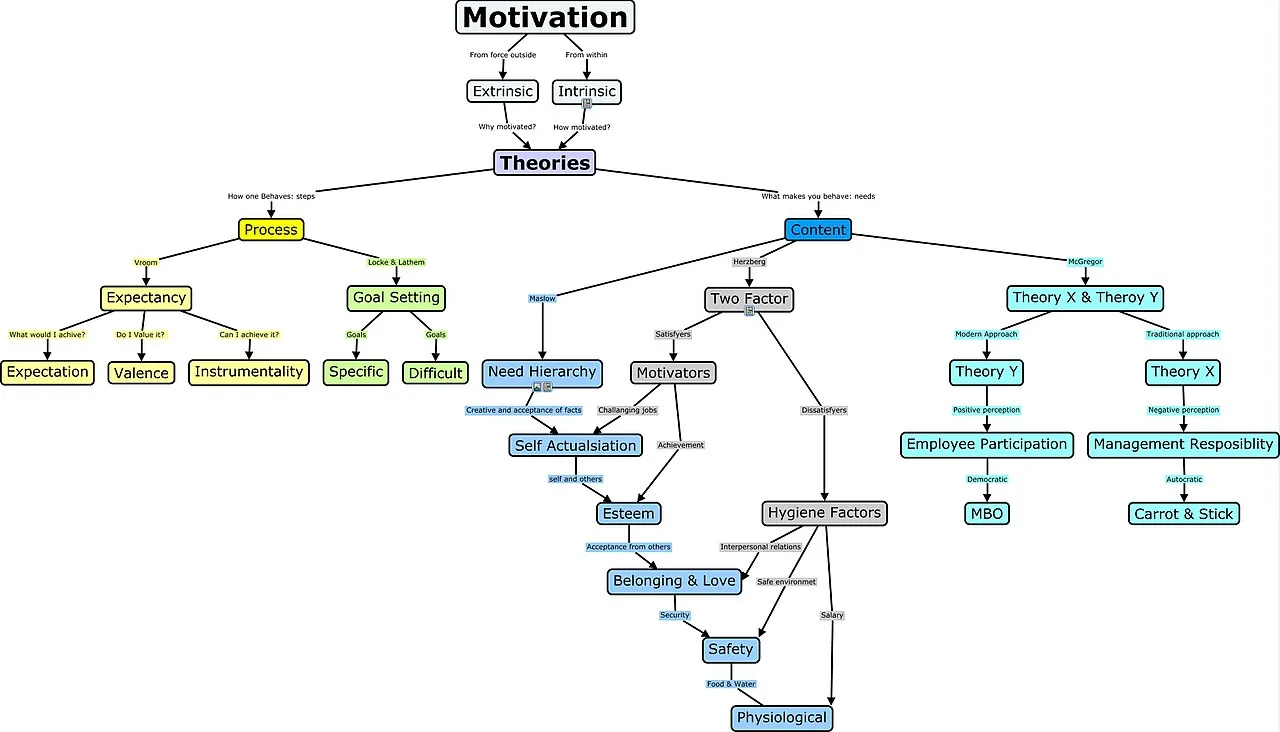
Victor Vroom's expectancy theory (1964) is the framework Locke's own theory both drew on and pushed back against. Vroom's version held that motivation came down to a kind of calculation: how much a person believed effort would lead to performance, how much they believed performance would lead to an outcome, and how much they valued that outcome.
Locke accepted that the first of these, expectancy, mattered, and it maps fairly directly onto what Bandura would later call self-efficacy, but he thought Vroom's model asked too much of real-time cognition: people are not running a probability calculation in their heads moment to moment. A goal does the same motivational work more simply, giving behavior a clear standard to aim at without requiring continuous cost-benefit arithmetic.
That line of thinking eventually fed into OKRs (Objectives and Key Results), the framework Andy Grove built at Intel in the 1970s and that John Doerr later carried into Google and much of Silicon Valley. An OKR is almost a direct translation of Locke and Latham's own conditions into management language: an ambitious objective supplies the challenge, specific and measurable key results supply the clarity, visible tracking supplies the feedback, and the framework asks for commitment at the organizational level as well as the individual one.
Strip away the branding and OKRs are goal-setting theory running at the scale of a whole company.
Empirical Research: What the Evidence Shows
The empirical foundation of goal-setting theory is among the most thoroughly established in organizational psychology. Locke and Latham's 2002 review in American Psychologist (57, 705-717) cited more than 400 studies across 40 years, conducted in laboratory and field settings, across multiple countries, industries, and task types.
Meta-analyses by Mento, Steel, and Karren (1987) in the Journal of Applied Psychology (72, 52-83), by Tubbs (1986), and by Wood, Mento, and Locke (1987) all found effect sizes in the range of d = 0.5 to 0.8 for specific, difficult goals relative to "do your best" conditions - large effects by the standards of social science interventions.[11]
The effect is moderated by several variables identified across this research base.
Feedback amplifies goal effects substantially; in Erez's 1977 study in the Journal of Applied Psychology (62, 624-627), feedback without goals produced less improvement than goals with feedback, which produced less improvement than specific goals with feedback together.
Goal commitment is essential: Hollenbeck and Klein's 1987 meta-analysis in the Journal of Applied Psychology (72, 537-545) found that the goal difficulty-performance relationship was positive only under high commitment conditions and sometimes negative under low commitment, confirming that assigned goals without acceptance are not merely neutral but potentially counterproductive.
Seijts and Latham showed that task complexity changes the direction of the effect, not just its size. Wood, Mento, and Locke's 1987 meta-analysis had already found the effect shrinking as tasks got harder (d = 0.58 on simple tasks, 0.56 on moderately complex ones, 0.43 on complex ones, still positive but clearly weaker), and Seijts and Latham's refinement goes further: on genuinely complex tasks, a learning goal tends to beat a performance goal outright.
What is striking is how far outside the lab this has held up. Academic performance among university students, weight loss and exercise adherence, sales performance, personal savings behavior, organizational productivity: field experiments keep finding the same pattern across settings that have almost nothing in common with each other. One of the cleaner examples is Morisano, Hirsh, Peterson, Pihl, and Shore's 2010 study in the Journal of Applied Psychology (95, 255-264), a randomized controlled trial that took underperforming undergraduates and randomly assigned them to either a structured goal-setting writing exercise or a control condition.[10] Four months on, the group that did the exercise showed significantly larger GPA gains, and the exercise itself took about two hours.
Nothing else changed: no extra tutoring, no added resources, just the act of writing down a specific, challenging academic goal.
Limits, Critiques, and Nuances
The case for goal-setting theory's practical value is strong. The case for its uncritical application is not.
The unethical behavior problem is the most consequential critique and the one that the academic literature was slowest to confront.
Schweitzer, Ordonez, and Douma published experimental evidence in 2004 in the Academy of Management Journal (47, 422-432) demonstrating that individuals who had narrowly missed specific performance goals showed significantly higher rates of data falsification than individuals who had no specific goal or who had easily exceeded their goal.[7]
The mechanism is not mysterious: specific goals create a bright-line standard for success and failure, and when people are near the threshold with inadequate legitimate means, the temptation to cross via illegitimate means increases.
The lab work backed up what the corporate case studies already hinted at: goal-setting does not care what means it motivates, only that the target gets hit. Tunnel vision is one documented cost of narrowing a goal too far. A 1994 study by Bavetta and Gibson in Organizational Behavior and Human Decision Processes gave participants a specific goal on one dimension of a multidimensional task, and their performance on the other, unspecified dimensions got worse compared with people who were simply told to do their best.
The same focusing that makes a goal effective on the thing it targets makes people less alert to everything around it, which is a real problem in any role where the dimensions that matter most are not the ones easiest to measure.
Commitment is the other underappreciated barrier. The literature is consistent that a goal only works if the person actually accepts it, yet the OKR movement, which has carried goal-setting prescriptions into thousands of organizations, rarely spells out how that acceptance is supposed to happen. Letting people participate in setting a goal raises the odds they commit to it, but it is no guarantee.
A goal that feels politically motivated, unrealistic, or out of step with how the organization actually rewards people will not get genuine buy-in no matter how participatively it was arrived at.
Erez and colleagues' cultural findings matter here too, since the prescriptions in most goal-setting frameworks were built mainly from North American industrial and laboratory settings and do not travel evenly. In high power-distance cultures a goal handed down by an authority figure is accepted and works.
In collectivist cultures, goals set individually can underperform goals set as a team. Where institutional trust is low, a specific performance goal can raise stress without the commitment that would actually make it pay off, and none of this is a minor edge case: together these conditions describe most of the world's working population.
Seijts and Latham formalized a further tradeoff, one with roots in Dweck's mindset research: push outcome-focused goals too hard and an organization can quietly lose the learning it needs over time. Dweck's own 1986 paper in the Journal of Personality and Social Psychology (51, 1040-1048) is where that idea starts.
Children praised for being smart after succeeding at something went on to avoid challenging tasks where they might fail, while children praised for working hard went looking for harder ones. That will not map onto a workplace automatically, but it hints at something real: a culture saturated with performance goals can end up producing very polished execution of familiar work while quietly squeezing out the exploration that produces anything new.
The Productive Tension
What makes goal-setting theory worth taking seriously is not how simple it sounds but how much complexity it has absorbed without breaking. The core finding, that a specific, challenging goal improves performance, is sturdy enough to anchor decades of organizational practice. The moderating conditions, the mechanisms, the side effects that 55 years of research have since documented are not cracks in the theory.
They are what a theory looks like once it has actually been tested against the world. Locke and Latham ended up with something unusual for social science: a framework born out of watching real industrial work, sharpened through hundreds of controlled experiments, that can account for both the logging camps where goal-setting worked exactly as intended and the failures of goal-setting at Enron and Ford.
That the same theoretical mechanism - the motivational power of a specific, challenging standard - can explain both outcomes is not a contradiction.
It is an accurate description of how powerful tools work. The measure of a theory is not whether it explains only the benign applications of a principle, but whether it explains the malignant ones as well. Goal-setting theory, at its mature form, passes that test.
Sources & Further Reading
Locke, E. A. (1968). Toward a theory of task motivation and incentives. Organizational Behavior and Human Performance, 3(2), 157-189. DOI: 10.1016/0030-5073(68)90004-4
Locke, E. A., & Latham, G. P. (1990). A Theory of Goal Setting and Task Performance. Prentice-Hall.
Locke, E. A., & Latham, G. P. (2002). Building a practically useful theory of goal setting and task motivation: A 35-year odyssey. American Psychologist, 57(9), 705-717. DOI: 10.1037/0003-066X.57.9.705
Latham, G. P., & Baldes, J. J. (1975). The "practical significance" of Locke's theory of goal setting. Journal of Applied Psychology, 60(1), 122-124. DOI: 10.1037/h0076354
Seijts, G. H., & Latham, G. P. (2001). The effect of learning, outcome, and proximal goals on a moderately complex task. Journal of Organizational Behavior, 22(3), 291-307. DOI: 10.1002/job.70
Ordóñez, L. D., Schweitzer, M. E., Galinsky, A. D., & Bazerman, M. H. (2009). Goals gone wild: The systematic side effects of over-prescribing goal setting. Academy of Management Perspectives, 23(1), 6-16. DOI: 10.5465/amp.2009.37007999
Schweitzer, M. E., Ordóñez, L., & Douma, B. (2004). Goal setting as a motivator of unethical behavior. Academy of Management Journal, 47(3), 422-432. DOI: 10.2307/20159591
Stajkovic, A. D., & Luthans, F. (1998). Self-efficacy and work-related performance: A meta-analysis. Psychological Bulletin, 124(2), 240-261. DOI: 10.1037/0033-2909.124.2.240
Erez, M., & Arad, R. (1986). Participative goal-setting: Social, motivational, and cognitive factors. Journal of Applied Psychology, 71(4), 591-597. DOI: 10.1037/0021-9010.71.4.591
Morisano, D., Hirsh, J. B., Peterson, J. B., Pihl, R. O., & Shore, B. M. (2010). Setting, elaborating, and reflecting on personal goals improves academic performance. Journal of Applied Psychology, 95(2), 255-264. DOI: 10.1037/a0018478
Mento, A. J., Steel, R. P., & Karren, R. J. (1987). A meta-analytic study of the effects of goal setting on task performance: 1966-1984. Organizational Behavior and Human Decision Processes, 39(1), 52-83. DOI: 10.1016/0749-5978(87)90045-8
Deci, E. L. (1971). Effects of externally mediated rewards on intrinsic motivation. Journal of Personality and Social Psychology, 18(1), 105-115. DOI: 10.1037/h0030644