
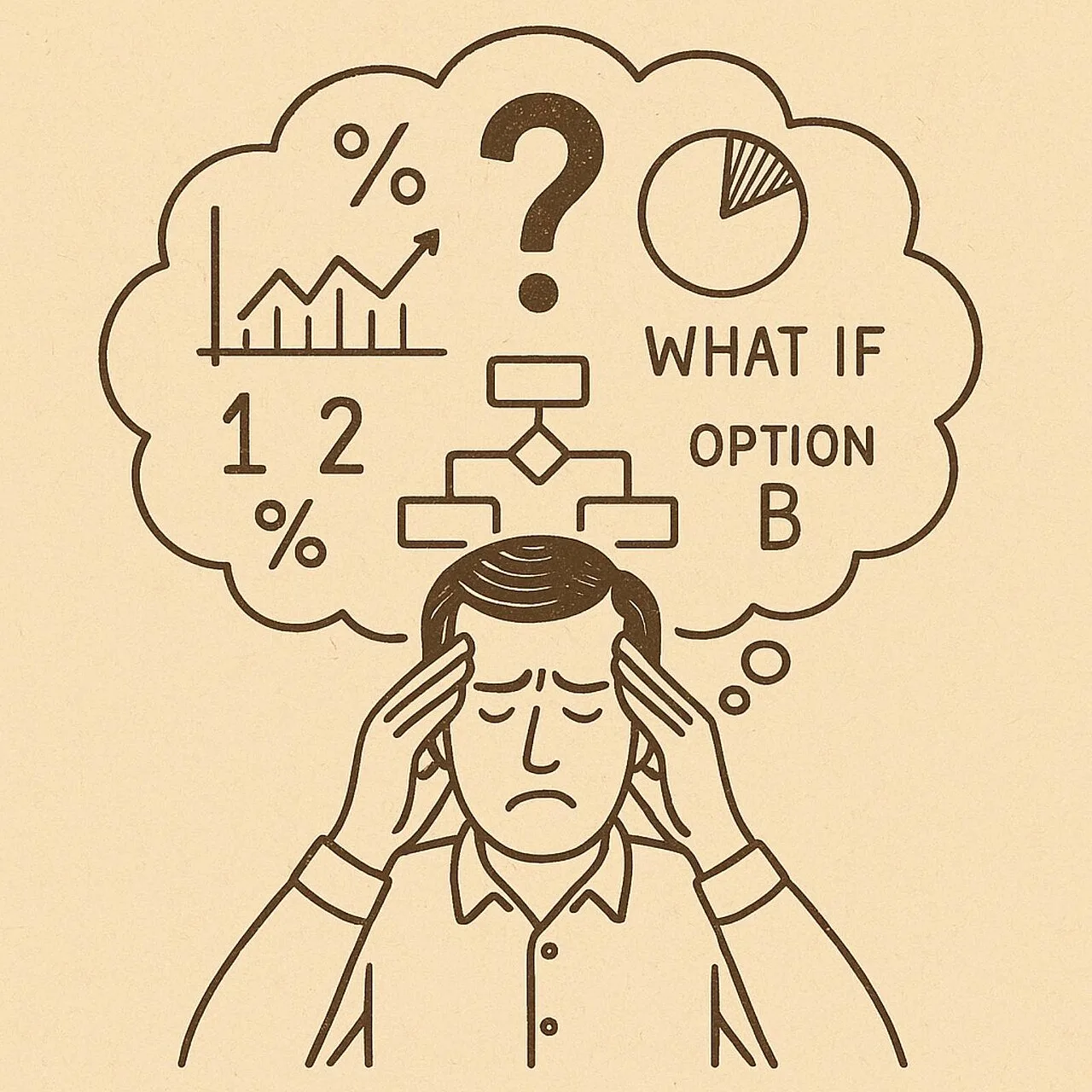
Overthinking: The thought that something might go wrong does not stop at one pass. It returns, in slightly different form, and runs through the scenario again. Then again, each time slightly more detailed, slightly more catastrophic, each iteration feeling like necessary thoroughness but producing nothing new.
At some point - often late at night, when the thinking is least productive - the mind is circling a problem it has already considered from every available angle, not because it has found a new angle but because the circling itself has become the problem.
This is overthinking: not the productive deliberation that leads to better decisions, but the repetitive, wheel-spinning cognition that generates distress without generating insight.
The distinction sounds simple but is psychologically meaningful. Susan Nolen-Hoeksema, whose research program at Yale established the scientific study of rumination, spent decades documenting how differently the ruminative mind operates compared to the reflective mind.
Reflection moves toward resolution - it examines a problem to generate understanding or action. Rumination cycles - it returns to the same content repeatedly without the forward movement that would constitute progress.[12]
The surface appearance is similar; both involve a mind engaged with a problem. The internal experience and outcome are completely different.
What makes overthinking particularly insidious is that it feels like productivity. The over-thinker is not wasting time in the way that obvious distraction wastes time. They are engaged, focused, taking the problem seriously. The cognitive load is real; the sense of effort is genuine.
The problem is that the effort is not doing useful work. It is consuming resources - attention, cognitive capacity, emotional energy - that would be better directed at the very decisions and actions the overthinking is nominally preparing for.
Understanding why this happens, at the level of neuroscience and cognitive psychology, is the first step toward interrupting it.
"Worry is a misuse of imagination." - Dan Zadra
Key Definitions
Rumination: Susan Nolen-Hoeksema's term for a repetitive, passive cognitive style involving dwelling on negative events, emotions, or problems without generating new insight or moving toward resolution. Distinguished from reflection by its circular, non-progressive character.[10]
Default Mode Network (DMN): A set of brain regions, identified by Marcus Raichle and colleagues in 2001, that show increased activity during internally directed thought, mind-wandering, and self-referential processing. The neural substrate of the wandering, self-focused mind.
| Overthinking Pattern | CBT Label | Typical Thought Form | Intervention |
|---|---|---|---|
| Catastrophizing | Magnification | "If this goes wrong, everything will fall apart" | Decatastrophize; examine actual likelihood and impact |
| Rumination | Repetitive negative thinking | Replaying the same negative event endlessly | Scheduled worry time; behavioral activation |
| Analysis paralysis | Decision avoidance | "I need more information before I can decide" | Time-limited analysis; accept good-enough decisions |
| Mind-reading | Projection | "They must think I'm incompetent" | Reality-test the assumption; ask or observe |
Analysis Paralysis: The state of being unable to make a decision due to excessive deliberation, often driven by perfectionism, fear of regret, or the absence of a natural stopping rule in the information-gathering process.
Cognitive Defusion: An Acceptance and Commitment Therapy technique developed by Steven Hayes involving changing one's relationship to thoughts - observing them as mental events rather than literal reality - rather than attempting to alter or suppress their content.
Worry Postponement: A cognitive behavioral technique, developed within the treatment of generalized anxiety disorder, involving the deferral of worry to a designated daily period, disrupting the automatic, uncontrolled nature of ruminative thinking.
Susan Nolen-Hoeksema and the Research on Rumination
Susan Nolen-Hoeksema began her career with a puzzle about gender differences in depression.[2] Women are consistently diagnosed with depression at roughly twice the rate of men across most Western countries. The biological explanations were incomplete.
Nolen-Hoeksema proposed that part of the explanation lay in characteristic differences in how men and women responded to negative mood - and that the ruminative response style was central to the difference.
Her Response Styles Theory, developed through the 1980s and 1990s and summarized in multiple papers and her 2003 book 'Women Who Think Too Much,' proposed that when people experience negative mood, they can respond in two characteristic ways: rumination (focusing attention on the mood and its causes) or distraction (directing attention toward other activities).
The theory predicted - and subsequent research confirmed - that ruminators stay depressed longer, have more severe depression episodes, and are more likely to develop clinical depression following a stressful life event.[1]
The mechanism is both cognitive and behavioral. Cognitively, rumination narrows attention to mood-congruent information - it makes negative memories more accessible, makes negative future events seem more probable, and interferes with the problem-solving processes that might otherwise generate behavioral responses.[11]
Behaviorally, rumination predicts inaction - ruminators are less likely to take concrete steps to address problems, both because rumination depletes the motivational resources needed for action and because it activates a passive, analytical mode that is not oriented toward behavioral output.
The Gender Question Revisited
Nolen-Hoeksema's original framing around gender differences has been both influential and contested. Subsequent research confirmed the basic finding - women score higher on measures of ruminative response style - while complicating its interpretation.
The difference in ruminative tendency may itself be a product of socialization patterns that reward emotional processing for girls and action-orientation for boys, rather than a biologically primary difference.
What is uncontested is that the ruminative response style, as a trait, is a robust predictor of depression risk regardless of gender.
The Default Mode Network: What Your Brain Does at Rest
One of the most significant neuroscience findings of the early twenty-first century was the demonstration that the brain is not less active at rest than during tasks - it is differently active.
Marcus Raichle and colleagues at Washington University first characterized the 'default mode' of brain function in a 2001 paper in the Proceedings of the National Academy of Sciences.[3]
The finding was that a specific set of regions - including the medial prefrontal cortex, the posterior cingulate cortex, and the angular gyrus - showed consistent deactivation during externally directed tasks and activation during rest.
This network, which Raichle named the default mode network, is not passive. It is actively engaged in internally directed cognition: self-referential thought, retrieval of autobiographical memory, imagination of future events, and the construction of mental models of other people's minds.
It is, in a meaningful sense, the neural substrate of the wandering mind - the default state of the human brain when it is not engaged with an external task.
The DMN's relationship to mental health is significant and bidirectional. Research has consistently found that the relative dominance of DMN activity over task-positive network activity is associated with negative affect, depression, and anxiety.
When the mind wanders, it tends to wander toward negative content - a finding established by Matthew Killingsworth and Daniel Gilbert's 2010 'wandering mind is an unhappy mind' paper, which used experience sampling to track the relationship between mind-wandering and moment-to-moment happiness across thousands of observations.[4]
Mindfulness and Default Mode Regulation
One of the most consistent findings in the neuroscience of meditation is that mindfulness practice reduces the relative dominance of the DMN. Long-term meditators show significantly reduced DMN activity compared to non-meditators, and even brief mindfulness training shows measurable effects on DMN-task positive network dynamics.
This finding provides a mechanistic account of why mindfulness-based interventions are effective for rumination and anxiety - they change the neurological pattern that underlies the wandering, self-focused mind.
The implication is not that the default mode network is pathological - it is the substrate of creativity, planning, and social cognition as well as rumination.
The goal is regulation rather than suppression: the ability to intentionally shift from internally directed to externally directed processing, and back, rather than being captured by either mode involuntarily.
Analysis Paralysis: The Paradox of Choice
Barry Schwartz's 2004 book 'The Paradox of Choice' synthesized research on decision-making and satisfaction that complicated the prevailing assumption that more options are always better.
Schwartz and colleagues found that the expansion of choice, beyond a certain point, increases decision difficulty, reduces decision satisfaction, and produces greater post-decision regret - the opposite of what economic theory would predict.
The key concept Schwartz introduced was the distinction between maximizers and satisficers.[5] Maximizers approach decisions with the goal of finding the objectively best option - they seek to exhaust the possibility space before committing.
Satisficers approach decisions with the goal of finding a sufficiently good option - they define acceptable criteria and stop searching when those criteria are met.
Maximizers spend more time deciding, feel less satisfied with their choices, and report higher levels of regret and anxiety than satisficers, even when their objective outcomes are equivalent or better.
Analysis paralysis is the maximizer's trap. When there is no natural stopping rule - no criterion for 'I have gathered enough information' - the search for certainty before committing continues indefinitely.
The paralysis is maintained by the implicit belief that enough deliberation will eventually yield a clearly correct answer, and by the anticipated regret that makes any commitment that might later be suboptimal feel dangerous.
The cognitive behavioral insight is that this belief is false in most domains of consequence. Decisions about career, relationships, and strategy involve genuine uncertainty that no amount of analysis eliminates.
The question is not whether to decide under uncertainty but what process will produce the best decisions under the uncertainty that inevitably remains.
Productive vs. Unproductive Thinking
One of the most practically useful distinctions in the overthinking literature is between productive and unproductive thinking - between the deliberation that actually makes decisions better and the deliberation that merely feels like it does.
Research on decision quality by Ap Dijksterhuis and colleagues, including his widely discussed 'unconscious thought theory' (2006), proposed that complex decisions involving many variables might be better made after a period of non-deliberative incubation than through extended conscious analysis.
The original findings have proven difficult to replicate robustly, and the strong version of the theory - that unconscious thought is generally superior to conscious thought for complex decisions - is not well-supported.
However, the weaker insight - that additional deliberation past a certain point adds noise rather than clarity, and that the mind benefits from periods of disengagement - is consistent with broader research on the incubation effect in creative problem-solving.
A more defensible distinction comes from distinguishing between deliberation that generates new information or perspectives and deliberation that merely recycles existing content.
The test is simple in principle: after this additional thinking, do I know something I did not know before, or have I considered an option I had not previously identified? If not, the thinking is not improving the decision; it is only extending the discomfort.
Worry Postponement: Scheduling the Uncontrollable
Tom Borkovec's research program at Penn State University on generalized anxiety disorder developed some of the most practical cognitive behavioral tools for rumination management.
Worry postponement - the instruction to defer worry to a designated brief daily period rather than engaging with it whenever it arises - emerged from this work as a particularly effective technique.
The technique works against the intuition that worry is automatic and uncontrollable. People who believe they cannot control when they worry are both right and wrong: the content of worry is largely automatic, but the response to worry - the decision to engage with it or defer it - is a skill that can be developed.
Worry postponement demonstrates this controllability experientially: when someone successfully defers a worry to their designated worry time, the experience provides evidence that worry can be managed, which in turn reduces the anxiety about anxiety that often compounds overthinking.
Borkovec's studies found that worry postponement significantly reduced both the duration of worry and its intrusiveness during the day.[6]
A notable secondary finding was that the postponed worries often seemed less important or urgent when the designated time arrived - which provides information about the extent to which the original feeling of urgency was a function of the content versus a function of the automatic engagement.
The practical implementation requires three elements: a specific daily time period (typically 15-30 minutes), a designated physical location for that worry session, and a practiced response for when worry intrudes outside that period: acknowledging the worry, writing it down if needed, and explicitly deferring it.
The written acknowledgment is important - it addresses the concern that deferring might mean losing the worry content.
Cognitive Defusion: Changing Your Relationship to Thoughts
Perhaps the most philosophically interesting of the evidence-based approaches to overthinking comes from Acceptance and Commitment Therapy (ACT), developed by Steven Hayes at the University of Nevada Reno.[8]
ACT represents a significant departure from the cognitive behavioral approach of challenging and modifying thought content. Instead of asking 'is this thought accurate?', ACT asks 'what is your relationship to this thought?'
Cognitive defusion is the ACT technique for changing that relationship. The goal is to observe thoughts as thoughts - as events in the mind - rather than as direct reports of reality. Defusion techniques achieve this in various ways.
Prefacing a thought with 'I am having the thought that...' adds a layer of observation between the self and the content. Imagining thoughts as leaves floating past on a stream uses metaphor to create observational distance.
Repeating a single word rapidly until it loses its semantic meaning demonstrates that the emotional charge attached to thoughts is not inherent in the content itself.
Daniel Wegner's research on thought suppression provides the complementary evidence.[7] His 'white bear' experiments (1987) established the ironic rebound effect: instructing people not to think about a white bear dramatically increased thoughts of white bears.
Suppression enhances the accessibility of the suppressed content by creating a monitoring process - scanning for the occurrence of the suppressed thought - that inevitably finds what it is scanning for. Defusion, by contrast, does not fight the thought's existence; it changes the relationship to it.
Research by Masuda and colleagues (2004) tested defusion against distraction and rational restructuring for negative self-referential thoughts.[9] Defusion produced significantly lower distress and discomfort than either alternative, and the differences persisted at follow-up.
The technique works not by making the thought go away but by stripping it of its obligatory command over behavior and its compulsory emotional charge.
Practical Takeaways
Diagnose whether you are ruminating or reflecting. Ask: is this thinking moving toward resolution, new understanding, or an action I could take? If yes, it is reflection. If you are circling the same content without generating new information, it is rumination. The diagnostic is the key to switching interventions.
Implement scheduled worry time. Choose a specific 20-minute window each day in a specific location. When worry intrudes at other times, write it down and explicitly tell yourself it is saved for later. Practice the deferral until the controllability of the worry is experientially demonstrated.
Set explicit decision criteria before beginning analysis. Decide in advance what 'good enough information' means for a given decision. This creates the stopping rule that maximizer thinking lacks, and it prevents the post-hoc rationalization that extends deliberation indefinitely.
Practice cognitive defusion for recurring intrusive thoughts. The simple practice of adding 'I am having the thought that...' before a distressing thought creates observational distance that reduces its compulsory character without requiring that the thought be true or false, or that it be suppressed.
Protect deliberate attention from digital fragmentation. The overthinking problem is compounded by environments that constantly interrupt focused thinking, preventing both the deliberate analysis that might resolve problems and the genuine rest that allows the DMN to perform its integrative function.
Protecting blocks of undistracted time serves both goals.
Sources & Further Reading
- Nolen-Hoeksema, S. (1991). Responses to depression and their effects on the duration of depressive episodes. Journal of Abnormal Psychology, 100(4), 569-582.
- Nolen-Hoeksema, S. (2003). Women Who Think Too Much: How to Break Free of Overthinking and Reclaim Your Life. Henry Holt.
- Raichle, M. E., MacLeod, A. M., Snyder, A. Z., Powers, W. J., Gusnard, D. A., & Shulman, G. L. (2001). A default mode of brain function. Proceedings of the National Academy of Sciences, 98(2), 676-682.
- Killingsworth, M. A., & Gilbert, D. T. (2010). A wandering mind is an unhappy mind. Science, 330(6006), 932.
- Schwartz, B. (2004). "The Paradox of Choice: Why More Is Less". Ecco.
- Borkovec, T. D., & Costello, E. (1993). Efficacy of applied relaxation and cognitive-behavioral therapy in the treatment of generalized anxiety disorder. Journal of Consulting and Clinical Psychology, 61(4), 611-619.
- Wegner, D. M., Schneider, D. J., Carter, S. R., & White, T. L. (1987). Paradoxical effects of thought suppression. Journal of Personality and Social Psychology, 53(1), 5-13.
- Hayes, S. C., Strosahl, K. D., & Wilson, K. G. (1999). Acceptance and Commitment Therapy: An Experiential Approach to Behavior Change. Guilford Press.
- Masuda, A., Hayes, S. C., Sackett, C. F., & Twohig, M. P. (2004). Cognitive defusion and self-relevant negative thoughts: Examining the impact of a ninety year old technique. Behaviour Research and Therapy, 42(4), 477-485.
- Treynor, W., Gonzalez, R., & Nolen-Hoeksema, S. (2003). Rumination reconsidered: A psychometric analysis. Cognitive Therapy and Research, 27(3), 247-259.
- Lyubomirsky, S., & Nolen-Hoeksema, S. (1995). Effects of self-focused rumination on negative thinking and interpersonal problem solving. Journal of Personality and Social Psychology, 69(1), 176-190.
- Watkins, E. R. (2008). Constructive and unconstructive repetitive thought. Psychological Bulletin, 134(2), 163-206.