
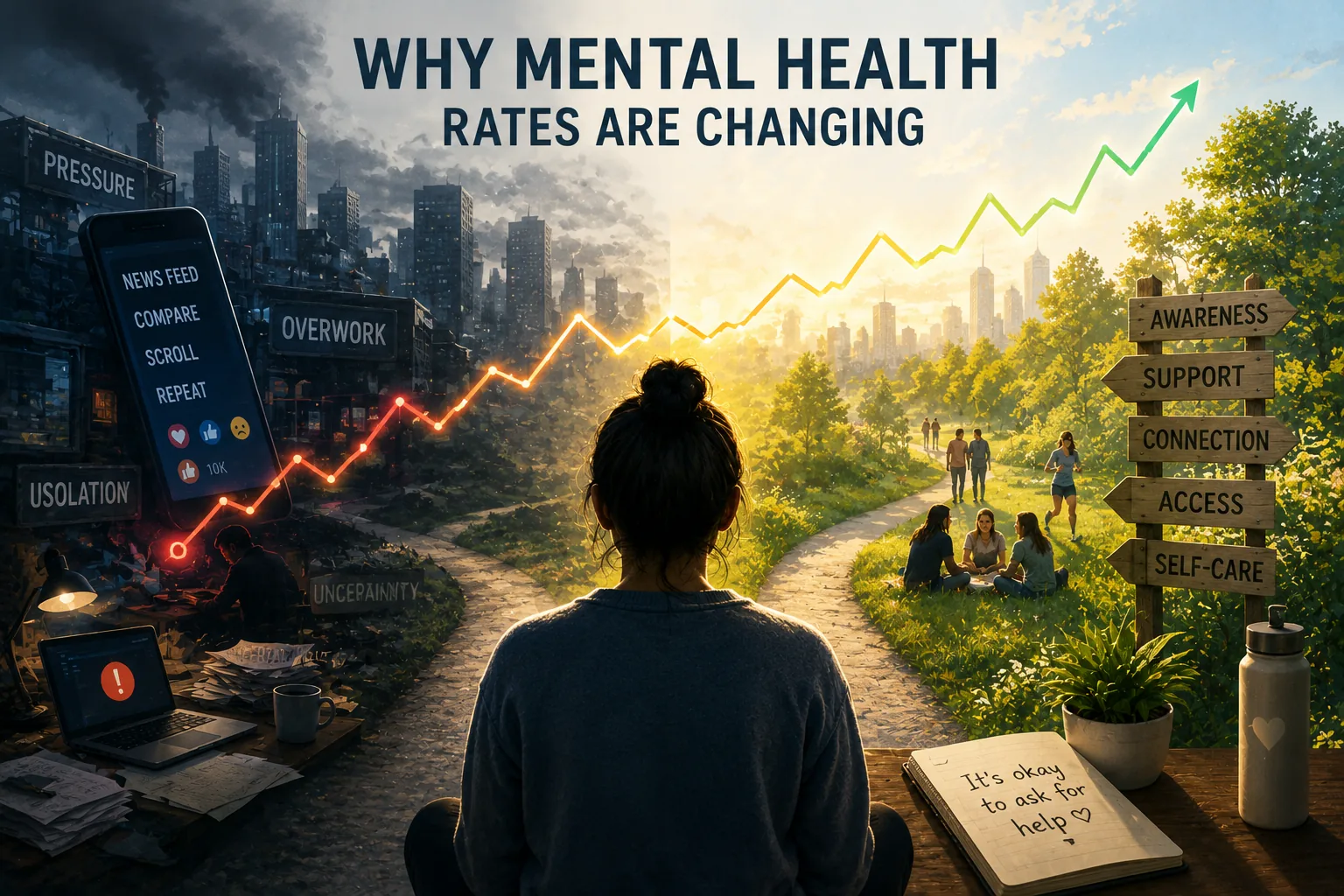
In 2012, something changed in American adolescents. The long-term trend in teen mental health - which had been relatively stable - began to deteriorate sharply. Emergency department visits for self-harm among girls increased by 189% between 2010 and 2021.
Rates of major depression, anxiety disorders, and suicidal ideation among teenagers rose dramatically. Among young adults, depression and anxiety rates doubled or tripled. The deterioration appeared first in girls, but boys followed.
It appeared first in countries where smartphone adoption was rapid, then in others. Something had happened - the question was what.
The question is not merely academic. Global disability statistics from the WHO's World Mental Health Report (2022) estimate that 1 billion people worldwide live with a mental health condition - about one in eight people on the planet.
Depression is the single leading cause of disability worldwide, costing the global economy an estimated $1 trillion annually in lost productivity.
In the United States, suicide is now the second leading cause of death among people aged 10-34. The scale of the problem demands serious analysis rather than comfortable assumptions.
What makes the question genuinely difficult is the layering of real change over measurement change. Rates of diagnosis increase whenever diagnostic criteria expand, whenever stigma decreases, and whenever more people seek care.
Disentangling "more people suffering" from "more people counted" requires careful methodology and intellectual honesty about uncertainty.
The best available evidence suggests that both are happening - and that among adolescents, particularly girls, the real increase is substantial and recent, with a plausible (if still contested) set of causal mechanisms.
"There is a mental health crisis among U.S. adolescents, with particular severity among girls and young women, that started around 2012-2013 and accelerated through the pandemic." - Jonathan Haidt, The Anxious Generation (2024)
Key Definitions
Prevalence vs. Incidence: Prevalence is the proportion of a population currently experiencing a condition at a given time; incidence is the rate of new cases occurring over a specified period. Rising prevalence can reflect either rising incidence (more new cases) or longer duration (existing cases lasting longer, or surviving longer).
Diagnostic Criteria Expansion: Changes in the definition of psychiatric disorders, particularly across DSM editions, that may count conditions previously excluded.
DSM-5 (2013) removed the bereavement exclusion for major depression, allowing diagnosis during grief - a change that increased prevalence without any change in underlying suffering.
Measurement Artifact: Apparent changes in rates that reflect changes in how we measure rather than changes in the underlying phenomenon. A partial explanation for rising rates, but insufficient to explain the full magnitude of recent trends.
Twenge iGen Thesis: Jean Twenge's argument, based on longitudinal survey data, that the generation born after 1995 shows dramatically worse mental health than previous generations, correlating with smartphone adoption.[1]
Haidt Anxious Generation: Jonathan Haidt's thesis in "The Anxious Generation" (2024) that the simultaneous decline of phone-free play-based childhood and rise of phone-based childhood explains the adolescent mental health crisis.[3]
Social Comparison Theory: Leon Festinger's 1954 theory that people evaluate themselves by comparing themselves to others. Social media provides an unusually intense environment for upward social comparison - comparing oneself to curated, idealized presentations.
Deinstitutionalization: The 1960s-1990s policy shift from large psychiatric hospitals to community-based care. Intended to improve conditions and expand freedom; often resulted in inadequate community support and increased homelessness and incarceration of severely mentally ill people.
Mental Health Parity: The legal principle that insurance coverage for mental health and substance use disorders must be equivalent to coverage for physical health conditions. Enacted in U.S. federal law in 2008 but inconsistently enforced.
Treatment Gap: The difference between the prevalence of mental health conditions and the proportion receiving any treatment. Ranges from 75-85% untreated in low-income countries to approximately 55% untreated in the United States.
Social Determinants of Mental Health: The social, economic, and environmental conditions that shape mental health outcomes: income, housing, education, employment, discrimination, social connection, and access to services.
Key Mental Health Trends: What the Data Shows
| Measure | Time period | Change | Source | Real change or artifact? |
|---|---|---|---|---|
| Major depressive episodes, US adolescents | 2005-2017 | 8.7% → 13.2% (+52%) | SAMHSA NSDUH | Mostly real; behavioral data corroborates |
| Suicidal ideation, US adults 18-25 | 2008-2017 | 7.4% → 11.3% | SAMHSA NSDUH | Largely real |
| ED visits for self-harm, girls 10-14 | 2010-2021 | +189% | CDC | Real (behavioral data not subject to reporting bias) |
| Global depression prevalence | 2020 | 280 million affected | WHO 2022 | Mixture; partly real, partly expanded diagnosis |
| Global anxiety disorder prevalence | 2020 | 301 million affected | WHO 2022 | Mixture |
| Mental health conditions overall | 2022 | ~1 billion (1 in 8 globally) | WHO 2022 | Includes diagnostic expansion but scale is real |
What the Data Actually Shows
The WHO World Mental Health Report (2022) provides the most comprehensive global snapshot.[5] Approximately 970 million people - about 13% of the global population - live with a mental health or substance use disorder. Depression and anxiety disorders are the most common.
Depression affects 280 million people globally; anxiety disorders affect 301 million. The economic burden is vast: the World Economic Forum estimates mental health conditions will cost the global economy $16 trillion in lost output between 2010 and 2030.
In the United States, SAMHSA's National Survey on Drug Use and Health tracks mental health measures annually with consistent methodology. The data show major depressive episodes in adolescents (aged 12-17) increasing from approximately 8.7% in 2005 to 13.2% in 2017 - a 52% increase.
The National Survey on Drug Use and Health shows suicidal ideation among 18-25 year olds increasing from 7.4% in 2008 to 11.3% in 2017. CDC data on emergency department visits for self-harm show a 189% increase among girls aged 10-14 between 2010 and 2021.
How much of this represents real change versus measurement artifact? Several analytical tools help address the question.
First, behavioral data are less susceptible to reporting bias than self-report data: emergency department visits for self-harm cannot be explained by increased willingness to disclose; they represent people actually presenting in crisis.
Second, longitudinal surveys with consistent methodology - particularly the Monitoring the Future survey, which has used the same instruments since 1975 - show inflection points in psychological well-being measures around 2012-2013 that do not correspond to changes in diagnostic criteria or survey methodology.
Third, the concentration of the deterioration in specific demographic groups (girls more than boys; teenagers and young adults more than older adults) and specific time windows (post-2012) suggests a specific causal mechanism rather than a diffuse awareness effect.
The measurement artifact explanation accounts for some of the increase in prevalence figures - probably a meaningful but not dominant share. The best current estimate is that something real happened to adolescent mental health, particularly among girls, from around 2012 onward.
The Adolescent Mental Health Crisis: The Social Media Debate
The most prominent and contested explanation for the post-2012 deterioration attributes it to the rapid adoption of smartphones and social media, particularly among adolescent girls.
Jean Twenge, a psychologist at San Diego State University, drew on the Monitoring the Future survey (which tracks U.S.
high school seniors and younger students annually) and the Youth Risk Behavior Surveillance System to document a sharp inflection point in multiple mental health measures around 2012 - the period when smartphone ownership became majority use among American teenagers.
Her 2017 book "iGen" and 2023 book "Generations" argued that this "iGen" generation (born 1995-2012) showed dramatically worse psychological well-being than earlier generations at the same age, with the deterioration correlating tightly with smartphone adoption.
Jonathan Haidt, a social psychologist at New York University, extended this argument in "The Coddling of the American Mind" (2018, with Greg Lukianoff) and "The Anxious Generation" (2024).[2]
Haidt argues for two simultaneous changes: the decline of unsupervised, phone-free play-based childhood (as parents became more protective and children's independent mobility and free play declined from the 1990s onward) and the rise of the phone-based social life (from around 2012).
Both changes, he argues, deprived children of the developmentally essential experiences - manageable risk-taking, peer negotiation, boredom - that build psychological resilience.
The mechanisms Haidt proposes are specific and testable. Upward social comparison on social media: Festinger's 1954 social comparison theory predicts that people evaluate themselves by comparing themselves to others, and social media provides an environment of constant upward comparison against curated, idealized, and often algorithmically selected images of peers' best moments.
Appearance comparison: Fardouly et al.'s 2015 paper in "Body Image" found that appearance-related social comparisons on Facebook were associated with increased body dissatisfaction, particularly in women.
Cyberbullying: unlike offline bullying, which ends when the school day ends, cyberbullying follows its victims home, occurs at any hour, is potentially public to thousands, and is permanent.
Displacement of sleep and in-person interaction: Twenge's data show that teenagers who spend more time on screens spend correspondingly less time sleeping and in face-to-face interaction, both of which are robustly associated with better mental health.
The challenge to this thesis comes from researchers including Andrew Przybylski and Amy Orben at the Oxford Internet Institute.[4]
In a 2019 Psychological Science paper (doi: 10.1177/0956797618812616), they analyzed three large national datasets and found that the association between social media use and adolescent well-being was small in magnitude - comparable, in their analysis, to the association between wearing glasses or eating potatoes and well-being.
In pre-registered analyses using identical methodology to Twenge, they found effects sizes far smaller than Twenge's figures suggested, accounting for 0.4-0.6% of variance. John Coyne, a clinical psychologist, has argued that Haidt selects and presents evidence in ways that overstate causal claims.
The current state of the scientific literature is genuine controversy among serious researchers.
Several points of provisional consensus: (1) heavy social media use is associated with worse outcomes for girls, particularly around body image and appearance comparison; (2) the direction of causality is difficult to establish - unhappy people may use more social media rather than social media causing unhappiness;
(3) even small effects, replicated across large populations, represent significant public health impact; (4) the timing and demographic concentration of the trend is consistent with a social media explanation, even if not proven by it.
Social Media Mechanisms: What the Research Shows
Setting aside the causality debate, several specific mechanisms linking social media to mental health outcomes have accumulated evidence.
Social comparison and body image: A 2016 meta-analysis by Valkenburg et al. reviewed 21 studies and found that social comparison on social media was associated with lower self-esteem and increased depression, with larger effects for appearance comparisons.
The asymmetry of Instagram and similar platforms - where people disproportionately post highlights, apply filters, and curate idealized versions of their lives and appearances - creates an environment of near-constant unfavorable social comparison.
Sleep displacement: A 2019 study of 3,134 adolescents in the UK, published in Lancet Child and Adolescent Health by Carter et al., found that social media use after 10 PM was specifically associated with poor sleep and psychological distress, independent of overall screen time.
Multiple studies show that the majority of teenagers bring phones to bed and check them during the night. Sleep is among the most robustly evidence-based protective factors for mental health; its systematic displacement is a plausible mechanism for population-level deterioration.
Cyberbullying: The Association of Internet Researchers' 2012 report estimated that 15-35% of young people had experienced cyberbullying. Unlike face-to-face bullying, cyberbullying is not bounded by school geography or school hours, can involve public humiliation in front of large audiences, and leaves permanent digital records.
Studies consistently show stronger associations between cyberbullying and depression, anxiety, and suicidal ideation than between face-to-face bullying and these outcomes.
Differential effects: The evidence is more consistent for girls than boys, for heavy users than moderate users, and for specific content types (appearance-focused, competitive status display) than for all social media equally.
A 2019 study in JAMA Pediatrics by Twenge and Joiner found associations between passive social media use (scrolling without engaging) and worse mental health outcomes than active use (communicating with friends).
These differentiations suggest that social media is not monolithic - its effects depend on how it is used.
Longer-Term Trends and Structural Factors
The social media thesis addresses the post-2012 inflection point but does not explain why mental health was deteriorating more gradually across a longer period, or why rates remain high across all age groups, not just adolescents.
Economic anxiety has been building for decades. Youth unemployment and underemployment, particularly for people without college degrees, increased substantially after the 2008 financial crisis and has remained elevated relative to pre-crisis norms.
Housing costs in major metropolitan areas have increased dramatically faster than wages. Student debt in the United States reached $1.7 trillion, creating financial pressures that affect career choices, family formation, and psychological security.
Economic insecurity predicts mental health outcomes through multiple pathways: chronic stress physiology, disrupted sleep, reduced access to healthy food and exercise, loss of purpose and structure.
Income inequality shows specific relationships with mental health. Richard Wilkinson and Kate Pickett's "The Spirit Level" (2009) demonstrated that across wealthy nations, income inequality predicts multiple health and social outcomes including mental illness rates, with effects visible across the income distribution - not just for the poorest.
Higher-inequality societies show worse mental health even among their middle classes, presumably through mechanisms of status anxiety and social comparison.
Climate anxiety is emerging as a significant and distinctive contributor for younger cohorts.
A 2021 Lancet Planetary Health study by Hickman et al., surveying 10,000 young people aged 16-25 across 10 countries, found that 59% were "very or extremely worried" about climate change and 45% reported that their feelings about it affected their daily functioning.[8]
A 2020 American Psychological Association survey found that 68% of American adults reported at least some climate anxiety - a figure likely higher among younger cohorts who will live through more consequences.
For young people, this anxiety has a rational basis that distinguishes it from anxiety disorders with irrational triggers.
Political polarization and the collapse of shared civic institutions affect mental health through the mechanisms of social trust and shared narrative. Robert Putnam's "Bowling Alone" (2000) documented the long-term decline of civic association in the United States.
Subsequent research has shown that social trust - confidence that other people and institutions are generally reliable - is among the most robustly predictive social determinants of population health including mental health.
The loneliness epidemic, documented by Julianne Holt-Lunstad and colleagues, shows increases in perceived loneliness across multiple countries over several decades.
Holt-Lunstad's 2015 meta-analysis in Perspectives on Psychological Science, drawing on 148 studies and 308,849 participants, found that social isolation and loneliness were associated with a 29% increase in risk of premature mortality - effects comparable to smoking fifteen cigarettes per day.[7]
Loneliness predicts depression, anxiety, cognitive decline, and cardiovascular disease through multiple physiological pathways.
The Treatment Gap: Why Help Remains Out of Reach
The treatment gap - the difference between need and care - is among the most striking inequities in global health. WHO estimates that 75-85% of people with mental health conditions in low- and middle-income countries receive no treatment.
Even in the United States, with its expensive healthcare system, only about 45% of adults with a mental illness receive any treatment in a given year.
The structural explanation begins with deinstitutionalization. From the 1950s onward, large psychiatric hospitals that had warehoused (often abusively) severely mentally ill patients were progressively closed, driven by a combination of humanistic reform impulses, the development of antipsychotic medications that made outpatient treatment theoretically possible, and the very practical desire of state governments to reduce mental health budgets.
The community mental health infrastructure intended to replace institutional care was never adequately funded.
The result, detailed in E. Fuller Torrey's "The Insanity Offense" (2008), is that severely mentally ill people in the United States are disproportionately found in jails, prisons, and on the streets rather than in treatment.
For the broader population with depression and anxiety, access barriers are more mundane but equally effective. Cost: a 50-minute psychotherapy session in the United States costs $100-300 without insurance coverage. Even with insurance, deductibles, copayments, and limited covered sessions create real barriers.
Provider shortage: the psychiatrist shortage in the United States is severe - the country has approximately 30,000 practicing psychiatrists for a population of 330 million, concentrated in urban areas.
Wait times of 18-24 months for child and adolescent psychiatry are common in many regions.
Stigma: despite decades of awareness campaigns, stigma remains a significant barrier, particularly for men (for whom seeking help is coded as weakness in many cultural contexts), for older adults, and in communities where mental illness is understood through religious rather than medical frameworks.
The Mental Health Parity and Addiction Equity Act (2008) was intended to require insurers to provide equivalent coverage for mental and physical health.
A 2020 report by the Bowman Family Foundation found that insurers still regularly deny mental health claims at higher rates than physical health claims, require prior authorization for mental health treatment more frequently, and offer narrower provider networks for mental health.
Enforcement remains inconsistent.
Telehealth has significantly reduced access barriers since 2020. The rapid expansion of platforms like BetterHelp, Talkspace, and telehealth psychiatry services has reduced cost, geography, and stigma barriers for many people - ironically, one consequence may be an apparent increase in diagnosed prevalence as previously unserved people reach care.
What Reduces Mental Health Problems at a Population Level
The evidence base for population mental health interventions is more limited than for individual treatment, partly because large randomized controlled trials of social interventions are difficult to conduct. But several factors have consistent support.
Exercise is among the most robust. Felipe Schuch and colleagues' 2018 meta-analysis in JAMA Psychiatry (doi: 10.1001/jamapsychiatry.2018.0566) pooled data from 49 prospective cohort studies involving 266,939 participants and found that physical activity was associated with a 25-35% lower risk of depression across the follow-up period.[6]
The effect was present across different exercise types (aerobic, resistance, yoga) and intensities (even moderate activity showed benefits), different age groups, and different countries.
The mechanisms include neurotrophic effects (exercise increases BDNF, brain-derived neurotrophic factor, which promotes neuroplasticity), HPA axis regulation (reducing chronic cortisol elevation), and social benefits of group exercise.
Social connection is the other major modifiable protective factor. Holt-Lunstad's mortality data (the 2015 meta-analysis in Perspectives on Psychological Science) demonstrate that social isolation is a risk factor comparable to smoking for all-cause mortality.
For mental health specifically, multiple meta-analyses show that social support moderates the relationship between stress and mental health outcomes. Loneliness and isolation are both strong predictors of depression onset and poor recovery.
Sleep quality and quantity have bidirectional relationships with mental health that have become increasingly well characterized. Matthew Walker's synthesis in "Why We Sleep" (2017) documents that chronic sleep insufficiency is associated with significantly elevated rates of depression, anxiety, and suicidal ideation.
The relationship is bidirectional - mental illness disrupts sleep, and disrupted sleep worsens mental illness - but sleep improvement is often an accessible intervention point.
Green space access is associated with lower anxiety and depression in multiple epidemiological studies, with effects observed even after controlling for exercise, income, and other potential confounders. A 2019 study in Science Advances by White et al.
using GPS data and mental health measures in the UK found that time spent in natural environments was associated with measurably better mental health.
Economic security is a structural determinant with large effects: reducing poverty, housing instability, and financial precarity would reduce mental illness rates substantially. This is sometimes overlooked in mental health conversations that focus on individual treatment rather than social conditions.
School-based programs with evidence of effectiveness include cognitive-behavioral skills training curricula. The MindMatters program in Australia, a whole-school mental health promotion program, has shown measurable effects on student well-being in controlled studies.
The Penn Resiliency Program, a CBT-based curriculum, has shown reductions in depression symptoms in multiple controlled trials, though effects have been modest and inconsistent.
What consistently fails to produce measurable population health improvement is awareness campaigns alone - "it's okay not to be okay" messaging reaches people who were already willing to seek help but does not address the structural barriers that prevent it.
Sources & Further Reading
- Twenge, Jean M. iGen: Why Today's Super-Connected Kids Are Growing Up Less Rebellious, More Tolerant, Less Happy - and Completely Unprepared for Adulthood. Atria Books, 2017.
- Haidt, Jonathan, and Greg Lukianoff. The Coddling of the American Mind. Penguin Press, 2018.
- Haidt, Jonathan. The Anxious Generation. Penguin Press, 2024.
- Przybylski, Andrew K., and Amy Orben. "Screens, Teens, and Psychological Well-Being: Evidence from Three Time-Use-Diary Studies." Psychological Science 30, no. 5 (2019): 682-696. doi: 10.1177/0956797618812616
- World Health Organization. World Mental Health Report: Transforming Mental Health for All. WHO, 2022.
- Schuch, Felipe B., et al. "Physical Activity and Incidence of Mental Disorders." JAMA Psychiatry 75, no. 11 (2018): 1146-1154. doi: 10.1001/jamapsychiatry.2018.0566
- Holt-Lunstad, Julianne, Timothy B. Smith, Mark Baker, Tyler Harris, and David Stephenson. "Loneliness and Social Isolation as Risk Factors for Mortality." Perspectives on Psychological Science 10, no. 2 (2015): 227-237.
- Hickman, Caroline, et al. "Climate Anxiety in Children and Young People and Their Beliefs about Government Responses to Climate Change." Lancet Planetary Health 5, no. 12 (2021): e863-e873.
See also: What Causes Depression, Why Loneliness Is Deadly, How Social Media Rewires the Brain
Health note: This article is general educational information about how a topic works, not medical, psychological, or mental-health advice, diagnosis, or treatment. Everyone's situation is different, and research findings describe groups, not individuals.
If you are struggling or have concerns about your health, please talk to a qualified professional such as a doctor or licensed therapist.
If you are in crisis or thinking about harming yourself, contact your local emergency services or a crisis line right away, in the US you can call or text 988 (Suicide & Crisis Lifeline); elsewhere, find local lines at findahelpline.com.